Archive entry · Hand-bound 1970s small-press handbook · Working textile-artist reference
Rocky Mountain Dye Plants — Anne Bliss, Boulder 1976 / Third Printing, drawings by Robert Bliss
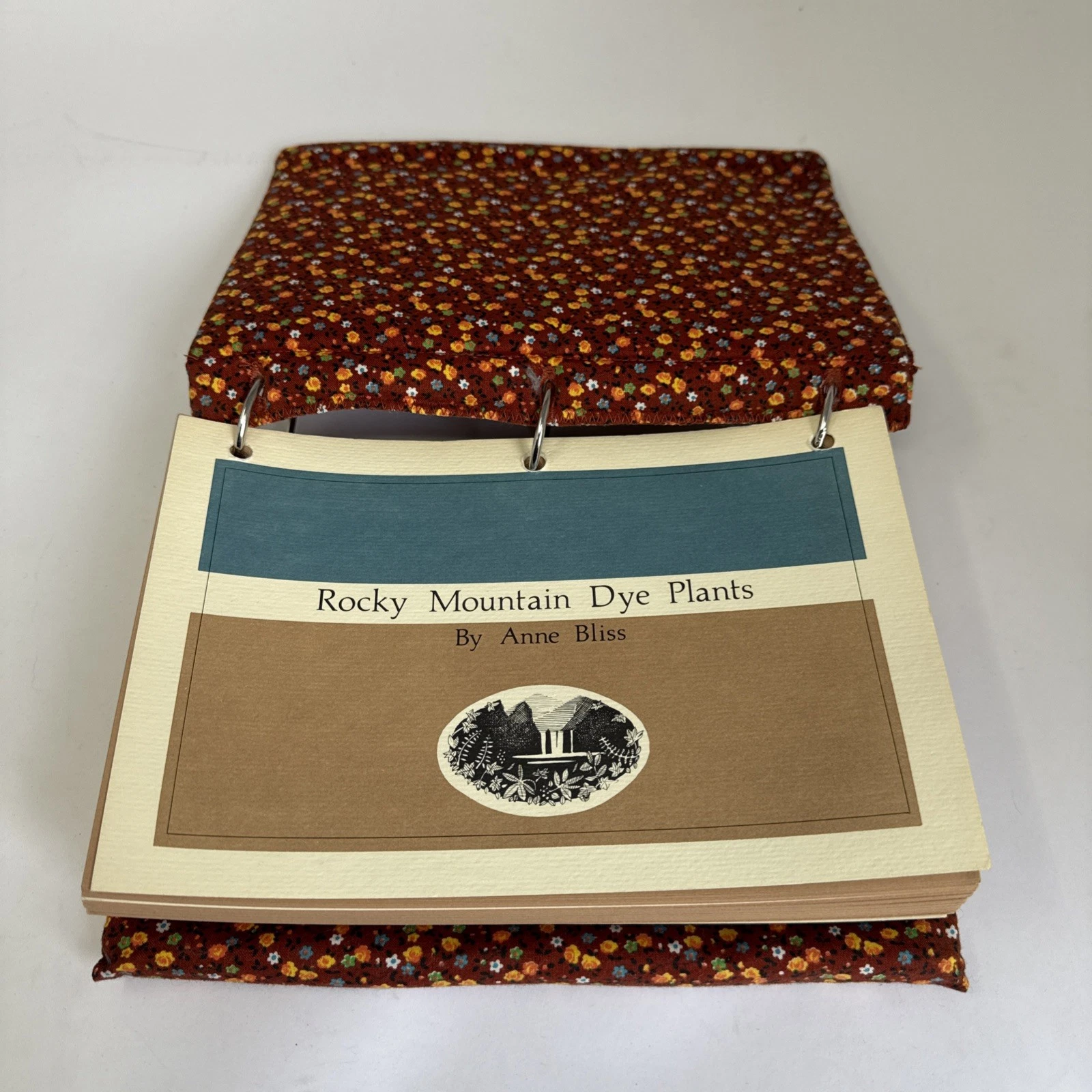
A Third Printing of Anne Bliss's working natural-dye handbook for the Rocky Mountain region — the standard hands-on reference for which plants yield which colors, which mordants to use, what seasons to gather, and how the resulting dyes hold on natural fibers. Self-published in Boulder, Colorado in 1976; distributed through Juniper House (PO Box 2094, Boulder CO 80306); printed by Johnson Publishing Company of Boulder; LCCN 76-376143. Hand-bound in floral fabric-covered boards over a three-ring binder mechanism — an unusually craft-made object format that signals the working-reference rather than coffee-table-display use the book was designed for. Drawings by Robert Bliss.
Catalog
What this book is
Rocky Mountain Dye Plants is a working handbook in the literal sense — a book intended to be opened on a workbench next to a stockpot, propped up while the dyer works, marked up over years with the user's own observations. The text is short, plain, and direct. Each plant entry leads with the common and Latin name, the plant family, an identification line on where and when to find it in the Rocky Mountain region, the plant parts to harvest (root, leaves, flowers, berries, bark), the mordants that work best with it (alum, iron, copper, tin, chrome, tannin), and the resulting color range on the major natural fibers (wool, cotton, silk, linen). Robert Bliss's line drawings supply the identification visuals. The book does not theorize. It documents.
The hand-bound fabric-covered three-ring binder physical format is part of the book's working-reference intent. Anne Bliss self-published Rocky Mountain Dye Plants in 1976 through her own small-press operation, with distribution through her Juniper House imprint at PO Box 2094 in Boulder, Colorado, and printing by the local Johnson Publishing Company. The three-ring binding allows the user to lay the book flat — critical when a dyer's hands are wet or holding plant material — and the fabric-covered boards protect the textblock in a working environment of damp wool, mordant baths, and plant-stain. The format itself signals the book's audience: the textile artists and natural-dyers of the 1970s back-to-the-land craft-revival movement, the women who were learning Spanish New Mexican colcha embroidery and Navajo natural-dye weaving in workshops at Tierra Wools and the Spanish Colonial Arts Society programs, the homesteaders and small-scale farmers who wanted to dye their own fleece in the colors their pastures supplied.
The book stayed in print at Juniper House through at least three printings (this copy is the marked Third Printing) and continued to circulate among working dyers long after the initial Juniper House distribution ended. It is the standard cited reference for natural-dye color yields in the Rocky Mountain region.
Who Anne Bliss is — and her wider bibliography
Anne Bliss is a Boulder, Colorado-based natural-dye author and textile artist whose career produced a small but durable bibliography of working reference handbooks on natural dyeing. Rocky Mountain Dye Plants (1976) was her first published title; she followed it with North American Dye Plants (also with Robert Bliss as illustrator; ISBN 0-934026-89-0), which extended the regional Rocky Mountain frame to a continental survey of natural-dye sources and is considered by many working dyers the definitive English-language reference on the subject. Her subsequent A Handbook of Dyes from Natural Materials covered mordants and chemistry in more depth, and Weeds: A Guide for Dyers and Herbalists turned the same field method on the dye yields of common weeds — documenting that the unwanted vegetation of disturbed ground often supplies the strongest mordantable colors. The four-book sequence is the working library many natural-dye practitioners build out from.
The Bliss collaboration is itself part of the artifact. Robert Bliss — named on the title page as illustrator on both Rocky Mountain Dye Plants and the subsequent North American Dye Plants — supplied the plant-identification line drawings that distinguish the books from purely textual references. His illustration style is plain working-naturalist line work — no shading, no decorative ornament, just the diagnostic plant parts in clear identification configurations. The Bliss books are recognizable on a working textile-artist's shelf at twenty feet by the combination of fabric or earth-toned covers and the Robert Bliss line drawings.
The 1970s natural-dye revival context
The book belongs to a quietly active small-press literature on natural dyeing produced in the 1970s and 1980s as part of the broader back-to-the-land craft-revival movement. Most of those titles survived in tiny print runs and disappeared from the open market within a decade. A handful, including the Bliss books, stayed in print long enough to acquire a working-reference standing. The 1970s revival was driven by several converging currents:
The Whole Earth Catalog (1968–1972) made the back-to-the-land craft-economy idea concrete for a generation of readers, and natural-dye references were part of the Catalog's recommended bibliography in every edition. The Spanish Colonial Arts Society in Santa Fe, founded 1925 and reactivated in the 1970s under the leadership of Ed Aguilar, Maria Romero Cash, and others, ran specifically Hispano-tradition natural-dye instruction programs as part of the broader Spanish Market revival. The Tierra Wools cooperative at Los Ojos, NM (founded 1983) brought natural-dye instruction directly into the Río Arriba village weaving economy. The Navajo Nation's Díné bii Tsíl Saad weavers and the Toadlena/Two Grey Hills tradition were — and remain — the major Indigenous natural-dye weaving tradition of the Southwest, with their own knowledge transmission systems independent of the Anglo craft-revival literature but increasingly cross-referenced through the published handbooks. Each of these communities produced or absorbed natural-dye reference materials, and the Bliss books are among the small number of Anglo-authored references that documented the plant-knowledge without claiming to teach the Indigenous traditions themselves.
The Bliss books also sit alongside, but distinct from, the ethnobotanical and medicinal-plants literature of the same period and region. L. S. M. Curtin's Healing Herbs of the Upper Rio Grande (Southwest Museum 1965 / Second Printing 1974), which the NMLP archive holds in an Albuquerque Public Library Title VII discard copy with the original salmon-ground endpaper map of the Upper Rio Grande villages, documents the medicinal uses of overlapping plant taxa. Where Curtin records what chamiso, palo amarillo, and capulín were used for therapeutically in the Spanish-NM villages, Bliss records what colors they produce on wool when boiled with alum or iron. The two books read together on a working shelf cover the same regional botany from complementary use-perspectives — medicine and color — and any natural-dyer or curandera-practice researcher benefits from owning both.
Bibliographic identification — printings of the Juniper House issue
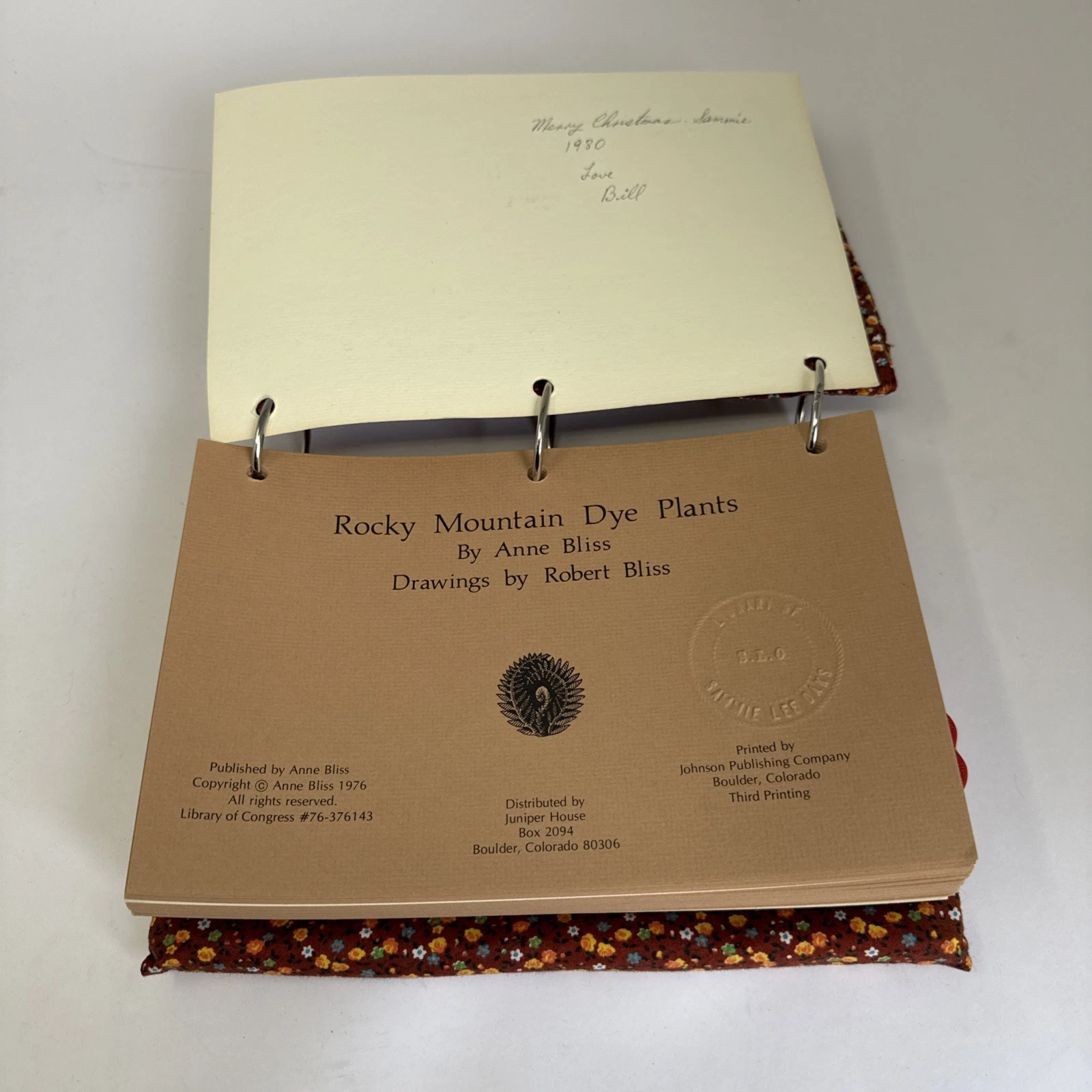
The 1976 first issue is the Juniper House first printing, also self-distributed through small-press craft channels and the Whole Earth Catalog supplements. Subsequent printings — second, third, and (in some collector accounts) fourth — were produced through the Juniper House operation as demand from working textile artists sustained interest. The copyright page of each printing carries the same 1976 copyright line and the same LCCN 76-376143; the printings are distinguished by the explicit printing notation. The text and Robert Bliss illustrations are identical across the printings; the hand-bound fabric-covered three-ring binder format is the standard production specification across the series. Cover fabrics vary between printings as different bolts of decorative quilting cotton were used — this copy's pale floral repeat is consistent with a mid-to-late 1970s acquisition by Juniper House.
The book has no ISBN. The LCCN 76-376143 is the principal authority identifier. WorldCat and the Library of Congress catalog both file the book under Anne Bliss's name with the Juniper House distribution noted.
Why this matters for the archive
First — the working-reference standing. Rocky Mountain Dye Plants has not been superseded as the standard hands-on natural-dye handbook for the Rocky Mountain region. Newer references (Rita Buchanan's A Dyer's Garden and A Weaver's Garden; J. N. Liles's The Art and Craft of Natural Dyeing; the Joyce Lewis volumes) extend, update, and amplify the natural-dye literature, but for the specific Rocky Mountain plant flora, Bliss remains the cited reference. Any natural-dyer working in NM, Colorado, southern Wyoming, northern Arizona, or northern Utah will own a copy.
Second — the small-press hand-bound artifact. The physical object is itself collectible. Fabric-covered three-ring-bound books are a vanished mid-twentieth-century small-press production format; the surviving examples in good condition are increasingly uncommon. The book's craft-revival physical format is consistent with the book's content and audience — the artifact and the text are of a piece — and the hand-bound copies turn up almost exclusively in the estates of working textile artists, weavers, and natural-dyers from the 1970s and 1980s craft-revival generation now downsizing or settling estates.
Third — the pairing with the Curtin record. In the NMLP archive specifically, the Bliss handbook sits in productive pair with the Curtin Healing Herbs of the Upper Rio Grande (1965 / 1974), the Susan H. Ellis New Mexico Colcha Embroidery handbook, and the Mark Winter Master Weavers Toadlena monograph. The four together cover the regional plant flora from four use-angles — medicine (Curtin), color (Bliss), embroidery (Ellis), and weaving (Winter) — and any working textile artist, natural-dyer, or regional-craft historian benefits from owning all four.
How this copy came in
Donated in May 2026 through NMLP. Donor scenario anonymized per archive policy. Condition: the floral fabric-covered boards are intact with light surface wear; the three-ring binder mechanism functions cleanly; the textblock pages are clean with the slight age-yellowing typical of small-press paper from the 1970s; no underlining, marginalia, or marked-up dye-test annotations; some light brown spotting on the top edge of the textblock consistent with workbench-environment handling rather than damage. A serviceable working-reference copy that has clearly been used as the book was intended to be used.
Where this copy is going
Three plausible routes after this archive documentation. First and most likely: a NM or Colorado natural-dye textile artist who specifically wants the original Bliss reference rather than a newer alternative. The Río Arriba weaving cooperative communities (Tierra Wools at Los Ojos, Centinela Traditional Arts at Chimayó, individual practitioners in the Española and Santa Fe corridors), the Toadlena/Two Grey Hills Navajo natural-dye weavers, and the Spanish Colonial Arts Society program participants are the core working audience. Second: a craft-school reference shelf at one of the institutions that teaches natural dyeing — the Penland School of Craft, the Anderson Ranch Arts Center in Snowmass Colorado, the Santa Fe Community College textile program. Third: a regional-craft-history private collector building a 1970s craft-revival small-press shelf alongside the Whole Earth Catalogs, the Foxfire books, and the contemporaneous regional craft-pamphlet literature. The archive entry will remain regardless of which route the physical book takes.
External references & authoritative sources
- Library of Congress catalog record: lccn.loc.gov/76376143 — the LCCN authority record for this title.
- WorldCat / OCLC institutional holdings: search.worldcat.org/title/3083213 — library holdings worldwide.
- Anne Bliss — Goodreads author record: goodreads.com/author/show/994565.Anne_Bliss — the author's collected bibliography.
- North American Dye Plants (Bliss's continental sequel): search.worldcat.org — North American Dye Plants — the working dyers' continental reference companion volume.
- Tierra Wools / Los Ojos Handweavers cooperative: handweavers.com — the Río Arriba village weaving cooperative founded 1983 in the same craft-revival period, where this kind of book is a working reference.
- Spanish Colonial Arts Society / Spanish Market: spanishcolonial.org — the Santa Fe institutional home of the Hispano craft-revival natural-dye programs of the 1970s onward.
- Toadlena / Two Grey Hills Trading Post: toadlenatradingpost.com — the Navajo natural-dye weaving tradition the regional knowledge supports.
- Centinela Traditional Arts, Chimayó: chimayoweavers.com — the Trujillo / Ortega family weaving tradition in the same Río Arriba region.
- Penland School of Craft natural-dye program: penland.org — the North Carolina craft-school institutional reference for natural-dye instruction.
How to cite this archive entry
Eldred, Josh. "Rocky Mountain Dye Plants — Anne Bliss, Boulder 1976 / Third Printing, Hand-Bound Juniper House Small Press." NMLP Donation Archive, May 1, 2026 (expanded May 11, 2026). https://newmexicoliteracyproject.org/archive/rocky-mountain-dye-plants-bliss-1976
Related on this site
- Back to the archive index
- Healing Herbs of the Upper Rio Grande (Curtin, 1965 / 1974) — the medicinal-use companion volume to this color-use handbook; together they cover the regional Rocky Mountain / Upper Rio Grande flora from complementary working perspectives.
- New Mexico Colcha Embroidery (Susan H. Ellis) — the Hispano embroidery handbook in the same NMLP working-textile-artist shelf.
- Embroideries by Rebecca James (MOIFA, 1963) — the Santa Fe Museum of International Folk Art exhibition catalog of Rebecca Salsbury James's revival of the colonial NM colcha stitch in Taos.
- Master Weavers (Winter, Toadlena 2011) — the Navajo natural-dye weaving tradition the regional plant-knowledge in Bliss supports.
- Cañones — Kutsche & Van Ness, 1981 / 1988 — the Río Arriba village ethnography for the cultural-region context.
- Collecting New Mexico Ethnobotany — the parent authority pillar that situates this 1976 Bliss natural-dye field guide inside the four-period New Mexico ethnobotany print record (Fényes precursor → Curtin canon → late-20th-century field guides → modern Native Plant Society / Moerman era).