Archive entry · Pimería Alta frontier novel · Albuquerque Public Library Withdrawn discard · Closed signature pool
The Devil's Highway — Richard A. Summers, illustrated by Nils Hogner, Thomas Nelson and Sons, New York, 1937
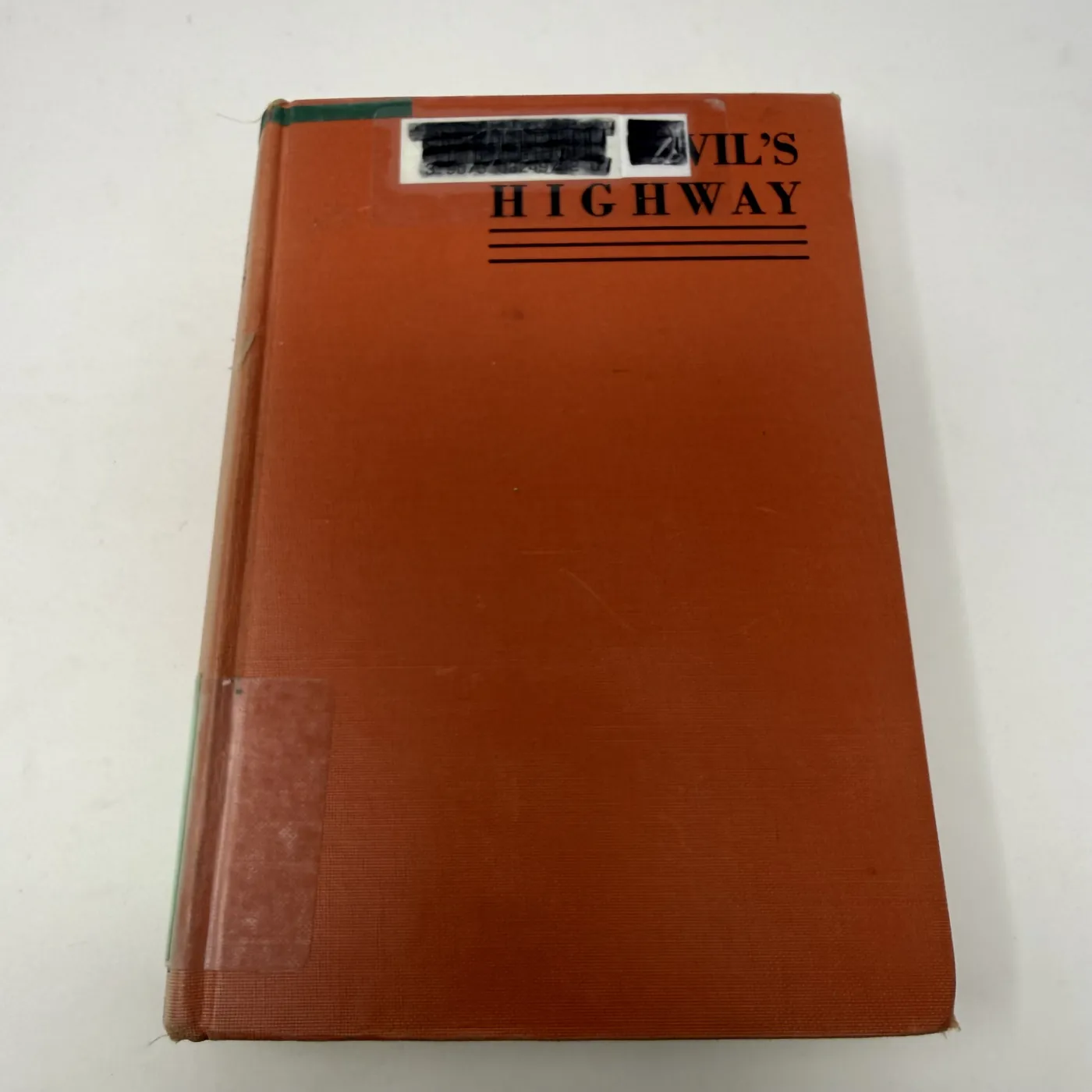
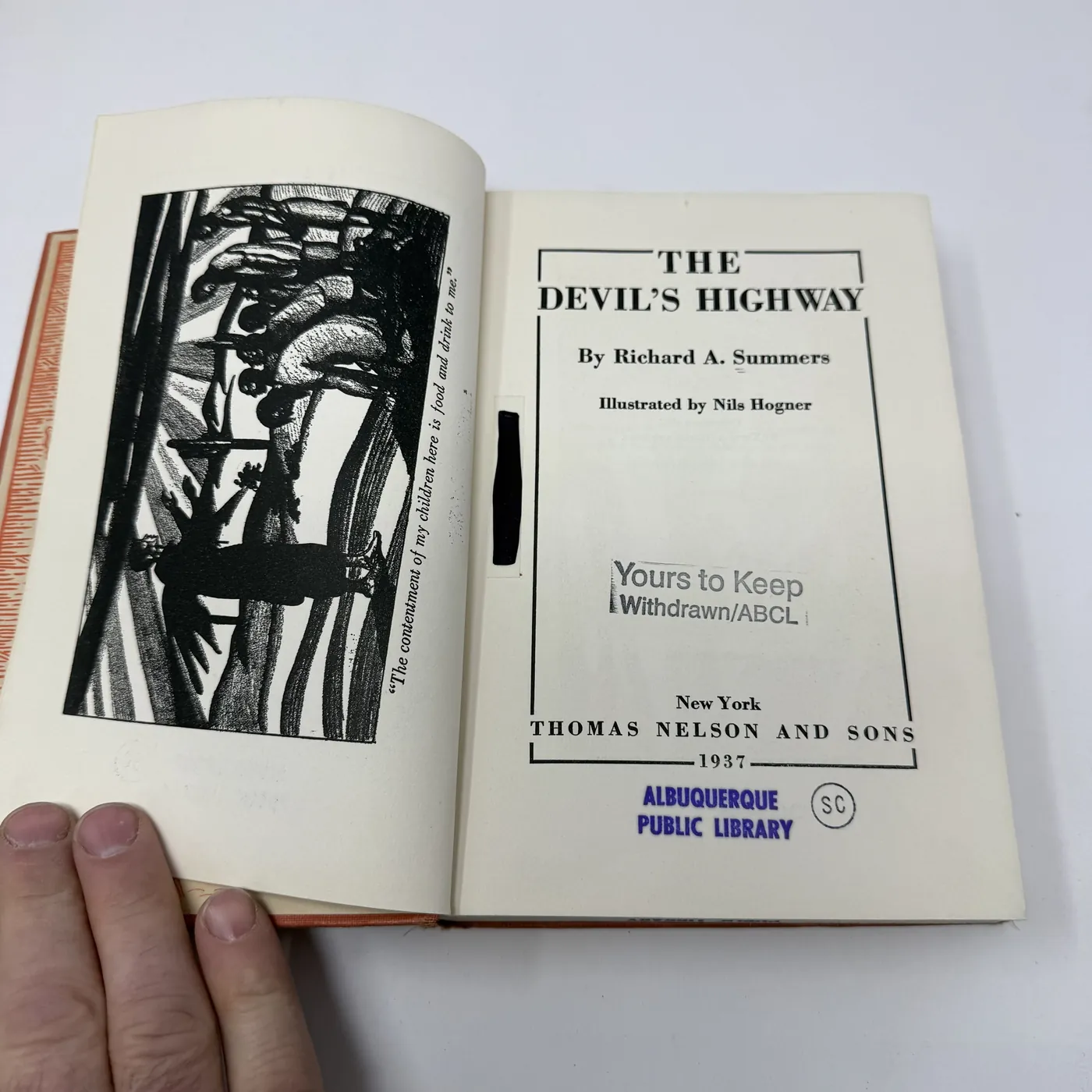
A 1937 first-edition copy of Richard A. Summers' frontier historical novel set on El Camino del Diablo, the 250-mile waterless track between Sonoyta in Sonora and the Gila River in Arizona that Father Eusebio Francisco Kino's Pimería Alta mission system grew up around. Illustrated and mapped by Nils Hogner (1887–1970), the Swedish-American painter who spent four years on the University of New Mexico art faculty in Albuquerque in the 1920s before returning east to build his New York studio practice. This copy is an Albuquerque Public Library withdrawn discard with the original Yours to Keep / Withdrawn-ABCL stamp on the title page, the Albuquerque Public Library purple oval ownership stamp on the copyright page, and accession number 306488 visible at the foot.
Catalog
What this book is
The Devil's Highway is one of Richard Summers' earliest published books — issued in 1937, the same year as his more frequently cited Dark Madonna. Summers was thirty-one at publication, a Tucson novelist who had joined the University of Arizona faculty in 1928 as a professor of English. He would publish prolifically through the 1940s and 1950s — novels, short stories, plays, textbooks — with Vigilante (1949) becoming the basis for the 1952 Warner Brothers Western film The San Francisco Story. He stayed in Tucson until his death in October 1969. His papers and over forty manuscript drafts are held at the University of Arizona Libraries Special Collections.
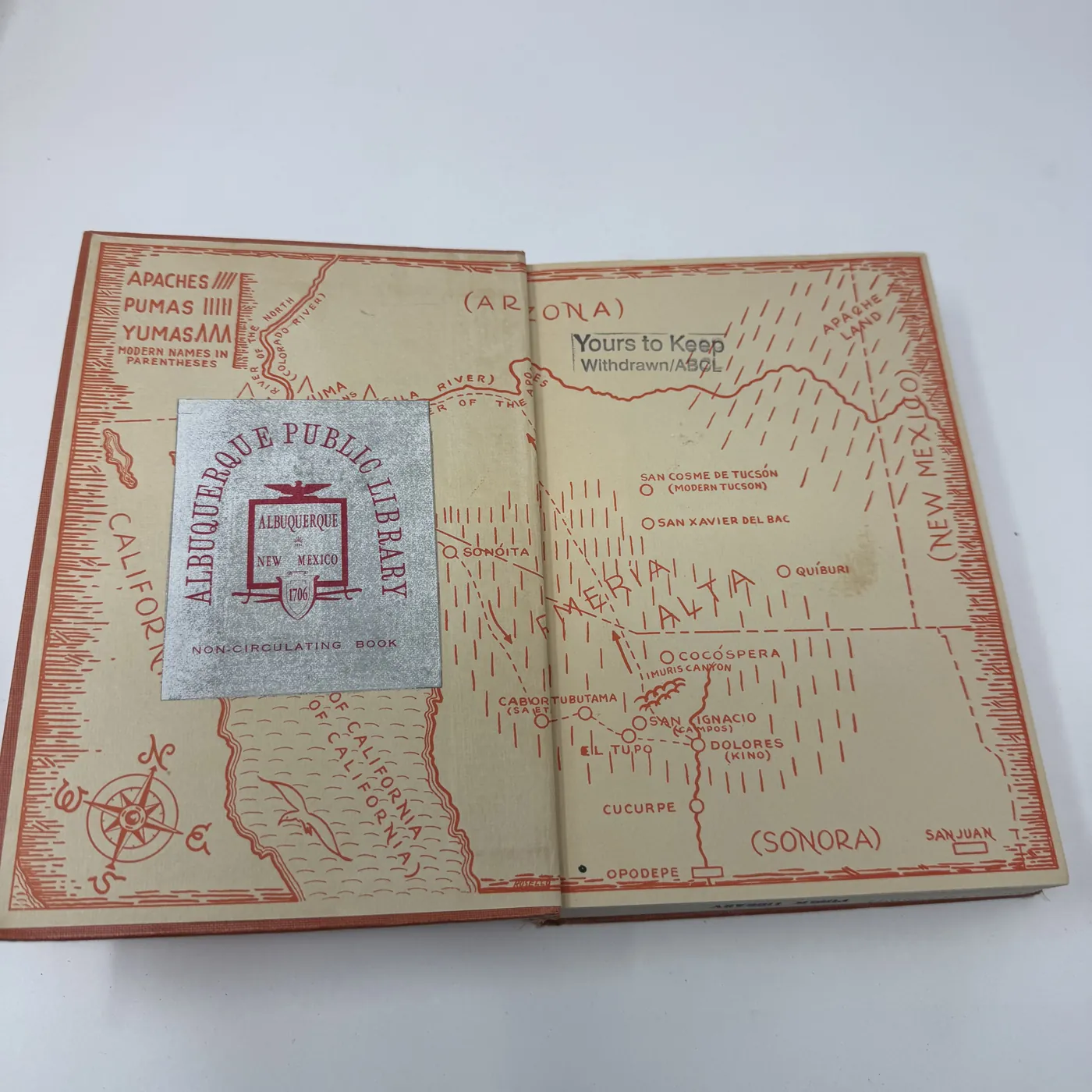
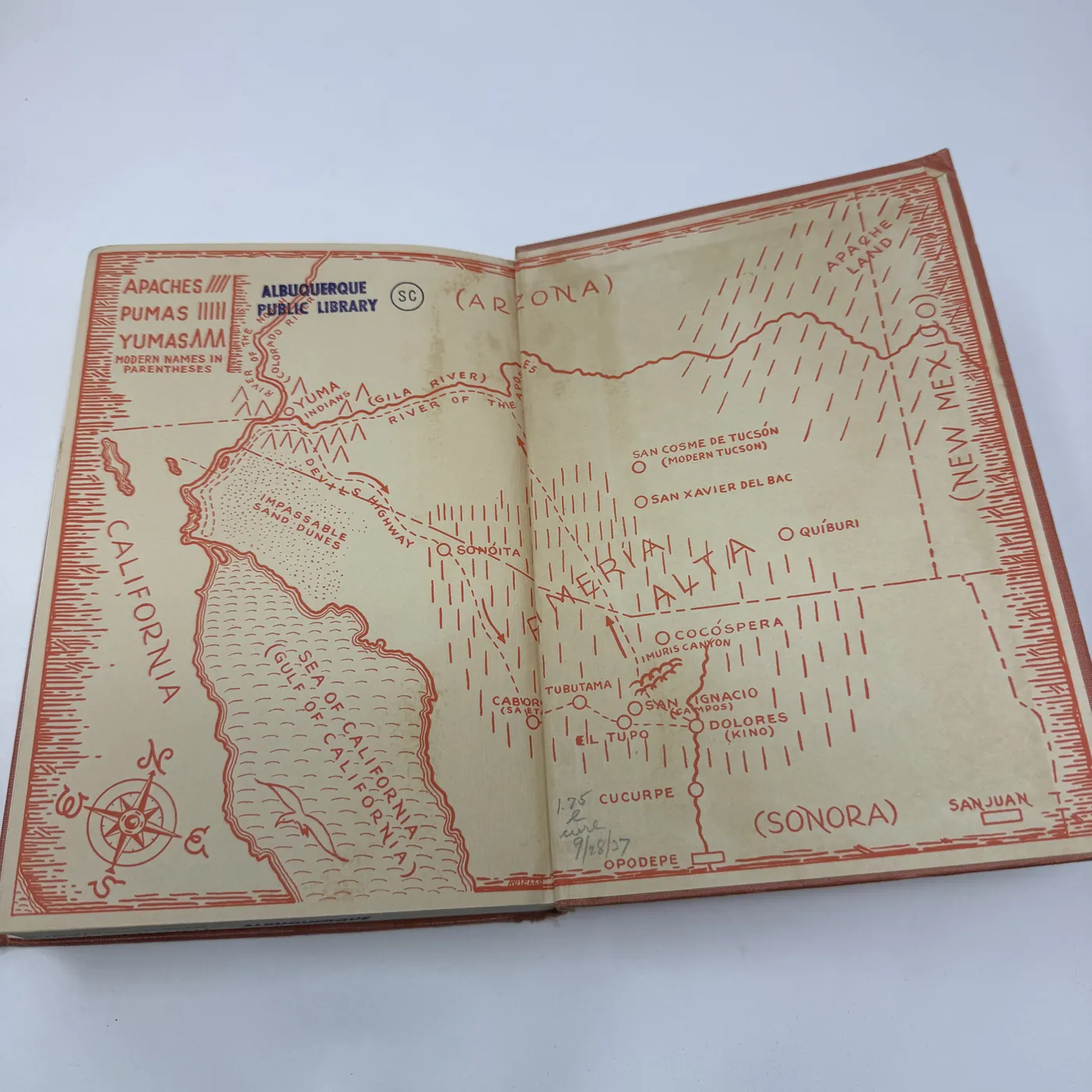
The geographic and historical setting is the Pimería Alta — the Spanish colonial administrative region that comprised what is today southern Arizona and the northern half of the Mexican state of Sonora. The dramatic spine of the book is El Camino del Diablo — "The Devil's Highway" — the 250-mile waterless trail from Sonoyta in Sonora north to the Gila River in Arizona, a passage marked across its length by the unburied bones of travelers who failed to reach the next water. The novel sits inside the late-seventeenth and early-eighteenth-century period when the Jesuit missionary Father Eusebio Francisco Kino (1645–1711) was establishing the Pimería Alta mission system: Mission San Xavier del Bac (founded 1692, the white-stucco landmark on the south edge of present-day Tucson), Mission Tumacácori, Mission Cocóspera, Mission Caborca, and the chain of smaller visitas connected by the cart-road system between them.
The Kino quotation that captions the title-page frontispiece — "The contentment of my children here is food and drink to me" — is the keynote. Kino's Favores Celestiales (his missionary journal), published in fragments throughout the eighteenth and nineteenth centuries and reissued by the Arizona Historical Society and the Bolton-edited Historical Memoir of Pimería Alta, gave Summers and other twentieth-century Southwestern novelists a vivid first-person voice for the Sonora frontier. The Devil's Highway belongs to that genre — Spanish-mission historical fiction grounded in the documentary record — alongside contemporaneous work by Harold Lamb, Mary Austin, Paul Horgan, and others. The Thomas Nelson and Sons imprint is significant: Nelson ran a substantial young-people's historical-novel program in the 1930s, with Newbery-adjacent titles in their list. Summers' Pimería Alta novel sits in that programmatic context.
Who Nils Hogner was — and why this book matters for Albuquerque
The NM-regional hook for this title is the illustrator. Nils Richard Alexander Hogner (1887–1970) was a Swedish-American painter and book illustrator whose Southwestern period coincided directly with Albuquerque. Born to Swedish-immigrant parents who settled in Whiteville, Massachusetts, Hogner studied at the Boston School of Painting, the Boston Museum of Fine Arts School, and the Rhodes Academy in Copenhagen. He spent four years on the University of New Mexico art faculty in Albuquerque during the early 1920s, and in that period ran the Klagetoh Trading Post on the eastern Navajo Nation while painting Arizona and New Mexico landscapes. In Albuquerque he met Dorothy Childs, the children's-book author who became his wife; the couple subsequently collaborated on close to forty illustrated books, many of them Southwestern in subject matter — Pedro the Potter, The Navajo Flute Player, Education of a Burro, Santa Fe Caravans, and Navajo Winter Nights are the most-cited titles.
By the mid-1930s the Hogners had returned east and Nils had become a member of the National Society of Mural Painters, the Litchfield Art Club, the Silvermine Guild, and the Architectural League. His illustration work for The Devil's Highway in 1937 is consequently a back-end work of his Southwestern period — produced after the relocation east, but visually informed by the four UNM years and the Klagetoh trading-post immersion. Hogner's signature illustration style — the strong black-mass silhouettes, the suppression of fine detail in favor of bold compositional gesture, the heavy use of solid black against unprinted ground — defines both the frontispiece and the endpaper maps in this book.
For an Albuquerque Public Library copy of a Pimería Alta frontier novel, the Hogner UNM connection is the strongest local-significance hook in the object. The book itself was published in New York with a Tucson author about Sonora geography; the binding into the Albuquerque Public Library's permanent collection at some point in the late 1930s or 1940s is partly explained by the fact that the illustrator was a recent UNM faculty member whose presence in Albuquerque was within working memory at the time of acquisition.
Not sure what you have? Text me a photo at 505-250-3804 and I'll tell you what I see.
Who Father Kino was, and why this is a Southwest story
Eusebio Francisco Kino (1645–1711) is the central historical figure who underlies the narrative. Born in Segno in the prince-bishopric of Trent (in what is now the Italian Alto Adige region), Kino entered the Society of Jesus in 1665, trained in mathematics, cartography, and theology at Ingolstadt, and was sent to the New World in 1681. He arrived in the Pimería Alta in 1687 and spent the next twenty-four years — until his death at Magdalena in March 1711 — establishing the chain of mission stations that the salmon-ground endpaper map of this book displays. Kino founded San Xavier del Bac (1692), expanded the missions at Tumacácori and Guevavi, established Cocóspera and Caborca, and proved through ten major expeditions that Baja California was a peninsula and not an island — ending a geographic misconception that had survived in European cartography for over a century.
Kino's documentary legacy — the Favores Celestiales journal, the Historical Memoir of Pimería Alta edited and translated by the Berkeley historian Herbert Eugene Bolton in 1919–1948, and the surviving mission registers — is the primary source for any twentieth-century novelist working the period. Summers worked from those documents and from his own knowledge of the Tucson–Sonora desert country to construct the novel. The NM connection is real if indirect: the Pimería Alta mission system shared documentary correspondence with the contemporaneous Franciscan missions in New Mexico (Mission Acoma 1629, the Hopi missions, the Salinas Pueblo Missions); the Spanish colonial cultural region the novel depicts extends, on the endpaper map, directly into the labeled "New Mexico" along the eastern frame. The Hopi and Pueblo reductions in NM, the Sonora Pima missions, and the Camino del Diablo passage all sit within the same Spanish-colonial frontier administrative space.
The 1937 first edition — identification points
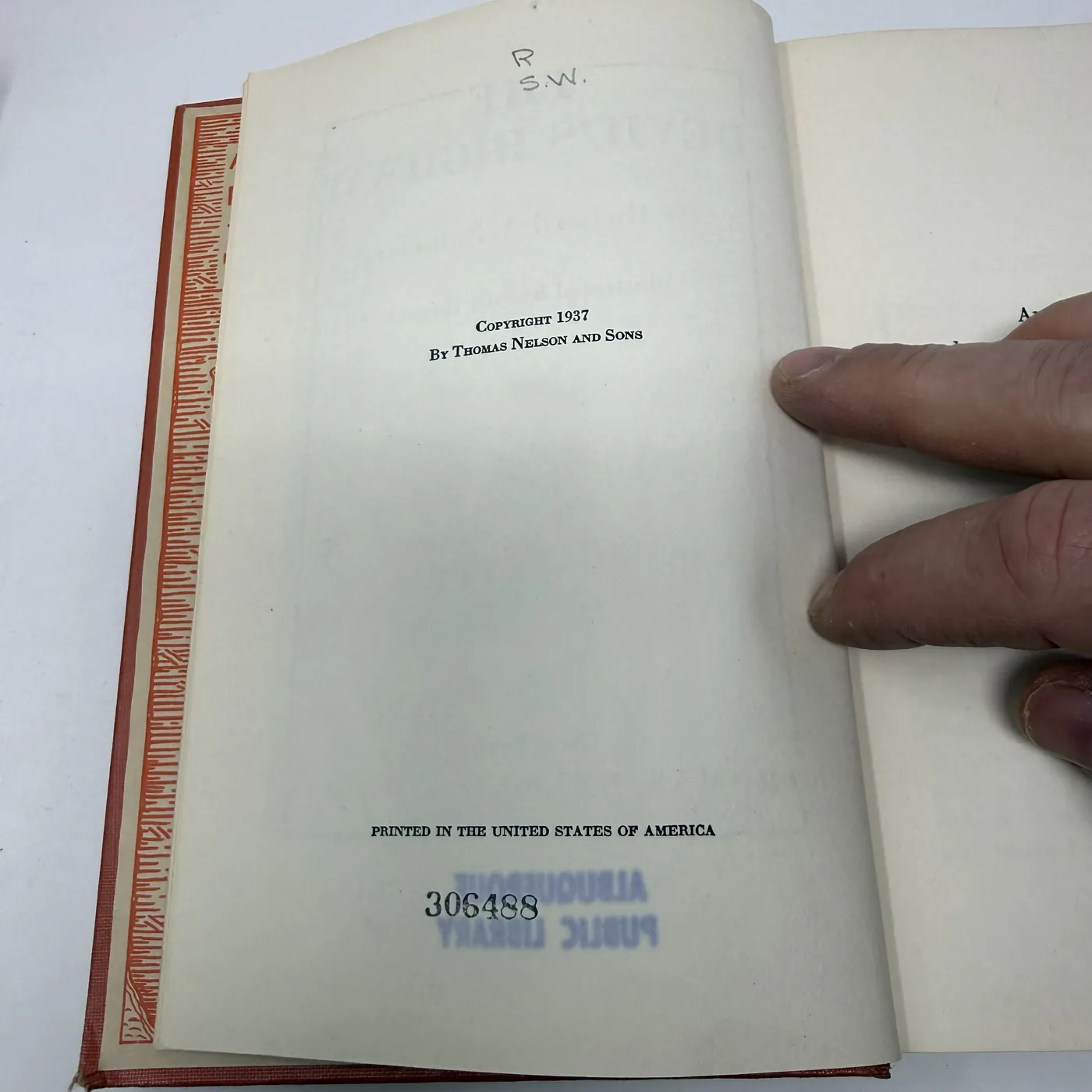
Bibliographic points of issue: the 1937 first carries the single copyright line "COPYRIGHT 1937 / By Thomas Nelson and Sons" with no subsequent printing or edition notations. The text is followed immediately by the "PRINTED IN THE UNITED STATES OF AMERICA" line. The original binding is the deep terracotta-red book cloth, with the title in black stenciled across the top quarter of the front cover. The endpaper maps — on both inside covers — print on a salmon-pink ground stock and depict the Pimería Alta from slightly different vantage points (the front endpaper centers Sonora and southern Arizona; the rear endpaper provides a complementary view). The frontispiece illustration on the title-page verso is a single full-page Hogner woodcut-style scene captioned with the Kino quotation. Interior chapter cuts and decorative dingbats are by the same hand throughout.
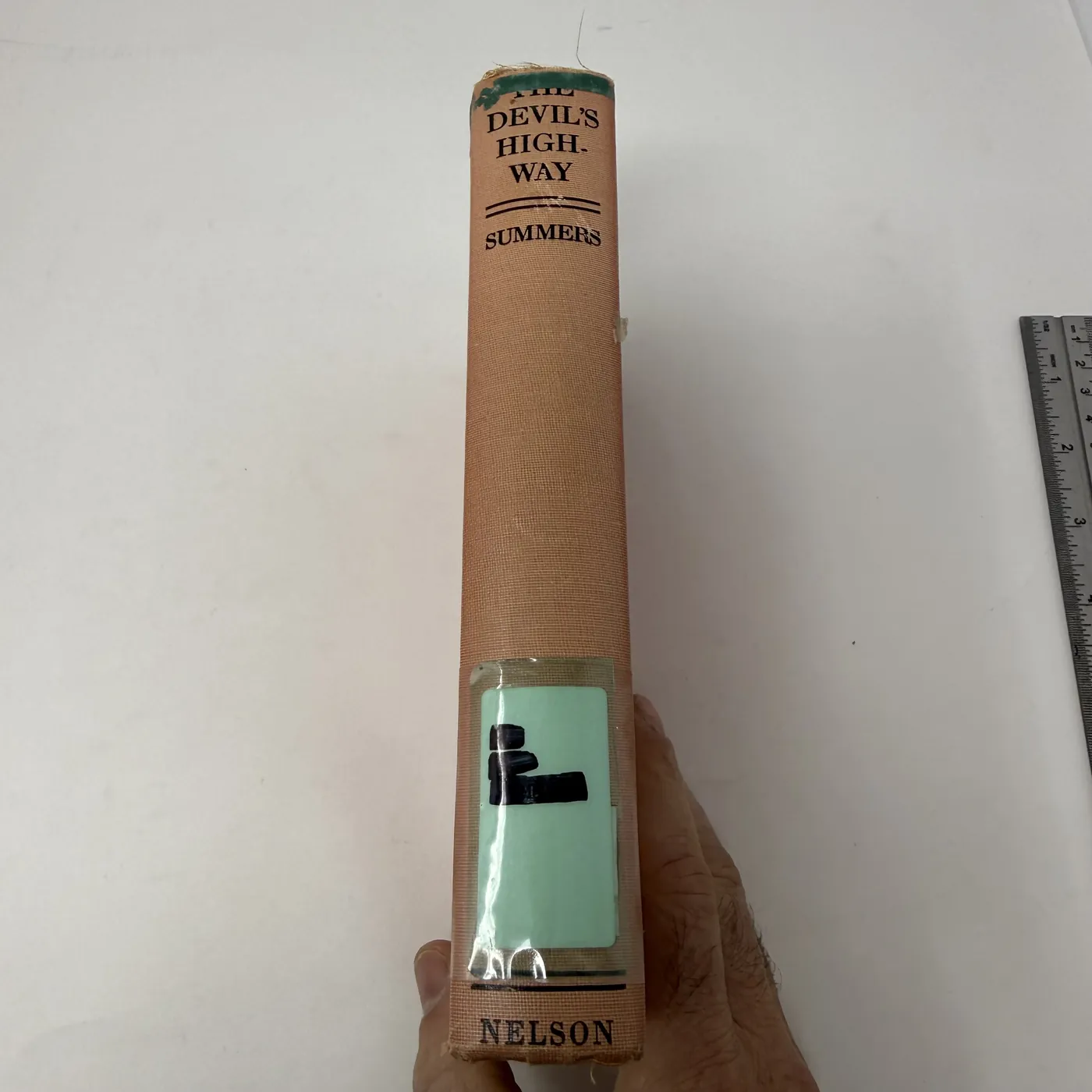
The dust jacket on the 1937 first edition is the most fragile element of the book; original jackets in any condition are now scarce. This copy lacks the dust jacket, with the original red cloth boards exposed and the original cover-title stenciling partially obscured by the Albuquerque Public Library's institutional black-redaction bar applied at the time of accession. The redaction was a common Albuquerque Public Library practice on cloth-bound circulating books of the period: a librarian or accession clerk would cover the publisher's original cover title with a uniform black bar before adding a typed spine label, on the grounds that the typed label was the official authoritative title for shelving purposes. The practice damaged collectable copies but produced a reliable institutional identification system for the day-to-day circulation department.
The Albuquerque Public Library Provenance
The library-stamp configuration on this copy is the standard Albuquerque Public Library accession pattern for cloth-bound trade hardcovers acquired in the 1930s and 1940s. The purple oval ALBUQUERQUE PUBLIC LIBRARY stamp on the copyright page is the primary ownership mark. The pencil accession number 306488 at the foot of the copyright page is the institutional control number used for shelf-list and circulation tracking. The cover-title black-redaction bar is the cataloging-department's intervention.
The "Yours to Keep / Withdrawn-ABCL" stamp on the title page is the later withdrawal mark applied when the book was deaccessioned from active circulation. "ABCL" expands to Albuquerque-Bernalillo County Libraries — the consolidated library system formed in 1976 from the merger of the Albuquerque Public Library and the Bernalillo County Library system. The "Yours to Keep" wording indicates the book was offered to the public as part of a deaccession sale rather than discarded directly. This is the standard ABCL withdrawal sequence for non-rare circulating books that have aged out of the active collection but are not damaged or obsolete enough to be pulped.
For a 1937 Sonora frontier novel illustrated by a former UNM art faculty member, the path from publication in 1937 to acquisition by the Albuquerque Public Library shortly thereafter, to active circulation for decades, to eventual withdrawal under the ABCL consolidation, to the secondary book trade, to this archive intake in May 2026 traces a complete public-library object life cycle. The book is a documentary artifact of the Albuquerque Public Library system's mid-century collecting practice as much as it is a novel.
Why this matters for the NMLP archive
Three reasons for inclusion at this level of bibliographic detail.
First — the Hogner connection. Nils Hogner's four UNM art-faculty years and his Klagetoh trading-post period make him a documented New Mexico cultural figure of the 1920s. His illustrations for an Albuquerque Public Library–acquired novel are a self-referential institutional artifact — the city library acquired a book illustrated by a recent UNM faculty member, and the book lived in the Albuquerque collection for the next several decades. The Hogner-illustrated children's books (the Pedro the Potter series, the Navajo books, the Santa Fe Caravans titles) are also collectable in their own right; collectors building a Hogner-illustrated shelf often miss The Devil's Highway because it is filed under Summers rather than under his more frequent collaborator Dorothy Childs Hogner.
Second — the Pimería Alta documentary frame. The Spanish colonial mission system on the Sonora–Arizona frontier is a directly contiguous cultural region to Spanish colonial New Mexico. The Kino missions, the Franciscan establishments at Santa Fe and the NM pueblos, and the El Camino del Diablo / Camino Real corridor are pieces of the same Spanish-colonial administrative space. Novels that work the period (Paul Horgan's Great River trilogy, Willa Cather's Death Comes for the Archbishop, and Summers' The Devil's Highway sit on a shelf together, the Sonora and NM Spanish-mission documentary record handled by different novelists.
Third — the library provenance. Albuquerque Public Library cloth-bound 1930s acquisitions with all three institutional markers intact — the purple oval ownership stamp, the pencil accession number, and the later ABCL withdrawal stamp — are increasingly uncommon. The deaccession sales of the 1990s and 2000s dispersed thousands of such books, but a substantial fraction were pulped, rebound, or had the library markings removed by intervening owners. Clean copies with the full provenance chain visible are useful objects for any Albuquerque institutional-history research.
How this copy came in
Donor scenario anonymized per archive policy. Documented as part of the May 2026 NMLP intake at the Edith Boulevard warehouse. Condition: the original red cloth boards are sound with light shelf wear at the head and foot of the spine; the cover-title redaction bar is intact and is itself a provenance artifact rather than damage; the textblock is clean with no underlining or marginalia beyond the library accession marks; both salmon-ground Hogner endpaper maps are intact on both inside covers with no tears; the Albuquerque Public Library spine call-number label is partly clouded with age but legible; no dust jacket. A solid working copy of the 1937 first edition with the full Albuquerque Public What is the library provenance of this copy? chain visible.
Where this copy is going
Three plausible routes. First: a Hogner illustration collector who needs the early-period Southwestern title and is willing to accept a library-marked copy in exchange for the otherwise scarce 1937 Thomas Nelson hardcover with both endpaper maps intact. Second: an Arizona or Pimería Alta historian / Kino bibliographer building a regional historical-fiction shelf alongside the Bolton-translated Historical Memoir, contemporary novels of the period, and modern Pimería Alta scholarship. Third: a research library that collects Albuquerque institutional-history artifacts — the full ABCL provenance configuration is the principal interest for that audience. The archive entry will remain regardless of which route the physical book takes.
External references & authoritative sources
- Eusebio Francisco Kino — Wikipedia: en.wikipedia.org/wiki/Eusebio_Francisco_Kino — biographical reference for the Jesuit missionary at the historical center of the novel.
- Pimería Alta — Wikipedia: en.wikipedia.org/wiki/Pimería_Alta — the Spanish colonial administrative region depicted on the endpaper maps.
- El Camino del Diablo — Wikipedia: en.wikipedia.org/wiki/El_Camino_del_Diablo — the 250-mile waterless trail that gives the novel its title.
- University of Arizona Libraries — Richard A. Summers Papers: speccoll.library.arizona.edu — the institutional archive holding Summers' manuscripts and correspondence (collection UAMS 494, bulk dates 1930–1960).
- Nils Richard Alexander Hogner — askArt biographical record: askart.com — Nils Hogner biography — documents Hogner's four-year UNM faculty period and his Klagetoh trading-post work.
- Mattatuck Museum — Nils Hogner artist record: mattatuckcollections.org — Nils Hogner — the Connecticut institutional collection record for Hogner's later studio work.
- Mission San Xavier del Bac — institutional site: sanxaviermission.org — the surviving Kino-founded mission church on the Tohono O'odham Reservation south of Tucson.
- WorldCat / OCLC institutional holdings: search.worldcat.org — The Devil's Highway, Summers, 1937 — library holdings worldwide for the 1937 Thomas Nelson first edition.
- Thomas Nelson (publisher) — Wikipedia: en.wikipedia.org/wiki/Thomas_Nelson_(publisher) — the trade publisher whose 1930s young-people's historical-novel program included this title.
- Albuquerque-Bernalillo County Libraries: abqlibrary.org — the consolidated library system formed in 1976 whose withdrawal stamps appear on this copy.
How to cite this archive entry
Eldred, Josh. "The Devil's Highway — Richard A. Summers, illustrated Nils Hogner, Thomas Nelson and Sons 1937; Albuquerque Public Library Withdrawn-ABCL Discard." NMLP Donation Archive, May 10, 2026. https://newmexicoliteracyproject.org/archive/devils-highway-summers-1937
Related on this site
- Back to the archive index
- Healing Herbs of the Upper Rio Grande (Curtin, Southwest Museum, 1965 / 1974) — the other Albuquerque Public Library–provenance archive entry in this May 2026 intake; Curtin's ethnobotanical work occupies the Spanish-NM regional record complementary to the Sonora frontier the Summers novel covers.
- Letters from the New World (Vargas / Kessell UNM Press 1989) — the late-seventeenth-century New Mexico Spanish colonial documentary record contemporaneous with Kino's Pimería Alta period.
- Cañones (Kutsche & Van Ness, 1981) — the Spanish-NM village ethnography in the same Curtin / Pimería Alta cultural-region tradition.
- Closed Signature Pools Reference — the structured reference for deceased-author signature markets; Summers (d. 1969) sits in the mid-century Southwestern novelist pool.