Archive entry · Signed by Paul Kutsche · Closed pool (d. 2017) · Foundational NM-village ethnography
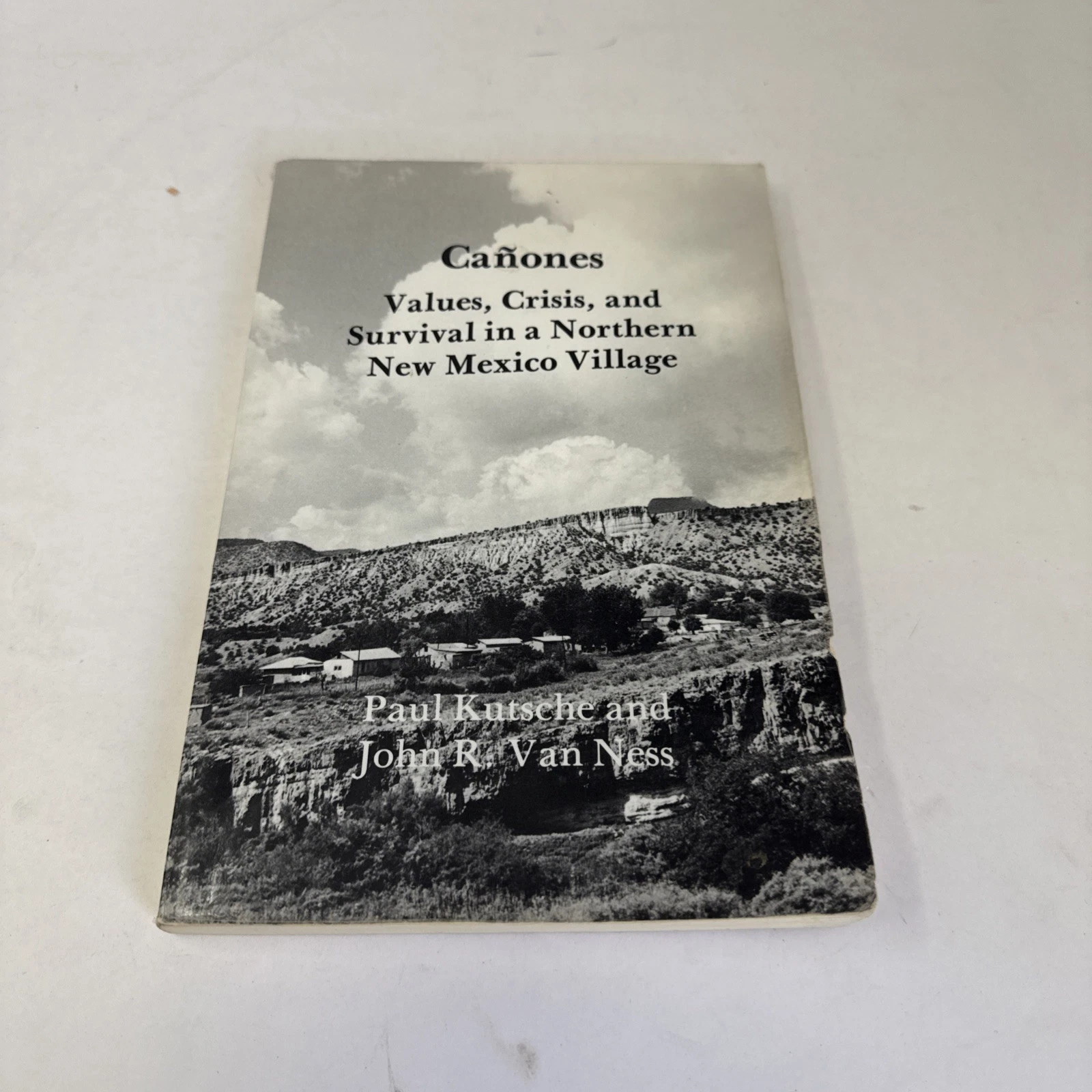
Cañones: Values, Crisis, and Survival in a Northern New Mexico Village — Paul Kutsche & John R. Van Ness, UNM Press 1981 / Sheffield Publishing 1988 Reissue, signed by Kutsche
A signed copy of the principal single-village ethnography of Hispano New Mexico from the late twentieth century. The Sheffield Publishing 1988 paperback reissue of the 1981 University of New Mexico Press first edition. Built from Paul Kutsche's Colorado College fieldwork in the Río Arriba County village of Cañones, on Cañones Creek north of Abiquiú, conducted principally between October 1966 and 1968 and continued through the 1970s. Co-authored with John R. Van Ness, the Hispanic land-grants specialist who would later co-edit Land, Water, and Culture (UNM Press 1987) with Charles L. Briggs. Signed by Kutsche on the title page above the byline. Kutsche died May 18, 2017 — the signature pool is closed.
Catalog
What this book is
Cañones is the result of a particular kind of mid-twentieth-century cultural-anthropology project — a sustained single-village ethnography in the tradition of Robert Redfield's Tepoztlán (1930) or Oscar Lewis's Pedro Martínez (1964), updated for the second half of the twentieth century. Paul Kutsche arrived in Cañones, a small agricultural village in Río Arriba County, New Mexico, in October 1966, with research support from his home institution Colorado College. He lived in the village or commuted to it through 1968, then continued site visits through the 1970s. John R. Van Ness joined the project as collaborator on the land-tenure and land-grant historical dimensions, where his subsequent career would specialize. The book that resulted, published by the University of New Mexico Press in 1981, is the principal English-language single-village ethnography of Hispano New Mexico from the late twentieth century.
The structure follows the standard village-ethnography format. The opening chapters establish the geographic and historical setting — the village's location on Cañones Creek, a tributary of the Rio Chama running south through Río Arriba County, north of Abiquiú (the village where Georgia O'Keeffe would establish her two studios). The book then surveys the village's social institutions in turn: family and kinship, the religious structure (the parish church, the Penitente morada, the calendar of religious observances), the working economy (subsistence agriculture, sheep and cattle, irrigation through the acequia system, off-farm labor in the regional economy), the political organization, the land-tenure pattern, and the relationships among households. The concluding section is the values-crisis-survival frame that supplies the book's subtitle: how the village maintained its institutions in the face of population loss, market pressures, the 1960s and 1970s land-grant disputes, federal Forest Service land enclosure, and the broader assimilationist pressures of post-WWII rural America.
The book is the standard English-language reference for the village it documents and is regularly assigned in graduate-level NM ethnography courses. UNM Press, Colorado College, and Sheffield Publishing have all kept it on their reference-availability lists; the 1988 Sheffield reissue is the issue most commonly available because Sheffield specialized in keeping academic monographs in print after the UNM Press first run had sold out.
Who Paul Kutsche was
Rudolph Paul "Buzz" Kutsche Jr. was born January 3, 1927, in Grand Rapids, Michigan, and died May 18, 2017. The biographical trajectory: Harvard BA 1949; University of Michigan MA 1955; University of Pennsylvania PhD 1961; appointment at Colorado College in Colorado Springs in 1959, where he founded the Department of Anthropology and taught through to his retirement in 1993 (a thirty-four-year career at one institution). His research interests over the long career included cultural anthropology more generally, the Cherokee of the southeastern United States (his dissertation field), the Hispano population of northern New Mexico (the Cañones project and its successors), and Costa Rica (a separate later fieldwork program). He is the namesake of the Colorado College Paul Kutsche Anthropology Fund.
The Cañones project was the principal sustained ethnographic work of his Colorado College career and produced not only this monograph but a series of journal articles, conference presentations, and the working relationship with Van Ness that allowed the historical and ethnographic dimensions to be integrated rather than separated. Kutsche's correspondence files in the Tutt Library at Colorado College and in the broader Social Networks and Archival Context (SNAC) database (cooperative identifier ark:/99166/w67w6b45) document the long arc of the work.
Kutsche signed copies of Cañones at lectures, conferences, and Colorado College alumni events through the 1980s, 1990s, and 2000s. He died in May 2017 in Colorado Springs at age 90. The signature pool is closed; no new signed copies have entered the market since.
Who John R. Van Ness was
John R. Van Ness was the historical-anthropology collaborator who supplied the land-grant and Spanish-Mexican colonial dimensions of Cañones. He visited the village with Kutsche in the 1960s and continued working on the wider Hispano upper-Rio-Grande material for the rest of his career. His subsequent published works trace a coherent intellectual program:
Spanish and Mexican Land Grants in New Mexico and Colorado (1980), co-authored with Christine M. Van Ness, is the standard reference primer on the colonial-period land-grant system whose dissolution and partial survival under US territorial administration is the legal and political background to Cañones. Hispanos in Northern New Mexico: The Development of Corporate Community and Multicommunity (Garland Publishing, 1991, in the AMS Press Immigrant Communities and Ethnic Minorities series) is Van Ness's more general theoretical statement on the "corporate community" structure of the upper Rio Grande Hispano villages — the analytical frame the Cañones book operates inside. Land, Water, and Culture: New Perspectives on Hispanic Land Grants (University of New Mexico Press, 1987), which Van Ness co-edited with the Córdova ethnographer Charles L. Briggs, is the major collection bringing together the historical, archaeological, and ethnographic work on the Hispano land-grant system through the 1980s. Van Ness and Kutsche together published A Unified Approach to the Anthropology of Hispanic Northern New Mexico: Historical Archaeology, Ethnohistory, and Ethnography, a programmatic methodological article that defends the integrated approach Cañones exemplifies.
The "Río Arriba subculture" frame that runs through both authors' work characterizes the Hispano communities of the upper Rio Grande north of Albuquerque as a coherent regional cultural region marked by (a) communal land-grant institutions surviving the US territorial transition; (b) small subsistence-and-trade village economies; (c) campanilismo — the village-loyalty social orientation Italian historians named for the campanile bell tower of the parish church; and (d) a relatively flat social structure of small landholders rather than a strong hacienda elite. Cañones is the single-village test case for that broader theoretical frame.
The village itself
Cañones is a small agricultural community on Cañones Creek in Río Arriba County, New Mexico, roughly twenty miles north of Abiquiú and west of the Chama River. The village sits inside the larger geographic region the Spanish colonial administration knew as the Río Arriba — literally "upper river," the Rio Grande corridor north of Santa Fe through the Española and Chama valleys to the Colorado border. The population through the twentieth century was a few hundred residents in a few dozen extended-family households, sustained by irrigated subsistence agriculture (corn, beans, squash, alfalfa, fruit orchards), sheep and cattle, and seasonal off-farm labor in the regional Río Arriba and Santa Fe County economies.
The village shares the geography and the institutional structure of several adjacent communities — Coyote, Youngsville, Gallina, El Rito, Abiquiú itself — that the early Spanish land-grant patents established along the Chama and its tributaries in the late seventeenth and early eighteenth centuries. Many of these communities have substantial individual ethnographic and historical literatures of their own, but Cañones is the one that received the sustained single-village treatment that became this book. The village still exists, has retained its core institutional patterns, and is a Census-designated place inside Río Arriba County.
The book's place in NM-village ethnography
For the discovery context of researchers, students, and serious regional readers, the book sits inside a discrete literature of late-twentieth-century single-community ethnographies of Hispano northern NM. The principal companion volumes:
Charles L. Briggs — The Wood Carvers of Córdova, New Mexico: Social Dimensions of an Artistic "Revival" (University of Tennessee Press, 1980) and Competence in Performance: The Creativity of Tradition in Mexicano Verbal Art (University of Pennsylvania Press, 1988) document the village of Córdova in the same Río Arriba region. Briggs and Van Ness were collaborators on the 1987 Land, Water, and Culture volume; the Briggs Córdova work is the natural complement to the Kutsche/Van Ness Cañones work for any reader building a single shelf on northern NM village ethnography.
Sylvia Rodríguez — The Matachines Dance: Ritual Symbolism and Interethnic Relations in the Upper Río Grande Valley (UNM Press 1996) covers the Taos area and the Matachines tradition that ties Hispano and Pueblo religious practice together; Rodríguez's ethnographic frame is comparable but more focused on a specific ritual complex than on a single village.
William deBuys — Enchantment and Exploitation: The Life and Hard Times of a New Mexico Mountain Range (UNM Press 1985) is the standard regional-history complement — the deBuys work covers the Sangre de Cristo range east of the Chama drainage and provides the long-arc historical context for understanding the constraints inside which the Cañones villagers worked their land.
Frances Leon Quintana — Pobladores: Hispanic Americans of the Ute Frontier (University Press of Colorado 1991) extends the Hispano-village ethnographic frame north into southern Colorado.
The Kutsche-Van Ness Cañones is the standard work for the village it documents; together with the Briggs Córdova volumes, it forms the core of any English-language single-village shelf on the Hispano Río Arriba.
I pick up books for free anywhere in the metro area. Call 505-250-3804 to schedule.
Bibliographic identification — 1981 first vs. 1988 Sheffield reissue
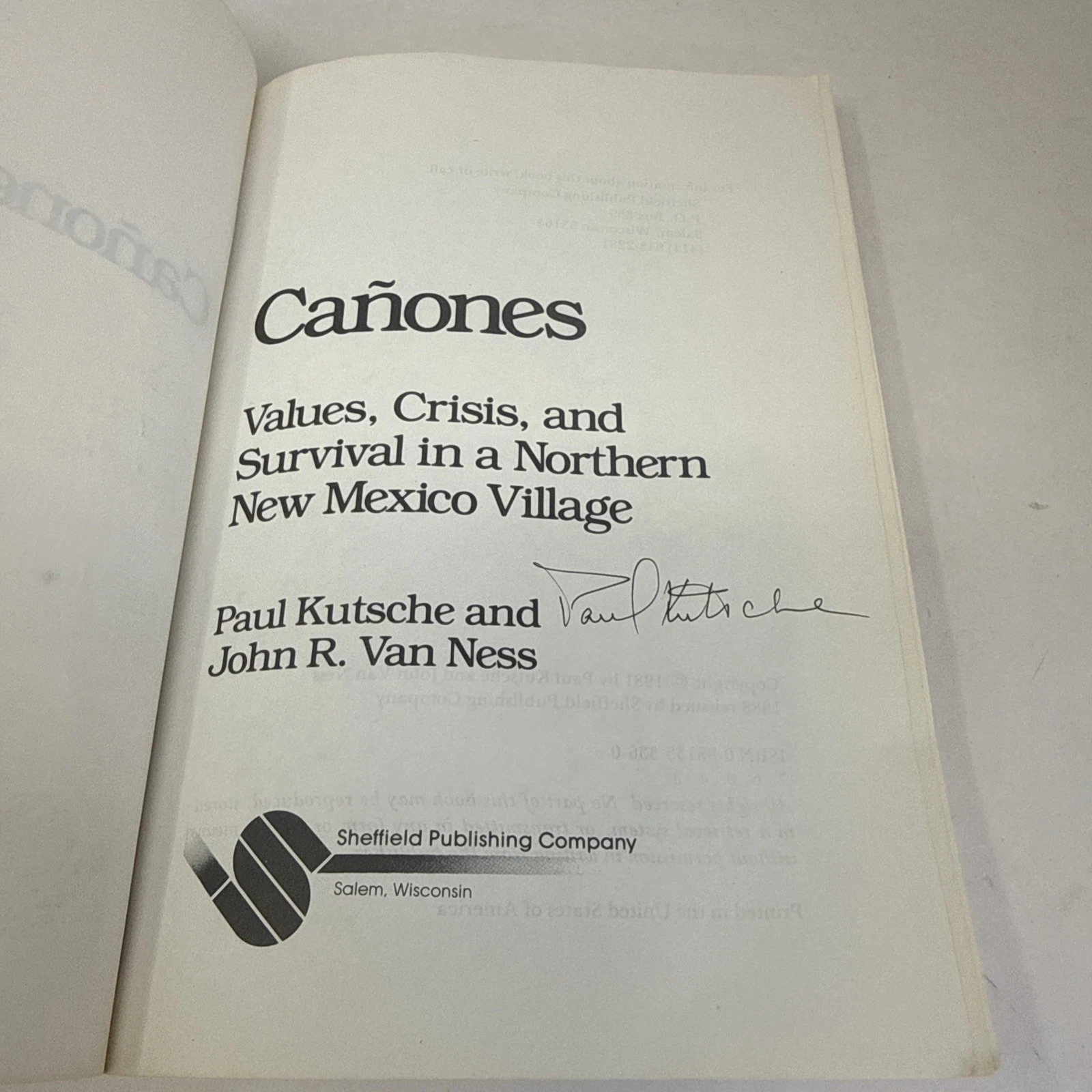
The 1981 first edition was published by the University of New Mexico Press in Albuquerque as a clothbound monograph in the standard UNM Press scholarly format of the era. The book went out of print at UNM Press after the initial run. Sheffield Publishing Company of Salem, Wisconsin (a small academic-trade press that specialized in keeping anthropology and sociology monographs in print after the original university-press runs sold out) acquired reissue rights and produced the 1988 paperback edition with a new cover photograph of the village, an updated 1988 preface, and the new ISBN 0-88133-336-0. The Sheffield 1988 is the issue most commonly encountered in the secondhand academic-book market.
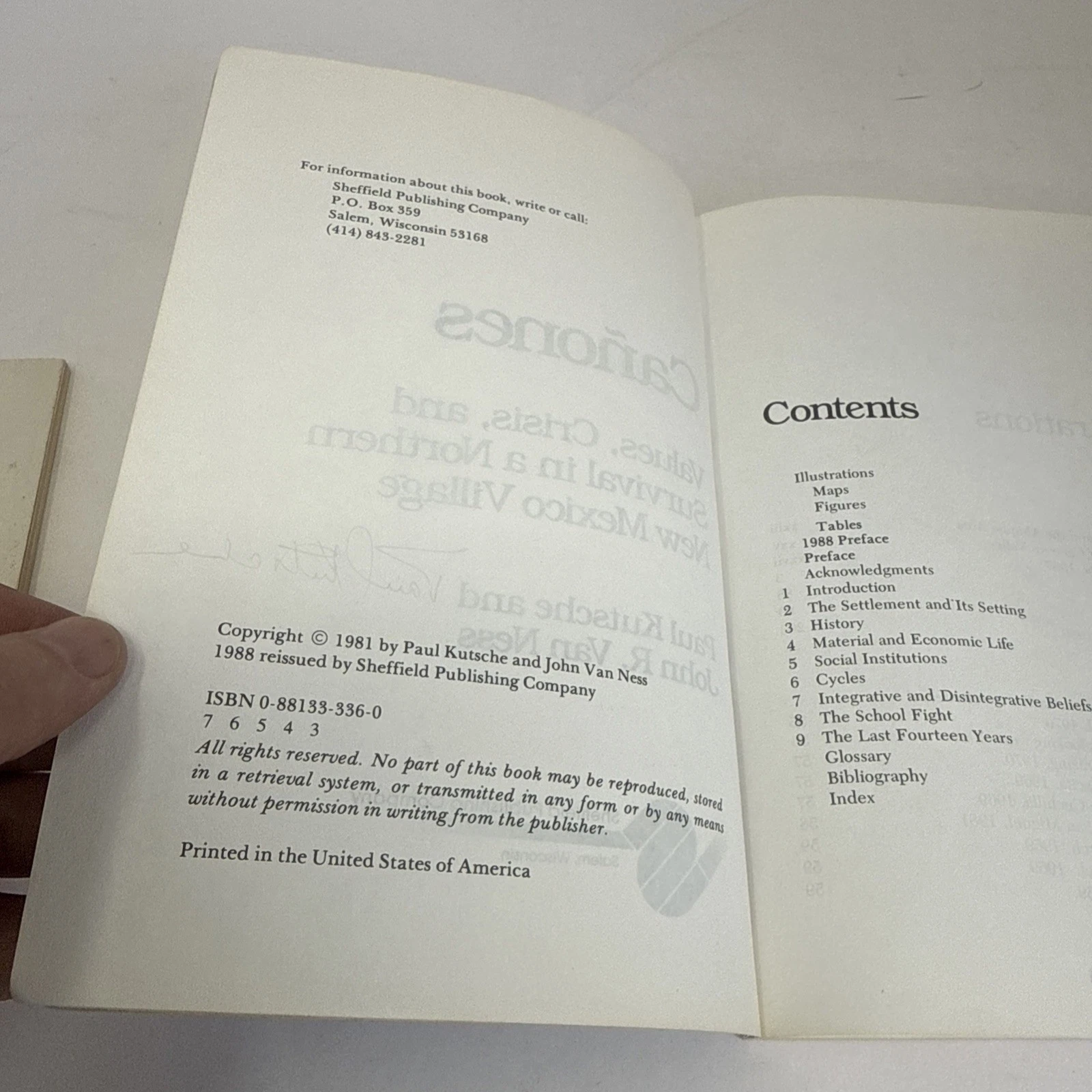
The text and pagination of the 1988 Sheffield reissue follow the 1981 UNM Press first edition; the Sheffield issue is distinguished by the photographic cover, the new ISBN, the Sheffield imprint at the title-page foot and on the spine, and (in some printings) a new short preface set before the original 1981 preface. The 1981 UNM Press cloth first is the collector-target edition; the 1988 Sheffield is the regularly-cited working-text edition. Signed copies of either edition by Kutsche are uncommon (he was a working academic, not a public-circuit author), and signed copies are now finite.
Why this matters for the archive
First — the signed-by-Kutsche closed-pool dynamic. Paul Kutsche died May 18, 2017. His signature pool is closed. Cañones is his principal published monograph; signed copies are a specific category of object that researchers, regional collectors, and the Colorado College alumni community track.
Second — the standing scholarly value. The book has not been superseded as the single-village ethnography of Cañones. Subsequent scholarship has updated, extended, and critiqued the analytical frame — the Briggs work on Córdova provides a parallel village; Sylvia Rodríguez's work brings ritual studies into the picture; the Critical Indigenous Studies and Chicano studies literatures have raised methodological questions about the 1960s-era anthropological-observer position — but the bibliographic record of Cañones village itself is still substantially this book.
Third — the Río Arriba documentary frame. The book is one of a small number of works that established the analytical frame of "Hispano northern New Mexico" as a distinct cultural region with its own institutional dynamics, separable from the Pueblo, Apache, Navajo, and Anglo histories of the same geography. That framing is now standard in regional historiography; Cañones is one of the works that put it there.
How this copy came in
Donated in May 2026 through NMLP. Donor scenario anonymized per archive policy. The book was in clean paperback condition consistent with a careful reader's reference copy — light edgewear on the covers, the spine creased once or twice as the book had been opened across its full thickness rather than only flipped through, no underlining, no marginalia, no torn pages, the signed title page bright. The signature is in dark ballpoint ink and is consistent in slant and pressure with other Kutsche signatures documented in the Colorado College alumni-event archive. Documented as part of the May 2026 NMLP intake.
Where this copy is going
Three plausible routes after archive documentation. First and most likely: a graduate student or junior faculty member in NM-history, Chicano studies, anthropology, or Hispanic studies who wants the signed Kutsche copy specifically — the closed-pool Kutsche signature carries marginal but real value over the unsigned identical text. Second: a Colorado College alumnus building a Kutsche-program collection (Kutsche's CC tenure, his Cherokee work, his Costa Rica work, and the NM-village work together represent the long-arc career). Third: a research library replacing a worn or missing circulating copy. The archive entry will remain regardless of which route the physical book takes.
External references & authoritative sources
- Cañones, New Mexico — Wikipedia: en.wikipedia.org/wiki/Cañones,_New_Mexico — geographic and demographic reference for the village.
- Paul Kutsche — Social Networks and Archival Context (SNAC): snaccooperative.org/ark:/99166/w67w6b45 — biographical authority record for the author (1927–2017).
- Colorado College — Department of Anthropology: coloradocollege.edu/academics/dept/anthropology — the department Kutsche founded; he taught there 1959–1993.
- Colorado College Bulletin — Summer 2017 (Kutsche obituary): sites.coloradocollege.edu/bulletin/issue/summer-2017 — CC's institutional obituary for Kutsche.
- WorldCat / OCLC — 1981 UNM Press first edition: search.worldcat.org/title/7464847 — institutional library holdings worldwide.
- WorldCat / OCLC — 1988 Sheffield Publishing reissue: search.worldcat.org/isbn/9780881333367 — library holdings for the paperback this copy is.
- Smithsonian Institution Libraries record: si.edu — Cañones bibliographic record — Smithsonian Libraries holding entry.
- University of New Mexico Press: unmpress.com — the original 1981 publisher.
- Sheffield Publishing Company: sheffieldpub.com — the 1988 reissue publisher; specialized in keeping academic monographs in print after the original university-press runs sold out.
- Charles L. Briggs & John R. Van Ness, eds., Land, Water, and Culture: New Perspectives on Hispanic Land Grants (UNM Press 1987): search.worldcat.org — Land, Water, and Culture — the major Van Ness/Briggs edited collection in the same intellectual program.
- John R. Van Ness, Hispanos in Northern New Mexico: The Development of Corporate Community and Multicommunity (Garland, 1991): search.worldcat.org — Hispanos in Northern New Mexico — Van Ness's more general theoretical statement.
How to cite this archive entry
Eldred, Josh. "Cañones: Values, Crisis, and Survival in a Northern New Mexico Village — Paul Kutsche & John R. Van Ness (signed by Kutsche), University of New Mexico Press 1981 / Sheffield Publishing 1988 Reissue." NMLP Donation Archive, May 1, 2026 (expanded May 11, 2026). https://newmexicoliteracyproject.org/archive/canones-kutsche-vanness-1981
Related on this site
- Back to the archive index
- Cobos Dictionary signed (2003) — the foundational reference for the regional Spanish that Cañones villagers spoke; Cobos and Kutsche are companion references on the same speech community.
- Healing Herbs of the Upper Rio Grande (Curtin, 1965 / 1974) — the ethnobotanical record of the same Río Arriba villages Kutsche worked in, conducted a generation earlier.
- Embroideries by Rebecca James (MOIFA, 1963) — the contemporaneous Santa Fe-circle institutional documentation of Hispano colcha-embroidery traditions.
- Letters from the New World (Vargas / Kessell, UNM Press 1989) — the late-seventeenth-century Spanish colonial documentary record for the same upper Rio Grande corridor.
- Women of the New Mexico Frontier (Foote, UNM Press) — the territorial-period scholarly companion volume from the same UNM Press regional-history program.
- Closed Signature Pools Reference — the structured reference for deceased-author signature markets; Kutsche (d. 2017) sits in the early-21st-century academic-anthropologist pool.