Archive entry · Ethnobotany of Spanish New Mexico · Albuquerque Public Library discard · Closed signature pool
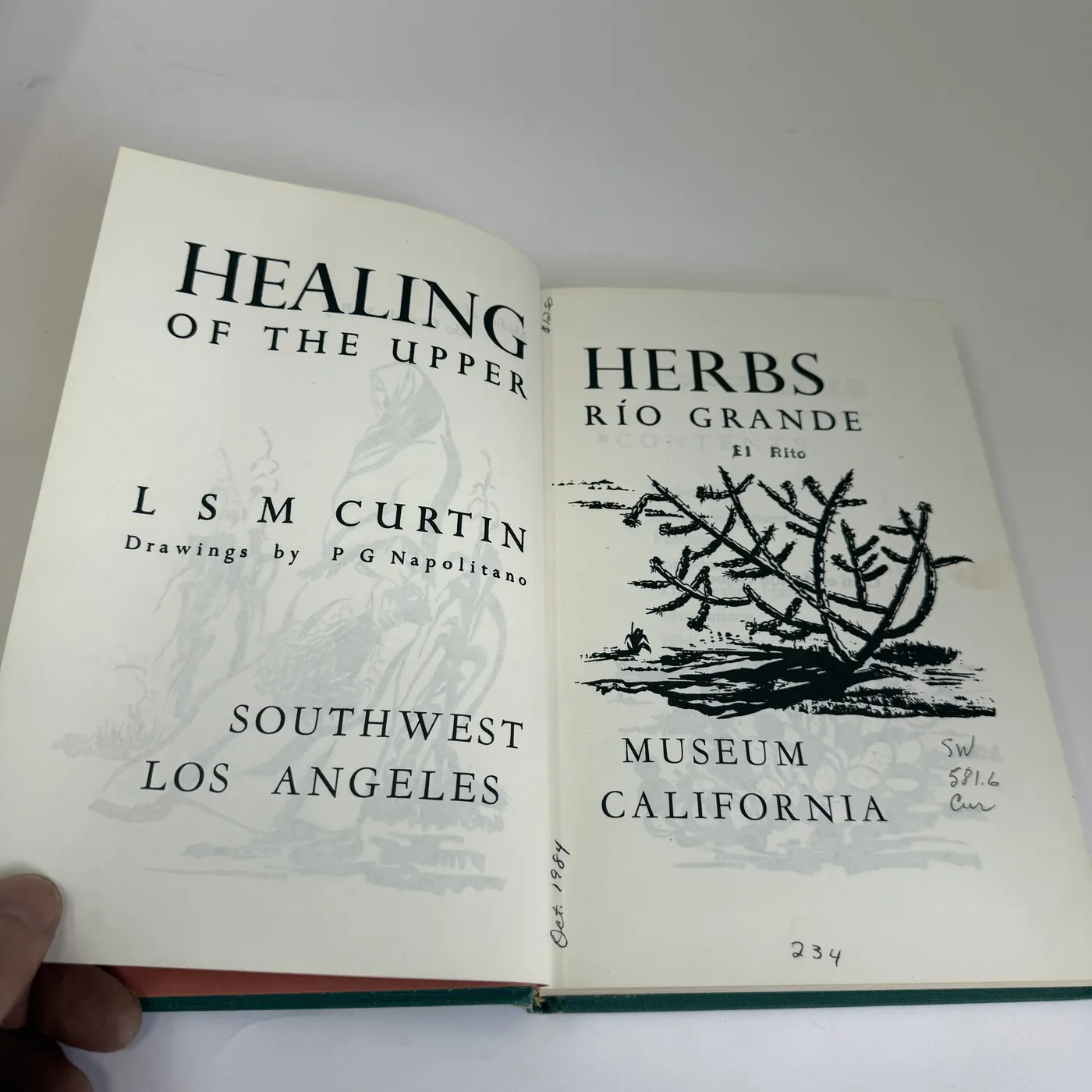
Healing Herbs of the Upper Rio Grande — L. S. M. Curtin, Southwest Museum, Los Angeles, 1965; Second Printing 1974
A library-bound second-printing copy of the foundational ethnobotanical record of Spanish New Mexican curandera medicine in the Upper Rio Grande valley. Compiled by Leonora Scott Muse Curtin (1879–1972) over decades of fieldwork with village healers and elders — the same network of Spanish-village artisans her short-lived Santa Fe Native Market (1934–1937) had supported a generation earlier — and published by the Southwest Museum at Los Angeles in 1965 with line drawings by P. G. Napolitano. This copy is an Albuquerque Public Library discard from the federal Title VII acquisitions program (call number SW 581.6 Cur).
Catalog
What this book is
Healing Herbs of the Upper Rio Grande is the documentary record of a research program Curtin carried out across the Spanish villages and pueblos of northern New Mexico from roughly the 1920s through the 1960s. The field method was old-fashioned and irreplaceable: she sat with curanderas, parteras (midwives), and village abuelas, learned which plants they used for which conditions, watched the preparations, recorded the Spanish vernacular plant names, and cross-walked those names against the Latin botanical taxonomy of the regional flora. The result is a several-hundred-entry plant-by-plant compendium, alphabetized by Spanish common name, that functions simultaneously as ethnographic record, working botica reference, and primary source for everything written on northern-New-Mexican folk medicine since.
The book is the second of Curtin's two ethnobotanical monographs. The earlier work, By the Prophet of the Earth, also published by the Southwest Museum, documented the medicinal plant knowledge of the Pima of southern Arizona. Healing Herbs turns the same field method on the Spanish-village knowledge of the Upper Rio Grande. The 1965 first issue from the Southwest Museum had a small initial run; the 1974 Second Printing — the issue held in this copy — was produced to satisfy continuing demand from herbalists, anthropologists, and regional historians. The text and pagination of the Second Printing follow the 1965 first; the only material difference is the line "Second printing, 1974" added below the copyright notice.
The book was reissued a third time in 1997 by Western Edge Press of Santa Fe in an annotated edition prepared by the Bisbee, Arizona, herbalist Michael Moore (1941–2009), whose annotations updated the Latin taxonomy and added clinical commentary. The 1997 Moore edition is the version most working modern herbalists own and cite. The 1965 first and the 1974 Second Printing — the Southwest Museum issues with the original P. G. Napolitano drawings and the salmon-ground endpaper maps intact — are the editions collectors and institutional libraries want. This copy is the latter.
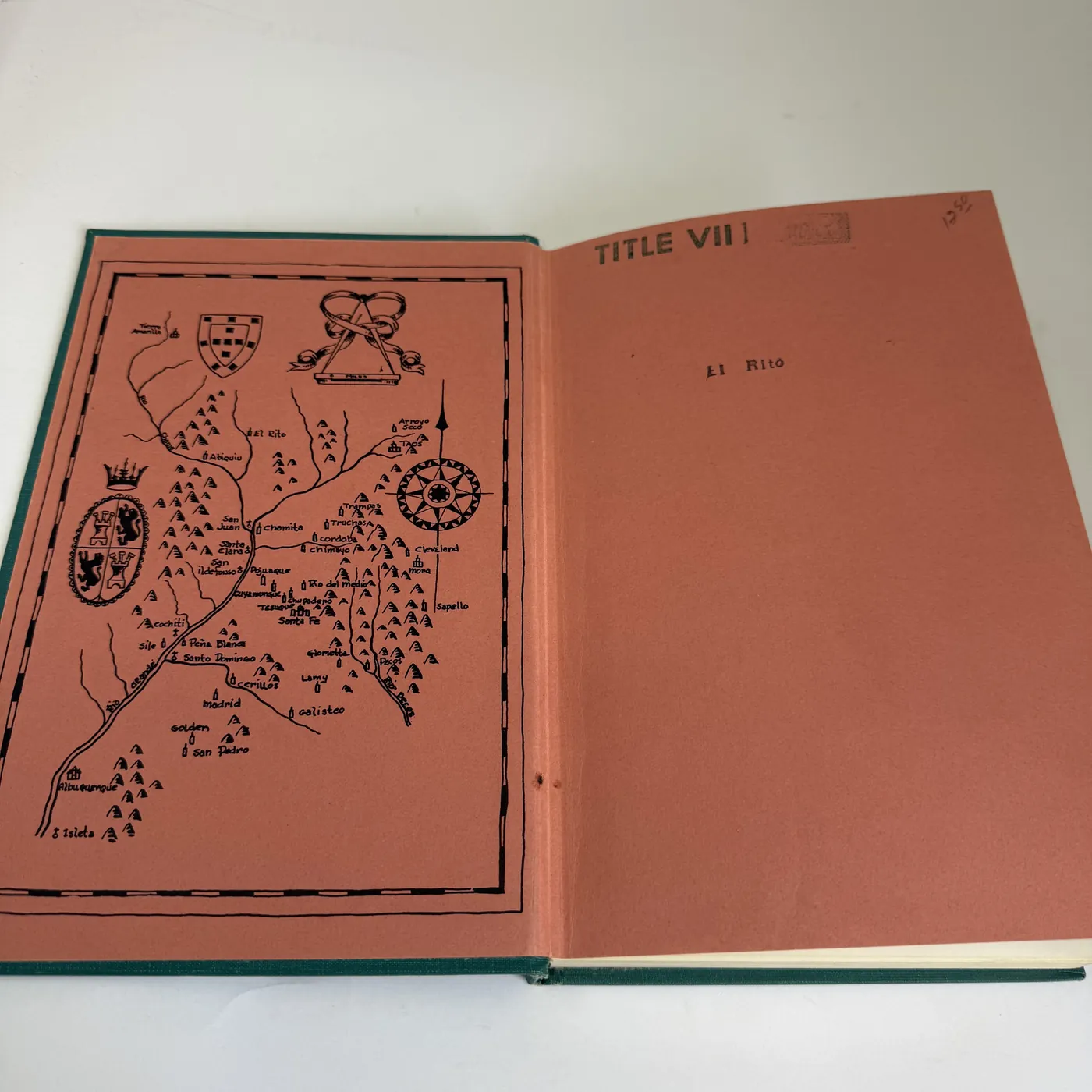
The geographic scope is the salmon-ground endpaper map. Curtin worked from Albuquerque north through Madrid and Galisteo to Santa Fe, then up the Rio Grande corridor through Tesuque and San Ildefonso, east to Chimayó and Truchas and Las Trampas, and as far north as El Rito and the Cordova / Ohkay Owingeh area. Several villages along that route — El Rito in particular — appear repeatedly in the entries as the source for specific named informants. The map is not decorative. It is a working geography of the field record.
Who Leonora Scott Muse Curtin was
Curtin was born in White Plains, New York, on October 2, 1879, to William S. Muse and Eva Scott Muse. Her mother moved the family to Santa Fe in 1889 in pursuit of a divorce; Leonora attended private schools in England, France, and Switzerland between 1891 and 1896, and in 1896 the family moved on to Pasadena, California, where her mother married the Hungarian entomologist Adalbert Fényes and became Eva Scott Fényes. Leonora met the New York lawyer Thomas Edward Curtin in 1900, married him in 1903, and gave birth the same year to her only child, Leonora Frances Curtin — later Leonora Curtin Paloheimo — in Colorado Springs.
The ethnobotanical work began in the 1920s, after Curtin had returned to Santa Fe and entered the circle of regional cultural figures who were building the institutional infrastructure of the early-twentieth-century Santa Fe Style: the Laboratory of Anthropology, the Museum of International Folk Art, the School of American Research. She did unaffiliated linguistic fieldwork for the Smithsonian Institution alongside John Peabody Harrington (then the Smithsonian's principal Native American languages researcher) and gathered the plant-knowledge interviews that would eventually become both her books.
In 1934 she put a portion of the same village-research network to commercial use. She founded the Native Market on West Palace Avenue in Santa Fe — an explicit Depression-era retail cooperative that took traditional Hispanic New Mexican textiles, tinwork, woodwork, and folk art directly from village artisans and sold them to tourists arriving on the Fred Harvey Indian Detours buses. The Market's tagline, "From Village to Market to You," declared the supply chain. It opened branches in Tucson and New York, ran for three years, and closed in 1937 — not because it failed commercially, but because the WPA Federal Art Project and parallel state programs assumed many of the same functions through public funding. Native Market is the source through which a great deal of pre–World War II Hispanic New Mexican craft entered private and institutional collections.
In 1933 Curtin and her daughter together purchased the La Cienega farm property — a Camino Real way-station southwest of Santa Fe — that would later, under her daughter and son-in-law Y. A. Paloheimo, become El Rancho de las Golondrinas, the open-air living history museum. The property is contiguous with what is now the Santa Fe Botanical Garden's Leonora Curtin Wetland Preserve. Curtin, her mother Eva Scott Fényes, and her daughter Leonora Curtin Paloheimo are recognized by the New Mexico Historic Women Marker Program as the "Three Wise Women" of the Acequia Madre House — the women's-collective historic house museum on Acequia Madre Street in Santa Fe that they jointly endowed and maintained.
The relevant biographical point for this book: by the time the Southwest Museum published Healing Herbs in 1965, Curtin was 86 years old, with fifty years of village-network fieldwork behind her, and the book represents a near-complete record of plant-medicine knowledge as it survived in the Upper Rio Grande villages in the generation before mass paved roads, television, and prescription pharmaceuticals reshaped that knowledge. She died seven years later, in 1972. Her signature pool is closed.
The P. G. Napolitano drawings
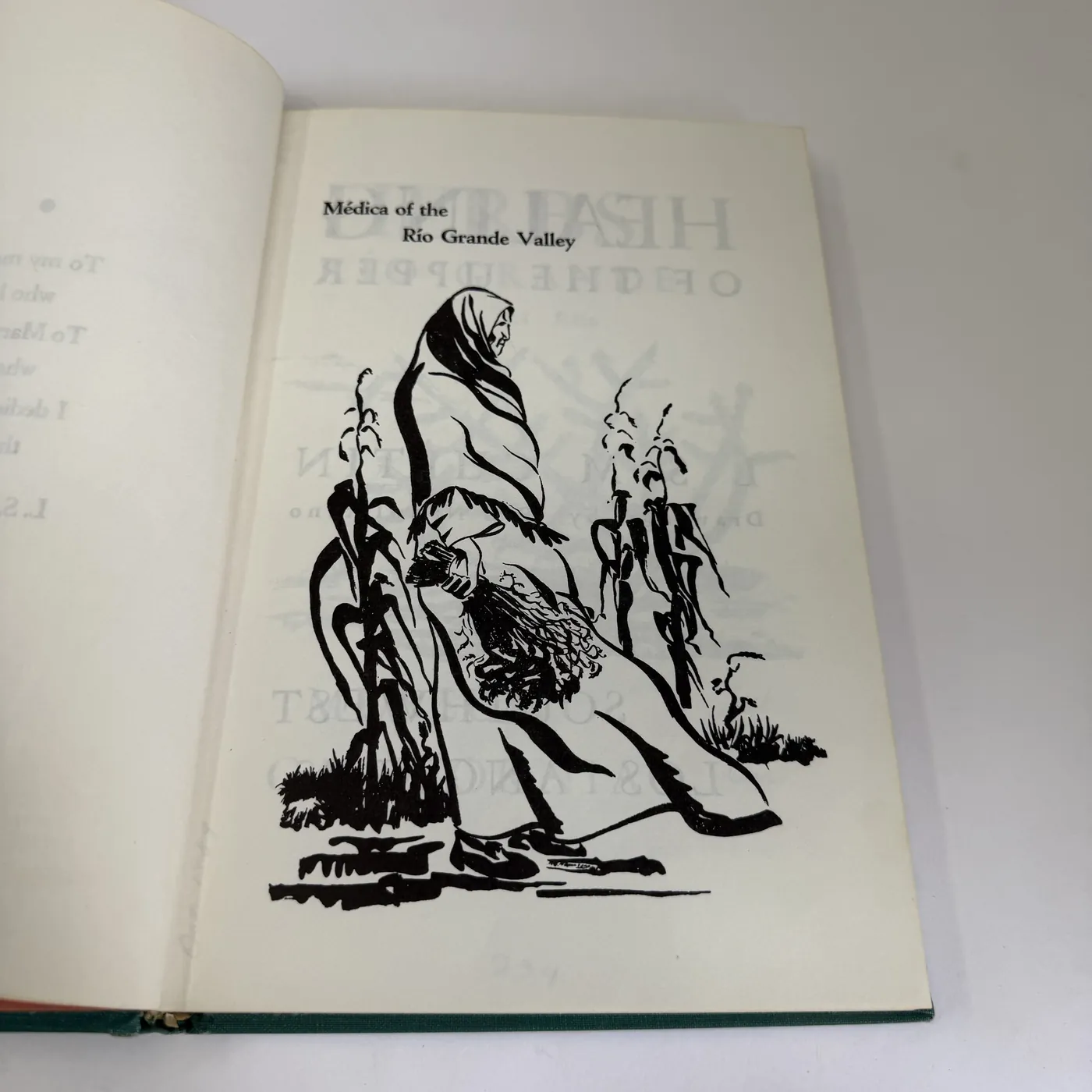
P. G. Napolitano provided the line-drawn illustrations that accompany the text: a frontispiece portrait of a generic curandera figure (titled "Médica of the Río Grande Valley"); a series of section openers showing the dominant plant of each chapter group (cactus, gourd, leafy herb, root); and small ornamental drawings interspersed through the entries. The drawing style is plain pen-and-ink with strong black-massed compositions — a deliberately archaic visual idiom that suits the ethnographic content. Napolitano is sparsely documented in the published record on Southwest Museum publications of the period; the drawings appear in both the 1965 first and 1974 Second Printing without further attribution beyond the title-page credit line "Drawings by P G Napolitano."
Bibliographic identification — first vs. second printing
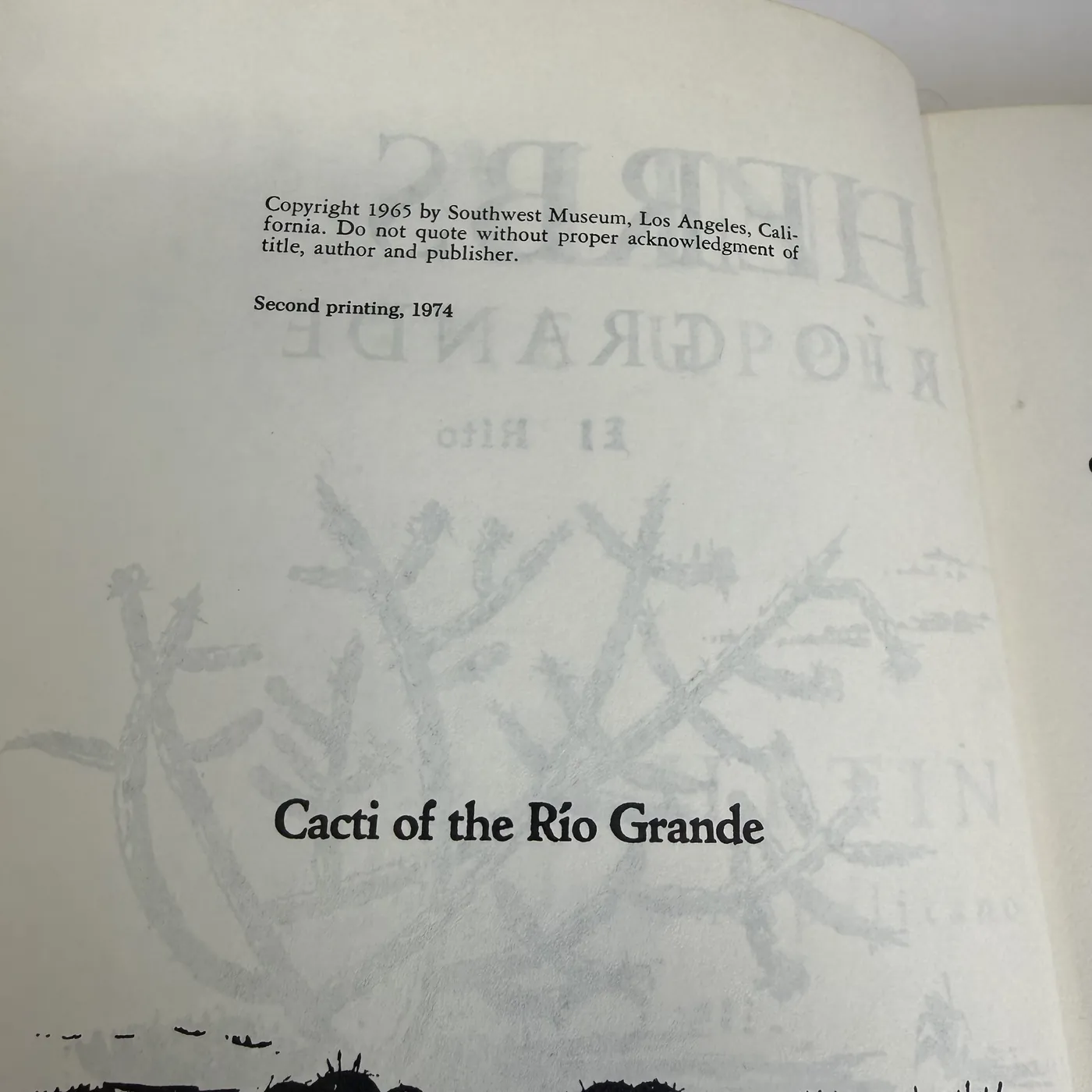
The 1965 Southwest Museum first issue and the 1974 Southwest Museum Second Printing are distinguishable only by the copyright page. The 1965 first lists "Copyright 1965 by Southwest Museum, Los Angeles, California. Do not quote without proper acknowledgment of title, author and publisher." with no additional printing line. The 1974 Second Printing adds, four lines below, the explicit line "Second printing, 1974" set in the same type as the copyright block. The text, pagination, illustrations, endpaper map, dust jacket (when present), and binding cloth are otherwise identical between the two issues. The 1997 Western Edge Press / Michael Moore annotated edition is a distinct publication with the same title but a different ISBN, different binding, and added editorial apparatus.
The contents — how Curtin organized the field record
The book opens with a brief preface and then proceeds directly into plant entries grouped by botanical family. The opening chapter group, "Cacti of the Río Grande," sets the structural pattern: each entry leads with the Spanish vernacular plant name in display capitals (e.g. PALO AMARILLO, PALO DURO, LIMONCILLO, LINASA, LIRIO), with the corresponding Latin botanical name and family appearing in smaller type below; the entry body then narrates the plant's preparation, application, named conditions treated, and where possible the specific village or informant who provided the knowledge. Where European or pre-Columbian parallels exist — the "greene and new gathered rootes of Iris" passage Curtin cites from sixteenth-century England next to the New Mexican use of lirio (iris) root for sore throat, smallpox, and burns is a representative example — she lays the parallel directly into the entry.
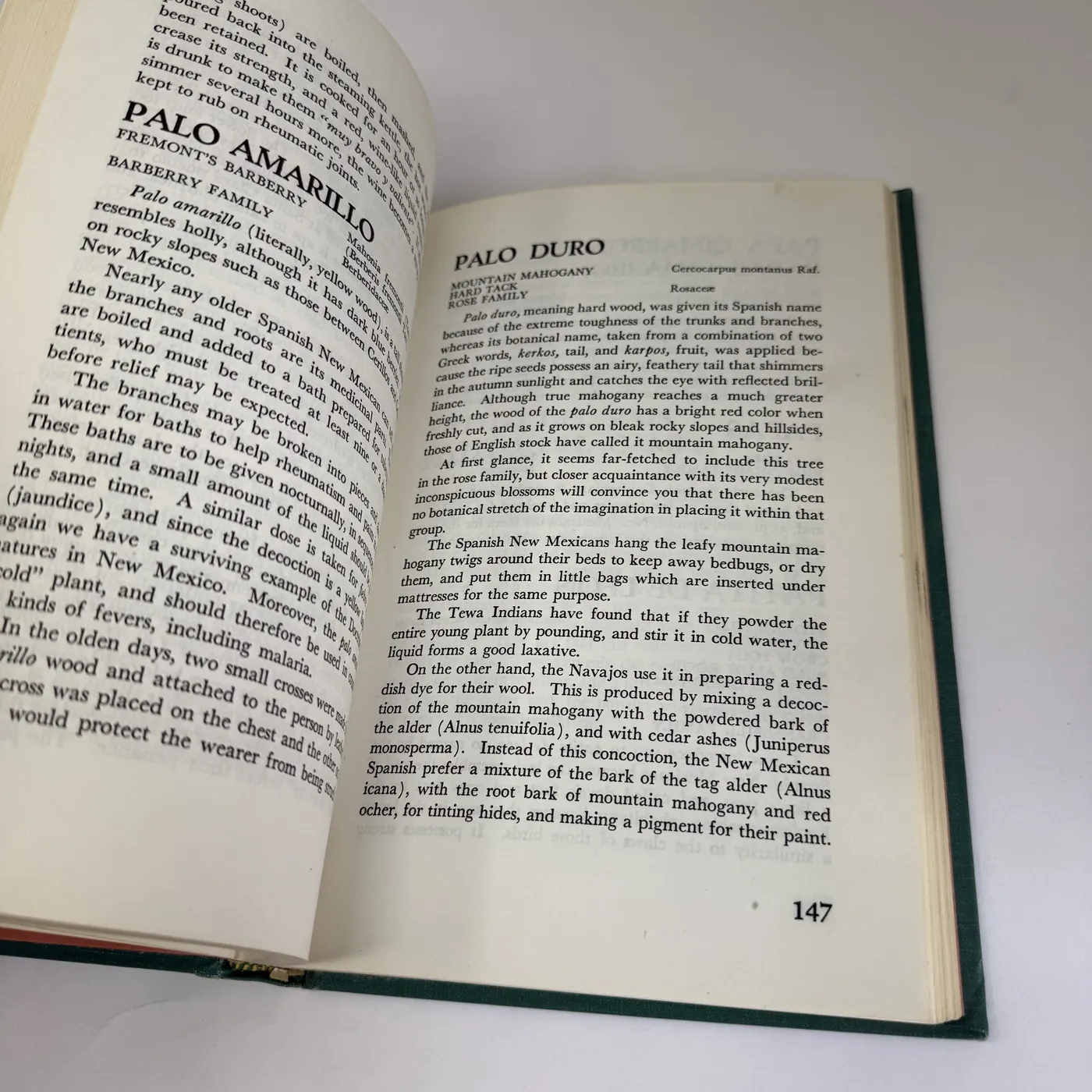
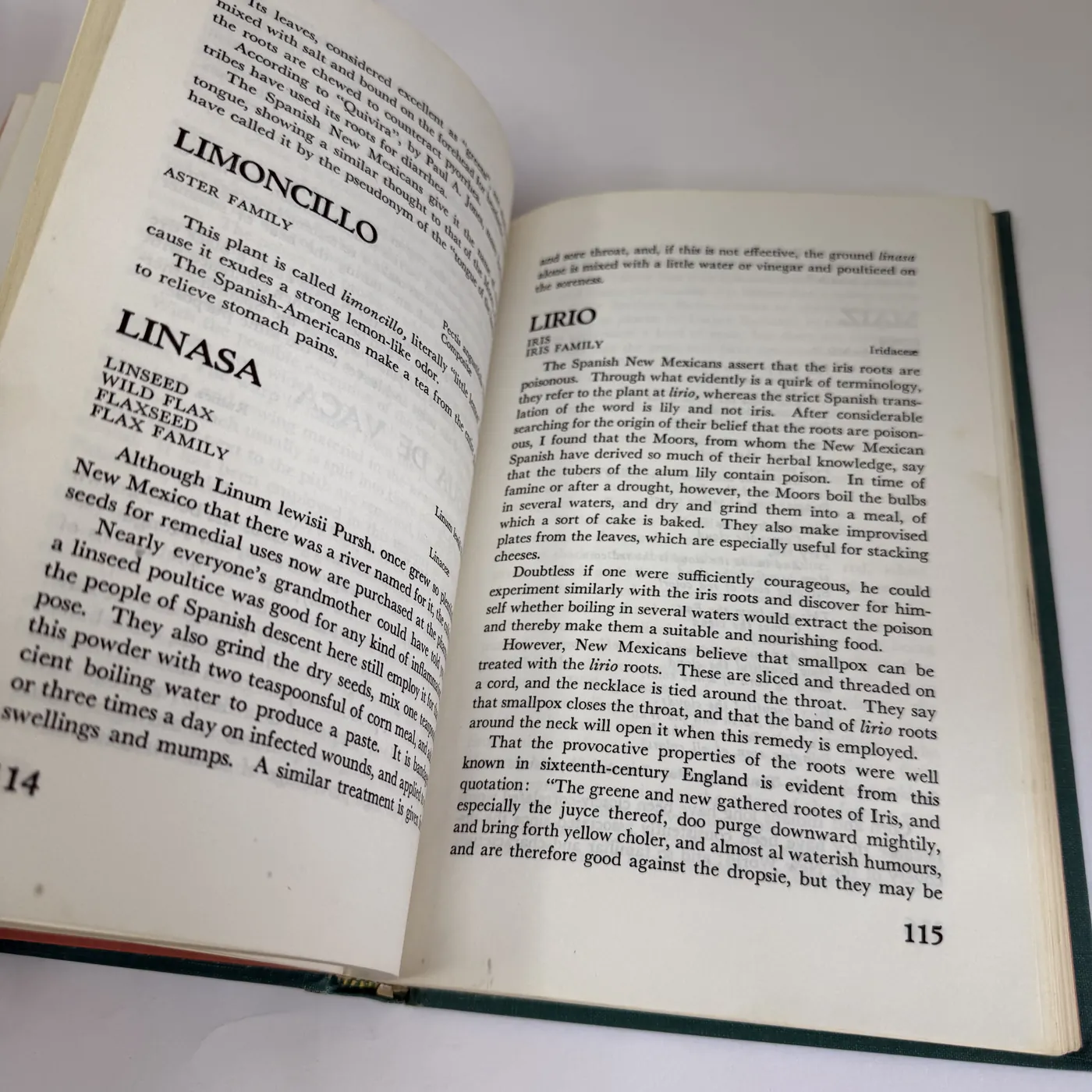
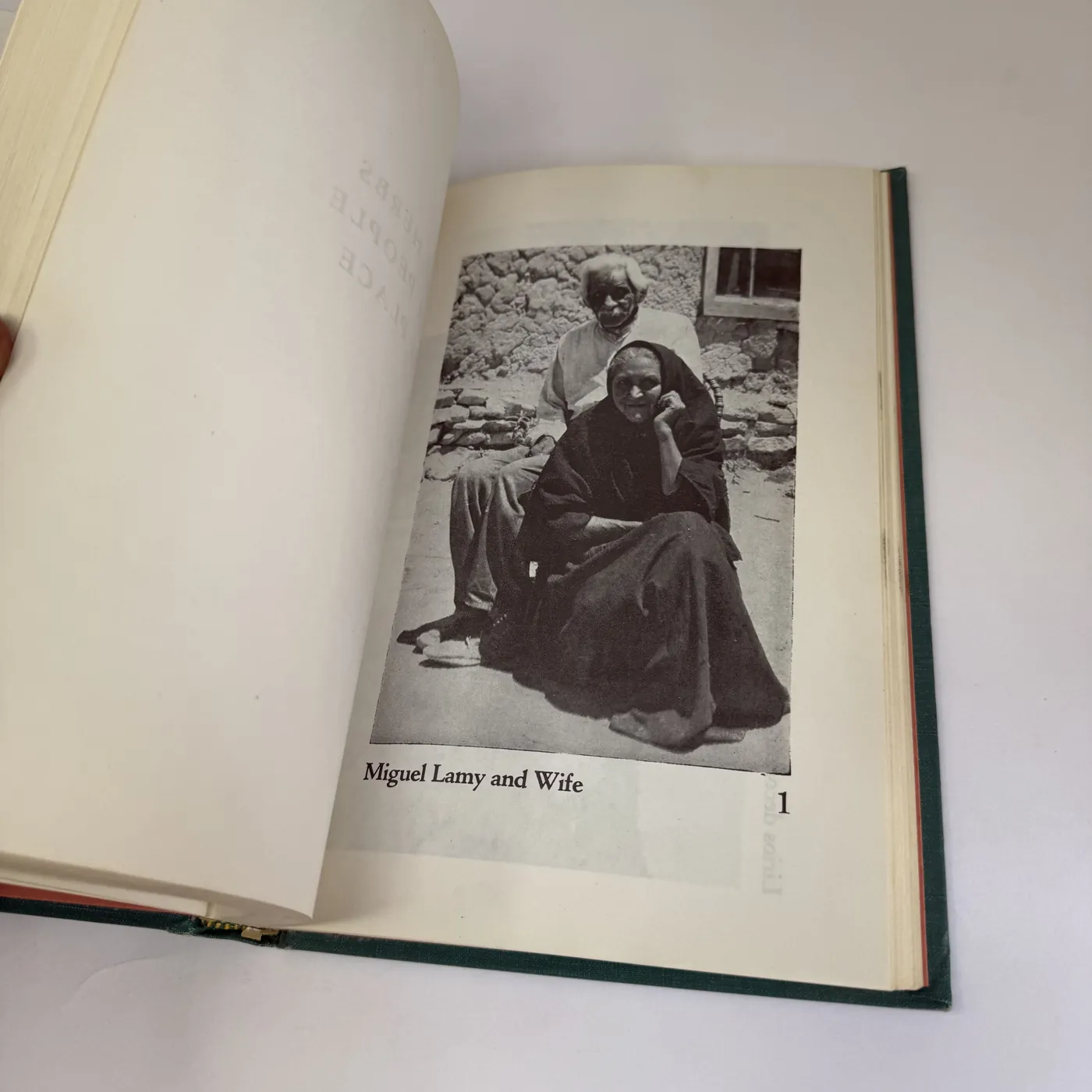
Several aspects of the field record deserve specific note. First: Curtin distinguishes carefully between Pueblo and Spanish-village preparations of the same plant where they differ, and notes when the two traditions converged on similar uses. Second: the named informants are real and locatable — Miguel Lamy of the Río Grande villages and his wife appear as the frontispiece photograph (page 1), and named curanderas are credited inside entries by village name. Third: the writing is plain, unsentimental, and unscholarly in the modern academic sense — Curtin is documenting what works, what was used, and what the practitioners told her, without rhetorical flourish or theoretical framing. This makes the text both easier to read and more reliable as primary source.
Library provenance — Title VII and the Albuquerque Public Library
The "TITLE VII" stamp on the front pastedown identifies this copy as a federal-program acquisition. "Title VII" in the public-library context of the 1970s and 1980s most commonly refers to Title VII of the Library Services and Construction Act — the bilingual-and-ethnic-collections funding program that helped public libraries serving Spanish-speaking and other linguistic-minority communities acquire materials in the relevant languages and cultural subject areas. An Albuquerque Public Library copy of a Spanish–New-Mexican ethnobotany monograph sits comfortably inside the program's stated purpose: this is exactly the kind of book the federal program existed to put on public-library shelves in cities like Albuquerque where a substantial portion of the patron base needed access to scholarship on its own communities' traditions.
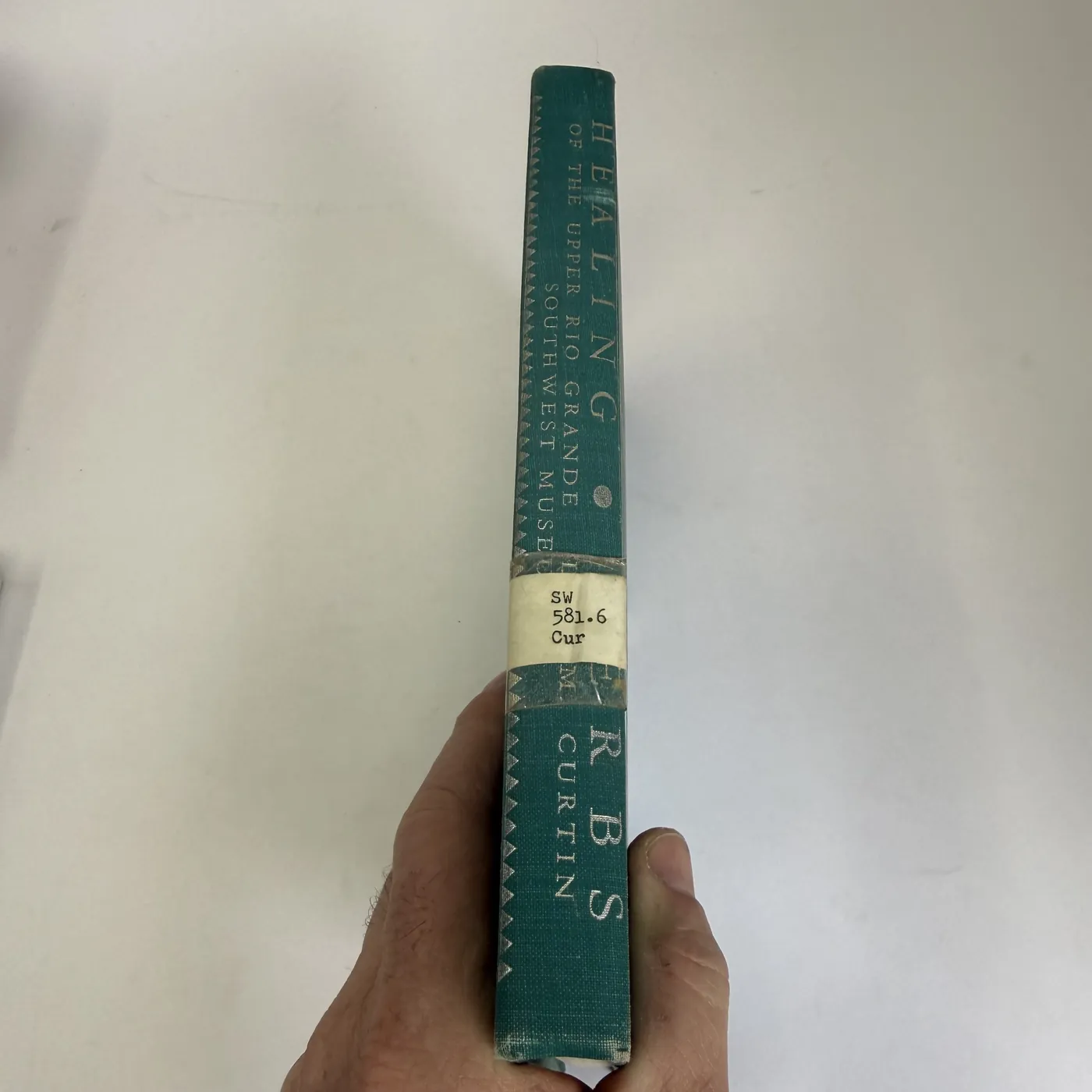
The spine carries the Albuquerque Public Library Southwest-collection call number SW 581.6 Cur on a small white label affixed near the foot of the spine. 581.6 in the Dewey Decimal system is the economic-botany / useful-plants subclass; the "SW" prefix is the local Southwest-collection designator. "Cur" is the Cutter author code. The label is partly worn but legible. The accompanying pencil marginalia ("a faint dealer price code", "Oct 1984", "234") suggest the book was processed through the Albuquerque Public Library's Southwest collection in October 1984, was eventually withdrawn from circulation, and passed through the secondary book trade before arriving in this archive.
Why this book matters for the NMLP archive
Three reasons place this title near the center of the archive's collection priorities for Spanish-New-Mexican regional reference works:
First — primary-source authority. The book is the foundational documentary record of Spanish-New-Mexican folk pharmacology. Modern works on the same subject — from Michael Moore's 1979 Medicinal Plants of the Mountain West through to the contemporary herbal-medicine clinical literature on traditional curandera practice — cite Curtin directly. Without Healing Herbs, the documentary chain back to early-twentieth-century village knowledge is broken.
Second — the Three Wise Women connection. Curtin is one of the three women (with her mother Eva Scott Fényes and her daughter Leonora Curtin Paloheimo) whose combined work built the Acequia Madre House, the Native Market, El Rancho de las Golondrinas, and a sustained generation of Santa Fe Hispanic-craft and cultural-preservation infrastructure. The book is a primary artifact of that women-led cultural preservation tradition. The New Mexico Historic Women Marker Program has formally recognized them on this basis.
Third — closed signature pool, scarce printing. Curtin died in 1972; her signature pool has been closed for over fifty years. The 1965 first issue is genuinely scarce; the 1974 Second Printing is the more commonly available Southwest Museum issue but is itself uncommon in clean library-rebinding condition. Albuquerque Public Library copies with the SW-prefix Southwest-collection label intact have additional value as provenance objects — they are physical evidence of how Curtin's book entered the public-library system of the city through the federal bilingual-collections program.
Found old books in an estate or attic? Text me a photo at 505-250-3804 and I'll tell you what I see.
How this copy came in
Donor scenario anonymized per archive policy. Documented as part of the May 2026 NMLP intake at the Edith Boulevard warehouse. Condition: the green cloth binding is sound with the typical light wear of a long-shelved library copy; the silver spine stamping is bright but the white SW 581.6 Cur label is partly worn; the salmon-ground endpaper maps are intact on both inside covers with no tears or chips; the textblock is clean with only the noted pencil marginalia on the title-page spread and the single "El Rito" pencil note on the front pastedown; no underlining, no highlighter, no torn or missing pages. A solid working copy of the Second Printing with the Albuquerque Public Library Title VII provenance still legible. Photographed under warehouse lighting alongside a standard inch-ruler for scale.
Where this copy is going
Three plausible routes after this archive documentation. First and most likely: a working herbalist or curandera-practice researcher who specifically wants the Southwest Museum issue with the Napolitano drawings and the original endpaper map intact — not the 1997 Moore-annotated reissue. The Southwest Museum hardcover is the cited-text version in the academic ethnobotany literature; serious researchers want the original. Second: a New Mexico regional-history collector building a Three Wise Women / Curtin family shelf alongside By the Prophet of the Earth, Eva Scott Fényes's botanical watercolors, and the Native Market catalog records. Third: a research library replacing a circulation-worn or missing copy — UNM, NMSU, the Santa Fe Botanical Garden's research library, and several university libraries in the Southwest list Curtin's monograph as a permanent reference holding. The archive entry will remain regardless of which route the physical book takes.
External references & authoritative sources
- Leonora Scott Curtin — Wikipedia: en.wikipedia.org/wiki/Leonora_Scott_Curtin — biographical reference for the author (1879–1972).
- New Mexico Historic Women Marker Program — Three Wise Women of the Acequia Madre House: nmhistoricwomen.org — Eva Scott Fényes, Leonora Scott Muse Curtin, and Leonora Frances Curtin Paloheimo — the state-recognized historic-women's biographical reference for the Curtin matriarchy.
- El Rancho de las Golondrinas — "The Three Wise Women of Santa Fe": golondrinas.org — History Herald — the living-history museum's institutional history of the Curtin family.
- Acequia Madre House: en.wikipedia.org/wiki/Acequia_Madre_House — the Santa Fe historic women's-collective house museum.
- Open Library — 1965 edition record: openlibrary.org — Healing Herbs of the Upper Rio Grande — institutional bibliographic record for the 1965 Southwest Museum first issue.
- Southwestern School of Botanical Medicine — full-text reference: swsbm.org — Healing Herbs of the Upper Rio Grande — Michael Moore's Bisbee, Arizona school of botanical medicine; Moore is the editor of the 1997 Western Edge Press annotated reissue.
- Santa Fe Botanical Garden — Leonora Curtin Wetland Preserve: santafebotanicalgarden.org — the preserve at La Cienega contiguous with El Rancho de las Golondrinas, named for the author.
- WorldCat / OCLC institutional holdings: search.worldcat.org — Healing Herbs of the Upper Rio Grande — library holdings worldwide for the 1965 first and 1974 Second Printing.
- Library Services and Construction Act, Title VII: the federal program (signed into law as part of the LSCA Title VII bilingual-collections expansion) that funded the Albuquerque Public Library's Spanish-language and ethnobotanical collection acquisitions of the era. The "TITLE VII" stamp on this copy's front pastedown is the federal-program acquisition marker.
How to cite this archive entry
Eldred, Josh. "Healing Herbs of the Upper Rio Grande — L. S. M. Curtin, Southwest Museum, Los Angeles, 1965; Second Printing 1974; Albuquerque Public Library Title VII Discard." NMLP Donation Archive, May 10, 2026. https://newmexicoliteracyproject.org/archive/healing-herbs-curtin-1965
Related on this site
- Back to the archive index
- Cocinas de New Mexico collection — the New Mexico Public Service Company / Bernalillo County Extension Service Spanish-New-Mexican cookbook tradition; the culinary parallel to Curtin's medicinal record.
- Embroideries by Rebecca James (MOIFA 1963) — another Curtin-circle Santa Fe institution publication of the same period (Museum of International Folk Art exhibition catalog).
- Letters from the New World (Vargas / Kessell UNM Press 1989) — comparable institutional-press regional-history monograph in the archive.
- Closed Signature Pools Reference — the structured reference for deceased-author signature markets; Curtin (d. 1972) sits among the early-twentieth-century New Mexico women-scholar pool.
- Collecting New Mexico Cookbooks — the regional-publication authority pillar; the Spanish-New-Mexican village-knowledge documentary tradition Curtin sits inside.
- Collecting New Mexico Ethnobotany — the parent authority pillar for the L. S. M. Curtin canon and the Three Wise Women of Santa Fe lineage (Fényes — Curtin — Paloheimo). This 1965/1974 Southwest Museum reissue is the canonical mid-century edition the pillar takes as its anchor text.