Archive entry · Museum exhibition catalog
Embroideries by Rebecca James — Museum of International Folk Art, Santa Fe (1963)
A 1963 Santa Fe museum exhibition catalog documenting Rebecca Salsbury James's revival of the colonial New Mexico colcha stitch. Foreword by E. Boyd, the foundational scholar of Spanish-colonial New Mexico folk art. The catalog spans the May 19–September 8, 1963 show at the Museum of International Folk Art and includes Rebecca James's own essay on the colcha knot stitch.
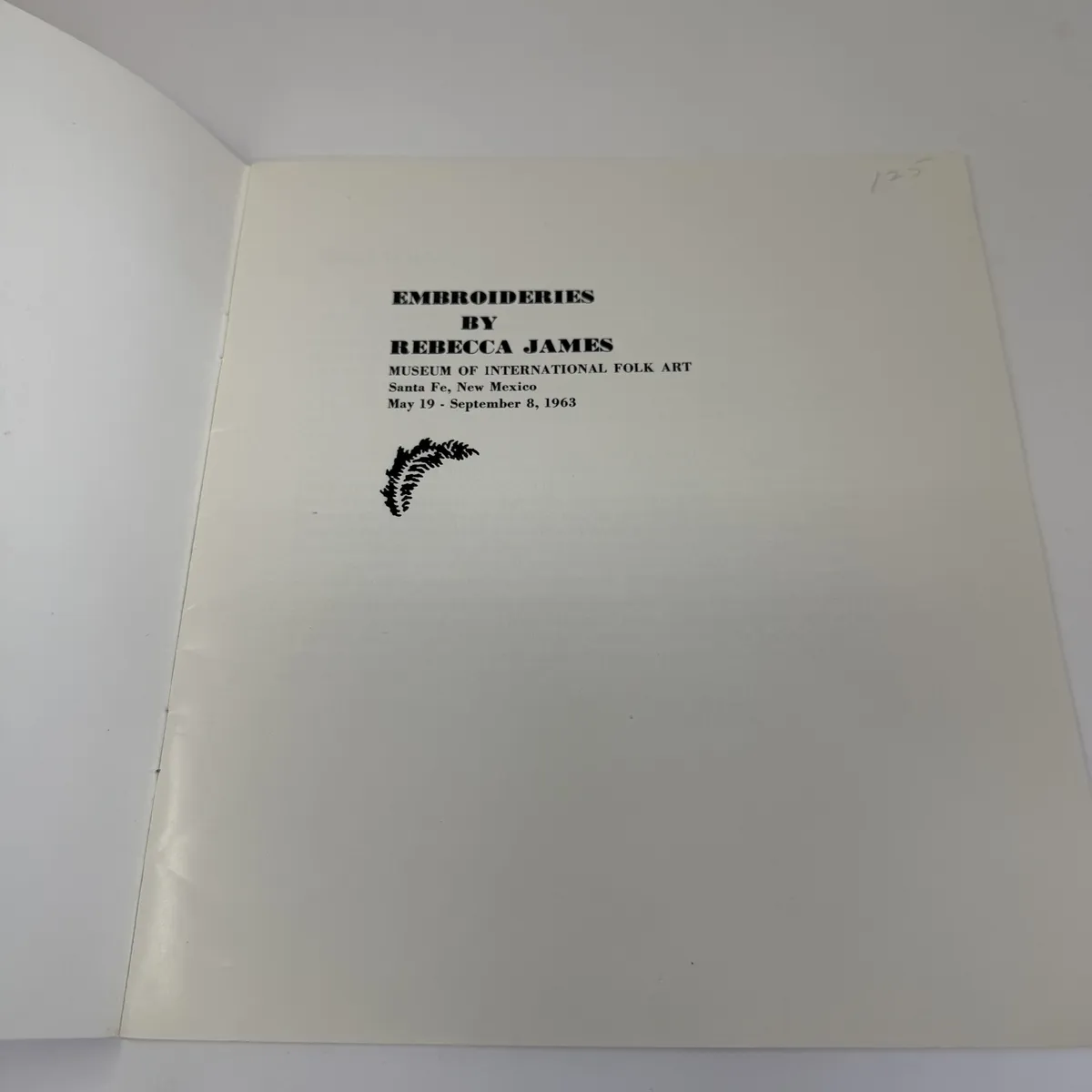
Catalog
What this catalog is
Rebecca Salsbury James (1891–1968) was an American painter and folk-textile artist who lived in Taos, New Mexico, from the late 1930s until her death. She was the second wife of the photographer Paul Strand from 1922 until their 1933 divorce, and her early career as a painter intersected with the Stieglitz circle in New York. After moving to Taos she turned increasingly to textile work and to the revival of regional craft traditions, and the colcha stitch — the surface-couching embroidery technique used in colonial New Mexico to ornament Spanish-style hangings — became the medium of her mature work.
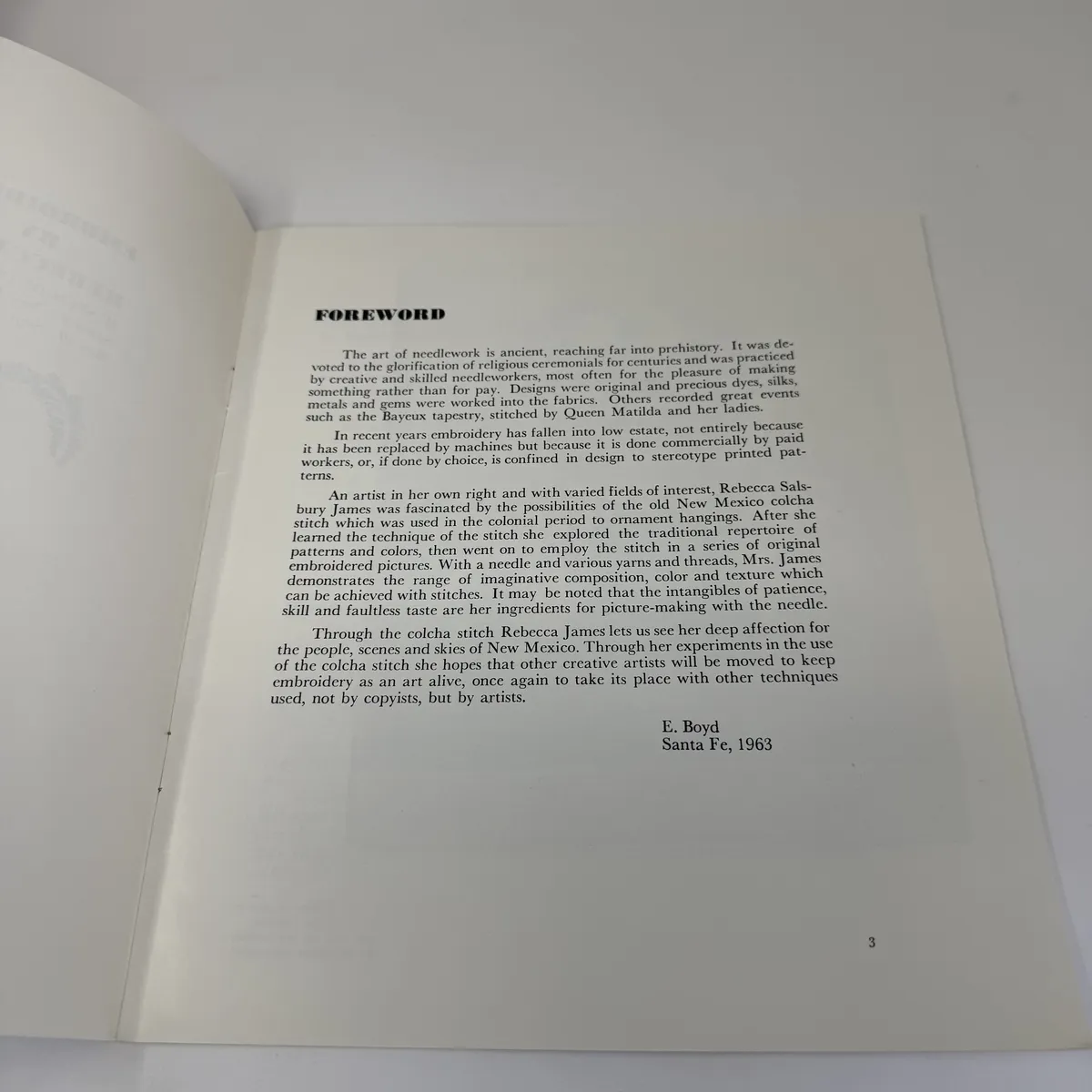
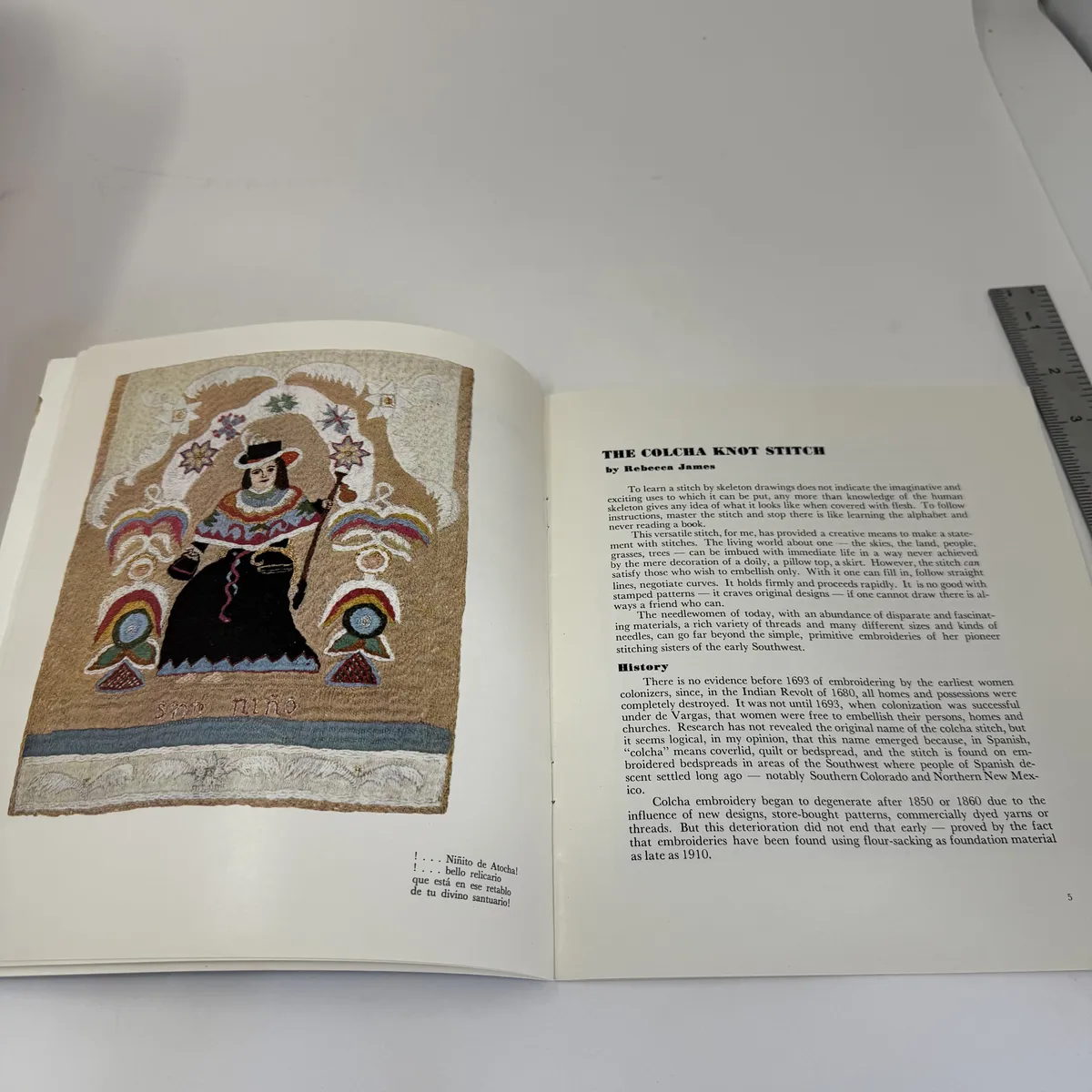
The 1963 Museum of International Folk Art exhibition was the museum’s first solo show of her textile work. The catalog includes a foreword by E. Boyd, the museum’s curator of Spanish Colonial Art and one of the foundational scholars of New Mexico folk art (her Popular Arts of Spanish New Mexico would be published posthumously in 1974); a catalog essay on the colcha knot stitch by Rebecca James herself, with technical detail on materials and method; reproductions of her embroidered pictures; and a checklist of works in the show.
The catalog is small (saddle-stitched, modest production) but the contents are scholarly. It’s a primary document for two distinct fields: the historiography of the colcha-stitch revival in 20th-century New Mexico, and the biography of Rebecca Salsbury James. Both fields are continuing today; modern colcha embroiderers in New Mexico cite this catalog as the bridge between the colonial-period source material and the contemporary practice.
Why this copy matters
Museum exhibition catalogs are notoriously elusive in the secondary market — the print runs are small (a few hundred to a few thousand for a regional show), they don’t go through wholesale book channels, and most copies were given away to opening-night visitors and discarded a generation later. A clean 1963 MOIFA catalog, sixty-three years on, is the kind of object that turns up only through estate-library cleanouts in Santa Fe and Albuquerque.
The E. Boyd foreword is itself an authorial datapoint: Boyd’s signature pool is closed (she died in 1974), and any document carrying her authoritative voice on Spanish-colonial folk art is incrementally important. The catalog is also one of the few sources that documents Rebecca James writing about her own technique in her own voice; most of the secondary literature on her work is by later art historians rather than the artist herself.
Multi-part bibliographic record
How it came in
Donated in May 2026 through NMLP. Donor scenario anonymized per archive policy. The catalog is in clean, lightly used condition with no markings; the corner of one early page carries a faint pencil notation "125" that is consistent with a long-ago private price.
Where it's going
Likely route: a Spanish-colonial textile scholar, a contemporary colcha-stitch practitioner, a regional-folk-art collector, or a museum library — the Harwood Museum in Taos, the Couse-Sharp Historic Site, or the Museum of International Folk Art's own library if their catalog file is missing this issue. The scholarly value of the document substantially exceeds its retail price.
External references & authoritative sources
- Museum of International Folk Art: internationalfolkart.org — the issuing institution; the catalog should be in their library file.
- Rebecca Salsbury James — biographical: Wikipedia; the Harwood Museum of Art in Taos holds important examples of her work.
- Harwood Museum of Art, Taos: harwoodmuseum.org — permanent collection includes Rebecca Salsbury James textile pieces.
- E. Boyd — biographical: author of Popular Arts of Spanish New Mexico (Museum of New Mexico Press, 1974, posthumous), the foundational scholarly volume on the field. Museum of New Mexico archives.
- NM colcha stitch — modern scholarship: Susan H. Ellis, New Mexico Colcha Embroidery; Spanish Colonial Arts Society resources at spanishcolonial.org.
- Stieglitz circle context: James was part of the early-20th-century Stieglitz circle through her marriage to photographer Paul Strand; Smithsonian Archives of American Art holds related correspondence.
Citation (Chicago): Eldred, Josh. "Embroideries by Rebecca James — Museum of International Folk Art (Santa Fe, 1963)." NMLP Donation Archive. Albuquerque: New Mexico Literacy Project, May 2, 2026. https://newmexicoliteracyproject.org/archive/embroideries-rebecca-james-1963.
Museum exhibition catalogs are nearly invisible in the chain-thrift donation stream.
Saddle-stitched, no ISBN, often misclassified as "magazines" by chain-thrift sorters. They go in the recycle bale unless someone with the right reference knowledge is looking. Free in-home pickup catches them.
Related on this site
- Back to the archive index
- New Mexico Colcha Embroidery (Susan H. Ellis) — the technical handbook on the same stitch tradition.
- Master Weavers (Winter, 2011) — another regional textile-arts archive entry.
- Cañones (Kutsche & Van Ness, 1981) — northern NM Hispanic ethnography.