Archive entry · Signed by author · Carl Hertzog design · Closed signature pool
Pershing's Mission in Mexico — Haldeen Braddy (signed), Carl Hertzog–designed Texas Western Press, 1966 first / 1973 reprint
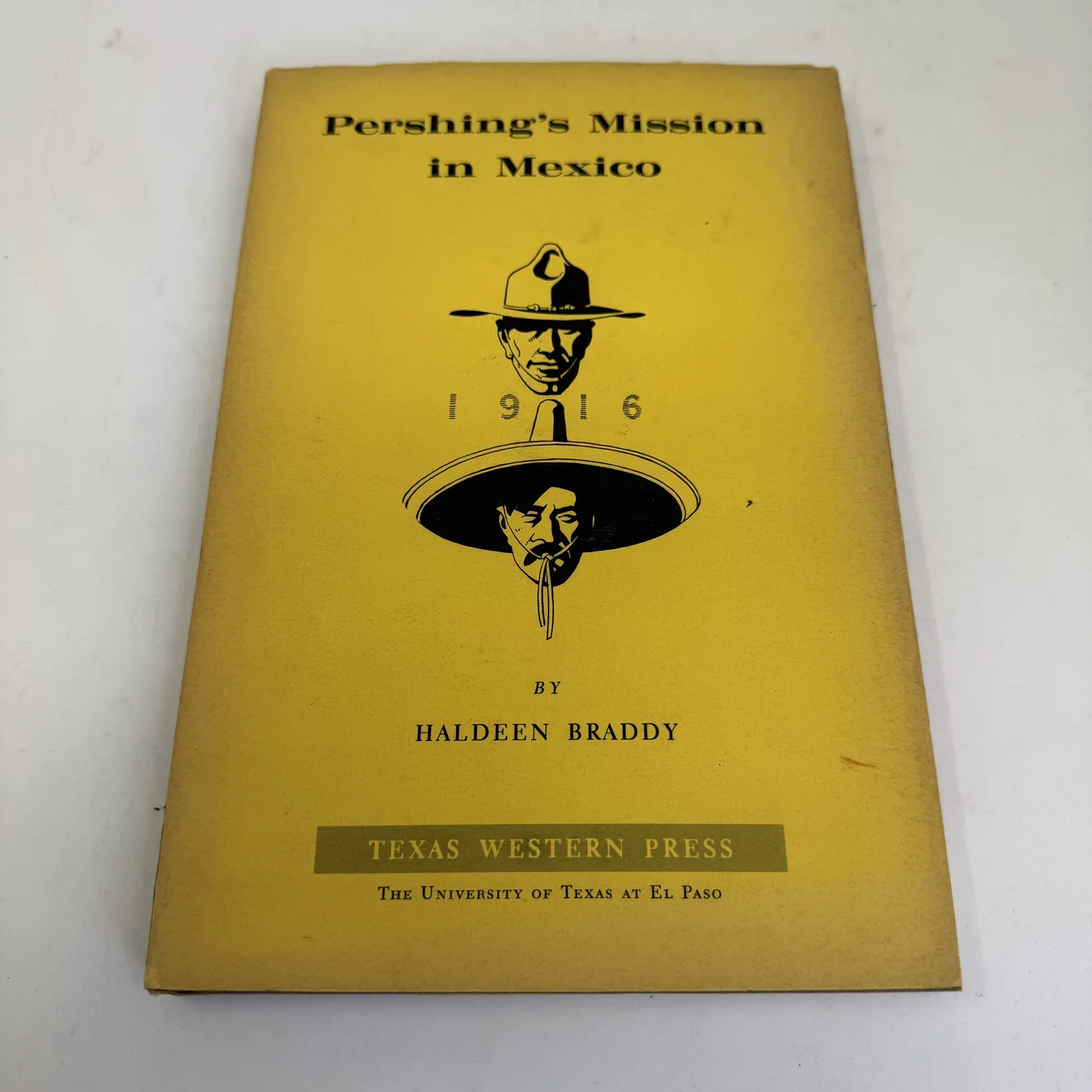
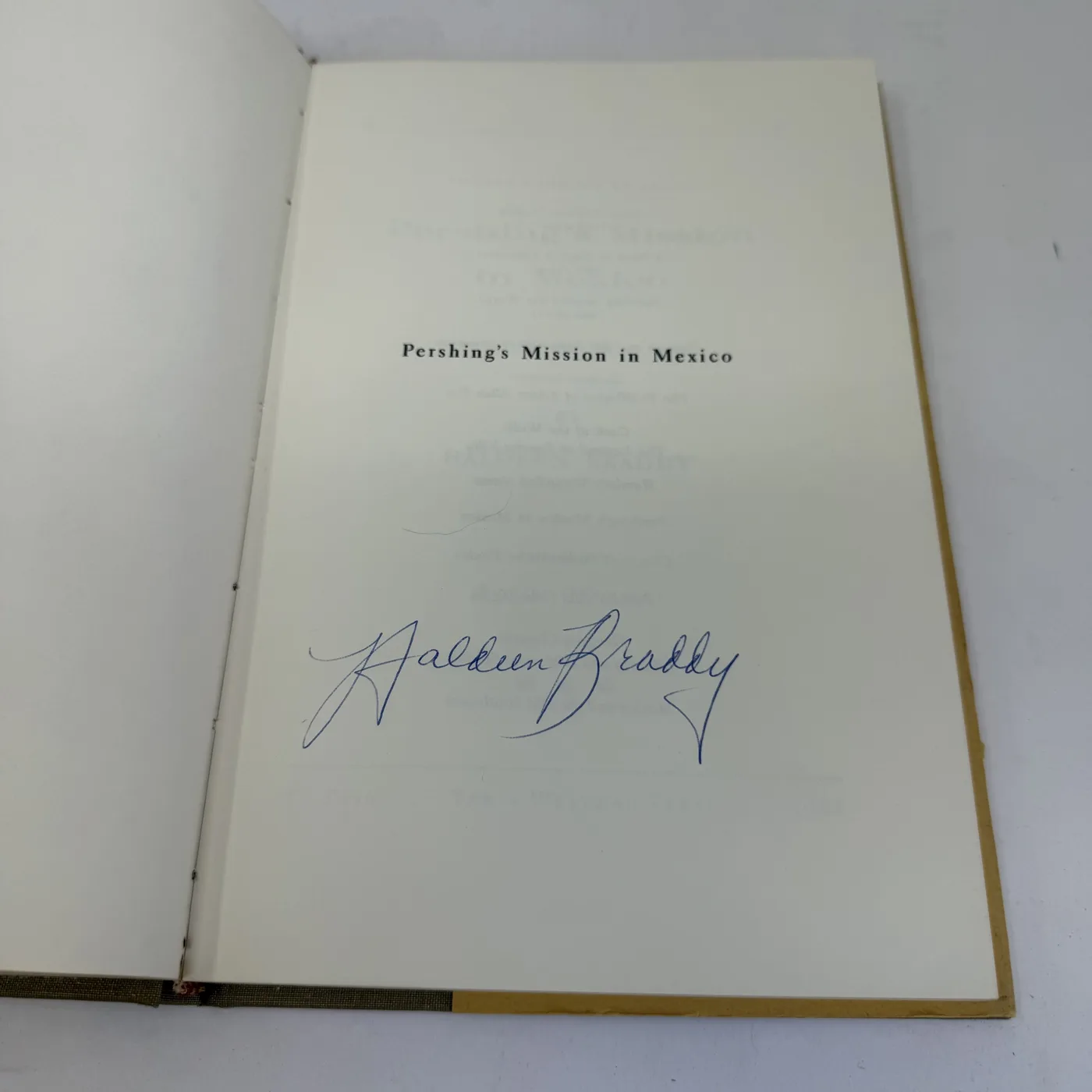
A signed copy of Haldeen Braddy's Pershing's Mission in Mexico, the Texas Western Press monograph issued for the fiftieth anniversary of the 1916 Punitive Expedition into Mexico. Typography and dust jacket by Carl Hertzog — the most consequential book designer in twentieth-century Southwestern publishing — whose design for this title won Rounce and Coffin Club recognition in February 1967 and was exhibited at the Henry E. Huntington Library. Signed by Braddy on the half-title in blue ink. This is the 1973 reprint edition of the 1966 first.
Catalog
What this copy is
Three layers of significance stack in a single object:
Layer one — the text. Haldeen Braddy's Pershing's Mission in Mexico is a compact (under 100 pages) monograph published by Texas Western Press to mark the fiftieth anniversary of the 1916 Punitive Expedition. Braddy, a UTEP English professor with a NYU PhD (1934) and a long secondary specialty in Mexican Revolution / Pancho Villa scholarship, narrates the expedition compactly with a battle-by-battle chronology of cavalry engagements: April 1 Agua Caliente (Brown of the 10th Cavalry, 170 Villistas), April 7 Agua Zarca (Kendrick of the 7th Cavalry, 30 Villistas), April 10 La Joya (Howze of the 11th Cavalry, 40 Villistas), April 12 Parral (Tompkins of the 13th Cavalry retreats before 200 Carrancistas), April 20 Green Road Verde River, April 22 Tomochic (Dodd of the 7th Cavalry, 140 Villistas), May 5 Ojos Azules (Howze of the 11th Cavalry defeats 160 Villistas, no US losses), May 14 San Miguel de Rubio (Patton of the 6th Cavalry), May 25 Alamillo Canyon. The book is exactly the kind of mid-length local-press historical monograph that academic Southwest history relies on but the trade market routinely overlooks.
Layer two — the signature. Braddy died in 1980. His signature pool is closed. Signed copies of his books cannot enter the market from any new source after 1980 — only resurfacings from private libraries. The closed-pool dynamic applies even to small-press university monographs like this one: each surviving signed copy is a fixed-supply object in a long-tail collector market.
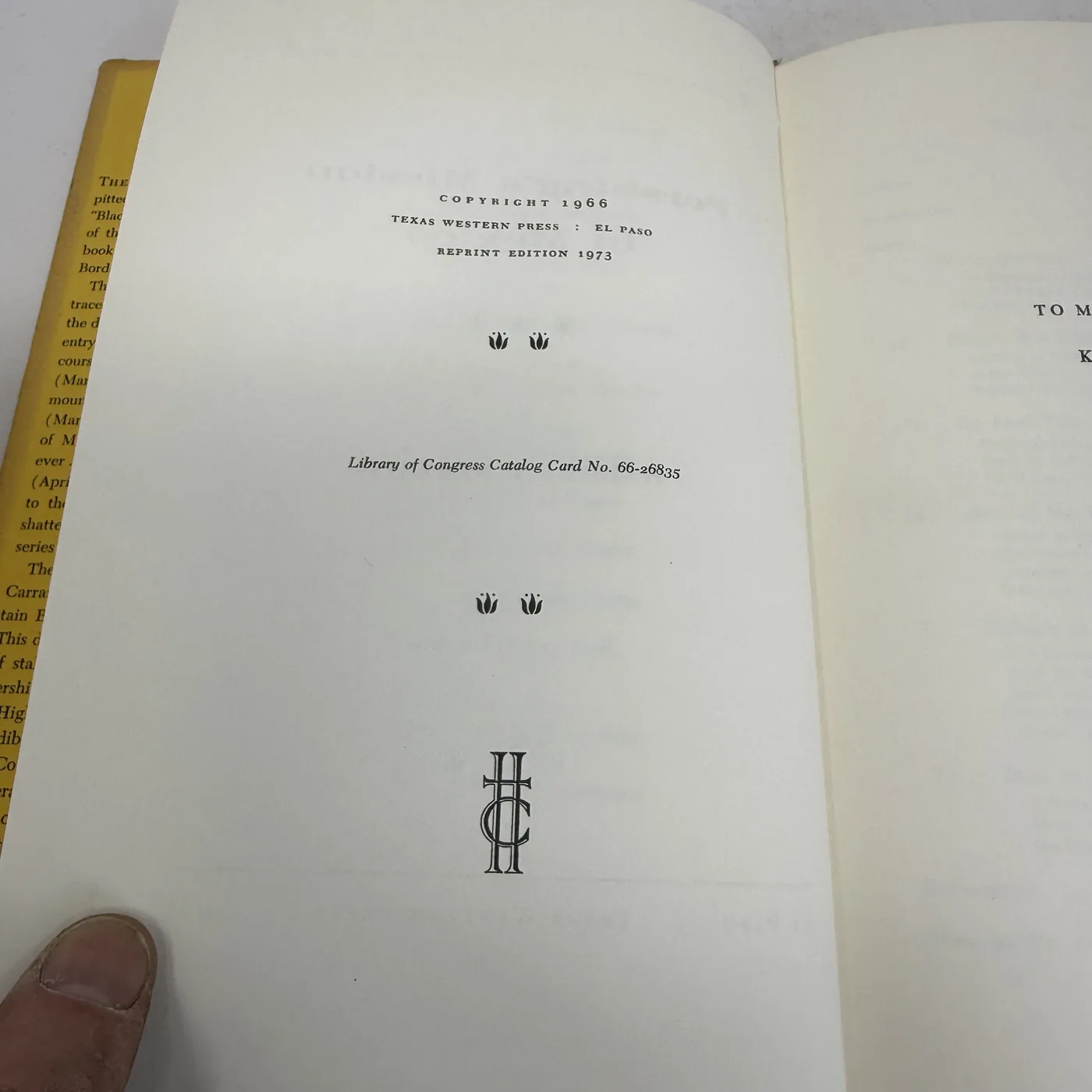
Layer three — the Hertzog design. Carl Hertzog (1902–1984) is the central figure of twentieth-century Southwestern book design. His Hertzog Press, then his work as the founding director of Texas Western Press at UTEP, produced what collectors generally consider the highest-quality fine-press historical books published anywhere in the American Southwest between roughly 1940 and 1980. The Hertzog design for this title — the yellow dust jacket with the silhouetted Pershing/Villa dual portraits, the typography, the half-title and title-page setting — was specifically recognized by the Rounce and Coffin Club (the Southern California fine-printing society) in February 1967 and displayed at the Twenty-Sixth Western Books Exhibition at the Henry E. Huntington Library, San Marino. The HC monogram visible on the copyright page is Hertzog's mark. Hertzog-designed books are collected as Hertzog objects independently of their text content; a signed-author copy of a Hertzog-designed book stacks the two collector interests.
The Hertzog design points
For collectors who track Hertzog work, the points of interest in this title:
The dust jacket is the canonical Hertzog "iconographic silhouette" treatment — reducing the subject matter to two facing portraits in flat black on a chromatic ground (here, the warm chrome yellow). This approach turns the political and military complexity of the Pershing pursuit into a single graphic gesture. It's the same design vocabulary Hertzog used across his career on Texas Western Press titles where a single visual idea had to carry the dust-jacket reading from twenty feet away on a bookstore display.
The typography uses Hertzog's preferred serif text setting with running heads in italic small caps. Chapter openings use the tulip-leaf ornament (the same flower-tip device visible on the copyright page above and below the publication line) that became a Hertzog signature across multiple Texas Western titles.
The HC monogram on the copyright page (an intertwined H and C in a small cartouche, below the catalog card line) is Hertzog's identifying device. Hertzog-monogrammed books are a documented subcategory in the fine-printing collector trade and are catalogued individually by specialist dealers including ABAA members focused on Texas and Southwestern printing.
Who Haldeen Braddy was
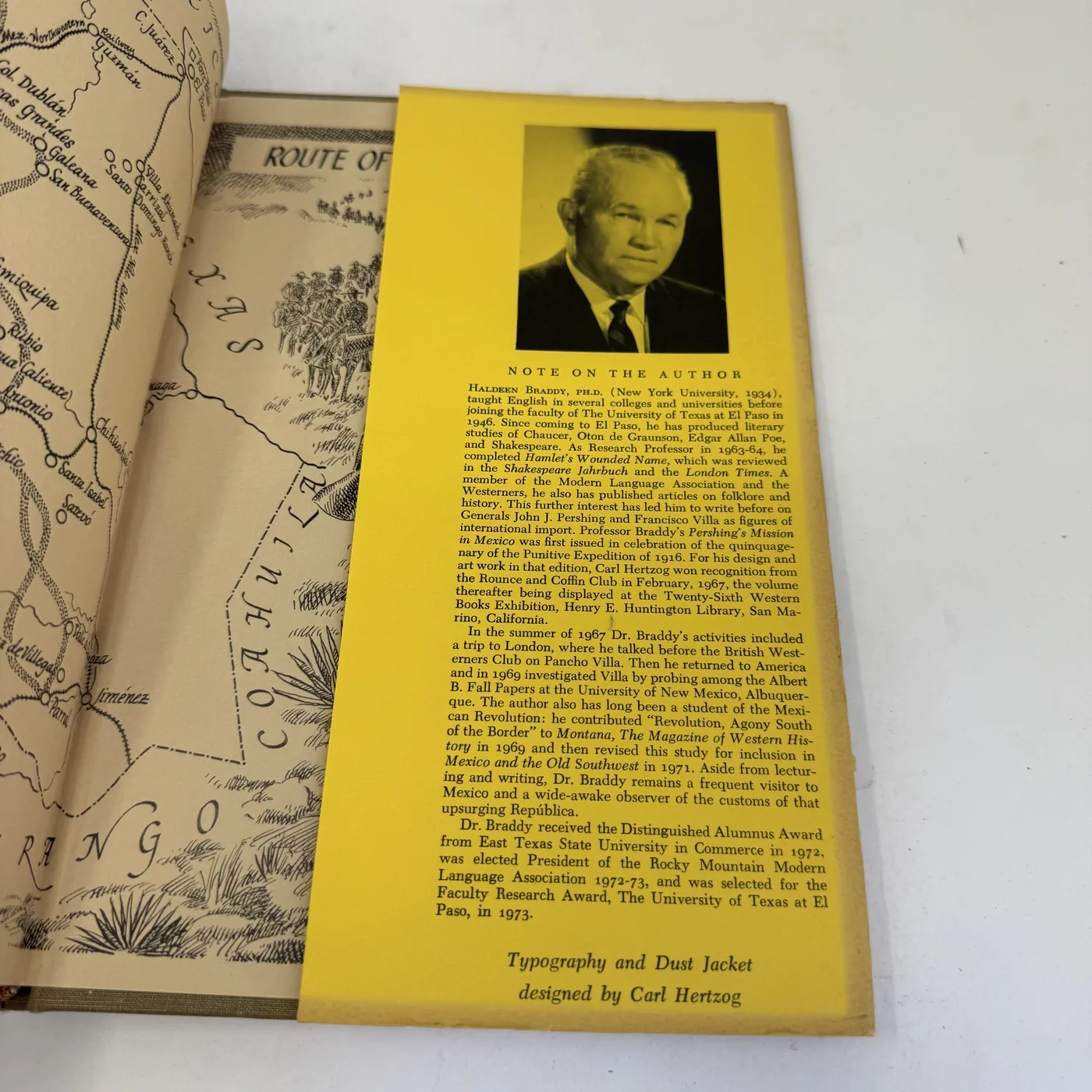
The dust-jacket flap on this copy (an unusually thorough author note, expanded for the 1973 reprint) sets out the biography in detail. Braddy received his PhD at New York University in 1934, taught at several institutions before joining the UTEP English faculty in 1946, and produced literary studies of Chaucer, Oton de Graunson, Edgar Allan Poe, and Shakespeare. As Research Professor in 1963–64 he completed Hamlet's Wounded Name, reviewed in the Shakespeare Jahrbuch and the London Times.
Beyond the English-literature work, Braddy developed a long secondary interest in the history of the Mexican Revolution — specifically the Pershing/Villa pursuit. He returned to it repeatedly: Pershing's Mission in Mexico (1966) was followed by talks to the British Westerners Club in London in 1967 on Pancho Villa, archival research in the Albert B. Fall Papers at the University of New Mexico (Albuquerque) in 1969, contributions to Montana, the Magazine of Western History in 1969, and inclusion in Mexico and the Old Southwest in 1971. He served as President of the Rocky Mountain Modern Language Association 1972–73 and received the UTEP Faculty Research Award in 1973 (the same year as this reprint edition).
Braddy's UNM/Albert Fall Papers research is the local-NM hook for this book. The Fall Papers at the UNM Center for Southwest Research document Albert Bacon Fall's role as the Senate's leading interventionist voice during the Mexican Revolution period (and later as Warren G. Harding's Interior Secretary at the center of the Teapot Dome scandal). Fall's archive is one of the primary scholarly resources on the US/Mexico borderlands politics of the 1916–1923 period and is held in Albuquerque.
Title page and bibliographic identification
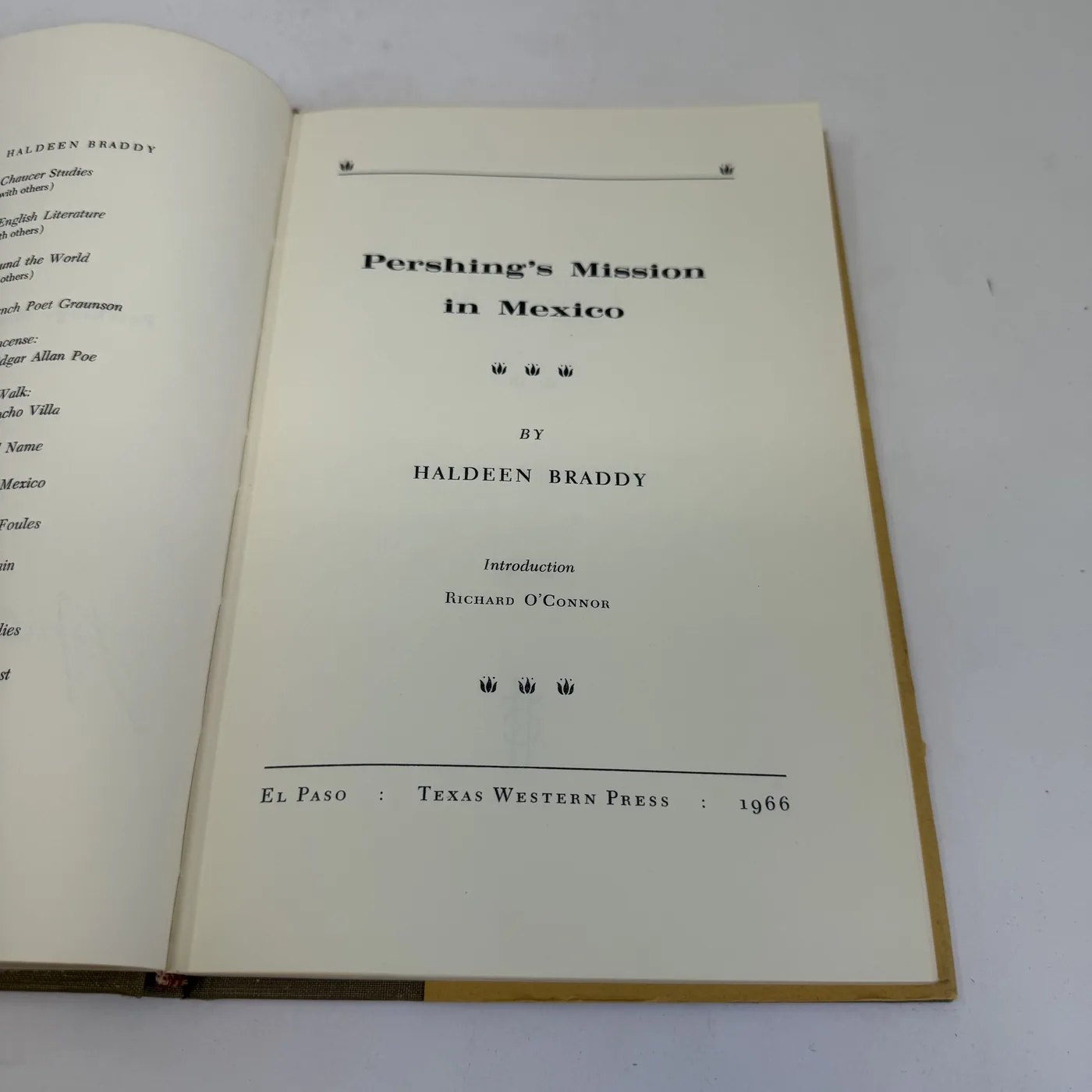
The points of issue to distinguish the 1966 first edition from the 1973 reprint: the copyright page on this copy carries the explicit line "COPYRIGHT 1966 / TEXAS WESTERN PRESS : EL PASO / REPRINT EDITION 1973" stacked above the LCCN. The 1966 first edition copyright page does not include the "REPRINT EDITION 1973" line. Both editions retain the same Hertzog dust jacket design and the same internal typography. The 1966 first is the collector's target; the 1973 reprint is a meaningful object in its own right (signed copies of either edition by Braddy are uncommon) and carries the more expansive author-biography flap text written after Braddy received the 1972 East Texas State Distinguished Alumnus Award and the 1973 UTEP Faculty Research Award.
Interior — battle chronology and the Aultman photographs
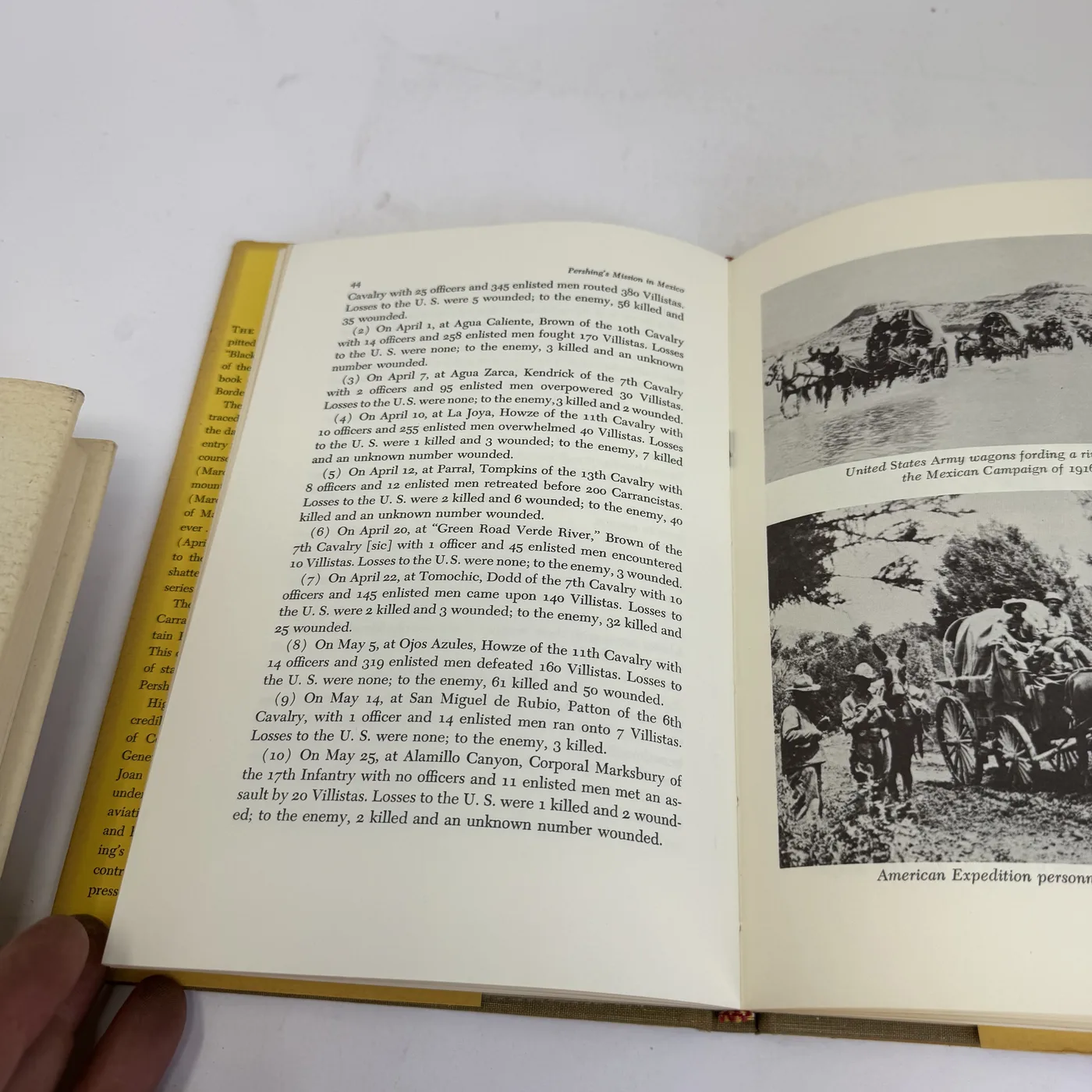
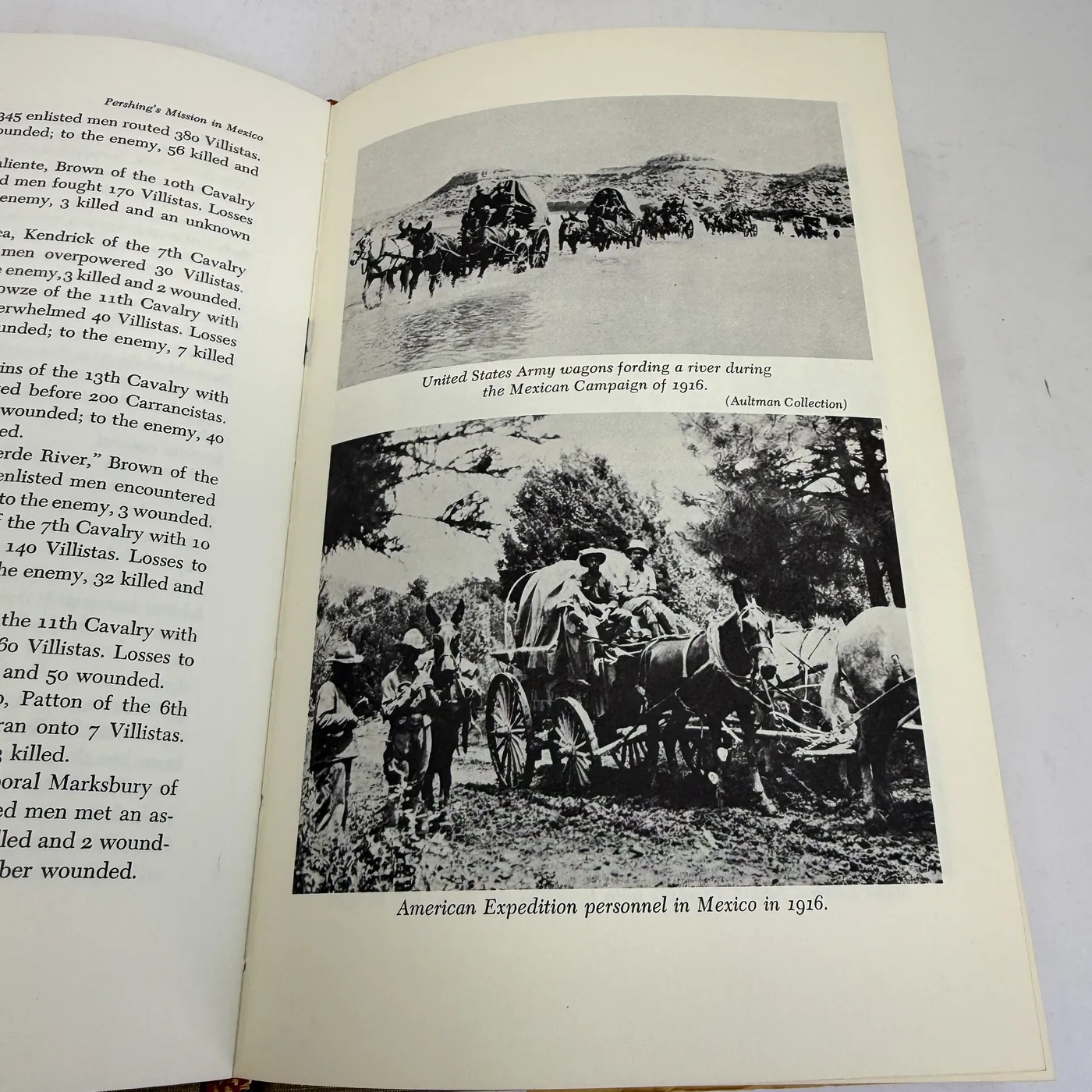
The integration of the Aultman Collection photographs into Hertzog's typography is part of the design recognition this book received. Aultman was the El Paso commercial photographer who documented the Mexican Revolution and the Punitive Expedition extensively from the border. His archive (now held at the El Paso Public Library) is the primary visual source for any serious account of the period, and Hertzog's placement of those photographs alongside Braddy's battle chronology is one of the small craft achievements that distinguishes Texas Western Press production from generic university-press publishing of the same era.
Why this matters for NM regional history
The 1916 Punitive Expedition is a New Mexico story before it is a Mexico story. The trigger was Pancho Villa's predawn raid on Columbus, New Mexico, on March 9, 1916 — the only large-scale military attack by a foreign force on continental US soil between the War of 1812 and Pearl Harbor. Columbus, a tiny rail-junction town in Luna County NM about three miles north of the Mexican border, was burned and looted; ten US civilians and eight soldiers were killed. The Pershing expedition was launched from Columbus and operated out of advance bases at Colonia Dublán and other Mexican Chihuahua locations across an eleven-month campaign.
The Columbus raid and its aftermath shape the historical identity of southern New Mexico through Luna County, Doña Ana County, and the El Paso corridor. The standard NM-regional-history shelf includes multiple titles on Villa, the Mexican Revolution, Columbus, and the expedition itself. Braddy's Pershing's Mission in Mexico sits in that shelf as the compact, Hertzog-designed, UTEP-published reference. Donations of NM-borderlands history libraries routinely include this title; clean signed copies with the Hertzog dust jacket intact are uncommon and worth documenting individually.
Provenance and how this copy came in
Donor scenario anonymized per archive policy. Documented as part of the May 2026 NMLP intake. Condition: the Hertzog dust jacket is intact with the characteristic yellow ground crisp on the front board and minor edgewear consistent with normal shelf handling; the signed half-title is bright; the textblock is clean with no marginalia. A solid, presentable copy of a scarce signed Hertzog-designed Texas Western Press title.
Where this copy is going
Three plausible routes after archival documentation. First and most likely: an antiquarian collector who tracks signed Carl Hertzog–designed books. The Hertzog-collector market is small but committed; signed-author copies of Hertzog-designed titles command meaningful premiums over unsigned copies. Second: a specialist in Mexican Revolution / Pancho Villa material who builds completing collections including the Braddy bibliography. Third: a UTEP alumnus or a research library building a Texas Western Press complete-imprint shelf (the press has a strong collecting following among Texas/Southwest historical libraries). The archive entry will remain regardless of which route the physical book takes.
External references & authoritative sources
- Carl Hertzog (Wikipedia): en.wikipedia.org/wiki/Carl_Hertzog — biographical reference for the designer; founder of Texas Western Press.
- Pancho Villa Expedition (Wikipedia): en.wikipedia.org/wiki/Pancho_Villa_Expedition — the 1916 Punitive Expedition, the subject of this book.
- Texas Western Press / UTEP Press: utep.edu — the publishing organization, originally Hertzog-led, now operating under the C. L. Sonnichsen Special Collections Department at UTEP.
- WorldCat / OCLC record for the 1966 first: search.worldcat.org — Pershing's Mission in Mexico, Braddy — institutional holdings worldwide.
- UNM Center for Southwest Research, Albert B. Fall Papers: elibrary.unm.edu/cswr — the Albuquerque-held archival source Braddy used for his 1969 Villa research.
- El Paso Public Library, Otis A. Aultman Photo Collection: elpasolibrary.org/border-heritage — primary visual archive of the photographs reproduced in this book.
- Rounce and Coffin Club / Western Books Exhibition: a Southern California fine-printing society that has annually recognized exceptional book design since 1931. Hertzog work appears regularly in the Western Books Exhibition record.
How to cite this archive entry
Eldred, Josh. "Pershing's Mission in Mexico — Haldeen Braddy (signed), Carl Hertzog–designed Texas Western Press 1966 / 1973 Reprint." NMLP Donation Archive, May 10, 2026. https://newmexicoliteracyproject.org/archive/pershings-mission-braddy-1973-signed
Related on this site
- Back to the archive index
- Carl Hertzog & Texas Western Press — Collector's Authority Guide — the full reference pillar this book anchors. The HC monogram, the Dobie-Lea axis, the Rounce and Coffin Club record, the Carl Hertzog Award genealogy.
- Closed Signature Pools Reference — the structured reference for deceased-author signature markets. Braddy (d. 1980) sits in the broader Southwest-historian closed-pool universe.
- Book Authentication Methodology — the 7-tier signature authentication framework applied to all signed-book archive entries.
- Letters from the New World (Vargas / Kessell UNM Press 1989) — another regional-press historical monograph in the archive.
- Ranchers, Ramblers, and Renegades (Marc Simmons, Ancient City Press 1984, signed) — comparable signed regional-press historical monograph.