The Navajo reservation trading post was one of the most distinctive commercial institutions in American history: a federally licensed general store, often the only retail outlet within a fifty-mile radius, that operated simultaneously as grocery, hardware supplier, pawn bank, wool-and-rug marketing house, post office, and cultural borderland between Navajo and Anglo-American economic systems. For roughly eighty years — from the establishment of the first licensed posts in the 1870s through the rapid decline of the traditional system in the 1970s and 1980s — the trading post was the primary site at which Navajo people and the larger American economy met. The literature documenting that institution is one of the richest collecting canons in Southwestern Americana: it ranges from the archival rigors of Frank McNitt's The Indian Traders (1962) to the intimate domestic memoir of Elizabeth Hegemann's Navajo Trading Days (1963) to the critical economic analysis of Willow Roberts Powers's Navajo Trading: The End of an Era (2001), and it includes some of the rarest first editions produced by the major Southwestern presses.
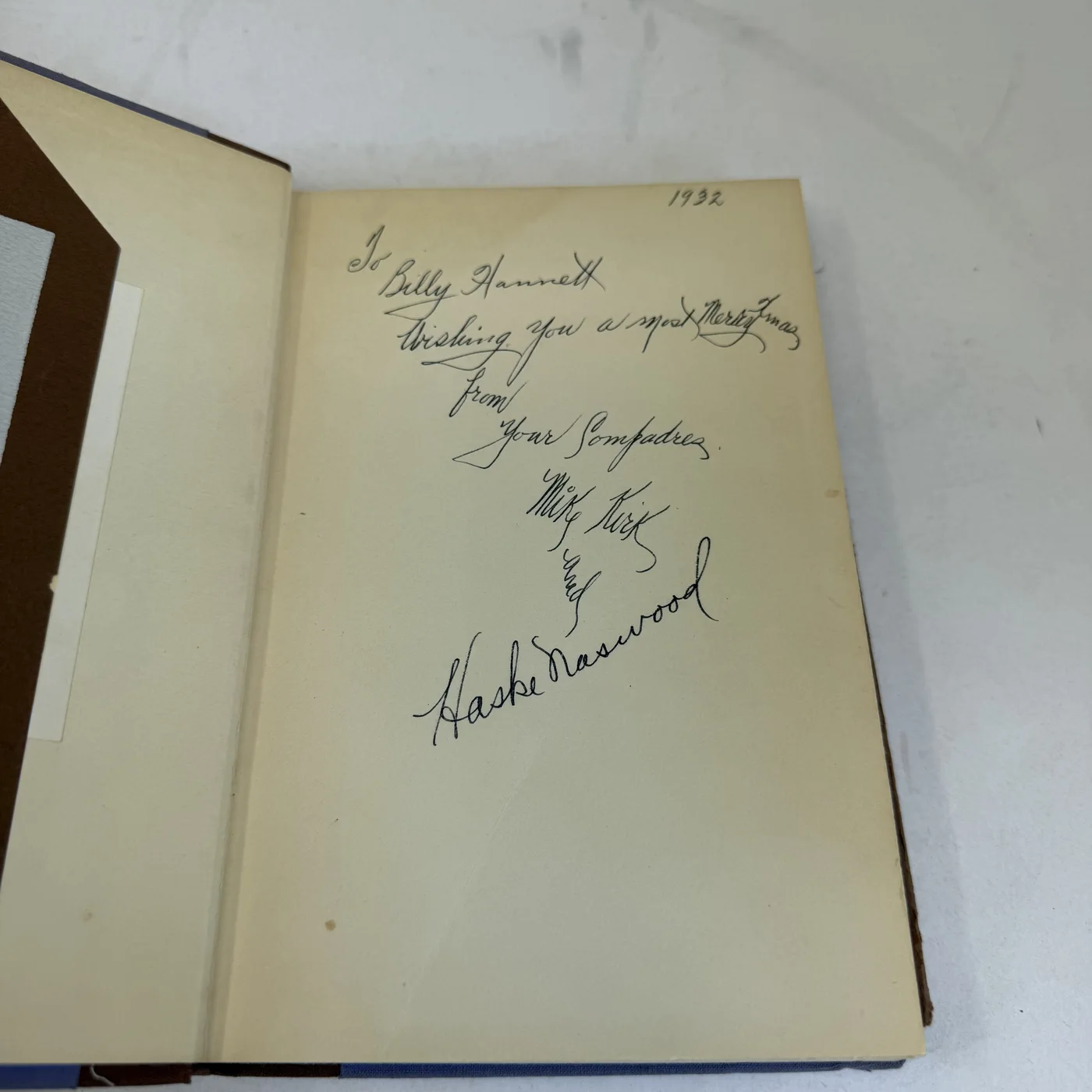
The traders left their marks in books as well as ledgers. This endpaper came through NMLP intake dated 1932: the Gallup trader Mike Kirk and Haske Naswood, signing together as “your Compadres,” giving James Paytiamo’s Flaming Arrow’s People — an Acoma author’s book, in its year of publication — as a Christmas present. The full copy is documented in the Donation Archive:
The collecting canon divides into four overlapping streams. The scholarly-historical stream, anchored by McNitt and continued by Powers, provides the archival and analytical foundation. The trader memoir stream — Hegemann, Richardson, Roberts's biography of Stokes Carson, Moon on Harry Goulding, the Gillmor-Wetherill narrative — provides the experiential and biographical dimension. The material-culture stream — Adair on silversmiths, the rug-grading and weaving literature that intersects with this guide — documents the objects that flowed through the trading post economy. And the ephemera stream — trading post catalogs, license applications, inspector reports, pawn records, and correspondence — provides the primary-document substrate on which all serious research in the field ultimately rests.
Last verified September 2026 · Original research by Josh Eldred
The Institution: Origins and Structure of the Trading Post System
New Mexico Trading Posts, Indian Traders & Reservation Commerce books, including The Indian Traders (1962), are sought-after collectibles commanding premium prices among Southwest and Western Americana collectors. The legal framework for the Navajo reservation trading post was established by the Indian Trade and Intercourse Acts and their successor statutes, which required traders operating on reservation land to hold a federal license issued through the Bureau of Indian Affairs (or its predecessors). The licensing requirement theoretically gave the federal government supervisory authority over trading post operations — the ability to revoke licenses for abusive practices — though in practice the inspectors were few, the posts were numerous and remote, and meaningful oversight was intermittent at best until the FTC investigation of the 1970s. The first licensed Navajo reservation posts date to the immediate post-Long Walk period, after the Navajo people were released from their internment at Bosque Redondo, New Mexico, in 1868 and returned to a reduced reservation in the Four Corners region. The returning Navajo population was destitute — their livestock killed, their crops destroyed, their material culture stripped — and the trading posts were among the first commercial institutions to fill the economic vacuum.
The physical structure of the classic reservation trading post was functional to the point of fortification. The typical post was a single-story stone, adobe, or concrete block building with thick walls, small windows, a heavy front door, and an interior layout centered on the trading counter — a chest-high barrier between the trader and the patron side of the room. Behind the counter, shelving held the goods: bolts of velveteen and calico fabric (for women's clothing and men's shirts), canned goods, flour, coffee, sugar, salt, baking powder, lard, tobacco, hardware, rope, harness parts, axes, shovels, patent medicines, candy. The patron side held a few chairs or benches, a wood stove, and the social space where Navajo patrons gathered, visited, and conducted business at their own pace. The pawn room was typically behind the counter, often a locked room accessible only to the trader — rows of paper envelopes and labeled hooks holding pledged jewelry, saddles, rugs, and ceremonial objects.
The trading post operated on a credit-and-barter economy for most of its history. Navajo patrons ran accounts settled seasonally: in spring when lambs were sold, in summer when wool was clipped and sold, in fall when sheep and cattle were marketed. Between settlements, credit flowed against the next season's expected production. The pawn system formalized this credit relationship: a pledged object became collateral against the account balance, and the post's pawn room served the function that a bank would serve in the market economy. The barter economy extended to specific goods: a weaver might bring a finished rug to the post and receive credit against goods rather than cash, with the trader assigning a rug grade and corresponding credit value according to the post's grading scale. This rug-grading system — the trader's assessment of a rug's quality based on thread count, weave evenness, dye quality, design regularity, and material — is the mechanism by which individual traders shaped regional rug styles, as described in detail in the Navajo weaving pillar guide.
The Foundational History: Frank McNitt's The Indian Traders (1962)
Frank McNitt's The Indian Traders (University of Oklahoma Press, Norman, 1962) is the definitive scholarly history of the Navajo reservation trading post system and the indispensable text of the entire canon. McNitt, a journalist by training who brought both narrative skill and archival discipline to his Southwest research, spent years in the primary archives before writing: Bureau of Indian Affairs record groups at the National Archives, territorial court files in New Mexico and Arizona, trading post license applications and inspector reports, and personal correspondence in family collections and university repositories. The result is the most rigorously documented account of the trading post system available — not a celebratory narrative or a nostalgic memoir, but a history grounded in documents that includes the failures, abuses, and contradictions of the institution alongside its genuine achievements as a commercial and cultural mediating structure.
The book's organization is primarily biographical-and-geographical: McNitt works through the major traders and their posts in rough chronological order, using each trader's career as a vehicle for documenting the broader system. The treatment of Lorenzo Hubbell is the most extensive — nearly fifty pages covering Hubbell's establishment of the Ganado post, his network of subsidiary posts and wholesale operations, his political career, his relationships with Navajo customers and leaders, his marketing strategies, and the documentary record of his business operations. The treatment of J.B. Moore at Crystal documents the mail-order catalog innovation that made Crystal one of the most commercially sophisticated operations in the early rug trade. The chapters on the Wetherill family — particularly Richard and John Wetherill, whose trading activities were inseparable from their archaeological work at Mesa Verde and elsewhere — provide the most archivally grounded account of that controversial family in the literature. The chapters on C.N. Cotton document the Gallup wholesale trade's role in creating the national market for Navajo rugs.
Points of issue for the 1962 OU Press first edition: The first is a standard University of Oklahoma Press academic hardcover of the period. Binding: blue or dark blue cloth boards, with title and author stamped in gilt or silver on the spine; the OU Press colophon at the spine foot. Title page: 'University of Oklahoma Press, Norman' with the 1962 copyright date and no printing statement (later printings add a printing history). Contents: approximately 380 pages of text plus black-and-white photographs, a fold-out or bound-in map of trading post locations, notes, bibliography, and index. Dust jacket: pictorial jacket with trading post or Southwest landscape imagery; surviving jackets in fine condition are the condition variable that separates Tier 2 from Tier 3. The book was reprinted by the University of Oklahoma Press multiple times, including a paperback edition; the 1962 hardcover first with jacket is the collector target. McNitt's other Oklahoma Press title — Navajo Wars: Military Campaigns, Slave Raids, and Reprisals (1972) — is a companion volume and Tier 3 collector target that completes the McNitt set on Navajo history.
McNitt (1912-1972) died relatively young, limiting the signing period for his books. Signed copies of The Indian Traders surface occasionally through the Southwestern dealer network; a signed copy is a meaningful premium over unsigned in the collector market. The book is genuinely important enough that it belongs in any library of Southwestern Americana or Native American history regardless of edition — but the first hardcover with jacket is the right object for the collector who regards books as documents of their own publication history.
The Founding Memoir: Gillmor & Wetherill's Traders to the Navajos (1934)
Frances Gillmor and Louisa Wade Wetherill's Traders to the Navajos: The Story of the Wetherills of Kayenta (Houghton Mifflin, Boston, 1934) established the trader memoir as a literary genre and remains the most important single book in the subjective, experiential dimension of the trading post literature. It predates McNitt by nearly three decades and provides what McNitt, for all his archival superiority, cannot: the feel of trading life from inside the post, the texture of the relationship between a trader's family and the Navajo community, the daily accumulation of mutual knowledge that constitutes the trader's cultural competence.
Louisa Wade Wetherill (1877-1945) came to Kayenta, Arizona, in 1906 when her husband John Wetherill established the trading post there (John was a brother of Richard Wetherill, who had explored and excavated Mesa Verde and Chaco Canyon). Over four decades at Kayenta, Louisa became one of the most accomplished Anglo-Navajo cultural intermediaries of her era: she achieved fluency in spoken Navajo (an extremely rare accomplishment among non-Navajos), was given the Navajo name Asthon Sosi (Slim Woman), was trusted by Navajo healers and religious leaders in ways that very few outsiders were, and accumulated a knowledge of Navajo ceremony, oral tradition, and material culture that she shared with ethnographers and scholars who visited Kayenta. Frances Gillmor, a University of Arizona professor of literature, interviewed Louisa over several years and shaped the narratives into the book's literary form — a blend of memoir, biography, and ethnographic observation that reads, at its best, like the best literature of the West.
Points of issue for the 1934 Houghton Mifflin first edition: Format: standard Houghton Mifflin trade hardcover. Binding: tan or orange-tan cloth boards with black stamping on front board (title and vaguely Southwestern decorative element) and black stamping on spine (title, authors, and Houghton Mifflin imprint). Title page: 'Houghton Mifflin Company, Boston and New York, The Riverside Press Cambridge, 1934.' Copyright page: 'Copyright, 1934, by Frances Gillmor and Louisa Wade Wetherill' with no printing statement (later printings state 'Second printing' or similar notation). The first is identified by the absence of any printing statement after the copyright. Dust jacket: pictorial wrapper depicting a Navajo landscape, trading post scene, or Navajo figure; the jacket significantly elevates value, as the tan cloth without jacket is difficult to distinguish from later printings on casual examination. Photographs: the first contains black-and-white photographs from Kayenta; the photo caption pages are a bibliographic checkpoint. The book was reprinted by the University of New Mexico Press beginning in the 1950s (multiple editions, still in print as a paperback); the UNM Press editions are working references. The Houghton Mifflin 1934 first with jacket is a Tier 1 collector target — scarce in fine condition after ninety-plus years of the fragile tan cloth and period dust jacket.
The book's significance extends beyond the trading post literature. Louisa Wetherill's Kayenta was the transit point through which ethnographers including Gladys Reichard and Samuel Barrett accessed Navajo ceremonial life; her documented relationships with Navajo singers (ceremonial practitioners) and her knowledge of sacred geography in the Monument Valley-Kayenta region make the book a primary source for the ethnohistory of that area. The connection to the archaeology literature (John Wetherill guided the first Anglo exploration of Rainbow Bridge in 1909) gives the book cross-canonical significance.
Lorenzo Hubbell's Legacy: Three Books on Ganado's Founder
Martha Blue, Indian Trader: The Life and Times of J.L. Hubbell (Walnut Canyon Press, Walnut Canyon National Monument / Flagstaff, 2000) is the most recent and most archivally comprehensive biography of Lorenzo Hubbell. Blue, a historian who worked with the Hubbell Trading Post archives at the University of Arizona Special Collections and with collections at the Arizona State Library, drew on correspondence, account books, and family papers that had not been systematically used by earlier writers. The biography covers Hubbell's full life from his New Mexico birth in 1853 through his death at Ganado in 1930 — his early career in the New Mexico territorial economy, his establishment of the Ganado post in 1878, his development of the rug marketing network, his political career in Arizona Territory, his relationships with Navajo leaders and Washington officials, his collection of Southwestern art, and the gradual financial difficulties of his later years. Walnut Canyon Press was a small regional imprint with modest production runs; the 2000 first edition hardcover with jacket is a Tier 2-3 collector target. Blue signed freely, and signed copies are accessible.
For the collector interested specifically in Hubbell, three texts form the essential set: Blue's biography for the full life narrative, McNitt's chapters in The Indian Traders for the most rigorous archival treatment of the business operations, and the Hubbell Trading Post National Historic Site itself — the rug room, the Burbank paintings, the visitor center exhibits, and the ongoing weaving demonstrations — as the primary material-culture source. The Hubbell Trading Post National Historic Site publication program (National Park Service) includes brochures, bulletins, and an occasional larger interpretive publication; these NPS publications are Tier 3 collector items and useful primary sources on the post's physical and operational history.
The older biography by Hester Jones — published in the Arizona Historical Quarterly and in a stand-alone pamphlet edition — preceded Blue and McNitt and is a primary source in its own right, as Jones had direct access to family informants in the 1930s-1940s. Original pamphlet editions of Jones's Hubbell work are Tier 2-3 ephemera items and are periodically found in the Southwestern book-dealer network.
Have books you're ready to part with? I offer free pickup across Albuquerque — call 505-250-3804.
The Memoir Literature: Life Inside the Post
Elizabeth Compton Hegemann, Navajo Trading Days (University of New Mexico Press, Albuquerque, 1963) is, alongside Gillmor and Wetherill's Kayenta narrative, the finest piece of literary memoir in the trading post canon. Hegemann lived at the Shonto Trading Post — a remote post in the sandstone canyon country of northern Arizona, accessible by a dirt road that became impassable in wet weather — during the 1930s and 1940s. Her book is organized not as chronological autobiography but as a series of vignettes organized by subject: the trading counter and barter transactions, the pawn room and its objects, wool and rug marketing, seasonal ceremonies observed from the respectful distance of a trader's wife, the children who came to the post, the isolation of canyon-country life without telephone or dependable mail service, and the slow education in Navajo culture that came from decades of daily contact. Hegemann writes with unusual specificity about the material culture of the post: she itemizes what was stocked, how goods were priced and bartered, how the pawn system was actually administered, what the rug-grading negotiations looked like from the trader's side of the counter. The UNM Press 1963 first edition hardcover with jacket is a Tier 2 collector target. The book was reprinted by UNM Press; the original hardcover first with jacket is the artifact.
Gladwell Richardson, Navajo Trader (University of Arizona Press, Tucson, 1986) is Richardson's memoir of a trading post career spanning the mid-twentieth century. Richardson operated posts in the Four Corners region for decades and writes from deep practical experience of the trading-post-as-business: the economics of the wool trade, the dynamics of rug purchasing and grading, the management of the pawn system, the relationships with BIA inspectors, and the gradual changes in the reservation economy through the 1950s and 1960s. Richardson is less literary than Hegemann but more commercially precise — the book is a useful counterpoint to the more romantically inflected trader memoirs, written by someone who regarded trading as a business rather than a calling. The UAP 1986 first edition is a Tier 2-3 collector target.
Willow Roberts, Stokes Carson: Twentieth-Century Trading on the Navajo Reservation (University of New Mexico Press, Albuquerque, 1987) is a biographical account of one trader's career — a useful microcosm of the trading post system across its mature and declining phases. Stokes Carson traded on the Navajo reservation for most of the twentieth century, and Roberts's biography draws on extensive interviews with Carson and his contemporaries to document the daily realities of reservation trading: the economics of the barter system, relationships with Navajo customers, the seasonal rhythms of the wool and rug trades, and the transition to a changed reservation economy in the post-1970 period. The UNM Press 1987 first edition is a Tier 2-3 target. Roberts later published under the name Willow Roberts Powers (her Navajo Trading: The End of an Era is the most important single book for the post-1970 period), and the Roberts-Carson biography is a useful complement to the later analytical work.
Samuel Moon, Tall Sheep: Harry Goulding, Monument Valley Trader (University of Oklahoma Press, Norman, 1992) occupies a unique position in the trading post literature because Goulding's story intersects with Hollywood cinema in a way that no other trader's story does. Harry Goulding (1897-1981) established a trading post in Monument Valley, Utah/Arizona, in 1928, trading with Navajo families in one of the most remote and visually spectacular landscapes in the American Southwest. In 1938, Goulding traveled to Hollywood with photographs of Monument Valley and persuaded director John Ford to film there. The result was Stagecoach (1939), the first of the Monument Valley films that defined the visual vocabulary of the classic Western. Goulding's post became the base camp for Ford's productions, and Monument Valley became synonymous with the American Western landscape in ways that shaped the national imagination. Moon's biography, based on extensive interviews with Goulding, his wife Mike, and their contemporaries, covers the full arc of Goulding's career as trader, guide, and inadvertent Hollywood impresario. The OU Press 1992 first edition is a Tier 2-3 collector target — the book's cross-appeal to both Western Americana collectors and cinema history collectors gives it a broader potential buyer base than most trading post titles.
The Pawn System: Commerce, Credit, and Controversy
The trading post pawn system was the most contested institution in the trading post economy and the primary target of the federal regulatory intervention that accelerated the system's decline. Understanding the pawn system is essential to understanding both the historical trading post literature and the contemporary dead-pawn collector market for Navajo jewelry and other objects.
In its ideal form — the form that appears in the trader memoirs and is sometimes nostalgically described in the popular literature — the pawn system functioned as a mutual-benefit credit arrangement. A Navajo patron who needed credit for goods would leave a valued object with the trader as collateral; the trader provided credit against the object's assessed value; the patron redeemed the object when the account was settled at the next seasonal payment. The trader provided secure storage for the pledged object, protecting it against loss or theft, and the patron retained the right of redemption indefinitely as long as the account was kept current. The system was particularly suited to the rhythms of a pastoral economy: a family whose income came primarily from wool sales, lamb sales, and rug production had predictable seasonal income and genuine need for year-round credit.
In its documented reality — the reality that appears in the FTC report, in the scholarly critical literature, and in the oral histories of Navajo patrons collected by Roberts Powers and others — the pawn system was a captive-market credit arrangement with structural abuses built into its design. Traders who were the only commercial outlet within a fifty-mile radius faced no competition in setting pawn valuations; systematic undervaluation of pledged objects was widespread. The credit prices charged for goods — structurally higher than off-reservation retail prices, with the margin functioning as implicit interest on the credit extended — were not transparent to patrons who had no easy basis for comparison. The transition from live pawn to dead pawn, and the resulting sale of culturally significant objects that families intended to redeem, was experienced by many Navajo families as a loss of irreplaceable heritage objects rather than a commercial transaction. The FTC's 1973 report, The Trading Post System on the Navajo Reservation, documented these abuses systematically for the first time and recommended regulatory intervention; it is the primary critical primary document on the pawn system and is essentially absent from the collector market (it exists primarily in institutional library government-documents collections).
The dead-pawn collector market that emerged from the trading post system is covered in the NMLP Turquoise & Jewelry Books pillar guide. The key point for the trading post book collector is that dead-pawn objects — Navajo silver-and-turquoise jewelry, woven items, saddles, and other goods that passed through the pawn system and were not redeemed — are a distinct collecting category precisely because they were made for Navajo use, not for tourist sale. They tend to be heavier, more personal, and more technically accomplished than commercial pieces, and they carry the authentication of having been made and owned within Navajo culture. The books that document the dead-pawn market sit at the intersection of the trading post literature and the Indian arts collecting literature.
The Rug-Grading System and Trading Post Style Development
The trading post rug-grading system was the commercial mechanism by which individual traders exercised the design influence that created the regional rug styles. A trader who wanted to encourage Two Grey Hills weavers to maintain the fine tapestry-weave tradition in natural wool could simply grade such rugs higher — paying more per pound or per piece for fine natural-wool weaves than for cruder commercial-yarn pieces — and the market signal was clear. A trader who wanted Ganado weavers to maintain the deep-red Ganado palette could refuse to grade (or grade at lower rates) rugs in other color schemes. The grading system was the invisible hand of the regional rug market.
The standard grading categories used in the trading post rug trade were: First quality (the finest weaves, tightest thread count, best dye quality, most regular design, no loose threads or weft distortions); Second quality (good workmanship with minor technical imperfections or slightly irregular design); Third quality (acceptable commercial production with visible technical limitations); and Utility or Common (basic weaves with significant technical limitations, typically purchased for bulk resale). Individual posts added their own refinements — Two Grey Hills posts developed an elaborate sub-grading system based on thread count per inch, which drove the competition among weavers to achieve finer and finer weaves. The specific grading criteria and price schedules of individual posts are documented in H.L. James's Rugs and Posts (multiple editions) and in the trading post correspondence preserved in the Hubbell Trading Post archives at the University of Arizona.
H.L. James, Rugs and Posts: The Story of Navajo Weaving and the Role of the Indian Trader (multiple editions, various publishers) is the primary book-length treatment of the trading post system's role in shaping rug production and grading. James, who had direct commercial experience with the Navajo rug trade, documents the individual posts and their regional style contributions with a practical specificity that the more scholarly treatments lack. The book exists in multiple editions published by different imprints over several decades — the first edition (West Wind Press, 1976, or Schiffer, 1988, depending on which published the first commercial edition — James went through multiple publishers) is a Tier 2-3 target; later printings are working references. The book sits at the intersection of the trading post literature and the weaving literature and is essential to both.
Kelley's Navajo Rugs — various regional rug guide titles carrying the Kelley name have circulated in the Navajo rug market — document the grading and identification system for collector use. These pocket guides and reference manuals, produced for buyers attending Indian arts shows and trading post sales, are Tier 3 working references and useful to the collector building the practical side of a weaving and trading post library.
The Silversmith in the Trading Post Economy: John Adair's Foundational Study
John Adair, The Navajo and Pueblo Silversmiths (University of Oklahoma Press, Norman, 1944) is the foundational anthropological study of Indian silversmithing as an economic and cultural practice embedded within the trading post system. Adair (1913-1997), a Columbia-trained anthropologist who conducted his fieldwork in the late 1930s and early 1940s, studied both Navajo and Zuni silversmithing with a methodological rigor — observing production, interviewing working smiths, recording technical processes and economic arrangements — that no previous treatment had matched. The book's central argument is that Navajo and Zuni silversmithing developed not as an ancient indigenous tradition but as a relatively recent (post-1860s) craft that spread through the reservation economy in direct relationship to the trading post commercial system.
The trading post connection is structural: traders stocked silversmithing tools (files, chisels, bellows, draw plates, soldering equipment), purchased coin silver from smiths for the original metal supply, provided commercial turquoise as the primary stone material through a wholesale supply network, bought finished jewelry at wholesale prices, held jewelry in pawn, and marketed pieces to tourists through post retail and through the Fred Harvey Company distribution network. Adair documents the price structure of this system — what a smith received for a piece versus what it sold for at retail — with the economic precision of an anthropologist trained in the Boas school. The tension between the authenticity value of handmade Indian jewelry and the commercial pressures that drove standardization of tourist-market pieces is already visible in Adair's 1944 study and remains a central theme of the jewelry literature today.
Points of issue for the 1944 OU Press first edition: Standard University of Oklahoma Press academic hardcover. Binding: blue or grey cloth with gilt or silver spine stamping, OU Press colophon at spine foot. Title page: 'University of Oklahoma Press, Norman, 1944' with copyright statement. Photographs: black-and-white plates documenting smithing tools, techniques, and finished pieces. The 1944 first with dust jacket is a Tier 2 collector target; the book was reprinted by OU Press in paperback and remains the standard reference for the field. The connection to the broader turquoise and jewelry collecting literature is covered in the NMLP Turquoise & Jewelry Books pillar guide.
I pick up books for free anywhere in the metro area. Call 505-250-3804 to schedule.
Willow Roberts Powers and the End of an Era (2001)
Willow Roberts Powers, Navajo Trading: The End of an Era (University of New Mexico Press, Albuquerque, 2001) is the most important single scholarly contribution to the trading post literature since McNitt, and the most comprehensive treatment of the post-1970 decline. Powers brings both academic credentials (her earlier work as Willow Roberts produced Stokes Carson in 1987, which demonstrated her oral-history methodology) and a critical analytical framework that earlier trader-memoir writers could not or would not apply to the institution they had participated in. Navajo Trading draws on oral histories with former traders, with Navajo community members who had been patrons of the traditional posts, with tribal council members who drove regulatory reform, and with researchers and bureaucrats involved in the FTC investigation.
The book's central argument is that the decline of the traditional trading post was not primarily an external accident — not simply the result of roads and pickup trucks giving Navajo consumers access to off-reservation stores — but was also driven by the accumulated resentments of the credit and pawn system's structural inequities, the Navajo Nation government's active effort to replace trader monopolies with tribally owned commercial ventures, and the political mobilization of the civil rights era that reframed the trading post as an instrument of economic colonialism rather than a benevolent commercial service. Powers neither romanticizes the traditional system (as the trader memoirs often do) nor demonizes individual traders (as the most polemical critical literature does); she treats the trading post as a complex institution that served real needs through imperfect means in a context of structural power imbalance. The UNM Press 2001 first edition hardcover with jacket is the Tier 2 collector target; a paperback edition followed. The book is essential for any library on the trading post system that goes beyond nostalgia.
The C.N. Cotton Era and the Gallup Wholesale Trade
Cary Nichols Cotton (1859-1936), universally known as C.N. Cotton, was the dominant figure in the Gallup-based wholesale trade that connected reservation trading posts to national markets in the late nineteenth and early twentieth centuries. Cotton arrived in Gallup in 1884 and built the most extensive wholesale operation in the regional Indian arts trade: his Gallup warehouse received wool, rugs, blankets, and other products from reservation posts and marketed them to Eastern department stores, mail-order buyers, and collector networks. At his peak, Cotton was operating his own chain of trading posts on the reservation while acting as wholesale agent for dozens of independent operations.
The C.N. Cotton Company papers — correspondence, account books, trade catalogs, and business records — are held at the University of New Mexico Center for Southwest Research and constitute a primary archival resource for the commercial history of the early rug trade. Researchers who have used these records include McNitt (who covers Cotton extensively in The Indian Traders) and the authors of several exhibition catalogs on the Navajo rug trade. For the ephemera collector, C.N. Cotton Company trade catalogs and price sheets — essentially the Gallup wholesale equivalent of J.B. Moore's Crystal retail catalogs — are Tier 1 rarities when they surface. The Cotton Company correspondence in the UNM archives is a primary document of the commercial system that transformed Navajo weaving from local craft to national commodity.
The Gallup retail landscape that Cotton's wholesale infrastructure helped shape includes two establishments with significant historical presence in the trading post literature: Richardson's Trading Company (now Richardson's Cash Pawn), established in Gallup in 1913 and still operating as a pawn and Indian arts dealer, is the longest-running commercial successor to the trading post system in Gallup. It holds one of the largest active pawn inventories of Navajo and Pueblo jewelry in the Southwest. Tobe Turpen's Indian Trading Company, another Gallup operation documented in McNitt and in the broader trading post literature, served the wholesale and retail rug and arts trade for much of the twentieth century. Both establishments appear in the historical literature as representatives of the Gallup commercial hub.
Skip Maisel's and the Albuquerque Indian Arts Trade
Skip Maisel's Indian Trading Post (202 Central Ave SW, Albuquerque, established 1939) occupies a unique position in the New Mexico Indian arts commercial landscape. Located on Historic Route 66 in downtown Albuquerque, Maisel's building features an exterior with WPA-era murals depicting Native artists at work — painted by Navajo, Hopi, and Pueblo artists including Harrison Begay and Pablita Velarde under the Works Progress Administration program. The murals, completed in 1939-1940, are among the most significant examples of WPA public art in New Mexico and have been listed on the National Register of Historic Places. The building's artistic heritage gives Maisel's a significance in the WPA arts literature and the Route 66 commercial history literature that extends beyond its function as an Indian arts retailer. For the book collector, Maisel's appears in the Route 66 literature (covered in the NMLP Route 66 Books pillar guide), in the WPA arts literature, and tangentially in the trading post and Indian arts commercial literature as one of the Albuquerque retail venues in the Fred Harvey succession — the post-Harvey era urban Indian arts market that replaced the railway-hotel retail model.
The Fred Harvey Company's Alvarado Hotel on Central Avenue (the Route 66 corridor), demolished in 1970, was the original Albuquerque anchor for Indian arts retail. Its Indian Museum and retail room, curated by Herman Schweizer's Harvey Indian Department, was for decades the primary high-end retail venue for Navajo rugs and jewelry in Albuquerque. The Fred Harvey — trading post connection is documented in the weaving literature and in the jewelry literature, with the Harvey Company's systematic role in standardizing tourist-market Indian arts production constituting one of the central critical themes of both canons.
The Indian Arts and Crafts Act: Truth-in-Advertising and the Trading Post Legacy
The Indian Arts and Crafts Act of 1990 (Public Law 101-644) criminalized misrepresentation in the marketing of Indian-made arts and crafts — specifically the false attribution of non-Indian-made objects as Indian-made, or the false claim of tribal affiliation for objects made by unenrolled makers. The Act was a response to the growing problem of mass-produced imitation Indian jewelry, rugs, and other goods — manufactured in Asia or by non-Indian American producers — being sold to tourists and collectors as authentic Indian-made work. The trading post legacy is relevant here because the traditional trading post system had served as an authentication infrastructure: a rug purchased directly from a trading post that bought from Navajo weavers carried an implicit provenance guarantee, and pawn jewelry that passed through the pawn system carried the authentication of having been owned and used by Navajo individuals. As the traditional post system declined and was replaced by a more diffuse retail landscape, those authentication mechanisms weakened and the fake-Indian-arts problem grew.
The 1990 Act and the 1935 Indian Arts and Crafts Board Act that preceded it are covered in legal and policy literature rather than in the collector books, but the truth-in-advertising issue is a recurring theme in the popular guides to buying Indian arts — including the practical buyer's guides (Dedera's Navajo Rugs: How to Find, Evaluate, Buy, and Care for Them, various editions; Schrader's various price guides) that are Tier 3 collector references and working tools for anyone entering the Indian arts market. The Indian Arts and Crafts Board, housed in the Department of the Interior, publishes a directory of certified Indian-owned and -operated businesses that is a current-use resource rather than a collector target.
Not sure what you have? Text me a photo at 505-250-3804 and I'll tell you what I see.
Key Trading Posts: A Geographic Survey
Hubbell Trading Post, Ganado, Arizona. Established by Lorenzo Hubbell, 1878. Now a National Historic Site operated by the National Park Service. The oldest continuously operating trading post on the Navajo Nation. The rug room (with the original E.A. Burbank oil paintings used as design models), the family homestead and outbuildings, the walled compound layout, and the visitor center are all preserved. NPS conducts ongoing weaving demonstrations at the post. The Hubbell National Historic Site is the most important physical survivor of the nineteenth-century trading post system and the essential site visit for anyone seriously engaged with the trading post literature.
Two Grey Hills and Toadlena, New Mexico. The Two Grey Hills area in the Chuska Mountains of northwestern New Mexico (between Newcomb and Sheep Springs on NM Route 134) is the home of the most technically refined regional Navajo rug tradition. The Historic Toadlena Trading Post, operated by Mark Winter, is the surviving institutional anchor of the tradition; Winter's The Master Weavers (2011) documents the weaving families of the Two Grey Hills-Toadlena region across a century of production. The Two Grey Hills Trading Post itself (a separate establishment from Toadlena) remains a working community post.
Crystal Trading Post, Crystal, New Mexico. The Crystal Trading Post, operated by J.B. Moore from 1897 to 1911, is documented in McNitt's The Indian Traders and in the weaving literature as the source of the Crystal regional rug style and the landmark mail-order catalogs of 1903 and 1911. Crystal is located in the Chuska Mountains near Narbona Pass (Washington Pass). The post building survives in altered form; the Crystal chapter of the Navajo Nation operates community facilities nearby. The Moore catalogs are the primary surviving documents of the Crystal post's commercial operations.
Wide Ruins Trading Post, Wide Ruins, Arizona. The Wide Ruins post, under the Lippincott family's management in the 1930s-1940s, became the center of the vegetal-dye revival in Navajo weaving. The Lippincotts documented their work in A Trading Post at Wide Ruins (unpublished manuscript) and in correspondence preserved in Southwestern archives. The Wide Ruins regional style — soft earth-tone vegetal-dye banded rugs — continues in the work of weavers descended from the Lippincott-era practitioners.
Teec Nos Pos Trading Post, Teec Nos Pos, Arizona. Located at the intersection of US 160 and Navajo Route 35 in the far northeastern corner of Arizona, near the Four Corners. The Teec Nos Pos regional style — elaborately bordered rugs with complex geometric and outline designs — is among the most ornate in the Navajo rug tradition. The post is documented in McNitt and in the regional weaving literature.
Burnham Trading Post, Burnham, New Mexico. Located in the San Juan Basin of northwestern New Mexico, Burnham is associated with the Burnham-area weaving tradition and with the coal-leasing controversies of the late twentieth century that are documented in the tribal sovereignty and land-use literature.
Shiprock Trading Post, Shiprock, New Mexico. The Shiprock area post was one of the most commercially significant posts in the New Mexico Navajo country, serving the large Navajo population of the Shiprock area and acting as a commercial hub for the northern San Juan Basin. The Shiprock trading community is documented in McNitt and in the broader commercial history literature.
Borrego Pass Trading Post, Borrego Pass, New Mexico. Located in the Chuska Mountains south of Crownpoint, Borrego Pass is a remote post in the heart of the New Mexico Navajo country. Posts like Borrego Pass represent the isolated, community-embedded model of reservation trading that is most thoroughly documented in the memoir literature (Hegemann's Shonto is the closest analogue).
Points of Issue: Identifying the Collector Targets
Gillmor and Wetherill, Traders to the Navajos, Houghton Mifflin 1934 first edition. Tan or orange-tan cloth boards, black spine and front-board stamping. 'Houghton Mifflin Company, Boston and New York, The Riverside Press Cambridge, 1934' on title page. Copyright page states copyright year with no printing notation. Pictorial dust jacket (scarce). 280-plus pages with black-and-white photographs. UNM Press reprint editions (beginning 1950s) are standard references. The HM 1934 first with jacket: Tier 1.
McNitt, The Indian Traders, OU Press 1962 first edition. Blue or dark blue cloth boards, gilt or silver spine stamping, OU Press colophon at spine foot. 'University of Oklahoma Press, Norman, 1962' on title page; no printing statement on copyright page. Approximately 380 pages, black-and-white photographs, fold-out or bound-in trading post map, notes, bibliography, index. Pictorial dust jacket. The OU Press first with jacket: Tier 2.
Hegemann, Navajo Trading Days, UNM Press 1963 first edition. Standard UNM Press academic hardcover. Cloth boards with jacket depicting a trading post or Canyon Country scene. No printing statement on copyright page of first printing. Black-and-white photographs throughout. The UNM Press 1963 first with jacket: Tier 2.
Adair, The Navajo and Pueblo Silversmiths, OU Press 1944 first edition. Standard OU Press academic hardcover. Blue or grey cloth boards, gilt spine stamping. 'University of Oklahoma Press, Norman, 1944' on title page; no printing statement. Black-and-white photographs and diagrams. Dust jacket (period pictorial wrapper). The OU Press 1944 first with jacket: Tier 2.
Richardson, Navajo Trader, University of Arizona Press 1986 first edition. Standard UAP academic hardcover or trade paperback. Photographs. UAP first hardcover (if issued in hardcover — some UAP memoir titles of this period were paperback-only) with jacket: Tier 2-3.
Roberts, Stokes Carson, UNM Press 1987 first edition. Standard UNM Press hardcover with jacket. Black-and-white photographs. UNM Press 1987 first with jacket: Tier 2-3.
Moon, Tall Sheep, OU Press 1992 first edition. Standard OU Press hardcover with jacket. Black-and-white photographs. OU Press 1992 first with jacket: Tier 2-3.
Blue, Indian Trader, Walnut Canyon Press 2000 first edition. Walnut Canyon Press was a small regional imprint with modest production runs. Hardcover with jacket. The 2000 first with jacket: Tier 2-3. Blue signed copies are accessible.
Powers, Navajo Trading: The End of an Era, UNM Press 2001 first edition. Standard UNM Press academic hardcover with jacket. Black-and-white photographs. UNM Press 2001 first with jacket: Tier 2. The paperback followed; the hardcover first is the collector target.
J.B. Moore Crystal Trading Post mail-order catalogs, 1903 and 1911. Original ephemeral commercial documents with very low survival rates. The 1903 catalog is a staple-bound illustrated price list, approximately 28 pages, listing Navajo rug designs by number with prices and dimensions. The 1911 catalog is larger and more elaborate. Both are Tier 1 rarities — among the most sought-after pieces of trading post ephemera. The Avanyu Publishing facsimile edition (Albuquerque, 1987) is the realistic acquisition target for most collectors.
Trading post ephemera: license applications, inspector reports, account books, and pawn records. Original trading post business documents surface occasionally through estate sales and institutional deaccessions. A BIA inspector's report from the 1890s-1920s period, a trading post license application in its original folder, or a pawn room ledger from a named post are among the rarest and most historically significant objects in the collector market. Values are individually negotiated based on the post's significance, the document's date, and its physical condition; Tier 1 is appropriate for named-post documents from the early period.
Three-Tier Collector Market
Tier 1 — Trophy targets (upper mid-range to serious collector territory): Gillmor and Wetherill Traders to the Navajos Houghton Mifflin 1934 first edition fine with dust jacket (signed copies by Gillmor or authenticated association copies with Wetherill family provenance are exceptional rarities); J.B. Moore Crystal Trading Post original mail-order catalogs 1903 and 1911 (genuine ephemeral rarities; the 1903 is rarer than 1911); original trading post license applications, BIA inspector reports, or account books from named posts (individually valued, occasionally surface through estate and institutional channels); C.N. Cotton Company trade catalogs and price sheets (pre-1920, essentially absent from the dealer market).
Tier 2 — Collector targets (the mid-range collectible zone): McNitt The Indian Traders OU Press 1962 first hardcover with dust jacket (signed McNitt copies are meaningful premiums); Hegemann Navajo Trading Days UNM Press 1963 first hardcover with jacket; Adair The Navajo and Pueblo Silversmiths OU Press 1944 first with jacket; Gillmor and Wetherill Houghton Mifflin 1934 first without jacket but in fine condition; Powers Navajo Trading UNM Press 2001 first hardcover with jacket; Moon Tall Sheep OU Press 1992 first with jacket; Roberts Stokes Carson UNM Press 1987 first with jacket; Blue Indian Trader Walnut Canyon Press 2000 first signed; Richardson Navajo Trader UAP 1986 first; J.B. Moore Crystal catalog facsimile (Avanyu 1987) signed by the facsimile's editor; original photographs of named trading posts from the 1890s-1940s (individually valued).
Tier 3 — Working library (under modest value): McNitt The Indian Traders OU Press paperback reprint; H.L. James Rugs and Posts all editions; Gillmor and Wetherill UNM Press reprint paperback editions; Adair The Navajo and Pueblo Silversmiths OU Press paperback; J.B. Moore Crystal catalog facsimile unsigned; Kelley Navajo Rugs practical guides; Dedera Navajo Rugs: How to Find, Evaluate, Buy, and Care for Them (Northland Press, various editions); standard survey paperbacks on Navajo arts and reservation history; Hubbell Trading Post National Historic Site NPS publications and interpretive brochures; Indian Arts and Crafts Board buyer's guides; auction catalogs from Heritage Western Americana, Bonhams Native American Art, and Sotheby's that document trading-post-era objects (annual catalogs with realized price records constitute a working price guide); FTC 1973 Report (institutional library photocopy, not a collectible in the normal sense but essential primary reading).
NMLP Intake Position
Trading post and Indian trader books arrive in the NMLP donation stream from several distinct donor populations. Albuquerque collector estates with Southwestern Americana libraries — often built in the 1960s-1980s when the Navajo arts market was at peak cultural visibility — are the most consistent source; the same library that contains weaving books and turquoise-jewelry books typically contains the McNitt, the Hegemann, and the Gillmor-Wetherill. Gallup-area estate libraries (which reach NMLP by drop-off and mail-in, not pickup) surface trading post books with higher frequency because Gallup was the commercial hub of the rug and arts trade and many Gallup families had direct connections to the trading post system through employment, family relationships, or commercial dealings. Farmington and Aztec estate libraries (San Juan Basin) similarly reflect the northern New Mexico-reservation border community's connection to the trading tradition. Santa Fe estates with proximity to the School of American Research community surface the more scholarly titles — the Powers, the Blue biography — alongside the museum and exhibition catalog literature.
NMLP routes Tier 1 trophy items — Gillmor-Wetherill Houghton Mifflin 1934 firsts with jackets, McNitt OU Press 1962 firsts with jackets in fine condition, original trading post ephemera — into individual research and listing at the warehouse. Tier 2 trade firsts route through SellBooksABQ standard hand-sort. Tier 3 subsequent printings and working references route to community literacy partners (Navajo and Native American history curriculum), and the general circulation pool.
Important note on objects: NMLP does NOT accept Navajo rugs, silver jewelry, pawned objects, or trading post material culture in donation pickups. Those objects belong with specialist textile and jewelry dealers, auction houses with Native American arts expertise (Heritage Auctions Western Americana, Bonhams, Cowan's), or appropriate tribal cultural programs (the Navajo Nation Museum at Window Rock, the Navajo Nation Historic Preservation Department). Questions about trading-post-era objects belong with specialist dealers or the appropriate tribal cultural program. Free Albuquerque-metro pickup with no condition limit applies to books only — schedule your pickup or call/text 505-250-3804.
Donate Trading Post & Indian Trader Books
If you have trading post histories, Indian trader memoirs, Navajo arts references, or Southwestern commercial history books to donate, NMLP offers free pickup across the Albuquerque metro — estates, downsizes, storage unit clears. No condition minimum, no quantity minimum.
Call or text: 505-250-3804 — or schedule online.
External References
- Hubbell Trading Post National Historic Site — Ganado AZ, National Park Service, oldest continuously operating trading post on the Navajo Nation
- Wikipedia: Hubbell Trading Post NHS
- Wikipedia: Lorenzo Hubbell — founder of Hubbell Trading Post, Ganado AZ, 1853-1930
- Wikipedia: Frank McNitt — author of The Indian Traders (OU Press, 1962)
- Wikipedia: John Adair — author of The Navajo and Pueblo Silversmiths (OU Press, 1944)
- University of Oklahoma Press — primary publisher of McNitt, Moon, Adair, and key trading post scholarship
- University of New Mexico Press — publisher of Hegemann, Roberts, Powers, and the Gillmor-Wetherill reprint
- Heard Museum — Phoenix, Fred Harvey Company collection, primary commercial-period archive for Navajo arts
- Navajo Nation Museum — Window Rock AZ, primary tribal cultural institution for Navajo history and material culture
- Wikipedia: Indian Arts and Crafts Act of 1990 — the federal truth-in-labeling statute for Indian-made arts and crafts
Related on This Site
- NM Navajo Weaving & Textile Books — the parallel canon for rug scholarship; trading post influence on regional rug styles is the connective tissue between the two guides
- NM Turquoise & Jewelry Books — Adair's silversmithing study and the dead-pawn collecting market connect the trading post and jewelry literatures
- Navajo Long Walk & Bosque Redondo Books — the historical context for the establishment of the reservation and the first trading posts
- Pueblo Sovereignty & Governance Books — the tribal sovereignty movements that drove the reform and decline of the trading post system post-1970
- New Mexico Route 66 Books — Skip Maisel's, the Alvarado Hotel, and the Route 66 commercial context for Albuquerque's Indian arts trade
- New Mexico Archaeology Books — the Wetherill family's dual role as traders and archaeologists connects these canons
- NM Native American Literature — Navajo and Pueblo voices in the broader literary canon, including critiques of the trading post era
- Kachina & Katsina Books — Hopi and Pueblo arts that also passed through the trading post commercial network