Navajo Long Walk & Bosque Redondo Literature: A Collector's Authority Guide
The Long Walk · Hwéeldi · The Treaty of 1868 · Canyon de Chelly · Carleton · Carson · Diné Oral Tradition
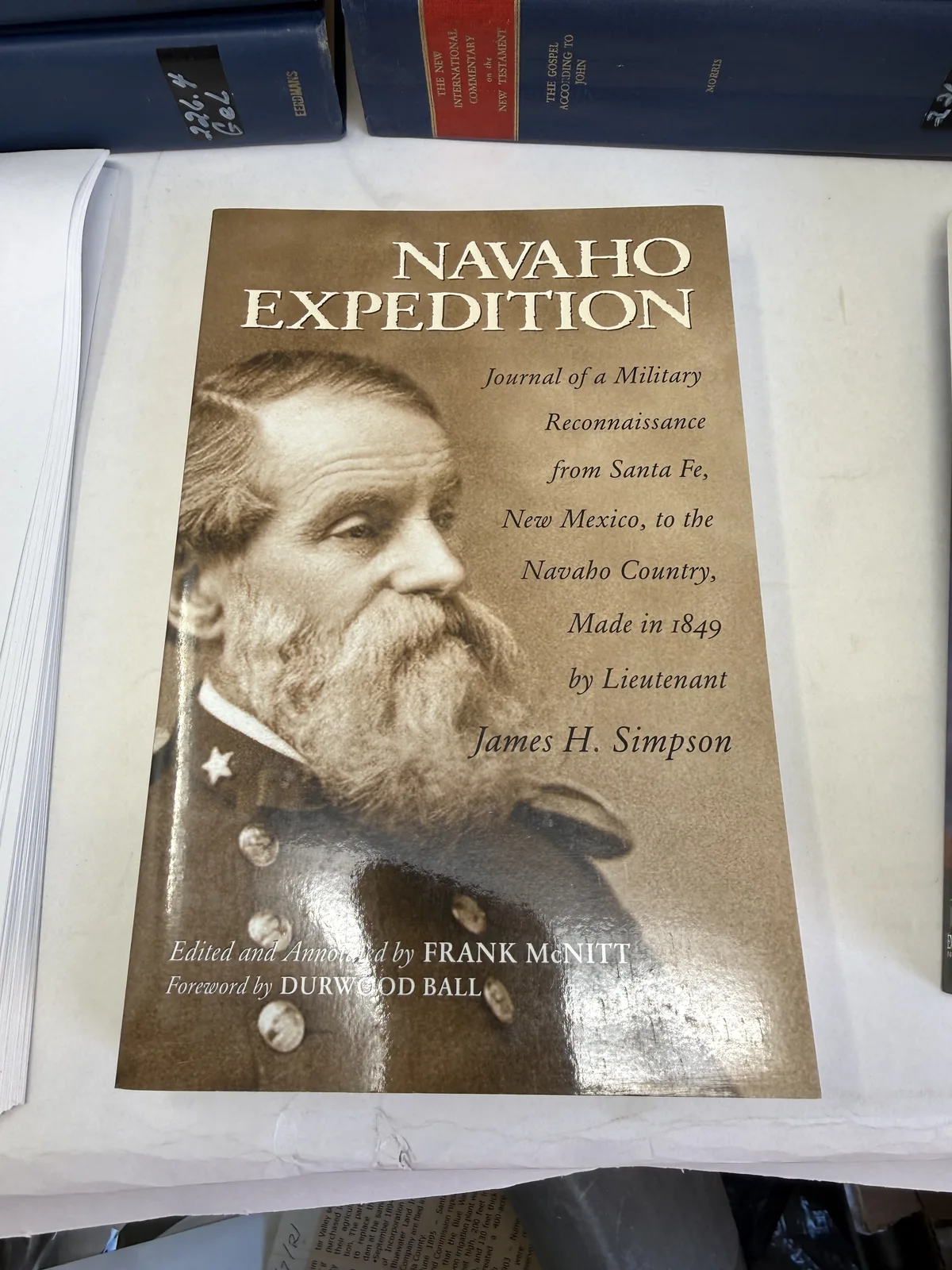
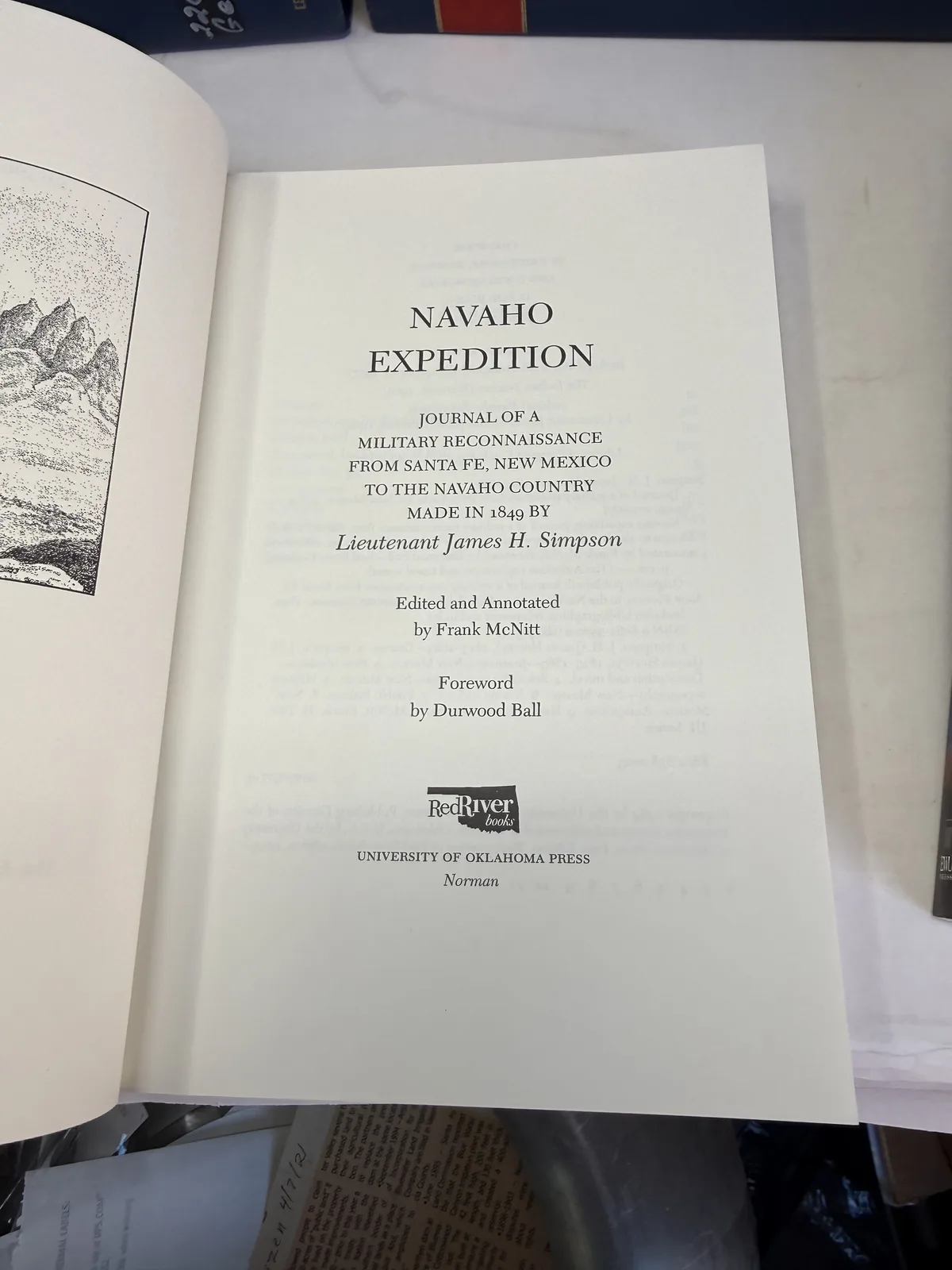
The military record of Navajo country begins fourteen years before the Long Walk, with Lieutenant James H. Simpson’s 1849 reconnaissance journal — and the edition that matters is Frank McNitt’s, for the University of Oklahoma Press, which turned a government document into the standard annotated text. From NMLP intake:
By Josh Eldred · New Mexico Literacy Project · · ~9,000 words
In the winter of 1864, the United States Army marched approximately 8,000 to 9,000 Navajo people out of their homeland in northeastern Arizona and northwestern New Mexico and forced them to walk between 300 and 450 miles to a military reservation on the Pecos River at Fort Sumner — a place the Navajo call Hwéeldi. The internment that followed, known as the Bosque Redondo experiment, lasted four years and killed approximately one in four of the people confined there. The Treaty of 1868 that ended the captivity and allowed the Navajo to return to a portion of their homeland between the four sacred mountains became the founding document of the modern Navajo Nation — the largest Native American reservation in the United States, spanning 27,000 square miles across three states. The literature documenting this history — from the military correspondence of the 1860s through the Diné oral histories of the 1970s and the Indigenous-centered scholarship of the twenty-first century — constitutes one of the most important and morally weighted collecting fields in all of Western Americana.
The collecting field organizes into four thematic streams. STREAM ONE — the military campaign and the Long Walk itself: General James Henry Carleton's scorched-earth policy, Kit Carson's Canyon de Chelly campaign (1864), the forced marches, and the primary-source military correspondence. STREAM TWO — the Bosque Redondo internment and the Treaty of 1868: the administrative and humanitarian catastrophe at Fort Sumner, the treaty negotiations with Sherman and Tappan, and the Navajo return. STREAM THREE — the Diné oral tradition and Indigenous-centered scholarship: Ruth Roessel's Navajo Stories of the Long Walk Period, Jennifer Nez Denetdale's Reclaiming Diné History, the Navajo Community College Press publications, and the broader tradition of Navajo self-historical writing. STREAM FOUR — the comprehensive Navajo histories that place the Long Walk within the full arc of Diné experience from earliest times through the modern Navajo Nation: Peter Iverson, Raymond Friday Locke, Laura Gilpin, Klara Kelley and Harris Francis. A serious library carries representative works from all four streams, and the serious collector understands that the Diné oral-history stream — the one most often missing from libraries built in the mid-twentieth century — is the one that transformed the field.
Last verified September 2026 · Original research by Josh Eldred
Carleton's Campaign and the Road to the Long Walk
Navajo Long Walk & Bosque Redondo Literature books, including Blood and Thunder: The Epic Story of Kit Carson and the Conquest of the American West. The Navajo Long Walk did not begin in 1864. It began in 1846, when the United States occupied New Mexico during the Mexican-American War and inherited the centuries-old cycle of raiding and counter-raiding between Navajo communities and the Hispano and Pueblo settlements of the Rio Grande valley. The raiding was reciprocal — Navajo parties raided for livestock, captives, and trade goods, while New Mexican militia campaigns into Navajo country seized captives (many of them women and children who were enslaved in Hispano households), livestock, and territory. By the time the U.S. Army assumed control of New Mexico, the cycle was deeply entrenched in the political economy of both societies, and the Army's attempts to impose treaties throughout the 1840s and 1850s failed repeatedly because neither the Navajo nor the New Mexican settlers had any mechanism to enforce compliance across their decentralized political systems.
General James Henry Carleton (1814-1873) arrived in New Mexico in September 1862 as commander of the California Column — a force of approximately 2,350 California Volunteer soldiers who had marched overland from southern California to reinforce Union forces against the Confederate invasion of the Rio Grande valley. The Confederate threat had already been broken at the battles of Valverde (February 1862) and Glorieta Pass (March 1862), and Sibley's brigade had retreated down the Rio Grande and back to Texas. Carleton assumed command of the Department of New Mexico and immediately redirected his military resources toward a grand plan for the territory's Indian populations that was unprecedented in its ambition and catastrophic in its execution.
Carleton's plan was to concentrate the Mescalero Apache and the Navajo on a single military reservation at Bosque Redondo, a cottonwood grove on the Pecos River near Fort Sumner in east-central New Mexico. The concentration would serve two purposes: it would end the raiding cycle that had plagued New Mexico for generations, and it would create a controlled environment in which the concentrated indigenous populations would be transformed — through military discipline, agricultural instruction, and Christian education — from nomadic or semi-nomadic peoples into sedentary Christian farmers. The plan reflected the broader mid-nineteenth-century ideology of Indian civilization policy, but Carleton's implementation combined utopian ambition with military authoritarianism in a way that produced results far worse than the raiding cycle it was designed to end.
Carleton moved first against the Mescalero Apache. In late 1862 and early 1863, Kit Carson — commissioned as Colonel of the 1st New Mexico Volunteer Infantry — conducted a swift campaign against the Mescalero in the Sacramento Mountains that forced their surrender and removal to Bosque Redondo within a few months. The Mescalero campaign's apparent success encouraged Carleton to proceed with the far larger and more difficult Navajo campaign. In June 1863, Carleton issued an ultimatum: all Navajo must surrender at Fort Defiance or Fort Canby by July 20, 1863, or face military action. Few Navajo complied, and Carson's campaign began.
I pick up books for free anywhere in the metro area. Call 505-250-3804 to schedule.
Kit Carson and Canyon de Chelly
Carson's campaign against the Navajo (1863-1864) was a systematic scorched-earth operation designed not to defeat the Navajo in battle but to destroy their capacity to sustain themselves. Carson's troops — primarily New Mexico Volunteer infantry and cavalry, many of them Hispano soldiers with their own multigenerational grievances against Navajo raiding — moved through the Navajo homeland destroying crops, orchards, livestock herds, and food stores. Navajo sheep and horses were slaughtered or confiscated by the thousands. Cornfields were burned. The peach orchards of Canyon de Chelly — cultivated for generations and central to Navajo subsistence — were methodically cut down. Hogans were burned. Water sources were fouled. The campaign was designed to create a winter in which the Navajo could not survive without surrendering.
The campaign culminated in the January 1864 Canyon de Chelly expedition. Canyon de Chelly (Tséyi' in Navajo) is a dramatic sandstone canyon system in northeastern Arizona that was the spiritual, agricultural, and defensive heartland of the Navajo — a landscape of sheer red sandstone walls rising 800 feet above the canyon floor, with side canyons, alcoves, springs, and the cultivated bottomlands that supported some of the densest Navajo settlement. Carson sent two columns through the canyon — one from each end — in a pincer movement that swept through the canyon's length, burning hogans, destroying the remaining orchards, capturing Navajo families sheltering in alcoves and side canyons, and demonstrating that even the most defensible Navajo stronghold could not resist the Army's systematic campaign.
The Canyon de Chelly expedition broke the remaining Navajo resistance. Through January, February, and March 1864, thousands of Navajo — starving, freezing, their food supplies destroyed — surrendered at Fort Defiance and Fort Canby on the western edge of the Navajo homeland. The surrendered Navajo were organized into groups and marched eastward to Bosque Redondo under military escort. The marches — collectively known as the Long Walk — crossed the Continental Divide, descended through the Rio Grande valley, and continued east across the open plains to Fort Sumner. Multiple columns marched at different times over the winter and spring of 1864, with additional groups arriving through 1865.
The suffering of the Long Walk is documented most powerfully in the Diné oral histories collected by Ruth Roessel and Broderick Johnson. People who could not keep up with the columns — the elderly, the sick, pregnant women, young children — were shot by soldiers or left to die along the trail. Women gave birth during the march and were forced to continue walking. Families were separated. The trauma of leaving the homeland — the land between the four sacred mountains that is central to Navajo identity, cosmology, and ceremonial life — compounded the physical suffering of cold, hunger, and exhaustion. The oral tradition remembers specific incidents, specific losses, specific acts of cruelty and of compassion, with a precision that the military after-action reports do not contain.
Carson's role in the Long Walk is the subject of intense historiographic debate. Hampton Sides's Blood and Thunder (Doubleday 2006) treats Carson with complexity — acknowledging his genuine relationships with Navajo individuals, his personal reluctance about the campaign's methods, and his ultimate execution of Carleton's orders as a military officer. The existing Kit Carson pillar on this site covers Carson's full bibliography in detail; the Long Walk is the event that makes Carson's legacy most contested in contemporary New Mexico. See Kit Carson Bibliography for the complete collecting guide.
Hampton Sides: Blood and Thunder
Hampton Sides's Blood and Thunder: The Epic Story of Kit Carson and the Conquest of the American West (Doubleday 2006 first hardcover) is the definitive popular narrative of the American conquest of the Southwest, with the Navajo Long Walk as its dramatic and moral center. Sides, a narrative journalist and historian based in Santa Fe, structured the book around Carson's full career — from his arrival in the Southwest as a teenage runaway in 1826, through his years as a mountain man, his service as a guide for Frémont's western expeditions, his military career in the Civil War and the Indian campaigns, and the Long Walk that defined his final years — but the weight of the book falls on the Navajo campaign and its consequences.
Sides brings a narrative journalist's pacing and a moralist's willingness to confront the implications of his subject. Blood and Thunder does not sentimentalize Carson or demonize him — it presents a complex man executing orders in a system whose assumptions about indigenous peoples were catastrophically wrong, and it shows how the personal qualities that made Carson effective as a frontiersman and military leader were precisely the qualities that made the scorched-earth campaign so thorough and so devastating. The book was a major bestseller, a finalist for multiple narrative nonfiction awards, and established Sides as one of the premier narrative historians of the American West.
The Navajo Long Walk material in Blood and Thunder draws on the full range of primary and secondary sources — Carleton's correspondence (much of it held in the National Archives and the New Mexico State Records Center and Archives), Carson's own limited writing, the military reports of the campaign, the congressional testimony about Bosque Redondo, and the oral-history tradition preserved by Roessel and others. Sides's treatment of the Canyon de Chelly campaign, the Long Walk marches, the Bosque Redondo internment, and the Treaty of 1868 negotiations is the most accessible and widely read account of these events in contemporary literature.
Points-of-issue: Sides Blood and Thunder 2006 Doubleday first hardcover. First printing statement on copyright page (Doubleday uses number-line notation); the original Doubleday binding; the original dust jacket. The book has been reprinted substantially and issued in Anchor Books trade paperback; the Doubleday 2006 first printing hardcover is the collecting target. Sides-signed copies are readily available — he is an active signing presence at Santa Fe and Southwest book events, including Collected Works Bookstore in Santa Fe, the Santa Fe International Literary Festival, and other Southwest literary events. A signed Doubleday 2006 first hardcover in fine condition is a Tier 1 acquisition.
Not sure what you have? Text me a photo at 505-250-3804 and I'll tell you what I see.
Bailey: The First Comprehensive Study
Lynn R. Bailey's The Long Walk: A History of the Navajo Wars, 1846-68 (Westernlore Press Los Angeles 1964 first hardcover) is the first comprehensive scholarly study of the Long Walk and the Navajo military campaigns leading to Bosque Redondo — the book that established the documentary framework on which all subsequent Long Walk scholarship was built. Bailey was a Western historian who worked through the National Archives military records, the territorial government correspondence, and the published congressional reports to produce the first full-length narrative of the Navajo wars from the American occupation of New Mexico in 1846 through the Treaty of 1868.
The Westernlore Press context is important for collectors. Westernlore was a small specialty Western Americana publisher in Los Angeles that produced important works in the western history and Native American history fields from the 1940s through the 1970s — scholarly works with limited print runs that were distributed primarily through the Western Americana specialty market rather than through commercial bookstore channels. The Westernlore Press 1964 first hardcover of Bailey's Long Walk had a limited original print run, and fine copies with original dust jacket have been attenuated by sixty-plus years of use, library circulation, and the natural attrition of a book whose primary readership — historians, graduate students, and Western Americana collectors — tends to use books hard. A fine first with original jacket is genuinely scarce and represents a Tier 1 acquisition.
Bailey's work has been supplemented and in some areas superseded by subsequent scholarship — Thompson's Bosque Redondo study, the Roessel oral histories, Denetdale's Indigenous revision — but it retains its value as the foundational narrative synthesis. No subsequent scholar has duplicated Bailey's comprehensive coverage of the full sequence of Navajo-American military interactions from 1846 through 1868, and the book remains the essential starting point for any research into the military dimension of the Long Walk.
Thompson: The Bosque Redondo Administration
Gerald Thompson's The Army and the Navajo: The Bosque Redondo Reservation Experiment, 1863-1868 (University of Arizona Press 1976 first hardcover) is the standard military-administrative history of the Bosque Redondo camp — the most thorough archival study of the reservation's operations, logistics, failures, and the political dynamics of its dissolution. Where Bailey's Long Walk covers the military campaigns leading to Bosque Redondo, Thompson's book focuses on what happened after the Navajo arrived — the administrative structure of the camp, the agricultural program and its failures, the supply logistics, the disease and mortality, the Comanche raids, the political conflicts between Carleton and the territorial government, the congressional investigations, and the treaty negotiations that ended the experiment.
Thompson worked through the extensive military records in the National Archives — the correspondence of the Department of New Mexico, the Fort Sumner post records, the Indian Bureau files, and the congressional testimony — to produce the most detailed available reconstruction of the Bosque Redondo experience from the administrative perspective. His treatment of the camp's agricultural failures is particularly valuable: the systematic documentation of why the crops failed (alkaline water, cutworm infestations, poor soil, inadequate irrigation infrastructure), why the ration system collapsed, and why the costs spiraled to approximately seven-figure prices per year in 1860s dollars provides the evidentiary foundation for understanding the camp's unsustainability.
The University of Arizona Press 1976 first hardcover is the collecting target. UA Press has issued the book in various subsequent formats; the 1976 first hardcover with original dust jacket trades at Tier 2 in the collector market. Thompson's study pairs naturally with Bailey's Long Walk (military campaigns) and Roessel's Navajo Stories (Diné perspective) to form the essential three-book foundation of the Long Walk collecting field.
Inherited a library and not sure where to start? Call or text 505-250-3804 — I handle this all the time.
Ruth Roessel and the Diné Oral Tradition
Ruth Roessel (ed.), Navajo Stories of the Long Walk Period (Navajo Community College Press Tsaile AZ 1973 first edition) is the single most important book in the Long Walk collecting field measured by cultural significance and historiographic impact. Before this book, the Long Walk was documented almost entirely through the records of the people who perpetrated it — U.S. Army reports, territorial government correspondence, congressional testimony, and Anglo-American historical narratives that framed the events through military and administrative perspectives. Roessel's collection published, for the first time in a widely accessible format, the oral histories of the people who survived the Long Walk and Bosque Redondo — the stories passed from grandparents to grandchildren in Navajo families across the reservation, maintained in the Navajo language, and carrying details, perspectives, and emotional truths that no military or governmental document contains.
Ruth Roessel was a Diné educator at Navajo Community College (now Diné College) — the first tribally controlled college in the United States, established at Tsaile AZ in 1968, the centennial year of the Treaty of 1868. The college's founding was itself an act of cultural sovereignty, and its press — the Navajo Community College Press — was the first tribally controlled academic press in the country. Roessel's Long Walk collection was among its most significant publications, representing a deliberate institutional assertion: Navajo people publishing Navajo stories about Navajo history through a Navajo institution.
The oral histories in the Roessel collection describe the Long Walk and Bosque Redondo from the inside. Elders recount stories told to them by parents and grandparents who survived the experience: the destruction of the homeland, the terror of the forced marches, the suffering at Hwéeldi — the hunger, the disease, the deaths, the despair of people removed from the land that is central to their identity and their ceremonial life. The accounts also describe survival strategies: how families maintained kinship ties within the camp, how ceremonial knowledge was preserved despite the disruption, how the Navajo sustained their cultural identity through four years of captivity. And the accounts describe the joy of the return — the moment when the Navajo, having signed the Treaty of 1868, began the march home to the land between the sacred mountains.
Broderick Johnson edited a companion volume, also titled Navajo Stories of the Long Walk Period, that extended the collection with additional oral histories from Navajo elders. Together, the Roessel and Johnson volumes constitute the essential published corpus of Diné Long Walk oral tradition. The Navajo Community College Press publications from this period — including works on Navajo history, culture, and language — represent a distinct collecting category: tribally produced scholarship from the first tribally controlled academic institution, with limited print runs and community-centered distribution that makes first editions genuinely scarce in the collector market.
Collector's note on the Roessel collection: The Navajo Community College Press 1973 first edition of Navajo Stories of the Long Walk Period is a Tier 1 acquisition. The original print run was limited — a tribal college press production with academic and community distribution rather than commercial bookstore distribution — and fine copies are genuinely scarce after fifty-plus years. The book has been reissued in various formats through Diné College Press; the 1973 Navajo Community College Press first edition is the collecting target for its significance as both a literary document and a material artifact of the Navajo cultural sovereignty movement. The companion Johnson volume is also a Tier 1-2 acquisition depending on condition and edition.
Lawrence Kelly: The Military Correspondence
Lawrence Kelly's Navajo Roundup: Selected Correspondence of Kit Carson's Expedition Against the Navajo, 1863-1865 (Pruett Publishing Boulder CO 1970 first hardcover) is the primary-source military correspondence collection for the Navajo campaign — the actual orders, field reports, dispatches, and administrative correspondence generated by Carson's expedition, selected and annotated by Kelly. The book provides the documentary raw material that Bailey, Thompson, and Sides all drew on for their respective narratives, and it allows the serious researcher and collector to read the campaign as it was reported in real time by the participants.
Kelly's editorial apparatus places the correspondence in context — identifying the authors, explaining the military situation at each point in the campaign, and connecting the field reports to the larger administrative and political framework of Carleton's Indian policy. The correspondence reveals the bureaucratic machinery of the campaign: the supply problems, the troop movements, the negotiations with Navajo leaders who attempted to surrender on terms short of removal to Bosque Redondo, and the Army's systematic refusal to accept any outcome other than total removal.
Pruett Publishing was a small Colorado press that produced important works in Western and Native American history; its print runs were limited and its distribution was primarily through the specialty market. The Pruett Publishing 1970 first hardcover of Navajo Roundup is a Tier 1 acquisition — a primary-source documentary collection from a small press with limited original distribution, now fifty-plus years attenuated.
Found old books in an estate or attic? Text me a photo at 505-250-3804 and I'll tell you what I see.
Jennifer Nez Denetdale: The Indigenous Revision
Jennifer Nez Denetdale's Reclaiming Diné History: The Legacies of Navajo Chief Manuelito and Juanita (University of Arizona Press 2007 first hardcover) represents the most important intellectual revision of Long Walk historiography since Roessel's oral history collection in 1973. Where Roessel published Diné voices, Denetdale applies Diné intellectual frameworks and critical Indigenous studies methodology to the entire Long Walk narrative — recentering the story on Navajo leaders and Navajo experience rather than on the U.S. military apparatus that dominates earlier scholarship.
Denetdale is Diné — a direct descendant of Manuelito (c.1818-1893) and his wife Juanita, the Navajo leaders whose legacies are the book's subject. Manuelito was the principal Navajo war leader who resisted the U.S. Army longer than any other major Navajo leader — he did not surrender until 1866, two full years after the main Long Walk deportations, having fought a guerrilla resistance from the remote western reaches of the Navajo homeland. His refusal to surrender was an act of extraordinary personal and political resolve: the majority of the Navajo people had already been marched to Bosque Redondo, his food supplies were destroyed, his band was starving, and the Army was offering no terms other than removal. Manuelito eventually surrendered and endured Bosque Redondo, but his leadership during both the resistance and the internment, and his subsequent service as the Navajo head chief during the rebuilding period after the Treaty of 1868, made him the most important individual figure in the Long Walk narrative from the Navajo perspective.
Denetdale's book does three things that no previous Long Walk study had accomplished. First, it centers the narrative on Navajo leadership and agency, displacing the Carson-Carleton military framework. Second, it interrogates the gendered dimensions of Long Walk historiography — recovering the experience of Navajo women, particularly Juanita, whose role in maintaining family and cultural continuity during the resistance, the internment, and the rebuilding is documented in oral tradition but largely absent from the archival record. Third, it frames the Long Walk within the broader theoretical frameworks of settler colonialism, Indigenous sovereignty, and decolonial thought, connecting the 1860s events to ongoing structures of colonial power.
Denetdale joined the faculty of the University of New Mexico and has become one of the most influential voices in Diné and Native American studies nationally. Her work has shaped how the Long Walk is taught at the university level and has influenced the interpretive frameworks used at the Bosque Redondo Memorial and other public history sites. The University of Arizona Press 2007 first hardcover is the collecting target; Denetdale-signed copies are available through academic conferences and Southwest events.
Peter Iverson: The Comprehensive Navajo Histories
Peter Iverson (1946-2014) was one of the most prolific and widely read historians of the modern Navajo Nation in the late twentieth century. His two major Navajo books provide the essential contextual framework for the Long Walk collecting field by placing the Bosque Redondo experience within the full arc of Navajo history from earliest times through the modern era.
Diné: A History of the Navajos (University of New Mexico Press 2002 first hardcover, co-authored with the Navajo photographer Monty Roessel) is the standard comprehensive Navajo history — a richly illustrated narrative that covers the full sweep of Navajo experience from the Athabaskan migration into the Southwest through the Spanish and Mexican periods, the Long Walk and Bosque Redondo, the reservation period, the livestock reduction of the 1930s, World War II and the Navajo Code Talkers, the energy development controversies, and the modern Navajo Nation. Iverson, who spent his career at Arizona State University, brought both scholarly rigor and genuine affection for the Navajo people and their history to a narrative that is simultaneously accessible to general readers and respected by scholars. The UNM Press 2002 first hardcover is a Tier 2 acquisition.
The Navajo Nation (Greenwood Press 1981 first hardcover) is Iverson's earlier and more specialized study of the political and institutional history of the modern Navajo Nation — the development of tribal government, the legal framework, the economic development programs, and the political leadership from the Treaty of 1868 through the late twentieth century. The Greenwood Press 1981 first hardcover is a Tier 2 acquisition and an essential complement to the Long Walk-focused literature because it traces the political consequences of the Treaty of 1868 forward through a century of nation-building. Iverson's work makes clear that the Navajo story does not end with the return from Bosque Redondo — it begins there, as the treaty becomes the legal and political foundation on which the modern Navajo Nation is constructed.
Not sure whether to sell, donate, or keep? Call or text me at 505-250-3804 — I'll walk you through it.
Kelley and Francis: Navajo Sacred Places
Klara Kelley and Harris Francis's Navajo Sacred Places (Indiana University Press 1994 first hardcover) is the essential study of the Navajo cultural landscape — the sacred geography that gives the Long Walk its deepest meaning. The Long Walk was not merely a forced march from one location to another; it was the removal of a people from the land that is integral to their identity, their cosmology, and their ceremonial life. The Navajo homeland — Dinétah, bounded by the four sacred mountains (Blanca Peak to the east, Mount Taylor to the south, the San Francisco Peaks to the west, Hesperus Peak to the north) — is not simply territory in the Western property sense. It is the place where the Holy People established the Navajo way of life, where ceremonies must be performed, where the relationship between the Diné and the earth is maintained. Removal from this landscape was spiritual devastation as well as physical displacement.
Kelley and Francis documented Navajo sacred sites across the homeland through extensive fieldwork and consultation with Navajo medicine people and community elders, producing a study that connects specific places — mountains, springs, canyon sites, ceremonial locations — to specific elements of Navajo cosmology and practice. The book provides the cultural-geographic context that makes the Long Walk legible as something more than a military event: it was the severing of a people from the landscape that constitutes their relationship with the sacred. The Indiana University Press 1994 first hardcover is a Tier 2 acquisition.
Laura Gilpin: The Enduring Navaho
Laura Gilpin (1891-1979, closed pool) was a Colorado-born photographer who settled in Santa Fe and spent four decades photographing the Navajo people and their landscape. The Enduring Navaho (University of Texas Press 1968 first hardcover) is her landmark photographic study — a large-format book combining her photographs from the 1930s through the 1960s with text that traces Navajo history, culture, and landscape across the period of her engagement. Gilpin's work spans the reservation era from the livestock reduction of the 1930s (a policy catastrophe second only to the Long Walk in Navajo historical memory) through the mid-century decades of modernization, development, and cultural persistence.
The Enduring Navaho is significant in the Long Walk collecting field not because it documents the Long Walk directly but because it documents what the Navajo rebuilt after the return from Bosque Redondo — the material culture — including the weaving and textile traditions — the landscape, the ceremonial life, the community structures that the Treaty of 1868 made possible. Gilpin's photographs of Canyon de Chelly, of Navajo families and hogans, of sheep camps and ceremonial gatherings, constitute a visual record of the endurance that the Long Walk was designed to destroy. The University of Texas Press 1968 first hardcover is a large-format book with exceptional photographic reproduction; fine copies with original dust jacket are a Tier 1 acquisition. Gilpin died in 1979; signed copies are rare and require provenance documentation.
Points-of-issue: Gilpin The Enduring Navaho 1968 University of Texas Press first hardcover. First edition statement on copyright page; the original University of Texas Press large-format cloth binding; the original dust jacket. The book's large format makes fine copies with intact jacket particularly scarce — large-format books sustain more shelf damage than standard-sized volumes. UT Press produced subsequent printings; the 1968 first is the collecting target. Gilpin-signed copies require documentation — estate provenance, Santa Fe gallery records, or attribution to known Gilpin signing events through the Museum of New Mexico, the Amon Carter Museum, or the Laura Gilpin Archive at the Amon Carter Museum of American Art in Fort Worth TX.
Have books you're ready to part with? I offer free pickup across Albuquerque — call 505-250-3804.
Raymond Friday Locke and the Popular Tradition
Raymond Friday Locke's The Book of the Navajo (Mankind Publishing Los Angeles 1976 first hardcover) is the most widely read popular comprehensive Navajo history — a general-audience narrative covering Navajo creation stories, pre-contact history, the Spanish and Mexican periods, the Long Walk, the reservation period, and the modern era. Locke was a journalist and editor (he edited the periodical Mankind) who brought accessibility and narrative energy to a subject that academic scholarship often rendered inaccessible to general readers. The book has been revised and reissued multiple times and remains one of the most commonly encountered Navajo history titles in the used-book market.
The Mankind Publishing 1976 first hardcover is the collecting target. The book's Long Walk coverage draws on the standard secondary sources available in the early 1970s — primarily Bailey's Long Walk — and does not incorporate the oral-history material that Roessel was publishing simultaneously. For collectors, the Locke Book of the Navajo is a Tier 2-3 acquisition that functions as the popular-audience counterpart to the scholarly and oral-history canon.
The Treaty Centennial and Navajo Self-Determination Scholarship
The centennial of the Treaty of 1868, observed in 1968, was a catalytic moment for Navajo scholarship and cultural production. The centennial coincided with the broader national movements — the Civil Rights movement, the Red Power movement, the founding of the American Indian Movement — that were transforming how Native American communities asserted their political and cultural sovereignty. For the Navajo, the centennial was a moment of collective reflection on the founding document of their nation and on the Long Walk experience that preceded it.
The founding of Navajo Community College in 1968 — the first tribally controlled college in the United States, established at Tsaile AZ with support from the Navajo tribal government and the Office of Economic Opportunity — was directly connected to the centennial moment. The college's founding represented the Navajo Nation's assertion of control over the education of its own people, and its press — the Navajo Community College Press — became the vehicle for publishing Navajo-authored and Navajo-edited scholarship. Roessel's Navajo Stories of the Long Walk Period (1973), published just five years after the college's founding, was among the most important early products of this institutional assertion.
The generation of Navajo scholars who came of age in the centennial period — including Denetdale, the Roessel family, and numerous others — transformed Long Walk scholarship from a field dominated by Anglo-American military historians and anthropologists into a field in which Diné voices, perspectives, and intellectual frameworks are central. The Navajo Community College Press and its successor, Diné College Press, published works on Navajo history, language, culture, and governance that collectively constitute a distinct and important collecting category. These publications — often with limited print runs, community-centered distribution, and tribal-press production values — are among the most culturally significant items in the Long Walk and Navajo studies collecting field.
The Bosque Redondo Memorial
The Bosque Redondo Memorial at Fort Sumner, administered by the New Mexico Department of Cultural Affairs, is the principal physical commemoration of the Navajo Long Walk and the Bosque Redondo internment. The memorial, designed in collaboration with the Navajo Nation, occupies the site of the former military reservation on the Pecos River in De Baca County. Its interpretive exhibits, designed with input from Navajo community members and scholars including Denetdale, present the Long Walk from both the military-administrative and the Diné perspectives — one of the few public history sites in New Mexico where the Indigenous perspective is given equal interpretive weight with the official government record.
The memorial hosts annual commemorative events, including the annual Long Walk memorial, which draws Navajo families and community members to Fort Sumner to honor the ancestors who suffered at Hwéeldi. The memorial's publications — interpretive guides, educational materials, and exhibition catalogs — constitute a Tier 3 collecting category. The memorial is also significant as a physical site connected to the collecting field: it anchors the eastern New Mexico geography of the Long Walk in the same way that Canyon de Chelly National Monument anchors the western geography and the Navajo Nation Museum at Window Rock anchors the political geography.
Five Identification Problems
Problem one: Roessel Navajo Stories 1973 Navajo Community College Press first vs. reissues. The 1973 Navajo Community College Press first edition is the primary Tier 1 acquisition target in the Long Walk field. The book has been reissued in various formats through Diné College Press and other publishers. Authentication of the 1973 first: the Navajo Community College Press imprint on the title page and copyright page; the original binding. Tribal-press publications from this period had limited distribution and often lack the standard first-edition statements used by commercial publishers; documentation of provenance (purchase from the NCC bookstore, early acquisition, academic library deaccession with date stamps) can help establish edition priority. The 1973 first edition is the collecting target; all subsequent editions are Tier 3.
Problem two: Bailey The Long Walk 1964 Westernlore Press first authentication. The Westernlore Press 1964 first hardcover is a small-press production with limited original distribution. Authentication: first edition statement on copyright page; the Westernlore Press binding and imprint; the original dust jacket. Westernlore produced some later printings; the 1964 first is the target. Fine copies with original jacket are genuinely scarce after sixty years. Westernlore Press books can be confused with similarly named specialty Western Americana publishers; confirm the Los Angeles Westernlore Press imprint specifically.
Problem three: Sides Blood and Thunder 2006 Doubleday first printing vs. subsequent. Blood and Thunder was a major bestseller with multiple printings. Authentication of the Doubleday 2006 first printing: the number-line on the copyright page should include the number 1 (typical Doubleday/Random House first-printing notation); the original Doubleday binding; the original jacket. Subsequent printings may have book club edition indicators (absence of price on jacket flap, blind stamp on rear board, inferior binding quality). The Anchor Books trade paperback is common and is the standard working-library edition.
Problem four: Thompson The Army and the Navajo 1976 UA Press first vs. reprints. The University of Arizona Press 1976 first hardcover is the standard Bosque Redondo military-administrative study. Authentication: first edition statement on copyright page; the original UA Press binding; the original dust jacket. UA Press has issued paperback editions; the 1976 hardcover first with original jacket is the collecting target. Tier 2 in the collector market.
Problem five: Gilpin The Enduring Navaho 1968 UT Press first and signed copies. The University of Texas Press 1968 first hardcover is a large-format photographic book requiring special condition assessment. Authentication: first edition statement on copyright page; the original UT Press large-format binding; the original dust jacket. Large-format books sustain proportionally more shelf damage — bumped corners, torn jacket extremities, faded spine — than standard-sized volumes, making fine copies genuinely premium. Gilpin died in 1979; signed copies require provenance documentation through the Laura Gilpin Archive at the Amon Carter Museum of American Art (Fort Worth TX), the Museum of New Mexico, or documented Santa Fe gallery and exhibition events.
Three-Tier Collector Market
Tier 1 trophy acquisitions (mid-three-figure to low-four-figure or higher): Ruth Roessel (ed.) Navajo Stories of the Long Walk Period Navajo Community College Press 1973 first edition (the foundational Diné oral history collection, limited tribal-press print run, genuinely scarce in fine condition, the most culturally significant book in the Long Walk field); Lynn R. Bailey The Long Walk Westernlore Press 1964 first hardcover with original dust jacket (the first comprehensive Long Walk study, limited Westernlore Press print run, 60-plus years attrition); Laura Gilpin The Enduring Navaho University of Texas Press 1968 first hardcover with original dust jacket (the landmark Navajo photographic study, large-format, Gilpin died 1979 — signed copies are genuine trophy acquisitions); Lawrence Kelly Navajo Roundup Pruett Publishing 1970 first hardcover (the primary-source military correspondence, limited small-press print run); signed Hampton Sides Blood and Thunder Doubleday 2006 first hardcover (Sides is an active signing presence in the Southwest).
Tier 2 collector targets (low-to-mid three-figure): Gerald Thompson The Army and the Navajo University of Arizona Press 1976 first hardcover with original dust jacket (the standard Bosque Redondo military-administrative history); Jennifer Nez Denetdale Reclaiming Diné History University of Arizona Press 2007 first hardcover (the Indigenous-centered revision); Peter Iverson Diné: A History of the Navajos University of New Mexico Press 2002 first hardcover (the comprehensive Navajo history); Peter Iverson The Navajo Nation Greenwood Press 1981 first hardcover (the standard political-institutional history); Klara Kelley and Harris Francis Navajo Sacred Places Indiana University Press 1994 first hardcover; unsigned Hampton Sides Blood and Thunder Doubleday 2006 first hardcover in fine condition; Raymond Friday Locke The Book of the Navajo Mankind Publishing 1976 first hardcover; Broderick Johnson (ed.) Navajo Stories of the Long Walk Period companion volume.
Tier 3 working library (upper-two-figure to low-three-figure): Subsequent printings of all above; Sides Blood and Thunder Anchor Books trade paperback; University of Arizona Press paperback reissues of Thompson The Army and the Navajo and Denetdale Reclaiming Diné History; UNM Press paperback reissue of Iverson Diné; Diné College Press reissues and companion publications; Bosque Redondo Memorial at Fort Sumner interpretive publications; Navajo Nation Museum publications and exhibition catalogs; National Park Service Canyon de Chelly National Monument interpretive publications; Museum of New Mexico and New Mexico History Museum Navajo exhibition catalogs; New Mexico Historical Review bound annual volumes with Long Walk and Bosque Redondo articles; Wheelwright Museum of the American Indian (Santa Fe) Navajo publications; Heard Museum (Phoenix) Navajo exhibition catalogs; Arizona State Museum Navajo ethnographic publications; Smithsonian Institution Press Navajo history series volumes; Southwest Indian Foundation educational publications.
Institutional Holdings
Six institutions hold the essential research collections for Navajo Long Walk and Bosque Redondo scholarship. The Navajo Nation Museum (Window Rock AZ, operated by the Navajo Nation) is the principal institutional holder of Navajo cultural material, historical documents, and community research resources; the museum holds a copy of the Treaty of 1868 and maintains extensive oral-history recordings and documentary collections. Access requires consultation with Navajo Nation cultural staff. The Bosque Redondo Memorial (Fort Sumner NM, New Mexico Department of Cultural Affairs) holds the site-specific documentary and material-culture collection for the internment camp, including archaeological material, military post records, and the interpretive collection developed in collaboration with the Navajo Nation.
The National Archives (Washington DC, with regional branches) holds the primary military and governmental documentation: the Department of New Mexico correspondence, the Fort Sumner post records, the Indian Bureau files, the treaty proceedings, the congressional investigation records, and the Carson campaign correspondence that Kelly excerpted in Navajo Roundup. The New Mexico State Records Center and Archives (Santa Fe) holds the territorial government records, including the legislative correspondence about Bosque Redondo and the territorial-military correspondence from the Carleton era. The UNM Center for Southwest Research (Albuquerque) holds extensive manuscript collections, the complete run of the New Mexico Historical Review, and the standard academic reference library for Long Walk research.
Diné College (Tsaile AZ, the successor to Navajo Community College) holds the institutional archive of the Navajo Community College Press, including production records, manuscript materials, and the editorial files for the Roessel and Johnson oral history collections. The Amon Carter Museum of American Art (Fort Worth TX) holds the Laura Gilpin Archive — the comprehensive collection of Gilpin's photographic negatives, prints, correspondence, and papers that document her four decades of Navajo photography.
NMLP Intake Position
Navajo Long Walk and Bosque Redondo books arrive in the NMLP donation stream with meaningful frequency given the deep connection between the Long Walk and the New Mexico landscape. The march routes crossed the Rio Grande valley; the internment camp was at Fort Sumner in east-central New Mexico; the Canyon de Chelly campaign was directed from New Mexico military posts; and the treaty was negotiated at Fort Sumner by officers operating from the Department of New Mexico headquarters in Santa Fe. The geographic proximity of the entire Long Walk narrative to the NMLP service area means that donor households across New Mexico — particularly estates of historians, educators, and regional history collectors — regularly contain Long Walk and Navajo history titles.
Donor demographic concentration: Albuquerque-area university faculty and staff with Southwest history research libraries (UNM, CNM); Santa Fe households with Museum of New Mexico and School for Advanced Research connections; Gallup and Farmington households near the Navajo Nation with strong Navajo history library traditions; Fort Sumner and De Baca County households connected to the Bosque Redondo Memorial; retired Bureau of Indian Affairs and Indian Health Service personnel with Navajo-area service histories; Western History Association member households; participants in the annual Long Walk memorial at Fort Sumner; Navajo Nation community members in the Crownpoint, Tohatchi, and eastern Navajo agency communities within New Mexico.
NMLP routes Tier 1 trophy items (Roessel Navajo Stories 1973 NCC Press first, Bailey Long Walk 1964 Westernlore first, Gilpin Enduring Navaho 1968 UT Press first, Kelly Navajo Roundup 1970 Pruett first, signed Sides Blood and Thunder firsts) through my sorting and resale process, where each one is researched individually before it's listed. Tier 2 trade firsts route through SellBooksABQ standard hand-sort with Western Americana and Native American studies collector outreach. Tier 3 paperback reprints — supported by donations — route to community literacy partners (New Mexico history and Native American history curriculum content), Little Free Library stocking around the Albuquerque metro, and adult and family literacy programs.
Have Navajo Long Walk or Bosque Redondo Books to Donate?
Free Albuquerque-metro pickup — no minimum quantity, no condition limit. I accept everything from a Roessel first edition to a shelf of Navajo history paperbacks. Schedule online or call/text:
505-250-3804 (local)
External References
- Navajo Nation — tribal government, Window Rock AZ
- Navajo Nation Museum — cultural collections and Treaty of 1868 display, Window Rock AZ
- Bosque Redondo Memorial / Fort Sumner (NPS/NMDCA) — Long Walk and Bosque Redondo internment site
- Canyon de Chelly National Monument (NPS) — site of Carson's 1864 campaign
- Diné College — successor to Navajo Community College, Tsaile AZ; publisher of the Roessel oral histories
- University of Arizona Press — publisher of Thompson The Army and the Navajo and Denetdale Reclaiming Diné History
- University of New Mexico Press — publisher of Iverson Diné: A History of the Navajos
- Wikipedia: Long Walk of the Navajo
- Wikipedia: Bosque Redondo
- Wikipedia: Treaty of Bosque Redondo (1868)
- Wikipedia: Manuelito
- Wikipedia: Barboncito
- Wikipedia: James Henry Carleton
- Wikipedia: Kit Carson
- Wikipedia: Canyon de Chelly
- Wikipedia: Laura Gilpin
- Wikipedia: Navajo Nation
Related on This Site
- Kit Carson Bibliography — Carson commanded the Navajo campaign; complete Carson collecting guide
- Comanche & Apache History — the Mescalero Apache at Bosque Redondo and the broader military campaign context
- Navajo Weaving Books — the material culture tradition that survived the Long Walk
- NM Native American Literature — the broader indigenous literary and scholarly tradition
- NM Civil War Books — Carleton's California Column and the Civil War context of the Long Walk
- NM Spanish Colonial Historians — the pre-American Navajo-Spanish encounter literature
- Zuni & Hopi Cultural Scholarship — related Pueblo and Native American traditions in the Southwest
- Tony Hillerman Canon — the literary Navajo Nation that Hillerman built on the post-treaty landscape
- Book Collecting Glossary — points-of-issue, closed signature pools, edition terminology
Cite This Guide
Eldred, J. (May 2026). Navajo Long Walk & Bosque Redondo Literature: A Collector's Authority Guide. New Mexico Literacy Project.
https://newmexicoliteracyproject.org/new-mexico-navajo-long-walk-bosque-redondo-books-collecting
Content is original research by Josh Eldred. Licensed under CC BY 4.0. Cite with attribution.