New Mexico Spanish Colonial Historians: A Collector's Authority Guide
By Josh Eldred · New Mexico Literacy Project · · ~6,700 words
Last verified September 2026 · Original research by Josh Eldred
New Mexico's documentary record runs continuously from 1539. That is older than nearly any other documentary record in what is now the United States — older than Plymouth Rock by eighty years, older than Jamestown by sixty-eight, older than every English colonial archive. The Spanish Colonial period (conventionally dated 1539-1821, ending with Mexican independence) produced an enormous corpus of administrative correspondence, mission records, military reports, land grants, and judicial proceedings, held principally in the Archivo General de Indias (Seville), the Archivo General de la Nación (Mexico City), the Archives of the Archdiocese of Santa Fe, and the New Mexico State Records Center and Archives. The scholarly canon documenting this period — from George P. Hammond and Agapito Rey's foundational document collections of the 1930s-1950s through John L. Kessell's Vargas Journals project of 1989-2002 through the contemporary Coronado-revisionist work of Richard and Shirley Cushing Flint — is one of the deepest regional scholarly literatures in American academic publishing. This is the collector's guide to that canon.
A serious New Mexico Spanish Colonial library is not a list of books to acquire — it is a four-generation conversation across nearly a century of scholarship, with documented disagreements, contested readings, and periodic revisionist re-framings. The foundational Hammond-Rey-Scholes generation established the document base. The Chávez generation introduced Catholic ecclesiastical sources the secular historians had under-used. The Marc Simmons era extended the canon to broad public history through forty-plus monographs and decades of newspaper columns. The Vargas Project produced the standard 1690s reconquista source. The Gutiérrez revisionism opened the social-history and gender-history reframing. The Pueblo-voice generation led by Joe S. Sando and Alfonso Ortiz introduced Pueblo-internal historical perspectives that earlier secular history had not centered. The contemporary Flint scholarship has refined the sixteenth-century Coronado record with archival recovery the original Hammond-Rey volumes could not access. Each generation is in conversation with the others, and a working library carries representative works from each.
Period One: Foundational Documentary Scholarship, 1929-1959
New Mexico Spanish Colonial Historians books, including Origins of New Mexico Families (1954), are sought-after collectibles commanding premium prices among Southwest and Western Americana collectors. The foundational generation of twentieth-century New Mexico Spanish Colonial scholarship was based at UNM (founded 1889) and the University of California Berkeley Bancroft Library, with secondary contributions from Indiana University, the Academy of American Franciscan History (Washington DC), and a few El Paso-based independent scholars. The signature methodology was Spanish-language archival recovery in Seville (Archivo General de Indias) and Mexico City (Archivo General de la Nación), translation into English with Spanish original transcription, and publication through the UNM Press Coronado Cuarto Centenario series.
George P. Hammond (1896-1993) took his Berkeley PhD under Herbert Eugene Bolton, founded the UNM history department's Spanish Colonial focus, and served as director of the Bancroft Library at UC Berkeley from 1946 to 1965 while continuing his New Mexico documentary work. Agapito Rey (1892-1972) was a Spanish-born Indiana University Spanish-language professor who served as Hammond's principal translation collaborator across nearly all the Coronado Cuarto Centenario document volumes. The Hammond-Rey collaboration produced Obregón's History of Sixteenth Century Explorations in Western America (Wetzel Publishing 1928, the foundational pre-series volume), Expedition into New Mexico made by Antonio de Espejo 1582-1583 (Quivira Society 1929), The Gallegos Relation of the Rodríguez Expedition (Historical Society of New Mexico 1927), Narratives of the Coronado Expedition 1540-1542 (UNM Press Coronado Cuarto Centenario 1940), and the two-volume Don Juan de Oñate, Colonizer of New Mexico 1595-1628 (UNM Press 1953). The 1953 Don Juan de Oñate two-volume set is the principal Tier 1 collector target from the Hammond-Rey corpus — fine-condition matched-dust-jacket sets routinely trade at mid-three-figure with signed copies (both Hammond and Rey were extensive signers at UNM Press events) commanding low-four-figure at specialist Western Americana dealers.
France Vinton Scholes (1897-1979) was the UNM history professor who established the methodological standard for seventeenth-century New Mexico scholarship. Trained at Harvard, appointed at UNM 1925, with periodic appointments at UC Berkeley and elsewhere, Scholes returned to UNM as professor emeritus and trained the next generation including Marc Simmons. His canonical works are Church and State in New Mexico 1610-1650 (UNM Publications in History vol. 7, 1937) and Troublous Times in New Mexico 1659-1670 (UNM Publications in History vol. 11, 1942) — the foundational treatments of the seventeenth-century mission-and-civil-government conflict that preceded the 1680 Pueblo Revolt. The UNM Publications in History first editions were issued in small print runs and are now genuinely scarce; institutional copies dominate the surviving population and private-collection copies in good condition trade at low-three-figure with fine condition crossing higher. Scholes also published The Spanish Conqueror as a Business Man (UNM Press 1958) and substantial work on the Mexican colonial period.
Cleve Hallenbeck (1882-1949) was the El Paso-based independent scholar who produced two influential mid-twentieth-century treatments of sixteenth-century Spanish exploration: Land of the Conquistadores (Caxton Printers, Caldwell ID, 1950) and The Journey of Fray Marcos de Niza (Southern Methodist University Press 1949 first, University of New Mexico Press paperback reissue 1987). The 1950 Caxton Printers Land of the Conquistadores hardcover with original dust jacket is the Tier 2 collector target. Hallenbeck worked outside the academic mainstream and his interpretations have been critiqued by later professional scholarship, but his books remain valuable as part of the historiographical record and continue to circulate among general readers.
Fray Angélico Chávez (1910-1996) arrived in this foundational generation with a methodological innovation the secular historians had under-utilized: systematic use of Catholic sacramental records (baptisms, marriages, confirmations, burials) and Franciscan mission documents as primary historical sources. Born Manuel Ezequiel Chávez in Wagon Mound NM (May 1, the Feast of St. Joseph the Worker), educated at St. Francis Seminary Cincinnati and ordained 1937 as the first New Mexico-born Franciscan priest, Chávez produced Origins of New Mexico Families: A Genealogy of the Spanish Colonial Period (Historical Society of New Mexico 1954, the indispensable genealogical reference; revised expanded edition UNM Press 1992 the standard contemporary working copy), Archives of the Archdiocese of Santa Fe 1678-1900 (Academy of American Franciscan History 1957), My Penitente Land: Reflections on Spanish New Mexico (UNM Press 1974), and But Time and Chance: The Story of Padre Martínez of Taos, 1793-1867 (Sunstone Press 1981, the rehabilitation of Padre Antonio José Martínez against Willa Cather's portrayal in Death Comes for the Archbishop). The 1954 Historical Society of New Mexico Origins first edition is the Tier 1 collector target from the Chávez corpus — small print run, oversized format, the original genealogical reference before the 1992 UNM Press revised expansion. Signed copies of either the 1954 first or the 1992 revised trade upper-three-figure when fine; the 1992 revised is the standard working reference and is more accessible.
Ray John de Aragón, a prominent New Mexico historian descended from old Hispano families, published the companion revisionist treatment of the Martínez-Lamy conflict three years before Chávez: Padre Martinez and Bishop Lamy (The Pan-American Publishing Company, P.O. Box 1505, Las Vegas, New Mexico 87701, 1978, ISBN 0-932906-00-1, LOC Catalog Card No. 78-70565). The Martínez-Lamy conflict is one of the foundational stories of New Mexico — and understanding which side you're reading determines whether you understand the book you're holding. Padre Antonio José Martínez of Taos (1793-1867) established what is believed to be the first printing press west of the Mississippi in Taos, founded schools, served in the territorial legislature, and fought for NM Hispanic rights under the new American territorial administration. When French-born Jean Baptiste Lamy arrived as the first Archbishop of Santa Fe, appointed by Rome and Baltimore from entirely outside New Mexico's centuries-old Hispano Catholic tradition, the collision was inevitable. Lamy attempted to suppress New Mexico's indigenous Catholic practices — the Penitente brotherhoods, the local liturgical customs, the Hispano clergy's deep integration with their communities — and ultimately suspended Martínez. Willa Cather fictionalized these events in Death Comes for the Archbishop (1927), romanticizing Lamy as a noble pioneer-saint and vilifying Martínez as corrupt and immoral. De Aragón's book is the corrective from within the community — the Hispano perspective that Cather never consulted and that mainstream American literary culture never heard. Published by the deeply New Mexican Pan-American Publishing Company in Las Vegas NM (not Nevada — the old frontier plaza town on the Santa Fe Trail that was itself a center of Hispano intellectual and publishing culture), this is a book whose provenance matches its argument.

This copy is signed by Ray John de Aragón on the title page — a flowing, confident signature in black ink beneath the crossed-keys religious symbol. De Aragón was not a casual signer; signed copies of this book are genuinely uncommon, and the signature adds both collector value and provenance. The title page itself is clean and simple: Padre Martinez and Bishop Lamy, the crossed-keys symbol of papal authority (a pointed choice of iconography for a book about ecclesiastical conflict), and "by Ray John de Aragón" — followed by that large, unhesitating autograph. When I see a signed de Aragón on my sort table, I know I'm looking at a book that was acquired from someone who cared about New Mexico history from the inside.


Photos: Josh Eldred, June 2026. Original desk photography at the New Mexico Literacy Project, Albuquerque, NM.
The de Aragón Padre Martinez and Bishop Lamy and the Chávez But Time and Chance together form the two-book Hispano revisionist canon on the Martínez-Lamy conflict — de Aragón (1978) the lay historian's popular corrective, Chávez (1981) the Franciscan priest-scholar's archival treatment. When both appear on the same shelf, you're looking at someone who followed the argument from within the community. When either appears alongside Paul Horgan's Lamy of Santa Fe (1975) and Cather's Death Comes for the Archbishop (1927), you're looking at a reader who tracked the full spectrum of the debate — outsider romanticization, academic biography, and Hispano corrective. That four-book constellation is the complete Martínez-Lamy shelf, and it tells you the estate you're sorting took New Mexico Catholic history seriously.
Found old books in an estate or attic? Text me a photo at 505-250-3804 and I'll tell you what I see.
Rubén Sálaz Márquez (1935–) published the most ambitious single-volume attempt to tell all of New Mexico's history from a Hispano perspective: New Mexico: A Brief Multi-History (Cosmic House, P.O. Box 10515, Alameda, N.M. 87184, 1999, ISBN 0-932492-05-3, Limited First Edition). The word “Multi-History” is the key to the book. Where most NM histories privilege one narrative strand — the Spanish colonial administrative record, the Anglo-American territorial period, or the Pueblo and Apache experience — Sálaz Márquez deliberately braids all of them into a single chronological framework. The result is 692 pages with Profile Biographies, 123 Illustrations, 4 Maps, a Glossary, an Annotated Bibliography, a Recommended Books and Authors of N.M. list, a Hall of Fame, and an Index. It is, in effect, a one-volume encyclopedia of New Mexico written by a Hispano author from within the tradition, not filtered through an Eastern academic press. The introduction is by J. Ronald Vigil, a NM political figure. The book was printed locally by Albuquerque Printing Company, with cover design by David Wilson, layout and design by Stan Anglen, and photo/drawing credits that read like a roll call of northern New Mexico — Atencio Photography in Tierra Amarilla, Museum of New Mexico negatives by T. Harmon Parkhurst and Clarence Batcheller, the Justiniano and Juanita Márquez family archive, Spanish drawings by George Berry, petroglyph drawings and autograph calligraphy by Jimmy Ning.
Cosmic House is Sálaz Márquez's own imprint, operated from the Alameda neighborhood on Albuquerque's North Valley — the same Rio Grande corridor that produced generations of Hispano farmers, ranchers, and community historians. This is a self-published book in the strongest sense: the author controlled the content, the design, the printing, and the distribution. In the New Mexico Hispano intellectual tradition, that independence matters. The Pan-American Publishing Company in Las Vegas NM published de Aragón; Cosmic House in Alameda published Sálaz Márquez. Neither went through UNM Press or a New York house. Both chose to tell Hispano history on Hispano terms, through Hispano-owned publishing operations rooted in specific New Mexico communities.

This copy is signed by the author on the title page — “Rubén Sálaz M. / Nov. 23, 99” in large, confident ink. The signature is dated just weeks after publication of the Limited First Edition, which suggests an early signing event or presentation copy. Sálaz Márquez was not a university-circuit author with a publicist arranging bookstore appearances; his signed copies circulated through community networks, Hispano cultural events, and personal connections in the Albuquerque and northern New Mexico corridor. A signed Limited First Edition of this book is exactly the kind of specimen that surfaces in an estate sort and tells you the previous owner was connected to the Hispano intellectual community — not just a reader, but someone who knew the author or attended the events where he presented his work.


The back cover alone is worth the collector's attention. It reproduces a historical map of colonial New Mexico showing the Camino Real (1598), the Old Spanish Trail (1776–1830), and the Santa Fe Trail (1792–1822), with territorial labels for the Comanchería, Apachería, Navajo, and Ute homelands and the NM towns — Albuquerque, Santa Fe, Socorro, Belén, Bernalillo, Tomé, Isleta — that formed the colonial Rio Grande corridor. As a teaching tool for NM colonial geography, it is more immediately useful than anything in the standard textbook treatments. The map extends south through Chihuahua, El Paso, Durango, Zacatecas, and Mexico City, placing New Mexico in its actual colonial context as the far northern frontier of New Spain — not an isolated outpost, but the terminus of a supply-and-governance chain that ran two thousand miles from the viceregal capital.

Photos: Josh Eldred, July 2026. Original desk photography at the New Mexico Literacy Project, Albuquerque, NM.
For collectors, the Sálaz Márquez Multi-History occupies a distinctive niche. The Limited First Edition designation, the author's signature dated within weeks of publication, the Cosmic House independent imprint, and the 692-page scope make it a Tier 2 collector target in the NM Hispano historiography field — not yet commanding the prices of a signed Chávez Origins first or a matched Hammond-Rey Oñate set, but exactly the kind of signed independent-press reference that appreciates as the author's broader corpus gains recognition. When I find one on my sort table, I know I am looking at a collection assembled by someone who cared about New Mexico history from the Hispano center — not from the university seminar room, not from the Eastern publishing house, but from the North Valley kitchen table where the book was conceived, written, and published.
Period Two: The Marc Simmons Era, 1968-2023
If the Hammond-Rey-Scholes generation established the documentary foundation, the second generation of New Mexico Spanish Colonial scholarship was carried by a single extraordinarily prolific figure: Marc Simmons (1937-2023, closed pool). Born in Texas, raised in California, undergraduate at UT Austin, UNM doctorate under France V. Scholes, and from the late 1960s until his death in 2023 the most prolific, most publicly-visible, and most commercially-successful New Mexico historian of the twentieth and twenty-first centuries. The Coronado Cuarto Centenario Lecturer designation (UNM), the Order of Isabella the Catholic from King Juan Carlos I of Spain in 1993 (the only American historian so honored for New Mexico work), the Caballero de Vargas designation, the Premio of the Conquistadores Society, the National Society Sons of the American Revolution award, and dozens of regional historical society and museum honors.
Simmons's canonical monographs include: Spanish Government in New Mexico (UNM Press 1968, his dissertation, the standard treatment of the alcalde-and-cabildo system); Witchcraft in the Southwest: Spanish and Indian Supernaturalism on the Rio Grande (Northland Press 1974 first, Bison Books University of Nebraska Press paperback reissue 1980); New Mexico: A Bicentennial History (W.W. Norton / American Association for State and Local History 1977, the States and the Nation Series, the standard one-volume statewide history); Albuquerque: A Narrative History (UNM Press 1982, the standard one-volume history of the city); People of the Sun: Some Out-of-Fashion Southwesterners (Ancient City Press 1979); Yesterday in Santa Fe: Episodes in a Turbulent History (Sunstone Press 1989); Coronado's Land: Essays on Daily Life in Colonial New Mexico (UNM Press 1991); The Last Conquistador: Juan de Oñate and the Settling of the Far Southwest (University of Oklahoma Press 1991, the standard English-language Oñate biography); Massacre on the Lordsburg Road: A Tragedy of the Apache Wars (Texas A&M Press 1997); Stalking Billy the Kid: Brief Sketches of a Short Life (Sunstone Press 2006); On the Santa Fe Trail in Color (Sunstone Press 2008); and dozens of regional and trail-history monographs across Sunstone Press, Ancient City Press, UNM Press, Northland Press, University of Oklahoma Press, and Texas A&M Press.
Simmons's weekly Trail Dust column ran in the Santa Fe New Mexican (and a syndication network including the Albuquerque Journal) for decades, producing perhaps the longest-running regional-history newspaper column in the United States. The column produced four collected volumes: Following the Santa Fe Trail (Ancient City Press 1984), On the Santa Fe Trail (UPress Kansas 1986), When Six-Guns Ruled (Sunstone Press 1990), and Trail Dust (Sunstone Press 2009). Simmons signed extensively at Santa Fe and Albuquerque bookstore events (Garcia Street Books Santa Fe, Bookworks Albuquerque, Collected Works Bookstore Santa Fe, the New Mexico Book Co-op events, Spanish Colonial Arts Society annual meetings, Old Santa Fe Trail Books Tucumcari, and dozens of regional library and historical society programs) through 2023. Signed firsts are accordingly present in the New Mexico secondary market in substantial numbers but signed Tier 1 trophy titles (signed Last Conquistador first hardcover Oklahoma 1991, signed New Mexico Bicentennial Norton 1977, signed Witchcraft Northland 1974 first) command meaningful premium at Sellbooksabq, Old Santa Fe Trail Books, and Heritage Western Americana auction. His papers are at UNM Center for Southwest Research.
Period Three: The Vargas Project and Native Re-Reading, 1979-2002
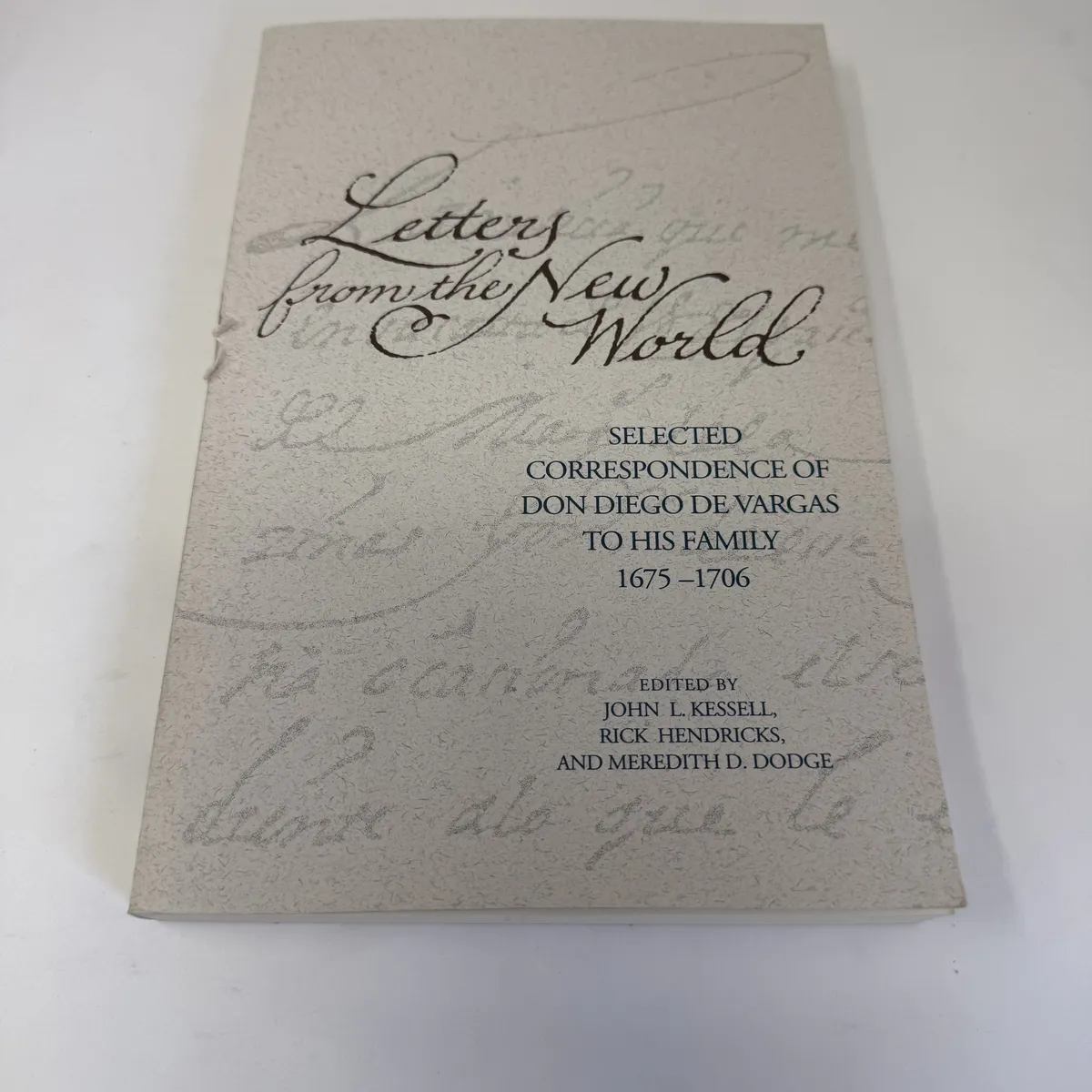
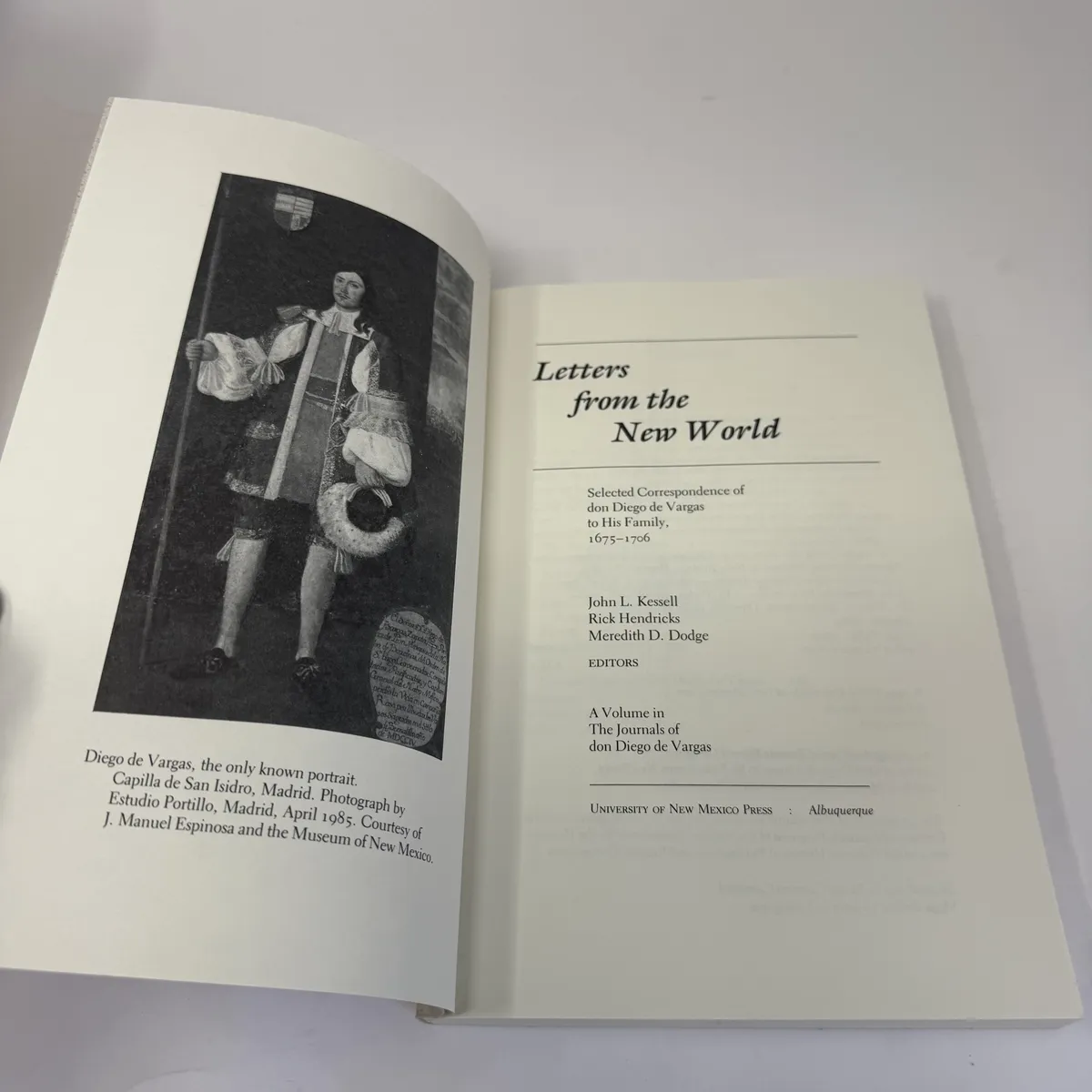
The third generation of New Mexico Spanish Colonial scholarship was anchored at UNM Press by John L. Kessell, whose Vargas Project (1989-2002) produced the six-volume scholarly edition of the Journals of don Diego de Vargas — the Spanish governor who led the 1692 Reconquista of New Mexico after the 1680 Pueblo Revolt. The complete Vargas Journals: Remote Beyond Compare: Letters of don Diego de Vargas to His Family from New Spain and New Mexico, 1675-1706 (1989); By Force of Arms: The Journals of don Diego de Vargas, 1691-1693 (1992); To the Royal Crown Restored: The Journals of don Diego de Vargas, 1692-1694 (1995); Blood on the Boulders: The Journals of don Diego de Vargas, 1694-1697 (1998); That Disturbances Cease: The Journals of don Diego de Vargas, 1697-1700 (2000); A Settling of Accounts: The Journals of don Diego de Vargas, 1700-1704 (2002). Co-editors across the series include Rick Hendricks (later New Mexico State Historian 2011-2020), Meredith D. Dodge, and Larry D. Miller.
Kessell's companion monographs are equally canonical: Kiva, Cross, and Crown: The Pecos Indians and New Mexico 1540-1840 (National Park Service 1979 first, UNM Press 1987 reissue, UNM Press revised 2008) — the standard history of Pecos Pueblo from first Spanish contact through abandonment in 1838; Spain in the Southwest: A Narrative History of Colonial New Mexico, Arizona, Texas, and California (University of Oklahoma Press 2002, the standard one-volume synthetic regional history); and Pueblos, Spaniards, and the Kingdom of New Mexico (University of Oklahoma Press 2008). A complete Vargas Journals six-volume set in fine condition with original dust jackets is a Tier 1 collector object trading in the mid-three-to-low-four-figure range; signed sets command upper-four-figure at specialist auction. Individual volumes in good condition are accessible in the lower three figures, which makes assembling a complete set across years of patient acquisition realistic for a serious collector who is not budget-constrained.
Joe S. Sando (1923-2011, Jemez Pueblo, closed pool) is the foundational Pueblo-voice historian of the modern period. His canonical works are Nee Hemish: A History of Jemez Pueblo (UNM Press 1982 first; revised editions through the 2000s) — the first major scholarly history of a single Pueblo community written by a member of that community; Pueblo Nations: Eight Centuries of Pueblo Indian History (Clear Light Publishers, Santa Fe, 1992 first; revised 1998) — the standard one-volume synthetic history of the nineteen NM Pueblos; The Pueblo Indians (Indian Historian Press 1976 first, the foundational earlier work); and Po'pay: Leader of the First American Revolution (co-edited with Herman Agoyo, Clear Light Publishers 2005, the rehabilitation of Po'pay following his 2005 placement in the U.S. Capitol's National Statuary Hall as one of New Mexico's two contributed statues alongside Dennis Chávez). Sando's methodology drew on Pueblo oral tradition, Pueblo language sources, and tribal-internal genealogical knowledge that secular historians had not previously incorporated. His treatment of the 1680 Pueblo Revolt in particular reframes the event from the Spanish-document-driven external view of earlier historians to a Pueblo-internal view centered on Po'pay of San Juan Pueblo (Ohkay Owingeh).
Alfonso Ortiz (1939-1997, San Juan Pueblo / Ohkay Owingeh) at the UNM Department of Anthropology produced The Tewa World: Space, Time, Being, and Becoming in a Pueblo Society (University of Chicago Press 1969) and edited Volumes 9 and 10 of the Handbook of North American Indians (Smithsonian Institution 1979, 1983, the Southwest volumes — the standard reference for Pueblo and Pueblo-adjacent communities). The Smithsonian Handbook volumes are large, heavy, expensive when new, and now scarce in matched fine condition; collectors target the original Smithsonian printings rather than later reprintings.
Ramón A. Gutiérrez (then at UC San Diego, now at the University of Chicago), When Jesus Came, the Corn Mothers Went Away: Marriage, Sexuality, and Power in New Mexico, 1500-1846 (Stanford University Press, 1991) is the most influential and most contested revisionist treatment of Pueblo-Spanish colonial encounter published in the late twentieth century. The book applies social-history methods drawn from the French Annales school and historical-anthropology methods to the New Mexico mission period, arguing that the Franciscan missions imposed a fundamentally different ordering of marriage, sexuality, gender, and household authority on Pueblo communities than the pre-contact Pueblo systems had organized — and that the resulting tensions were central to the 1680 Pueblo Revolt. The book won the Herbert Eugene Bolton Prize from the Conference on Latin American History and the Hubert Herring Prize. It was also intensely contested: a 1993 American Indian Culture and Research Journal special issue carried responses from Pueblo and Native scholars (including Joe S. Sando, Alfonso Ortiz, and others) challenging both Gutiérrez's reading of Pueblo sexual norms and his use of Spanish sources as ethnographic evidence for Pueblo practice. The Stanford 1991 first edition with original dust jacket is the collector target. The controversy itself is part of the historiographical record — a serious New Mexico Spanish Colonial library contains both Gutiérrez and the responses to him.
Not sure whether to sell, donate, or keep? Call or text me at 505-250-3804 — I'll walk you through it.
Period Four: Coronado-Era Documentary Revisionism, 2002-Present
The fourth and contemporary generation of New Mexico Spanish Colonial scholarship has been anchored by independent Albuquerque-based scholars Richard Flint and Shirley Cushing Flint, whose comprehensive Coronado-expedition documentary project has substantially extended and revised the foundational Hammond-Rey 1940 Narratives of the Coronado Expedition. The Flints' methodology combines traditional Spanish archival recovery (Archivo General de Indias Seville, Archivo General de la Nación Mexico City, regional Spanish archives) with route-of-march fieldwork, geospatial analysis, and Indigenous-language consultation. Canonical Flint works: Great Cruelties Have Been Reported: The 1544 Investigation of the Coronado Expedition (Southern Methodist University Press 2002, the first major publication of the 1544 investigatory testimony alleging Spanish atrocities against Pueblo and other Native communities); The Coronado Expedition: From the Distance of 460 Years (edited collection, UNM Press 2003); Documents of the Coronado Expedition 1539-1542: They Were Not Familiar with His Majesty (SMU Press 2005, the comprehensive document collection that substantially expands the Hammond-Rey 1940 baseline); No Settlement, No Conquest: A History of the Coronado Entrada (UNM Press 2008); A Most Splendid Company: The Coronado Expedition in Global Perspective (UNM Press 2019).
The 2005 SMU Press Documents first hardcover with original dust jacket is the principal Tier 1 collector target from the Flint corpus. The 2019 A Most Splendid Company UNM Press first is the most recent canonical Flint title and represents the contemporary professional standard for sixteenth-century Spanish exploration scholarship. The Flints also produce a substantial corpus of New Mexico Historical Review articles, conference papers, and Smithsonian-style technical publications — collectors of contemporary Coronado scholarship should also be tracking NMHR back issues from 1995 onward.
Beyond the Flints, contemporary New Mexico Spanish Colonial scholarship continues at UNM Center for Southwest Research (the principal archival repository for personal papers of mid-to-late-twentieth-century historians including Marc Simmons), the Fray Angélico Chávez History Library (Palace of the Governors complex Santa Fe, the principal Spanish Colonial document repository), the Archives of the Archdiocese of Santa Fe (Catholic Center Albuquerque, the principal sacramental and ecclesiastical document repository for the colonial period), and the New Mexico History Museum publication program. Younger contemporary scholars producing influential work include Rick Hendricks (former New Mexico State Historian, multiple Vargas Project co-editor credits and substantial post-Vargas-Project publication), James F. Brooks (Captives and Cousins: Slavery, Kinship, and Community in the Southwest Borderlands, UNC Press 2002, Bancroft Prize winner), Andrés Reséndez (The Other Slavery: The Uncovered Story of Indian Enslavement in America, Houghton Mifflin Harcourt 2016, Bancroft Prize winner, substantial New Mexico content), Suzanne Stamatov (UNM Hispanic Studies, post-Chávez genealogical and family-history scholarship), and Pueblo and Hispano scholars at Indian Pueblo Cultural Center, Poeh Cultural Center, and the Institute of American Indian Arts.
The Institutional Canon: Where the Documents Live
Six institutional repositories anchor the New Mexico Spanish Colonial documentary canon, and collectors orient their reading and acquisition around the publication programs of these institutions.
University of New Mexico Press (Albuquerque, founded 1929) is the principal academic publisher of the New Mexico Spanish Colonial canon. Series of collector interest: Coronado Cuarto Centenario (1928-1953, the foundational Hammond-Rey document collections), UNM Publications in History (Scholes monographs), the Vargas Project (Kessell 1989-2002), and the Pasó por Aquí series of regional cultural studies. Most canonical Spanish Colonial historians have UNM Press in their catalog (Hammond-Rey, Scholes, Chávez, Simmons, Kessell, the Flints).
Fray Angélico Chávez History Library (Santa Fe, in the Palace of the Governors complex on the Plaza, part of the New Mexico History Museum) is the principal Spanish Colonial document repository. Named for Fray Angélico Chávez whose archival work substantially built its colonial-period holdings. The library catalog includes the Spanish Archives of New Mexico (SANM I and SANM II, the two principal colonial-period administrative document collections), the Mexican Archives of New Mexico, and substantial Catholic ecclesiastical records.
UNM Center for Southwest Research (Zimmerman Library, UNM Albuquerque) holds the personal papers of major twentieth-century New Mexico historians including Marc Simmons. The Center is the principal Albuquerque-side complement to the Fray Angélico Chávez History Library — Santa Fe holds the colonial-era documents themselves, Albuquerque holds the twentieth-century scholarly papers about those documents.
Archives of the Archdiocese of Santa Fe (Catholic Center, 4000 St. Joseph Place NW Albuquerque) is the principal Catholic ecclesiastical document repository for the colonial period. Sacramental records (baptisms, marriages, confirmations, burials) from the New Mexico missions are held here. Fray Angélico Chávez's 1957 catalog Archives of the Archdiocese of Santa Fe 1678-1900 (Academy of American Franciscan History) is the finding aid that opened these holdings to twentieth-century scholarship.
Historical Society of New Mexico (founded 1859) publishes the New Mexico Historical Review continuously since 1926 — the principal peer-reviewed journal for New Mexico historical scholarship. NMHR back issues are themselves collectible; complete runs of NMHR from 1926 forward are held only at major research libraries and a handful of private collections.
Palace of the Governors (Santa Fe, built 1610 by Pedro de Peralta, the oldest continuously occupied public building in the United States, now part of the New Mexico History Museum) houses both the Fray Angélico Chávez History Library and the Palace of the Governors Photo Archives. The building itself is the principal physical artifact of the Spanish Colonial period continuously present in New Mexico.
Have books you're ready to part with? I offer free pickup across Albuquerque — call 505-250-3804.
Five Identification Problems
Problem one: Chávez Origins 1954 Historical Society of New Mexico first vs 1992 UNM Press revised expanded. The 1954 first is a large-format softcover original-genealogical-reference printed in a small run by the Historical Society; many surviving copies are ex-library or have library-binding modifications. The 1992 UNM Press revised expanded edition is hardcover, incorporates four additional decades of genealogical research, and is the standard working reference. Collectors target both: the 1954 first as the foundational artifact, the 1992 revised as the working reference. Signed copies of either trade meaningful premium.
Problem two: Hammond-Rey Don Juan de Oñate 1953 UNM first vs subsequent printings. The 1953 UNM Press first is a two-volume set with original dust jackets; matched-set integrity matters (both volumes with original jackets in fine condition). The two volumes were sold together but estate breakups frequently separate them; single-volume offerings should be priced at a discount relative to fine matched sets. Hammond signed at UNM Press events; Rey signed less frequently. Signed Hammond-Rey sets trade four-figure at specialist Western Americana auction.
Problem three: Vargas Journals six-volume completeness. The six volumes were published across thirteen years (1989, 1992, 1995, 1998, 2000, 2002) and rarely appear together in single-collection donations. Complete six-volume sets in fine condition with original dust jackets are the Tier 1 trophy from the Vargas Project — verify all six titles by full title page rather than spine before pricing a "complete set." Co-editor variations across volumes (Kessell solo on vol. 1; Kessell-Hendricks on vols. 2-3; Kessell-Hendricks-Dodge on vols. 4-6) help confirm publication-order completeness.
Problem four: Marc Simmons signed-first authentication. Simmons signed extensively across decades, so signed Simmons is not by itself rare. What separates a Tier 1 signed Simmons from a Tier 2 signed Simmons is title scarcity (Witchcraft 1974 Northland first > The Last Conquistador 1991 Oklahoma first > Coronado's Land 1991 UNM first > later Sunstone Press reissues), inscription quality (full inscription with date and location > signed first-issue book > signed reissue), and provenance documentation (event photographs, programs, bookseller letters of authenticity). Simmons used several signature variants across his career; specialist dealers can authenticate but standard secondary-market signed copies require care.
Problem five: Coronado document collections — Hammond-Rey 1940 vs Flint-Flint 2005. Both are canonical, both are required for a serious library, neither replaces the other. The Hammond-Rey 1940 Narratives of the Coronado Expedition (UNM Press Coronado Cuarto Centenario) is the foundational mid-century document collection. The Flint-Flint 2005 Documents of the Coronado Expedition (SMU Press) is the contemporary expanded collection that incorporates archival material recovered after 1940. Collectors target both. Hammond-Rey 1940 first in fine condition with dust jacket is genuinely scarce now (small print run, eighty-five years of attrition); Flint-Flint 2005 first in fine condition is currently accessible but is the future trophy as the print run is exhausted.
Three-Tier Collector Market
Tier 1 trophy (mid-three-figure to low-four-figure): Hammond-Rey Don Juan de Oñate 1953 two-volume matched-jacket fine set, signed copies of either Hammond or Rey at premium; Chávez Origins 1954 Historical Society first fine condition with author inscription; Scholes Church and State 1937 UNM Publications in History vol. 7 first fine condition (small print run, genuinely scarce); Scholes Troublous Times 1942 UNM Publications in History vol. 11 first fine condition; complete Vargas Journals six-volume matched-jacket fine set; signed Marc Simmons Witchcraft 1974 Northland Press first hardcover with dust jacket; signed Marc Simmons The Last Conquistador 1991 University of Oklahoma Press first hardcover; signed Flint-Flint Documents 2005 SMU Press first; signed Gutiérrez Stanford 1991 first hardcover with dust jacket; Sando Nee Hemish 1982 UNM Press first signed by author. Complete matched-set Vargas Journals fine signed by Kessell cross four-figure at specialist auction.
Tier 2 collector targets (low-to-mid three-figure): Trade firsts of canonical monographs — Simmons New Mexico Bicentennial 1977 Norton first hardcover with dust jacket; Simmons Albuquerque 1982 UNM Press first; Simmons Coronado's Land 1991 UNM Press first; Kessell Kiva, Cross, and Crown 1979 NPS first softcover (the 1987 UNM Press reissue is more common); Kessell Spain in the Southwest 2002 OU Press first hardcover; Chávez My Penitente Land 1974 UNM Press first; Chávez But Time and Chance 1981 Sunstone Press first; Sando Pueblo Nations 1992 Clear Light first; Ortiz The Tewa World 1969 Chicago first; Hallenbeck Land of the Conquistadores 1950 Caxton Printers first; Flint-Flint Great Cruelties 2002 SMU Press first; Flint-Flint A Most Splendid Company 2019 UNM Press first; Hammond-Rey Narratives of the Coronado Expedition 1940 UNM Press first (without matched-set context).
Tier 3 working library (upper-two-figure to low-three-figure): Subsequent printings of all of the above; softcover reissues (UNM Press paperback editions of canonical hardcovers, Bison Books University of Nebraska Press reissues); Sunstone Press reissues of Simmons trail-history titles; Chávez Origins 1992 UNM Press revised paperback; Smithsonian Handbook of North American Indians vols. 9-10 in unmatched or worn condition; New Mexico Historical Review back issues individual numbers; Spanish Colonial Arts Society annual journals; Historical Society of New Mexico newsletters and program publications; later Marc Simmons Trail Dust columns collected paperback editions from Sunstone Press; standard regional-history paperbacks from Ancient City Press, Sunstone Press, and Lightning Tree Press.
Cultural and Methodological Context
Contemporary New Mexico Spanish Colonial scholarship operates in a methodological landscape that is substantially different from the foundational mid-twentieth-century work. Three reframings are central. First, the Pueblo-voice generation led by Joe S. Sando and Alfonso Ortiz introduced Pueblo-internal historical perspectives that earlier secular history had not centered — the 1680 Pueblo Revolt is now standardly treated through Pueblo oral tradition, Pueblo language sources, and tribal-internal genealogy alongside the Spanish documentary record. Second, the social-history-and-gender reframing led by Ramón Gutiérrez introduced questions of marriage, sexuality, household authority, and gender that earlier military-and-administrative history had under-examined — with substantial controversy from Pueblo scholars about the appropriateness and accuracy of applying Annales-school methods to Pueblo communities. Third, the contemporary documentary-recovery work led by the Flints, Hendricks, and the post-Vargas-Project UNM Press program has substantially expanded the archive base from which all subsequent scholarship works.
A serious New Mexico Spanish Colonial library carries representative works from each of these reframings. The foundational Hammond-Rey-Scholes-Chávez canon is required; the Marc Simmons era public history is required; the Vargas Project documentary corpus is required; the Pueblo-voice generation (Sando, Ortiz) is required; the social-history-and-gender reframing (Gutiérrez and the responses to him) is required; the contemporary documentary work (the Flints, Hendricks, Brooks, Reséndez) is required. The library is not complete — the documentary recovery continues, and contemporary scholars are still actively writing — but the four-generation structure is now stable enough that a collector can build a coherent representative library without chasing every recent academic-press release.
NMLP Intake Position
New Mexico Spanish Colonial historical books arrive in the NMLP donation stream regularly — particularly from estates with UNM-history-faculty, Santa Fe Hispano-heritage, Catholic-clergy, retired-state-government, or Spanish Colonial Arts Society demographic patterns. The Albuquerque concentration is heavy: UNM faculty estates, Catholic parish leadership transitions, retired professional historians, Spanish Colonial Arts Society members downsizing, descendants of Hispano-heritage Albuquerque families. Santa Fe intake patterns add the Spanish Colonial Arts Society retired-state-government and curatorial-professional segments. Las Vegas/Mora/Taos/Tierra Amarilla/Mora County intake patterns add the rural Hispano family library segment.
NMLP's intake routing for this category: Tier 1 trophy items route to specialist New Mexico history dealers (SellBooksABQ, Old Santa Fe Trail Books, Books On The Bosque, Collected Works Santa Fe) or specialist auction houses (Heritage Western Americana, Bonhams Books and Manuscripts, Swann Galleries). Tier 2 trade firsts route through SellBooksABQ standard hand-sort. Tier 3 subsequent printings, softcover reissues, and New Mexico Historical Review back issues route to community literacy partners (the New Mexico history curriculum requirement makes Spanish Colonial trade reprints valuable to ABQ middle and high schools), the regional research-library partnership network, and Little Free Library stocking. New Mexico Catholic ecclesiastical material with institutional research value — sacramental records reproductions, Penitente brotherhood scholarship, archdiocesan history, and Catholic Worker / liberation-theology Spanish-language material — goes to a regional archive, when one will take it, if the material has institutional research value beyond standard secondary market resale. Free Albuquerque-metro pickup with no condition limit and no minimum quantity — schedule your pickup or text/call 505-250-3804.
External References
- University of New Mexico Press — primary academic publisher of the canon
- Fray Angélico Chávez History Library — principal Spanish Colonial document repository
- UNM Center for Southwest Research — Marc Simmons Papers and other twentieth-century historians
- Historical Society of New Mexico — publisher of New Mexico Historical Review since 1926
- New Mexico History Museum & Palace of the Governors — the 1610 building, the Spanish Colonial-era physical artifact
- SMU Press — Flint-Flint Coronado documentary publication program
- Wikipedia: Marc Simmons
- Wikipedia: Fray Angélico Chávez
- Wikipedia: Joe S. Sando
- Wikipedia: Don Juan de Oñate
- Wikipedia: Don Diego de Vargas
- Wikipedia: Francisco Vásquez de Coronado
Related on This Site
- Closed Signature Pools — Albuquerque/NM Authors — Marc Simmons (closed 2023), Fray Angélico Chávez (closed 1996), France V. Scholes (closed 1979), George P. Hammond (closed 1993), Joe S. Sando (closed 2011)
- Collecting New Mexico Cookbooks — the parallel Hispano food-tradition documentary canon
- Collecting New Mexico Ethnobotany — the parallel Hispano-Pueblo-Native plant-knowledge canon
- Pueblo Pottery Books — Pueblo-voice scholarship overlap with Sando, Ortiz, contemporary Native scholars
- Pueblo Revival Architecture Books — Bandelier, Hewett, the institutional 1912 Old Santa Fe Plan overlap
- Taos Society of Artists Books — Mabel Dodge Luhan circle / Willa Cather / Padre Martínez overlap
- Book Authentication Methodology — signature-pool authentication for closed-pool Spanish Colonial historians
- NM Archaeology Books — Bandelier's The Delight Makers and archaeological fieldwork bridge Spanish colonial documentary history and Pueblo archaeological research
- NM Maps & Cartography — Miera y Pacheco's 1779 maps and the Disturnell Map are primary documents for Spanish colonial territorial history
- NM Ranching & Cowboy Literature — Fabiola Cabeza de Baca's ranch memoirs document Hispano ranching culture rooted in the Spanish colonial land-grant system
- Vintage NM Travel & Tourism Books — Spanish colonial missions and Camino Real sites as recurring subjects in NM travel and tourism literature
Cite This Guide
Eldred, J. (May 2026). New Mexico Spanish Colonial Historians: A Collector's Authority Guide. New Mexico Literacy Project.
https://newmexicoliteracyproject.org/new-mexico-spanish-colonial-historians-collecting
Content is original research by Josh Eldred. Licensed under CC BY 4.0. Cite with attribution.
From the NMLP Archive
Real specimens I’ve handled
Books on this subject that came through my intake and were documented with full photographic provenance — click through for cover, title page, copyright, and condition detail.