Comanche & Apache New Mexico History: A Collector's Authority Guide
The Comanchería · The 1786 Peace · Geronimo · Cochise · Victorio · The Mescalero & Jicarilla Traditions
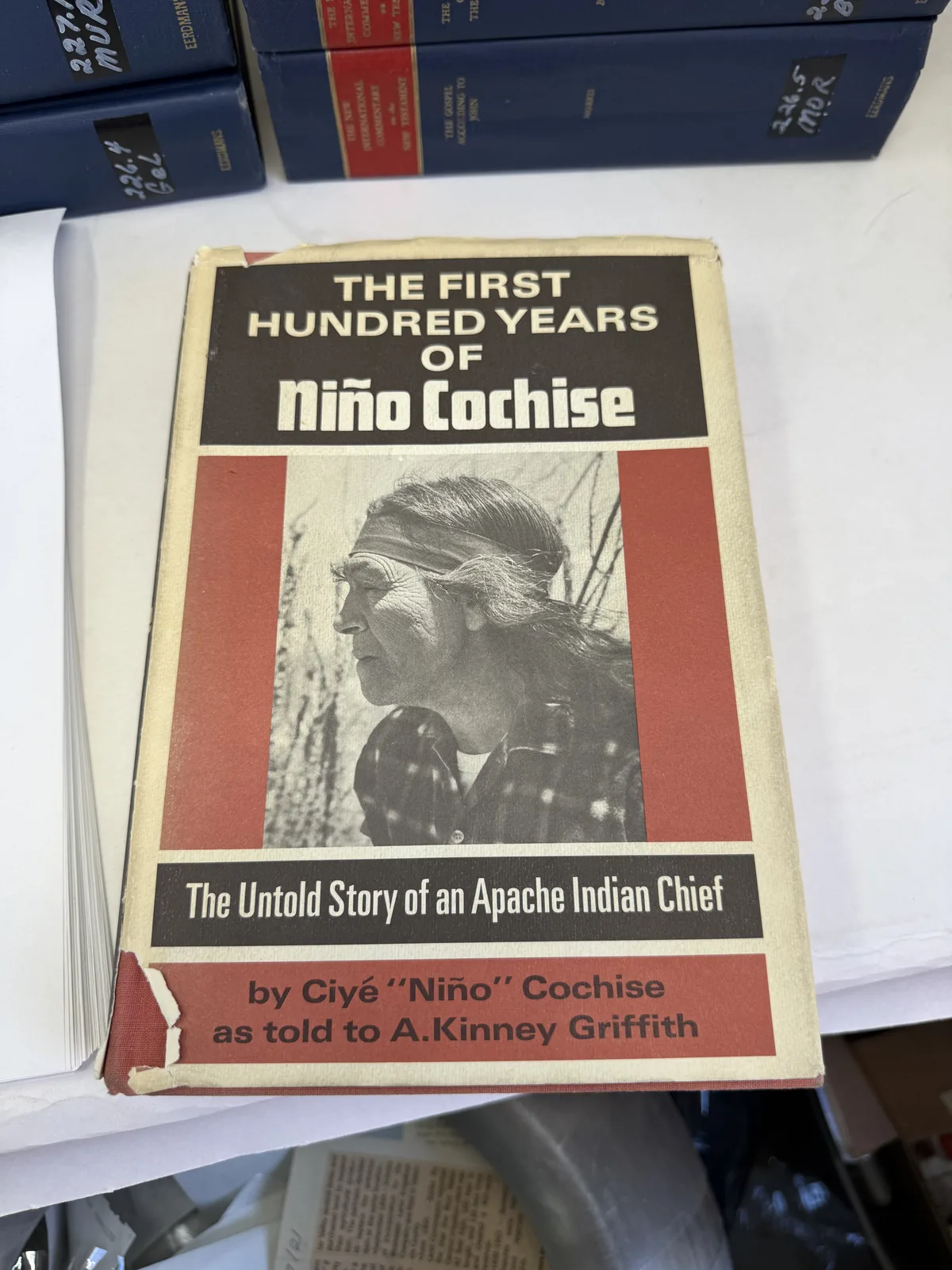
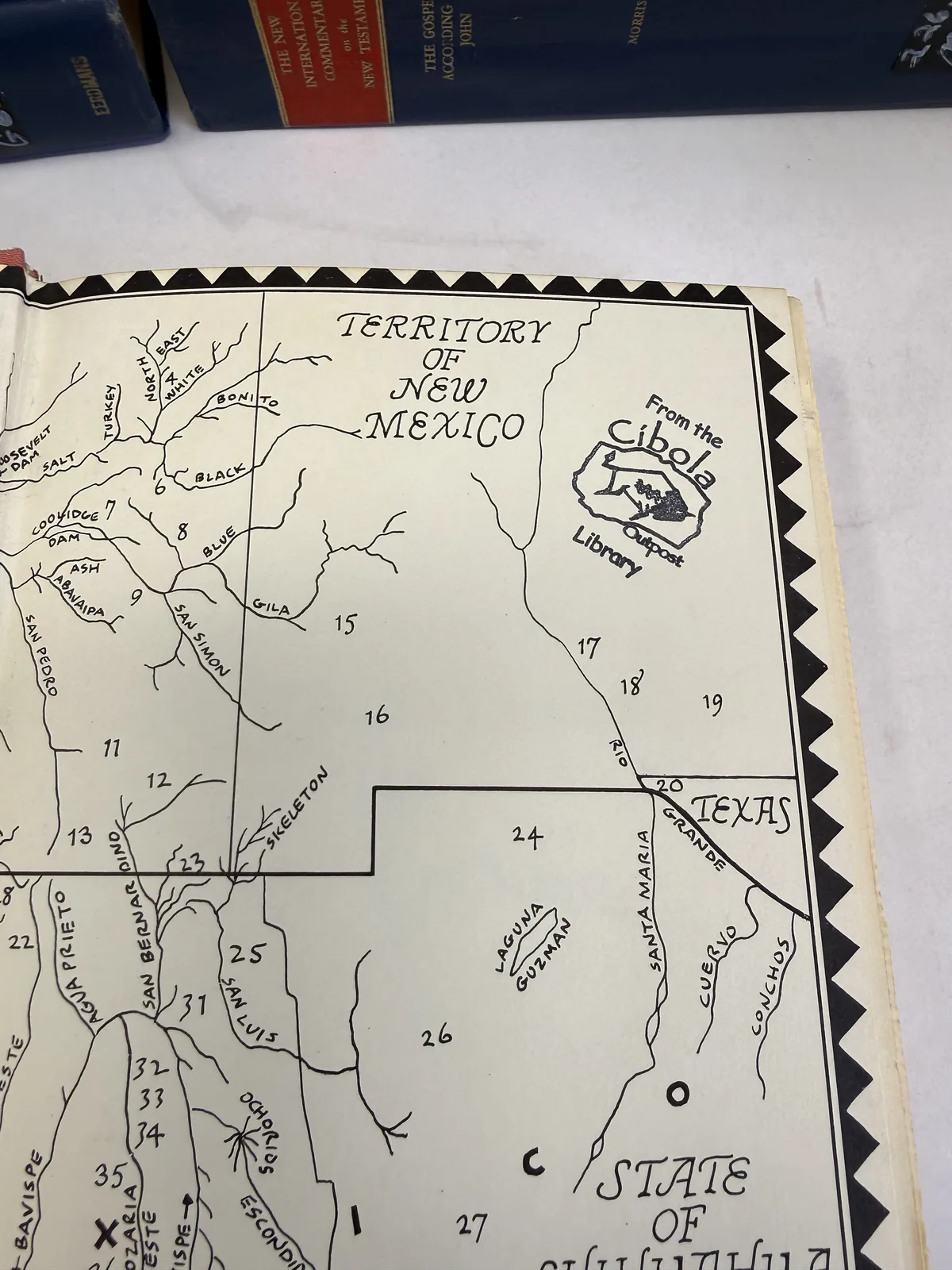
The Apache side of this shelf runs on memoirs, and the most argued-over one keeps arriving in donation boxes: The First Hundred Years of Niño Cochise, the life of Cochise’s grandson as told to A. Kinney Griffith. Historians have contested how much of it is memory and how much is Griffith — which is exactly why the book stays collected, argued with, and cited. This copy came through NMLP intake:
By Josh Eldred · New Mexico Literacy Project · · ~8,500 words
From the early eighteenth century through the final Apache surrender of 1886, the southern plains and mountain Southwest were shaped by the military, diplomatic, and commercial power of two of the most consequential indigenous nations in North American history: the Comanche and the Apache. New Mexico stands at the intersection of both stories. The Comanchería — the vast southern plains empire that stretched from Kansas to the Llano Estacado and east to the New Mexico mountains — defined colonial New Mexico's security environment for a century, while the Chiricahua, Mescalero, and Jicarilla Apache traditions are woven into the landscape, the law, and the living communities of the state from the Sacramento Mountains to the northern Rio Grande. The scholarly and popular literature documenting these histories constitutes one of the richest collecting fields in Western Americana, anchored by the University of Oklahoma Press's Civilization of the American Indian series, Yale University Press, the University of Arizona Press, and a tradition of exceptional primary-source oral history that runs from Eve Ball's Sacramento Mountains interviews through Angie Debo's Oklahoma research.
The collecting field organizes into three chronological and thematic streams. STREAM ONE — the Comanchería and New Mexico: the Spanish colonial period through the 1786 Comanche Peace, the nineteenth-century Comanche empire at its height, and the scholarly revolution sparked by Pekka Hämäläinen's The Comanche Empire (Yale 2008) alongside S.C. Gwynne's popular Empire of the Summer Moon (Scribner 2010). STREAM TWO — Chiricahua Apache and the Apache Wars: Cochise, Geronimo, Victorio, and the final campaigns across the Black Range, the Jornada del Muerto, and the Peloncillo and Chiricahua mountains from the Bascom Affair of 1861 to the Skeleton Canyon surrender of 1886. STREAM THREE — the living Apache traditions of New Mexico: the Mescalero Apache in the Sacramento Mountains, the Jicarilla Apache in northern New Mexico, the oral history traditions documented by Eve Ball and others, and the cultural program literature produced by the tribes themselves. A serious library carries representative works from all three streams.
Last verified September 2026 · Original research by Josh Eldred
The Comanchería and Colonial New Mexico
Comanche & Apache New Mexico History books, including Empire of the Summer Moon (2010), are sought-after collectibles commanding premium prices among Southwest and Western Americana collectors. The Comanche arrived on the southern plains approximately around 1700 — a dramatic and consequential migration southward from the Great Basin by a Numic-speaking people closely related to the Shoshone, who followed the availability of feral horses that had dispersed across the plains after the Pueblo Revolt of 1680 scattered Spanish horse herds across the region. Within a generation of acquiring horses, the Comanche developed one of the most formidable cavalry cultures in world history. Their mastery of horses — breeding, training, riding, fighting from horseback — gave them a decisive military and economic advantage over both neighboring indigenous groups and colonial powers that would sustain the Comanchería as a regional power for nearly two centuries.
The impact on New Mexico was immediate and devastating. From the 1710s through the 1780s, Comanche raiding on Pueblo and Hispano settlements in the Rio Grande valley and the Sangre de Cristo mountain communities was chronic and catastrophic — settlements were abandoned, populations were reduced by captive-taking and direct violence, and the agricultural communities of northeastern New Mexico lived under the constant threat of Comanche attack. The Jicarilla Apache, who had occupied the northeastern New Mexico plains and provided a buffer zone, were militarily broken by Comanche pressure and pushed into the mountains, ultimately emerging as the northern New Mexico mountain people they became. Taos Pueblo — the most northerly of the major Pueblo communities and the principal trade fair site of colonial New Mexico, later home to the Taos literary colony — was on the front line of Comanche-Spanish-Pueblo interaction, a triple nexus of violence and commerce that defined northern New Mexico's character.
Governor Juan Bautista de Anza (1736-1788, closed pool) arrived in New Mexico in 1778 having already established himself as the most capable frontier administrator in the northern Spanish colonial system — the man who had opened the overland route from Sonora to Alta California in 1775-1776 and founded San Francisco. In 1779, Anza led a combined Spanish-Pueblo force north into Colorado, crossing the Sangre de Cristo Mountains and striking into the heart of the Comanchería to defeat and kill the paramount Comanche war leader Cuerno Verde (Green Horn, Tabivo Naritgant) at the battle now commemorated at Greenhorn Mountain near Pueblo Colorado. The 1779 campaign demonstrated that Spanish forces could project power deep into the Comanchería itself — a critical precondition for successful diplomacy.
The 1786 Comanche Peace was the result of years of patient negotiation. Anza proposed that the Comanche select a unified leader with whom Spain could negotiate sustained agreements, rather than continuing the band-by-band fragmentation that made durable peace impossible. The Comanche chose Ecueracapa (Leather Jacket) as their principal peace chief, and the agreement reached at Pecos Pueblo in 1786 established commercial trade relations, mutual prisoner exchange, military cooperation against the Apache, and an end to raiding on New Mexico settlements. The effects transformed colonial New Mexico: abandoned communities were resettled, the Taos trade fair expanded into a major commercial institution, and the frontier security environment improved dramatically for the remaining decades of Spanish rule and into the Mexican period. The 1786 Comanche Peace is one of the most consequential diplomatic agreements in New Mexico history and remains underappreciated in general American historical literature.
Not sure whether to sell, donate, or keep? Call or text me at 505-250-3804 — I'll walk you through it.
Hämäläinen's Paradigm Shift: The Comanche Empire
Pekka Hämäläinen's The Comanche Empire (Yale University Press 2008 first hardcover) is the single most important Comanche book published in the twenty-first century and one of the most significant works in the broader field of Native American history published in any period. Hämäläinen, a Finnish-American historian then at the University of California Santa Barbara (now at Oxford University), built his argument over a decade of archival work in Spanish colonial records in Seville, Madrid, and the Archivo General de la Nación in Mexico City, in French colonial records, in Mexican national and provincial archives, and in the full range of American military and diplomatic documentation. The result is a complete reframing of Comanche history.
The standard narrative before Hämäläinen cast the Comanche as raiders and resisters — reactive agents responding to colonial pressure, their history defined by what they opposed rather than what they built. Hämäläinen's argument is the reverse: the Comanche built an indigenous empire. The Comanchería was an economic and political system in which the Comanche extracted tribute from surrounding peoples, controlled the horse and bison trade across the entire southern plains, set the terms of commercial and diplomatic interaction with Spanish New Mexico, French Louisiana, Mexican Texas, and American Texas, and maintained their imperial position through a combination of military dominance and sophisticated political economy. Spain, Mexico, France, and the United States were not the principal powers shaping the southern plains — the Comanche were. The diplomatic tools the Comanche deployed — like the 1786 Anza Peace — were expressions of Comanche imperial management, not colonial concessions.
The Comanche Empire won the Bancroft Prize, the Western History Association's Caughey Prize, and the Texas State Historical Association's Liz Carpenter Award. It transformed the teaching of western American history at the university level and permanently altered the scholarly framework for thinking about Native power, indigenous imperialism, and colonial relations in the eighteenth and early nineteenth century Americas. The book sold far beyond the normal academic press audience, running through multiple printings and Yale Press paperback editions.
Points-of-issue: Hämäläinen The Comanche Empire 2008 Yale University Press first hardcover. First edition statement on copyright page; Yale University Press cloth binding in the standard Yale academic format; the original jacket with its distinctive design. The book has been reprinted multiple times in hardcover and issued in Yale paperback; the 2008 first hardcover is the collecting target. Hämäläinen-signed copies are available — he has appeared at academic conferences and bookstore events through the 2010s and 2020s. A signed first hardcover in fine condition is a Tier 1 acquisition.
Gwynne and the Popular Canon: Empire of the Summer Moon
S.C. Gwynne's Empire of the Summer Moon: Quanah Parker and the Rise and Fall of the Comanches, the Most Powerful Indian Tribe in American History (Scribner 2010 first hardcover) is the major popular bestseller of the Comanche canon — a Pulitzer Prize finalist (General Nonfiction 2011) with millions of copies sold and sustained New York Times bestseller presence. Gwynne, a former executive editor of Texas Monthly with a Texas journalist's feel for narrative pacing, structured the book around one of the great dramatic arcs in American frontier history: the 1836 capture of nine-year-old Cynthia Ann Parker by Comanche raiders at the Parker's Fort massacre in eastern Texas, her assimilation into the Comanche as Naduah, her marriage to Peta Nocona and motherhood of Quanah Parker, her re-capture by Texas Rangers in 1860 and the final decade of her life among Anglos, and her son Quanah Parker's rise to become the last principal chief of the Quahada Comanche, his military leadership during the Red River War of 1874, and his subsequent decades as the most prominent Native American leader in the post-reservation Southwest — rancher, businessman, political broker between the Comanche Nation and the U.S. government, and enduring figure of the Comanche legacy.
Quanah Parker (c.1845-1911, closed pool) was the son of Peta Nocona (a Quahada war chief) and Cynthia Ann Parker, the Texas captive who became fully Comanche. His dual heritage made him simultaneously an insider to Comanche culture — he spoke Comanche as his first language, trained as a warrior and war chief from childhood, and led the Quahada Comanche resistance during the Red River War — and a figure capable of moving through the Anglo-American world that surrounded and eventually absorbed the Comanchería. After his surrender following the Red River War's decisive Battle of Palo Duro Canyon (September 1874) and the Army's systematic destruction of the Comanche horse herds, Quanah built a second career as a political leader, cattleman, and mediator on the Comanche reservation in Oklahoma. He died in 1911 at his Star House near present-day Lawton Oklahoma, one of the most documented and complex Native American figures of his era.
Points-of-issue: Gwynne Empire of the Summer Moon 2010 Scribner first hardcover. First printing statement on copyright page (Scribner uses number-line notation); original Scribner binding; the original jacket. The book has been substantially reprinted and issued in Scribner trade paperback; the first printing hardcover is the collecting target. Gwynne-signed copies are freely available — he is an active signing presence at Texas and Southwest book events. A signed Scribner 2010 first hardcover in fine condition is a Tier 1 acquisition.
Have books you're ready to part with? I offer free pickup across Albuquerque — call 505-250-3804.
The Foundational Ethnography: Wallace and Hoebel
Ernest Wallace and E. Adamson Hoebel's The Comanches: Lords of the South Plains (University of Oklahoma Press 1952 first hardcover, Civilization of the American Indian series volume 34) is the foundational scholarly study of Comanche culture, society, and history — the book that established the scholarly baseline for all subsequent Comanche research and remains a standard reference more than seventy years after publication. Wallace was a historian at Texas Technological College (now Texas Tech University) who brought the archival dimension; Hoebel was an anthropologist at the University of Minnesota who had conducted fieldwork with Comanche informants on the Oklahoma reservation in the 1930s and 1940s as part of the broad mid-century ethnographic project that produced important documentation of Plains peoples whose elders still held living memory of the nineteenth-century world. The collaboration produced the comprehensive account of Comanche society: kinship, political organization, religion, warfare, the horse complex, economic life, and the historical narrative from the plains arrival through the reservation period.
The Civilization of the American Indian series is itself one of the great collecting categories in Western Americana — a University of Oklahoma Press scholarly series begun in 1932 that eventually ran to over 200 volumes, each the standard scholarly reference for its subject. The series binding (distinctive cloth with the series spine stamp) is recognizable across the collecting market, and the Wallace-Hoebel Comanches is among the most sought volumes in the series alongside the comparable ethnographies of other Plains peoples. Points-of-issue for the 1952 OU Press first hardcover: first edition statement on copyright page; the distinctive Civilization of the American Indian cloth binding in olive/tan with series spine stamp; the original dust jacket. The 1952 first in fine condition with original jacket is a Tier 1 acquisition; 70-plus years of attrition and a specialized audience have made fine copies genuinely scarce.
Kavanagh's Ethnohistorical Synthesis
Thomas Kavanagh's The Comanches: A History 1706-1875 (University of Nebraska Press 1996 first hardcover, Studies in the Anthropology of North American Indians series) is the most systematic ethnohistorical synthesis of Comanche history, drawing on the full range of Spanish colonial, Mexican, French, and American archival sources alongside Comanche oral tradition to produce a year-by-year reconstruction of Comanche political history from their initial southern plains presence through the Red River War. Kavanagh, an anthropologist at Indiana University, spent decades working through the Archivo General de la Nación, the Béxar Archives at the University of Texas, the National Archives Comanche agency records, and the substantial Spanish colonial documentation of the New Mexico-Comanche diplomatic relationship that Hämäläinen would later synthesize into The Comanche Empire.
Kavanagh's treatment of the 1786 Comanche Peace and the broader New Mexico-Comanche diplomatic relationship is the most archivally grounded available and complements Hämäläinen's interpretive framework with primary-source depth. The book is essential for any researcher working on the Comanchería-New Mexico interface and is the standard technical reference for the chronological reconstruction of Comanche political history. The University of Nebraska Press 1996 first hardcover is a Tier 2 acquisition.
I pick up books for free anywhere in the metro area. Call 505-250-3804 to schedule.
Eve Ball and the Apache Oral History Tradition
Eve Ball (1890-1984, closed pool) was a Ruidoso New Mexico schoolteacher — born in Tennessee, educated at the University of Tennessee, who came to New Mexico in 1921 and spent more than six decades in the Lincoln County and Sacramento Mountains community — who became the most important oral historian of the Mescalero and Chiricahua Apache in the twentieth century through the simple and extraordinary expedient of listening. For decades, she visited with elderly Apache men and women on the Mescalero Reservation who had lived through the final campaigns, the surrender, the prisoner-of-war years in Florida and Alabama, and the return to New Mexico, and she recorded what they told her. Her principal informants included James Kaywaykla (a Warm Springs Apache who as a boy survived the Victorio War and Tres Castillos), Ace Daklugie (a son of the Apache leader Juh and nephew of Geronimo, who interpreted for Geronimo during the surrender negotiations), Asa Daklugie's wife Ramona Chihuahua, and dozens of other Apache elders whose names and stories would otherwise have been lost entirely.
In the Days of Victorio: Recollections of a Warm Springs Apache (University of Arizona Press 1970 first hardcover) is based primarily on James Kaywaykla's testimony and frames the Victorio War of 1879-1880 from the inside — from the perspective of a child who survived the battles in the Black Range and Mogollon Mountains of southwestern New Mexico, the flight into Mexico, the killing of Victorio and most of the Warm Springs Apache leadership at Tres Castillos in Chihuahua in October 1880, and the subsequent years of desperate movement under Nana across the New Mexico-Texas-Mexico borderlands. The book is the closest thing to a first-person Warm Springs Apache account of the events that are otherwise documented only in U.S. Army reports, Mexican military dispatches, and Texas frontier newspapers. Ball's editorial framing is careful to identify Kaywaykla's testimony as his recollection while preserving its first-person voice and its resistance to the standard military-history narrative that centers Anglo and American perspectives.
Indeh: An Apache Odyssey (Brigham Young University Press 1980 first hardcover) is Ball's larger collection — oral histories and reminiscences from multiple Mescalero Apache informants, primarily Ace Daklugie and a range of Chiricahua elders — that covers the full arc of Chiricahua Apache experience from the pre-reservation period through the 1886 surrender, the twenty-seven years of captivity as prisoners of war at Fort Marion Florida, Mount Vernon Barracks Alabama, and Fort Sill Oklahoma, and the 1913 release that allowed a portion of the prisoners to come to the Mescalero Reservation. The title Indeh, the Apache word meaning the dead or the slaughtered, signals the weight of the testimony: this is a literature of survival, loss, and memory by a people who were systematically removed from the New Mexico landscape they had inhabited for generations.
Collector's note on Eve Ball: Both In the Days of Victorio (University of Arizona Press 1970) and Indeh (Brigham Young University Press 1980) are Tier 1 acquisitions in fine first hardcover with original dust jacket. Ball died in 1984; signed copies of either book are rare and require provenance documentation. Indeh is less commonly encountered than In the Days of Victorio and commands a premium in fine condition. University of Arizona Press reissued In the Days of Victorio in paperback; the original 1970 hardcover is the collecting target. The BYU Press Indeh first hardcover has not been reissued in the same accessible paperback format and is the scarcer of the two books in the collector market.
Angie Debo and Geronimo
Angie Debo (1890-1988, closed pool) was the foremost woman historian of the American West in the twentieth century — a figure whose career spans from her 1934 OU Press doctoral dissertation The Rise and Fall of the Choctaw Republic through And Still the Waters Run (1940, the definitive account of the dispossession of the Five Civilized Tribes following Oklahoma statehood), Prairie City (1944), A History of the Indians of the United States (1970 OU Press, Civilization of the American Indian series volume 103), to her 1976 Geronimo biography, written when she was eighty-six years old. That she produced the standard Geronimo biography as her last major scholarly work — drawing on the full depth of her fifty-year career in Native American history — and that it remains the standard biography nearly fifty years after publication is a measure of the book's quality.
Geronimo: The Man, His Time, His Place (University of Oklahoma Press 1976 first hardcover) is the standard Geronimo biography for several reasons. Debo had access to a broader range of Apache testimony (through interviews, correspondence, and the oral history material assembled by Ball and others) than any previous biographer. She brought a critical eye to the military record that had dominated previous Geronimo literature — understanding that the Army's after-action reports were self-serving documents designed to explain failures and justify policy. And she had the full depth of her career's knowledge of how U.S. government policy worked, and how it was documented and distorted in official records, to bring to the analysis of the prisoner-of-war period. The result is a biography that takes Geronimo's perspective seriously without romanticizing it, and that places his resistance in the context of a specific political, diplomatic, and military situation rather than treating it as a personality quirk or savage instinct.
Geronimo (Goyaałé, c.1829-1909, closed pool) was born into the Bedonkohe band of the Chiricahua Apache in the upper Gila River country of southwestern New Mexico. His transformation from a relatively obscure medicine man and warrior into the most feared Apache raider of the 1870s-1880s began with the Sonora militia raid in 1851 that killed his mother, wife, and children at Janos, Mexico. From that point, Geronimo's career was defined by an extraordinary personal intensity in raid and warfare against Mexican settlements that eventually placed him in the leadership vacuum created by Cochise's death in 1874 and the subsequent dissolution of the Chiricahua Apache reservation. He evaded capture through four U.S. Army campaigns — in 1876, 1878, 1881-1882, and the final campaign of 1885-1886 — before surrendering to General Nelson Miles at Skeleton Canyon in southeastern Arizona on September 4, 1886. He died at Fort Sill Oklahoma in 1909 as a prisoner of war, having outlived the warrior society he represented.
Points-of-issue: Debo Geronimo 1976 University of Oklahoma Press first hardcover. First edition statement on copyright page; OU Press cloth binding; the original dust jacket. Debo died in 1988 — signed copies of the 1976 Geronimo are genuine trophy acquisitions requiring provenance documentation (estate provenance, bookseller records, or Debo's known signing practices documented through the Western History Association and Oklahoma historical community). An unsigned fine first with original jacket is a Tier 1 acquisition. OU Press has issued paperback editions; the 1976 hardcover first is the collecting target.
Not sure what you have? Text me a photo at 505-250-3804 and I'll tell you what I see.
Edwin Sweeney: The Cochise and Chiricahua Canon
Edwin R. Sweeney's Cochise: Chiricahua Apache Chief (University of Oklahoma Press 1991 first hardcover, Civilization of the American Indian series volume 204) is the standard Cochise biography — the product of a decade of archival research in Mexican, Spanish, American, and Apache sources that is the most thoroughly documented study of the Chokonen band chief who dominated Apache history for a quarter century. Cochise (c.1804-1874, closed pool) was the principal chief of the Chokonen Chiricahua whose career became defined by the Bascom Affair of February 1861, in which U.S. Army Lieutenant George Bascom wrongly accused Cochise of a raid (conducted by the Pinal Apache, not the Chokonen) and attempted to take him hostage in a confrontation at Apache Pass in the Dos Cabezas Mountains. Cochise escaped but the Bascom Affair sparked eleven years of Chiricahua-American war — the period called the Apache Wars — that Cochise prosecuted until General O.O. Howard reached an agreement with him in 1872 establishing a Chiricahua reservation in the Dragoon and Chiricahua mountains.
Sweeney's research in the Sonoran and Chihuahuan state archives, the Archivo General de la Nación, and the extensive U.S. military and diplomatic record gives his biography a depth of pre-Bascom Affair documentation that no previous Cochise study possessed. The book reconstructs Cochise's career from his early adulthood in the 1820s and 1830s (when Chiricahua-Mexican relations were already deeply antagonistic following the Sonora militia's periodic massacres of Apache), through the Bascom Affair and the Apache Wars years, to the 1872 reservation agreement and Cochise's death in 1874. The Civilization of the American Indian series volume 204 context places the Sweeney Cochise in the most distinguished series of tribal and individual biographies in Western Americana.
From Cochise to Geronimo: The Chiricahua Apaches 1874-1886 (University of Oklahoma Press 2010 first hardcover) is Sweeney's sequel, covering the twelve-year period from Cochise's death through the final 1886 surrender — the dissolution of the Chiricahua reservation under Commissioner John Clum's forced removal to San Carlos, the sequence of breakouts and campaigns involving Victorio, Loco, Nana, Chato, and Geronimo, and the final General Miles campaign that ended with Skeleton Canyon. It is the most thoroughly documented account of this period and complements the Debo Geronimo biography by providing the full Chiricahua-Apache-as-a-people framework rather than the individual biography focus. The 2010 OU Press first hardcover is a Tier 2 acquisition; Sweeney-signed copies are available through Southwest book events and specialty dealers.
Thrapp and the Military History Canon
Dan L. Thrapp's The Conquest of Apacheria (University of Oklahoma Press 1967 first hardcover) is the foundational military history of the Apache wars — a comprehensive account of U.S. Army operations against all the Apache groups from the 1850s through the 1886 final surrender, with particular strength on the organizational structure of the Army's Arizona and New Mexico Apache campaigns, the role of Apache scouts in Army operations, and the careers of the principal military figures including General George Crook (the dominant commander of the 1870s-1880s Apache campaigns), General Nelson Miles (the 1886 campaign commander), and the key scout and interpreter figures like Al Sieber and Tom Horn. Thrapp was a Los Angeles Times foreign correspondent and columnist who spent his post-journalism career producing the most comprehensive reference system in the Apache wars field.
The Thrapp Apache wars bibliography is a collecting category in itself: Al Sieber: Chief of Scouts (University of Oklahoma Press 1964 first hardcover, the standard biography of the German-immigrant Apache-wars scout who served Crook through the campaigns of the 1870s-1880s); Victorio and the Mimbres Apaches (University of Oklahoma Press 1974 first hardcover, the standard Victorio history that preceded Eve Ball's oral-history approach with a military-record reconstruction); and the encyclopedic three-volume Encyclopedia of Frontier Biography (Arthur H. Clark Company Glendale CA 1988 first hardcover, three volumes) — the most comprehensive biographical reference for the entire Apache-wars-era cast of military, civilian, and Native American figures. The Arthur H. Clark Company (the specialty Western Americana publisher in Glendale CA founded in 1902) produced Thrapp's Encyclopedia in a limited hardcover edition; the three-volume Arthur H. Clark first is a Tier 1 reference-set acquisition.
Points-of-issue for The Conquest of Apacheria 1967 OU Press first: first edition statement on copyright page; the OU Press cloth binding in the Civilization of the American Indian format; the original dust jacket. A fine first with original jacket is a Tier 1 acquisition. Thrapp died in 1994; signed copies of The Conquest of Apacheria or the Sieber biography are rare and require documentation.
Inherited a library and not sure where to start? Call or text 505-250-3804 — I handle this all the time.
Jason Betzinez and the Insider Memoir
Jason Betzinez with W.S. Nye, I Fought with Geronimo (Stackpole Books Harrisburg PA 1959 first hardcover) is the most important insider memoir by a Chiricahua Apache participant in the wars. Betzinez (c.1860-c.1960) was born into the Bedonkohe band — Geronimo's natal group — and rode with Geronimo through several campaigns of the 1880s, witnessing the 1886 surrender negotiations at Skeleton Canyon, surviving the prisoner-of-war decades at Fort Marion Florida, Mount Vernon Barracks Alabama, and Fort Sill Oklahoma, converting to Christianity through Deyo Mission at Fort Sill, and living to approximately 100 years old. Colonel W.S. Nye — a Fort Sill Army historian who had previously written Carbine and Lance: The Story of Old Fort Sill (OU Press 1937) — collaborated with Betzinez to shape his reminiscences into the memoir published by Stackpole in 1959.
The value of Betzinez's account is its participant perspective on Geronimo as a leader — the personality, decision-making, relationships within the Apache community, and the internal dynamics of the resistance camps that are absent from any outside account. Betzinez knew Geronimo personally, observed him in battle and in camp, and was present for key moments including the 1886 surrender. His Christian conversion and long post-war life in Oklahoma gave him both temporal distance and a complicated relationship with his earlier self, which Ball's oral-history approach with older informants partially compensates for in the parallel Eve Ball documentation. The Stackpole Books 1959 first hardcover with original dust jacket is a Tier 2 acquisition. Stackpole was a Pennsylvania-based military history publisher that produced several important Apache wars memoirs in the 1950s; its backlist in this category is a useful secondary market.
The Mescalero Apache in New Mexico
The Mescalero Apache inhabited the Sacramento, Guadalupe, White, and Capitan mountain ranges of south-central New Mexico, ranging east across the Llano Estacado and south through the Guadalupe Mountains into the Chihuahuan Desert and northern Mexico. The Mescalero were distinct from the Chiricahua in band organization and territory though linguistically and culturally closely related; their territory overlapped in the southern New Mexico mountain corridors that were the operational space of both the Victorio War and the earlier Kit Carson Mescalero campaign of 1862-1863 directed by General Carleton. The Mescalero Apache Reservation was established in 1873 in the Sacramento Mountains of Lincoln and Otero Counties following the Mescalero's return from the disastrous Bosque Redondo confinement at Fort Sumner, and the Mescalero Apache Tribe remains headquartered at Mescalero NM.
C.L. Sonnichsen's The Mescalero Apaches (University of Oklahoma Press 1958 first hardcover, Civilization of the American Indian series volume 49) is the standard tribe-focused Mescalero history — a comprehensive account from Sonnichsen, the University of Texas El Paso literary and western-history scholar, covering Mescalero history from earliest Spanish-colonial contact through the mid-twentieth century. Sonnichsen was one of the most versatile and productive southwestern historians of the mid-century period (The El Paso Salt War, Tularosa: Last of the Frontier West, Billy King's Tombstone, and dozens of other works) and his Mescalero history remains the standard accessible reference. The OU Press Civilization of the American Indian 1958 first in fine condition with original jacket is a Tier 1 acquisition within the Mescalero collecting subset.
The Mescalero Apache Cultural Center, operated by the tribe at Mescalero NM, is the principal institutional anchor of Mescalero Apache cultural preservation. Its programs document Mescalero oral tradition, material culture, language, and history; the cultural center publications and oral-history recordings represent a distinct category of tribal-produced documentation that is essential for understanding the community's self-historical project alongside the academic and popular literature. The Mescalero Apache Tribe has also been a consistent source of archival material in the broader Fort Stanton and Lincoln County historical literature, including the substantial scholarship on Fort Stanton's establishment in 1855 and its role in the Mescalero and Chiricahua campaigns.
Found old books in an estate or attic? Text me a photo at 505-250-3804 and I'll tell you what I see.
The Jicarilla Apache in Northern New Mexico
The Jicarilla Apache are the northernmost Apache group in New Mexico, inhabiting the mountains and mesas of the upper Rio Chama, Cimarron, and Mora river drainages of northern New Mexico — the Sangre de Cristo, Jemez, and San Pedro mountains and the high plains east of the mountains near Cimarron and Taos. The Jicarilla's eighteenth-century history was shaped decisively by Comanche pressure: pushed out of the northeastern New Mexico plains by Comanche military dominance in the early 1700s, they retreated into the mountains and adopted a more fully mountain-dwelling subsistence strategy. Their relationship with the Taos, Picuris, and other northern Pueblo communities, and with the Hispano settlers of the northern Rio Grande, was complex — alternating raiding with trade and alliance — through the eighteenth and early nineteenth centuries.
Veronica Tiller's The Jicarilla Apache Tribe: A History, 1846-1970 (University of Nebraska Press 1983 first hardcover; revised edition University of Nebraska Press Bison Books 1992) is the standard Jicarilla tribal history, covering the American territorial period through the mid-twentieth century. Tiller, who is Jicarilla Apache herself, brings both insider cultural knowledge and formal historical training to an account that is particularly strong on the reservation period and the twentieth-century legal and political history of Jicarilla land rights. The Jicarilla Apache Nation is headquartered at Dulce NM in Río Arriba County on a reservation of approximately 742,000 acres in the mountains of northern New Mexico. Their tribal government, cultural programs, and historical records represent a distinct and living institutional dimension of the Jicarilla collecting field.
Morris Edward Opler's early ethnographic work on the Jicarilla — including Myths and Tales of the Jicarilla Apache Indians (American Folk-Lore Society Memoirs volume 31, 1938 first edition) — established the ethnographic baseline that subsequent scholars built on. Opler, one of the great mid-century anthropologists of the Apache, produced important works on the Chiricahua, Mescalero, and Jicarilla, including the landmark An Apache Life-Way: The Economic, Social, and Religious Institutions of the Chiricahua Indians (University of Chicago Press 1941 first hardcover) — the foundational Chiricahua ethnography that, despite its age, remains essential for understanding Chiricahua social structure, ceremony, and worldview. The Opler 1941 Chicago Press first hardcover with original dust jacket is a Tier 1 Apache ethnography acquisition.
Fort Literature: Stanton, Craig, and Bayard
The three principal military posts of New Mexico's Apache campaigns — Fort Stanton, Fort Craig, and Fort Bayard — each generated a substantial literary and documentary tradition that constitutes a collecting category in its own right, partially overlapping the Apache wars canon and partially constituting a distinct fort-history subfield.
Fort Stanton (established 1855, Lincoln County NM, in the Sacramento Mountains foothills near present-day Lincoln NM) was the principal installation for Mescalero Apache operations in south-central New Mexico. It was Kit Carson's operational base for the 1862-1863 Mescalero campaign that preceded the Navajo Long Walk and was the military anchor of the Lincoln County region through the 1870s — the period of the Lincoln County War that also generated the Billy the Kid literature. Fort Stanton remained in federal use as a tuberculosis sanitarium and later a merchant marine hospital through the twentieth century; the New Mexico Department of Cultural Affairs now administers Fort Stanton Historic Site. The fort's history is documented in Darlis Miller's Soldiers and Settlers: Military Supply in the Southwest 1861-1885 (University of New Mexico Press 1989 first hardcover), in the substantial Fort Stanton interpretive literature from New Mexico Historic Sites, and in the Lincoln County historical literature.
Fort Craig (established 1854, Socorro County NM, on the Rio Grande) was the anchor of the military road from Albuquerque south to El Paso and the base for operations against the Mescalero and Warm Springs Apache in the southern New Mexico mountains. Fort Craig is most famous in Civil War literature as the defensive anchor against Sibley's Confederate invasion of 1862 and the site of the Battle of Valverde (see the New Mexico Civil War collecting guide elsewhere on this site), but its earlier Apache-wars role and its post-Civil War use as a base for operations against Victorio and the Warm Springs Apache make it equally important in the Apache collecting context. Fort Craig National Historic Site is administered by the Bureau of Land Management; its interpretive literature includes period military post history and Apache-wars documentation.
Fort Bayard (established 1866, Grant County NM, in the Black Range foothills near present-day Silver City) was built specifically to control Warm Springs and Chiricahua Apache movement in southwestern New Mexico and was the primary operational base for the Victorio War of 1879-1880. Fort Bayard is also central to the history of the Buffalo Soldiers — the African-American cavalry and infantry regiments (9th and 10th Cavalry, 24th and 25th Infantry) who served extensively in the Apache campaigns across the Southwest. The 9th Cavalry was stationed at Fort Bayard through the Victorio War period and participated in several engagements with Victorio's force in the Black Range. Frank N. Leckie's The Buffalo Soldiers: A Narrative of the Negro Cavalry in the West (University of Oklahoma Press 1967 first hardcover) is the standard Buffalo Soldiers history; Monroe Lee Billington's New Mexico's Buffalo Soldiers, 1866-1900 (University Press of Colorado 1991 first hardcover) is the New Mexico-specific focus. Fort Bayard is now the Fort Bayard National Historic Landmark, administered with educational programming by the New Mexico Department of Veterans' Services.
Five Identification Problems
Problem one: Wallace-Hoebel The Comanches 1952 OU Press first authentication. The 1952 University of Oklahoma Press first hardcover is the foundational Comanche ethnography and the primary Tier 1 acquisition target in the Comanche field. Authentication: first edition statement on copyright page; the distinctive Civilization of the American Indian series cloth binding (olive/tan cloth, series spine stamp); the original dust jacket. Multiple OU Press printings followed through the 1950s and 1960s and into the OU paperback edition. Ex-library copies dominate the surviving supply; fine copies with original jacket are genuinely scarce after 70-plus years.
Problem two: Eve Ball In the Days of Victorio 1970 UA Press first vs. subsequent. The University of Arizona Press 1970 first hardcover is the collecting target. UA Press issued a second hardcover printing and subsequently a widely available paperback edition. Authentication of the 1970 first: first edition statement on copyright page; the original University of Arizona Press binding; the original dust jacket. The book in paperback is common; the 1970 hardcover first in fine condition with original jacket is the Tier 1 acquisition.
Problem three: Hämäläinen The Comanche Empire 2008 Yale first vs. reprints. Yale University Press has reprinted the hardcover multiple times and issued a widely available Yale paperback. Authentication of the 2008 first hardcover: first printing statement on copyright page; the original Yale cloth binding and jacket. The paperback is the standard working-library edition; the 2008 first hardcover is the collecting target. Signed copies require confirmation of Hämäläinen's signature — he has a distinctive signature well documented through academic conference and bookstore events.
Problem four: Thrapp The Conquest of Apacheria 1967 OU Press first vs. subsequent. The 1967 University of Oklahoma Press first hardcover is the foundational Apache wars military history and the Tier 1 acquisition. Authentication: first edition statement on copyright page; the OU Press cloth binding; the original dust jacket. OU Press produced paperback editions; the 1967 hardcover first in fine condition with original jacket is distinctly scarcer than its paperback successors in the used-book supply chain.
Problem five: Debo Geronimo 1976 OU Press first and signed copies. The 1976 University of Oklahoma Press first hardcover is the standard Debo Geronimo collecting target. Authentication: first edition statement on copyright page; the OU Press cloth binding; the original dust jacket. Signed copies of the Debo Geronimo require careful provenance documentation — Debo died in 1988 at age 98, and her signing activity was concentrated in Oklahoma historical events of the 1970s and 1980s. Provenance documentation should include either dealer records, estate documentation, or attribution to known Debo signing events at the Oklahoma Historical Society, Panhandle State University, or other institutions with which she was associated.
Three-Tier Collector Market
Tier 1 trophy acquisitions (mid-three-figure to low-four-figure or higher): Ernest Wallace and E. Adamson Hoebel The Comanches: Lords of the South Plains University of Oklahoma Press 1952 first hardcover with original dust jacket (the foundational Comanche ethnography, Civilization of the American Indian series volume 34, 70-plus years attrition, genuine scarcity in fine condition); Eve Ball In the Days of Victorio University of Arizona Press 1970 first hardcover with original dust jacket; Eve Ball Indeh: An Apache Odyssey Brigham Young University Press 1980 first hardcover with original dust jacket (less common than In the Days of Victorio); Dan L. Thrapp The Conquest of Apacheria University of Oklahoma Press 1967 first hardcover with original dust jacket; Dan L. Thrapp Al Sieber University of Oklahoma Press 1964 first hardcover with original dust jacket; C.L. Sonnichsen The Mescalero Apaches University of Oklahoma Press 1958 first hardcover with original dust jacket (Civilization of the American Indian series volume 49); Morris Opler An Apache Life-Way University of Chicago Press 1941 first hardcover with original dust jacket (the foundational Chiricahua ethnography, 80-plus years attrition, genuinely scarce in fine condition); Jason Betzinez I Fought with Geronimo Stackpole Books 1959 first hardcover with original dust jacket; Dan Thrapp Encyclopedia of Frontier Biography Arthur H. Clark 1988 three-volume set (limited Arthur H. Clark edition, the standard Apache wars biographical reference); signed Pekka Hämäläinen The Comanche Empire Yale University Press 2008 first hardcover; signed S.C. Gwynne Empire of the Summer Moon Scribner 2010 first hardcover; signed Angie Debo Geronimo University of Oklahoma Press 1976 first hardcover (signed copies require provenance documentation).
Tier 2 collector targets (low-to-mid three-figure): Edwin R. Sweeney Cochise University of Oklahoma Press 1991 first hardcover with original dust jacket (unsigned); Edwin R. Sweeney From Cochise to Geronimo University of Oklahoma Press 2010 first hardcover; unsigned Angie Debo Geronimo University of Oklahoma Press 1976 first hardcover in fine condition with original jacket; unsigned Hämäläinen The Comanche Empire Yale University Press 2008 first hardcover; Thomas Kavanagh The Comanches University of Nebraska Press 1996 first hardcover; Veronica Tiller The Jicarilla Apache Tribe University of Nebraska Press 1983 first hardcover; Monroe Lee Billington New Mexico's Buffalo Soldiers University Press of Colorado 1991 first hardcover; Frank Leckie The Buffalo Soldiers University of Oklahoma Press 1967 first hardcover with original jacket; Dan Thrapp Victorio and the Mimbres Apaches University of Oklahoma Press 1974 first hardcover; Morris Opler Myths and Tales of the Jicarilla Apache American Folk-Lore Society 1938 first edition; unsigned Gwynne Empire of the Summer Moon Scribner 2010 first hardcover in fine condition.
Tier 3 working library (upper-two-figure to low-three-figure): Subsequent printings of all above; Hämäläinen The Comanche Empire Yale University Press paperback; Gwynne Empire of the Summer Moon Scribner trade paperback; University of Oklahoma Press paperback reissues of Debo Geronimo, Sweeney Cochise, Thrapp Conquest of Apacheria, Sonnichsen Mescalero Apaches; University of Arizona Press paperback reissues of Eve Ball In the Days of Victorio; New Mexico Historical Review bound annual volumes with Comanche, Apache, and Jicarilla articles; Mescalero Apache Tribe and Jicarilla Apache Nation tribal publications; National Park Service interpretive publications for Fort Stanton Historic Site, Fort Craig National Historic Site, and Bosque Redondo Memorial at Fort Sumner; Bureau of Land Management Fort Craig interpretive literature; Museum of New Mexico and New Mexico History Museum exhibition catalogs with Apache content; Smithsonian Institution Press Native American history series volumes; Arizona Historical Society publications with Chiricahua Apache content; Lincoln County Historical Society publications; New Mexico State University Library and NMSU Press southwestern history series volumes.
Institutional Holdings
Five institutions hold the essential research collections for Comanche and Apache history connected to New Mexico. The Mescalero Apache Cultural Center (Mescalero NM, operated by the Mescalero Apache Tribe) is the principal institutional holder of Mescalero Apache oral tradition, material culture, and community historical memory; access to community research resources requires tribal permission and consultation with tribal cultural staff. The New Mexico State Records Center and Archives (Santa Fe) holds the colonial-period Spanish administrative records documenting the Comanche-New Mexico diplomatic relationship including the Anza era negotiations and the 1786 Comanche Peace documentation. The UNM Center for Southwest Research (Albuquerque) holds the most extensive academic research collection in New Mexico — the complete run of the New Mexico Historical Review, extensive manuscript collections including the Eve Ball Papers, and the standard reference library for Apache and Comanche New Mexico research. The Palace of the Governors / New Mexico History Museum (Santa Fe) holds period documentary and material culture from the Comanche trade fair tradition and the Apache campaigns. The Arizona State Museum (University of Arizona, Tucson) holds the most comprehensive Chiricahua and Western Apache ethnographic collection in the southwestern United States, including the Opler field notes and the extensive Apache-wars-era photograph and documentary collection.
The Fort Sill National Historic Landmark and Museum (Lawton Oklahoma, U.S. Army) holds the principal primary-source collection for the Apache prisoner-of-war period 1886-1913, including Geronimo's prisoner-of-war records, Betzinez's community documentation, and the extensive Chiricahua Apache prisoner records from the Fort Marion, Mount Vernon Barracks, and Fort Sill periods. The Oklahoma Historical Society (Oklahoma City) holds the Angie Debo Papers — the essential archive for understanding the Debo Geronimo biography's research and for documenting Debo-signed books. The Newberry Library (Chicago) holds the most comprehensive Great Plains and southern plains Native American documentary collection including the Comanche-period Spanish colonial records and the American military records of the Comanche campaigns.
NMLP Intake Position
Comanche and Apache history books arrive in the NMLP donation stream with meaningful frequency given the depth of the New Mexico historical library tradition and the geographic proximity of the NMLP service area to the principal Apache history sites — the Sacramento Mountains (Fort Stanton, Mescalero Reservation), the Black Range and Silver City corridor (Fort Bayard, Warm Springs Apache territory), the Jornada del Muerto and Fort Craig, and the Lincoln County landscape that is simultaneously Billy the Kid territory, Fort Stanton territory, and Mescalero Apache territory. If you have Comanche, Apache, or any other New Mexico history books to donate, NMLP offers free pickup across the Albuquerque metro. Donor demographic concentration: Ruidoso, Alamogordo, Silver City, and Lincoln County households with strong regional history library traditions; estates of New Mexico History Museum and New Mexico Archaeological Council members; retired military and Bureau of Land Management personnel from the southern New Mexico fort-site corridor; UNM, NMSU, and ENMU faculty and staff with Southwest history research libraries; Jicarilla Apache Nation community members in the Dulce and Río Arriba County area; Mescalero Apache Tribe community members in the Lincoln and Otero County area; Western History Association member households; participants in the Comanche Nation of Oklahoma reunion and cultural events who also maintain New Mexico historical connections through the Comanchería heritage.
NMLP routes Tier 1 trophy items (Wallace-Hoebel The Comanches 1952 OU Press first, Eve Ball In the Days of Victorio 1970 UA Press first, Eve Ball Indeh 1980 BYU Press first, Thrapp Conquest of Apacheria 1967 OU Press first, Thrapp Al Sieber 1964 OU Press first, Sonnichsen Mescalero Apaches 1958 OU Press first, Opler An Apache Life-Way 1941 Chicago Press first, Betzinez I Fought with Geronimo 1959 Stackpole first, Thrapp Encyclopedia of Frontier Biography 1988 Arthur H. Clark three-volume set, signed Hämäläinen and Gwynne firsts, signed or documented-signed Debo Geronimo) to individual research and listing at the warehouse. Tier 2 trade firsts route through SellBooksABQ standard hand-sort with Western Americana collector outreach. Tier 3 paperback reprints go to community literacy partners, Little Free Libraries, and adult and family literacy programs; material with real historical interest goes to a regional archive when one will take it.
Have Comanche or Apache History Books to Donate?
Free Albuquerque-metro pickup — no minimum quantity, no condition limit. I accept everything from a Wallace-Hoebel first edition to a shelf of Apache paperbacks. Schedule online or call/text:
505-250-3804 (local)
External References
- Mescalero Apache Tribe — tribal government and cultural center, Mescalero NM
- Jicarilla Apache Nation — tribal government, Dulce NM
- University of Oklahoma Press — publisher of the Civilization of the American Indian series and the core Apache-Comanche scholarly canon
- University of Arizona Press — publisher of Eve Ball In the Days of Victorio
- Yale University Press — publisher of Hämäläinen The Comanche Empire
- Bosque Redondo Memorial / Fort Sumner (NPS) — Navajo and Apache prisoner-of-war history
- Fort Craig National Historic Site (BLM) — Apache-wars-era fort documentation
- Wikipedia: Quanah Parker
- Wikipedia: Geronimo
- Wikipedia: Cochise
- Wikipedia: Victorio
- Wikipedia: Juan Bautista de Anza
- Wikipedia: Comanchería
- Wikipedia: Mescalero Apache Tribe
- Wikipedia: Jicarilla Apache Nation
- Wikipedia: Eve Ball
- Wikipedia: Angie Debo
Related on This Site
- NM Civil War Books — the Mescalero Apache campaign of 1862-1863 and Kit Carson overlap
- Kit Carson Bibliography — Carson commanded the Mescalero campaign and the Navajo Long Walk
- Navajo Weaving Books — the Bosque Redondo period where Apache and Navajo prisoners overlapped
- NM Native American Literature — the broader indigenous literary and scholarly tradition
- Billy the Kid Bibliography — Lincoln County and Fort Stanton shared landscape
- NM Spanish Colonial Historians — the Anza-era documentation and colonial New Mexico context
- Zuni & Hopi Cultural Scholarship — the Pueblo dimension of the Comanche-Spanish-Pueblo triangle
- Book Collecting Glossary — points-of-issue, closed signature pools, edition terminology
Cite This Guide
Eldred, J. (May 2026). Comanche & Apache New Mexico History: A Collector's Authority Guide. New Mexico Literacy Project.
https://newmexicoliteracyproject.org/comanche-apache-plains-warfare-books-collecting
Content is original research by Josh Eldred. Licensed under CC BY 4.0. Cite with attribution.