New Mexico Native American Literature: A Collector's Authority Guide
By Josh Eldred · New Mexico Literacy Project · · ~5,700 words
In 1969 the Pulitzer Prize for Fiction was awarded to a novel set substantially at Jemez Pueblo, New Mexico, written by an enrolled Kiowa Nation citizen who had been raised on the Jemez Pueblo reservation where his parents taught at the Jemez Day School. House Made of Dawn (Harper & Row 1968) by N. Scott Momaday was the first novel by a Native American author to win the Pulitzer Prize, and the literary-critical landmark that scholars now call the Native American Renaissance — the wave of Native American novelists, poets, and essayists who entered mainstream American literary recognition beginning in the late 1960s. The Renaissance's foundational generation produced canonical NM-anchored work: Momaday's House Made of Dawn 1968 and The Way to Rainy Mountain 1969, Leslie Marmon Silko's Ceremony 1977 set at Laguna Pueblo, Simon Ortiz's Going for the Rain 1976 anchored at Acoma Pueblo, Paula Gunn Allen's Laguna-Pueblo-and-Lebanese-heritage feminist scholarship culminating in The Sacred Hoop 1986. The contemporary generation centered on the Institute of American Indian Arts (IAIA) MFA in Creative Writing program (established 2013, the only Native-focused MFA in the United States) extends the canon with Joy Harjo's three-term U.S. Poet Laureate appointment 2019-2022, Layli Long Soldier's quadruple-award-winning WHEREAS 2017, and Tommy Orange's Pulitzer-finalist There There 2018. This is the collector's guide to that canon.
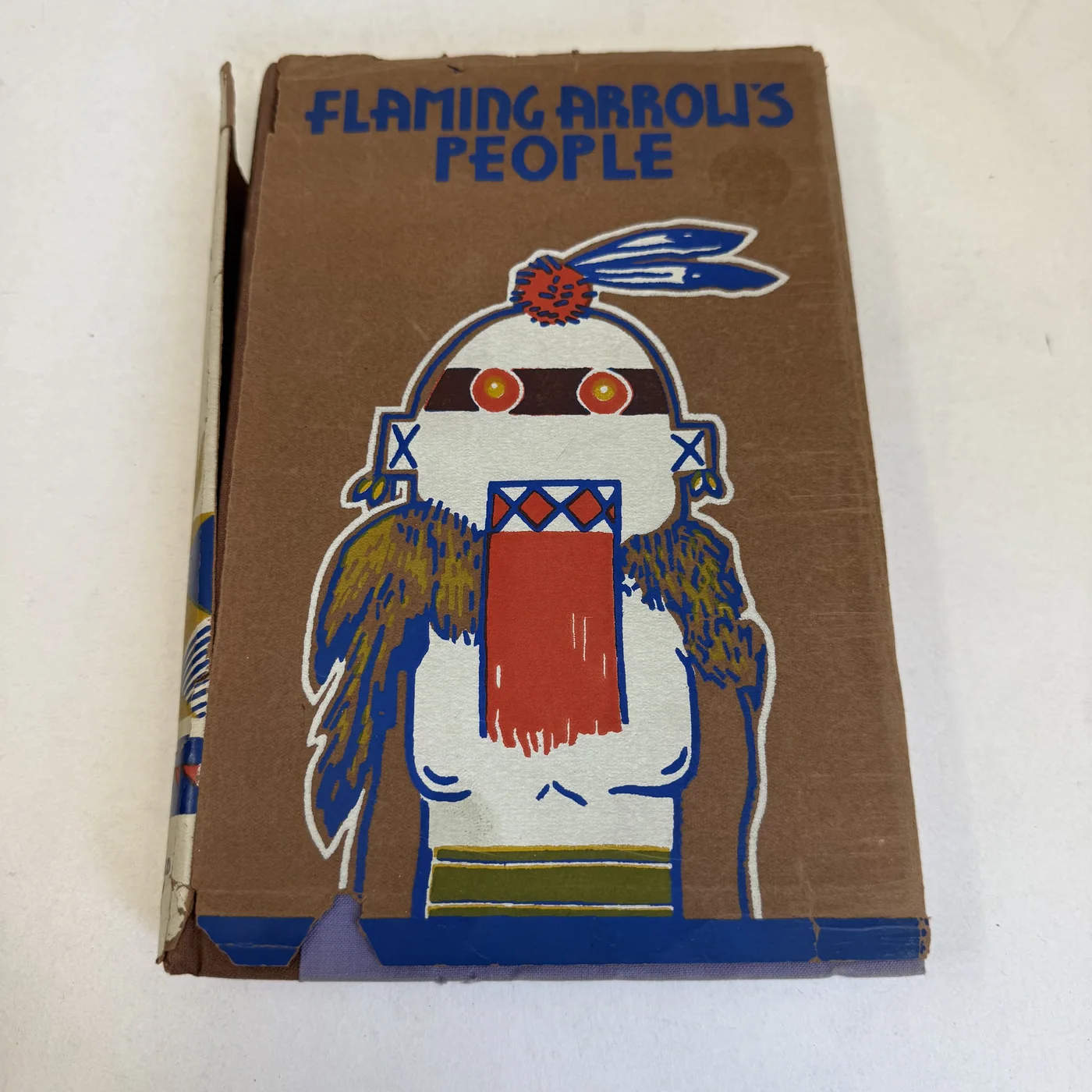
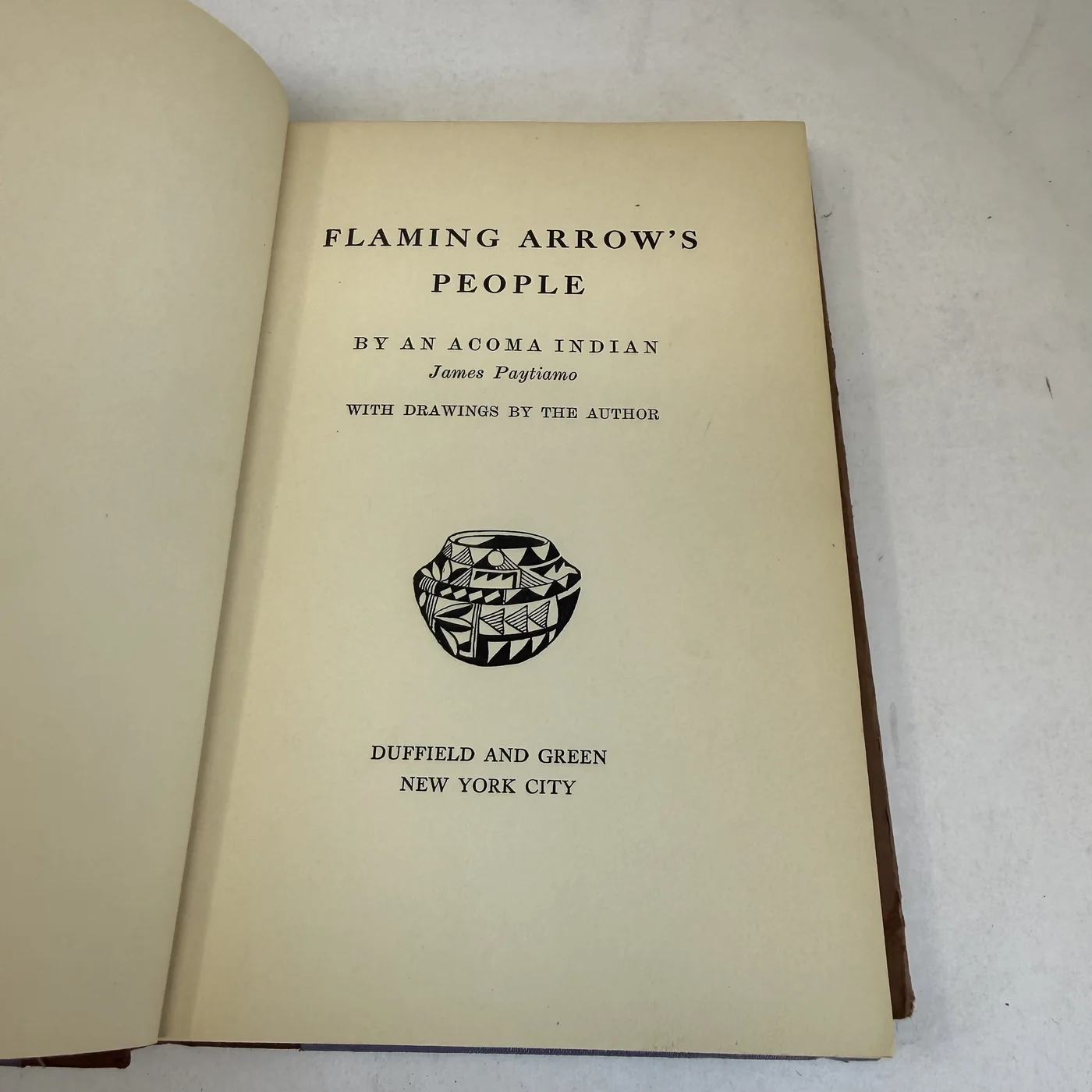
The chronological head of this shelf passed across the NMLP sorting desk: Flaming Arrow’s People (Duffield & Green, 1932), written and illustrated by James Paytiamo of Acoma — generally cited as the first book-length self-told Acoma account published for a trade audience, here in its scarce pictorial jacket from the author’s own art. Full specimen study in the Donation Archive:
The NM Native American literary canon is unusual among regional American literary canons in that it is institutionally Native-led across the contemporary period. The IAIA MFA, the Indian Pueblo Cultural Center publishing program, the Sun Tracks series at University of Arizona Press, and the substantial Native faculty positions across UNM, NMSU, and IAIA together constitute an infrastructure that did not exist in any comparable form in 1968 when Momaday published House Made of Dawn. A serious NM Native American literary library covers four generations: the foundational Renaissance generation (Momaday, Silko, Ortiz, Allen), the second generation working in adjacent traditions (Harjo, James Welch, Linda Hogan), the contemporary IAIA-anchored MFA generation (Long Soldier, Belin, Orange, Skeets, LaPointe), and the supporting scholarly canon (Lincoln Native American Renaissance 1983, Warrior Tribal Secrets 1995, Womack Red on Red 1999, Weaver-Warrior-Womack American Indian Literary Nationalism 2006).
Last verified September 2026 · Original research by Josh Eldred
Oliver La Farge: The Pulitzer Winner Who Came Before the Renaissance
Before Momaday, before Silko, before the phrase "Native American Renaissance" existed, there was Oliver La Farge. He won the Pulitzer Prize for Fiction in 1930 — thirty-nine years before Momaday's House Made of Dawn — for Laughing Boy, a novel about Navajo life that was arguably the first widely read American novel to treat Native peoples with genuine depth, autonomy, and respect. La Farge was not Native himself (he was a Harvard-educated anthropologist from a prominent Rhode Island family), but he spent decades in the Southwest, lived in Santa Fe from the early 1930s until his death in 1963, and devoted his career to Indian rights advocacy and to writing fiction that took Navajo, Hopi, and Pueblo people seriously as human beings with complex inner lives. That sounds like a low bar until you consider what American fiction was doing with Native characters in the 1920s.
Oliver Hazard Perry La Farge (December 19, 1901 — August 2, 1963, closed pool) arrived in the Southwest as a young archaeologist in the 1920s, doing fieldwork in Arizona and Guatemala. The fieldwork became fiction; Laughing Boy (Houghton Mifflin 1929) drew on his deep familiarity with Navajo culture to create a love story between two young Navajo people navigating the collision between traditional life and Anglo encroachment. The Pulitzer arrived when La Farge was twenty-eight. He moved to Santa Fe, became president of the Association on American Indian Affairs (1933-1937 and again 1948-1963), and spent the rest of his life writing short stories set in Indian Country while fighting for tribal sovereignty in the courts and in Congress. He died in Santa Fe in 1963 — five years before Momaday's House Made of Dawn would catalyze the literary movement that La Farge's work had quietly anticipated.
Yellow Sun, Bright Sky: The Indian Country Stories of Oliver La Farge (University of New Mexico Press, Albuquerque, 1988, First Edition, ISBN 0-8263-1033-8) is the posthumous collection that gathers La Farge's Indian Country short fiction in one volume — twelve stories spanning Navajo and Hopi country, edited and with an introduction by David L. Caffey (then director of the UNM Division of the Arts) and published with the permission of La Farge's son, John Pendaries La Farge. The copyright page reads "© 1988 by John Pendaries La Farge. All rights reserved. First Edition." UNM Press published this twenty-five years after La Farge's death, and the collection's appearance was itself a statement — the state university press of La Farge's adopted home reclaiming his short fiction for a new generation of readers.
The back cover carries an endorsement from N. Scott Momaday — one Pulitzer Prize winner writing about another — and the quote is worth reading carefully. Momaday credits La Farge's contribution as "something other than casual or sentimental, a legitimate recognition of Americanness as something other than Anglo-Saxon without intention or style." That is not faint praise. Momaday is acknowledging that La Farge, decades before the Renaissance, understood that American literature's treatment of Native peoples required substance rather than sentiment. The stories collected here — "North Is Black," "Harder Winter," "Higher Education," "Women at Yellow Wells," "All the Young Men," "The Happy Indian Laughter," "The Bride at Dead Soldier Spring," and seven more — are the evidence for that claim.
For collectors, the 1988 UNM Press First Edition softcover in clean condition trades in the Tier 2 to Tier 3 range — it is not a four-figure trophy, but it is a foundational piece in any serious NM Native American literary collection. La Farge's Laughing Boy first edition (Houghton Mifflin 1929) is the genuine Tier 1 trophy and trades accordingly when it surfaces with dust jacket intact. The fact that La Farge has been conspicuously absent from this page until now was a gap I wanted to fill — you cannot tell the story of Native American literature in New Mexico without starting here. If you have La Farge titles in a collection you are considering donating or selling, I want to hear from you.


Photos: Josh Eldred, June 2026. Original desk photography at the New Mexico Literacy Project, Albuquerque, NM.
N. Scott Momaday and the Native American Renaissance
Navarre Scott Momaday (February 27, 1934 — February 24, 2024, closed pool) is the foundational figure of the Native American Renaissance. Born in Lawton Oklahoma to Alfred Morris "Al" Momaday (Kiowa painter and educator) and Natachee Scott Momaday (Cherokee descent, writer), raised principally on the Jemez Pueblo NM Reservation where his parents taught at the Jemez Day School from 1946 to 1962, with summers at the Kiowa community in southwestern Oklahoma. UNM bachelor's 1958, University of Virginia graduate work, Stanford English PhD 1963 (dissertation on Frederick Goddard Tuckerman under Yvor Winters, the Stanford professor and literary critic who became Momaday's principal mentor), and held faculty appointments at UC Santa Barbara, UC Berkeley, Stanford, the University of Arizona, and UNM across his career. Died at Santa Fe NM on February 24, 2024.
House Made of Dawn (Harper & Row 1968 first hardcover with original dust jacket) is Momaday's first novel, set substantially at the fictional Walatowa Pueblo (Momaday's Jemez Pueblo). Protagonist Abel is a Walatowa Pueblo World War II veteran returning to the reservation, undergoing the cultural-dislocation crisis that the novel's narrative engages through traditional Pueblo healing ceremony, Catholic mission framework, and the bicoastal Los Angeles-displacement context that mid-century Pueblo veterans frequently encountered. The novel won the 1969 Pulitzer Prize for Fiction — the first Native American novelist to win the Pulitzer. The 1968 Harper & Row first hardcover with original dust jacket is the principal Tier 1 trophy of the entire Native American Renaissance canon. Fine signed firsts trade four-figure to upper-four-figure at specialist auction; Momaday signed extensively at UNM, Santa Fe, Tucson, and Native literature conference events through his February 2024 closed pool.
The Way to Rainy Mountain (University of New Mexico Press 1969 first hardcover) is the foundational Kiowa-tradition prose-and-illustration memoir, with Al Momaday's illustrations integrated alongside text. The book combines three voices — Kiowa oral tradition, anthropological-historical commentary, and personal memoir — in a tripartite structure that became Momaday's signature formal innovation. The 1969 UNM Press first hardcover with original dust jacket and Al Momaday illustrations intact is the second-tier Momaday trophy. Companion canonical Momaday: Angle of Geese and Other Poems (David R. Godine 1974); The Names: A Memoir (Harper & Row 1976 first hardcover, the principal Momaday autobiographical work); The Ancient Child (Doubleday 1989 novel); In the Presence of the Sun: Stories and Poems 1961-1991 (St. Martin's 1992); The Man Made of Words: Essays, Stories, Passages (St. Martin's 1997); In the Bear's House (St. Martin's 1999); Three Plays (UNM Press 2007); Earth Keeper: Reflections on the American Land (HarperOne 2020 — his final book before his 2024 death).
Leslie Marmon Silko: The Laguna Voice
Leslie Marmon Silko (born March 5, 1948, Albuquerque NM), Laguna Pueblo enrolled member with substantial Anglo and Mexican heritage from her father's side, raised at Laguna Pueblo NM, is the principal Pueblo-voice novelist of the contemporary Native American canon. UNM bachelor's in English 1969, briefly attended UNM Law School before withdrawing to focus on writing, MacArthur Foundation Fellow 1981 (one of the early Native American MacArthur recipients).
Laguna Woman: Poems (Greenfield Review Press 1974) is the foundational Silko chapbook — small Greenfield Review Press print run, the genuinely scarce Tier 1 starting point for serious Silko collecting. Ceremony (Viking 1977 first hardcover) is the foundational post-Momaday Pueblo-voice Native American Renaissance novel. Protagonist Tayo is a mixed-heritage Laguna Pueblo World War II veteran (similar in structural framing to Momaday's Abel) returning home and undergoing traditional Pueblo healing ceremony. Immediate canonical status, persistent presence in college and graduate Native American literature curricula, frequent inclusion in American-literature survey anthologies. The 1977 Viking Ceremony first hardcover with original dust jacket is the principal Tier 1 Silko trophy. Fine signed firsts trade upper-three-figure to low-four-figure at specialist auction.
Storyteller (Seaver Books / Arcade 1981 first hardcover) is the multi-genre collection of stories, poems, photographs, and family-history material that established Silko's distinctive formal innovation — the interweaving of multiple narrative modes that became increasingly central to her work. Almanac of the Dead (Simon & Schuster 1991 first hardcover) is the massive 762-page apocalyptic novel covering five centuries of Indigenous Americas history — substantially more difficult and commercially challenging than Ceremony, but increasingly recognized as the central Silko work of the late twentieth century. The 1991 Simon & Schuster Almanac of the Dead first is the second-tier Silko trophy. Companion: Sacred Water (Flood Plain Press 1993); Yellow Woman and a Beauty of the Spirit (Simon & Schuster 1996 essay collection); Gardens in the Dunes (Simon & Schuster 1999 novel); The Turquoise Ledge: A Memoir (Viking 2010).
Not sure what you have? Text me a photo at 505-250-3804 and I'll tell you what I see.
Simon J. Ortiz: The Acoma Voice
Simon Joseph Ortiz (born May 27, 1941, Albuquerque NM), raised at Deetseyamah (the McCartys Village of Acoma Pueblo NM), Acoma Pueblo enrolled member, is the principal Pueblo-voice poet of the contemporary Native American canon. UNM undergraduate work and Fort Lewis College, U.S. Army Vietnam War service, Iowa Writers' Workshop, and faculty appointments at Sinte Gleska University (Rosebud SD), College of Marin, UNM, and Arizona State University.
Going for the Rain (Harper & Row 1976 first hardcover with original dust jacket) is the foundational Ortiz collection — the first major-trade-press collection of Pueblo-voice contemporary poetry. The Harper & Row first-novel-print-run-for-a-Native-poet was small; fine first hardcovers are now scarce. A Good Journey (Turtle Island / University of Arizona 1977) continues the Pueblo-voice tradition. From Sand Creek: Rising in This Heart Which Is My America (Thunder's Mouth Press 1981 first, Pushcart Prize winner) is the major book-length poetry sequence anchored to the November 29, 1864 Sand Creek Massacre — frequently cited as the artistic peak of Ortiz's work, the Tier 2 collector target.
Woven Stone (University of Arizona Press Sun Tracks Series 1992) is the comprehensive collected poetry combining Going for the Rain, A Good Journey, and Fight Back. Companion canonical Ortiz: Howbah Indians (Blue Moon Press 1978 short stories); Song, Poetry, Language: Expression and Perception (Institute of American Indian Arts 1977); Fightin': New and Collected Stories (Thunder's Mouth 1983); After and Before the Lightning (University of Arizona 1994); Out There Somewhere (University of Arizona Sun Tracks 2002); Speaking for the Generations: Native Writers on Writing (University of Arizona 1998 edited anthology). Ortiz signs at UNM, Acoma Pueblo, ASU, and contemporary Native literature events; signed firsts of Going for the Rain and From Sand Creek trade meaningful premium at specialist Native American literature dealers.
Joy Harjo: The Three-Term U.S. Poet Laureate
Joy Harjo (born May 9, 1951, Tulsa Oklahoma), Mvskoke (Muscogee Creek) Nation enrolled citizen, with substantial UNM and IAIA Albuquerque/Santa Fe publishing-and-residency career across decades, is the principal contemporary Native American poet. Library of Congress appointed her U.S. Poet Laureate in June 2019, reappointed her for a second term June 2020 (the first reappointment in fourteen years), and reappointed her for an unprecedented third term June 2021 — the only American poet to serve three terms and the first Native American Poet Laureate.
Harjo took the UNM bachelor's in poetry 1976, where she studied with Leslie Marmon Silko and Simon Ortiz (the foundational Native voice generation that taught her — writers whose work engages the Pueblo sovereignty tradition), the Iowa Writers' Workshop MFA 1978, and held faculty appointments at the University of Colorado, Arizona State, UCLA, the Institute of American Indian Arts Santa Fe, and UT Knoxville. Her Albuquerque and Santa Fe residencies across decades make her substantially a New Mexico literary figure alongside her Mvskoke Nation citizenship.
Canonical Harjo bibliography: The Last Song (Puerto Del Sol Press, Las Cruces NMSU, 1975 first chapbook — extremely scarce, the foundational Harjo artifact); What Moon Drove Me to This? (I. Reed Books 1979); She Had Some Horses (Thunder's Mouth Press 1983 first chapbook — the foundational Harjo collection, the Tier 1 Harjo trophy, small Thunder's Mouth Press print run); Secrets from the Center of the World (University of Arizona Sun Tracks 1989 with Stephen Strom photographs); In Mad Love and War (Wesleyan University Press 1990 American Book Award + Delmore Schwartz Memorial Award — the second-tier Harjo trophy); The Woman Who Fell from the Sky (W.W. Norton 1994); A Map to the Next World (Norton 2000); How I Became Human: New and Selected Poems 1975-2001 (Norton 2002); Crazy Brave: A Memoir (Norton 2012 American Book Award + PEN Open Book Award); An American Sunrise (Norton 2019 first hardcover during her Laureate term); Poet Warrior: A Memoir (Norton 2021); Weaving Sundown in a Scarlet Light: Fifty Poems for Fifty Years (Norton 2022 her Laureate-term-anchor selected). Harjo also produced multiple albums of poetry-and-music collaboration; the saxophone-poetry-and-spoken-word performance tradition is central to her work.
Paula Gunn Allen and the Native Feminist Tradition
Paula Gunn Allen (October 24, 1939 — May 29, 2008, closed pool), born Cubero NM in western Valencia County, Laguna Pueblo / Lebanese / Scottish heritage, raised at the boundary of Laguna and Acoma Pueblos, was the principal Laguna-voice scholar and writer of the second half of the twentieth century, with substantial influence in Native feminist theory and Indigenous literary studies. UCLA PhD in American Studies 1975 with dissertation that became The Sacred Hoop. Faculty appointments at San Francisco State University, UCLA Native American Studies (where she chaired the department), emeritus status until her 2008 death.
Canonical Allen bibliography: Coyote's Daylight Trip (La Confluencia 1978 poems); The Blind Lion (Thorp Springs Press 1974); A Cannon Between My Knees (Strawberry Press 1981); Shadow Country (UCLA American Indian Studies Center 1982); The Woman Who Owned the Shadows (Aunt Lute Press 1983, the foundational Native lesbian novel); The Sacred Hoop: Recovering the Feminine in American Indian Traditions (Beacon Press 1986 first hardcover — the canonical Allen text, persistent presence in Women's Studies and Native American Studies curricula); Skins and Bones (West End Press 1988); Spider Woman's Granddaughters: Traditional Tales and Contemporary Writing by Native American Women (Beacon Press 1989 edited anthology); Grandmothers of the Light: A Medicine Woman's Source Book (Beacon Press 1991); Off the Reservation: Reflections on Boundary-Busting, Border-Crossing Loose Canons (Beacon 1998); Pocahontas: Medicine Woman, Spy, Entrepreneur, Diplomat (HarperSanFrancisco 2003).
The 1986 Beacon Press Sacred Hoop first hardcover with original dust jacket is the Tier 1 Allen trophy. Beacon Press trade-first print run was modest; signed Allen copies trade upper-three-figure at specialist Native American literature dealers (Allen closed pool 2008). The 1983 Aunt Lute Press Woman Who Owned the Shadows first is the second-tier Allen trophy and the foundational Native lesbian novel in the broader Native literary canon.
The Contemporary IAIA Generation, 2000-Present
The contemporary post-Renaissance generation of NM Native American literature substantially overlaps with the Institute of American Indian Arts (IAIA) Santa Fe MFA in Creative Writing program (established 2013, the only Native-focused MFA in the United States), the Sun Tracks American Indian Literary Series at University of Arizona Press, Graywolf Press, and the substantial Native-faculty network at UNM, NMSU, and IAIA.
Layli Long Soldier (Oglala Lakota, MFA Bard College 2009, IAIA MFA faculty) — WHEREAS (Graywolf Press 2017 first softcover) won the 2018 National Book Critics Circle Award, the Whiting Award, the PEN Open Book Award, and the LA Times Book Prize for Poetry — the major book-length poetry response to the 2009 Congressional Apology to Native Peoples (Public Law 111-118, Section 8113, signed by President Obama with no Native Americans present, the apology that the title's "WHEREAS" derives from). The 2017 Graywolf first trade paperback is the Tier 1 contemporary Native poetry trophy; signed firsts trade upper-three-figure at specialist auction.
Tommy Orange (Cheyenne/Arapaho, IAIA MFA, sustained Santa Fe IAIA faculty residency) — There There (Knopf 2018 first hardcover) won the PEN/Hemingway Award 2019, was a Pulitzer Prize finalist 2019, and is the foundational urban-Indian-perspective contemporary Native novel set substantially in Oakland CA. The 2018 Knopf There There first hardcover with original dust jacket is the Tier 1 contemporary Native novel trophy. Companion: Wandering Stars (Knopf 2024 the sequel).
Other contemporary major figures: Esther G. Belin (Diné) From the Belly of My Beauty (University of Arizona Sun Tracks 1999 American Book Award) and Of Cartography (University of Arizona Sun Tracks 2017); Sherman Alexie (Spokane/Coeur d'Alene, sustained Santa Fe IAIA residency) The Lone Ranger and Tonto Fistfight in Heaven (Atlantic Monthly Press 1993) through The Absolutely True Diary of a Part-Time Indian (Little Brown 2007); Stephen Graham Jones (Blackfeet, sustained Santa Fe IAIA faculty residency) The Only Good Indians (Saga Press 2020) and the Indian Lake Trilogy (Saga 2021-2023); Jake Skeets (Diné, sustained Albuquerque/Window Rock residency) Eyes Bottle Dark with a Mouthful of Flowers (Milkweed Editions 2019 Whiting Award 2020 + American Book Award 2020); Sasha LaPointe (Coast Salish, sustained Santa Fe residency) Red Paint (Counterpoint 2022); Crisosto Apache (Mescalero Apache, sustained Albuquerque residency) Ghostword (Mongrel Empire Press 2018); Sherwin Bitsui (Diné, IAIA MFA faculty) Shapeshift (University of Arizona 2003), Flood Song (Copper Canyon 2009), Dissolve (Copper Canyon 2018 American Book Award 2019).
Inherited a library and not sure where to start? Call or text 505-250-3804 — I handle this all the time.
Five Identification Problems
Problem one: Momaday House Made of Dawn 1968 Harper & Row first vs subsequent printings. The 1968 Harper & Row first hardcover with original dust jacket is the Pulitzer-winner artifact. Subsequent: Perennial Library paperback 1969 and subsequent; HarperCollins reprintings of the 1990s-2000s; Vintage trade paperback editions. The 1968 Harper & Row hardcover is the artifact; Pulitzer-winner editions of the 1969-1970 mass-market are working copies.
Problem two: Silko Ceremony 1977 Viking first vs subsequent. The 1977 Viking first hardcover with original dust jacket is the artifact. Subsequent: Penguin trade paperback editions of the late 1970s and 1980s; Viking Critical Library expanded editions with critical apparatus; Penguin 30th and 40th anniversary editions. The 1977 Viking hardcover with dust jacket is the collector target.
Problem three: Harjo She Had Some Horses 1983 Thunder's Mouth chapbook authentication. The 1983 Thunder's Mouth Press first chapbook is genuinely scarce — small Thunder's Mouth Press print run, the foundational Harjo collection. Signed firsts are heavily sought; Harjo signed at NM events through her Laureate years and continues to sign. Subsequent: W.W. Norton reissues; the 2008 Norton 25th anniversary edition.
Problem four: Sun Tracks Series identification. The Sun Tracks American Indian Literary Series at University of Arizona Press (founded by Larry Evers and Felipe Molina at University of Arizona late 1970s) publishes many canonical Native American literature firsts in the contemporary period. Sun Tracks-imprint identification matters — Sun Tracks firsts trade premium over later University of Arizona reissues; collectors verify Sun Tracks series-volume number and original dust jacket.
Problem five: IAIA Press and small-press chapbook authentication. Many contemporary Native American poets publish chapbooks through IAIA Press, Mongrel Empire Press, West End Press, and other small Native-focused publishers. Print runs are small, distribution is limited, and chapbook firsts are scarce in the broader secondary market. Collectors verify imprint, edition number, and ideally event-signing provenance.
Three-Tier Collector Market
Tier 1 trophy (mid-three-figure to upper-four-figure): Signed Momaday House Made of Dawn Harper & Row 1968 first hardcover with original dust jacket Pulitzer-winner fine condition (signed Momaday firsts cross four-figure at specialist auction, fine signed firsts can reach upper-four-figure given the 2024 closed pool); signed Silko Ceremony Viking 1977 first; signed Silko Laguna Woman Greenfield Review Press 1974 chapbook first; signed Ortiz Going for the Rain Harper & Row 1976 first; signed Ortiz From Sand Creek Thunder's Mouth 1981 first; signed Harjo She Had Some Horses Thunder's Mouth 1983 first chapbook; signed Allen Sacred Hoop Beacon 1986 first hardcover; signed Long Soldier WHEREAS Graywolf 2017 first; signed Tommy Orange There There Knopf 2018 first; complete signed Sun Tracks Series first-edition runs of major NM Native authors.
Tier 2 collector targets (low-to-mid three-figure): Trade firsts of canonical NM Native American literature — Momaday Way to Rainy Mountain UNM 1969 first hardcover with Al Momaday illustrations and dust jacket, Momaday Names: A Memoir Harper & Row 1976 first, Momaday Ancient Child Doubleday 1989 first; Silko Storyteller Seaver 1981 first hardcover, Silko Almanac of the Dead Simon & Schuster 1991 first, Silko Gardens in the Dunes Simon & Schuster 1999 first; Ortiz Woven Stone University of Arizona 1992 first softcover Sun Tracks Series; Harjo In Mad Love and War Wesleyan 1990 first, Harjo Crazy Brave Norton 2012 first; Allen Woman Who Owned the Shadows Aunt Lute 1983 first; Belin From the Belly of My Beauty Arizona Sun Tracks 1999 first softcover; Skeets Eyes Bottle Dark Milkweed 2019 first; Bitsui Flood Song Copper Canyon 2009 first; Stephen Graham Jones The Only Good Indians Saga 2020 first; Sasha LaPointe Red Paint Counterpoint 2022 first.
Tier 3 working library (upper-two-figure to low-three-figure): Subsequent printings of all above; Perennial/Harper trade paperback House Made of Dawn editions; Penguin Ceremony editions including the 30th and 40th anniversary; Vintage Contemporaries trade paperback editions; Norton trade paperback Harjo editions; Penguin and University of Arizona Sun Tracks trade paperback editions; small-press Native chapbooks from West End Press, Mongrel Empire, IAIA Press; literary anthologies including selected NM Native American work (Norton Anthology of Native American Literature, Reinventing the Enemy's Language: Contemporary Native Women's Writing Joy Harjo and Gloria Bird edited 1997, Returning the Gift); academic monographs on Native American literature; UNM Press scholarly editions.
NMLP Intake Position
Native American literature arrives in the NMLP donation stream with substantial frequency given New Mexico's deep Native scholarly-and-residency tradition. Donor surface concentration: UNM English Department and Native American Studies faculty estates (signed Momaday, Silko, Ortiz, Harjo, Allen across decades — UNM was Momaday's, Silko's, Ortiz's, and Harjo's foundational educational institution), IAIA Santa Fe-adjacent residential estates (sustained IAIA faculty and student-and-alumni libraries, the principal contemporary-Native-literature donor surface), Indian Pueblo Cultural Center-adjacent Hispano-Pueblo-Anglo Albuquerque household donations — donor contributions help NMLP process these culturally significant collections — (deep canon-set Pueblo-voice donations), Santa Fe arts-community estates with substantial Native American collecting interest (collectors of both art and books, often with signed Tier 1 Momaday and Silko first editions), Laguna Pueblo and Acoma Pueblo regional household donations (Silko and Ortiz home-community libraries), Albuquerque attorneys and physicians whose practices serve Pueblo and Native client populations.
NMLP routes Tier 1 trophy items — signed Momaday House Made of Dawn Harper & Row 1968 first, signed Silko Ceremony Viking 1977 first, signed Ortiz Going for the Rain Harper & Row 1976 first, signed Harjo She Had Some Horses Thunder's Mouth 1983 first chapbook, signed Allen Sacred Hoop Beacon 1986 first, signed Long Soldier WHEREAS Graywolf 2017 first, signed Tommy Orange There There Knopf 2018 first — through its sorting and resale process, where each one is researched individually before it's listed. Tier 2 trade firsts route through SellBooksABQ standard hand-sort with Native American literature collector outreach.
Tier 3 paperback reprints route extensively to community literacy partners (the NM history and English curriculum increasingly includes contemporary Native American literature with the 2020-present Native curriculum-mandate updates), classroom sets for local teachers, and Little Free Library stocking. Cultural-protocol note: certain Native ceremonial or restricted material (sandpainting reproductions, restricted kiva-tradition material, ceremonial calendars, restricted-knowledge ethnographic transcriptions) requires specialist cultural-protocol consultation before resale and is not routed through standard secondary market channels — these arrive infrequently in NMLP intake but require careful handling when they do, with their disposition guided by consultation with the appropriate tribal authority.
Free Albuquerque-metro pickup with no condition limit and no minimum quantity — schedule your pickup or text/call 505-250-3804.
From the Sorting Stream: First Nations Version New Testament
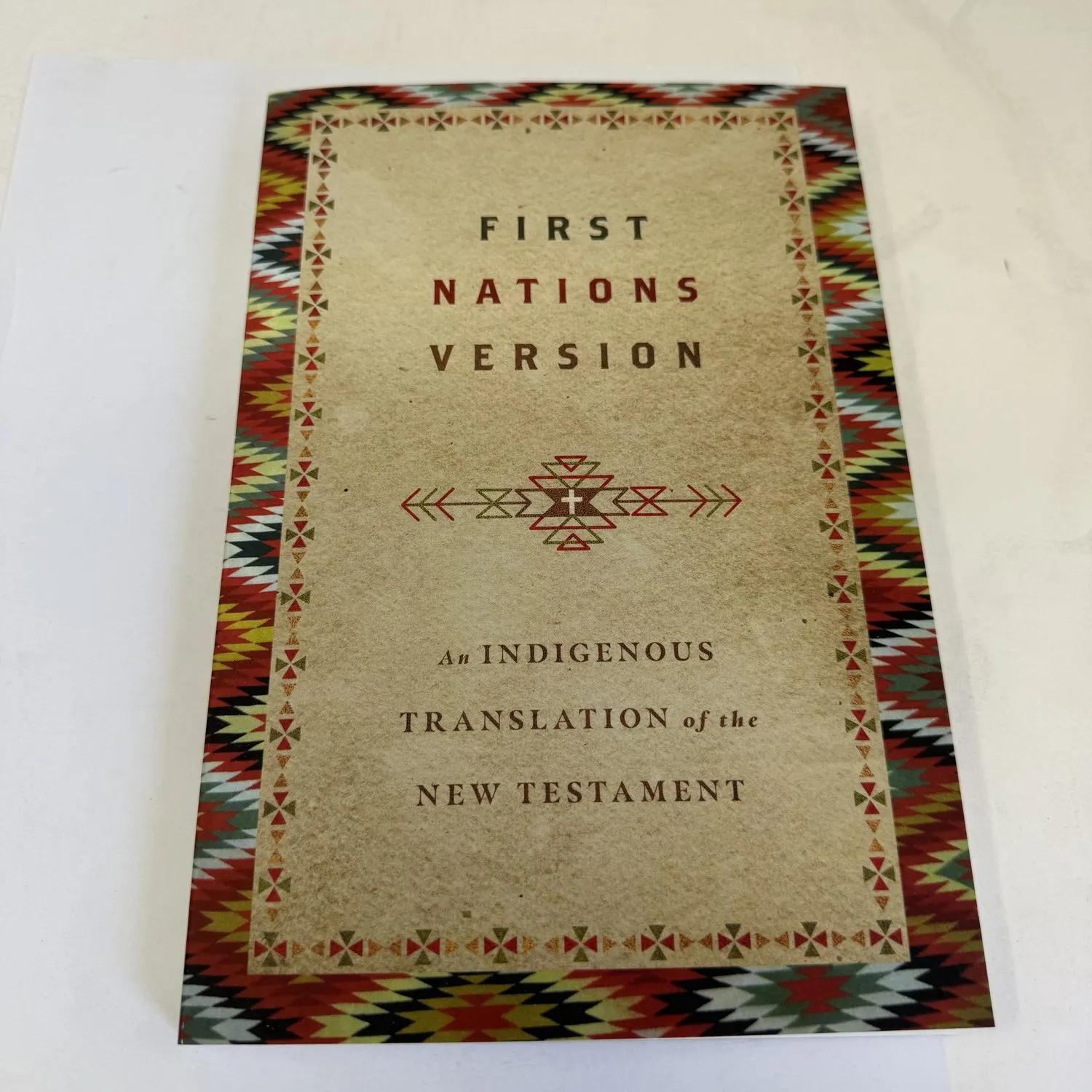
This one stopped me mid-sort. The First Nations Version: An Indigenous Translation of the New Testament (InterVarsity Press 2021, ISBN 978-0-8308-1350-6) came through in a donated collection, and I held it for twenty minutes before I could put it down. It is a complete dynamic-equivalence translation of the New Testament into the cultural vocabulary of Native North America — not a paraphrase layered over English idiom, but a genuine re-rendering of the source texts through Indigenous conceptual frameworks. Jesus becomes "Creator Sets Free." God becomes "Great Spirit." Christ becomes "the Chosen One." The Pharisees become "Separated Ones." Jerusalem becomes "Village of Peace." The effect is startling even if you have read dozens of Bible translations — and for communities where English-language Christianity arrived inseparable from colonial displacement, the effect is something deeper than startling.
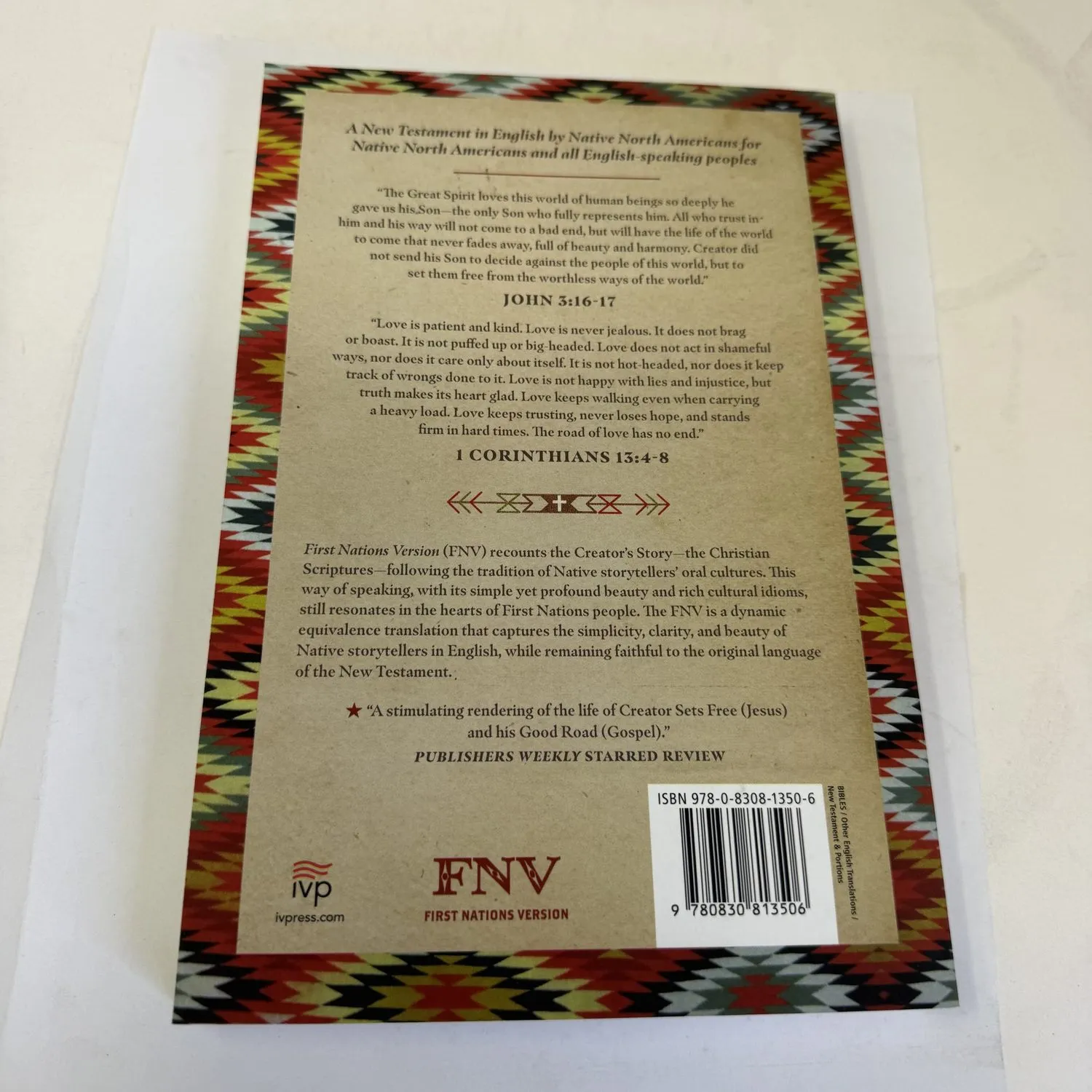
Published by InterVarsity Press (Downers Grove, Illinois) with a copyright held by Rain Ministries, Inc., the translation received a starred review from Publishers Weekly — an honor reserved for roughly fifteen percent of titles reviewed. The paperback features a striking cover with a traditional Native American diamond-and-arrow pattern in red, yellow, black, and green against a dark field. The back cover prints John 3:16-17 and 1 Corinthians 13:4-8 in the First Nations voice, and those passages alone demonstrate the translation's ambition: "The Great Spirit loves this world so deeply and so strongly that he gave his one and only Son" reads differently in the hand than anything in the KJV or NIV tradition.
New Mexico has the largest Native American population as a percentage of any state in the nation — roughly eleven percent, across twenty-three sovereign nations including nineteen Pueblos, the Navajo Nation, and the Mescalero and Jicarilla Apache Nations. The Spanish missions arrived at the Pueblos in the early 1600s; the Navajo code talkers carried their language into World War II battlefields while simultaneously navigating a boarding-school system designed to erase it. A translation that renders Christian scripture through Indigenous cultural concepts rather than against them speaks to four centuries of that tension. I have handled hundreds of Bibles in the sorting stream — family Bibles, study Bibles, devotionals in every translation from Tyndale to The Message. This is the first one I have photographed for the site, because this one matters to New Mexico in a way the others do not.
For collectors: the 2021 InterVarsity Press first printing in clean condition is a contemporary acquisition target in the mid-single-digit range — not a trophy-shelf item, but a book that belongs in any serious NM-focused Indigenous literature collection alongside the Momaday and Silko canon documented above. It is also, if I am being direct, a book worth reading rather than shelving.
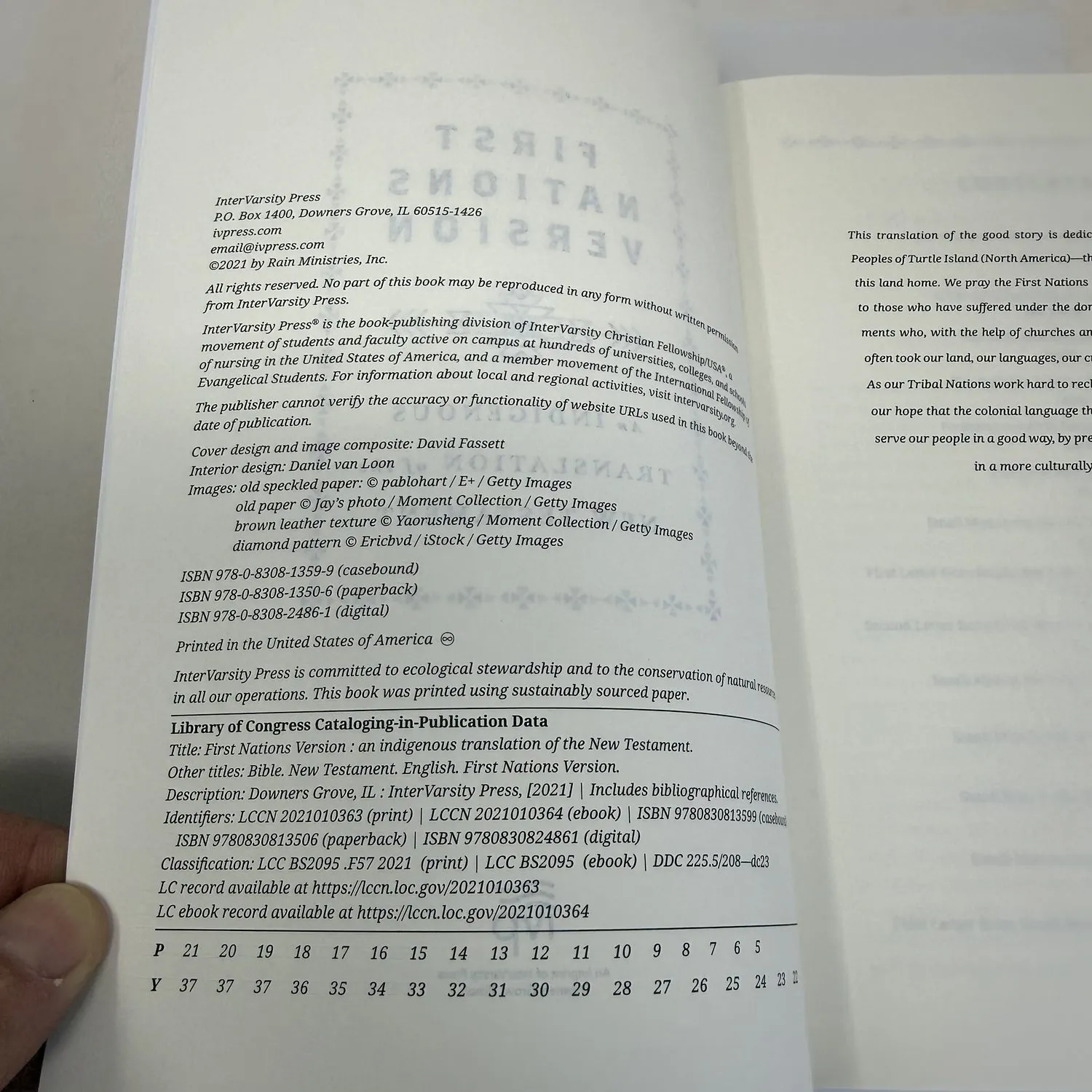
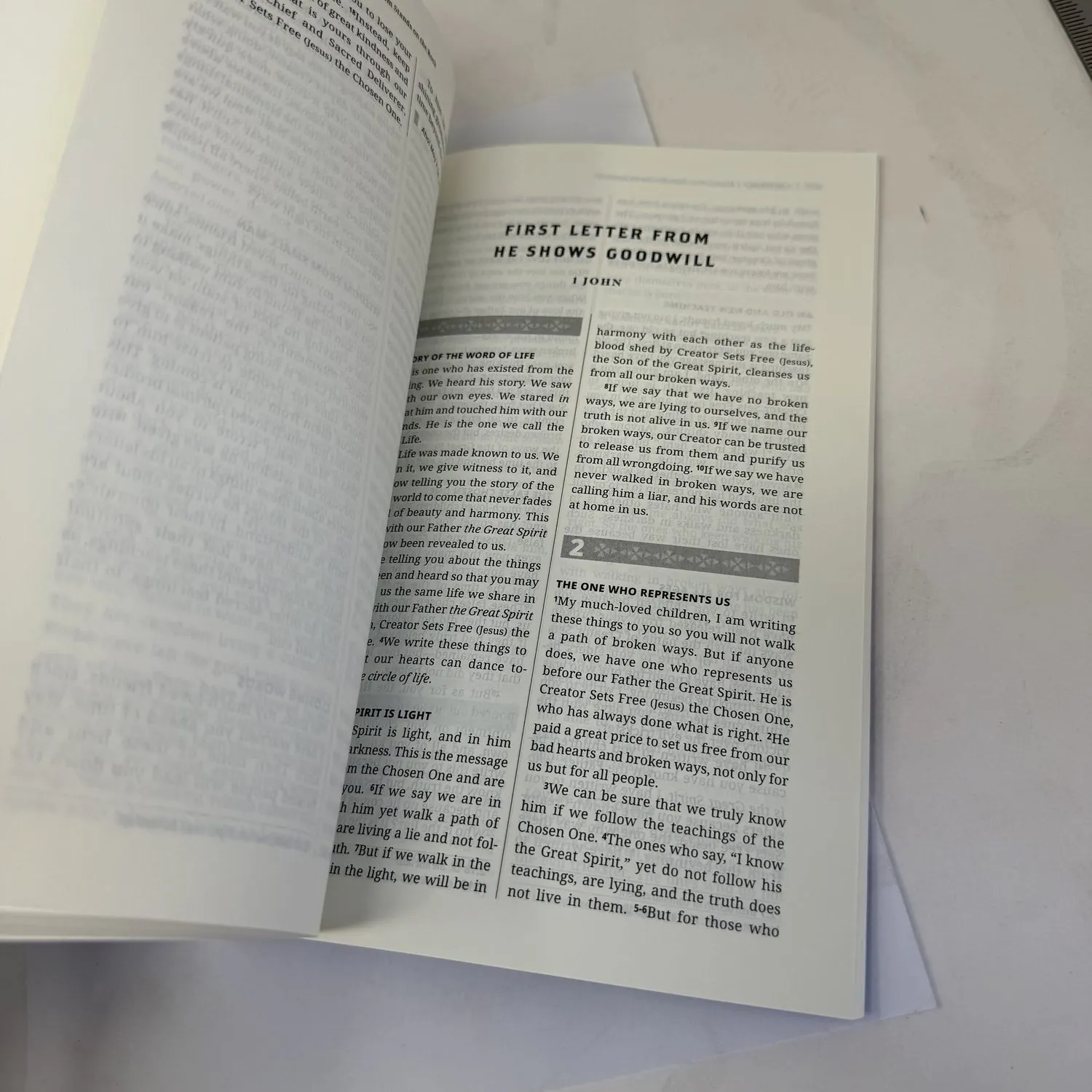
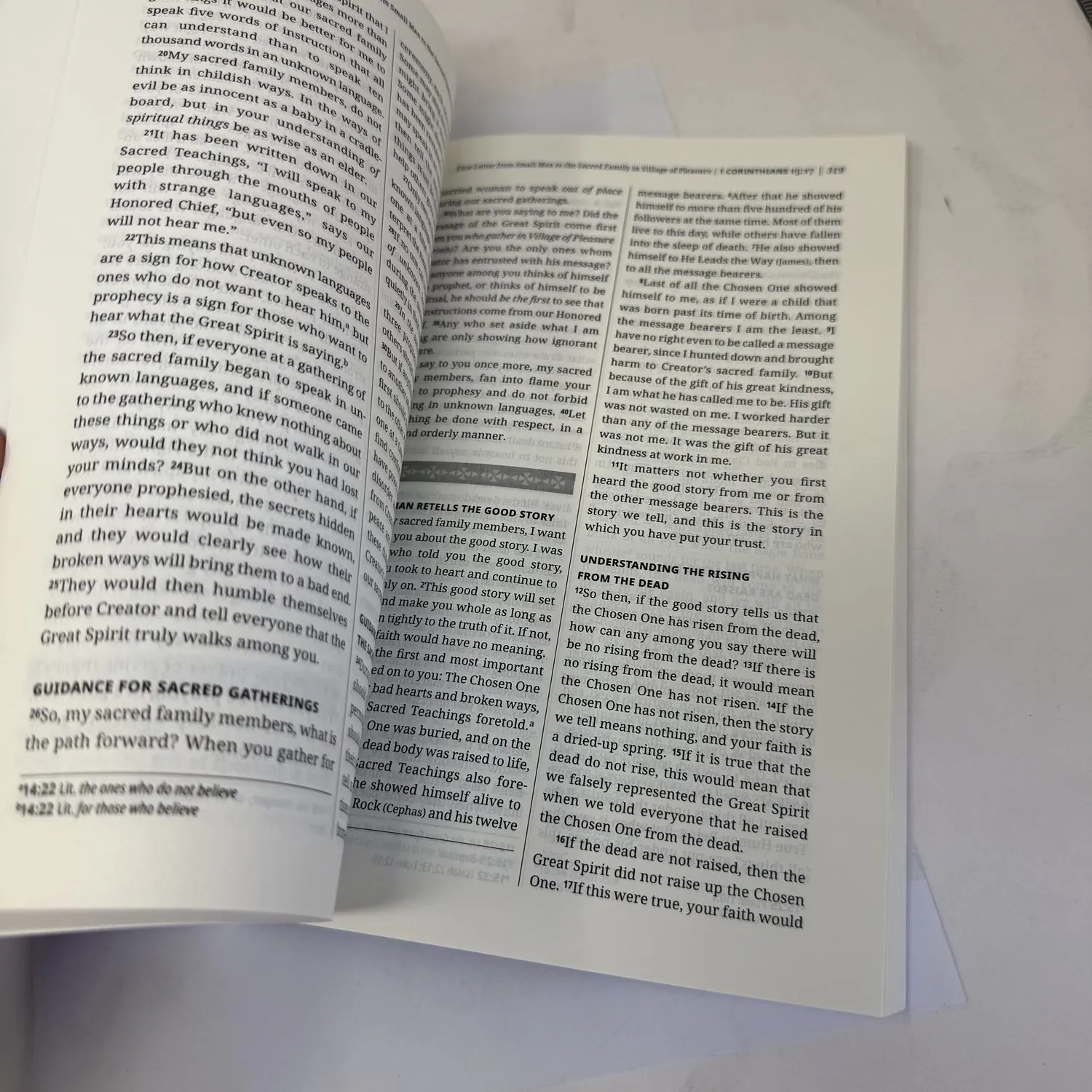
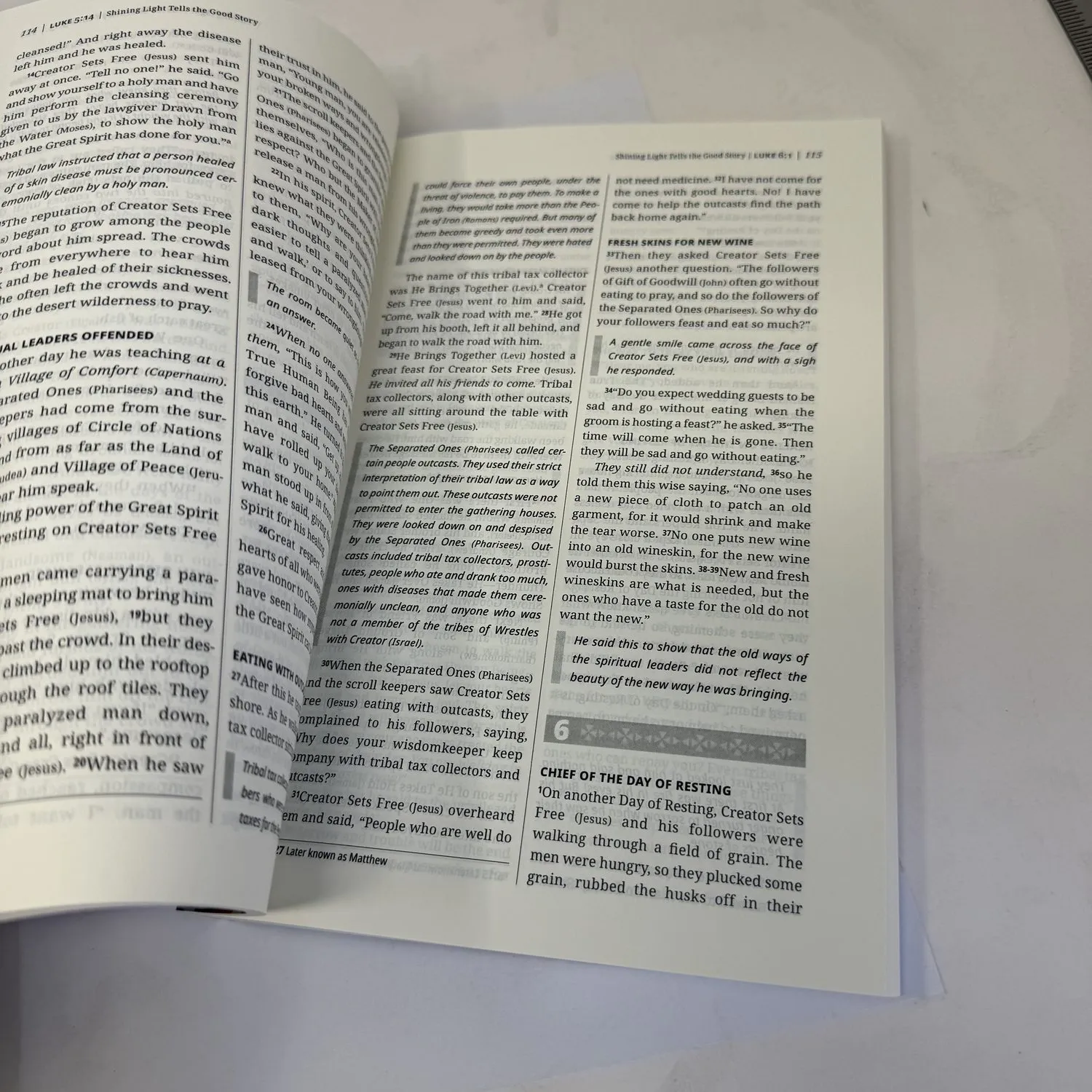
Photos: Josh Eldred / New Mexico Literacy Project. Cover and copyright page images used under standard book-trade documentation practice. Interior pages shown to document the translation approach.
From the Sorting Stream: Arizona Highways — Navajo Weaving Special Issue (July 1974)
This one came out of the same estate stream that produces the best surprises — a clean copy of Arizona Highways magazine, July 1974, the Navajo weaving special issue. The cover alone stopped me: a full-color Yei rug design, one of the most striking covers in the magazine's long history of documenting the Southwest. But what made this copy extraordinary was what fell out of it when I opened it — a loose newspaper clipping about the Maxwell Museum of Anthropology at UNM unveiling a Navajo weaving exhibit. Someone had tucked that clipping inside deliberately. This was not a casual reader. This was someone actively tracking Navajo textile exhibitions in Albuquerque, clipping coverage, filing it with the relevant magazine. The kind of collector's instinct I recognize.
Arizona Highways is one of the most collectible magazine titles in the American Southwest. Published since 1925 — first by the Arizona Highway Department, today by the Arizona Department of Transportation — it evolved from a road-condition bulletin into what became the premier photographic showcase of Southwest landscapes, Native arts, and regional culture. The magazine's large-format color photography — especially in the pre-digital era when color printing at this quality was expensive and rare — made certain issues genuine visual documents of traditions that were not being recorded with this fidelity anywhere else. The July 1974 Navajo weaving issue is a standout: the interior spreads cover Yei figures (the stylized Holy People of Navajo ceremonial tradition rendered in textile form), regional weaving styles including the distinctive Ganado Red pattern associated with the Hubbell Trading Post, and the broader taxonomy of Navajo textile art that was entering its modern collector-market phase in the early 1970s.
The Maxwell Museum connection ties this directly to Albuquerque. The Maxwell Museum of Anthropology at the University of New Mexico is one of the premier anthropological collections in the Southwest, with a Navajo textile collection that reflects a century of institutional relationships between UNM and the Navajo Nation. A newspaper clipping about a Maxwell weaving exhibit tucked inside a Navajo weaving issue of Arizona Highways tells you something about the previous owner's world — someone living in the Albuquerque orbit, attending museum exhibitions, reading the definitive Southwest magazine, keeping their reference material organized. As a fourth-generation New Mexican who handles estate collections regularly, I have learned that the ephemera tucked inside magazines and books often tells a more interesting story than the publications themselves.
For collectors: vintage Arizona Highways issues from the 1940s through 1970s trade actively in the Southwest collectibles market, with Native arts special issues commanding premium prices. The July 1974 Navajo weaving issue in clean condition is a mid-range acquisition target — not the rarest issue, but one of the most visually striking and culturally substantive. The loose ephemera adds provenance character that serious collectors value. If you are building a NM-focused Native American arts library alongside the literary canon documented above, the Arizona Highways archive is where the visual tradition lives.


Photos: Josh Eldred / New Mexico Literacy Project. Magazine cover shown under standard collectibles documentation practice. Interior spreads shown for editorial documentation of this 52-year-old publication's role in recording Southwest Native textile arts.
From the Sorting Stream: R.C. Gorman — The Lithographs (Northland Press 1978)
The literature on this page is predominantly literary — novels, poetry, memoir, criticism. But the Native American collecting tradition in New Mexico is not confined to words on a page, and some of the most important books in the field are catalogues of visual art. R.C. Gorman: The Lithographs by Doris Monthan (Northland Press, Flagstaff, 1978, ISBN 0-87358-179-2) is the definitive reference for the lithographic work of Rudolph Carl Gorman (1931–2005), and it sits at the intersection of visual art documentation and the broader Native American cultural-material canon that collectors in this region encounter constantly.
Gorman was Diné (Navajo), born at Canyon de Chelly, Arizona, the son of the Navajo artist Carl Nelson Gorman and grandson of a Navajo medicine man. He studied at Northern Arizona University, Mexico City College (where he was the first Navajo recipient of a Navajo Tribal Council grant to study art abroad), and San Francisco State College. In 1968 he opened the Navajo Gallery on Ledoux Street in Taos, New Mexico — the first gallery owned by a Native American artist, and for decades one of the most recognized cultural landmarks in Taos. He lived and worked in Taos from 1968 until his death in 2005, and his lithographs of Navajo women wrapped in blankets — rendered in broad, flowing lines with an economy of form that draws on both Navajo aesthetic tradition and mid-century modernist figuration — became the most widely recognized Native American visual art of the twentieth century. The New York Times called him "the Picasso of Indian artists." In 1973 he was the only living artist whose work was included in the Metropolitan Museum of Art's "Masterworks of the American Indian" exhibition in New York, and his work was shown at galleries and museums across the country, including the Heard Museum in Phoenix.
Doris Monthan's catalogue documents Gorman's complete lithographic output through 1978 — the medium that made him famous and the medium that collectors most actively seek. Published by Northland Press in Flagstaff, Arizona (the premier Southwest art and culture publisher of the mid-twentieth century, responsible for essential volumes on Hopi, Navajo, and Pueblo art), the book is a large-format hardcover with full-color and black-and-white plates reproducing the lithographs at near-original scale. For collectors identifying Gorman prints in the secondary market, this is the reference — plate identification, edition numbering, printer documentation, the full scholarly apparatus.
I see this title regularly in Albuquerque estate donations. Large-format art books are heavy, and they are often the first thing heirs want to move when clearing a house. The copy photographed here — a First Edition, Second Printing, identified by the "FIRST EDITION / Second Printing" statement on the copyright page — came through an Albuquerque estate donation. The distinction between First Printing and Second Printing matters to collectors: the First Printing is the more desirable artifact, but the Second Printing is still a First Edition and carries the same plates, the same scholarship, and substantially similar collector interest. Both printings in clean condition with the distinctive plum-colored dust jacket intact trade comfortably in the Tier 2 to Tier 3 range — more for copies signed by Gorman (closed pool 2005). If you are building a New Mexico Native American collection and you encounter one of these at an estate sale or a thrift store, pick it up. It belongs on the shelf next to the Momaday and Silko literary canon documented above, because Gorman's visual art and the Native American Renaissance literary movement are parallel expressions of the same cultural moment.


Photographed at the NM Literacy Project sorting desk, June 2026. This copy came through an Albuquerque estate donation — one of the most common Gorman titles I see, and one of the most frequently undervalued.
Photos: Josh Eldred / New Mexico Literacy Project. Cover, copyright page, and back cover images used under standard book-trade documentation practice.
From the Sorting Stream: A Powwow Summer Across North America (Gathering of Nations Publication)
Every page on this guide so far covers the literary canon — the novels, the poetry, the scholarly apparatus. But powwow culture is a living tradition that the literary canon orbits around without always documenting directly, and the books that do capture it from the inside are worth knowing about. A Powwow Summer Across North America by Dr. Lita Mathews is one of those books — a first-person travel memoir following the powwow circuit across the continent, published by A Gathering of Nations Publication in Albuquerque. That imprint matters. The Gathering of Nations is the largest powwow in North America, held annually at Expo New Mexico in Albuquerque (formerly at Tingley Coliseum on the UNM campus), drawing tens of thousands of dancers, singers, and spectators from hundreds of tribal nations. When the Gathering of Nations organization publishes a book, it carries institutional weight that a mainstream press can't replicate — this is the powwow community documenting itself.
Dr. Mathews traveled the summer powwow trail and wrote what the back-cover endorsers describe as a behind-the-scenes insider account — the regalia preparation, the drum circles, the family logistics of a circuit season, the cultural protocols that outsiders rarely see. The endorsements come from two University of New Mexico faculty members (Dr. Kathryn Herr, Educator, and Dr. Ruth Salvaggio, American Studies Department), grounding the book in the same NM academic tradition that anchors the Momaday and Silko scholarship documented above. Dr. Herr calls it "a cultural artifact in its own right," and Salvaggio praises it as "a real behind the scenes story." Cover photograph by Derek Mathews; the sepia-toned oval image on the black cover shows a Native American dancer in traditional buckskin regalia with fringe, feather, and beadwork — the kind of image that stops your hand during sorting.
This particular copy is an ex-library copy — there's a library sticker on the back cover (03/06, 10-0-B) partially obscuring the cover photo credit line. That's a condition variant I see constantly in estate and library-deaccession donations: a book that circulated, did its job, got weeded from the collection, and landed in a donation box that ended up on my sorting desk. Ex-library copies trade at a discount to clean retail copies, but for a title like this — institutional imprint, limited distribution, culturally specific content — the ex-library copy may be the only copy you encounter. The triple pricing ($12.95 US / $19.95 Canada / £8 UK) suggests international distribution ambitions for what is essentially a small-press Albuquerque publication, which tells you something about the Gathering of Nations organization's reach and aspirations.


Photographed at the NM Literacy Project sorting desk, June 2026. Ex-library copy from an Albuquerque donation — the Gathering of Nations imprint made me pull it from the stream for documentation.
Photos: Josh Eldred / New Mexico Literacy Project. Cover and back cover images used under standard book-trade documentation practice.
From the Sorting Stream: Right Place, Right Time — A Signed Pueblo of Laguna Memoir (All About Indians Press 2013)
This page started with the literary canon — Momaday, Silko, Ortiz, the names that show up in Norton anthologies and MFA syllabi. But the books I pull from Albuquerque donation boxes most often aren't the canon. They're the books that people actually write about their own lives, publish through their own family presses, and sign with their own tribal names. Right Place, Right Time: The Journey of a Pueblo of Laguna Native by Robert C. Carr (Guwatimu) is exactly that kind of book — and it's exactly the kind of book that matters most when you're trying to understand what New Mexico Native American literature actually looks like in the wild, outside the university bookstore.
Robert C. Carr grew up at Pueblo of Laguna, in the village of Guishsche — the same pueblo that produced Leslie Marmon Silko, documented in detail on this page's dedicated Silko guide. He spent summers herding sheep. He attended Indian boarding school, like other Native Americans of his generation — a lived experience that Silko fictionalized in Ceremony and that the national conversation around Native education has only recently begun reckoning with at scale. BA from University of Tulsa in 1962. MSW from University of Denver Graduate School of Social Work in 1966. A career devoted to working with and for Native Americans. Retired in 1999. Lives in Albuquerque with his wife Patricia Merriman Carr. This is his first book.
What makes this copy significant isn't just the content — it's the signature. Carr signed the title page with his tribal name, Guwatimu, in flowing cursive beneath the printed "Robert C. Carr / Guwatimu." That's a culturally deliberate choice. He didn't sign "Robert Carr" or "Bob Carr" or scrawl an illegible autograph. He signed as Guwatimu — the name the village of Guishsche gave him, the name that connects to the sheep camp ruins on the front cover, the name that carries the weight of the dedication page's opening line: "For: My parents, Pedro and Edith Pacheco Carr, the best teachers of what is to be valued in life."
This is a family production in every sense. Carr wrote it. His wife Patricia Merriman Carr designed the book. Their daughter Stephanie Carr designed the front cover — a landscape photograph of the ruins of the family sheep camp at Skro kana, set against the red rock mesas west of Albuquerque on I-40. Their daughter Rhiannon Carr took the photographs. They published it through All About Indians Press in Albuquerque ([email protected]) — a micro-press, not institutional, with a Yahoo email address on the copyright page. ISBN 978-0-9860615-1-6. Library of Congress Control Number 2013919279. Price: $19.95. Every detail says: this family had a story to tell, and they told it themselves, with care and intention.
The dedication page alone is a document of New Mexico Native American life in the mid-twentieth century. Carr dedicates the book to his parents, to the people of Guishsche, to the Ganado Mission faculty and staff "who acknowledged and nurtured my potential," to the Roy and Jo Garten family "whose home provided me refuge," and to his wife Patricia "whose company brought meaning to my journey." Ganado Mission is in Ganado, Arizona — deep in the Navajo Nation, a Presbyterian mission that educated generations of Native American students from across the Southwest. The boarding-school-to-college-to-professional-career trajectory Carr describes is the same trajectory that produced the Native American Renaissance writers documented at the top of this page, but told from the inside rather than analyzed from the outside.
Pueblo of Laguna sits about 45 miles west of Albuquerque on Interstate 40. It's one of the largest pueblos in New Mexico, with a tribal enrollment of roughly 8,000. The pueblo's literary output is disproportionate to its size — Silko is the most famous Laguna writer, but Paula Gunn Allen (also documented on this page) was Laguna Pueblo / Lebanese heritage, and the broader Laguna intellectual tradition runs deep. Carr's memoir adds to that tradition from a different angle: not the MFA-trained novelist's perspective but the social worker's, the boarding school graduate's, the man who herded sheep as a boy and retired to Albuquerque to write about what it all meant.


Photos: Josh Eldred, June 2026. Original desk photography at the New Mexico Literacy Project, Albuquerque, NM.
External References
- Institute of American Indian Arts (IAIA) — Santa Fe NM, the principal Native MFA program
- Indian Pueblo Cultural Center — Albuquerque, owned by 19 NM Pueblos
- Gathering of Nations — Albuquerque, the largest powwow in North America, also an institutional publisher
- University of Arizona Press — Sun Tracks American Indian Literary Series
- Graywolf Press
- Wikipedia: Oliver La Farge — Pulitzer Prize 1930, Santa Fe NM, Indian rights advocate
- Wikipedia: N. Scott Momaday
- Wikipedia: Leslie Marmon Silko
- Wikipedia: Joy Harjo
- Wikipedia: Simon J. Ortiz
- Wikipedia: Paula Gunn Allen
- Wikipedia: Tommy Orange
- Wikipedia: Native American Renaissance
Related on This Site
- Donate Oliver La Farge Books — the dedicated La Farge donation page for Laughing Boy, Yellow Sun Bright Sky, and the Santa Fe literary estate canon
- Collecting Oliver La Farge — the Pulitzer-winning Laughing Boy and the complete La Farge bibliography
- Collecting Leslie Marmon Silko — the dedicated first-edition guide to Ceremony, Storyteller, and the scarce Laguna Woman chapbook
- Closed Signature Pools — Albuquerque/NM Authors — Momaday (closed 2024), Paula Gunn Allen (closed 2008)
- NM Hispano Literature — the parallel Hispano-voice NM literary tradition, Anaya canon overlap
- Pueblo Pottery Books — the Pueblo material-culture parallel canon
- Pueblo Dances & Ceremonial Books — the ceremonial contexts woven through Momaday’s and Silko’s fiction
- NM Spanish Colonial Historians — Joe S. Sando and Alfonso Ortiz the Pueblo-voice historical scholarship parallel
- Tony Hillerman Leaphorn-Chee Canon — the Diné cultural consultancy and contemporary Indigenous-cast Dark Winds adaptation overlap
- Navajo Weaving Books — the Diné material-culture canon parallel
- Book Authentication Methodology — signature-pool authentication for closed-pool Native American authors
- Navajo Code Talkers Books — the Diné language-and-warfare tradition that connects to the First Nations Version’s cultural translation project
- Religious Books Worth Money — the broader religious-books collecting context for the First Nations Version and other significant translations
- NM Archaeology Books — Bandelier, Kidder at Pecos, Chaco Canyon, the SAR Press and Museum of NM institutional tradition overlapping Pueblo scholarship
- NM Children’s Literature — Ann Nolan Clark’s BIA-era children’s books, the Indian Life Readers, and Byrd Baylor’s Caldecott Honor desert narratives
Cite This Guide
Eldred, J. (May 2026). New Mexico Native American Literature: A Collector's Authority Guide. New Mexico Literacy Project.
https://newmexicoliteracyproject.org/new-mexico-native-american-literature-collecting
Content is original research by Josh Eldred. Licensed under CC BY 4.0. Cite with attribution.