The kachina book is one of the most distinctive collecting categories in Southwest Americana — a bibliography that sits at the intersection of ethnographic scholarship, art-market documentation, museum catalog publishing, and the ongoing negotiation between Pueblo communities and the non-Native world over who has the authority to document, interpret, and profit from Pueblo ceremonial traditions. The books in this category serve multiple functions simultaneously: they are identification guides for collectors of kachina figures, scholarly records of Pueblo ceremonial systems, historical documents of the ethnographic encounter between the Bureau of American Ethnology and the Hopi and Zuni communities, and art books whose illustrations carry independent aesthetic value.
The core bibliography is compact. Five authors and one institutional publishing program constitute the canonical reference library: Barton Wright's two major kachina volumes (1973 and 1977, both Northland Press), Harold S. Colton's identification key (1949 UNM Press, revised 1959), Frederick J. Dockstader's cultural-impact study (1954 Cranbrook Institute, revised 1985 UNM Press), Alph H. Secakuku's Hopi-authored treatment (1995 Northland/Heard Museum), and Jesse Walter Fewkes's foundational BAE reports from the 1890s through the 1920s. Ruth Bunzel's Zuni Katcinas (1932 BAE 47th Annual Report) extends the documentation to the Zuni tradition. Around these canonical titles orbits a larger bibliography of museum catalogs, exhibition publications, carver monographs, and collecting guides that constitutes the working literature of the field.
This page is the collecting reference for the kachina/katsina book category as it surfaces through NMLP intake. The material arrives from Albuquerque and Santa Fe estate libraries with Southwest art connections, from retired museum professionals, from anthropology faculty estates at the University of New Mexico and Northern Arizona University, and from the general New Mexico collector demographic that has maintained kachina figure collections alongside Southwest pottery and weaving. The reference framework applies the NMLP authentication methodology and closed-signature-pools record to the specific complications of this category: the multiple editions of the Wright and Colton, the Cranbrook-versus-UNM-Press question for Dockstader, the Fewkes BAE reports as a collecting sub-category, and the contemporary carver market's impact on demand for the reference literature.
Last verified September 2026 · Original research by Josh Eldred
The kachina-versus-katsina spelling debate
Kachina & Katsina books, including Kachinas: A Hopi Artist's Documentary (1973), are sought-after collectibles commanding premium prices. Before addressing the bibliography, the spelling question requires treatment because it runs through the entire literature and reflects a deeper issue about cultural authority over Hopi knowledge.
The word entered English through Spanish colonial records, which rendered the Hopi term variously as cachina, katchina, and related forms. Jesse Walter Fewkes standardized katcina in his BAE publications of the 1890s and 1900s. By mid-twentieth century, kachina had become the dominant English spelling through Colton's 1949 UNM Press book and its widespread adoption in museum labels, dealer catalogs, and popular usage. Ruth Bunzel used katcina in her 1932 Zuni work, following the BAE convention.
Beginning in the 1980s and accelerating through the 1990s, Hopi cultural authorities — particularly the Hopi Cultural Preservation Office — advocated for katsina (plural katsinam) as the spelling that most accurately represents Hopi pronunciation and that asserts Hopi authority over the transliteration of their own language. The shift reflects the broader movement across Native American studies toward terminology controlled by the communities whose cultures are being described.
The practical result for collectors: every canonical title in the field uses kachina or katcina because the books were published before the terminological shift. Library catalogs, auction records, and dealer databases are indexed under kachina. Contemporary scholarship and Hopi-authored publications use katsina. A collector searching for material must search both forms. This page uses both deliberately — kachina when referring to the titles as published, katsina when discussing the tradition in contemporary terms.
The Fewkes foundation — BAE kachina documentation, 1890s–1920s
The bibliographic history of kachina documentation begins with Jesse Walter Fewkes and the Bureau of American Ethnology. Fewkes (1850–1930), a Harvard-trained zoologist who came to ethnology through marine biology, brought a taxonomist's instinct for classification to Hopi ceremonialism. His systematic documentation of kachina types, ceremonial sequences, and the iconographic conventions of kachina masks and costumes established the descriptive vocabulary that every subsequent kachina book uses.
Jesse Walter Fewkes — BAE Kachina Reports
1850–1930 · BAE ethnologist, later BAE Chief (1918) · Closed signature pool
Fewkes's principal kachina publication is Tusayan Katcinas, published in the BAE 15th Annual Report (1893–94, published 1897). This is the foundational kachina classification: it identifies and describes approximately 66 named kachina types with illustrations, establishing the visual and descriptive framework on which all subsequent identification guides — Colton, Wright, Dockstader — are built. The word Tusayan is Fewkes's term for the Hopi mesas (adopted from Spanish colonial usage); it appears throughout his publications and is the immediate search term for his Hopi work in the BAE catalog. Additional Fewkes kachina-related publications appear in the BAE 17th Annual Report (1895–96, additional kachina descriptions), the BAE 19th Annual Report (1897–98, Sky God Personations in Hopi Worship), the BAE 21st Annual Report (1899–1900, migration legends and clan-associated kachinas), and the BAE 33rd Annual Report (1911–12, updated kachina documentation). Fewkes also published in the BAE Bulletin series and in the Journal of American Ethnology and Archaeology. The BAE Annual Reports containing his major kachina work — particularly the 15th (1897) and 33rd (1911–12) — are the primary collector targets in the Fewkes bibliography. These are large quarto volumes in government-cloth bindings published by the Government Printing Office. Private-library copies in clean condition command mid three-figure prices; institutional-library-discard copies with stamps and pocket labels trade in the upper two-figure range. Fewkes died in 1930; he is a closed signature pool, and signed copies of any Fewkes publication are exceptionally rare because the institutional-distribution model dominated.
Fewkes's kachina work is foundational in a literal sense: his classification numbers and his descriptive categories are embedded in the Colton key, the Wright identification guides, and the museum cataloging systems at the MNA and the Heard. A collector who encounters references to "Fewkes type 41" or "Fewkes's classification of the Nata-aska" is seeing the persistence of his 1897 taxonomy through a century of subsequent scholarship. The BAE reports containing his kachina work are collected both as part of the broader BAE Annual Report series (see the Zuni & Hopi scholarship pillar) and as standalone kachina references by collectors who may not be interested in the broader BAE corpus.
Found old books in an estate or attic? Text me a photo at 505-250-3804 and I'll tell you what I see.
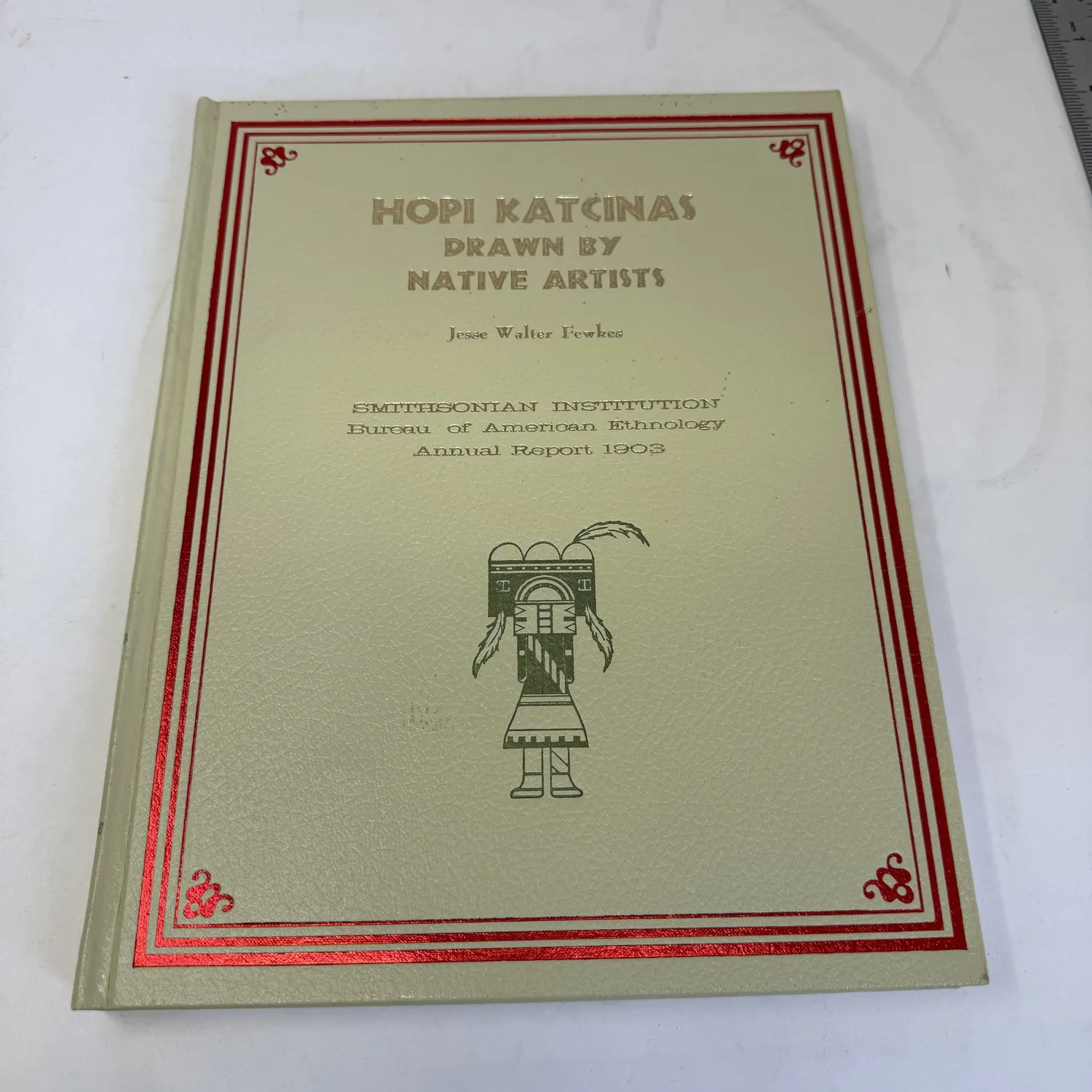
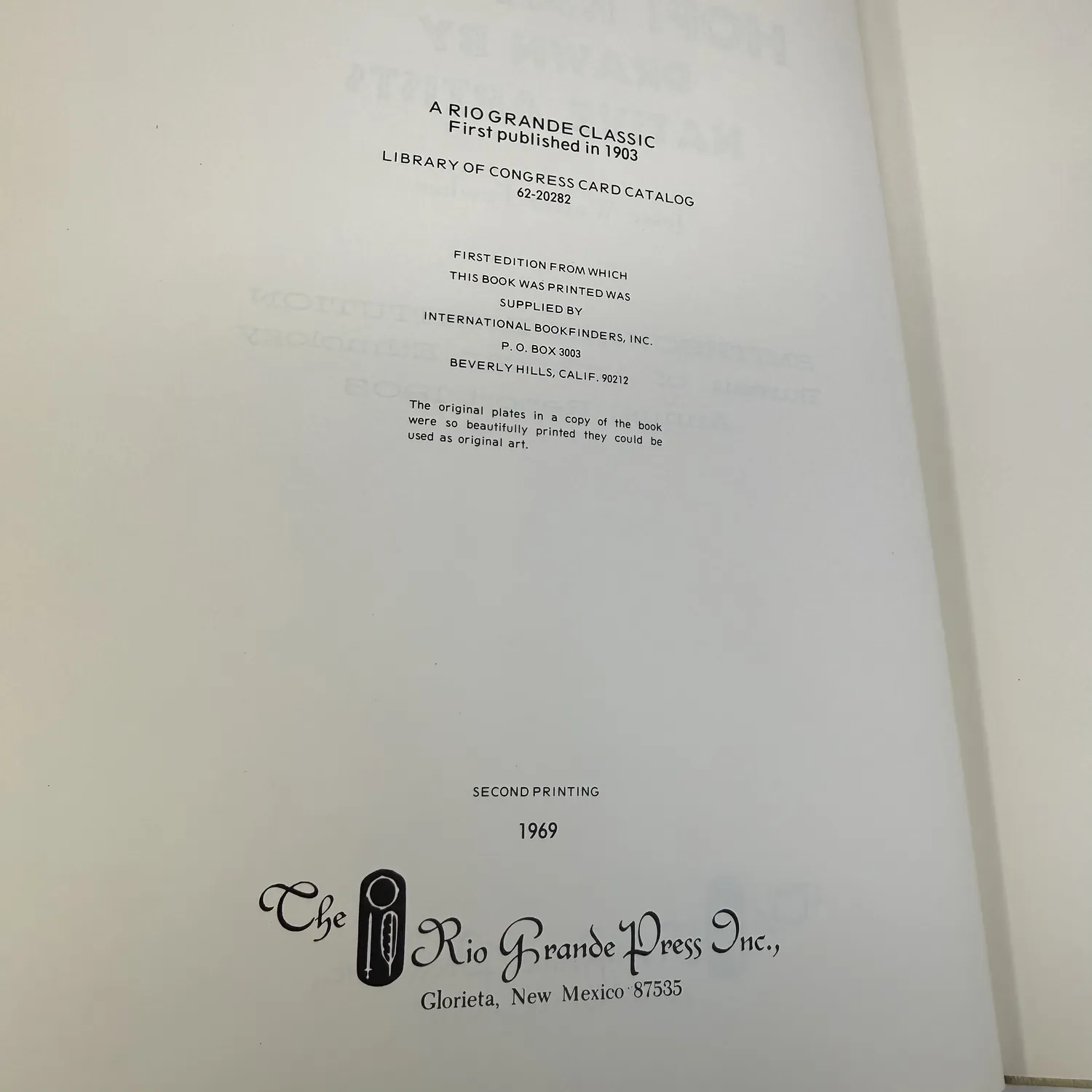
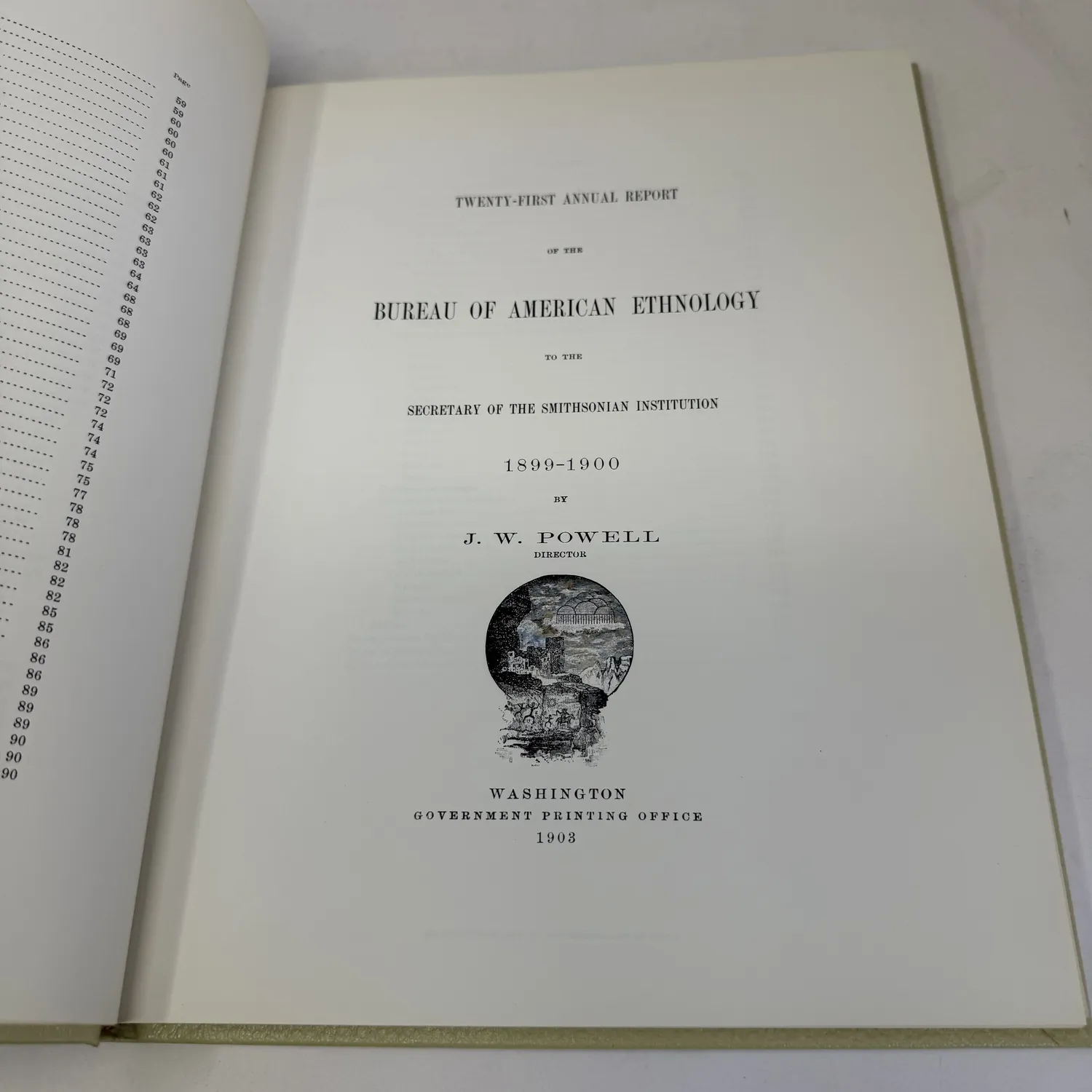
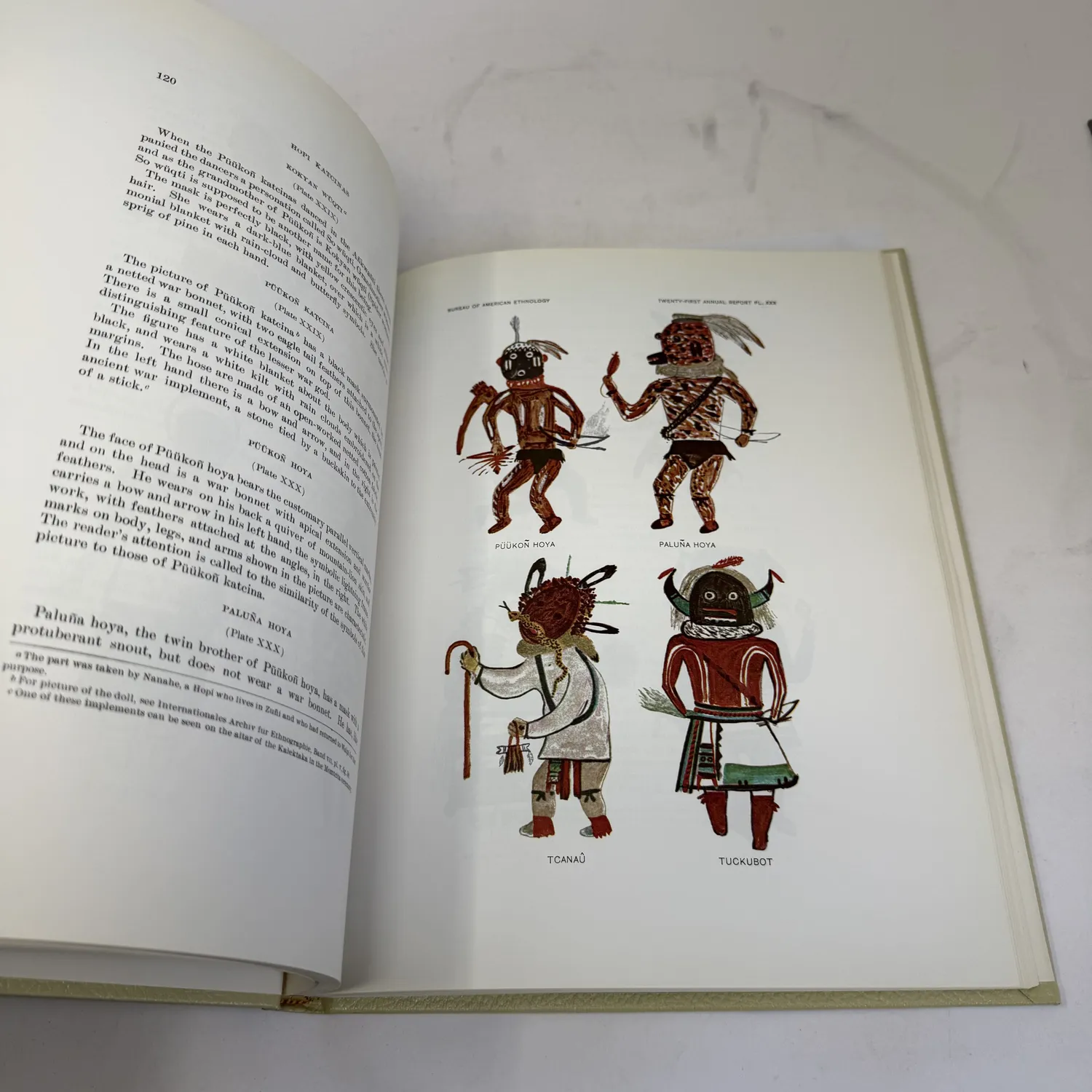
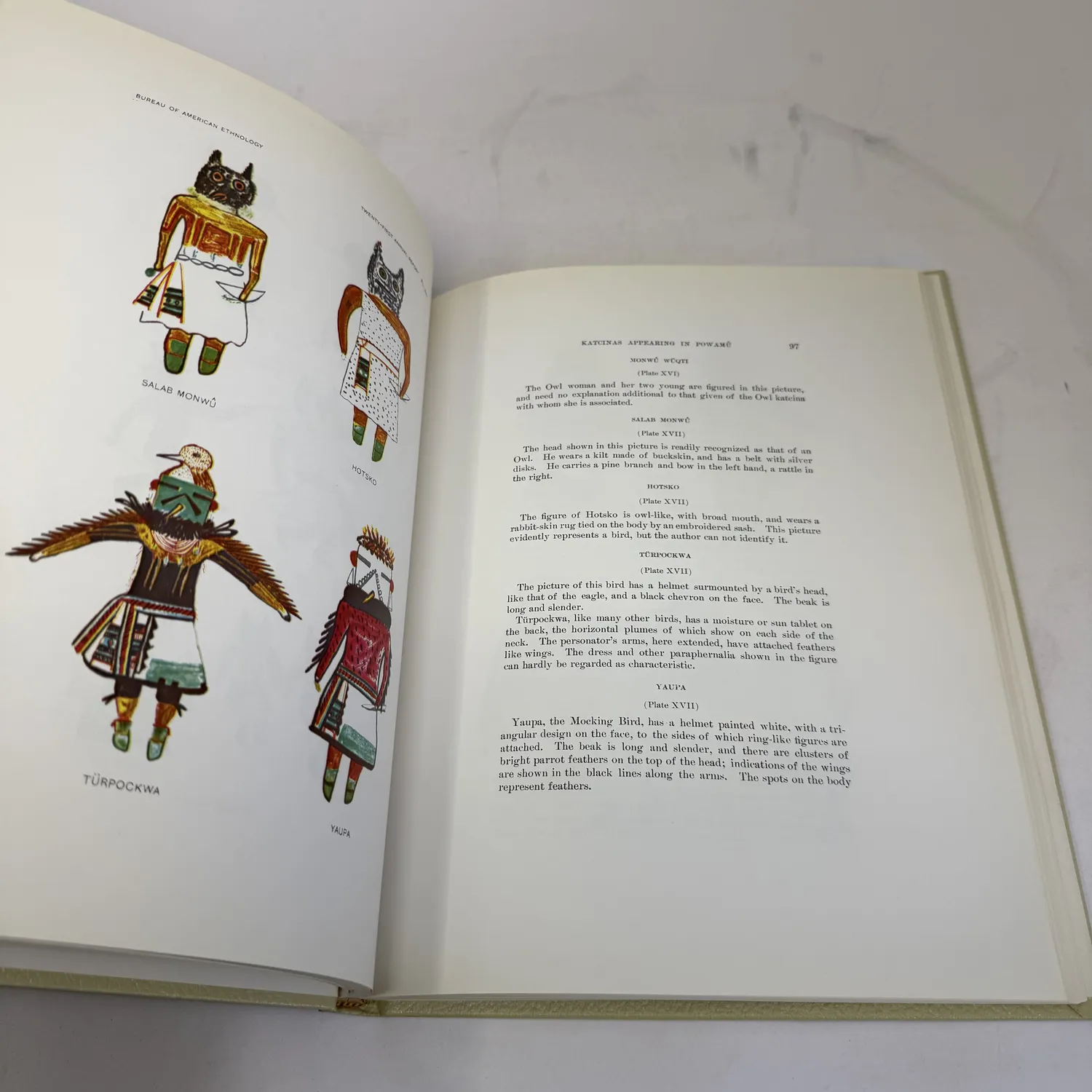
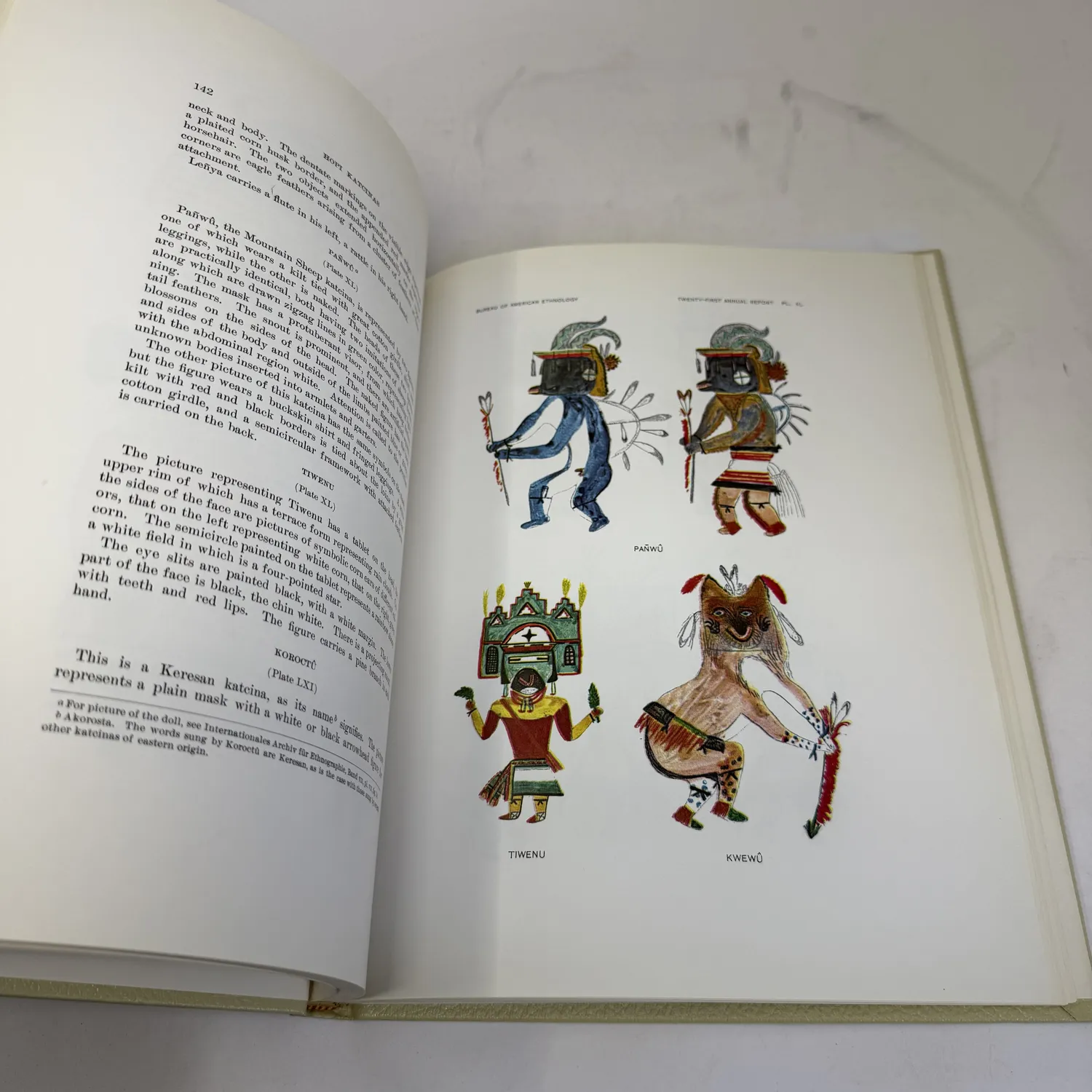
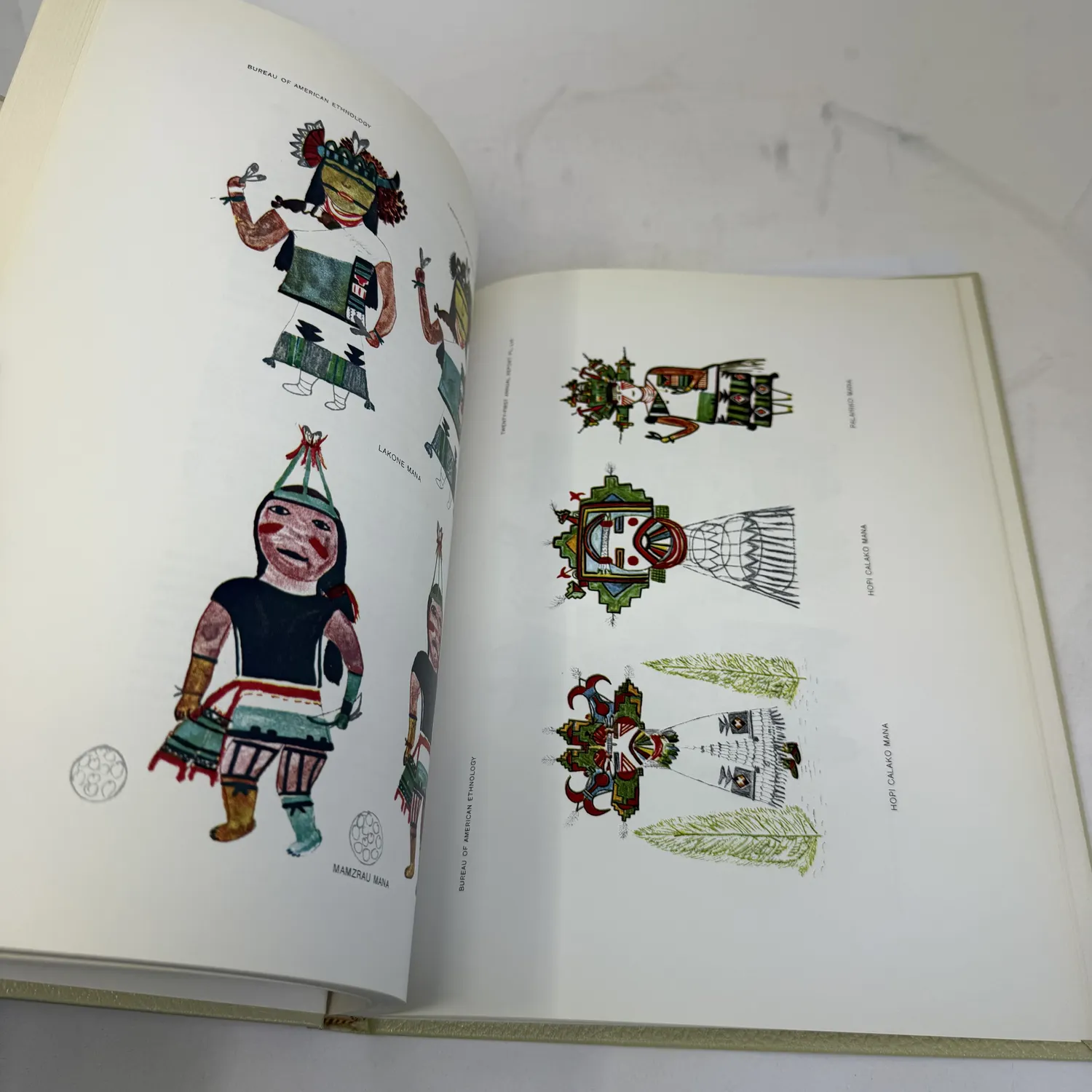
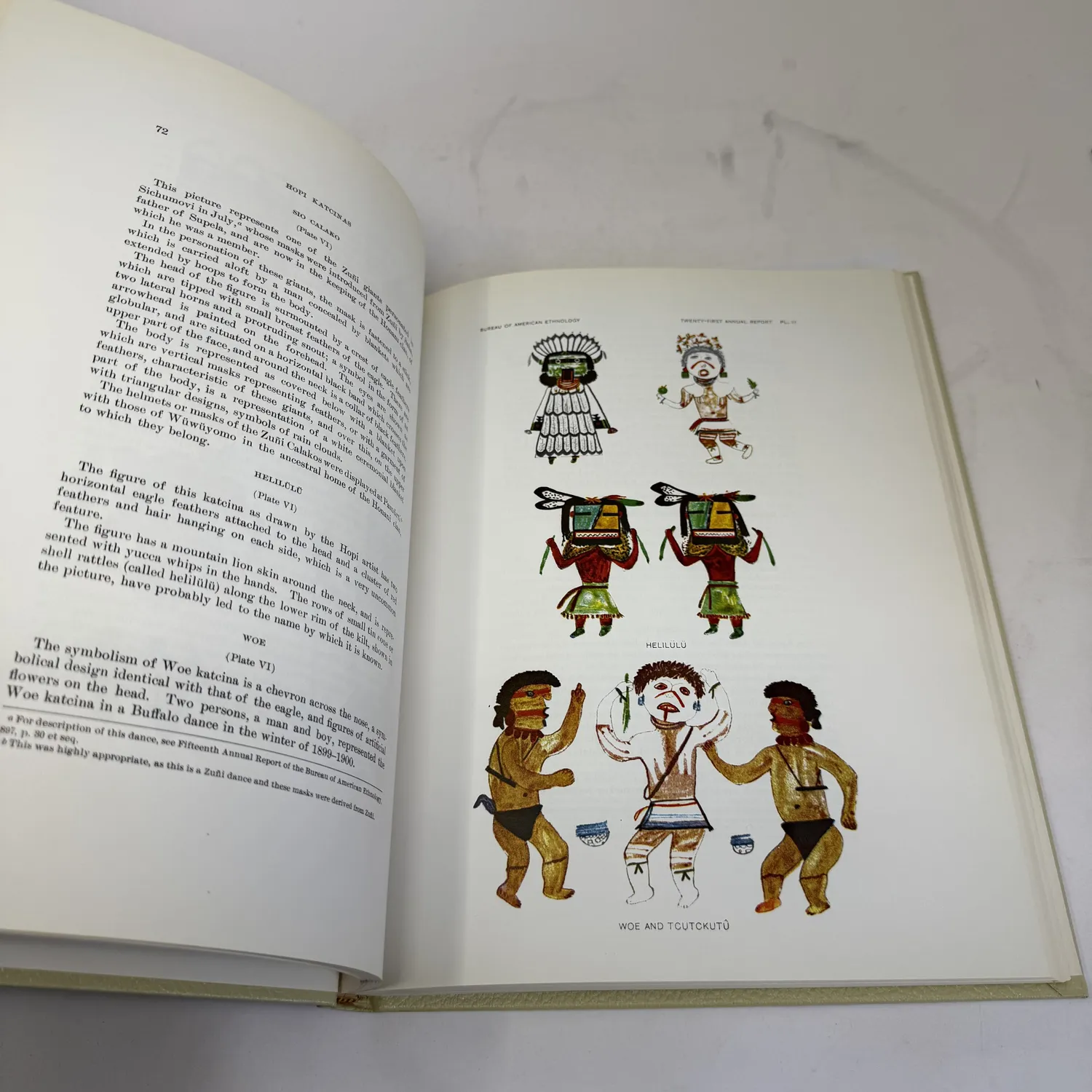
From the NMLP Collection: Hopi Katcinas Drawn by Native Artists
Jesse Walter Fewkes · Bureau of American Ethnology Twenty-First Annual Report, 1903 · The Rio Grande Press, Inc., Glorieta, New Mexico · Second Printing, 1969 · LCCN 62-20282. The Rio Grande Press “Rio Grande Classics” reprint series preserved dozens of out-of-print Southwest Americana titles in handsome cloth bindings for a new generation of collectors. This copy came through an Albuquerque estate library. All kachina plates are public-domain — original 1903 U.S. government publication.
Harold S. Colton — the standard reference, 1949
Harold S. Colton — Hopi Kachina Dolls with a Key to Their Identification
Colton: 1881–1970 · Founder, Museum of Northern Arizona, 1928 · Closed signature pool
Harold Sellers Colton was a University of Pennsylvania zoology professor who moved to Flagstaff, Arizona, in 1926 and founded the Museum of Northern Arizona in 1928. The museum became the institutional anchor for Hopi material culture documentation, and Colton's kachina classification system — built over two decades of work with the MNA collection and with Hopi consultants — became the scholarly standard. Hopi Kachina Dolls with a Key to Their Identification (University of New Mexico Press, 1949) is organized as a dichotomous key: the researcher works through a sequence of descriptive choices (mask shape, ear type, body paint, carried objects) to arrive at an identification. This format — borrowed from Colton's training in biological taxonomy — gives the book a reference utility that the more narrative treatments by Wright and Dockstader do not replicate. The 1949 UNM Press first edition is a modestly sized volume (approximately 6 x 9 inches) in blue cloth binding. Most copies encountered lack a dust jacket; the jacket, when present, carries a simple typographic design. The copyright page of the first edition carries the 1949 date with no additional printing notation. The 1959 revised edition carries a new copyright line and incorporates additional kachina types identified through continued MNA fieldwork. The 1984 UNM Press paperback reprint is the common estate-library form. A Tier 1 collector targets the 1949 first in blue cloth in very good or better condition. Colton died in 1970. Signed copies are uncommon; institutional distribution dominated the initial market.
Colton's contribution to the field extends well beyond the kachina book. His classification systems for Pueblo pottery types (the Colton-Hargrave ceramic typology), his archaeological site-survey methodology, and his direction of the MNA established the institutional framework within which subsequent kachina scholars — particularly Barton Wright, who spent his career at the MNA — worked. The kachina identification key is one manifestation of a broader project of systematic classification of Hopi material culture that made the MNA the primary research institution for the field.
Frederick J. Dockstader — the cultural-impact study, 1954/1985
Frederick J. Dockstader — The Kachina and the White Man
Dockstader: 1919–2005 · Director, Museum of the American Indian (Heye Foundation) 1960–1975 · Closed signature pool
Dockstader's The Kachina and the White Man: A Study of the Influences of White Culture on the Hopi Kachina Cult occupies a unique position in the kachina bibliography because it addresses a question the other canonical titles do not: what happened to the kachina tradition when Europeans arrived? The book traces the appearance of new kachina types after Spanish contact — soldier kachinas, priest kachinas, cowboy kachinas — and documents how the ceremonial system incorporated representations of the colonial encounter into its own framework. This is not simply an ethnographic curiosity; it demonstrates that the kachina system is a living, adaptive tradition rather than a frozen pre-contact artifact. The 1954 Cranbrook Institute of Science first edition (Bulletin 35, small quarto format, institutional cloth binding, small print run) is the Tier 1 collector target. Cranbrook, in Bloomfield Hills, Michigan, was a research institution rather than a major commercial publisher; the initial distribution was primarily to institutional subscribers and academic libraries. Surviving copies in fine private-library condition are genuinely scarce. The 1985 UNM Press revised edition substantially expanded the text with a new introduction, additional illustrations, and thirty years of scholarship on the topic. The UNM Press edition is the working-reference form; it trades at Tier 2 levels. Dockstader's career at the Museum of the American Indian (Heye Foundation) in New York gave him access to one of the largest institutional kachina collections outside the Southwest. His later career was complicated by the revelation that his claimed Oneida/Navajo ancestry — central to his professional identity and institutional position — was disputed and possibly fabricated. The ancestry controversy does not diminish the scholarly value of The Kachina and the White Man, which is based on documentary evidence and museum collections rather than on insider cultural access. Dockstader died in 2005; he is a closed signature pool.
The Dockstader book pairs naturally with the Colton and Wright volumes in a collector's reference library. Where Colton provides the identification key and Wright provides the visual catalog, Dockstader provides the historical analysis of how the tradition changed over time — the diachronic dimension that the synchronic identification guides do not address. A collector with all three has the identification, visual, and historical tools to understand any kachina figure encountered in the market.
Barton Wright — the visual canon, 1973 and 1977
Barton Wright — Kachinas: A Hopi Artist's Documentary
Wright: 1920–2012 · Curator, Museum of Northern Arizona · Closed signature pool
Barton Wright spent his career at the Museum of Northern Arizona, building on the institutional foundation Harold Colton had established. His Kachinas: A Hopi Artist's Documentary (Northland Press, 1973) is the single most important kachina identification book ever published — the volume that displaced Colton as the standard popular reference and that remains, fifty years later, the first book most collectors and dealers reach for when identifying a kachina figure. The book's power lies in its format: Wright commissioned Cliff Bahnimptewa, a Hopi artist from Shungopavi village on Second Mesa, to paint 240 individual kachina types in full color, each accompanied by Wright's descriptive text identifying the kachina's name, ceremonial function, visual attributes, and seasonal appearance. The Bahnimptewa paintings are not museum photographs or ethnographic sketches; they are fully realized artistic renderings by a Hopi artist working from inside the ceremonial tradition, which gives them an authority and visual quality that no non-Hopi illustrator could replicate. The 1973 Northland Press first edition is a large folio (approximately 10 x 13 inches) in cream-colored cloth with a kachina illustration on the front board, issued with a color dust jacket featuring Bahnimptewa paintings. The copyright page carries no printing-number statement beyond the initial copyright; subsequent Northland Press printings add printing lines. The first edition in fine condition with the original dust jacket is the primary Tier 1 collector target in the entire kachina book category. Wright signed copies throughout his long career at the MNA and at Southwest book fairs and gallery events. Bahnimptewa also occasionally signed copies. Wright died in 2012; Bahnimptewa died in 1984. Both are closed signature pools. A copy signed by both Wright and Bahnimptewa is the trophy variant in the field.
Barton Wright — Hopi Kachinas: The Complete Guide to Collecting Kachina Dolls
1977 · Northland Press, Flagstaff
Wright's second major kachina volume shifts focus from identification to collecting. Hopi Kachinas: The Complete Guide to Collecting Kachina Dolls (Northland Press, 1977) addresses the practical dimensions of the kachina market: how to evaluate carving quality, how to distinguish Hopi-made figures from commercial imitations, how to assess age and condition, and how to understand the relationship between ceremonial function and commercial value. The book reflects the mid-1970s kachina market, when serious private collecting was expanding beyond the museum and institutional context and gallery prices were rising. The 1977 Northland Press first edition is the collector target; it is smaller format than the 1973 folio and was issued in both cloth and paperback editions. The cloth first edition in fine condition with dust jacket trades at the upper Tier 2 level. Wright's subsequent kachina publications include Kachinas of the Zuni (Northland Press, 1985, with illustrations by Duane Dishta, a Zuni artist) and Pueblo Shields from the Fred Harvey Fine Arts Collection (Heard Museum, 1976). The complete Wright bibliography functions as a connected series; a collector building the full set targets first editions of each volume.
The Wright volumes established the modern kachina book market. Before the 1973 folio, kachina identification literature was primarily institutional (Colton's key, the BAE reports) or academic (Dockstader's cultural study). Wright created a book that was simultaneously a scholarly reference, a visual art object, and a collector's tool — a combination that made it the bestselling kachina title in publishing history and the standard against which all subsequent kachina books are measured.
Alph H. Secakuku — the Hopi voice, 1995
Alph H. Secakuku — Following the Sun and Moon: Hopi Kachina Tradition
Secakuku: Sipaulovi village, Second Mesa · Hopi cultural authority
Secakuku's Following the Sun and Moon: Hopi Kachina Tradition (Northland Publishing in association with the Heard Museum, 1995) is the single most important correction to the non-Hopi authorship that defines the rest of the canonical bibliography. Every other major kachina book — Fewkes, Colton, Wright, Dockstader — was written by non-Hopi observers. Secakuku writes from inside the tradition. He is from Sipaulovi village on Second Mesa, a participating member of the ceremonial community whose tradition he documents. The book presents the katsina ceremonial calendar as it is lived — from the Soyal ceremony at the winter solstice through the Powamu (Bean Dance) in February, the spring and summer plaza dances, and the Niman (Home Dance) in July when the katsinam depart for their home in the San Francisco Peaks near Flagstaff. Secakuku is deliberately circumscribed about what he discloses. He presents what the Hopi community considers appropriate for public knowledge and makes clear that deeper ceremonial knowledge exists but is not appropriate for publication. This authorial restraint distinguishes the book fundamentally from Fewkes and Wright, who documented everything they could observe or learn. The Northland Publishing / Heard Museum first edition (1995, trade paperback format, color photographs) is the only edition. It has not been reprinted. Copies in fine condition are increasingly uncommon as the book moves into the out-of-print market. It trades at the upper Tier 2 level. The Heard Museum co-publication gives the book institutional authority beyond Secakuku's personal standing, important because the Heard's kachina collection and research program provide the institutional context within which the book was produced.
Secakuku's book changed the field's center of gravity. After 1995, it was no longer possible for serious participants in the kachina book market — collectors, dealers, scholars — to treat the non-Hopi reference literature as the complete or final word. The existence of a Hopi-authored treatment made the authorial position of the earlier books (outsider documentation conducted without full community consent) visible as a position rather than a neutral default. This does not diminish the value of Wright, Colton, or Dockstader as collector objects; it adds a dimension of critical awareness to the collecting field.
Not sure whether to sell, donate, or keep? Call or text me at 505-250-3804 — I'll walk you through it.
Ruth Bunzel and the Zuni kachina tradition
Ruth Bunzel — Zuni Katcinas: An Analytical Study
Bunzel: 1898–1990 · Columbia University, Boasian school · Closed signature pool
Ruth Bunzel's Zuni Katcinas: An Analytical Study, published as part of the BAE 47th Annual Report (1929–30, published 1932), is the primary ethnographic documentation of the Zuni masked-dance tradition. The Zuni kachina system (Zuni term: koko, plural kokko) is parallel to but distinct from the Hopi katsina system in iconography, ceremonial calendar, and mythological framework. The Shalako ceremony — the major annual Zuni ceremonial event, held in late November or December, involving towering masked figures that are visually unlike any Hopi kachina type — is the most publicly visible manifestation of the Zuni tradition. Bunzel documented the koko types, the ceremonial calendar, the mask iconography, and the relationship between the masked-dance tradition and Zuni cosmology. The BAE 47th Annual Report containing her Zuni studies (including Zuni Katcinas, Zuni Ritual Poetry, and Zuni Texts) is a significant collector object in its own right because of the concentration of Zuni scholarship it contains. Barton Wright extended his kachina documentation to the Zuni tradition with Kachinas of the Zuni (Northland Press, 1985, illustrations by Duane Dishta, a Zuni artist), which provides the visual identification catalog for Zuni kachina types in the same format as his 1973 Hopi folio. The Bunzel BAE report, the Wright Zuni volume, and the Stevenson treatment in the BAE 23rd Annual Report (1904) constitute the core Zuni kachina collecting targets.
The distinction between the Hopi and Zuni traditions matters for collectors because the two bodies of literature are often shelved together but serve different collecting communities. Hopi kachina figure collectors need the Wright, Colton, and Fewkes references. Zuni collectors need the Bunzel and the Wright Zuni volume. Collectors of both traditions need the full set. The Zuni kachina book market is smaller and more specialized than the Hopi market because fewer Zuni kachina figures circulate in the commercial art market — the Zuni tradition has been less intensively commercialized than the Hopi tradition, in part because the Zuni community has maintained tighter control over the circulation of ceremonial objects.
Rio Grande Pueblo connections
The kachina/katsina tradition is not exclusively Hopi and Zuni. The Rio Grande Pueblos of New Mexico — from Taos in the north through the Keres-speaking Pueblos (Cochiti, Santo Domingo/Kewa, San Felipe, Santa Ana, Zia, Acoma, Laguna) and the Tewa-speaking Pueblos (San Juan/Ohkay Owingeh, Santa Clara, San Ildefonso, Nambe, Pojoaque, Tesuque) — have related masked-dance traditions. These traditions are less extensively documented in the published literature for a reason: the Rio Grande Pueblos have been more restrictive about allowing non-Pueblo observers to document their ceremonial practices. The Spanish colonial administration, the Catholic missions, and the subsequent Anglo-American political structure all imposed pressures on the Rio Grande Pueblos that made public ceremonial documentation a more sensitive issue than it was at Hopi and Zuni, which were geographically more remote from the colonial centers at Albuquerque and Santa Fe.
Elsie Clews Parsons's two-volume Pueblo Indian Religion (University of Chicago Press, 1939) remains the most comprehensive comparative treatment of masked-dance traditions across the full range of Pueblo communities, including the Rio Grande Pueblos. Parsons had access to ceremonial events at multiple Pueblos that no subsequent non-Pueblo scholar has replicated, and her comparative framework allows the reader to see the structural relationships between the Hopi katsina system, the Zuni koko tradition, and the Rio Grande Pueblo masked-dance practices. The Parsons volumes are covered in detail in the Zuni & Hopi scholarship pillar and the Pueblo sovereignty pillar.
For the kachina book collector, the Rio Grande Pueblo dimension means that the bibliography extends beyond the Hopi-and-Zuni core into the broader Pueblo ethnographic literature. A collector who encounters Rio Grande Pueblo ceremonial material — particularly from the Keres-speaking Pueblos, which have the most developed kachina-like traditions of the Rio Grande group — needs the Parsons and the broader BAE literature rather than the Hopi-specific Wright and Colton volumes.
The Fred Harvey Company and kachina commercialization
No discussion of kachina books is complete without the Fred Harvey Company, because the Harvey Company created the commercial market that the books document and serve. Beginning in the early 1900s, the Harvey Company — the hospitality enterprise that operated hotels, restaurants, and gift shops along the Atchison, Topeka and Santa Fe Railway — purchased kachina figures directly from Hopi carvers and sold them through the Harvey Houses across the Southwest. Herman Schweizer, the company's chief buyer of Indian curios from 1901 through the 1940s, was the single most influential figure in establishing a cash market for kachina figures outside the ceremonial context.
The Harvey Company's purchasing practices shaped the kachina carving tradition in ways that Dockstader's The Kachina and the White Man directly addresses. Harvey buyers preferred certain sizes (small enough for tourist display), certain styles (colorful, visually dramatic), and certain levels of finish (smooth, polished, with clean paint lines) that influenced what Hopi carvers produced for the commercial market. The distinction between figures made for ceremonial use (tihu given to Hopi children as teaching objects, with a flat, iconic style and ceremonial pigments) and figures made for commercial sale (more detailed, polished, often with stands) became sharper as the Harvey market matured.
The Fred Harvey Fine Arts Collection — built through decades of Schweizer's purchasing and eventually donated to the Heard Museum in Phoenix — includes thousands of kachina figures and constitutes one of the most important public assemblages of the material. The collection is documented in several Heard Museum publications and in Barton Wright's Pueblo Shields from the Fred Harvey Fine Arts Collection (Heard Museum, 1976). Kathleen L. Howard and Diana F. Pardue's Inventing the Southwest: The Fred Harvey Company and Native American Art (Northland Publishing, 1996) is the comprehensive study of the Harvey Company's role in Southwest art commercialization; it is a Tier 2 collector object in its own right and an essential contextual reference for anyone collecting kachina literature.
Kachina doll collecting, authenticity, and the art market
The kachina figure market operates on three levels, and the book literature serves each level differently.
The traditional/ethnographic level. Historic kachina figures — those made before approximately 1940 — in the traditional flat-body, iconic style are collected as ethnographic objects. Their value depends on age, condition, provenance, and ceremonial authenticity. The identification literature (Colton's key, Fewkes's BAE descriptions, Wright's 1973 visual catalog) is essential for identifying the kachina type and assessing whether the carving conventions match the documented tradition. Museum deaccessions, estate sales, and the older dealer market are the sources. Prices for significant historic kachina figures range from the low hundreds to the low thousands depending on age, rarity, and provenance.
The contemporary fine-art level. Since the 1970s, a generation of Hopi carvers has elevated kachina figure carving into a recognized fine art form. Carvers including Lowell Talashoma Sr., Cecil Calnimptewa, Brian Honyouti, Loren Phillips, and Ros George produce figures of extraordinary sculptural sophistication — dynamic poses, detailed musculature, elaborate carved (rather than applied) costume elements, and surface finishes that approach fine woodworking rather than folk carving. Prices for top contemporary carvings range from the mid hundreds to five figures. The Wright collecting guide (1977) and Helga Teiwes's Kachina Dolls: The Art of Hopi Carvers (University of Arizona Press, 1991) document the stylistic evolution and the market. Gallery exhibition catalogs and individual carver monographs constitute the secondary literature.
The tourist and commercial level. Mass-produced kachina figures, including figures made by non-Hopi carvers in the Philippines, Pakistan, and Mexico, flood the lower end of the market. Authenticity is the central issue. The Indian Arts and Crafts Act of 1990 makes it illegal to market a product as "Indian made" if it was not in fact made by a member of a federally recognized tribe, but enforcement is uneven and the commercial market includes substantial quantities of misrepresented material. The Wright and Colton identification guides serve collectors at this level by providing the descriptive framework for distinguishing Hopi-made figures from commercial imitations — a function that gives the reference books practical economic value beyond their scholarly interest.
Have books you're ready to part with? I offer free pickup across Albuquerque — call 505-250-3804.
NAGPRA and the sacred-object question
The Native American Graves Protection and Repatriation Act (NAGPRA, 1990) applies to physical objects — human remains, funerary objects, sacred objects, and objects of cultural patrimony — in institutional collections. NAGPRA does not apply to published books. A collector of Wright, Colton, Dockstader, or Secakuku is not subject to NAGPRA compliance requirements, and no ethnographic book is a repatriable object under the statute.
But NAGPRA has profoundly affected the kachina market that the books document and serve. The key distinction — and the distinction that the identification literature helps collectors navigate — is between kachina figures made for commercial sale and sacred ceremonial objects that were never intended for commercial circulation. The former are legal to buy and sell. The latter are potentially subject to NAGPRA claims when held by covered institutions and raise ethical questions regardless of legal status.
The Hopi Tribe has been particularly active in pursuing repatriation of sacred objects from auction houses and private collections. The most visible cases involved Paris auction sales in 2013 and subsequent years, where Hopi sacred objects (including what Hopi authorities described as sacred friends, not mere artifacts) were sold over the objections of the Hopi Tribe and with diplomatic representations from the U.S. government. The cases drew international attention to the question of whether Western auction-house and property-law frameworks are adequate to protect Indigenous ceremonial patrimony.
For kachina book collectors, the NAGPRA context is relevant in two ways. First, the identification literature — particularly Colton's key and Wright's visual catalog — helps distinguish between commercial art objects and items with potential ceremonial provenance, a distinction that carries legal and ethical weight. Second, the broader NAGPRA framework has elevated awareness of the extractive dimension of the ethnographic project that produced the kachina literature in the first place. Fewkes, Colton, and Wright all documented ceremonial practices that the communities conducting them did not necessarily consent to having published. Secakuku's 1995 book — with its deliberate restraint about what it discloses — represents the community's response to that history. A serious collector holds both the comprehensive outsider documentation and the Hopi-authored treatment, understanding that the tension between them is part of the intellectual substance of the field.
Museum collections and institutional anchors
Five institutions hold the primary kachina collections and drive the contemporary scholarly publishing in the field. A collector routing significant kachina library material through NMLP benefits from knowing where the institutional collection and research strengths lie.
Museum of Northern Arizona (MNA)
Flagstaff, AZ — 3101 N. Fort Valley Road. Founded by Harold Colton in 1928. Holds the largest institutional kachina collection in the world and the Barton Wright archive and research library. The MNA Bulletin series, the Plateau journal, and the MNA monograph publications on Hopi material culture are the primary institutional-publication sources for kachina scholarship. The MNA is the first institutional address for researchers working on kachina identification, classification, and the documentary history of kachina studies. The museum's annual Hopi Festival of Arts and Culture (formerly the Hopi Craftsman Show, running since 1930) is the primary venue for contemporary Hopi carvers and the institutional bridge between the traditional carving tradition and the contemporary fine art market.
Heard Museum
Phoenix, AZ — 2301 N. Central Ave. Holds the Fred Harvey kachina collection (thousands of figures accumulated through decades of Harvey Company purchasing) and co-published Secakuku's Following the Sun and Moon. The Heard's kachina collection catalog series and its exhibition publications are Tier 2 and Tier 3 collector objects. The Heard Museum Guild Indian Fair and Market is a primary contemporary venue for Hopi carvers. The Heard's research library is the second institutional address for kachina documentation after the MNA.
Wheelwright Museum of the American Indian
Santa Fe, NM — 704 Camino Lejo. Founded by Mary Cabot Wheelwright in 1937 (originally the Museum of Navajo Ceremonial Art). Holds Pueblo ceremonial material including kachina figures and publishes on Southwest Indigenous art. The Wheelwright is the primary NM-based museum address for kachina material outside the university context. Its exhibition catalogs and publications are Tier 3 collecting targets that occasionally address kachina traditions within broader Southwest Indigenous art frameworks.
School for Advanced Research (SAR)
Santa Fe, NM — 660 Garcia Street. The Indian Arts Research Center at SAR holds Pueblo material collected across the twentieth century, including kachina figures and related documentation. SAR Press publishes the contemporary Southwest anthropology monograph series. The SAR collection is accessible to researchers by appointment and serves as a teaching and research resource for the scholarly community working on Pueblo material culture.
Indian Pueblo Cultural Center (IPCC)
Albuquerque, NM — 2401 12th Street NW. Operated by the 19 Pueblos of New Mexico. The IPCC addresses the Rio Grande Pueblo dimension of the kachina tradition and provides the Pueblo-community-controlled institutional context for understanding kachina and related ceremonial traditions within the broader Pueblo world. The IPCC library and archive are important for the NM-specific aspects of kachina collecting and documentation.
Collector-scholars — Bromberg, Ballow, and the connoisseur tradition
The kachina field has a stronger collector-scholar tradition than most Southwest book-collecting categories because kachina identification requires hands-on familiarity with carving techniques, pigments, wood types, and construction methods that photographs and published descriptions alone cannot fully convey. The feedback loop between collecting and scholarship is unusually tight: the identification literature (Wright, Colton) was built on close examination of collected objects, and serious private collectors in turn contribute to the broader understanding of the carving traditions through their accumulation and documentation of material.
Erik Bromberg assembled one of the most important private kachina collections over several decades of focused acquisition, developing an expertise in identifying kachina types, dating figures by carving style and materials, and distinguishing authentic Hopi work from commercial imitations that was cited by dealers and museum curators as a reference standard. His collection and his published observations on kachina identification contributed to the field's documentation beyond what any single reference book could provide.
Gene Ballow similarly built a substantial private collection with an emphasis on documenting the range of carving traditions across different Hopi villages and time periods. The Ballow collection's depth in representing village-specific carving styles — the subtle differences between figures from First Mesa, Second Mesa, and Third Mesa communities, each with its own carving conventions and ceremonial emphasis — contributed to the understanding that the Hopi kachina tradition is not monolithic but varies across the mesa communities.
Both Bromberg and Ballow represent a collecting tradition in which the books — Wright, Colton, Dockstader, the Fewkes BAE reports — are working tools rather than display objects. Their copies of the canonical titles carry the evidence of heavy use: annotations, bookmarks, cross-references to specific figures in their collections. When collector-scholar libraries of this kind surface in estate sales, the annotations themselves add documentary value to the books beyond their standard market worth. NMLP flags such annotated copies for the Donation Archive when they carry provenance from known collector-scholars in the field.
Contemporary carvers and the fine art market
The transformation of kachina carving from a ceremonial and tourist-trade craft into a recognized fine art form is one of the most significant developments in Southwest Indigenous art since the 1970s. Traditional kachina figures (tihu) are carved from cottonwood root (the wood of the Fremont cottonwood, Populus fremontii, which grows along the washes of the Hopi mesas) and painted in a relatively flat, iconic style that emphasizes identification of the specific kachina type over sculptural drama. Beginning in the 1960s and accelerating through the 1980s and 1990s, a generation of Hopi carvers began producing figures with increasing sculptural sophistication.
The transition from traditional to contemporary style is documented in several publications. Helga Teiwes's Kachina Dolls: The Art of Hopi Carvers (University of Arizona Press, 1991) is the most comprehensive treatment of the stylistic evolution. The Heard Museum and MNA exhibition catalogs from the 1980s through 2000s document individual carvers and the market. The Hopi Festival of Arts and Culture at the MNA and the Heard Museum Guild Indian Fair and Market are the primary venues where contemporary carvers show and sell their work, and the catalogs from these events constitute a serial documentation of the field's development.
The contemporary carving market has created a secondary demand cycle for the reference books. A collector purchasing a significant contemporary kachina sculpture wants the Wright, Colton, and Fewkes references to identify the kachina type being represented. The sculptor may have taken creative liberties with the traditional iconography — adding dramatic poses, abstracted elements, or mixed-media components — and the buyer needs the canonical references to understand what the traditional form looks like and how the contemporary artist has departed from or extended it. This documentation-demand function keeps the Wright 1973 and the Colton 1949 in active market demand decades after their publication.
I pick up books for free anywhere in the metro area. Call 505-250-3804 to schedule.
The collector market — three tiers
Tier 1 trophy items. The 1973 Northland Press first edition of Wright's Kachinas: A Hopi Artist's Documentary in fine condition with original dust jacket; the same title signed by Wright, and the supreme variant signed by both Wright and Bahnimptewa. The 1949 UNM Press first edition of Colton's Hopi Kachina Dolls in blue cloth in very good or better condition. The 1954 Cranbrook Institute first edition of Dockstader's The Kachina and the White Man (Bulletin 35) in private-library condition. BAE 15th Annual Report (1897, Fewkes Tusayan Katcinas) and BAE 33rd Annual Report (1911–12, Fewkes kachina update) in private-library clean condition. These trade in the upper three-figure to low four-figure range at specialist Southwest Americana dealers. The Wright/Bahnimptewa dual-signed first is the highest-value single object in the kachina book category.
Tier 2 collector targets. The 1977 Northland Press first edition of Wright's Hopi Kachinas: The Complete Guide to Collecting Kachina Dolls in cloth with dust jacket. The 1985 UNM Press revised edition of Dockstader. The 1995 Northland/Heard first edition of Secakuku's Following the Sun and Moon (increasingly uncommon in fine condition as a single-edition out-of-print title). The 1959 revised edition of Colton. The 1985 Northland Press first edition of Wright's Kachinas of the Zuni. BAE Annual Reports with significant kachina content in institutional-library condition. Howard and Pardue's Inventing the Southwest (1996). Teiwes's Kachina Dolls: The Art of Hopi Carvers (1991). The BAE 47th Annual Report (Bunzel Zuni Katcinas 1932) in clean condition. These trade in the low to mid three-figure range.
Tier 3 working-library targets. The 1984 UNM Press paperback reprint of Colton. Later Northland Publishing printings and paperback editions of the Wright titles. General Heard Museum and MNA exhibition catalogs with kachina content. The Dockstader 1985 UNM Press in paperback. Museum of Northern Arizona Bulletin series copies with kachina-related content. Contemporary carver exhibition catalogs. General Pueblo art reference books that include kachina chapters. The Dover, Bison Books, and other reprint editions of the canonical ethnographic texts (Bunzel, Parsons, Cushing) that include kachina material as part of broader treatments. These trade in the upper two-figure to low three-figure range.
The kachina book market is collected across four overlapping buyer groups. Kachina figure collectors buy the identification references as documentation tools supporting their physical collections — a Wright first and a Colton first are the expected reference library for a serious figure collector. Southwest Americana rare-book collectors track the Tier 1 items as part of the broader field of regional Americana and ethnographic publishing. Anthropology scholars and academic libraries build the complete bibliography including the BAE reports, the Parsons comparative framework, and the SAR Press contemporary monographs. General New Mexico regional collectors acquire the Wright and Colton as part of broader Southwest art and culture collecting.
Points of issue — edition identification summary
Wright, Kachinas: A Hopi Artist's Documentary (1973)
First edition: Northland Press, Flagstaff. Large folio, cream cloth, kachina illustration stamped on front board. Dust jacket with Bahnimptewa color paintings. Copyright page: ISBN 0-87358-117-0, no printing-number notation. Later printings: Northland Press, with printing-line statements added to copyright page. Subsequent editions: Northland Publishing (successor imprint) with different ISBNs and cover treatments. Signed variants: Wright signed (common, meaningful premium); Bahnimptewa signed (uncommon, significant premium); dual-signed (rare, trophy).
Wright, Hopi Kachinas: The Complete Guide to Collecting Kachina Dolls (1977)
First edition: Northland Press, Flagstaff. Smaller format than the 1973 folio. Issued in both cloth and paperback. Cloth first with dust jacket is the collector target. Later printings: Northland Press with printing statements. Signed variants: Wright signed copies available.
Colton, Hopi Kachina Dolls (1949)
First edition: University of New Mexico Press, 1949. Blue cloth, approximately 6 x 9 inches. Copyright page: 1949, no additional printing notation. Most copies encountered lack dust jacket. Revised edition: UNM Press, 1959. New copyright line, additional kachina types. Paperback reprint: UNM Press, 1984 (common estate-library form).
Dockstader, The Kachina and the White Man (1954/1985)
First edition: Cranbrook Institute of Science, 1954 (Bulletin 35). Small quarto, institutional cloth, small print run. Genuinely scarce in private-library condition. Revised edition: University of New Mexico Press, 1985. Substantially expanded with new introduction. Common in both cloth and paperback. The 1985 UNM is the working-reference form.
Secakuku, Following the Sun and Moon (1995)
Only edition: Northland Publishing / Heard Museum, 1995. Trade paperback, color photographs. Not reprinted. Increasingly uncommon in fine condition as a single-edition out-of-print title.
Bunzel, Zuni Katcinas (1932)
Original publication: BAE 47th Annual Report (1929–30, published 1932). Large quarto government-cloth binding. Part of a larger volume containing four Zuni studies. Reprint: The Bunzel Zuni studies have been reprinted in various academic editions; the BAE original is the collector target.
The NMLP intake position
Kachina and katsina books surface through NMLP intake from several donor demographics. Kachina figure collectors downsizing or settling estates produce the densest concentration of the identification literature — Wright, Colton, and the MNA and Heard Museum catalogs, often in heavily used condition with annotations and cross-references to their figure collections. UNM and NAU anthropology faculty estates produce the academic literature including the BAE reports, the Parsons, the Bunzel, and the SAR Press monographs. Santa Fe and Albuquerque gallery-community estates produce mixed libraries with the popular identification references alongside broader Southwest art scholarship. Fred Harvey and railroad-history collectors occasionally produce libraries that include the Howard-Pardue Inventing the Southwest and the Harvey Company documentation alongside kachina identification material.
NMLP intake position: any condition, any quantity, free Albuquerque-metro pickup, no minimum, no tax receipt (NMLP is for-profit). Tier 1 material from this category — the 1973 Wright first with jacket, the 1949 Colton first, the 1954 Cranbrook Dockstader, signed Wright copies, BAE Annual Reports with kachina content in private-library condition — is resold through the sister SellBooksABQ channel. Tier 2 and Tier 3 material flows through standard NMLP warehouse sorting, Amazon and eBay listing, and donation-forward routing to regional libraries and archives when the material matches their collecting priorities.
Annotated collector-scholar copies — the working copies from Bromberg, Ballow, or comparable private collections that carry marginalia, bookmarks, and cross-references to specific kachina figures — are archived through the open NMLP Donation Archive when regionally significant. A Wright first with a known collector's annotations is worth more than its standard market value because the annotations document a knowledgeable eye's reading of the identification literature against actual objects.
Cite This Guide
Eldred, J. (May 2026). Kachina & Katsina Books — A Collector's Authority Guide to the Puebloan Ceremonial Figure Literature. New Mexico Literacy Project.
https://newmexicoliteracyproject.org/new-mexico-kachina-katsina-books-collecting
Content is original research by Josh Eldred. Licensed under CC BY 4.0. Cite with attribution.