Have books on the Manhattan Project, Los Alamos, Trinity Site, or the atomic age in New Mexico? NMLP offers free pickup across the Albuquerque metro, plus a free 24/7 outdoor drop-off at 5445 Edith Blvd NE for donors anywhere else in the state. Call or text 505-250-3804. Any condition, any quantity — no minimum, no charge.
At 5:29:21 am Mountain War Time on Monday, July 16, 1945, the United States Army detonated a plutonium implosion device on a 100-foot steel tower in the Jornada del Muerto desert of southern New Mexico, approximately 35 miles southeast of Socorro. The blast yield was approximately 21 kilotons of TNT. The mushroom cloud rose to 38,000 feet. The steel tower evaporated. The desert sand fused into a glassy green mineral that would later be named trinitite. Three weeks later, similar devices destroyed Hiroshima and Nagasaki and ended the Second World War. The wartime laboratory that designed the device — Project Y at Los Alamos, established in the autumn of 1942 by the U.S. Army Corps of Engineers under Brigadier General Leslie R. Groves and directed by J. Robert Oppenheimer — set into motion a nuclear landscape that now encompasses Los Alamos National Laboratory, Sandia National Laboratories in Albuquerque, Kirtland Air Force Base, the Waste Isolation Pilot Plant near Carlsbad, White Sands Missile Range, and the Trinity Site itself, designated a National Historic Landmark and open to the public twice each year. The literature documenting this landscape — from participant memoirs written in the immediate postwar years through contemporary nuclear anthropology and the downwinder justice literature of the 2020s — constitutes one of the most consequential regional American canons. This is the collector’s guide to that literature.
The canon organizes into six overlapping currents. First, the foundational narrative histories that established the Manhattan Project as a subject of sustained popular and scholarly interest: Rhodes, Bird and Sherwin, Jungk. Second, the Trinity-specific literature: Szasz, Lamont, the White Sands Missile Range documentation. Third, the Los Alamos community literature: Conant, Hunner, Peggy Pond Church, the Ranch School displacement narratives. Fourth, the military and scientific memoirs: Groves, Oppenheimer, Feynman, Bethe, Teller, Ulam. Fifth, the nuclear anthropology and downwinder justice literature: Masco, Bartimus and McCartney, the Tularosa Basin Downwinders Consortium. Sixth, the institutional and technical literature: LANL historical publications, Sandia technical reports, Atomic Heritage Foundation documentary anthologies, and the Manhattan Project National Historical Park publishing program. A serious atomic-age New Mexico library carries representative works from each current, and the collector who builds across all six possesses a library that documents not only the creation of the bomb but its enduring consequences for the communities that live in its shadow.
Last verified September 2026 · Original research by Josh Eldred
I. The Foundational Narrative Histories
Richard Rhodes — The Making of the Atomic Bomb (Simon & Schuster, 1986) is the principal one-volume narrative history of the entire Manhattan Project. Rhodes researched the book for nearly a decade, drawing on declassified archives from Los Alamos, Oak Ridge, and Hanford, on scientist memoirs and oral histories, and on original interviews with surviving Manhattan Project participants. The scope is comprehensive: from the late-nineteenth-century discoveries in radioactivity through Leo Szilard’s 1933 chain-reaction insight, through the 1938 discovery of nuclear fission by Otto Hahn and Lise Meitner, through the establishment of the Manhattan Engineer District in 1942, through the parallel industrial programs at Oak Ridge (uranium enrichment) and Hanford (plutonium production), through the Los Alamos laboratory’s design and assembly of the weapons, through Trinity, through Hiroshima and Nagasaki. The book runs 886 pages and won the 1987 National Book Award for Nonfiction, the 1987 National Book Critics Circle Award for General Nonfiction, and the 1988 Pulitzer Prize for General Nonfiction — the only triple-prize-winning Manhattan Project history.
The 1986 Simon & Schuster first hardcover with original dust jacket is the Tier 1 collector target. Points of issue: Simon & Schuster imprint on title page; “FIRST EDITION” designation on copyright page with the “10 9 8 7 6 5 4 3 2 1” number string intact; original dust jacket with a $22.95 price on front flap (price-clipped copies suffer a serious Tier-degradation at specialist auction). Signed copies are uncommon from the 1986 first printing — Rhodes did not extensively tour for the initial publication; tour-signing came later in his career with subsequent volumes. Fine signed 1986 firsts trade upper-three-figure to low-four-figure at specialist science-history dealers and Heritage Auctions; unsigned fine firsts with dust jackets trade low-to-mid three-figure. The companion volume Dark Sun: The Making of the Hydrogen Bomb (Simon & Schuster, 1995) extends the narrative through the November 1, 1952 Ivy Mike thermonuclear test. Later Rhodes volumes: Arsenals of Folly: The Making of the Nuclear Arms Race (Knopf, 2007) and The Twilight of the Bombs: Recent Challenges, New Dangers, and the Prospects for a World Without Nuclear Weapons (Knopf, 2010). The complete four-volume Rhodes nuclear history is a substantial collecting achievement; the 1986 first remains the artifact.
Kai Bird and Martin J. Sherwin — American Prometheus: The Triumph and Tragedy of J. Robert Oppenheimer (Alfred A. Knopf, 2005) is the principal scholarly biography of Oppenheimer and the source text for Christopher Nolan’s 2023 film. The book represents the culmination of approximately twenty-five years of research by Martin J. Sherwin (1937–2021, closed pool), beginning in the late 1970s, with Kai Bird joining the project in the late 1990s to bring it to publication. American Prometheus won the 2006 Pulitzer Prize for Biography and the National Book Critics Circle Award for Biography. The Nolan film grossed nearly a billion dollars worldwide and won seven Academy Awards in March 2024 including Best Picture, Best Director, Best Actor (Cillian Murphy as Oppenheimer), and Best Supporting Actor (Robert Downey Jr. as Lewis Strauss). The film drove enormous collector demand for the underlying source materials through 2023–2024.
Points of issue for the American Prometheus first edition: Alfred A. Knopf imprint on title page and spine; “FIRST EDITION” designation on copyright page; a $35.00 price on front flap of dust jacket; Borzoi Books colophon. The 2005 Knopf first hardcover with original dust jacket is the artifact. Sherwin’s 2021 death closed the signature pool for one of the two authors; signed-by-both-authors copies are now a substantially scarcer subset than signed-by-Bird-only copies. Fine signed-by-both firsts trade upper-four-figure at specialist auction. The Vintage Contemporaries 2023 movie-tie-in trade paperback with Cillian Murphy cover art is the principal Tier 3 working-library acquisition. Companion Oppenheimer biographies: Jeremy Bernstein Oppenheimer: Portrait of an Enigma (2004); Ray Monk Robert Oppenheimer: A Life Inside the Center (Doubleday, 2012); Charles Thorpe Oppenheimer: The Tragic Intellect (University of Chicago Press, 2006).
Robert Jungk — Brighter Than a Thousand Suns: A Personal History of the Atomic Scientists (Harcourt Brace, 1958, translated from the German Heller als tausend Sonnen, Scherz & Goverts, Stuttgart, 1956) is the foundational popular-press Manhattan Project history, preceding Rhodes by nearly three decades. Jungk drew on interviews with surviving scientists including Werner Heisenberg, Hans Bethe, and Leo Szilard, and established the moral-historical framework — the physicists’ collective responsibility, the seduction of scientific challenge, the post-Hiroshima moral reckoning — that all subsequent popular histories adopted. The 1958 Harcourt Brace first English hardcover with original dust jacket is the Tier 2 collector target.
II. The Trinity-Specific Literature
Ferenc Morton Szasz (1940–2010, closed pool), UNM professor of history, authored The Day the Sun Rose Twice: The Story of the Trinity Site Nuclear Explosion, July 16, 1945 (University of New Mexico Press, 1984). This is the canonical scholarly monograph devoted specifically to the Trinity test. Szasz combined documentary research from declassified Manhattan Project archives with eyewitness oral histories from scientists, military personnel, and nearby ranching families, plus the cultural and political history of the test site from 1945 through the early 1980s. The book covers the selection of the Jornada del Muerto site by Kenneth Bainbridge, the construction of the 100-foot test tower and the instrumentation bunkers at 10,000 yards north, south, and west, the assembly of the plutonium-implosion device (designated “the Gadget”) at the George McDonald Ranch House approximately two miles southeast of Ground Zero, the final countdown and Fermi’s paper-scrap blast-measurement experiment, and the immediate aftermath including the radioactive fallout that drifted northeast toward the Tularosa Basin communities.
The 1984 UNM Press first hardcover with original dust jacket is the Tier 1 Trinity-specific collector trophy. Szasz-signed copies are scarce given his 2010 closed pool and trade upper-three-figure at specialist dealers. The UNM Press paperback edition remains the working reference. Szasz’s other NM-relevant works include British Scientists and the Manhattan Project: The Los Alamos Years (Macmillan, 1992) and Larger Than Life: New Mexico in the Twentieth Century (UNM Press, 2006). The 1984 first is the artifact that any serious Trinity collector builds around.
Lansing Lamont — Day of Trinity (Atheneum, 1965) is the first full popular-press narrative account of the Trinity test. Lamont, a journalist, conducted interviews with surviving Trinity participants in the early 1960s while the event was barely twenty years past. The book established the popular narrative framework that all subsequent Trinity accounts adopted and refined: the countdown, the weather delays that pushed the shot from 4:00 am to 5:30 am, the betting pool among the scientists on the explosive yield (ranging from Oppenheimer’s cautious 300 tons to Teller’s optimistic 45 kilotons), Fermi’s paper-scrap experiment, Oppenheimer’s invocation of the Bhagavad Gita. The 1965 Atheneum first hardcover with original dust jacket is the Tier 2 collector target. The book is less frequently encountered in the secondary market than Rhodes or Bird-Sherwin because the 1965 first had a smaller print run and Atheneum never issued a mass-market paperback reprint.
Trinity Site itself is now a National Historic Landmark, part of the Manhattan Project National Historical Park established 2015, and is open to the public twice annually — the first Saturday of April and the first Saturday of October — under White Sands Missile Range public-access protocols. Access is through the Stallion Range Center north entrance or the south entrance through the WSMR Main Gate. The George McDonald Ranch House where the plutonium core was assembled is preserved and open during the public-access dates. The Trinity Site obelisk at Ground Zero and the trinitite display (the glassy green mineral formed when the sand fused under the fireball’s heat) are the principal visitor features. White Sands Missile Range has published visitor guides and historical pamphlets across the decades; the pre-2000 WSMR publications are scarce institutional ephemera.
Have books you're ready to part with? I offer free pickup across Albuquerque — call 505-250-3804.
III. The Los Alamos Community Literature
The Los Alamos community literature documents the human experience of living in the secret city — the scientists and their families, the displaced communities, the postwar transition from wartime laboratory to permanent national-security installation. This current runs parallel to the grand narrative histories but occupies different ground: domestic life, community formation, cultural displacement, and the long-term social consequences of planting a weapons laboratory on a former boys’ school in the mountains of northern New Mexico.
Jennet Conant — 109 East Palace: Robert Oppenheimer and the Secret City of Los Alamos (Simon & Schuster, 2005) takes its title from the Santa Fe address of Dorothy McKibbin’s office, the gateway through which every scientist, soldier, and family member passed on their way to the secret laboratory on the mesa. McKibbin, a Santa Fe widow hired by Oppenheimer in 1943, served as the unofficial social director and gatekeeper of Los Alamos, processing arrivals and managing the human logistics of a community that officially did not exist. Conant’s book uses McKibbin’s perspective to tell the social history of wartime Los Alamos — the wives who were told nothing about their husbands’ work, the children who grew up behind barbed wire, the tensions between military security and scientific freedom, the parties and dances and amateur theatricals that provided relief from the pressure of the work. The 2005 Simon & Schuster first hardcover with original dust jacket is the Tier 2 collector target. Conant signs at events and book festivals; her other Manhattan Project-adjacent works include Tuxedo Park: A Wall Street Tycoon and the Secret Palace of Science That Changed the Course of World War II (Simon & Schuster, 2002).
Jon Hunner — Inventing Los Alamos: The Growth of an Atomic Community (University of Oklahoma Press, 2004) is the canonical Los Alamos community history, covering both the wartime laboratory period and the postwar development of the Los Alamos townsite from military installation to civilian community. Hunner, NMSU professor emeritus of history, drew on Los Alamos Historical Society archives, the Los Alamos National Laboratory institutional records, and extensive oral histories with longtime Los Alamos residents. The book documents the physical construction of the wartime laboratory, the housing crisis, the postwar debate over whether to maintain or disband the laboratory, the 1962 transfer of the townsite from government to private ownership, and the formation of Los Alamos as a distinctive American community — one of the most educated per-capita communities in the nation, deeply shaped by its origins in wartime secrecy and nuclear weapons work. The 2004 University of Oklahoma Press first hardcover with dust jacket is the Tier 2 collector target. Hunner’s companion works include J. Robert Oppenheimer, the Cold War, and the Atomic West (University of Oklahoma Press, 2009).
Peggy Pond Church (1903–1986, closed pool) — The House at Otowi Bridge: The Story of Edith Warner and Los Alamos (University of New Mexico Press, first edition variously dated 1959 and 1960) is a foundational text in the literature of atomic-age displacement. Church was the daughter of Ashley Pond, the founder of the Los Alamos Ranch School, and grew up on the Pajarito Plateau before the Army seized the school and its land in 1943 for Project Y. Her book tells the story of Edith Warner (1893–1951), the civilian at Otowi Bridge who served meals to Manhattan Project scientists in her small house at the foot of the mesa, maintaining connections with both the San Ildefonso Pueblo community (particularly Tilano, her companion) and the secret world above. The book is both biography and elegy — for Warner, for the pre-atomic Pajarito landscape, and for the communities displaced by the weapons laboratory. The 1959/1960 UNM Press first hardcover is the Tier 1 collector target. Church-signed copies are genuinely scarce given her 1986 closed pool. The book has been continuously in print through UNM Press in paperback and remains a touchstone in New Mexico literary culture.
Fermor S. Church and Peggy Pond Church — When Los Alamos Was a Ranch School (Los Alamos Historical Society, 1974) documents the Los Alamos Ranch School (1917–1943), the boys’ preparatory school founded by Ashley Pond on the Pajarito Plateau that was commandeered by the Army for the Manhattan Project. The book preserves photographs, recollections, and the institutional history of the school that produced a distinctive educational culture — outdoor education, horseback riding, academic rigor, and connection to the New Mexico landscape — before the Army’s seizure ended it forever. The 1974 Los Alamos Historical Society first edition is a genuinely scarce institutional publication; copies in fine condition trade upper-two-figure to low-three-figure. The book is a companion piece to The House at Otowi Bridge and together they document the pre-atomic Los Alamos that the Manhattan Project destroyed.
IV. The Military and Scientific Memoirs
Leslie R. Groves (1896–1970, closed pool) — Now It Can Be Told: The Story of the Manhattan Project (Harper & Brothers, 1962) is the military director’s memoir. Groves, the Army Corps of Engineers brigadier general who oversaw the entire Manhattan Project from September 1942 through its dissolution, wrote the book as both personal memoir and administrative history, covering site selection (Los Alamos, Oak Ridge, Hanford), industrial procurement, security operations, the relationships with the scientific leadership (particularly the complicated Groves-Oppenheimer partnership), and the decision-making process that led to the combat use of the weapons. The 1962 Harper & Brothers first hardcover with original dust jacket is the Tier 1 collector target. Groves-signed copies are scarce — Groves died in 1970 and was not an extensive tour-and-sign author — and trade upper-three-figure when authenticated. The book remains essential reading because it provides the military-administrative perspective that Rhodes and Bird-Sherwin supplement but do not replace.
J. Robert Oppenheimer — Oppenheimer did not write a conventional memoir. His literary legacy is preserved in collected letters (Robert Oppenheimer: Letters and Recollections, edited by Alice Kimball Smith and Charles Weiner, Harvard University Press, 1980), in the Los Alamos Primer (the declassified introductory physics lecture delivered to incoming Los Alamos scientists, published in various forms), in the transcripts of his 1954 security hearing (In the Matter of J. Robert Oppenheimer: The Security Clearance Hearing, edited by Richard Polenberg, Cornell University Press, 2002), and in his published lectures and essays (The Open Mind, Simon & Schuster, 1955; Science and the Common Understanding, Simon & Schuster, 1954). The 1980 Harvard Letters and Recollections first hardcover is the Tier 2 collector target for Oppenheimer primary sources. The 1954 security hearing transcripts are a foundational document in the history of Cold War loyalty politics and are available in multiple editions; the Polenberg 2002 Cornell edition is the annotated scholarly standard.
The Manhattan Project produced an unusually deep scientist-memoir literature. Richard Feynman (1918–1988, closed pool) — Surely You’re Joking, Mr. Feynman! Adventures of a Curious Character (W.W. Norton, 1985) contains substantial Los Alamos content, particularly the safe-cracking chapters and the computing-laboratory narratives. The 1985 Norton first hardcover with dust jacket is a principal Tier 1 scientist-memoir collector target. Feynman-signed copies are genuinely scarce because he did not extensively tour, signed sparingly at Caltech events, and died in 1988 just three years after publication. Signed copies are heavily faked; provenance documentation is essential. Hans Bethe (1906–2005, closed pool) — The Road from Los Alamos (Simon & Schuster, 1991) collects the Nobel laureate’s essays and reflections on the Manhattan Project and the postwar nuclear weapons debate. Stanislaw Ulam (1909–1984, closed pool) — Adventures of a Mathematician (Scribner, 1976) contains substantial Los Alamos and post-war hydrogen bomb content. Edward Teller (1908–2003, closed pool) — Memoirs: A Twentieth-Century Journey in Science and Politics (Perseus Publishing, 2001) covers the H-bomb controversy and the Oppenheimer hearing from Teller’s perspective. Leona Marshall Libby (1919–1986, closed pool) — The Uranium People (Crane Russak / Charles Scribner’s Sons, 1979) is the foundational woman-scientist Manhattan Project memoir.
V. Nuclear Anthropology and Downwinder Justice Literature
Joseph Masco — The Nuclear Borderlands: The Manhattan Project in Post-Cold War New Mexico (Princeton University Press, 2006) is the foundational nuclear anthropology monograph examining how the Manhattan Project and the Cold War weapons complex transformed New Mexico’s social, cultural, and political landscape. Masco conducted extensive fieldwork in northern New Mexico — Los Alamos, Española, the surrounding Pueblo communities, and the broader nuclear-adjacent population — examining the relationship between the weapons laboratory and the multicultural landscape it was embedded in. The book addresses topics the popular histories largely omit: the economic dependency of northern New Mexico on the weapons laboratory, the environmental legacy of weapons production (including the contamination of the surrounding watersheds), the cultural politics of nuclear secrecy in a region where the laboratory’s Pueblo and Hispano neighbors lived with the consequences of weapons work but were excluded from it, and the post-Cold War identity crisis as the laboratory sought new missions after the end of the Soviet threat. The Nuclear Borderlands received the 2008 Sharon Stephens Prize (American Ethnological Society) for the best book on the anthropology of war. The 2006 Princeton first hardcover is the Tier 2 collector target.
Tad Bartimus and Scott McCartney — Trinity’s Children: Living Along America’s Nuclear Highway (Harcourt Brace Jovanovich, 1991) documents the communities along New Mexico’s nuclear corridor from Los Alamos south through Albuquerque (Sandia, Kirtland) through the Trinity Site and the Tularosa Basin. The book is the principal journalistic treatment of the human geography of the nuclear landscape — the families who lived downwind of Trinity, the Sandia weapons designers who commuted to work at the nuclear weapons complex while their children attended Albuquerque public schools, the Hispano and Pueblo communities whose land and water were affected by weapons production. The 1991 Harcourt Brace Jovanovich first hardcover with dust jacket is the Tier 2 collector target.
The Tularosa Downwinder Literature and the 2024 RECA Expansion. The Trinity test’s radioactive fallout drifted northeast over the Tularosa Basin on July 16, 1945, exposing ranching and farming communities in Otero, Lincoln, and Socorro counties to significant radiation — communities that were neither warned, evacuated, nor monitored. The resulting health consequences, particularly elevated cancer rates documented over subsequent decades, produced a distinct body of literature and advocacy. The Tularosa Basin Downwinders Consortium, led by Tina Cordova, has been the principal organizational voice. The Radiation Exposure Compensation Act (RECA), originally enacted in 1990, specifically excluded Trinity Site downwinders for decades despite compensating uranium miners and certain Nevada Test Site downwinders. The 2024 RECA expansion finally included Trinity downwinder communities in the compensation framework — a legislative achievement sought for more than thirty years. The downwinder literature connects the Trinity test to contemporary environmental justice and makes the atomic-age collecting field a living, politically active canon rather than a purely historical one. For the related broader Tularosa Basin history and land-use context, see the NM Water Rights and Environmental Literature pillar.
VI. The Institutional and Technical Literature
LANL Historical Publications and Technical Reports. Los Alamos National Laboratory (and its predecessor organizations — the wartime Los Alamos Laboratory, the postwar Los Alamos Scientific Laboratory) has produced a massive technical-publication corpus since 1943, a fraction of which is collectible. The principal collectible categories: the Los Alamos Primer (the declassified introductory physics lecture series); the Manhattan District History volumes (the classified wartime administrative and technical history, portions of which were declassified in the 1960s-1970s, including Edith C. Truslow’s Manhattan District History: Nonscientific Aspects of Los Alamos Project Y, published by LASL in 1973); the Lillian Hoddeson-led Critical Assembly: A Technical History of Los Alamos During the Oppenheimer Years, 1943-1945 (Cambridge University Press, 1993), the canonical technical history; and the various LANL institutional histories and anniversary publications (the 50th anniversary in 1993, the 75th anniversary in 2018). The Truslow 1973 LASL first publication is genuinely scarce in fine condition; institutional copies dominate the surviving population. The 1993 Cambridge Critical Assembly first hardcover is the Tier 2 collector target for the technical-history canon.
The Smyth Report. Henry DeWolf Smyth (1898–1986, closed pool), Princeton physicist, authored Atomic Energy for Military Purposes: The Official Report on the Development of the Atomic Bomb Under the Auspices of the United States Government, 1940-1945, released by the U.S. War Department on August 12, 1945, one week after the Hiroshima bombing. The report was deliberately declassified to provide the American public with an authoritative technical account. The original War Department printing (paperbound, August 1945) is the foundational artifact and is genuinely scarce in fine condition. The Princeton University Press hardcover edition (October 1945) with original dust jacket is the standard collector form. Smyth-signed copies are scarce — Smyth was Princeton faculty rather than a tour-and-sign author — and trade upper-three-figure when authenticated. For a comprehensive treatment of the Smyth Report and the official-history tradition, see the companion Manhattan Project & Los Alamos Books pillar.
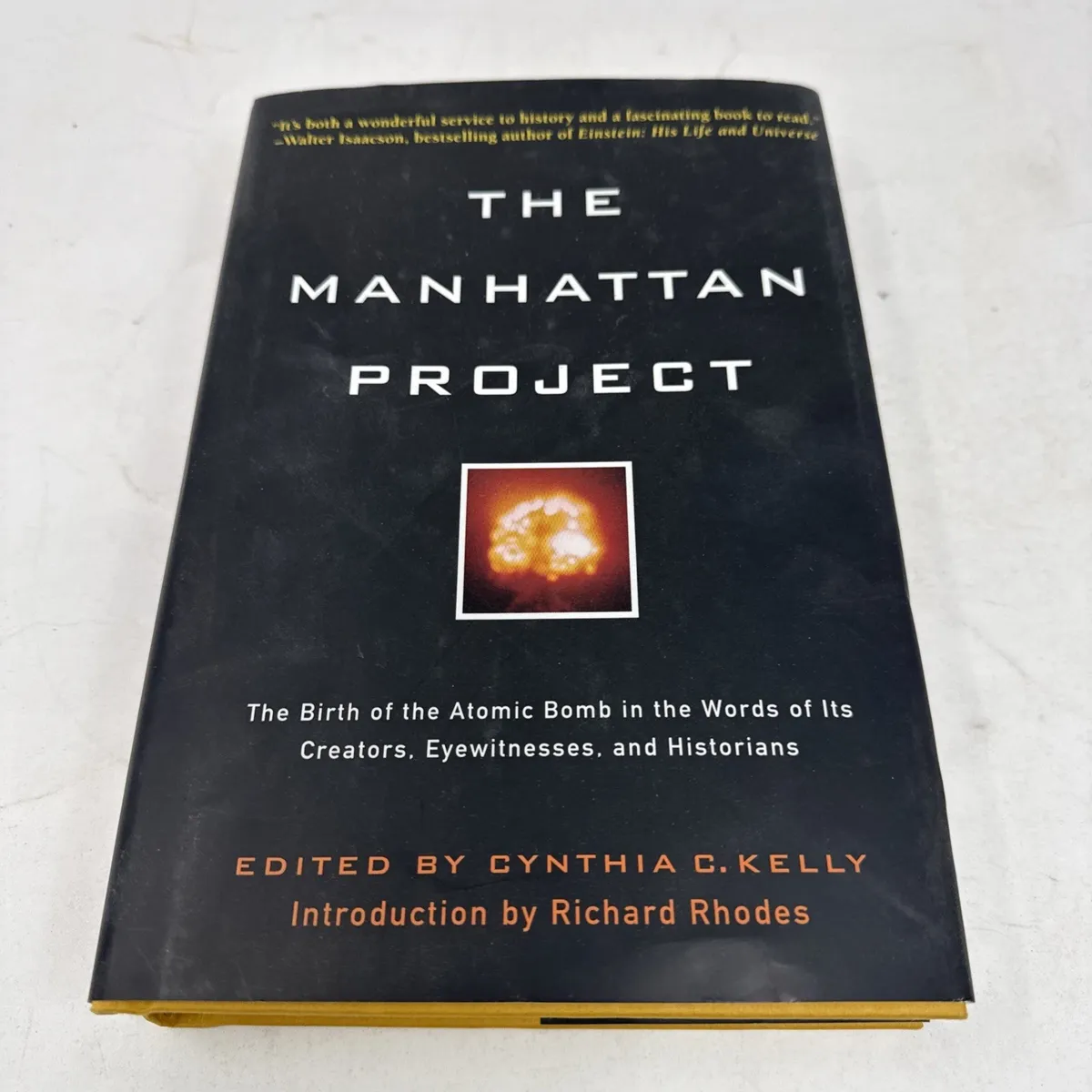
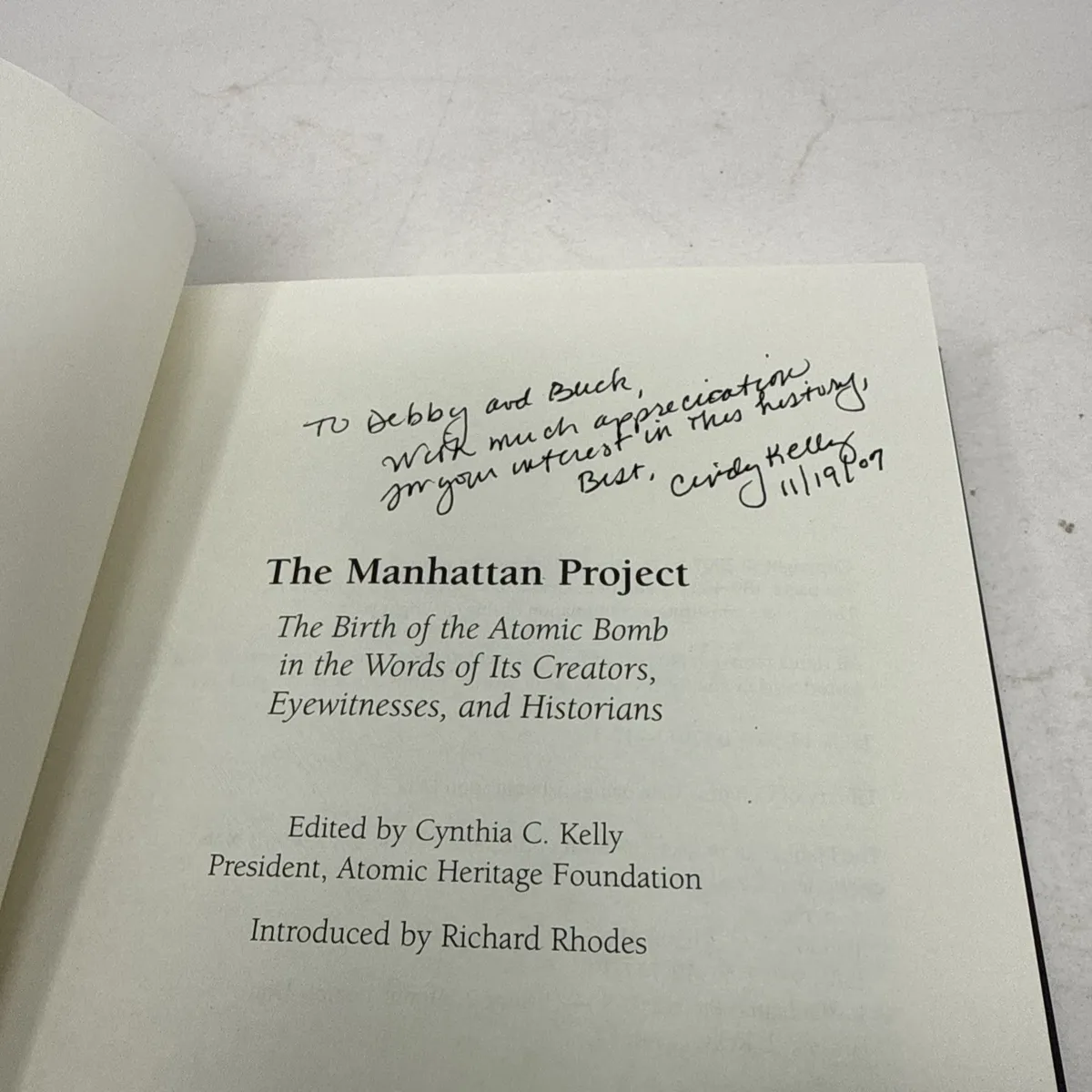
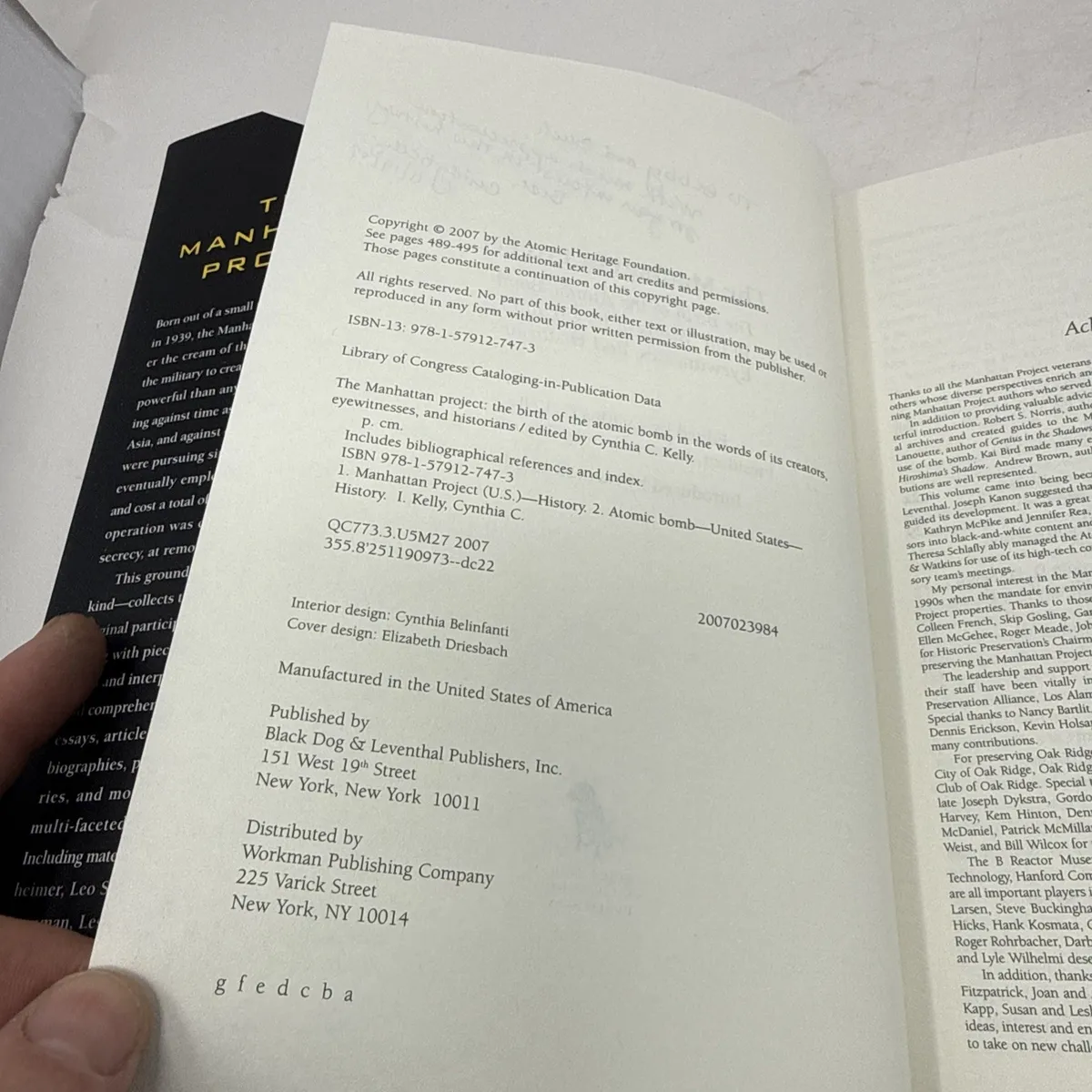
Atomic Heritage Foundation Oral Histories. Cynthia C. Kelly founded the Atomic Heritage Foundation (Washington, DC) in 2002 to preserve Manhattan Project sites and produce documentary scholarship. The Foundation’s principal legacy is the Voices of the Manhattan Project oral history collection — hundreds of recorded interviews with surviving Manhattan Project participants, their families, and the affected communities. The Foundation was dissolved in 2021 with its collection transferred to the National Park Service. Kelly’s editorial work produced the foundational documentary-anthology corpus: The Manhattan Project: The Birth of the Atomic Bomb in the Words of Its Creators, Eyewitnesses, and Historians (Black Dog & Leventhal, 2007); Oppenheimer and the Manhattan Project (World Scientific, 2006); Remembering the Manhattan Project (World Scientific, 2005). The 2007 Black Dog & Leventhal first hardcover is the principal Kelly collector target; signed copies are documented at NMLP in the archive.
White Sands Missile Range Literature. The post-Trinity history of White Sands is principally a missile-testing and rocket-development story. WSMR, established in 1945 immediately after the Trinity test, became the principal U.S. missile testing range and the site of the first American high-altitude rocket launches using captured German V-2 rockets. The WSMR historical publications cover the Trinity Site, the V-2 program, the subsequent missile development programs, and the range’s role in the Cold War weapons testing infrastructure. Key works: White Sands History: Range Beginnings and Early Missile Testing (WSMR, various editions); the WSMR Museum publications; and the popular-press accounts including David DeVorkin Science with a Vengeance: How the Military Created the US Space Sciences After World War II (Springer, 1992). Pre-2000 WSMR institutional publications are scarce ephemera.
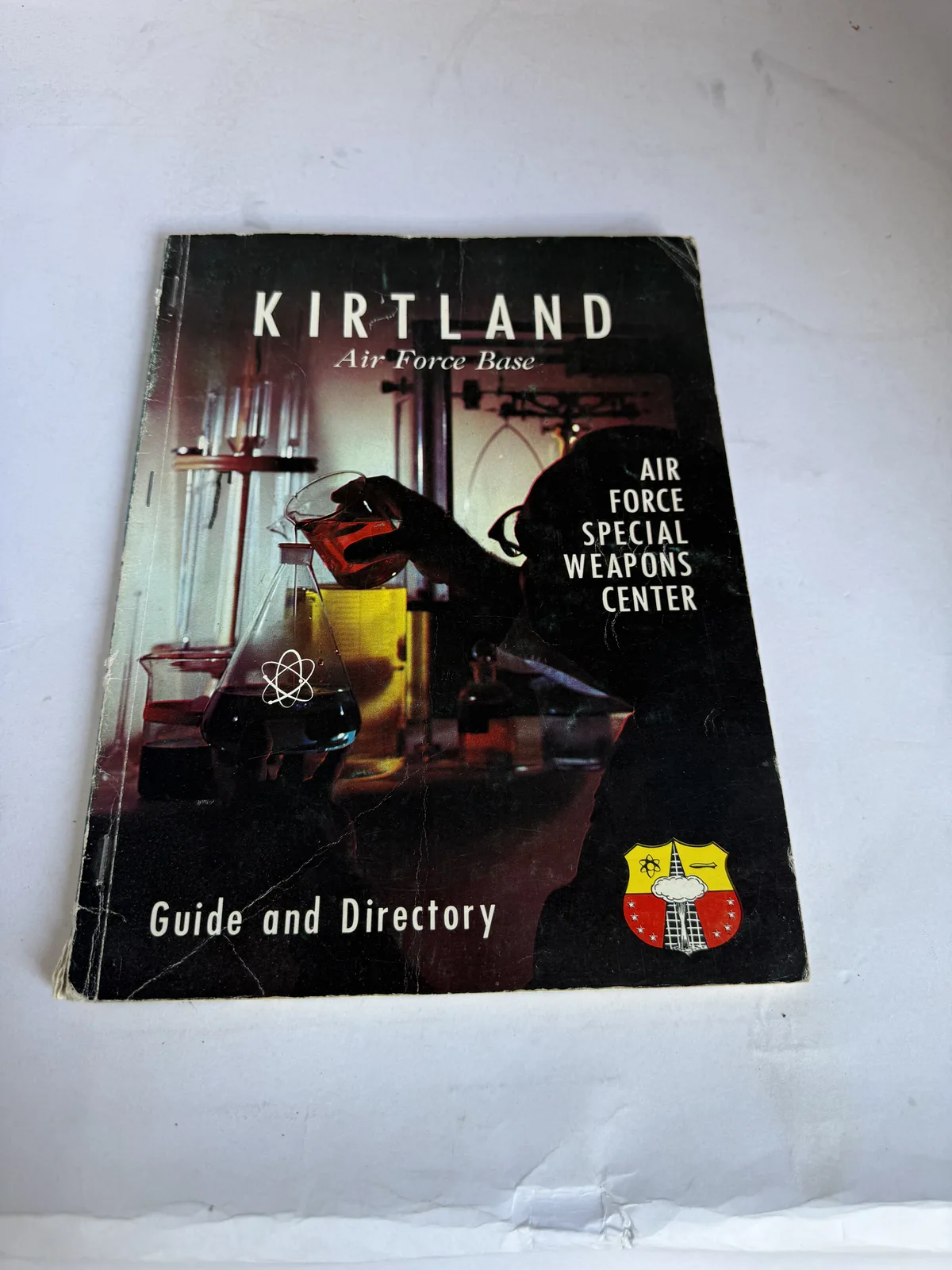
Kirtland Air Force Base and Sandia National Laboratories History. Kirtland AFB in Albuquerque has been the headquarters of the Air Force’s nuclear weapons operations since the late 1940s, including the Special Weapons Command and the Manzano Weapons Storage Facility (where nuclear warheads were stored in tunnels carved into the Manzano Mountains on the base’s eastern boundary). Sandia National Laboratories, originally Z Division of Los Alamos, was separated in 1949 and relocated to Kirtland, where it has served as the principal nuclear weapons engineering laboratory — responsible for the non-nuclear components of nuclear weapons, weapons systems integration, and surety. The Sandia institutional publication corpus is massive but largely technical; the collectible fraction includes Sandia anniversary publications (50th in 1999, 75th in 2024), the Sandia National Laboratories historical summaries, and the Kirtland AFB historical publications. Leland Johnson’s Sandia National Laboratories: A History of Exceptional Service in the National Interest (Sandia National Laboratories, 1997) is the canonical institutional history. The Manhattan Project & Los Alamos Books pillar covers additional Kirtland/Sandia history.
The NM Nuclear Landscape. New Mexico’s nuclear geography extends beyond Los Alamos and Trinity to encompass a statewide complex: Los Alamos National Laboratory (weapons design and basic science); Sandia National Laboratories in Albuquerque (weapons engineering and systems); Kirtland Air Force Base (nuclear weapons operations and storage); White Sands Missile Range (testing and the Trinity Site); the Waste Isolation Pilot Plant near Carlsbad (the nation’s only deep geological repository for transuranic nuclear waste, operational since 1999); the uranium mining districts of the Grants Mineral Belt on the Navajo Nation and in Cibola and McKinley counties (producing the principal American uranium supply during the Cold War and leaving a devastating environmental and health legacy documented in the NM Water Rights and Environmental Literature pillar); and the National Museum of Nuclear Science and History in Albuquerque (the principal southwestern atomic heritage museum, 601 Eubank Boulevard SE). The geographic scope means that atomic-age NM books surface all across the state — from Los Alamos estates to Carlsbad WIPP-related collections to Grants-area uranium-mining-community donations — and while my free pickup covers the Albuquerque metro, donors anywhere else in New Mexico can bring these to the free 24/7 drop-off at 5445 Edith Blvd NE.
I pick up books for free anywhere in the metro area. Call 505-250-3804 to schedule.
VII. The Literary and Cultural Responses
The atomic age in New Mexico has produced literary and cultural responses beyond the historical and scientific canon. Cormac McCarthy (1933–2023, closed pool), who spent the last decades of his life in Santa Fe as a research fellow at the Santa Fe Institute, is the most prominent literary figure associated with the post-atomic New Mexico landscape. While McCarthy’s major works — the Border Trilogy, Blood Meridian, No Country for Old Men, The Road — are not directly about the Manhattan Project, his late novels The Passenger and Stella Maris (both Knopf, 2022) engage explicitly with the legacy of nuclear physics and the Santa Fe Institute scientific-intellectual community. McCarthy’s connection to the atomic-age NM collecting field is tangential but real: the Santa Fe Institute, where he held a long-term research position, was founded in 1984 by Los Alamos scientists including Murray Gell-Mann, and the Institute’s intellectual culture reflects the post-Manhattan-Project scientific community that settled in northern New Mexico.
The poetry of the atomic age includes Peggy Pond Church’s work beyond The House at Otowi Bridge, documented in the New Mexico Poetry pillar. The visual-art response is documented in part in the Photographing New Mexico pillar, which covers the photographic record of the atomic-heritage landscape. The film and documentary tradition is covered in the NM Film & Cinema History pillar, which includes the Nolan Oppenheimer film and its predecessors (the 1980 BBC Oppenheimer television series, the 1989 Fat Man and Little Boy feature film). The children’s literature of the atomic age — including picture books about the Trinity test aimed at elementary-school readers — is documented in the NM Children’s Literature pillar.
Eight Identification Problems
Problem one: American Prometheus 2005 Knopf first vs. subsequent editions. The 2005 Alfred A. Knopf first hardcover with original dust jacket and a $35.00 cover price is the artifact. Subsequent: Vintage Books trade paperback editions of the late 2000s; the Vintage Contemporaries 2023 movie-tie-in trade paperback with Cillian Murphy/Oppenheimer-film cover art. The 2005 Knopf first is the collector target; the 2023 movie-tie-in is the working-library acquisition.
Problem two: Rhodes Making of the Atomic Bomb 1986 Simon & Schuster first vs. subsequent. The 1986 Simon & Schuster first hardcover with “FIRST EDITION” designation and original dust jacket with a $22.95 price is the artifact. Subsequent: 1987 Touchstone trade paperback; 1995 reissue with new preface; 2012 25th-anniversary edition with new author preface; multiple later trade-paperback printings. The 1986 first is the artifact.
Problem three: Szasz Day the Sun Rose Twice 1984 UNM Press first identification. The 1984 UNM Press first hardcover carries the UNM Press colophon on the title page. The first printing is identified by the standard UNM Press first-edition statement on the copyright page. Subsequent UNM Press paperback editions and later printings are working copies. The 1984 hardcover with original dust jacket is the artifact.
Problem four: Groves Now It Can Be Told 1962 Harper first vs. later editions. The 1962 Harper & Brothers first hardcover with original dust jacket is the artifact. The book was reissued by Harper & Row (after the 1962 merger) and subsequently by Da Capo Press in trade paperback. The 1962 Harper & Brothers first with the pre-merger imprint is the collector target.
Problem five: Peggy Pond Church House at Otowi Bridge dating. The UNM Press first edition of The House at Otowi Bridge is variously dated 1959 and 1960 in bibliographic sources. The colophon and copyright page must be examined to determine the specific first-printing state. Both dates refer to the same edition; the variation is a bibliographic complication rather than a substantive difference. Church-signed copies require authentication given the 1986 closed pool.
Problem six: Feynman Surely You’re Joking 1985 Norton first authentication. The 1985 W.W. Norton first hardcover with original dust jacket is the artifact. Feynman-signed copies are heavily faked — the combination of high demand, three-year signing window (1985–1988), and Feynman’s cultural celebrity makes forgery profitable. Provenance documentation, dealer attestation, and comparison with authenticated exemplars are essential. See the Book Authentication Methodology pillar.
Problem seven: Lamont Day of Trinity 1965 Atheneum scarcity. The 1965 Atheneum first had a modest print run and was never reissued by a mass-market paperback house, making fine copies with original dust jacket less common in the secondary market than Rhodes or Bird-Sherwin firsts. The book did not benefit from the 2023 Oppenheimer film-driven collector surge to the same degree. Condition premium is substantial: fine with dust jacket trades meaningfully higher than good-only copies.
Problem eight: LANL/LASL institutional publications dating and edition identification. Los Alamos institutional publications — including the Truslow Manhattan District History, the Critical Assembly technical history, anniversary publications, and Bradbury Science Museum catalogs — require careful bibliographic examination. Many were issued in multiple printings with minimal exterior changes. The 1973 LASL Truslow first is identified by the LASL (not LANL — the name changed in 1981) imprint. Post-2010 institutional reprints and digital-print-on-demand versions are working copies, not collectible firsts.
Three-Tier Collector Market
Tier 1 trophy (mid-three-figure to low-four-figure or higher): Signed Richard Rhodes The Making of the Atomic Bomb Simon & Schuster 1986 first hardcover with dust jacket (Pulitzer/NBA/NBCC triple-prize winner); signed Kai Bird AND Martin J. Sherwin American Prometheus Knopf 2005 first hardcover with dust jacket (Sherwin closed pool 2021 makes signed-by-both copies genuinely scarce, fine signed-by-both trades upper-four-figure at specialist auction); signed Ferenc Szasz The Day the Sun Rose Twice UNM Press 1984 first hardcover (canonical Trinity monograph, Szasz closed pool 2010); signed Leslie Groves Now It Can Be Told Harper 1962 first hardcover (Groves closed pool 1970, signed copies scarce); signed Peggy Pond Church The House at Otowi Bridge UNM Press 1959/1960 first (Church closed pool 1986); signed Richard Feynman Surely You’re Joking, Mr. Feynman! Norton 1985 first (Feynman signed sparingly, closed pool 1988); August 1945 War Department Smyth Report first government paperbound printing; signed Hans Bethe The Road from Los Alamos 1991 first; signed Stanislaw Ulam Adventures of a Mathematician Scribner 1976 first.
Tier 2 collector targets (low-to-mid three-figure): Unsigned Tier 1 firsts in fine condition with original dust jackets; Lansing Lamont Day of Trinity Atheneum 1965 first; Jennet Conant 109 East Palace Simon & Schuster 2005 first; Jon Hunner Inventing Los Alamos Oklahoma 2004 first; Joseph Masco The Nuclear Borderlands Princeton 2006 first; Tad Bartimus and Scott McCartney Trinity’s Children Harcourt Brace Jovanovich 1991 first; Fermor and Peggy Pond Church When Los Alamos Was a Ranch School LAHS 1974 first; Robert Jungk Brighter Than a Thousand Suns Harcourt Brace 1958 first English; Lillian Hoddeson Critical Assembly Cambridge 1993 first; Alice Kimball Smith and Charles Weiner Robert Oppenheimer: Letters and Recollections Harvard 1980 first; Henry DeWolf Smyth Atomic Energy for Military Purposes Princeton University Press 1945 first hardcover (unsigned); Edward Teller Memoirs Perseus 2001 first; Leona Marshall Libby The Uranium People Scribner 1979 first; Vincent Jones Manhattan: The Army and the Atomic Bomb Center of Military History 1985 first; Edith Truslow Manhattan District History LASL 1973 first.
Tier 3 working library (upper-two-figure to low-three-figure): Subsequent printings of all above; American Prometheus Vintage trade paperback editions; Vintage Contemporaries 2023 Oppenheimer movie-tie-in trade paperback; Simon & Schuster trade paperback Making of the Atomic Bomb editions; UNM Press paperback editions of Szasz and Church; Bradbury Science Museum exhibition catalogs and visitor guides; Los Alamos Historical Society publications post-2010; Manhattan Project National Historical Park NPS publications and visitor guides; National Museum of Nuclear Science and History publications; Atomic Heritage Foundation reissued documentary anthologies post-2010; White Sands Missile Range visitor guides and historical pamphlets; Sandia National Laboratories anniversary publications; Cynthia Kelly trade-paperback anthology reprints; mass-market paperbacks of scientist memoirs; Bulletin of the Atomic Scientists back issues.
NMLP Intake Position
Trinity Site and Atomic Age NM books arrive in NMLP donation intake with substantial concentration in the Sandia/Kirtland/Scientific Estate Library donor surface documented at Selling Sandia/Kirtland Scientific Estate Libraries. The donor demographic concentration: retired Sandia National Laboratories and Los Alamos National Laboratory scientific staff (Manhattan Project second-generation and Cold War-era researchers, with substantial library accumulations including signed scientist memoirs, AEC/DOE technical reports, Bulletin of the Atomic Scientists back issues from 1945 forward, and Tier 1 trophy items); Kirtland Air Force Base retired military personnel libraries (Manhattan Project military-history angle, often with substantial WWII corpus alongside); Albuquerque physicians and engineers who served at Los Alamos or Sandia; Los Alamos NM resident estates downsizing to Santa Fe or Albuquerque (deep canon-set donations including the local-history Los Alamos Historical Society publications and Ranch School memorabilia); Santa Fe and Albuquerque arts-community estates with the Oppenheimer-Pueblo-NM-cultural-history overlap; Carlsbad-area estates with WIPP-related technical and community literature.
NMLP routes Tier 1 trophy items (signed American Prometheus first, signed Rhodes Making of the Atomic Bomb 1986 first, signed Szasz Day the Sun Rose Twice 1984 first, signed Groves Now It Can Be Told 1962 first, signed Church House at Otowi Bridge first, signed Feynman Surely You’re Joking 1985 first, August 1945 Smyth Report War Department paperbound first, signed Bethe / Ulam / Teller scientist memoirs) to specialist nuclear-history and science-history dealers (Heritage Auctions Books and Manuscripts, Swann Galleries Books and Manuscripts, PBA Galleries science-and-medicine sales, Jeff Weber Rare Books specialist science-history dealer) or to specialist auction houses. Tier 2 trade firsts route through SellBooksABQ standard hand-sort with science-history-collector-customer outreach.
Tier 3 paperback reprints and trade-paperback editions route extensively to community literacy partners (NM history curriculum requires Manhattan Project content, and the Oppenheimer film drove enormous student interest in the subject), Bradbury Science Museum gift-shop donations when accepting institutional donations, the regional research-library partnership network, and Little Free Library stocking (Manhattan Project paperbacks are reliably wanted at LFL locations near Sandia/Kirtland and in the Los Alamos and White Rock NM neighborhoods). Operational documentation: /archive/manhattan-project-kelly-2007 records the NMLP intake of a signed Cynthia Kelly first hardcover with full provenance documentation. Free Albuquerque-metro pickup with no condition limit and no minimum quantity — schedule your pickup or text/call 505-250-3804.
Not sure what you have? Text me a photo at 505-250-3804 and I'll tell you what I see.
External References
- Wikipedia: Trinity (nuclear test)
- Wikipedia: J. Robert Oppenheimer
- Wikipedia: The Making of the Atomic Bomb
- Wikipedia: American Prometheus
- Wikipedia: Oppenheimer (2023 film)
- Wikipedia: Leslie Groves
- Wikipedia: Richard Feynman
- Wikipedia: Los Alamos National Laboratory
- Wikipedia: Sandia National Laboratories
- Wikipedia: Peggy Pond Church
- Wikipedia: Smyth Report
- Manhattan Project National Historical Park — NPS three-site unit
- Bradbury Science Museum — Los Alamos public-engagement museum
- Los Alamos Historical Society
- National Museum of Nuclear Science and History — Albuquerque NM
- Wikipedia: Radiation Exposure Compensation Act
Related on This Site
- Manhattan Project & Los Alamos Books — the companion pillar covering the official-history tradition, the Smyth Report, the Cynthia Kelly canon, and the full NM-anchored institutional scholarship
- Archive: Cynthia Kelly Manhattan Project (signed first) — the NMLP operational example
- Selling Sandia/Kirtland Scientific Estate Libraries — the principal atomic-age donor demographic surface
- Closed Signature Pools — Albuquerque/NM Authors — Oppenheimer (closed 1967), Groves (closed 1970), Church (closed 1986), Feynman (closed 1988), Bradbury (closed 1997), Bethe (closed 2005), Szasz (closed 2010), Sherwin (closed 2021), McCarthy (closed 2023)
- Cormac McCarthy Border Trilogy — the Santa Fe Institute connection and McCarthy’s late nuclear-physics novels
- NM Water Rights & Environmental Literature — the uranium mining legacy, WIPP, and the broader nuclear-environmental canon
- Photographing New Mexico — the photographic record of the atomic-heritage landscape
- New Mexico Poetry — Peggy Pond Church’s broader poetic canon
- NM Film & Cinema History — the Nolan Oppenheimer film, Fat Man and Little Boy, BBC Oppenheimer
- NM Science Fiction — the nuclear-age SF tradition rooted in the Los Alamos scientific community
- Book Authentication Methodology — signature-pool authentication for closed-pool atomic scientists
Cite This Guide
Eldred, J. (May 2026). Collecting Trinity Site, Los Alamos & Atomic Age New Mexico Books. New Mexico Literacy Project.
https://newmexicoliteracyproject.org/trinity-site-atomic-age-new-mexico-books-collecting
Content is original research by Josh Eldred. Licensed under CC BY 4.0. Cite with attribution.