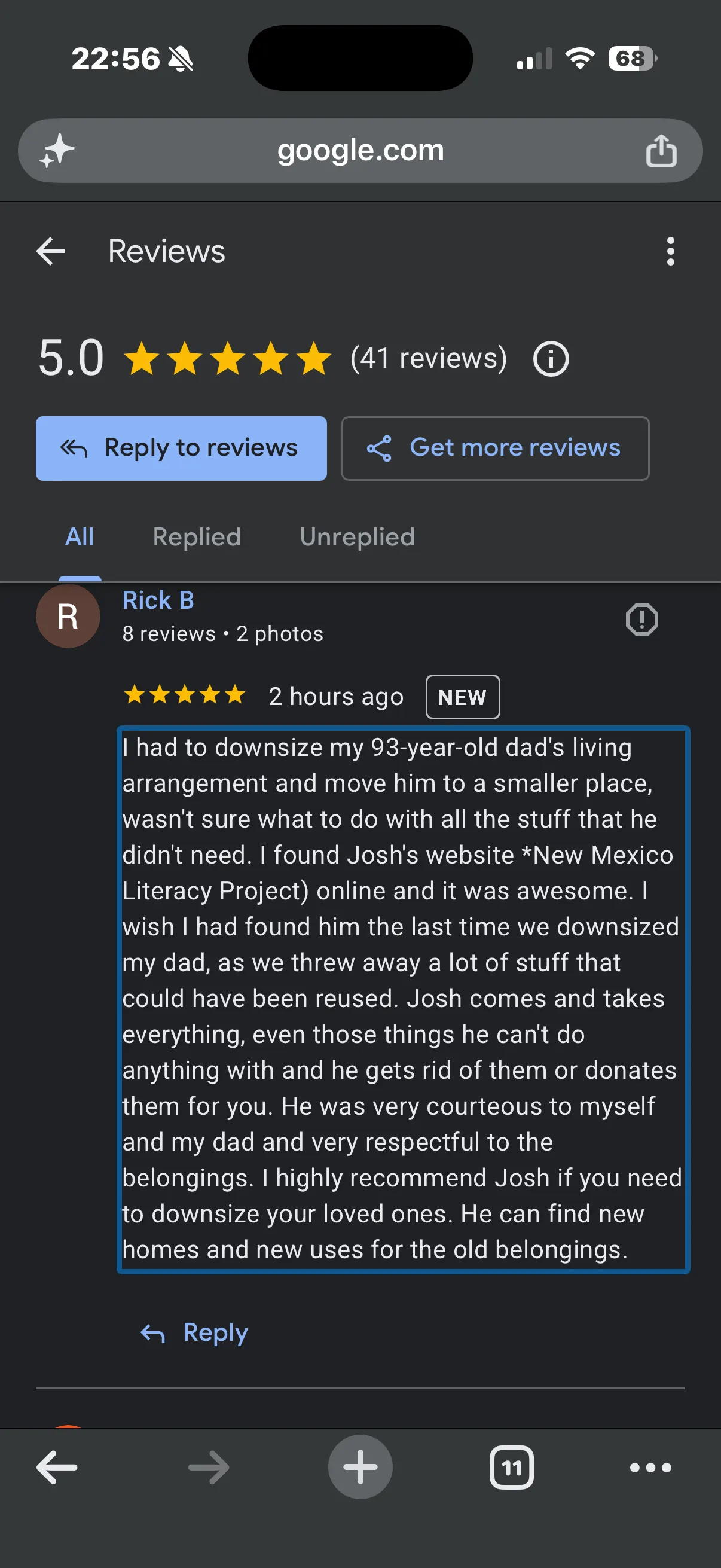
“I wish I had found him the last time we downsized my dad.”
“I had to downsize my 93-year-old dad's living arrangement and move him to a smaller place, wasn't sure what to do with all the stuff that he didn't need. I found Josh's website (New Mexico Literacy Project) online and it was awesome. I wish I had found him the last time we downsized my dad, as we threw away a lot of stuff that could have been reused. Josh comes and takes everything, even those things he can't do anything with and he gets rid of them or donates them for you. He was very courteous to myself and my dad and very respectful to the belongings. I highly recommend Josh if you need to downsize your loved ones. He can find new homes and new uses for the old belongings.”
— Rick B, Albuquerque
Last verified September 2026 · Original research by Josh Eldred
What This Page Covers
The Emotional Difficulty of Letting Go
I want to start here, because everything else on this page only makes sense if I acknowledge what is actually happening when a senior begins to let go of their books. This is not a logistics problem. It is not a space problem. It is an identity problem. A lifetime of books is a lifetime of who someone was and who they became. The shelves in the study are not just storage. They are autobiography.
I have walked into homes in Albuquerque where a retired professor has floor-to-ceiling shelves in three rooms. Homes where a former nurse has every medical reference she ever consulted alongside the mystery novels she read to decompress after thirty years of night shifts. Homes where a widower has kept every book his late wife loved, untouched on the shelf, because moving them would feel like losing her again. I have stood in living rooms where a ninety-year-old veteran pointed to a shelf and told me the story of buying each book — this one from a shop in Paris in 1953, that one from a base library sale in Okinawa, the one on the end from a bookstore in Albuquerque that closed forty years ago.
These are not just objects. A book you read in your twenties that shaped how you thought about the world is not the same thing as a sweater you outgrew. A signed copy of a novel that a favorite author handed to you at a reading in 1978 carries a kind of meaning that cannot be replaced by a digital download. The cookbooks your mother used, with her handwriting in the margins and the splatter stains on the pages she returned to most — those are artifacts of a life lived. Letting go of them is real grief, even when the practical reasons for doing so are clear and undeniable.
I understand this because I handle books every day, and I have learned that the physical objects carry emotional weight that has nothing to do with their market value. A mass-market paperback of a novel that changed someone's life at age twenty-two is worth nothing on the resale market and everything to the person who kept it for fifty years. When I come to pick up a senior's collection, I come knowing that. I am not there to strip a house. I am there to help someone navigate a transition that involves saying goodbye to part of who they are.
If you are a senior reading this page, I want you to know something: there is no wrong way to do this. If you want to keep every book and find a way to make the space work, that is valid. If you want to let go of everything at once and be done with it, that is valid too. If you want to do it gradually over months, releasing a shelf at a time as you feel ready, I will work with you on that timeline. There is no pressure from my end. I have been doing this long enough to know that the pace has to be yours.
And if you are an adult child reading this because you are trying to help a parent through this process, I want you to know that I have been in your position too. The conversations around downsizing a parent's books are some of the most emotionally charged conversations a family can have, because the books represent the parent's inner life in a way that furniture and kitchenware do not. The bookshelf is where you see who your parent really was — what they cared about, what they studied, what they read for pleasure when nobody was watching. Clearing those shelves is not the same as clearing a closet.
I am Josh Eldred. I run the New Mexico Literacy Project from a warehouse at 5445 Edith Blvd NE in Albuquerque. I handle senior downsizing book collections regularly, and I approach every one of them with the understanding that this is personal. Call or text 505-250-3804 whenever you are ready. There is no rush.
I should also say this: when a senior is downsizing, it is almost never just about the books. There are decades of clothing in the closets and dressers. Coats that have not been worn since the 1990s. Outdoor gear from years of hiking the Sandias and camping along the Jemez. Household items accumulated across a lifetime of holidays, hobbies, and daily living. I handle all of it now — clothing pickup, outdoor gear, and household items — in the same visit as the books. Everything gets the same careful sorting: valuable and vintage pieces go to resale, everyday items go to community reuse, and worn-out textiles go to material recycling where possible. If you are facing a full household downsize and not just a library, one call to me covers the entire scope. My estate cleanout service page explains how I handle the broader process for families dealing with an entire home.
The Difference Between “Decluttering” and “Honoring a Collection”
The popular culture around downsizing treats books like any other household item. The advice is the same whether you are talking about kitchen gadgets or a library that took sixty years to build: does it spark joy? If not, let it go. That framework works fine for spatulas. It does not work for a retired English teacher's personal library. It does not work for a World War II veteran's collection of military history. It does not work for a woman who spent forty years building one of the finest personal collections of Southwest art books in Albuquerque.
The problem with the decluttering mindset is that it treats the destination of the books as irrelevant. The book goes in the donation bag, the bag goes to a thrift store, and the thrift store puts it on a shelf where it either sells for a dollar or gets thrown in a dumpster. For most household items, that outcome is fine. For books that someone curated over a lifetime, it is a failure. A first edition of Rudolfo Anaya's Bless Me, Ultima sitting in a Goodwill bin priced at fifty cents is not a successful outcome. It is a waste.
What I offer is fundamentally different from a decluttering service. I do not approach a senior's library as clutter that needs to be removed. I approach it as a collection that needs to be understood. Every book gets sorted individually at the warehouse. The titles with collector value are researched and listed where collectors and serious readers will find them. The good reading copies go to community programs, schools, and Little Free Libraries across Albuquerque. Books that have outlived their usefulness as reading material go to my paper recycler. No book is landfilled. Nothing is treated generically.
This distinction matters to the seniors I work with. When I can tell someone that their signed Tony Hillerman novel is going to a collector who will treasure it, that their set of Time-Life nature books is going to a homeschool family, and that even their mass-market paperbacks are being redistributed rather than discarded — that changes the emotional experience of letting go. It is not about the money. It is about the books finding their next purpose rather than simply disappearing.
The knowledge required to do this well is not trivial. I need to know the difference between a Book of the Month Club edition and a true first printing. I need to recognize a first state dust jacket on a mid-century novel. I need to understand which regional cookbooks have collector followings and which are common reprints. I need to know that a particular edition of a Southwest art book was limited to five hundred copies and is now sought after, while a similar-looking later printing is not. This is what I do every day. It is my profession, and I bring all of it to every senior downsizing pickup. My first edition identification guide and condition grading guide explain some of the basics, but you never need to learn any of it first: I take the whole collection, no sorting needed, and every book gets sorted individually at the warehouse.
Which Books from the 1950s–1990s Have Value
Seniors who built their collections during the mid-twentieth century are sitting on a generation of books that the collector market cares about deeply. The problem is that most people have no idea which of their books carry value and which do not. The hardcover novel that looks important might be a book club edition worth very little. The paperback that looks ordinary might be a first printing worth quite a lot. Without specific knowledge, it is nearly impossible to tell from the outside.
Here is a broad overview of what I commonly find in senior collections in Albuquerque that has genuine collector or resale value. This is not exhaustive, but it covers the categories I see most frequently.
Mid-Century Modern Design and Architecture Books
Albuquerque experienced significant growth in the 1950s and 1960s, and many homes from that era still contain design and architecture books that reflect the period's aesthetic. Books on Eames furniture, mid-century interior design, Alexander Girard's textiles, and the residential architecture of the Southwest from that period have strong collector followings. Large-format art and design books published by Abrams, Rizzoli, and the Museum of Modern Art between 1955 and 1975 are particularly sought after. If your parent's bookshelf includes heavy, beautifully illustrated books about design, architecture, or decorative arts from this period, they deserve careful packing.
Vintage Cookbooks
Cookbooks are one of the most commonly undervalued categories in senior collections. A first edition of Julia Child's Mastering the Art of French Cooking from 1961 is a genuinely valuable book. Early printings of The Joy of Cooking, The Silver Palate Cookbook, and Marcella Hazan's Italian cookbooks all carry collector interest. But the real treasures in Albuquerque tend to be regional: spiral-bound New Mexico cookbooks from churches, women's clubs, and community organizations published in the 1950s through the 1970s. Cookbooks from the Santa Fe School of Cooking, early editions of recipes from New Mexico pueblos, and locally published collections of New Mexican cuisine are in steady demand from both collectors and working cooks. The cookbook with the torn cover and the chile-stained pages might be the most valuable book on the shelf.
Book Club Editions vs. First Editions
This is one of the most important distinctions in senior collections, and it trips up almost everyone who is not a book professional. During the 1950s through the 1980s, the Book of the Month Club and the Literary Guild were enormously popular. Millions of Americans received hardcover novels through these programs, and those books look almost identical to the trade first editions published by the original publishers. The differences are subtle — a blind stamp on the back cover, a slightly different binding, the absence of a price on the dust jacket flap. But the value difference is enormous. A true first edition of Harper Lee's To Kill a Mockingbird is worth serious money. A Book of the Month Club edition of the same title is worth a few dollars. Telling them apart is part of the hand sort at the warehouse, so the family never has to.
Literary Fiction First Printings
The generation that built their libraries from the 1950s through the 1980s was reading during what many consider the golden age of American literary fiction. First printings of Saul Bellow, John Updike, Philip Roth, Toni Morrison, Joan Didion, Flannery O'Connor, Cormac McCarthy, and Larry McMurtry all carry collector value — sometimes substantial value. In Albuquerque specifically, I see a concentration of Southwest literary fiction: Tony Hillerman's early Navajo mysteries, Rudolfo Anaya's works, John Nichols' New Mexico trilogy, and Edward Abbey's desert writing. The short version: if your parent was buying hardcover literary fiction in the 1960s and 1970s and keeping it in good condition, those shelves deserve careful packing, and every book on them gets sorted by hand at the warehouse.
Science Fiction First Editions
Science fiction from the 1950s through the 1970s is one of the hottest areas of the collector market. First editions of Isaac Asimov, Arthur C. Clarke, Ray Bradbury, Frank Herbert, Ursula K. Le Guin, and Philip K. Dick in dust jackets are consistently in demand. Even later printings of canonical science fiction titles hold value if they are in good condition. Albuquerque has a history of attracting scientists, engineers, and technically oriented professionals — exactly the demographic that was buying science fiction during this period. If your parent has a shelf of hardcover science fiction from the mid-century, it gets a careful look during the hand sort at the warehouse.
Southwest Art Books
This is a category that is specific to this region and that I see more frequently in Albuquerque senior collections than almost anywhere else. Large-format books on Pueblo pottery, Navajo weaving, Rio Grande blankets, Santos and retablos, Taos Society of Artists paintings, Georgia O'Keeffe, and the broader Santa Fe and Albuquerque art scenes from the 1960s and 1970s were published in relatively small runs and are now sought after by collectors, galleries, and institutions. Books published by the University of New Mexico Press, the Museum of New Mexico Press, and the School of American Research (now the School for Advanced Research) are particularly valuable. Many seniors in Albuquerque have these on their shelves because they lived through the era and participated in the culture. Those books matter to the people who collect them now.
The NMLP White-Glove Pickup for Large Collections
For large, carefully maintained personal libraries, I come to the home personally. There is no crew. There is no truck full of laborers who will throw boxes around. It is me, walking through the collection with the owner or the owner's family, taking the time to listen and to pack everything with care.
The process starts with a conversation, usually by phone or text. You tell me about the collection — how many books approximately, what kinds of books, how long they have been accumulated, and what the situation is. Are you downsizing to a smaller home? Moving to a senior living community? Clearing a room for a different use? Is the senior making this decision themselves, or is an adult child coordinating? The answers to these questions shape how I approach the visit.
When I arrive, I do not start by grabbing boxes. I walk through the rooms with whoever is present — the senior, an adult child, sometimes both — so I know which shelves are going, which books the family is keeping, and how to pack everything safely. I do not rush it. The careful, book-by-book sorting happens later at the warehouse, so nobody has to sort anything before I get there.
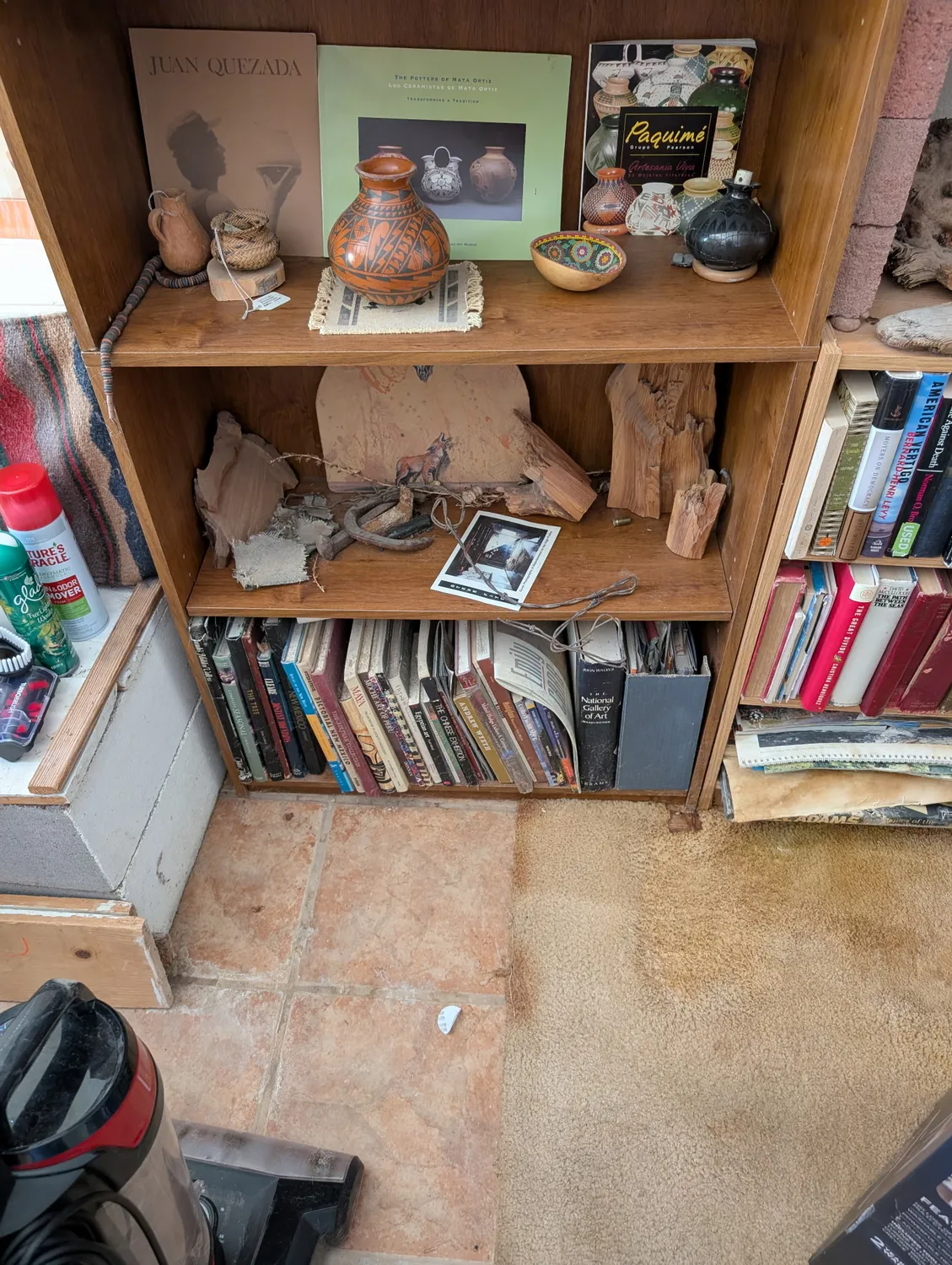
During the walkthrough, the owner is welcome to tell me about their books. Many seniors want to do this, and I genuinely enjoy it. The retired geologist who spent his career in the Jemez Mountains wants to tell me about his field guides and the signed monograph from a colleague. The former English teacher wants to explain why her annotated Shakespeare matters to her. The widow whose husband collected military history wants me to know that these books represented his lifelong passion. I listen because the stories add context that helps me understand the collection, and because it is the right thing to do when someone is letting go of something they care about.
After the walkthrough, I explain where everything goes. Books with collector interest are researched and listed where collectors will find them, good reading copies are redistributed to the community, and books that have outlived their useful life are recycled. I am transparent about that process. I do not appraise books, and you never need to know what is on the shelves before you donate them — Reader's Digest condensed books and outdated textbooks go in the truck right alongside everything else.
Then I load. I bring my own vehicle, I do all the physical work, and I handle the books with care. These are not getting thrown into garbage bags. They go into the truck organized and protected. The special pieces get packed separately. The reading copies are handled carefully. Even the books destined for recycling are treated as what they are — someone's possessions that deserve to be handled respectfully on their way to their next purpose.
To schedule a white-glove pickup, call or text 505-250-3804. I serve the entire Albuquerque metro — the Northeast Heights, the North Valley, Corrales, Rio Rancho, the East Mountains, the South Valley, and everywhere in between.
Working with Adult Children
More often than not, the person contacting me about a senior's book collection is not the senior themselves. It is a daughter. A son. Sometimes a niece or nephew, a grandchild, or a close family friend. The senior may be willing but overwhelmed. They may be reluctant. They may have cognitive decline that makes the decision-making process difficult. They may be in a senior living facility already, and the adult child is dealing with the house. Every situation is different, and I have navigated all of them.
If you are the adult child arranging this, here is what I have learned from years of doing this work. The most important thing is to make this feel like honoring rather than stripping. The language matters. Saying "I need to get rid of Dad's books" lands very differently than "I want to make sure Dad's books go somewhere they'll be appreciated." The outcome might be the same — the books leave the house — but the framing changes whether it feels like a loss or a legacy.
Involve the parent wherever possible. Even if they cannot physically participate in the sorting, let them know what is happening and give them the opportunity to choose what they keep. A senior who gets to say "I want to keep my Julia Child and my Tony Hillerman, but the rest can go" feels agency in the process. A senior who comes home to empty shelves feels robbed. The difference between those two experiences is entirely about how the adult child manages the conversation and the process.
When I come to the home, I can help facilitate this by keeping the pace unhurried. The senior and the adult child can walk the shelves together first and pull the books the senior wants to keep or hand to someone specific, and I take everything else. Walking the shelves together also gives the adult child a framework for the conversation — instead of "which books do you want to keep," the question becomes "would you like one of the grandkids to have your Hillerman mysteries?" Specific questions get better answers than open-ended ones, especially when emotions are running high.
I also work with adult children who are managing this process from out of state. Albuquerque has a large population of retirees whose children live in Denver, Phoenix, Dallas, Los Angeles, or further away. If you are coordinating your parent's downsizing remotely, I can be your person on the ground for the books. You can give me access to the house, I will walk it, and we will confirm by phone what stays before anything is removed. I have done this many times and it works well. My page on out-of-state estate cleanouts covers the logistics in detail.
One more thing for adult children: be patient with your parent. The resistance to letting go of books is not stubbornness. It is not hoarding. It is a rational emotional response to losing something that represents decades of intellectual identity. Give them time. Start small. Let them see that the books are going somewhere good. The process gets easier as trust builds, and I am happy to be part of building that trust.
Senior Living Community Partnerships
Albuquerque has a significant senior living infrastructure, and the residents of these communities are constantly in transition. Independent living residents downsize when they move in. Assisted living residents downsize further when they transition from larger apartments to smaller ones. Memory care transitions involve clearing entire living spaces. At every stage, books need to go somewhere.
I work with senior living communities across the Albuquerque metro as an ongoing resource for residents and staff. La Vida Llena, Albuquerque's premier continuing care retirement community in the Northeast Heights, has residents who are accomplished professionals, academics, and lifelong readers. Senior communities across the city have populations of readers who arrived with personal libraries and eventually need help transitioning those collections.
For social workers, activities directors, and resident services coordinators at these communities: I can serve as a standing resource for your residents. When a new resident is downsizing to move in, when a current resident is transitioning to a smaller space, or when a family is clearing a resident's apartment after a passing, I am available to handle the books. Families navigating a loved one's library after a death can also use my step-by-step guide to books after someone passes. If the family has hired an estate sale company for the household contents, I work alongside them to handle the library separately. The service is the same for community residents as it is for anyone else — I come personally, I take everything, and no book goes to the landfill.
The advantage of a partnership arrangement is that your residents and their families have a trusted referral rather than having to search for someone on their own during an already stressful transition. You can keep my contact information on file and share it when the situation arises. There are no referral fees, no contracts, and no obligations. I am simply available when your residents need me.
I have also donated books to community libraries within senior living facilities. If your community has a lending library for residents and you would like specific categories of books — large print fiction, Southwest history, gardening, biographies — let me know. I see thousands of books every week and I am happy to set aside titles that would serve your resident population well.
To discuss a partnership with your community, call or text 505-250-3804.
The Gradual Approach
If a move date is already set and time is short, my guide on how to get rid of books fast when moving covers the compressed-timeline approach. But if you have the luxury of time, use it. Not everything has to go at once. I want to say that clearly because the conventional downsizing advice tends to treat the process as a single event — a weekend of purging, a one-time cleanout, a decisive break. For some people, that works. For many seniors, it does not. The all-at-once approach can feel violent, like ripping out a part of the house that made it home. The gradual approach respects the emotional timeline while still making steady progress.
Here is how the gradual approach works in practice. On the first visit, I start with the books the senior knows they will not reread. The outdated reference books. The novels they tried but did not enjoy. The duplicates. The books that belonged to a different phase of life and no longer feel relevant. This first layer is usually the easiest to release because there is no emotional attachment — these are books that are taking up space without serving a purpose.
Then I wait. Six months, three months, whatever feels right. During that time, the senior lives with the remaining collection and has a chance to notice what they reach for and what they do not. The books that sit untouched for six months are candidates for the second round. The books that get opened, referenced, or even just looked at with pleasure — those stay.
I have worked with seniors over the course of a full year using this approach. Three visits, six months apart, each one releasing another layer. By the end, the collection that remains is distilled down to the books that truly matter — the ones that earn their shelf space through continued meaning rather than inertia. The senior arrives at that final collection feeling like they chose it rather than having it chosen for them. That psychological difference is enormous.
The gradual approach requires patience from everyone involved, including the adult children who may be eager to get the house cleared or the space freed up. If a real estate agent is staging the home for sale and needs bookshelves emptied on a tighter timeline, I can accommodate that too. But I have seen enough of these transitions to know that patience pays dividends in family harmony and the senior's emotional well-being. A parent who feels respected and in control of the process is a parent who stays cooperative. A parent who feels rushed and overridden becomes resistant, and the whole thing becomes harder for everyone.
There is no extra charge for multiple visits. I do not pressure anyone to let go of more books than they are ready to release. The pace is yours. Call or text 505-250-3804 when you are ready for the first conversation.
Books as Legacy
Some seniors want specific books to go to specific people. This is one of the most meaningful aspects of a book collection — the ability to pass individual volumes to family members or friends who will appreciate them in a way that a stranger cannot. A signed Hillerman to the grandchild who loved mysteries. A set of Julia Child to the daughter who cooks. A father's complete collection of Zane Grey to the son who grew up hearing about them. These are not financial bequests. They are emotional ones, and they carry a weight that goes far beyond the market value of the book.
I can help with this. During the walkthrough, I can help a senior think through which meaningful, well-preserved books a family member would treasure, and which books match which people. The grandchild studying environmental science might love the collection of Edward Abbey first editions. The nephew who collects vintage cookbooks would be thrilled by the regional New Mexico cookbook collection. The old friend who shared a love of military history would appreciate the signed unit history from Korea.
Once the legacy books are set aside, the rest of the collection can be handled through my normal process — white-glove pickup, hand sorting, community redistribution, no book landfilled. The senior gets the satisfaction of knowing that the most meaningful books went to the right people, and the remaining books found their next purpose rather than a landfill.
I have seen families create beautiful moments around this process. A grandmother sitting at her dining table with her three adult grandchildren, going through her book collection together, telling stories about where each book came from and why it mattered, handing specific volumes to specific people with specific explanations. That afternoon becomes a family memory that outlasts the books themselves. I am not always present for those moments — sometimes the family does this before I arrive, and I handle what remains — but I have been part of enough of them to know their value.
If the family wants time to pick out books for gifting before I load, I am happy to work around that as part of the visit. There is no fee. It is simply part of treating a book collection with the care it deserves.
What About the Books Nobody Wants?
Every senior collection has them. The three thousand mass-market paperbacks. The outdated encyclopedias. The Reader's Digest condensed books that fill an entire bookcase. The thirty-year-old computer manuals. The self-help books from decades past. The book club editions that looked like first editions but are not. Nobody in the family wants them. No collector wants them. No used bookstore will take them. And the senior — or the adult child — feels guilty about that.
I want to address the guilt directly: do not feel bad about letting these books go. A 1987 edition of a DOS computer manual served its purpose thirty years ago. A set of World Book encyclopedias from 1974 was a wonderful resource when it was current. Reader's Digest condensed books brought pleasure to millions of readers who enjoyed the format. None of these books are garbage — they simply completed their useful life as reading material, which is exactly what books are supposed to do. A book that was read, enjoyed, and eventually worn out or made obsolete is a book that succeeded.
I take everything. When I say everything, I mean it. The mass-market paperbacks, the condensed books, the outdated references, the books with water damage, the books with torn covers, the books that smell like the closet they have been sitting in for fifteen years. I take them all, and here is what happens to them. Mass-market paperbacks in readable condition go to community distribution points — Little Free Libraries, laundromats, waiting rooms, anywhere a cheap novel in decent shape can find a reader. Books that are damaged or genuinely obsolete go to my regional paper recycler. No book goes to a landfill.
The reason I take everything is practical: I do not want you to have to sort. Sorting is work, and for a senior or an adult child dealing with an overwhelming collection, the requirement to sort creates a barrier that often prevents the whole project from happening. People look at two thousand books and think "I need to figure out which ones are worth donating and which ones are not," and the task feels so large that they do nothing. I eliminate that barrier. You do not sort. I sort. Everything leaves the house in one trip, and the sorting happens at my warehouse where I have the space, the knowledge, and the systems to do it efficiently.
So when you are standing in your parent's study looking at shelves full of condensed books and thirty-year-old paperbacks and feeling like nobody could possibly want any of this — call me anyway. I want it. All of it. And the fact that those ordinary books come packaged with the rest of the collection means I might find the valuable titles hidden among them that would have been missed if you had just thrown everything in a dumpster.
Practical Logistics
Scheduling
Contact me by phone or text at 505-250-3804. Tell me roughly how many books are involved, what kinds of books they are (if you know), and what your timeline looks like. Senior downsizing pickups are scheduled by route from first contact; the current wait is posted on the free pickup page. If you are working toward a specific deadline — a move-in date at a senior living community, a home sale closing, a family visit when everyone will be in town — I work around that date.
What to Expect During the Pickup
I arrive in my vehicle, I come to the door, and I walk through the collection together. For large collections, plan on one to two hours for the walkthrough and loading combined. I bring my own boxes and packing materials if needed, though most collections are already on shelves or in boxes. I do all the physical work — pulling books from shelves, loading boxes, carrying everything to my vehicle. You do not need to move anything yourself. If the senior or family member wants to be present for the walkthrough but not the loading, that is perfectly fine. Many people stay for the walkthrough and then step away while I handle the physical removal.
Areas Served
I serve the entire Albuquerque metro and surrounding areas. Northeast Heights, North Valley, South Valley, Downtown, Nob Hill, the Westside, Rio Rancho, Corrales, Placitas, Bernalillo, the East Mountains (Edgewood, Tijeras, Cedar Crest, Sandia Park), and Los Lunas. Belen and the rest of Valencia County are covered on scheduled route days. Farther out — Santa Fe, Socorro — there is no pickup; the free 24/7 drop box at 5445 Edith Blvd NE takes any quantity, books can be mailed in at the sender's cost, and a genuinely standout collection can text photos to 505-250-3804 first for a case-by-case answer.
The 24/7 Drop Box
For smaller loads that you can transport yourself, my 24/7 outdoor drop box at 5445 Edith Blvd NE, Unit A, in Albuquerque is available around the clock. No appointment needed, no interaction required. Drive up, leave the bags or boxes in the bin, and you are done. This works well for the gradual approach — every time the senior is ready to release a few more books, the adult child can swing by the drop box on the way home from a visit.
How Long It Takes
Pickups are scheduled by route from first contact. The pickup itself — walkthrough, packing, loading — takes one to three hours depending on the size of the collection. A few hundred books can be packed and loaded in an hour. A few thousand takes longer. I do not rush the process, especially when the senior is present and wants to be involved. The careful part happens afterward, at the warehouse, where every title is sorted by hand.
For Veterans
Albuquerque has a large veteran population, and a significant number of those veterans are retirees who have been here for decades. Many came to Albuquerque through Kirtland Air Force Base or Sandia National Labs, served their careers, and stayed for the climate, the culture, and the community they built. Now they are downsizing, and their book collections reflect lifetimes that included military service, technical careers, and decades of reading in retirement.
Military history collections from veterans are among the most interesting collections I handle. These are not the generalized history-channel overviews that fill the shelves at chain bookstores. These are deep, specific collections built by people who lived the history. Unit histories — the printed books that chronicle a specific battalion, regiment, or squadron's service — are often produced in limited runs and distributed primarily to the unit's veterans. These can be genuinely rare and are sought after by military historians, genealogists, and other veterans researching their own service history. If your father or grandfather has a shelf of unit histories from Korea, Vietnam, or the Cold War era, those books may be far more valuable than they appear.
Service-related technical books also have value in specific markets. Nuclear weapons history from Sandia and Los Alamos veterans. Aviation technical manuals from Air Force pilots and engineers. Intelligence and strategy texts from career military officers. Cold War analysis from people who worked in the national security apparatus. These books find their way to academic libraries, military historians, and the steady community of collectors focused on military and intelligence history.
Beyond the military-specific material, veteran collections in Albuquerque tend to be broad and well-curated. Career military officers and career laboratory scientists are educated, intellectually curious people who read widely and kept what they read. Their personal libraries typically include significant fiction collections, political and strategic analysis, history far beyond their own service area, travel books from every posting, and often deep collections in a personal interest area — birding, fly fishing, the American West, whatever captured their attention during forty years of reading.
I treat veteran collections with particular respect because I understand what they represent. A military career produces a unique kind of personal library — one that reflects not just intellectual interests but the arc of a life spent serving. Those books deserve to be handled by someone who recognizes their significance. Call or text 505-250-3804.
Beyond the Bookshelves — Clothing, Western Wear, and Outdoor Gear
Seniors downsizing in Albuquerque rarely have just books to deal with. Decades of clothing fill closets and dressers — and in this city, those closets often contain vintage western wear, turquoise-accented pieces, and garments from the 1960s through 1980s that carry real collector value. Our dry climate preserves textiles remarkably well, so items stored for thirty or forty years often emerge in excellent condition.
I pick up clothing, outdoor gear, and household items in the same visit as your books. Vintage pieces get sorted for resale, everyday items go to community reuse, and worn-out textiles go to recycling. One call to 505-250-3804 handles the entire downsizing load.
Frequently Asked Questions
How does the white-glove pickup work?
Can the senior be present during the pickup?
Is there a minimum number of books?
What if my parent is reluctant to let go of books?
Do you take Reader's Digest condensed books?
Are donations tax-deductible?
What about books in storage that haven't been opened in years?
Can you work with my senior living community?
How quickly can you come?
What happens to books that aren't valuable?
Ready to Talk About Your Books?
No rush, no pressure, no judgment. Compassionate white-glove pickup for seniors and families anywhere in the Albuquerque metro. Every box sorted by hand at the warehouse. No book goes to the landfill.
Call or Text 505-250-3804NMLP is a for-profit business. Donations are not tax-deductible. I am transparent about this because trust matters more than a tax letter.
Related Pages
After Someone Passes
A compassionate guide to handling a loved one's book collection after a death. What to keep, what to donate, how to identify value.
Estate Cleanout
Full estate cleanout service for Albuquerque. Books, papers, household goods. One contact handles everything.
Free Book Pickup
Schedule a free pickup anywhere in the Albuquerque metro. Any quantity, any condition, no sorting required.
Sell or Donate?
Wondering whether to sell or donate your books? A straightforward guide to understanding your options in Albuquerque.
Military Family Donations
Free pickup for Kirtland AFB families during PCS moves. No weight allowance worries.