Georgia O’Keeffe (1887–1986) is the most collected American woman artist in book form. Her publishing record spans more than sixty years of primary production (1924–1986), a significant posthumous institutionalization through the Georgia O’Keeffe Museum (opened Santa Fe 1997), and a Catalog Raisonné (Barbara Buhler Lynes, 1999) that established the two-volume National Gallery / Yale University Press set as the authoritative scholarly standard. For New Mexico book collectors, the O’Keeffe library is the most prominent single-artist concentration in the state’s book culture: she lived here for the last thirty-seven years of her life, she is the subject of two historic house museums (Ghost Ranch and Abiquiú) within 65 miles of Albuquerque, and her work anchors the cultural heritage of the region and the permanent collection of the most-visited art museum in New Mexico.
This pillar covers every collectible O’Keeffe title in ranked order of importance, with edition-point identification for the key firsts, the Stieglitz circle cross-collectibles, the Juan Hamilton late-period publications, the Georgia O’Keeffe Museum publication program, the three-tier collector market, and provenance premiums specific to New Mexico estate libraries. 2026 marks the fortieth anniversary of O’Keeffe’s death on March 6, 1986 — the closed signing pool is now four decades deep, which affects the authentication landscape for signed copies.
Last verified September 2026 · Original research by Josh Eldred
The New Mexico biography — 1929 to 1986
Georgia O’Keeffe art books, including Georgia O'Keeffe (1976), are sought-after collectibles commanding premium prices among Southwest and Western Americana collectors. O’Keeffe’s relationship with New Mexico began with an invitation from Mabel Dodge Luhan, the patron and salon host whose Los Gallos compound in Taos was the most consequential American cultural salon of the early twentieth century, at the heart of the Taos art colony. Luhan wrote to O’Keeffe in the spring of 1929 inviting her and her friend Rebecca Strand (wife of the photographer Paul Strand) to spend the summer in Taos. O’Keeffe arrived in April 1929 and immediately began working; the paintings she produced that summer — the large black cross canvases, the penitente crosses, the first New Mexico landscape studies — signal the decisive turn in her career toward the Southwestern subjects she would work in for the remaining 57 years of her painting life.
The 1929 Taos summer was followed by return visits in 1930, 1931, and 1932, each producing major canvases. In 1934 she discovered Ghost Ranch — the Piedra Lumbre basin guest ranch in Rió Arriba County operated by Arthur Newton Pack, located approximately 14 miles north of Abiquiú on what is now NM-84 — and began staying there. The landscape visible from Ghost Ranch: the buff-and-red sandstone formations of the Piedra Lumbre (called “the cliffs” in O’Keeffe’s correspondence), Pedernal Mountain (the flat-topped peak visible to the southwest that O’Keeffe claimed was “God’s mountain” and that appears in dozens of her paintings), and the vast arroyo-cut high desert of Rió Arriba County — these subjects constitute the single largest geographical concentration in the O’Keeffe oeuvre. By 1940 she had purchased a small house on the Ghost Ranch property; she worked at Ghost Ranch each summer through 1984.
In 1945 O’Keeffe purchased a ruined Spanish colonial hacienda in the village of Abiquiú from the Archdiocese of Santa Fe for ten dollars, plus a commitment to restore the property. The restoration — consulting with the architect Alexander Girard and employing local builders — took several years. By approximately 1949, the year she established permanent New Mexico residency following Alfred Stieglitz’s death in July 1946, she was using the Abiquiú compound as her winter base. The arrangement she maintained for the next three and a half decades: Ghost Ranch in summer (April through October), Abiquiú compound in winter. Her Abiquiú studio — with its famous door-in-the-wall subject that appears in multiple paintings — was the workspace for her last painting decades.
She died in Santa Fe at St. Vincent Hospital on March 6, 1986, aged 98. Her signing pool closed that day. The Georgia O’Keeffe Foundation, which Juan Hamilton had helped establish, distributed her estate: approximately 400 works went to the Georgia O’Keeffe Museum (which did not yet exist; the foundation held them until the museum’s 1997 opening), and the remainder went to Hamilton and other beneficiaries. The Abiquiú compound was eventually transferred to the Georgia O’Keeffe Museum and operates as a historic house museum (tours strictly by advance appointment through the museum). Ghost Ranch, now operated by the Presbyterian Church USA as a conference and retreat center, preserves O’Keeffe’s casita but offers access only on specific tour programs.
The 1976 Viking Press monograph — the trophy book
No O’Keeffe book is more important to own, more frequently asked about in estate contexts, or more consistently held in NM estate libraries than Georgia O’Keeffe (Viking Press, New York, 1976). It is universally called “the Viking book” in the trade. Understanding exactly what you have — first printing trade edition, subsequent printing, or the limited signed edition — determines a meaningful spread in value.
Georgia O’Keeffe (Viking Press, 1976)
ISBN 0-670-33707-5 · 12.5 × 12.5 inches · 192 pages · 108 color plates · Trade and Limited editions
The oversize first-person monograph O’Keeffe wrote herself. Format: 12.5 inches square, bound in off-white cloth, 192 pages, 108 full-color plates each facing a page of O’Keeffe’s own handwritten (then typeset) commentary. The introduction is by O’Keeffe. There is no critical apparatus, no art-historical essay, no external author — only O’Keeffe’s own words describing her pictures. This format is what makes the book unique in her canon: it is the closest approximation to her voice addressing her oeuvre directly. Published simultaneously in a trade edition and a limited signed edition of 1,000 numbered and signed copies. The limited edition has a different binding (brown cloth with slipcase), a printed limitation leaf signed in blue ballpoint by O’Keeffe, and the same plate content as the trade edition. Original trade edition dust jacket price printed on the front flap. First printing trade edition identification: copyright page carries no printing number statement; title-page year and copyright-page year both read 1976. Second and subsequent printings add printing number statements to the copyright page (“Second printing 1977” etc.). Viking reprinted the book at least seven times through the mid-1980s. Juan Hamilton is credited in the production note for coordinating the plate reproduction program; he worked with O’Keeffe and Viking production staff on the plate sequencing and the caption text.
Edition points for the 1976 Viking — first printing vs. subsequent printings
First printing, trade edition. Copyright page: “Published in 1976 by The Viking Press / 625 Madison Avenue, New York, N.Y. 10022 / Published simultaneously in Canada by / The Macmillan Company of Canada Limited / Copyright © 1976 by Georgia O’Keeffe / All rights reserved” — followed by the Library of Congress Cataloging in Publication data entry. No printing number statement of any kind. The ISBN 0-670-33707-5 appears on the copyright page. The dust jacket is printed on uncoated stock with the image of Ram’s Head, White Hollyhock-Hills (1935). Front flap: the original printed price. Back flap: biographical note on O’Keeffe with a brief description of the book. The cloth is off-white (cream-colored) with gold lettering stamped on the spine.
Subsequent printings. Beginning with the second printing (1977), Viking added a printing statement to the copyright page. The second printing carries “Second printing 1977.” Later printings carry “Third printing,” etc. Some later printings have a revised price on the dust jacket flap; the original flap price was raised in subsequent printings as production costs increased. The cloth color and lettering remain consistent across printings; the binding itself is not a reliable edition differentiator for the trade edition.
Limited signed edition. 1,000 copies, numbered and signed. Bound in brown cloth (distinct from the off-white trade binding); housed in a brown cloth slipcase. The limitation leaf is a separate tipped-in sheet stating the limitation and carrying O’Keeffe’s signature in blue ballpoint. The plate content is identical to the trade edition. Each copy has a handwritten number (1/1000 through 1000/1000) in addition to O’Keeffe’s signature. Since the signing pool closed March 6, 1986, authentication of signed copies now requires provenance documentation or expert examination; the blue ballpoint signature is consistent, but forgeries exist in the market. The Georgia O’Keeffe Museum Research Center in Santa Fe is the institutional authentication resource.
The 1974 Atlantis Editions limited — the Albuquerque imprint
Some Memories of Drawings (Atlantis Editions, Albuquerque, 1974)
Limitation: 500 copies · Signed by O’Keeffe on colophon · Edited by Doris Bry · Original slipcase
The rarest institutionally published O’Keeffe book and the only one with an Albuquerque imprint. Atlantis Editions was a small Albuquerque fine-press operation; Some Memories of Drawings is its most consequential publication. Edited by Doris Bry, O’Keeffe’s longtime business manager and archivist. Content: O’Keeffe’s prose commentary on the abstract charcoal drawings she made in 1915–1916 in Canyon, Texas, before she began painting — the period during which she developed her visual language independently. Facsimile reproductions of twelve of the charcoal drawings are tipped-in as plates. The colophon (final page) carries O’Keeffe’s signature in blue ballpoint and the limitation statement: “This edition of Georgia O’Keeffe’s Some Memories of Drawings is limited to five hundred copies, each signed by the artist.” The original slipcase is printed with a title label; copies without the slipcase trade at roughly 40% discount to slipcased copies. The 1974 publication date predates the 1976 Viking monograph by two years and predates the Georgia O’Keeffe Museum by twenty-three years, making it the anchor of New Mexico O’Keeffe publishing.
The Atlantis Editions Some Memories of Drawings is the most locally anchored O’Keeffe book in the collecting canon. Its significance for NM estate libraries: it was published in Albuquerque, edited by O’Keeffe’s trusted archivist, and signed in a limitation so small (500 copies) that it now surfaces in perhaps one in twenty estate acquisitions involving serious O’Keeffe collections. Copies without the colophon signature are not complete and are treated as defective in the trade. Copies without the slipcase are complete but discounted. A copy with the original slipcase, the signed colophon, and a provenance trail to a named NM collection is the optimal specimen.
Doris Bry later had a complicated relationship with the O’Keeffe estate — she brought legal actions related to her claimed agency rights after O’Keeffe’s death — and her role is somewhat underplayed in the institutional O’Keeffe canon as a result. But her 1974 editing of Some Memories and her 1965 contribution to Alfred Stieglitz: Photographer (Boston, Museum of Fine Arts, 1965) represent two of the most important editorial contributions to the primary O’Keeffe/Stieglitz literary record.
The Catalog Raisonné (1999) — the scholarly standard
Georgia O’Keeffe: Catalogue Raisonné (NGA / Yale University Press, 1999)
ISBN 0-300-08176-3 (set) · Two volumes · 1,230 works cataloged · Author: Barbara Buhler Lynes
The definitive scholarly census of O’Keeffe’s complete oeuvre. Published by the National Gallery of Art (Washington DC) in association with Yale University Press (New Haven). Volume I: scholarly introduction, methodology essay, chronology, bibliography, and works CR 1–614. Volume II: works CR 615–1,230, appendices, exhibition history, collection index, and institutional provenance index. The CR numbering system established by this publication is now standard in the O’Keeffe trade for referencing individual works. Barbara Buhler Lynes was the founding chief curator of the Georgia O’Keeffe Museum; her access during the research phase included the O’Keeffe estate archive, the Yale Beinecke collection, and private collections not previously comprehensively documented. Both volumes are required for a complete set; single-volume copies trade at significant discount. The NGA/Yale first printing (1999) is distinguished from the later Abrams trade edition by the ‘National Gallery of Art’ and ‘Yale University Press’ credits on the spine; the Abrams later edition substitutes ‘Abrams’ for the Yale credit.
The raisonné is an essential working tool rather than a purely collectible object — it is large, heavy (the two volumes together weigh approximately 15 pounds), and used rather than kept pristine. For storing oversized art books long-term without warping or joint damage, see the book preservation and storage guide. A serious O’Keeffe book library has a working copy for reference regardless of whether a fine first-printing set is separately held. The raisonné is currently in print in a Abrams single-volume condensed format (2006 onwards) that differs meaningfully from the NGA/Yale two-volume set in its scholarly apparatus depth; collectors should be aware that the condensed Abrams format is not a substitute for the two-volume set.
Found old books in an estate or attic? Text me a photo at 505-250-3804 and I'll tell you what I see.
The early institutional canon — 1943 to 1970
The pre-1976 scholarly record is thinner than the post-1976 period but contains several titles that anchor the highest-level O’Keeffe library.
Georgia O’Keeffe (Art Institute of Chicago, 1943)
Exhibition catalog · January–February 1943 · Introduction by Daniel Catton Rich
The foundational museum publication. The 1943 Art Institute of Chicago retrospective was organized by Daniel Catton Rich, then director of fine arts, and produced the first serious institutional survey catalog. The catalog is pamphlet-format (48 pages, paper-covered boards) rather than the large-format monograph O’Keeffe later became associated with. It is the earliest institutional publication and the rarest; it surfaces perhaps once a decade in the Albuquerque estate market.
Georgia O’Keeffe (Amon Carter Museum, Fort Worth, 1966 / revised 1968)
Exhibition catalog · Revised 1968 edition is the standard reference · Director Mitchell A. Wilder · Foreword Lloyd Goodrich
The first large-format institutional monograph; the revised 1968 edition was the standard scholarly reference through the 1970s. The Amon Carter Museum, directed by Mitchell A. Wilder, organized the retrospective and produced the catalog with a foreword by Lloyd Goodrich of the Whitney Museum. The 1968 revised edition is out-of-print and trades meaningfully; the 1966 first edition is distinctly rarer. The catalog established the institutional O’Keeffe canon for American museum audiences before the large coffee-table monograph era.
Georgia O’Keeffe (Whitney Museum of American Art, 1970)
Exhibition catalog · October–November 1970 · By Lloyd Goodrich and Doris Bry · 125 works
The Whitney Museum retrospective of 1970, organized by Lloyd Goodrich (then director) and Doris Bry, produced a 125-work catalog that was the standard institutional reference between 1970 and the Roxana Robinson biography (1989). The 1970 Whitney catalog is the second-most-important pre-1976 institutional publication after the 1968 Amon Carter. The Goodrich / Bry dual authorship is significant: Goodrich was the most respected American museum director of his generation (his Whitney was the institutional anchor for American art), and Bry brought the archival access that gave the catalog its primary-source depth. Out of print; trades in the mid three-figure range in fine condition.
The 1980s publications — the scholarly consolidation
The Art & Life of Georgia O’Keeffe (Crown Publishers, 1985)
ISBN 0-517-55058-X · Author: Jan Garden Castro · Crown Publishers, New York, 1985 · First printing: number line “10 9 8 7 6 5 4 3 2 1”
Jan Garden Castro’s critical biography integrates O’Keeffe’s life narrative with full-color reproductions across her complete working career — from the 1915–1916 Canyon, Texas charcoal abstractions through the New Mexico landscape paintings of the 1970s. Castro contextualizes O’Keeffe within the broader American modernist movement: the Ansel Adams friendship, the Stieglitz circle dynamics, and the Ghost Ranch working environment that defined O’Keeffe’s mature period. The dust jacket rear flap identifies Castro as a critic and interviewer who had direct access to O’Keeffe — published while O’Keeffe was still alive (she died March 6, 1986, roughly a year after publication). First edition identification: the copyright page carries the standard Crown Publishers number line “10 9 8 7 6 5 4 3 2 1” — the presence of “1” at the end confirms first printing. Subsequent printings remove the lowest number. The Castro book occupies a solid Tier 2 position in the collecting hierarchy: it is the most accessible critical biography with color plates published during O’Keeffe’s lifetime, making it both a useful reference and a collectible object. Fine first-printing copies with unclipped dust jackets trade in the low-to-mid two-figure range.
First-hand evidence: a confirmed first edition in hand
These are original photographs taken at the NMLP workspace in Albuquerque — this is a copy I am physically handling and examining. The number line on the copyright page confirms first printing. This is the kind of verification you can only get from someone who actually works with these books.
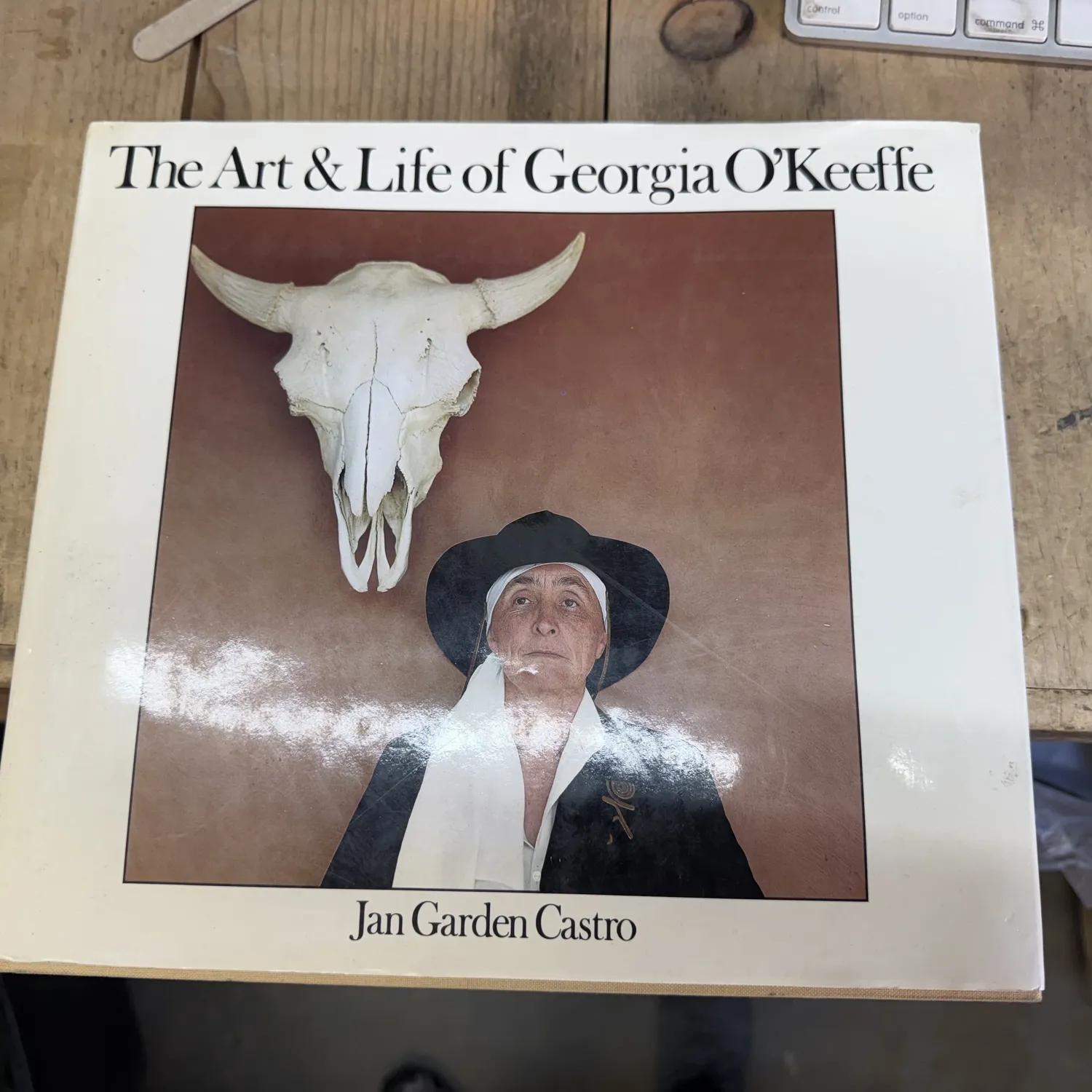
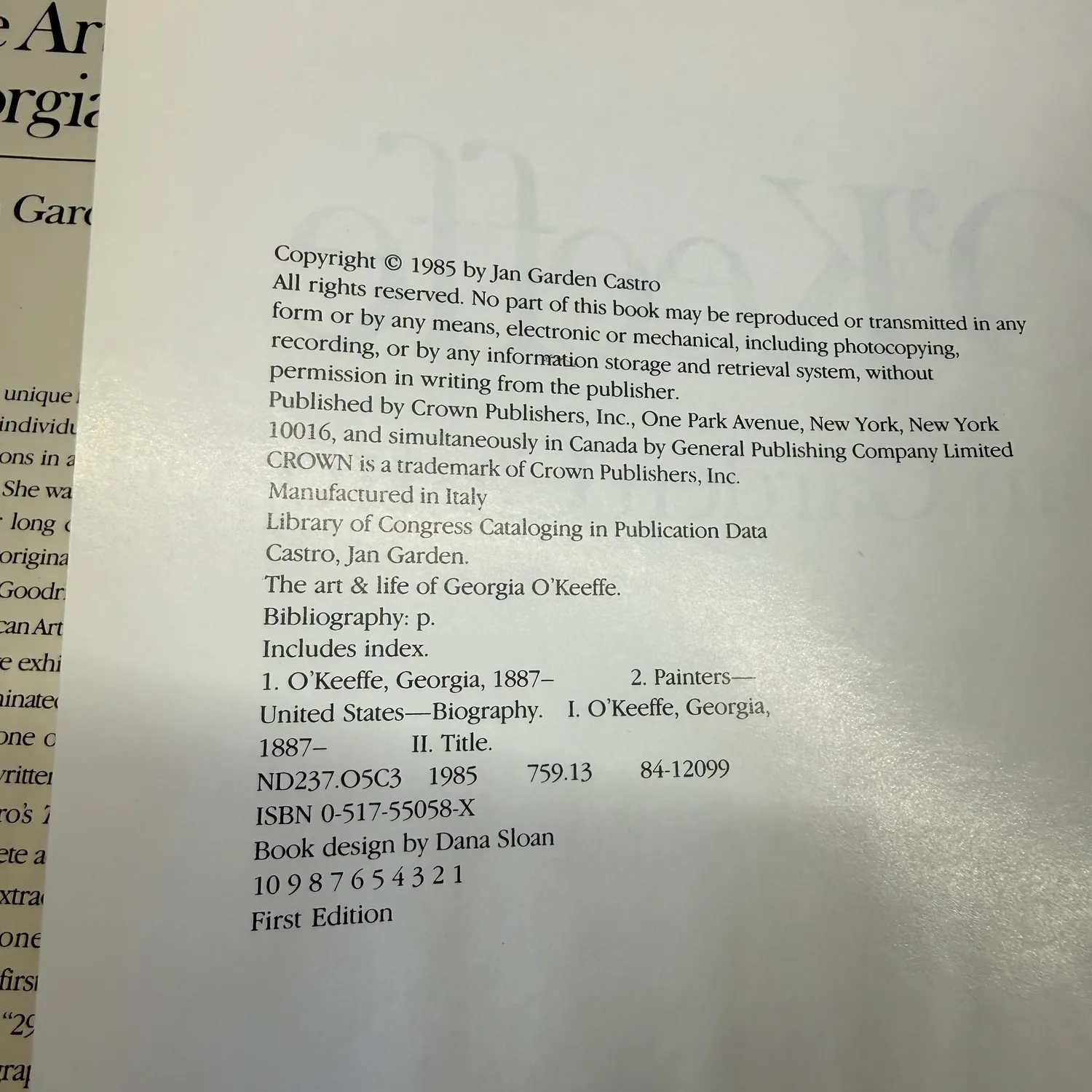
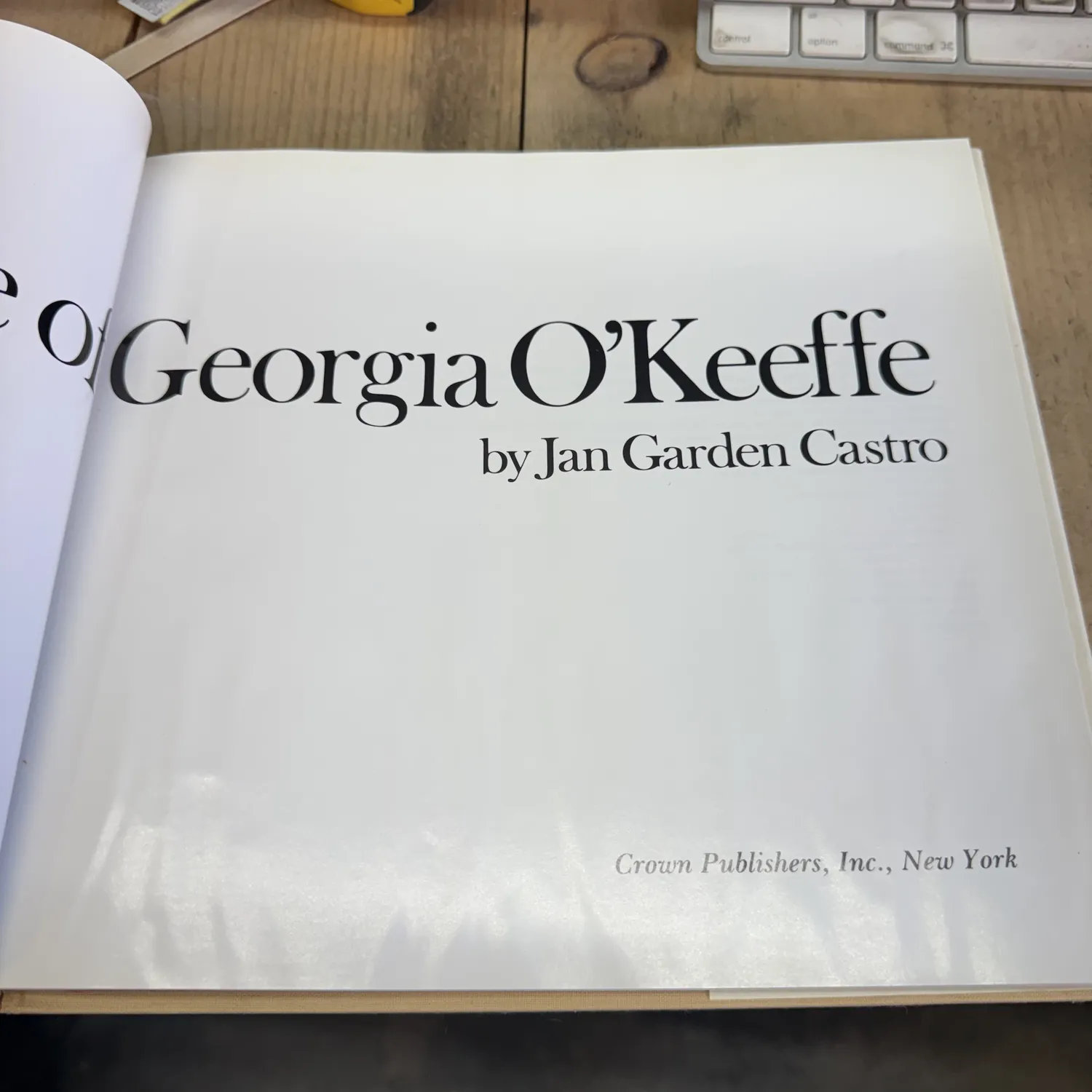
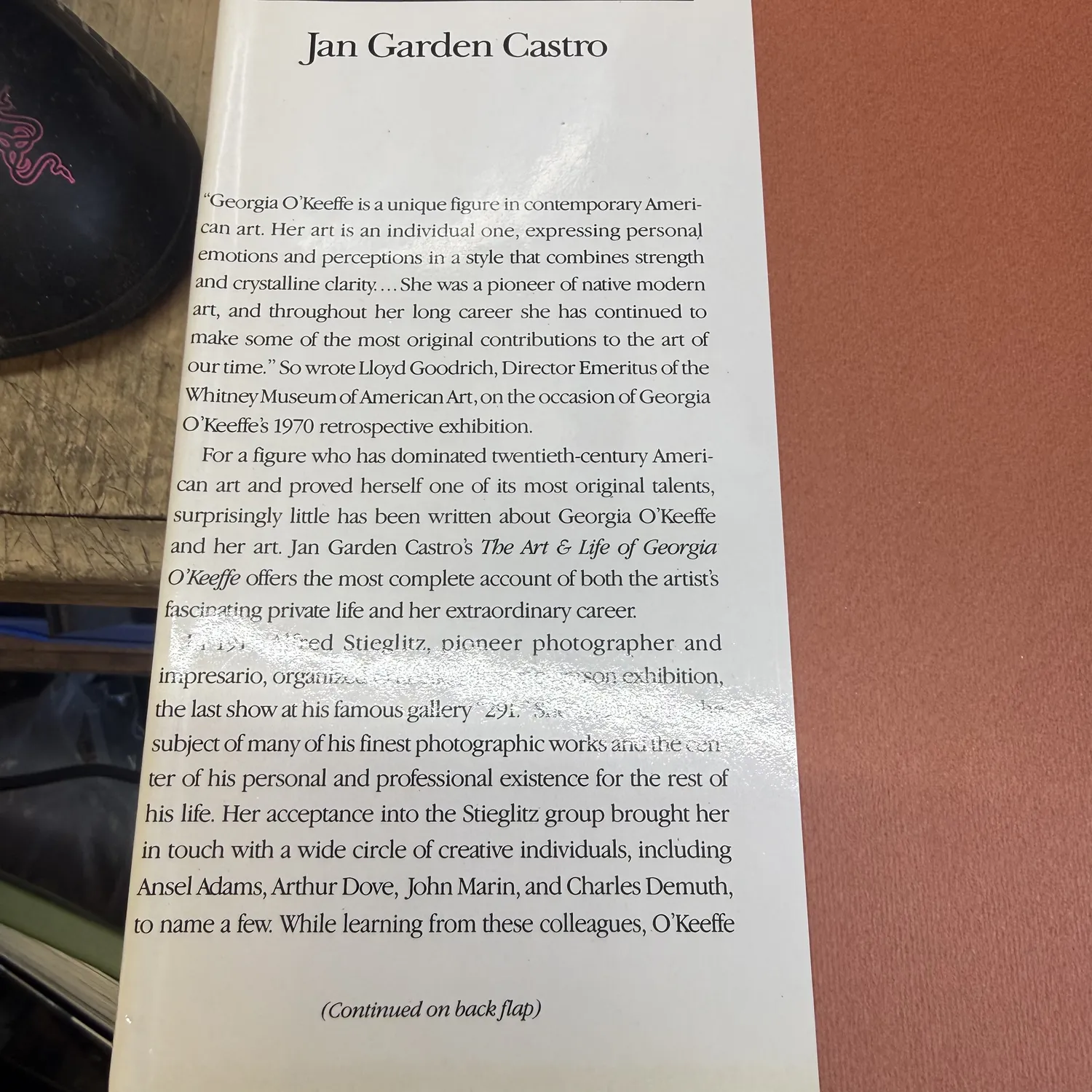
Photographs © 2026 Josh Eldred / New Mexico Literacy Project. Original photos taken at the NMLP workspace, Albuquerque NM.
Georgia O’Keeffe: Art and Letters (National Gallery of Art / Graphic Society, 1987)
ISBN 0-8212-1683-7 · Edited by Jack Cowart, Juan Hamilton, Sarah Greenough · 125 letters · 125 works
The 1987 NGA retrospective catalog, edited by Jack Cowart (NGA curator), Juan Hamilton (O’Keeffe’s assistant and estate executor), and Sarah Greenough (NGA photography curator). Reproduces 125 letters from the Yale Beinecke collection alongside 125 selected works in chronological sequence — the most extensive published primary-source letter selection prior to the 2011 Yale University Press edition of the full Stieglitz correspondence. The 1987 NGA first edition (green cloth boards, NGA colophon on copyright page) is the institutional collector target; the simultaneous Graphic Society / Little Brown trade edition (Boston, 1987, ISBN 0-8212-1683-7) is a slightly different binding configuration with the same content. Hamilton’s co-editorship here is the institutional validation of his archive stewardship role. O’Keeffe was still alive at the publication date (died March 6, 1986 — actually the book went to press after her death, it was published posthumously); the preface acknowledges the posthumous publication.
Georgia O’Keeffe: A Life (Harper and Row, 1989)
ISBN 0-06-015990-6 · Author: Roxana Robinson · 639 pages · Harper and Row, New York, 1989
The definitive O’Keeffe biography, 639 pages, by Roxana Robinson. The first biography written with access to O’Keeffe’s correspondence archive and the Georgia O’Keeffe Foundation records. Robinson interviewed dozens of O’Keeffe’s associates, former students, New Mexico neighbors, and family members; the bibliography and notes apparatus is the most comprehensive published. The 1989 Harper and Row first edition with dust jacket (gray background, O’Keeffe self-portrait on front) is the standard collector target. The dust jacket has a distinctive typographic design. No limitation; a trade first edition in fine condition with an unclipped dust jacket is the standard. A Harper and Row second printing (also 1989) exists; the copyright page first printing carries “FIRST EDITION” and a full printing number line “89 90 91 92 93 HC 10 9 8 7 6 5 4 3 2 1.” The “1” at the end of the line indicates the first printing; subsequent printings remove the lower numbers.
The Alfred Stieglitz circle — cross-collecting
Alfred Stieglitz (1864–1946) is inseparable from the O’Keeffe collecting canon. He gave O’Keeffe her first gallery exhibition at the 291 Gallery in April 1917 (she was not present; he mounted it from drawings she had mailed to a friend). They began corresponding in 1915, met in person 1917, and married in 1924. From 1917 through the late 1930s Stieglitz produced approximately 350 photographs of O’Keeffe — the most extensive photographic portrait sequence of a single subject in American art history — ranging from nudes and hands to the iconic face-and-sky portraits. The cross-collectibles:
Georgia O’Keeffe: A Portrait by Alfred Stieglitz (Metropolitan Museum of Art, 1978)
ISBN 0-87099-178-3 · Metropolitan Museum of Art, New York, 1978 · Introduction by Georgia O’Keeffe · 51 plates
The essential Stieglitz-O’Keeffe photographic book. 51 plates reproducing Stieglitz’s photographs of O’Keeffe from 1918 through 1937, selected by O’Keeffe herself, with an introduction written by O’Keeffe. O’Keeffe was 91 at the time of publication and the introduction is among her last substantial published prose writings before vision loss made writing impractical. Published by the Metropolitan Museum of Art in connection with the Stieglitz Archive exhibition; the Met holds the largest Stieglitz photographic archive. The 1978 Met first edition with dust jacket is the standard collector target. A Milkweed Editions reprint was published 1997; the 1978 Met edition is distinguishable by the Met colophon and the 1978 copyright date on the copyright page.
Camera Work: A Photographic Quarterly (Alfred Stieglitz, editor, 1903–1917)
50 issues · Facsimile reprint: Kraus Reprint, Millwood NY, 1978 · Complete sets extremely rare in original
Stieglitz’s foundational photography quarterly, 50 issues published between January 1903 and June 1917. The final double issue (Numbers 49/50, June 1917) featured O’Keeffe’s drawings alongside Paul Strand’s photographs — O’Keeffe’s first publication. Original complete sets of Camera Work are held primarily by institutional libraries; the Kraus Reprint facsimile edition (complete in one large-format volume or the 12-volume set, Kraus Reprint / Millwood NY, 1978) is the accessible collector version. The Kraus facsimile is the standard working reference; the original issues when they surface in estate contexts are major institutional or specialized-dealer items.
Alfred Stieglitz: Photographs and Writings (NGA / Bulfinch, 1983 first; revised 1999)
Edited by Sarah Greenough and Juan Hamilton · National Gallery of Art, Washington, 1983 first edition
The standard Stieglitz scholarly reference, edited by NGA photography curator Sarah Greenough and Juan Hamilton. The 1983 NGA first edition is the collector target; a revised and expanded edition was published 1999 (NGA / Bulfinch ISBN 0-8212-2606-7). The Hamilton co-editorship connects this directly to the O’Keeffe estate archive: Hamilton’s access to O’Keeffe’s correspondence with Stieglitz — then still in private hands before the Yale Beinecke acquisition — informed the documentary apparatus of this volume. The 1983 first and the 1999 revised edition are distinct collecting objects; the 1999 revision incorporates scholarship from the intervening sixteen years and is the more useful working reference, while the 1983 first is the more collectible object.
My Faraway One: Selected Letters of Georgia O’Keeffe and Alfred Stieglitz, Volume One 1915–1933 (Yale University Press, 2011)
ISBN 978-0-300-09411-2 · Edited by Sarah Greenough · Yale University Press, 2011
The first volume of the full scholarly edition of the O’Keeffe / Stieglitz correspondence, edited by Sarah Greenough from the Yale Beinecke Rare Book and Manuscript Library collection. Volume One covers 1915–1933 and draws on approximately 5,000 letters exchanged between O’Keeffe and Stieglitz. Volume Two covering 1933–1946 was published 2019 (ISBN 978-0-300-24397-3). The complete two-volume Yale correspondence edition is the primary-source anchor for all O’Keeffe scholarship; the Yale Beinecke archive is the largest single O’Keeffe/Stieglitz manuscript holding.
Alfred Stieglitz: An American Seer (Random House / Aperture, 1973)
ISBN 0-394-47580-2 · Author: Dorothy Norman · Random House, New York, 1973
The authorized Stieglitz biography by Dorothy Norman, a longtime Stieglitz associate and herself a significant figure in the Stieglitz circle. Contains extensive O’Keeffe-period documentation and the only sympathetic insider account of the 291 Gallery scene from someone who was present for the final decade. The 1973 Random House first edition with dust jacket is the standard collector target. Norman’s own relationship with Stieglitz was the subject of controversy and biography; her account of the O’Keeffe period is partial but contains primary material unavailable elsewhere.
The Georgia O’Keeffe Museum — Santa Fe 1997 publication program
The Georgia O’Keeffe Museum opened on July 17, 1997 at 217 Johnson Street, Santa Fe, NM 87501. It is the first and only museum in the United States dedicated to the work of a single female artist. The founding director was Robert Kret; the first chief curator was Barbara Buhler Lynes, who simultaneously completed the Catalog Raisonné (published 1999). The permanent collection at opening comprised approximately 400 works from the Georgia O’Keeffe Foundation; the collection has since grown to over 3,000 items including works, photographs, and archival materials.
The museum’s publication program since 1997 constitutes a distinct collecting category:
Georgia O’Keeffe and the Camera: The Art of Identity (Georgia O’Keeffe Museum, 2008)
Edited by Susan Danly · Yale University Press, 2008 · ISBN 978-0-300-12620-3
The museum’s foundational exploration of O’Keeffe’s relationship with photography, specifically Stieglitz’s portraits and the dozens of photographs O’Keeffe commissioned or permitted of herself throughout her life. Includes the Yousuf Karsh portraits, the Todd Webb New Mexico photographs, and the context for O’Keeffe’s careful management of her photographic image. The 2008 Yale University Press edition in association with the museum is the standard collector version.
O’Keeffe on Paper (Georgia O’Keeffe Museum / NGA, 2009)
Edited by Barbara Buhler Lynes and Ann Paden · National Gallery of Art, 2009
The definitive study of O’Keeffe’s works on paper — drawings, watercolors, pastels — from the 1915–1916 charcoal period through the late oil-and-watercolor New Mexico studies. Includes many works not in the primary Catalog Raisonné coverage. The joint NGA / O’Keeffe Museum publication is the standard reference for O’Keeffe’s non-oil-painting production.
Georgia O’Keeffe: Abstraction (Whitney Museum / Yale, 2009)
Edited by Barbara Haskell · Yale University Press, 2009 · ISBN 978-0-300-14745-1
The Whitney Museum retrospective catalog focused specifically on O’Keeffe’s abstract work. The most focused scholarly treatment of O’Keeffe’s relationship to American abstraction; establishes her as a foundational figure rather than a decorative outlier. The 2009 Yale / Whitney first edition is the current standard scholarly reference for the abstraction thesis, distinct from earlier biographical/survey approaches.
Not sure whether to sell, donate, or keep? Call or text me at 505-250-3804 — I'll walk you through it.
The Ansel Adams connection — Ghost Ranch cross-collectibles
Ansel Adams (1902–1984) is a significant cross-collectible with O’Keeffe. They were Ghost Ranch neighbors in the 1930s and 1940s; Adams photographed the Ghost Ranch landscape and O’Keeffe herself on multiple occasions. The specific collecting cross-overs:
Taos Pueblo (Grabhorn Press, San Francisco, 1930)
Photographs by Ansel Adams · Text by Mary Austin · Limitation: 108 copies · Grabhorn Press, 1930
The canonical Adams book and the first major published collaboration between Adams and any author. Published by the Grabhorn Press in San Francisco in a limitation of 108 copies; photographs by Adams, text by Mary Austin (one of the Mabel Dodge Luhan circle). The project grew from the Taos arts community that O’Keeffe also entered in 1929. The 108-copy limitation makes this one of the rarest photographic books in American art history; copies surface in the five-figure range at major auction houses. A facsimile reprint was published by New York Graphic Society (1977, ISBN 0-8212-0649-1) that is the accessible collector version. The connection to O’Keeffe’s New Mexico biography: both Adams and O’Keeffe were present at Ghost Ranch during the same periods in the 1930s and 1940s; Adams photographed her there.
Adams also photographed O’Keeffe directly. The most famous Adams portrait of O’Keeffe — the 1937 photograph at Ghost Ranch showing O’Keeffe in profile against the Piedra Lumbre cliffs — is reproduced in multiple Adams monographs and in the Georgia O’Keeffe Museum collection. Any Adams monograph from the large-format retrospective period (the Little Brown / New York Graphic Society productions of the 1970s–1980s) that includes the O’Keeffe portrait photograph commands a premium among NM estate buyers who collect both subjects simultaneously.
The Abrams monograph program — the coffee-table tier
Harry N. Abrams (New York) published several O’Keeffe monographs in the 1970s–1990s that constitute a middle-market collecting tier between the Viking 1976 trophy and the two-volume Catalog Raisonné. These are large-format, heavily illustrated books designed for a popular audience rather than the scholarly market.
Georgia O’Keeffe (Harry N. Abrams, 1977)
Text by Lloyd Goodrich and Doris Bry · ISBN 0-8109-0155-2 · Harry N. Abrams, New York, 1977
The first major Abrams O’Keeffe monograph, with text by Lloyd Goodrich and Doris Bry. This is not the same book as the 1976 Viking monograph, though confusion arises because both were published within a year. The Abrams 1977 is a conventional art-historical monograph with external-author critical text and a more extensive plate selection than the Viking book; the Viking 1976 is O’Keeffe’s own text. The Abrams 1977 edition is a Tier 2 collecting target — out of print, meaningful, but not the trophy item.
Georgia O’Keeffe: One Hundred Flowers (Alfred A. Knopf, 1987)
Introduction by Nicholas Callaway · ISBN 0-394-55806-2 · Alfred A. Knopf, New York, 1987
A focused monograph on O’Keeffe’s flower paintings specifically, with 100 plates. The Callaway edition is a high-production Knopf title; the introduction by Nicholas Callaway is the critical apparatus. Published the year after O’Keeffe’s death; the timing made it the first substantial posthumous publication. The 1987 Knopf first edition with dust jacket is the standard collector target for the flower-painting subset. A limited edition with a separate plate was also published.
Three-tier collector market analysis
Tier 1 — Trophy items. The 1976 Viking Georgia O’Keeffe in the limited signed edition (1,000 copies, signed and numbered, brown cloth, slipcase, signed limitation leaf) with full provenance documentation: this is the single most coveted O’Keeffe book and trades in the high three-figure to low four-figure range depending on condition and provenance, with authenticated examples from named NM collections commanding premiums. The 1974 Atlantis Editions Some Memories of Drawings in fine condition with original slipcase and signed colophon: trades in the mid to high three-figure range; the Albuquerque imprint and the 500-copy limitation keep this consistently at Tier 1. The 1976 Viking first-printing trade edition in fine condition with original unclipped dust jacket (original price intact on front flap): mid-to-high two-figure to low three-figure range; the first printing premium over subsequent printings is roughly 30–50%. The Catalog Raisonné two-volume NGA / Yale first printing (1999) in fine condition: high three-figure range when both volumes are fine.
Tier 2 — Collector targets. Roxana Robinson Georgia O’Keeffe: A Life (Harper and Row, 1989) first edition with unclipped dust jacket: mid two-figure to low three-figure range. Georgia O’Keeffe: Art and Letters (NGA, 1987) first edition with dust jacket: similar range. Georgia O’Keeffe: A Portrait by Alfred Stieglitz (Met, 1978) first edition: low to mid two-figure range. Whitney Museum 1970 retrospective catalog in fine condition: low to mid two-figure range. Amon Carter Museum 1968 catalog in fine condition: mid-two-figure range. Any O’Keeffe book with documented Ghost Ranch or Abiquiú provenance (bookplates, previous-owner inscriptions tied to named NM collections, Ghost Ranch acquisition stamps) commands a 50–100% premium over the base Tier 2 price at the same condition grade.
Tier 3 — Working library. Subsequent printings of the Viking 1976 (second through seventh printing) in good-to-fine condition: upper one-figure to low two-figure range. The Abrams 1977 monograph (Goodrich / Bry text), subsequent O’Keeffe Museum publications from the 2000s–2010s, the Knopf One Hundred Flowers (1987) in ordinary condition, and the various Whitney / NGA exhibition catalogs from the 1990s–2010s: upper one-figure range. These constitute the “working library” tier that serious collectors use for research while keeping the Tier 1 and Tier 2 items shelved as collectibles.
Ghost Ranch and Abiquiú provenance — what to look for
O’Keeffe books from NM estate libraries command premiums when the provenance is documentable. The specific indicators that are meaningful to the trade:
Ghost Ranch association. Arthur Pack, who sold O’Keeffe her Ghost Ranch house in 1940, assembled a substantial library at Ghost Ranch that was dispersed after the ranch transitioned to Presbyterian Church USA operation. Books with Ghost Ranch acquisition labels, Pack family bookplates, or provenance chains to the Pack collection are the most desirable Ghost Ranch–provenance items. O’Keeffe herself did not use conventional bookplates; a signed copy with a handwritten “Ghost Ranch” or “G.O’K. / Ghost Ranch” inscription in O’Keeffe’s hand would be extraordinary — no such inscriptions are known to the trade as of 2026.
Abiquiú compound. Books dispersed from the Abiquiú compound after O’Keeffe’s death went through the Georgia O’Keeffe Foundation before the museum opened; most significant items went directly to the museum’s Research Center archive. Books that reached the secondary market from this source are generally Tier 3 material (working reference books she used rather than collectibles) unless they carry O’Keeffe’s annotations, which would make them extraordinary primary-source objects.
Georgia O’Keeffe Museum Research Center. The Research Center at 217 Johnson Street, Santa Fe, holds the primary archive and is the institutional authentication resource for O’Keeffe signatures and manuscripts. Any signed copy of a major O’Keeffe book — particularly the 1974 Atlantis Editions (500 copies) and the 1976 Viking limited (1,000 copies) — should ideally carry a Research Center provenance notation, a dealer attribution to a specialist in O’Keeffe material (Hindman, Heritage, Christie’s American Art), or at minimum a clear chain of prior ownership.
Stieglitz circle provenance. Books from the libraries of named Stieglitz circle figures — Paul Strand, Edward Weston, Doris Bry, Dorothy Norman, Herbert Seligmann — carry cross-collecting premiums in both the O’Keeffe and the broader American modernism contexts. The Stieglitz circle is well documented bibliographically; a bookplate from a named circle figure can add 50–200% to baseline market value.
Have books you're ready to part with? I offer free pickup across Albuquerque — call 505-250-3804.
The closed signing pool — 40 years in 2026
O’Keeffe died March 6, 1986. As of 2026, her signing pool has been closed for exactly forty years. This is a material fact for collectors of signed copies because it means:
First, all supply of authentic signed copies is permanently fixed. No new supply can enter the market. The 1,000-copy limited Viking signed edition and the 500-copy signed Atlantis Editions are the two most important signed books, and both are closed. The only way to acquire a signed O’Keeffe book now is to find one that has already circulated through the market or that surfaces from an estate.
Second, the forgery problem is real. O’Keeffe’s signature is a simple, legible ballpoint-pen style (consistent with the limited edition signing, which she did in blue ballpoint) that has been forged. Any signed O’Keeffe item without a clear provenance chain should be treated with appropriate caution — the signed books authentication guide covers ink aging tests, pen pressure patterns, and exemplar comparison. The Georgia O’Keeffe Museum Research Center is the primary institutional authentication resource; dealers specializing in American art (particularly those who have handled authenticated examples) are secondary resources.
Third, the forty-year mark in 2026 is a collecting-awareness inflection point. As with all major American artist signing pools, the round-number anniversary of the closed pool typically generates renewed auction-house and dealer attention. This means both that more signed material may surface in 2026–2027 as estates are settled and that forgery pressure may increase. The NM estate market is particularly relevant because O’Keeffe’s 37 years of New Mexico residency means that signed items circulated in NM estate libraries are statistically more likely to be authentic than signed items appearing in the broader national market without NM provenance context.
The NMLP intake position
O’Keeffe books surface through NMLP intake regularly from three principal donor demographics. Santa Fe arts-community estates are the deepest concentration, often producing the Viking 1976 (almost always a later printing rather than a first), the Roxana Robinson biography, the Art and Letters NGA catalog, and sometimes the Catalog Raisonné. Abiquiú and Rió Arriba County estates occasionally produce material with direct Ghost Ranch or Abiquiú community context. Albuquerque UNM art-history-faculty estates produce the full scholarly range including institutional catalogs, the Stieglitz cross-collectibles, and sometimes the Atlantis Editions Some Memories of Drawings given its Albuquerque publishing origin.
Standard NMLP intake terms apply: any condition, any quantity, free Albuquerque-metro pickup, no minimum. If you hold significant O’Keeffe books as part of a collection, the book collection insurance guide explains how to document and insure high-value items properly. Tier 1 trophy material — particularly the limited signed Viking edition or the Atlantis Editions signed limited — is identified, documented, and researched before it's listed — NMLP never buys books. The same goes for the Catalog Raisonné two-volume set in fine condition. Tier 2 and Tier 3 material flows through the standard NMLP hand-sort and routing to the secondary book market. Material with documented O’Keeffe-related NM provenance is archived through the open NMLP Donation Archive when regionally significant.
Cite This Guide
Eldred, J. (May 2026). Georgia O'Keeffe Art Books — The Collector's Authority Guide. New Mexico Literacy Project.
https://newmexicoliteracyproject.org/georgia-okeeffe-art-books-collecting
Content is original research by Josh Eldred. Licensed under CC BY 4.0. Cite with attribution.