Curiosity entry · Foundational 1980s "visionary autobiography" · Out of NM scope, contested reception
Medicine Woman — Lynn V. Andrews, Harper & Row, 1981 first / 1983 first paperback; sixth printing
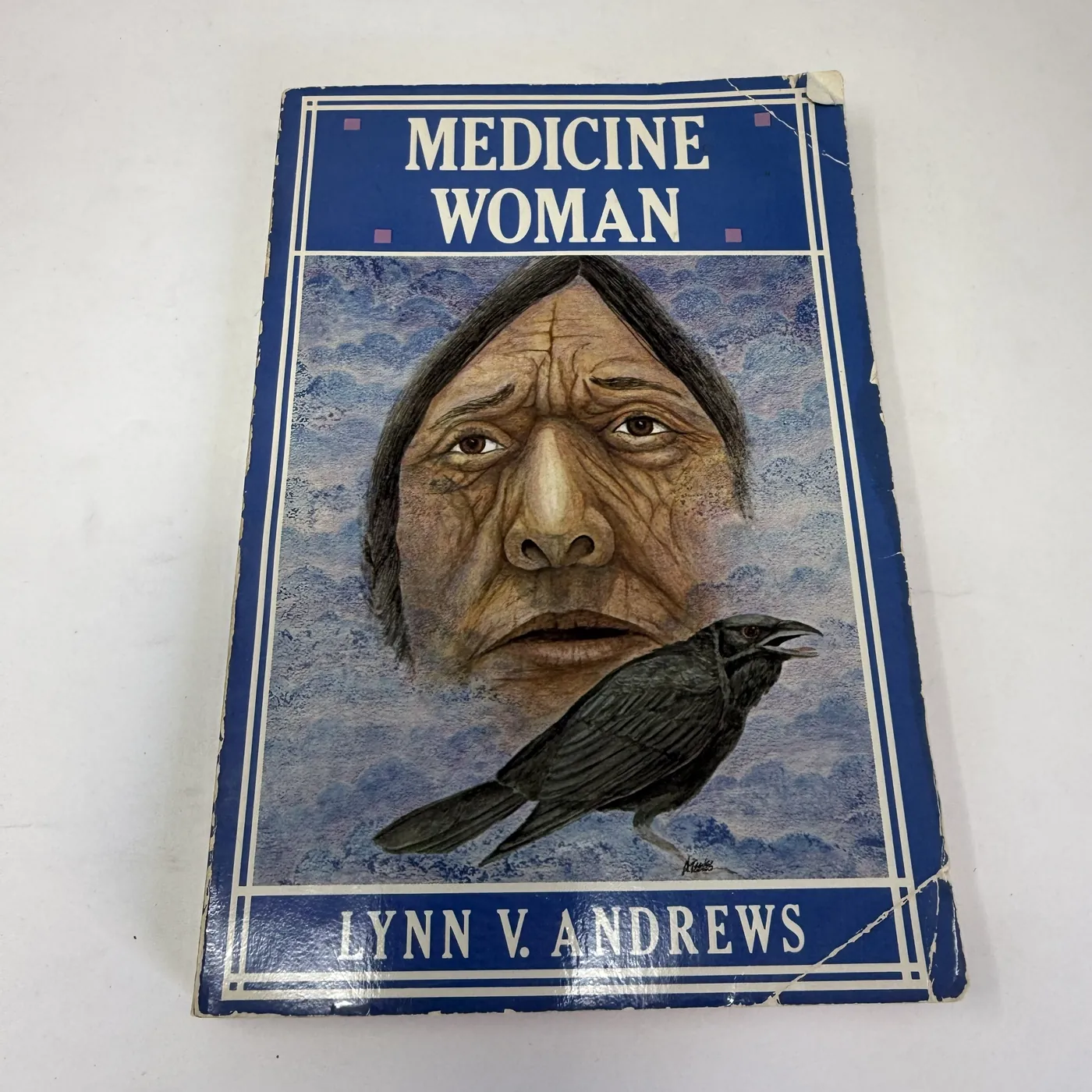
A sixth-printing copy of the Harper & Row paperback first edition of Lynn V. Andrews' Medicine Woman — the 1981 hardcover that, alongside Carlos Castaneda's earlier Don Juan books, defined the 1980s mass-market "visionary autobiography" genre and became the foundational text in what subsequent academic literature, beginning with Lisa Aldred's "Plastic Shamans and Astroturf Sun Dances" in the American Indian Quarterly (2000), would identify as commercial plastic-shamanism. The book sold over a million copies, anchored a multi-volume series and a retreat business, and was met with sustained protest by Indigenous communities in New York, Minneapolis, San Francisco, and Seattle. Filed in Curiosities because the book is out of NMLP's New Mexico regional scope; included because the reception record around it is significant documentary material.
Catalog
What this book is
Medicine Woman is the first-published volume in what would become a multi-decade Lynn V. Andrews authorial output: a first-person narrative in which a southern-California art collector and filmmaker named Lynn travels to northern Manitoba, meets an elderly Cree woman named Agnes Whistling Elk, and is gradually initiated into what the book presents as a women's tradition of Cree shamanic knowledge. The book opens with Andrews's pursuit of "a sacred Native American marriage basket," widens into a series of encounters with hostile and benevolent spirits, and culminates in a near-fatal confrontation with a male sorcerer named Red Dog. The back-cover copy frames the trajectory as "an autobiographical account of a woman's search for identity in a Native American culture."
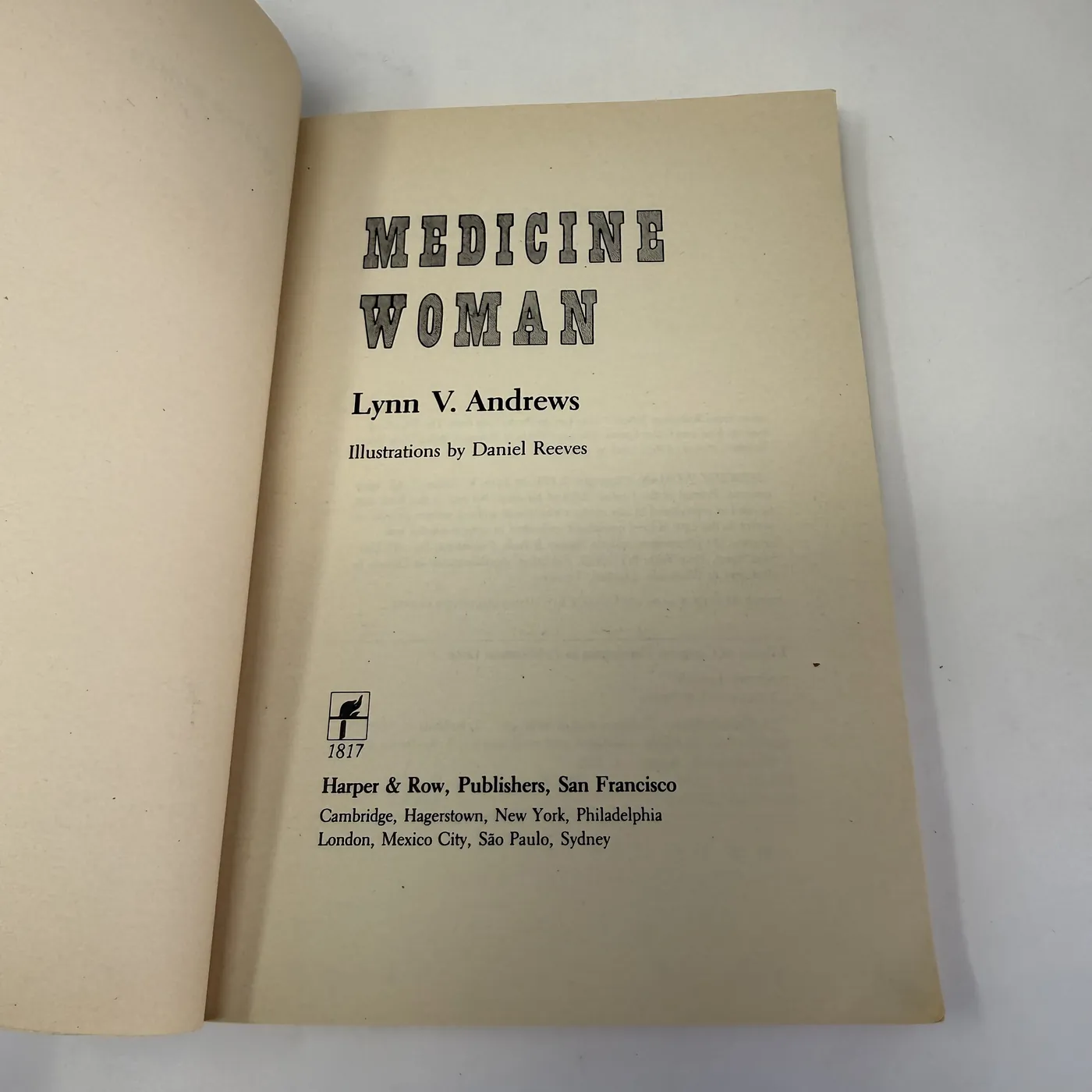
Andrews was, at time of writing, a southern California resident with a background she described on the back cover as "involved in film-making, art collecting, and women's activities." The book opens her career as a full-time author and lecturer; by the time of this sixth printing (c. 1987) she was already publishing a second volume in the series and running the women's-spirituality workshop business that would expand through the 1990s and 2000s into the Lynn Andrews Center for Sacred Arts and Training.
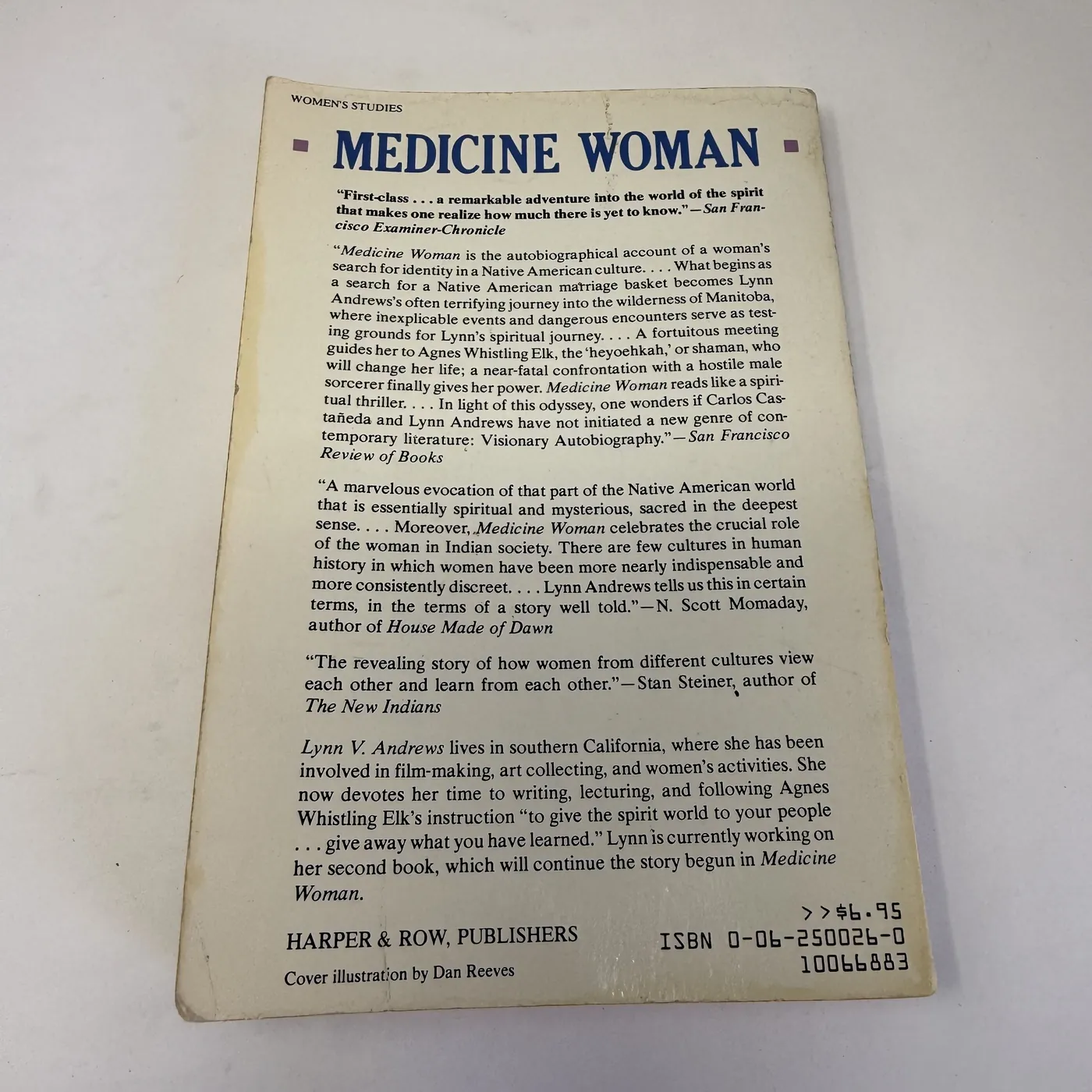
Two contemporaneous reception details place the book in its 1980s publishing context. First: Harper & Row marketed the book aggressively. The back cover stacks blurbs from San Francisco Examiner-Chronicle ("first-class… a remarkable adventure into the world of the spirit"), the San Francisco Review of Books ("one wonders if Carlos Castañeda and Lynn Andrews have not initiated a new genre of contemporary literature: Visionary Autobiography"), and the Native American novelist N. Scott Momaday, who at the time of the 1981 release was the most prominent Indigenous voice in American letters — he had won the 1969 Pulitzer Prize for Fiction for House Made of Dawn, the first Indigenous author to do so. Second: the publisher's positioning leaned hard on the Carlos Castaneda comparison. Castaneda's The Teachings of Don Juan (1968), A Separate Reality (1971), and subsequent books had created a market for first-person "spiritual apprenticeship to an Indigenous teacher" narratives; by 1981 Castaneda's anthropological credibility had been seriously challenged (Richard de Mille's Castaneda's Journey and The Don Juan Papers appeared in 1976 and 1980 respectively), but the genre market he opened was robust. Andrews entered exactly that market positioning.
The Momaday and Steiner blurbs — a 1981 reception puzzle
The two named-author blurbs on the back cover deserve direct attention because they are part of the documentary record of how the book was received in 1981 by serious Indigenous-literature voices. N. Scott Momaday — Kiowa, Pulitzer winner, author of House Made of Dawn — provided a substantial blurb describing the book as "a marvelous evocation of that part of the Native American world that is essentially spiritual and mysterious, sacred in the deepest sense" and explicitly endorsing Andrews's treatment of women in Indigenous societies. Stan Steiner — the Albuquerque-based journalist and historian whose The New Indians (1968) is one of the foundational serious nonfiction works on the Red Power movement of the 1960s, and who later worked extensively on Pueblo and Hispanic-NM cultural history — called the book "the revealing story of how women from different cultures view each other and learn from each other." Steiner's NM connection is notable: he lived in Santa Fe for much of his career and his work on Indigenous and Hispanic Southwest topics is widely respected.
The interpretive question, which the documentary record around Andrews has not fully answered, is what 1981-period readers and Indigenous critics took from this combination of endorsements. Some read the blurbs as confirmation of the book's seriousness. Some read them as the kind of pre-publication courtesy blurb that operates inside publishing networks regardless of the strength of the underlying work. Some, in the years that followed, would point to the Momaday and Steiner blurbs as part of how the book gained the mainstream credibility that would later be retrospectively contested. The blurbs themselves are reproduced verbatim on the back cover of every printing of the paperback and are not editable history. They are part of the artifact.
The Library of Congress cataloging decision
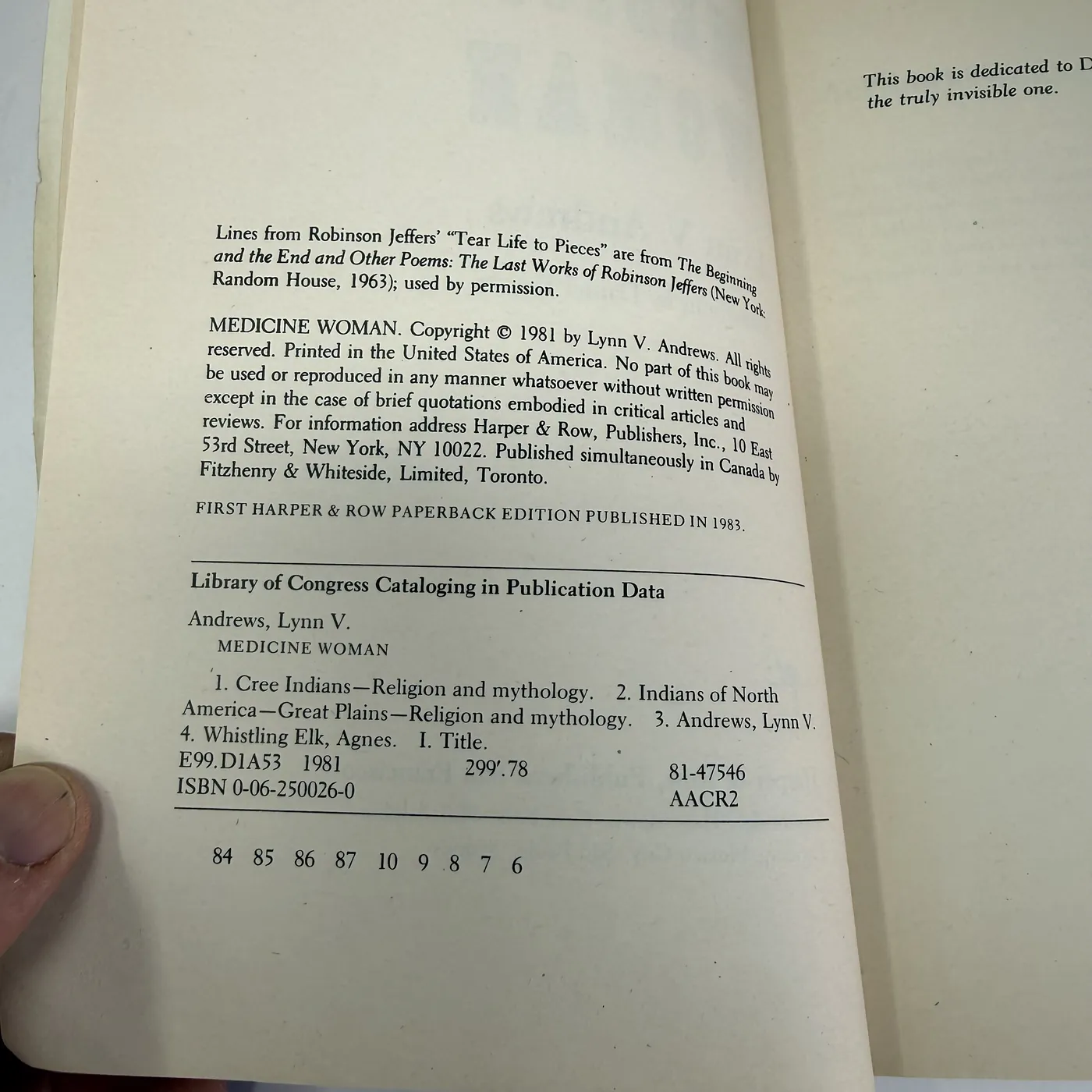
The 1981 Library of Congress cataloging decision is one of the more discussed artifacts around this book. The LC catalogers classified Medicine Woman under E99.D1A53 — the E99 class is "Indian tribes and cultures," D1 is the alphabetic-by-tribe extension for the Cree, A53 is the Cutter for Andrews. The subject headings on the cataloging block list "Cree Indians—Religion and mythology" and "Indians of North America—Great Plains—Religion and mythology" as the first two subject access points, and "Andrews, Lynn V." and "Whistling Elk, Agnes" as supplementary author/subject entries. The Dewey class 299.78 places the work in the New Religious Movements / non-Christian religions section.
The cataloging decision matters because library cataloging is an authoritative classification system. By placing the book in E99.D1 — Cree religion — as opposed to (for example) the BL classes for popular religion / mysticism or the BJ classes for ethics-derived self-help, the Library of Congress placed Andrews's text into the same shelving and discovery context as serious ethnographic studies of Cree religion. Working anthropologists, ethnographers, and library scholars critiquing the book in subsequent decades frequently cited the E99.D1A53 classification as itself an institutional decision that helped legitimize the book as religious-ethnographic source rather than as commercial spiritual autobiography. The LC has not, to the best of my reading of the published record, revised the cataloging.
The academic critique — Aldred 2000 and after
The standard academic citation for the critique of Medicine Woman and the broader New Age commercial-shamanism genre is Lisa Aldred, "Plastic Shamans and Astroturf Sun Dances: New Age Commercialization of Native American Spirituality," American Indian Quarterly 24, no. 3 (Summer 2000), pp. 329–352. Aldred's article surveys the commercial shamanism market that grew up around Castaneda and Andrews in the 1970s and 1980s, identifies Andrews as one of the central commercial figures (alongside Castaneda and Jamake Highwater / Jay Marks), documents the rise of paid retreats and workshop businesses positioned as instruction in Indigenous spirituality, and provides what has become the standard analytical frame for the critique:
Aldred's argument, in summary: the commercial shamanism market commodifies Indigenous spiritual practice for non-Indigenous consumption, undermines the actual transmission of those traditions within Indigenous communities, generates income for non-Indigenous authors and workshop leaders rather than for the communities whose practices are being claimed, and (in Aldred's words) functions as an "imperialistically nostalgic fetishization of Native American spirituality" that "hinders any recognition of [non-Indigenous practitioners'] own historical and social complicity in the oppression of Indigenous peoples."
In the specific case of Andrews, Aldred and subsequent critics have emphasized: (a) no independent ethnographic verification of an "Agnes Whistling Elk" as a documented Cree elder has emerged in the four decades since publication; (b) Andrews's narrative does not align with Cree religious practice as documented in the academic ethnographic literature on Cree religion; (c) the commercial scale of Andrews's subsequent retreat and workshop business operates outside any Cree community sanction; and (d) the book's marketing as "autobiographical" rather than "fiction" or "novel" implies factual ethnographic content that has not been substantiated.
The academic and Indigenous community critique was not confined to journals. Aldred documents that Lynn Andrews has been picketed by Native communities and Indigenous-rights organizations in New York, Minneapolis, San Francisco, Seattle, and other cities in the decades since Medicine Woman's publication. Andrews acquired the popular epithet "the Beverly Hills Shaman" in this period. The earlier 1993 Cultural Survival Quarterly article "Spiritual Hucksterism: The Rise of the Plastic Medicine Men" (by Andy Smith) is another widely cited treatment of the same critique and predates Aldred's more academic framing. The wider critical literature now includes substantial work by Indigenous scholars including Vine Deloria Jr., Beverly Hungry Wolf, and Wendy Rose (Hopi/Miwok), each of whom has addressed the New Age commercial-shamanism phenomenon directly.
The author Lynn V. Andrews is living, has continued to publish, and has not, to the best of the public record, formally responded to the substantive aspects of the Aldred critique in print. Her published position has been that her work is experiential rather than ethnographic in claim. The reader of this archive entry is encouraged to engage with both the primary text and the academic critique and to form an independent view; this entry's purpose is to document the bibliographic and reception record, not to issue a verdict.
Ready to clear the shelves? Call or text me at 505-250-3804 — free pickup across the Albuquerque metro, scheduled by route, or use the 24/7 drop box.
Why this is filed in Curiosities, not the main archive
The NMLP archive's main shelf is reserved for NM-regional, NM-published, or NM-provenance books. Medicine Woman meets none of those criteria. The author lives in southern California; the setting is northern Manitoba; the publisher is San Francisco / New York; there is no documented NM-provenance chain on this specific copy. The book belongs in Curiosities, the section reserved for objects that are operationally significant to NMLP's daily work but that fall outside the New Mexico regional thesis.
Several Curiosities entries already in the archive operate by the same principle. The Marguerite Kirmse signed Dogs in the Field is out of scope geographically but worth recording for the closed-pool signature; the ENIT 1930s Italian state-tourism golf brochure is out of scope thematically but worth recording for the pre-WWII Art Deco design; the Tarantino Pulp Fiction UTA Agency screenplay is the strongest precedent for documenting a culturally significant object whose value sits in its reception record. Medicine Woman sits in that company as a documentary artifact of 1980s New Age commercial publishing and the academic critique that followed.
How this copy came in
Donor scenario anonymized per archive policy. Documented as part of the May 2026 NMLP intake. Condition: a sixth-printing mass-market paperback, dimensions roughly 5.25 by 8 inches, with the typical light edgewear of a frequently-read 1980s paperback — small creases at the spine head, light yellowing of the textblock edges, no underlining or marginalia inside, the cover illustration crisp, the price clip absent. A serviceable reading copy of the printing that placed Medicine Woman in millions of mid-1980s American households.
Where this copy is going
Two plausible routes. First: standard secondhand-paperback resale. Sixth-printing mass-market copies of Medicine Woman are common; the book is in steady demand from readers entering the Andrews series, from used-bookstore browse stock, and from women's-spirituality and New Age retail. Second: donation to an academic library or Indigenous-studies program that maintains a working primary-source collection for teaching the Aldred-tradition critique. The book is regularly assigned alongside Aldred's article and the Smith "Spiritual Hucksterism" piece in undergraduate Indigenous studies courses; teaching copies of the actual paperback (as opposed to library hardcover or e-text) are frequently sought for that purpose. The archive entry will remain regardless of which route the physical book takes.
External references & authoritative sources
- Lisa Aldred, "Plastic Shamans and Astroturf Sun Dances: New Age Commercialization of Native American Spirituality" — American Indian Quarterly 24, no. 3 (Summer 2000), pp. 329–352: semanticscholar.org — Aldred 2000 — the standard academic citation for the critique of Andrews and the broader commercial-shamanism genre.
- "Plastic shaman" — Wikipedia: en.wikipedia.org/wiki/Plastic_shaman — encyclopedia entry that situates Andrews and Castaneda inside the wider analytic frame.
- Andy Smith, "Spiritual Hucksterism: The Rise of the Plastic Medicine Men" — Cultural Survival Quarterly, 1993: culturalsurvival.org — the earlier Indigenous-organization treatment of the same critique, predating Aldred's academic version.
- N. Scott Momaday — Wikipedia: en.wikipedia.org/wiki/N._Scott_Momaday — the Kiowa novelist and Pulitzer winner whose back-cover blurb is part of the book's reception record.
- Stan Steiner — Santa Fe journalist and historian: en.wikipedia.org/wiki/Stan_Steiner — the Albuquerque-based author of The New Indians (1968) whose blurb also appears on the back cover.
- WorldCat / OCLC institutional holdings: search.worldcat.org — Medicine Woman, Lynn V. Andrews, Harper & Row — library holdings worldwide for the 1981 hardcover and 1983 paperback editions.
- Lynn V. Andrews's own author site: lynnandrews.com — the author's own institutional presentation of her work, the multi-volume series, and the workshop business. Linked for documentary completeness; the archive does not endorse the underlying content.
- Cultural Survival, Inc.: culturalsurvival.org — the Cambridge MA Indigenous-rights organization whose publications carry the standing critical analysis of the commercial-shamanism field.
How to cite this archive entry
Eldred, Josh. "Medicine Woman — Lynn V. Andrews, Harper & Row 1981 / 1983 Paperback Sixth Printing; A Contested 1980s Bestseller." NMLP Donation Archive — Curiosities, May 10, 2026. https://newmexicoliteracyproject.org/archive/curiosities/medicine-woman-andrews-1981
Related on this site
- Back to the Curiosities index
- Main archive index
- Pulp Fiction Tarantino UTA 1993 screenplay — the structural precedent for documenting a culturally significant object whose value is in its reception record rather than in NM-regional provenance.
- Holy Island (Yeshe Losal, Kagyu Samye Ling, 2007) — a sincere-tradition Buddhist sanctuary booklet, useful contrast to the commercial-spirituality genre Andrews helped establish.
- Fetishes & Carvings of the Southwest (Branson, 1976, signed) — a regional Indigenous-material-culture documentary record produced by an Anglo author working with Pueblo, Zuni, and Navajo informants on a tradition-respecting frame; the productive alternative to the commercial-shamanism model.