Curiosity entry · Documented chain-of-custody · May 2026
Pulp Fiction — Quentin Tarantino, May 1993 last draft, UTA Agency copy
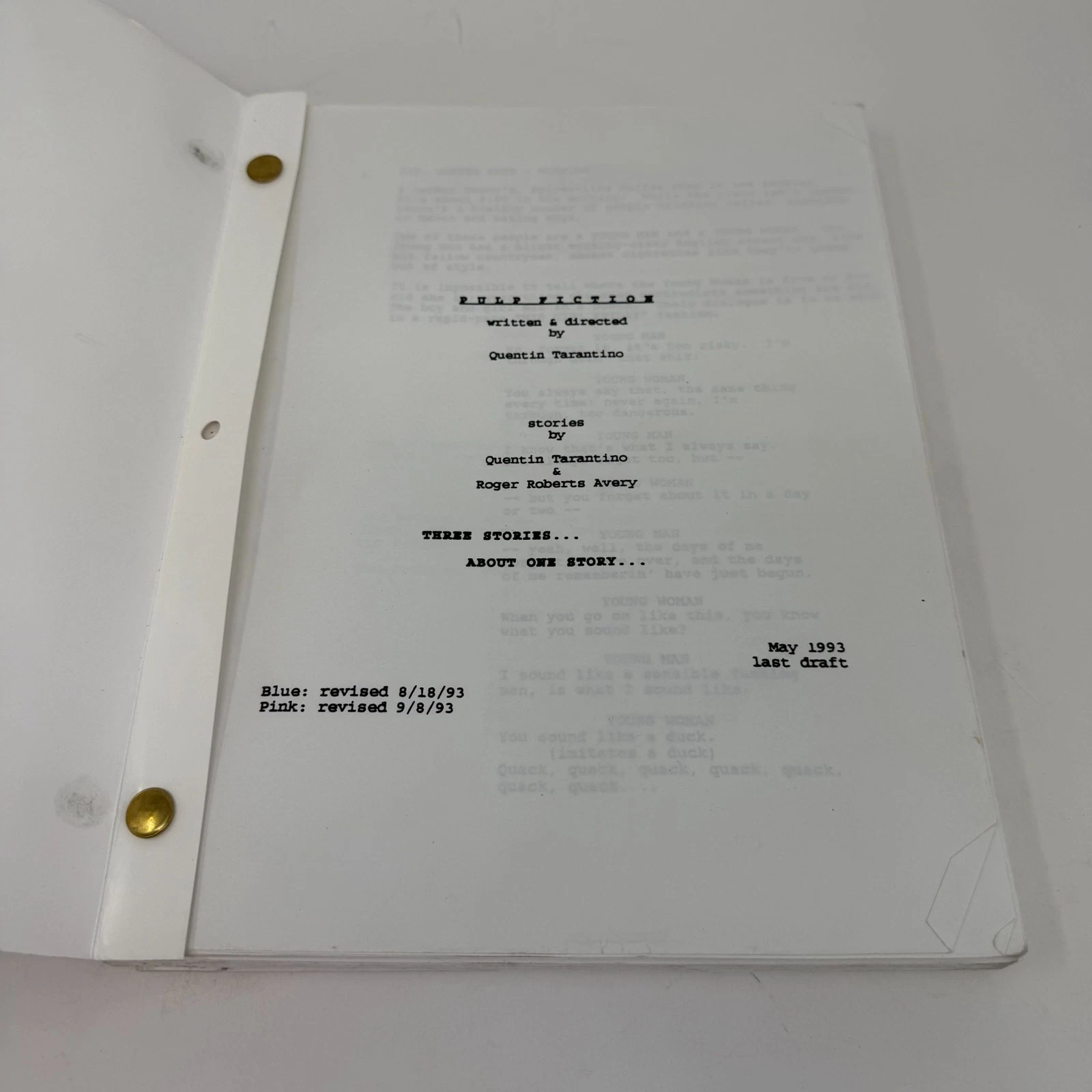
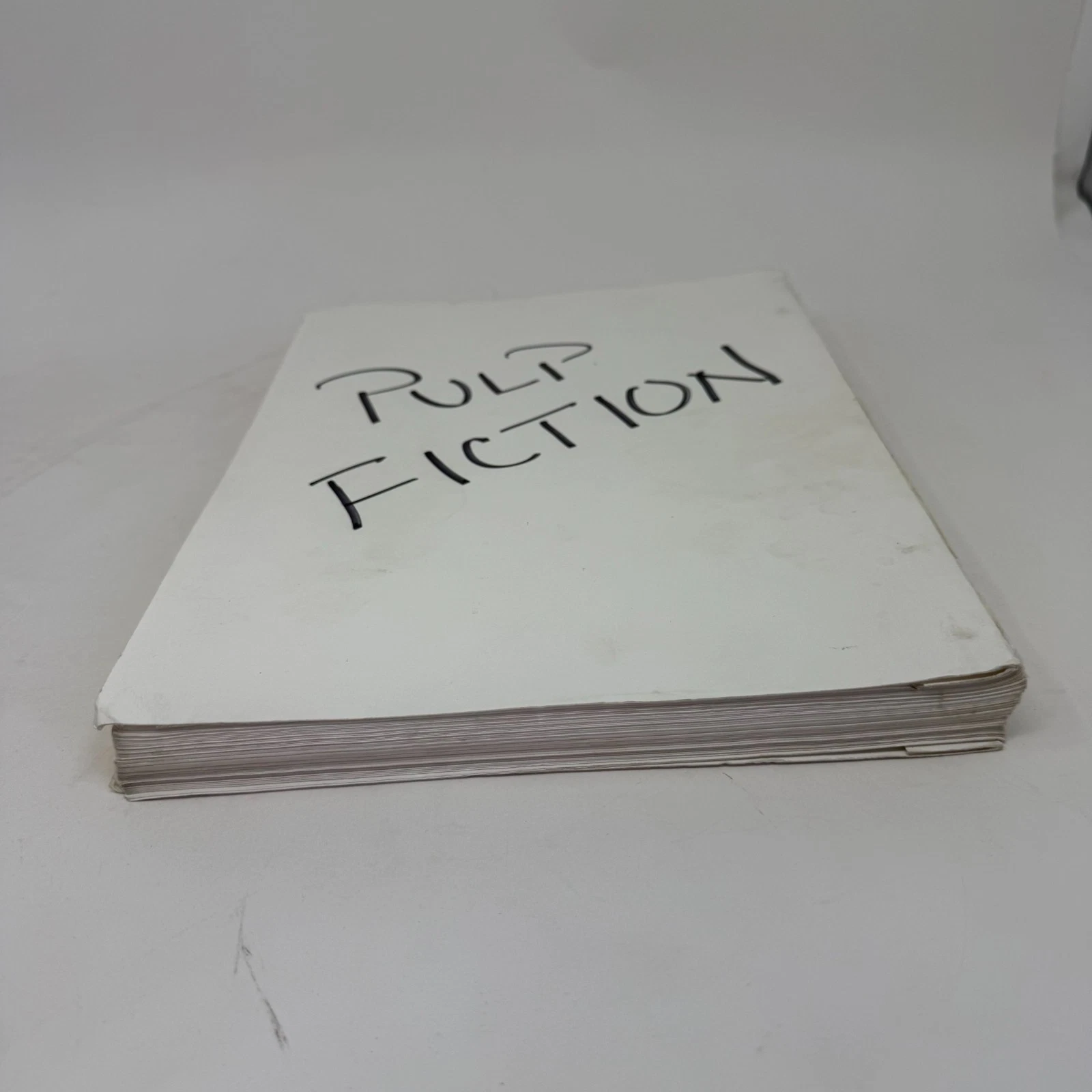
The brass-fastener-bound production screenplay for the 1994 film Pulp Fiction. May 1993 last draft, with revision-page color codes for August and September 1993 production rewrites. Came through donation in Albuquerque; routed through NMLP to a longtime Miramax executive who was at the company during the film’s production.
Catalog
What this object is
This is the actual production-period brass-fastener-bound screenplay for Pulp Fiction, dated May 1993, as distributed by United Talent Agency (UTA) — Tarantino’s agency at the time — to the production team and creative staff who would shoot the film over the following year. Pulp Fiction was filmed September through November 1993, premiered at Cannes in May 1994, and won the Palme d’Or that month. It went on to win the Academy Award for Best Original Screenplay (1995), grossed over $200 million worldwide on a roughly $8 million budget, and became one of the defining American films of the 1990s.
The two production-revision dates noted in the lower margin — Blue: revised 8/18/93, Pink: revised 9/8/93 — are the standard Hollywood production-script color codes. As a script enters production it accumulates revision pages in different colors so the production team can identify which version of a scene is current. Blue is the first revision, then Pink is the second; subsequent revisions go through Yellow, Green, Goldenrod, Buff, Salmon, Cherry, etc. This copy carrying both Blue and Pink notations means it was a working production-revision script as of early September 1993 — about a week before Pulp Fiction began principal photography in Los Angeles on September 20, 1993.
Why this object matters
Production-period Tarantino screenplays are documented major Hollywood-collector items. A Pulp Fiction last-draft UTA Agency copy with original brass binding and intact revision-page color codes is a specific category of object that doesn’t turn up often. Most production scripts were either retained by the production team, ended up in the personal archives of cast and crew, or were destroyed when the production wrapped. Surviving copies in this format trace through a small number of well-documented private collections and occasional auction-house consignments.
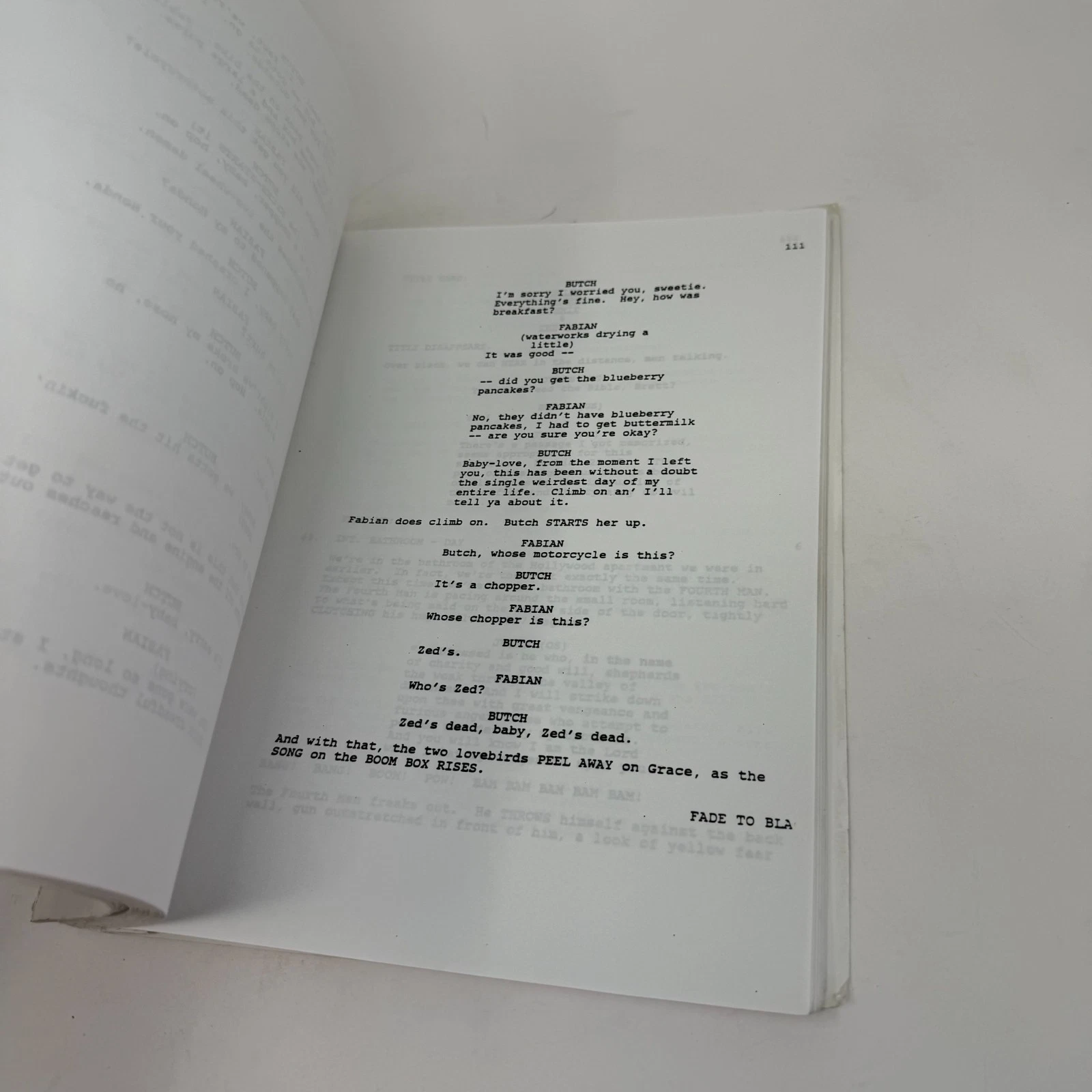
For Hollywood-archive scholars, screenplay collectors, and Tarantino specialists, the document is also a primary source: the Blue and Pink revision pages held within (not photographed here for proprietary reasons) record the specific changes made between the May 1993 last draft and what was eventually shot in September. That delta is itself the kind of thing film-history scholars cite.
Multi-part bibliographic record
How it came in
The screenplay arrived through a routine NMLP donation in May 2026, in an Albuquerque-area pile of mixed books and media. The donor was unaware of its specific significance — it was bound in brass fasteners and looked like a stack of typewritten pages. Donor scenario anonymized per archive policy.
Where it ended up
A thirty-three-year arc
September 1993: A brass-fastener package leaves a UTA agency office in Los Angeles, headed for a production team about to start shooting a small Miramax film called Pulp Fiction.
1993–2026: The script disappears into private hands. No public record. The film, meanwhile, wins the Palme d’Or at Cannes, takes the Best Original Screenplay Oscar, makes more than two hundred million on a modest budget, and becomes one of the defining American films of the decade.
May 2026: The brass-fastener package surfaces in an Albuquerque donation pile, in a stack of unrelated books, sitting next to titles that have nothing to do with each other. The donor doesn’t recognize what it is. The donor only knows they don’t want to keep it.
A few weeks later: The script is purchased through NMLP’s ordinary sales channel by a person who, in 1993, was running the operation that produced the film. Not Tarantino, not Avery, not the actors — the executive side of the production. The person whose desk those Blue and Pink revision pages would have crossed in real time, before they were marginal corrections in a script and were instead Monday-morning decisions about what to actually shoot.
That is the archive’s thesis-payoff in one document. After thirty-three years in private hands, after the film became a cultural artifact taught in film schools on five continents, after the agency that distributed it has changed identities twice and the studio that produced it has changed identities three times — the script returns to the desk of someone who was in the room when these specific revision pages were typed.
NMLP doesn’t arrange endings like this. The operation moves books to whichever buyer bids the asking price; it doesn’t curate destinations. But every so often a document finds the one person on earth for whom its arrival is more than a transaction. That happened here.
Per archive policy, the buyer is identified only by professional role — the role itself being public industry record. NMLP does not publish names, home addresses, or any personal contact information from sales records. If the buyer wishes to speak publicly about the acquisition, this entry will be updated with their permission.
External references & authoritative sources
- Pulp Fiction (film): Wikipedia: Pulp Fiction; IMDb: Pulp Fiction (1994).
- Quentin Tarantino: Wikipedia: Quentin Tarantino.
- Roger Avary: Wikipedia: Roger Avary (co-credited story).
- United Talent Agency (UTA): Wikipedia: United Talent Agency — the agency that represented Tarantino during Pulp Fiction’s development.
- Miramax (production company history): Wikipedia: Miramax.
- Hollywood production-revision color-code conventions: The standard Production Color Code Sequence (white, blue, pink, yellow, green, goldenrod, buff, salmon, cherry, tan, gray, ivory) is documented in WGA and DGA production handbooks and in standard screenwriting references such as The Screenwriter’s Bible (David Trottier).
- Auction-house provenance comparables: Bonhams, Christie’s, and Sotheby’s have all sold production-period Tarantino and other major-director screenplays in the four-to-five-figure range.
- Academy of Motion Picture Arts and Sciences — Margaret Herrick Library: oscars.org/library — the principal scholarly archive for film-production materials.
- WGA Foundation Library: wgfoundation.org/library — Writers Guild of America Foundation scholarly archive of screenplays.
Citation (Chicago): Eldred, Josh. "Pulp Fiction — Tarantino May 1993 Last Draft, UTA Agency Copy." NMLP Donation Archive — Notable Curiosities. Albuquerque: New Mexico Literacy Project, May 2, 2026. https://newmexicoliteracyproject.org/archive/curiosities/pulp-fiction-tarantino-1993.
Production-period scripts and Hollywood ephemera surface in NM estates more often than you’d expect.
Albuquerque has a long working relationship with the film industry — Breaking Bad, Better Call Saul, the entire NM-shot production economy. Retired crew, screenwriters, agents-in-exile, and second-home Hollywood folks all have shelves. Free in-home pickup catches the brass-fastener bindings before they become curb piles.
Related on this site
- Back to the Curiosities index
- The main NMLP Donation Archive
- About NMLP & Josh Eldred — who runs the operation.