Curiosities · Provenance object · Upaya Zen Center library
Yeshe Losal Rinpoche — Holy Island, from the Upaya Zen Center Library (2007)
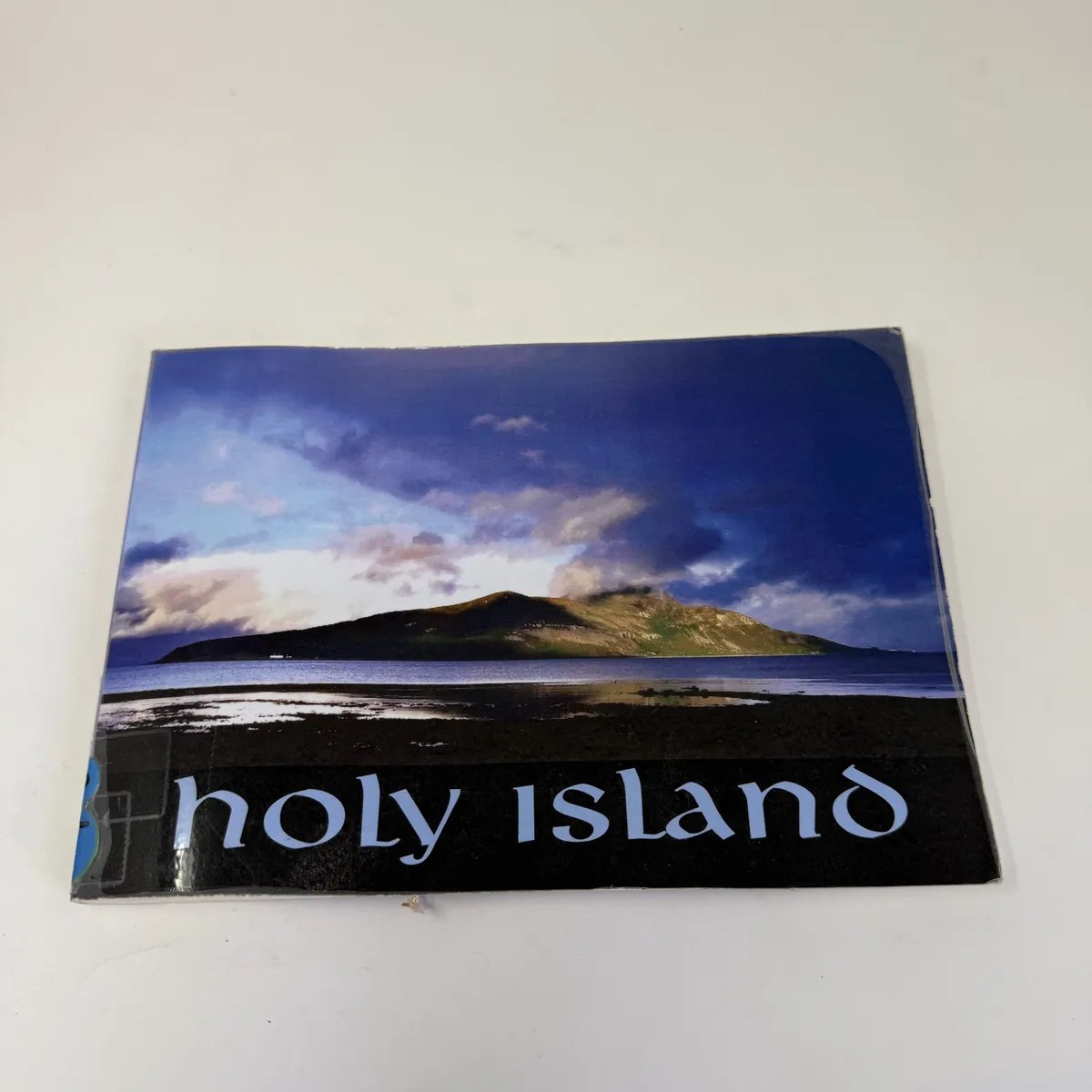
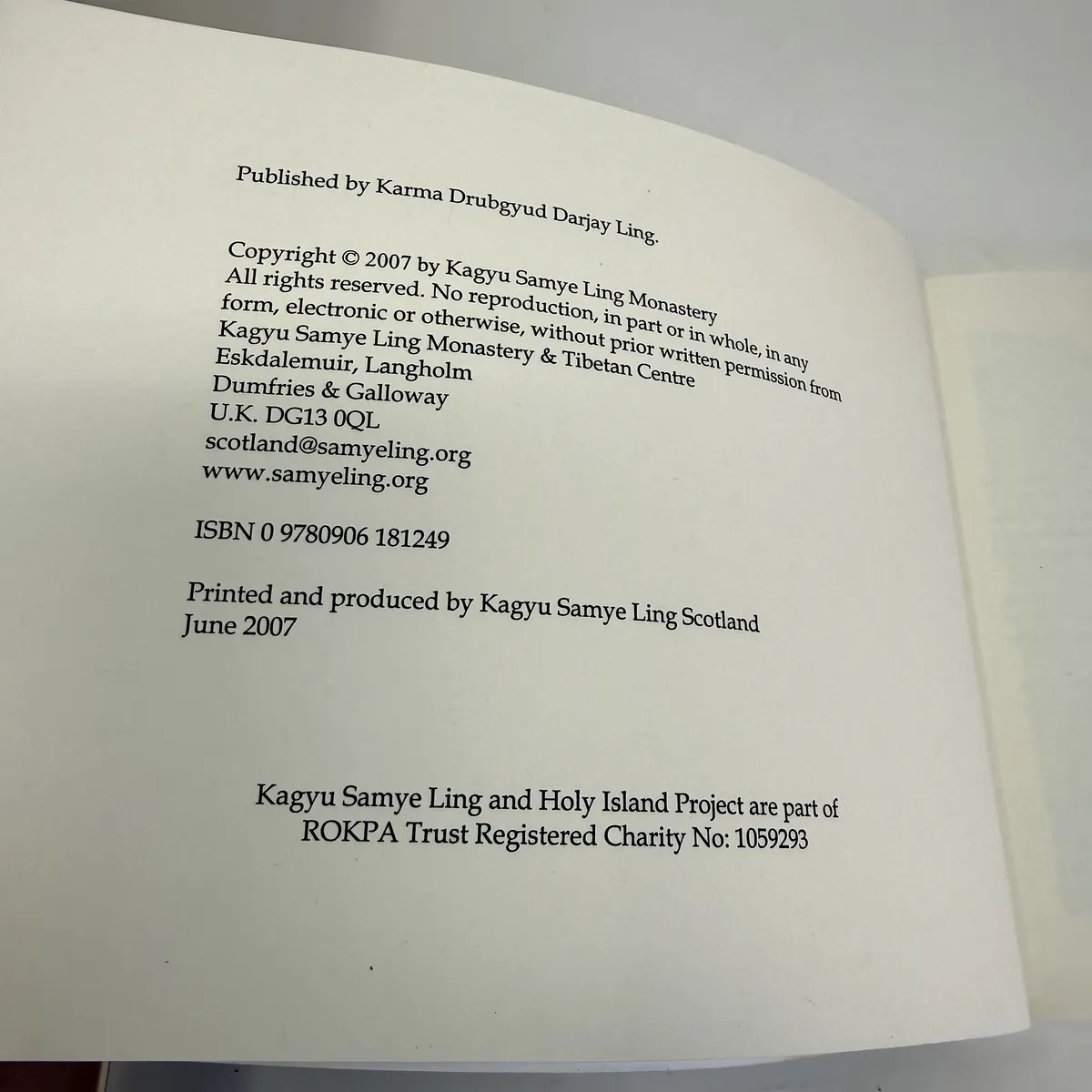
A 2007 Tibetan Buddhist sanctuary booklet by Yeshe Losal Rinpoche, published by Kagyu Samye Ling Monastery in Scotland. The copy in this archive carries an inscription dedicating it to the library of the Upaya Zen Center in Santa Fe, donated by a member named Laini after her time on Holy Island. A small object that documents the threads connecting the Santa Fe Buddhist community to the broader global Tibetan Buddhist network.
Catalog
Why this object is in the archive
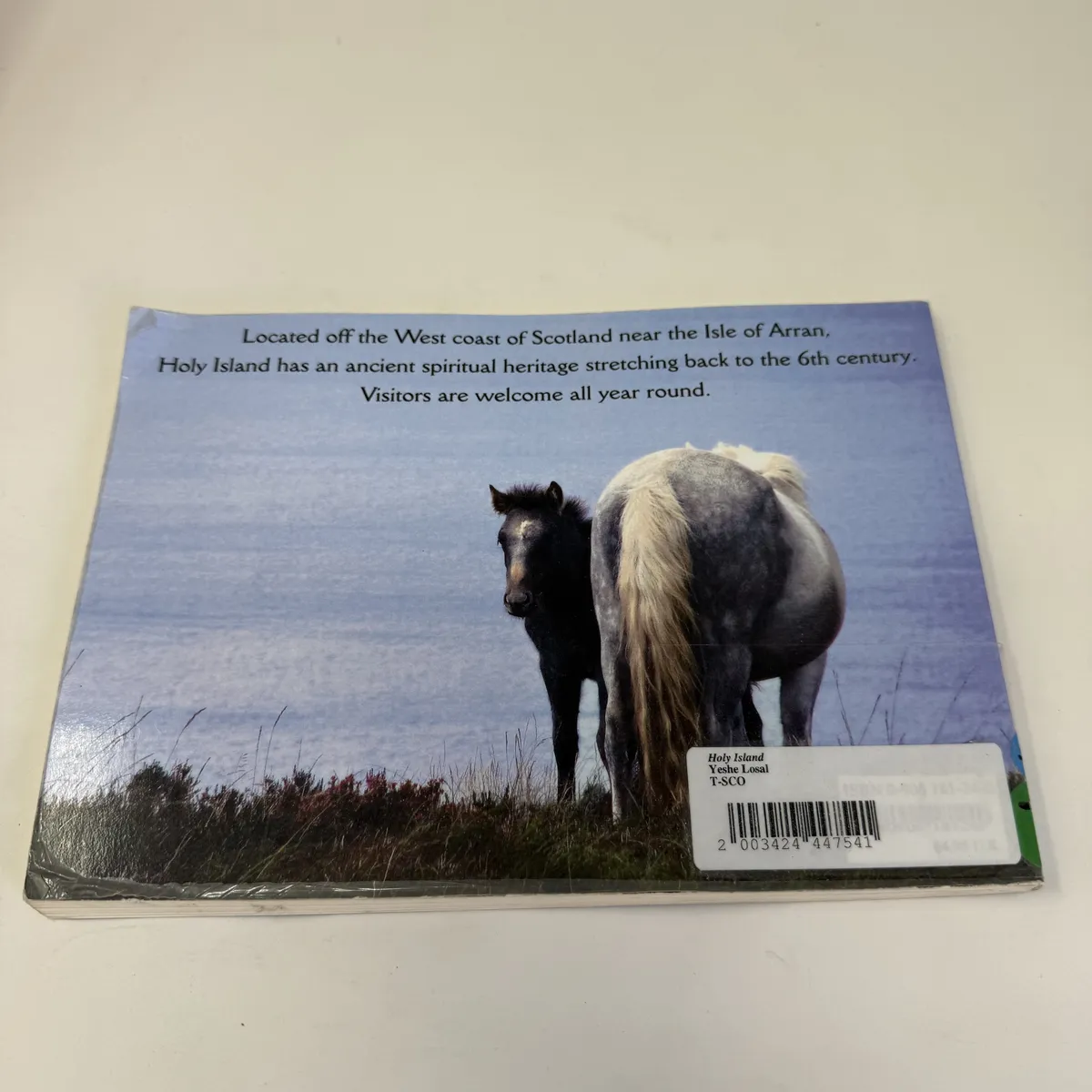
Holy Island — in Gaelic Eilean MoNaomh, "the Holy Isle" — is a small island off the western coast of Scotland near the Isle of Arran. It has an ancient spiritual heritage that the booklet traces back to the 6th century, when the Irish monk Saint Molaise of Leighlin lived there as a hermit. In 1992 the island was purchased by the Kagyu Samye Ling Monastery, a Tibetan Buddhist center founded in 1967 in Eskdalemuir, Scotland by the Tibetan exile lama Akong Tulku Rinpoche. Today Holy Island operates as both a Buddhist retreat center (the South End, including the Closed Retreat for long traditional retreats) and an interfaith environmental sanctuary (the North End, the Centre for World Peace and Health). The monastery is part of the ROKPA Trust, a UK registered charity.
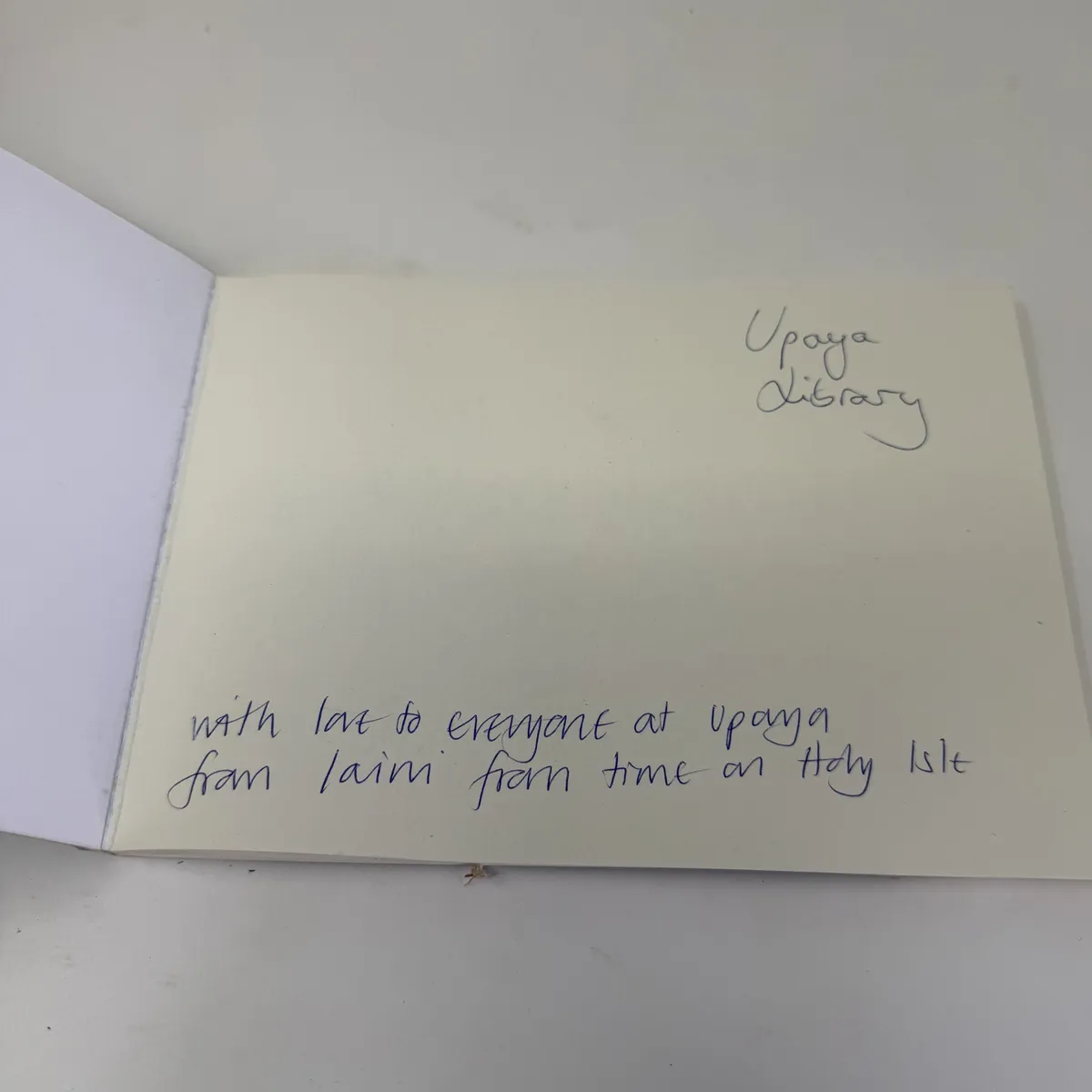
This particular booklet is not a regional NM document. It would be entirely outside the scope of the main archive, which focuses on regionally significant New Mexico material. It belongs in the Curiosities sub-section because of its provenance: the front free endpaper carries a handwritten inscription donating the booklet to the library of the Upaya Zen Center in Santa Fe, NM.
Upaya Zen Center is one of the most consequential American Buddhist institutions of the late 20th and early 21st centuries. Founded in 1990 by Roshi Joan Halifax — medical anthropologist, Soto Zen priest, and longtime collaborator with Joseph Campbell, Stanislav Grof, and the Dalai Lama on contemplative-care work — Upaya runs a year-round residential Zen practice center north of Santa Fe in the Cerro Gordo neighborhood, plus the Upaya Buddhist Chaplaincy training program (one of the principal certifying programs for hospital and prison contemplative chaplains in the US), an end-of-life care training under the heading "Being With Dying," and the long-running Upaya conference and retreat schedule. Roshi Halifax has been a transmitting Zen teacher in the lineage of Bernie Glassman Roshi, and Upaya is connected to the Zen Peacemakers and to a broader American convert-Buddhist network.
The inscription — "with love to everyone at Upaya from Laini from time on Holy Isle" — documents a small piece of the actual cultural traffic between American convert-Buddhist sanctuaries and the global network of traditional Buddhist sites. A member of the Upaya community traveled to Holy Island in or after 2007, picked up this booklet on site, and brought it back to Santa Fe as a gift to the Upaya library. The booklet then sat on the Upaya library shelf with a "T-SCO" cataloging code (probably "Tibet/Scotland") and an Upaya library barcode label, until the library deaccessioned it and it found its way to NMLP via a recent donation chain.
What this object documents
Three intersecting cultural threads:
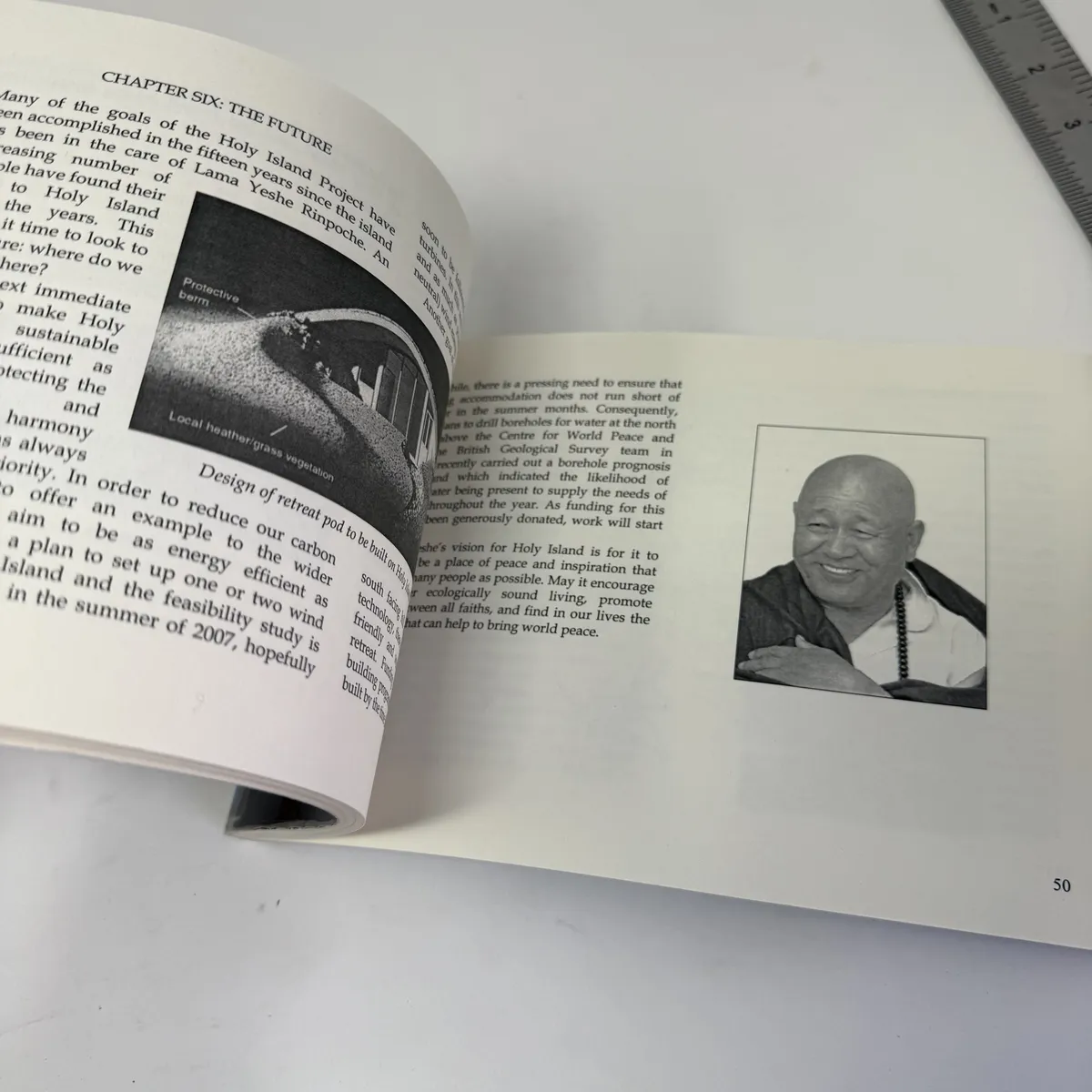
- The Tibetan Buddhist diaspora and Western retreat infrastructure. Akong Tulku Rinpoche escaped Tibet in 1959, settled in Scotland in the late 1960s, and built Kagyu Samye Ling and Holy Island as the principal Tibetan Buddhist sanctuary in Western Europe. Yeshe Losal Rinpoche, the author of this booklet, succeeded Akong as abbot and is the principal English-language voice of the Samye Ling community.
- The American convert-Buddhist network and Upaya specifically. Roshi Joan Halifax founded Upaya in 1990 in Santa Fe and has been a globally consequential Zen and contemplative-care teacher for thirty-plus years. Upaya hosts the Dalai Lama, has run programs with the Mind & Life Institute, and is a node in the international network of Buddhist retreat centers.
- The personal piece — "Laini's" trip. An individual member of the Upaya community traveled to Holy Island, spent meaningful time there, brought back a souvenir booklet to share, and left an inscription that the booklet now documents permanently. The inscription is the kind of small material trace that almost always disappears from second-hand books; it survives here because the Upaya library catalogued the booklet and kept it for years before it left the library.
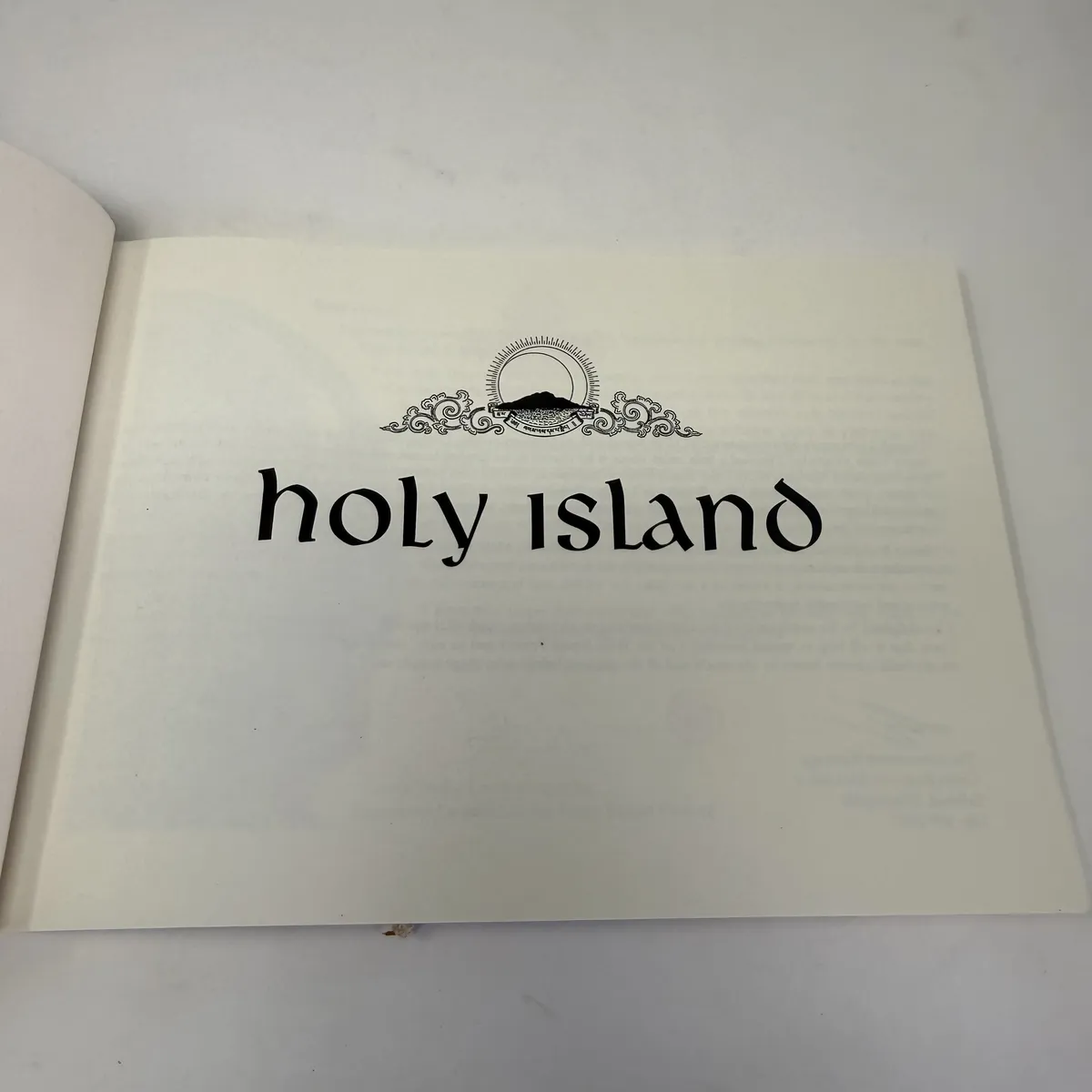
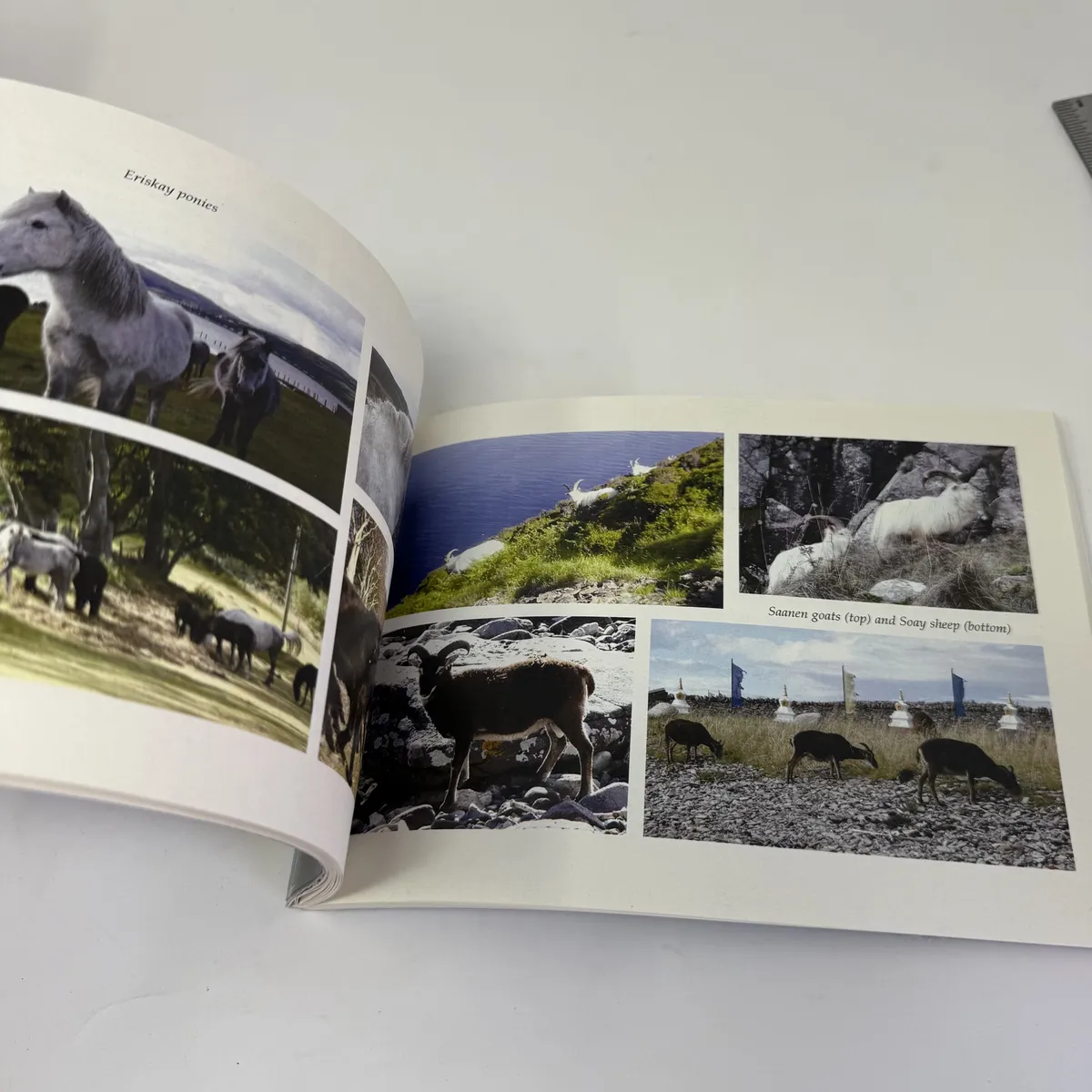
The booklet itself is a tour of the spiritual and natural history of Holy Island — St. Molaise's cave, the medicinal springs at Pillar Rock, the Eriskay ponies that graze the moorland (a traditional Scottish breed introduced to maintain the meadow ecology), the Saanen goats, the Soay sheep, the rock paintings of Buddhas at the retreat-gate area, the Tara puja, the OM MANI PEME HUNG mantra carved into the rocks. Pages of color photography, Tibetan script, Buddhist instruction. A small but real artifact of contemporary global Buddhism.
Multi-part bibliographic record
How it came in
Donated in May 2026 through NMLP. The Upaya library label and the Laini inscription together establish that the booklet had been in the Upaya Zen Center library in Santa Fe; the donor scenario by which it left Upaya and reached NMLP is anonymized per archive policy. In all likelihood the Upaya library deaccessioned a portion of its collection at some point between 2007 and 2026, and this booklet entered the Santa Fe-Albuquerque secondary book stream from there.
Where it's going
Likely route: a contemporary Buddhist studies scholar, an Upaya alumnus or current resident, a Kagyu Samye Ling specialist, or a sangha library elsewhere. The provenance to a named American Buddhist institution gives the object a different value class than an unmarked retail copy of the same booklet would carry — it's a small material document of the global American convert-Buddhist network rather than just a souvenir.
External references & authoritative sources
- Kagyu Samye Ling Monastery & Tibetan Centre, Scotland: samyeling.org — the issuing monastery; founded 1967; Akong Tulku Rinpoche and Chögyam Trungpa Rinpoche were the original abbots.
- Holy Island Project (Centre for World Peace and Health): holyisle.org — the formal sanctuary project on Holy Island.
- Yeshe Losal Rinpoche: Wikipedia; abbot of Kagyu Samye Ling and the principal English-language voice of the community after Akong Tulku Rinpoche's death.
- Upaya Zen Center, Santa Fe, NM: upaya.org — founded 1990 by Roshi Joan Halifax; one of the principal American convert-Zen institutions; located in the Cerro Gordo neighborhood north of Santa Fe.
- Roshi Joan Halifax: Wikipedia; medical anthropologist and Soto Zen priest; founder and abbot of Upaya; transmitted teacher in the lineage of Bernie Glassman Roshi.
- ROKPA Trust: rokpa.org — the parent UK registered charity (No. 1059293) of the Samye Ling community.
- Saint Molaise of Leighlin: 6th-century Irish monk who lived as a hermit on Holy Island; Wikipedia.
Citation (Chicago): Eldred, Josh. "Holy Island — Yeshe Losal Rinpoche (Kagyu Samye Ling, 2007), from the Upaya Zen Center Library." NMLP Donation Archive — Curiosities. Albuquerque: New Mexico Literacy Project, May 2, 2026. https://newmexicoliteracyproject.org/archive/curiosities/holy-island-yeshe-losal-2007.
Library deaccession copies are quiet provenance objects.
When Santa Fe institutions like Upaya, the School for Advanced Research, or the Folk Art Foundation library deaccession part of their holdings, individually labeled copies pass into the secondary stream. Free in-home pickup catches them.
Related on this site
- Back to the Curiosities sub-section
- Main NMLP Donation Archive
- Embroideries by Rebecca James (Santa Fe MOIFA, 1963) — another Santa Fe institutional document with personal provenance.
- Golf in Italy ENIT brochure (1930s) — another Curiosities entry.