New Mexico’s adobe and Pueblo Revival architectural tradition is among the most distinctive regional building vocabularies in the United States, and the scholarly literature documenting it — from Bainbridge Bunting’s comprehensive 1976 survey through Chris Wilson’s critical 1997 revisionist study — constitutes a collecting field of genuine depth and intellectual richness. Unlike most American regional architecture literatures, which tend to be either antiquarian (celebratory histories of old houses) or technical (construction manuals), the New Mexico architecture canon engages substantive questions about cultural identity, political power, colonialism, tourism, and the deliberate invention of tradition. It is a literature that rewards the collector who reads as well as acquires.
This page is the collecting reference for that literature as it surfaces through NMLP intake from estate libraries in Albuquerque, Santa Fe, and the broader New Mexico architecture, historic preservation, and construction community. Bainbridge Bunting’s two books — the 1976 Early Architecture in New Mexico and the 1983 John Gaw Meem: Southwestern Architect — are the foundational scholarly texts and the principal collector targets. Chris Wilson’s Myth of Santa Fe (1997) is the essential critical counterweight. John Gaw Meem himself (1894–1983) is the central architectural figure. This guide maps the full literature from its historical origins through the three-tier collector market.
Last verified September 2026 · Original research by Josh Eldred
The adobe building tradition: from Pueblo to hacienda
Ancestral Pueblo earthen construction
Adobe construction in New Mexico predates European contact by centuries. The Ancestral Puebloan tradition of building with puddled adobe (coursed mud walls without formed bricks) and later with sun-dried mud bricks produced the multi-story communal structures that the Spanish encountered in the sixteenth century — Taos Pueblo, Acoma Sky City, and the dozens of Rio Grande Pueblo villages. The building material was the landscape itself: alluvial clay soils from the Rio Grande floodplain, mixed with water and straw or grass as a binding agent, formed into bricks and dried in the intense high-desert sun. Wall thicknesses of eighteen to twenty-four inches provided thermal mass that moderated the extreme temperature swings of the New Mexico climate — cold winters at 7,000 feet elevation, hot dry summers.
The Spanish colonial adaptation of this tradition after the Oñate entrada of 1598 merged Pueblo earthen construction with the Spanish hacienda plan: a rectangular or L-shaped compound organized around an interior courtyard (placita), with exterior walls presenting a nearly windowless defensive face to the outside and interior rooms opening onto the courtyard through portals (covered porches supported by wooden posts). The roof system combined Pueblo and Spanish techniques: vigas (heavy peeled-log ceiling beams, typically ponderosa pine or Douglas fir, hauled from mountain forests) topped with latillas (smaller peeled poles laid in a herringbone or parallel pattern) and covered with layers of brush and packed earth. This basic construction vocabulary — load-bearing adobe walls, viga-and-latilla roof structure, flat or very low-pitched roof, portal arcade, placita plan — persisted with remarkably little change from the seventeenth century through the mid-nineteenth century and became the template that the Pueblo Revival movement would self-consciously revive in the twentieth century.
Paul Oliver’s Dwellings: The Vernacular House World Wide (Phaidon, 2003) places New Mexico’s adobe tradition within the global context of earth-building cultures. Oliver (1927–2017), the British vernacular architecture scholar, treats the Southwest adobe tradition as one variant of a worldwide family of earthen construction methods that includes rammed earth (pisé), cob, and wattle-and-daub. For the collector, Oliver provides the comparative frame that the New Mexico-focused literature omits; his book is a Tier 3 reference item that enriches any adobe architecture library.
The Spanish colonial hacienda and the plaza tradition
The Spanish colonial period (1598–1821) produced the architectural forms that the twentieth-century revival would draw on most directly. The Rio Grande hacienda — a self-contained agricultural and defensive compound with thick adobe walls, a central placita, corner torreons (defensive towers), and a chapel integrated into the domestic plan — represented the highest expression of the colonial adobe tradition. The few surviving early haciendas (the Martínez Hacienda in Taos, c. 1804, now a museum; the Baca House in Las Vegas, NM) show the building vocabulary that Bunting documented in his 1976 survey: massive adobe walls rising directly from grade without foundation in the modern sense, interior walls finished with yeso (gypsum plaster) applied over the adobe, floors of packed earth or flagstone, and the viga-and-latilla roof system.
The plaza communities — villages organized around a central public square with buildings forming a continuous perimeter wall — extended the defensive placita concept to the community scale. The plaza form, mandated by the Laws of the Indies (the Spanish colonial planning codes that governed urban layout across the Americas), produced the spatial pattern that the Plaza in Santa Fe, the Old Town plaza in Albuquerque, and the plazas in Taos, Las Vegas, Mesilla, and dozens of smaller communities still embody. Bunting 1976 is the essential reference for this material; Wilson 1997 adds the critical analysis of how the plaza form was romanticized and selectively preserved in the twentieth century.
Have books you're ready to part with? I offer free pickup across Albuquerque — call 505-250-3804.
The Territorial style: 1846–1912
The American military occupation of New Mexico beginning with General Stephen Watts Kearny’s 1846 march into Santa Fe introduced building materials and techniques that transformed the adobe tradition without replacing it. The U.S. Army posts — Fort Marcy in Santa Fe, Fort Union northeast of Las Vegas — brought milled lumber, window glass, fired brick, and the building skills of Anglo-American carpenters and masons. The arrival of the railroad in 1880 (the Atchison, Topeka and Santa Fe Railway reached Albuquerque in April 1880; the Lamy spur connected Santa Fe in 1880) made milled lumber, brick, and manufactured building hardware cheaply available for the first time.
The result was the Territorial style: a hybrid that retained the flat-roofed adobe wall construction of the Spanish colonial tradition but added brick coping along the parapet edge (eliminating the need for annual re-mudding of the vulnerable adobe parapet), milled-lumber window and door surrounds with pedimented lintels derived from Greek Revival vocabulary, multi-light double-hung sash windows, and occasionally classical columns or pilasters on public buildings. The style is most visible along the commercial streets of Las Vegas, NM (the best-preserved Territorial-period commercial district in the state), in the older residential neighborhoods of Santa Fe, and in the domestic architecture of the Río Arriba (upper Rio Grande) villages documented by Agnesa Lufkin Reeve.
Agnesa Lufkin Reeve
Architectural historian
From Hacienda to Bungalow: Northern New Mexico Houses 1850–1912 (UNM Press, 1988) is the only book-length study focused on the transitional domestic architecture of the Territorial period in northern New Mexico. Reeve documents the house types that bridged the gap between the Spanish colonial hacienda tradition and the California Bungalow-influenced styles that arrived with the railroad — a period of extraordinary architectural hybridization that the more famous Pueblo Revival movement would later deliberately obscure. The 1988 UNM Press first edition is the collector target: a modestly printed scholarly monograph that has not been reprinted and is genuinely uncommon in the trade. Fine-condition copies with original dust jacket trade in the Tier 2 range. For the collector building a comprehensive NM architecture library, Reeve 1988 is one of the most important and least well-known titles — the book that documents what Santa Fe and Taos actually looked like before the Pueblo Revival re-imagined them.
The Territorial style is architecturally significant precisely because it represents the authentic built environment of New Mexico during the period of greatest cultural transformation — the decades when New Mexico shifted from a Hispanic frontier province to an American territory integrated into the national economy through the railroad. The Pueblo Revival movement that followed would deliberately suppress the Territorial aesthetic in favor of a romanticized pre-American appearance, making Territorial-period buildings both historically important and architecturally endangered. Wilson 1997 is the essential critical source for understanding the cultural politics of this suppression.
From the Sorting Stream: Old Houses of New Mexico and the People Who Built Them
Sytha Motto’s Old Houses of New Mexico and the People Who Built Them came through the sorting stream from an Albuquerque estate, and I pulled it immediately. The book is published by Calvin Horn Publisher, Inc., Albuquerque, New Mexico — one of the most significant mid-twentieth-century publishers of New Mexico history and culture, active through the 1960s and 1970s. Calvin Horn also published New Mexico’s Troubled Years (1963) on territorial-era politics, and his imprint shows up across NMLP intake in estate libraries from Albuquerque historians, UNM-adjacent collectors, and anyone who was paying attention to New Mexico’s documentary heritage during that era. Seeing the Calvin Horn colophon on a title page is a signal: this is a locally produced, regionally important book from a publisher who understood New Mexico’s story from the inside.
Motto’s book documents territorial-era and pioneer homes across the state — precisely the building stock discussed in the Territorial section above. Two chapters stopped me mid-sort. The first covers the John Chisum ranch on the Pecos River near present-day Roswell. Chisum (1824–1884) was the cattle baron of the Pecos Valley, running herds across an enormous range from the Bosque Grande to the Texas line during the 1870s and early 1880s. He’s a Lincoln County War figure — his financial interests and political alliances were woven into the conflict that produced Billy the Kid’s notoriety. The spread on page 111 shows the cottonwood trees Chisum planted along Spring River, still standing when the photographer Roy Roseberry documented them, and a nineteenth-century portrait of Chisum himself. The ranch house and its grounds are exactly the kind of territorial-era domestic architecture that Bunting 1976 surveys at the scholarly level and that Motto documents at the human, biographical level.
The second chapter that caught my eye covers the S.W. Dorsey house in Colfax County — a spectacular red sandstone structure that Motto describes on page 43. Stephen W. Dorsey (1842–1916) was a U.S. Senator from Arkansas who relocated to northeastern New Mexico after leaving office, building an enormous cattle ranch and this remarkable sandstone house. The Dorsey ranch is one of those territorial-era New Mexico buildings that challenges the adobe-only narrative — it’s built from local red sandstone rather than adobe, reflecting the material resources and architectural ambitions of the Anglo cattle-baron class that arrived in New Mexico during the railroad era. The photograph by Clara C. Wetterhall documents the building in what appears to be its working-ranch period, before time and weather took their toll. For anyone collecting the literature of New Mexico’s territorial-era built environment, Motto’s book fills a gap that neither Bunting nor Reeve quite covers: the individual stories of the people who built these houses and the landscapes they shaped.
For collectors: this is a Calvin Horn Publisher title from the 1960s–1970s era, modestly printed, not widely held in the trade. It sits in the Tier 3 range as a standalone collectible, but its value increases substantially in the context of a comprehensive NM territorial-architecture library. The Calvin Horn imprint itself is a collecting signal — his press produced some of the most important regional-history titles of the mid-twentieth century, and copies in clean condition with original dust jacket are becoming genuinely uncommon.
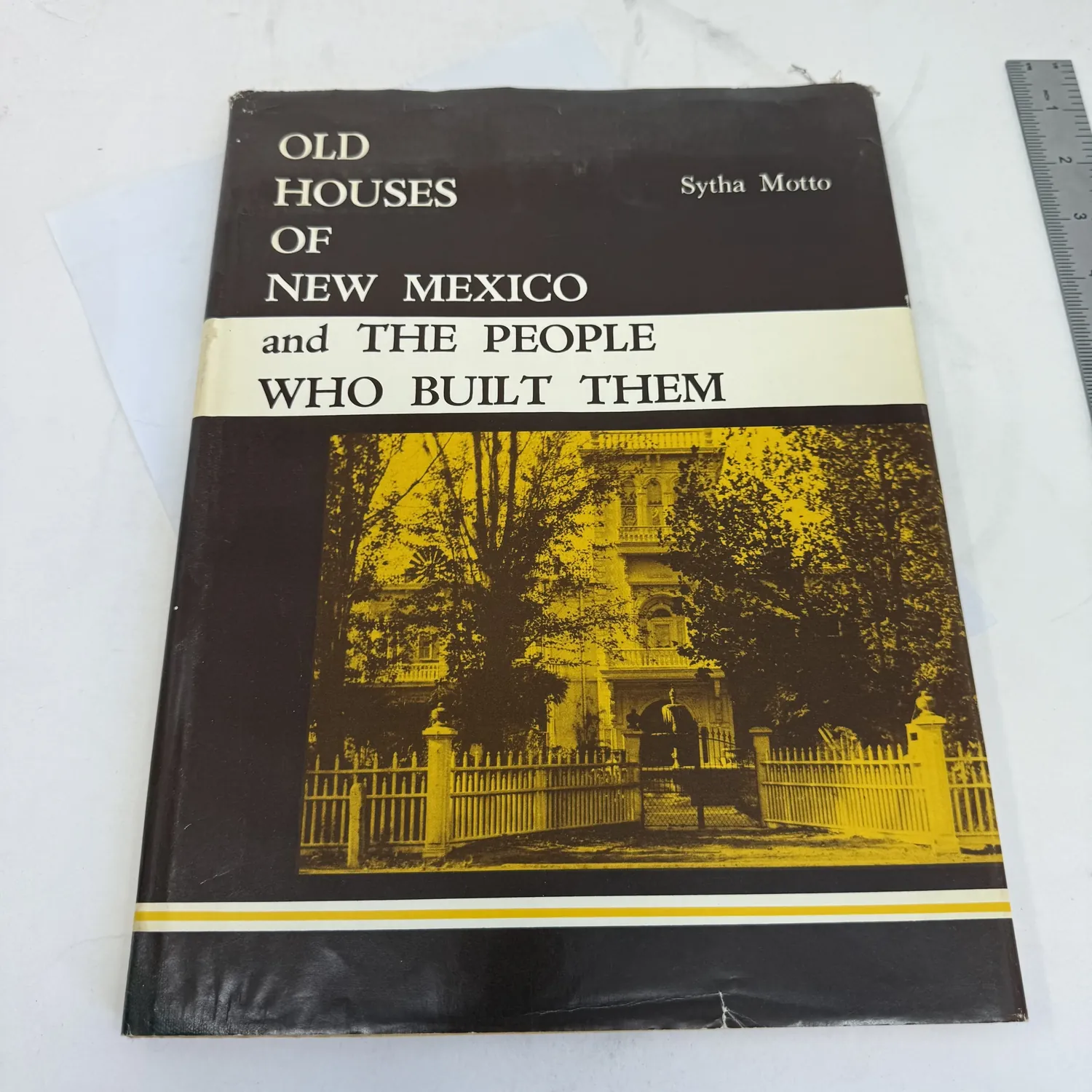
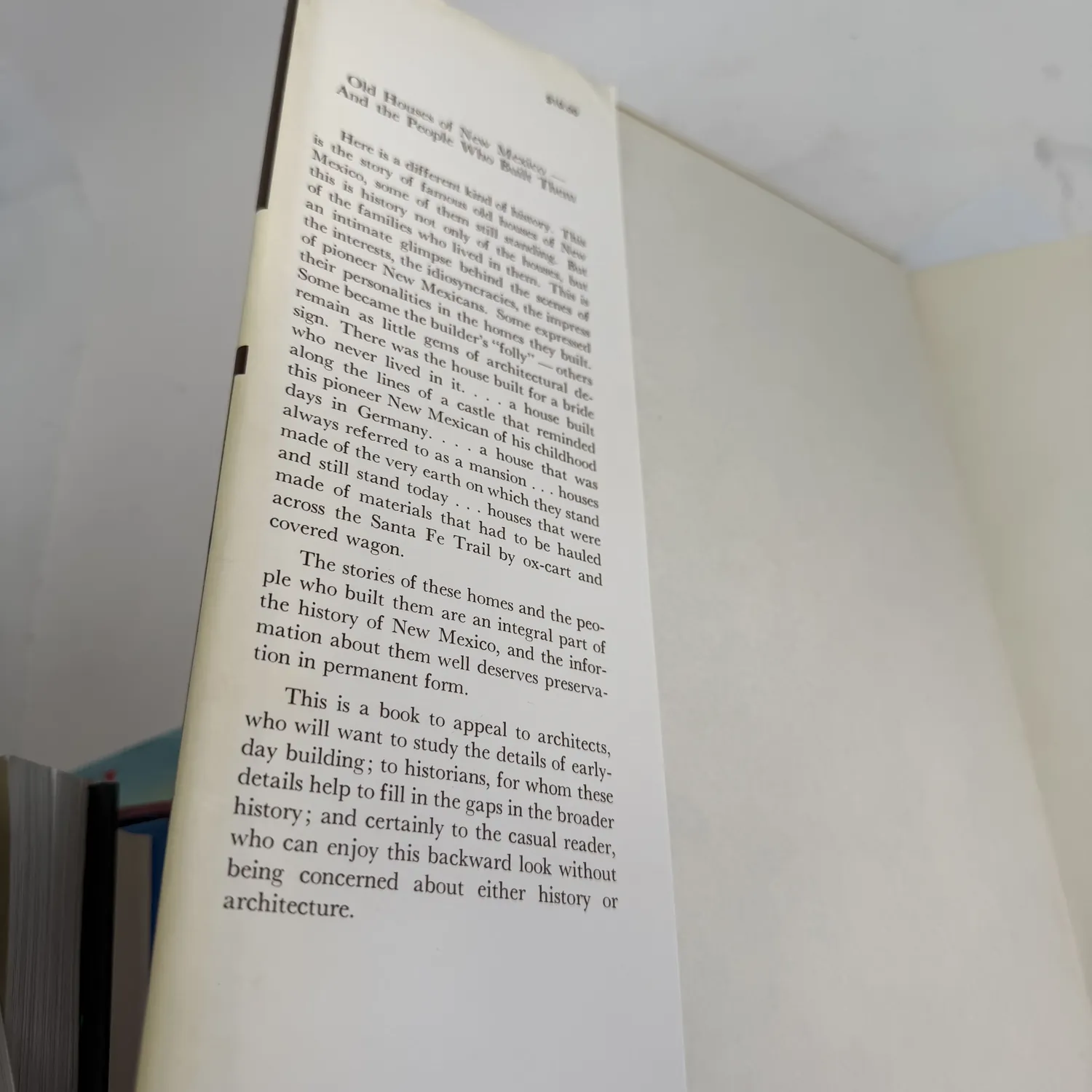
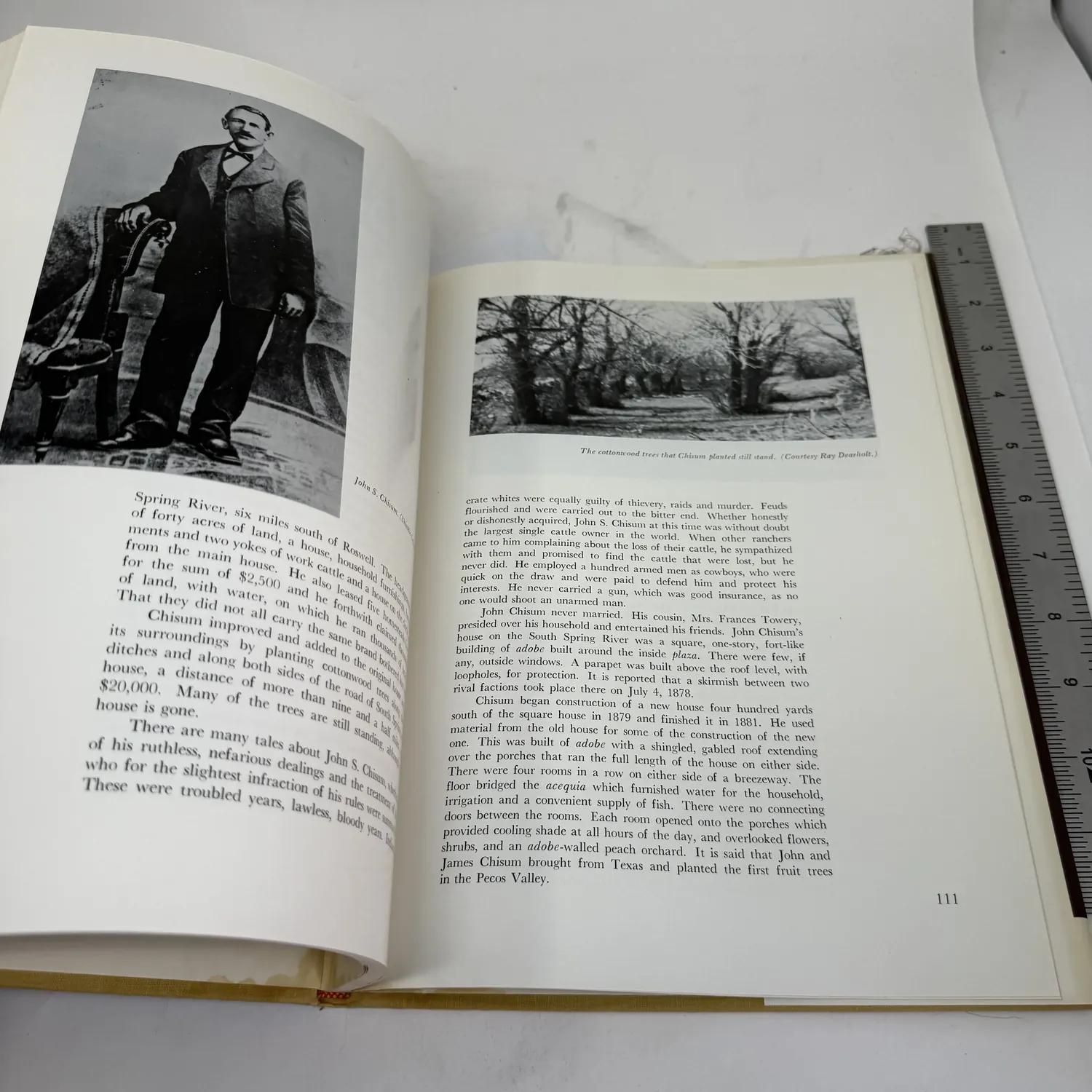
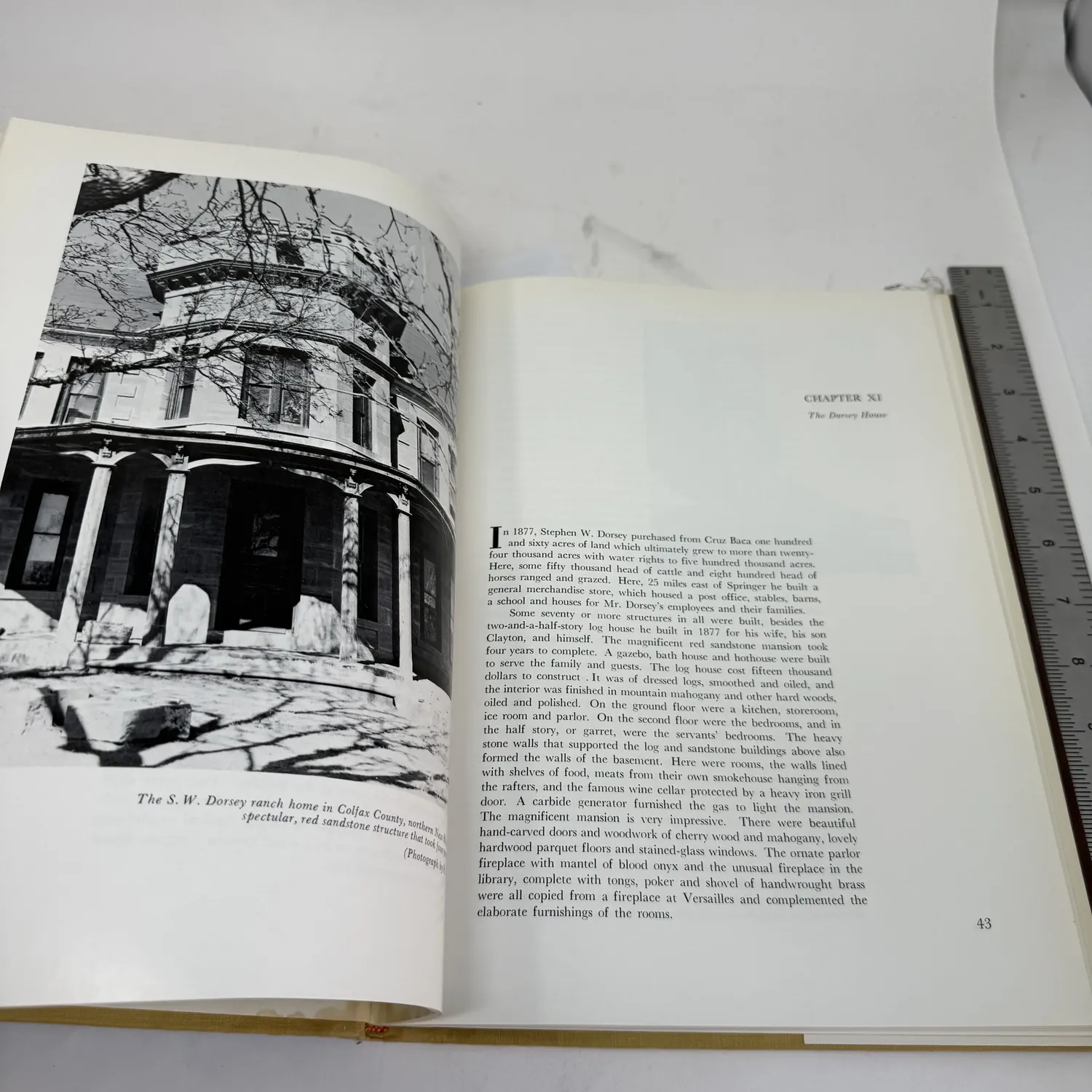
Photo Documentation
June 2026 · Albuquerque, NM
Desk photography by Josh Eldred, New Mexico Literacy Project. Original photos of a copy from the NMLP sorting stream. Cover, dust jacket flap, and title page images used under standard book-trade documentation practice. Interior spreads shown for documentary purposes — the Chisum portrait is a nineteenth-century photograph (public domain), the Roseberry and Wetterhall photographs are documentary architectural images with no active protective estate.
The invention of the Pueblo Revival: 1912–1917
Sylvanus Morley, Edgar Lee Hewett, and the 1912 plan
The Pueblo Revival movement did not emerge organically from the building tradition. It was invented — deliberately, self-consciously, and with specific political and economic objectives. The founding moment was the 1912 campaign by Sylvanus Morley (1883–1948) and Edgar Lee Hewett (1865–1946) to preserve and extend Santa Fe’s adobe architectural character at the precise moment when New Mexico statehood (achieved January 6, 1912) threatened to bring the standardized commercial architecture of the American mainstream to the capital city.
Sylvanus Morley
1883–1948 · Archaeologist, Mayanist
Morley was a young archaeologist working under Hewett at the School of American Archaeology (later the School of American Research, now the School for Advanced Research) in Santa Fe when he drafted the influential report arguing that Santa Fe should preserve its distinctive adobe architectural character. His argument was strategic: Santa Fe’s architectural distinction was its competitive advantage in the emerging tourist economy, and the city should build on that advantage rather than replacing its adobe buildings with standard American commercial structures. Morley would go on to a distinguished career as a Mayanist with the Carnegie Institution of Washington, but his early contribution to the Santa Fe movement was foundational. Wilson 1997 documents his role in detail.
Edgar Lee Hewett
1865–1946 · Archaeologist, institution builder
Hewett was the founding director of the School of American Archaeology in Santa Fe (established 1907, affiliated with the Archaeological Institute of America) and the Museum of New Mexico. As the most powerful cultural figure in the new state, Hewett used his institutional position to promote the Pueblo-style architectural identity for Santa Fe and for the Museum of New Mexico campus. His decision to commission Isaac Hamilton Rapp to design the 1917 Museum of Fine Arts building in an explicitly Pueblo Revival style was the single most consequential architectural decision in the history of the movement. Hewett is a complex figure — an ambitious institution-builder whose archaeological methods were criticized by contemporaries like Alfred Kidder, but whose cultural vision for Santa Fe proved extraordinarily durable. Wilson 1997 provides the most balanced assessment of his role.
The Morley-Hewett campaign succeeded because it aligned three interests: the cultural ambitions of Santa Fe’s Anglo-American intellectual community (artists, writers, archaeologists), the commercial interests of the tourism industry (particularly the Fred Harvey Company and the Atchison, Topeka and Santa Fe Railway, which were marketing the Southwest as an exotic domestic travel destination), and the civic boosterism of Santa Fe’s business community, which recognized that architectural distinction attracted the tourist economy more effectively than architectural conformity. The resulting movement was, as Wilson’s title states, a deliberately created regional tradition — a modern invention presented as a recovery of authentic historical character.
Isaac Hamilton Rapp and the 1917 Museum of Fine Arts
Isaac Hamilton Rapp
1854–1933 · Architect · Trinidad, Colorado and Santa Fe
Rapp was a Trinidad, Colorado-based architect who, with his brother William Morris Rapp, maintained an active practice across southern Colorado and northern New Mexico from the 1890s through the 1920s. His early work was in the standard commercial styles of the period — Richardsonian Romanesque, Queen Anne, Classical Revival. The pivotal commission was the New Mexico Building for the 1915 Panama-California Exposition in San Diego, for which Rapp drew on the forms of the Acoma mission church (San Esteban del Rey) and other Pueblo mission prototypes to create a dramatic exhibition building that attracted national attention. The success of the San Diego building led directly to the commission for the Museum of Fine Arts in Santa Fe (completed 1917, now the New Mexico Museum of Art), which adapted the same Pueblo mission-derived vocabulary — massive battered walls, projecting vigas, twin bell towers, irregular stepped massing — for a permanent institutional building on the northwest corner of the Santa Fe Plaza. The Museum of Fine Arts became the prototype for the entire Pueblo Revival movement: every subsequent Pueblo Revival building in Santa Fe, and eventually across New Mexico, Arizona, and the broader Southwest, descends from Rapp’s demonstration that Pueblo architectural forms could serve modern programmatic requirements.
Carl D. Sheppard’s Creator of the Santa Fe Style: Isaac Hamilton Rapp, Architect (UNM Press, 1988) is the only full-length study of Rapp and remains the essential source for his career, his design process, and his relationship to the broader movement. The book documents Rapp’s earlier Colorado and New Mexico commissions in conventional styles, traces his engagement with the Pueblo prototype through the San Diego exposition, and follows the impact of the Museum of Fine Arts building on subsequent Santa Fe architecture. The 1988 UNM Press first edition is a Tier 2 collector target — a modest print run that has not been reprinted. Sheppard’s analysis is essential because Rapp, not Meem, is the actual originator of the Pueblo Revival — though Meem would refine and perfect the style over the following decades.
I pick up books for free anywhere in the metro area. Call 505-250-3804 to schedule.
John Gaw Meem: the master architect
John Gaw Meem
1894–1983 · Architect · Santa Fe and Albuquerque
The defining architect of the Pueblo Revival. Born in Pelotas, Brazil, the son of a civil engineer working for a British-owned railway, Meem was educated at the Virginia Military Institute (graduated 1915), served in the U.S. Army during World War I, and contracted tuberculosis after the war. He came to Sunmount Sanatorium in Santa Fe in 1920 for treatment — one of thousands of “lungers” (tuberculosis patients) who came to New Mexico’s dry high-altitude climate seeking recovery. During his convalescence Meem became fascinated with New Mexico’s adobe building tradition and began studying architecture informally, eventually establishing a practice in Santa Fe in 1924. Over the next five decades he produced the buildings that define the Pueblo Revival at its most sophisticated and that collectively constitute the architectural identity of twentieth-century New Mexico.
The canonical Meem buildings
La Fonda Hotel, Santa Fe
Southeast corner of the Santa Fe Plaza, at the terminus of the Santa Fe Trail. The site had housed inns and hotels since at least the 1820s. The current building was begun in 1922 by Rapp and Rapp (Isaac Hamilton Rapp and William Morris Rapp) but the Fred Harvey Company, which leased the hotel from the Atchison, Topeka and Santa Fe Railway, commissioned Meem to renovate and substantially expand the building in 1929. Meem’s renovation established the La Fonda as the defining Pueblo Revival hotel — the building where the Fred Harvey Company’s southwestern romanticism and Meem’s architectural refinement of the Pueblo vocabulary converged most successfully. The interior decoration by Mary Elizabeth Jane Colter (the Fred Harvey Company’s architect-designer) complemented Meem’s exterior and structural work.
Cristo Rey Church, Santa Fe
Upper Canyon Road, Santa Fe. Designed by Meem 1939–1940 and completed 1940, built to commemorate the 400th anniversary of Coronado’s 1540 expedition. The largest modern adobe structure in the United States at the time of its completion: approximately 180,000 adobe bricks manufactured on site by parishioners and volunteers using traditional methods. The church was designed specifically to house the monumental stone reredos (altar screen) carved in 1761 for the military chapel La Castrense on the Santa Fe Plaza, which had been demolished in the nineteenth century (the reredos had been in storage). Cristo Rey represents Meem’s most ambitious attempt to build in the historic adobe tradition using traditional materials and techniques rather than the stuccoed-frame construction that most Pueblo Revival buildings actually employed. The building is a National Historic Landmark.
Zimmerman Library, University of New Mexico
Albuquerque. Designed by Meem 1936, completed 1938, with later additions in 1966 (also by Meem). The masterwork of Meem’s Pueblo Revival institutional architecture: a monumental building that translates the massed-adobe vocabulary of the Pueblo tradition into a modern reinforced-concrete-and-stucco structure functioning as a major research library. The building features projecting vigas, battered walls, irregular stepped massing, and an interior plan organized around a central reading room with exposed ceiling beams. Zimmerman Library is the centerpiece of Meem’s UNM campus plan, which he developed beginning in the 1930s and which made the University of New Mexico campus one of the most architecturally unified in the American West. The building now houses the UNM Center for Southwest Research and Special Collections, which in turn holds Meem’s own architectural papers — a fitting circularity.
The UNM Campus Plan
Meem served as the university architect for the University of New Mexico from the 1930s through the 1950s, producing a comprehensive campus plan in the Pueblo Revival style that shaped dozens of buildings and established the architectural character that the university maintains to this day. Beyond Zimmerman Library, Meem designed or influenced Scholes Hall, Hodgin Hall (the renovation of the campus’s original building into Pueblo Revival form), the Alumni Memorial Chapel, and numerous other campus structures. The UNM campus plan is arguably Meem’s most consequential achievement: it demonstrated that the Pueblo Revival vocabulary could sustain an entire institutional campus rather than just individual buildings, and it ensured that Albuquerque, not just Santa Fe, would carry the Pueblo Revival identity into the late twentieth century.
Meem’s residential work in Santa Fe — dozens of private houses in the city’s east side and in the surrounding foothills — established the vocabulary of the high-end Pueblo Revival residence: thick walls (whether genuine adobe or stuccoed frame), deep-set windows, kiva fireplaces (beehive-shaped corner fireplaces), portals with carved wooden posts and corbels, and interior spaces organized around views of the Sangre de Cristo Mountains. This residential vocabulary, refined by Meem and his office over three decades, became the template for the “Santa Fe Style” that the real estate and design industries would market globally from the 1980s onward.
The scholarly literature: edition by edition
Bainbridge Bunting, Early Architecture in New Mexico (1976)
Bainbridge Bunting
1913–1981 · UNM architectural historian
Bunting joined the University of New Mexico faculty in 1949 and spent three decades teaching architectural history and documenting New Mexico’s built environment. His fieldwork was exhaustive: he photographed and documented hundreds of buildings across the state, from pre-contact Pueblo structures through Territorial-period commercial buildings to early twentieth-century domestic architecture. His two major books were both published by UNM Press and reflect the depth of this fieldwork. Bunting died in 1981, before completing the final manuscript of the Meem monograph; the 1983 publication was prepared from his draft and research files. He is a closed-pool author (d. 1981): any signed Bunting material is from a fixed supply.
Early Architecture in New Mexico (UNM Press, 1976) is the comprehensive survey — the book that maps the full chronological span of New Mexico’s built environment from pre-contact Pueblo construction through the Spanish colonial period, the Mexican period, the Territorial period, and the early American era. Bunting’s approach is systematically typological: he classifies buildings by construction method, plan type, and period, providing the analytical framework that subsequent scholars have used as their baseline. The book is organized chronologically but reads as an architectural taxonomy, with each period and building type described in terms of materials, construction techniques, spatial organization, and relationship to precedent.
Points of issue. The true first edition bears the 1976 copyright date on the copyright page with no subsequent printing notation, no printing-line number sequence, and no “second printing” or “revised edition” language. The book was issued simultaneously in cloth (hardcover) and paperback by UNM Press. The cloth first edition in fine condition with the original pictorial dust jacket is the collector target. The dust jacket features a color photograph of a New Mexico building on the front panel. Later printings, identifiable by printing-line notations on the copyright page, are common and trade at significantly lower prices. The hardcover first is genuinely uncommon in fine condition because the book went into heavy institutional use — university architecture departments, historic preservation offices, and county planning libraries acquired it as a working reference, and those copies typically show the spine wear, page marking, and handling damage of daily professional use.
Bainbridge Bunting, John Gaw Meem: Southwestern Architect (1983)
Published posthumously by UNM Press two years after Bunting’s death, this is the only full-length scholarly monograph on the architect who defined the Pueblo Revival. Bunting had been working on the Meem project for years, with Meem’s active cooperation (Meem died in August 1983, the same year the book appeared), and the resulting work is both architectural history and something approaching authorized biography. The book documents Meem’s major commissions with architectural drawings, photographs, and analytical text that situates each building in its stylistic and institutional context. Bunting traces Meem’s evolution from his early Santa Fe houses through the major institutional commissions (La Fonda, Cristo Rey, Zimmerman Library, the UNM campus plan) to his later career and his role as dean of the New Mexico architectural profession.
Points of issue. The true first edition bears the 1983 copyright date with no reprint notation. Again available in both cloth and paperback from UNM Press. The cloth first in fine condition with original dust jacket is the collector target. Because it is the only monograph on the central figure of the Pueblo Revival, the book has remained in steady collector demand since publication. Fine-condition hardcover firsts are uncommon; the book was acquired by many of the same institutional libraries that bought Bunting 1976, and those copies sustained similar use damage. The posthumous publication is not a defect for the collector; Bunting had substantially completed the research and much of the writing before his death.
Chris Wilson, The Myth of Santa Fe (1997)
Wilson’s The Myth of Santa Fe: Creating a Modern Regional Tradition (UNM Press, 1997) is the book that changed how scholars think about the Pueblo Revival. Where Bunting treated the movement as an essentially aesthetic phenomenon — an architect (Meem) and a community (Santa Fe) recovering and refining an authentic building tradition — Wilson demonstrates that the Pueblo Revival was a deliberate cultural construction: a modern invention created by a specific group of Anglo-American archaeologists, artists, and civic boosters to serve specific economic and ideological purposes.
Wilson’s analysis is careful and nuanced, not polemical. He does not argue that the Pueblo Revival buildings are bad architecture or that the movement was simply a fraud. Rather, he shows that the “tradition” the movement claimed to be preserving was itself a selective fiction: pre-1912 Santa Fe was not uniformly Pueblo in character (the Territorial style dominated the commercial center, and Victorian, Italianate, and standard American domestic styles were common in residential neighborhoods), and the Pueblo Revival movement deliberately suppressed the architectural evidence of Santa Fe’s multicultural and stylistically diverse history in favor of a unified “ancient” appearance that was more marketable to the tourist economy. Wilson traces this process from the 1912 Morley-Hewett campaign through the institutional development of the Museum of New Mexico campus, the Fred Harvey Company’s hotel and tourist-court architecture, the Santa Fe Railway’s marketing imagery, the Works Progress Administration’s New Deal-era building projects, and the postwar commercialization of the “Santa Fe Style” brand.
The 1997 UNM Press first edition is the collector target. The book has been reprinted and remains available through UNM Press, but the true first edition in fine condition with original dust jacket is the version collectors seek. Wilson, who holds the J.B. Jackson Chair of Cultural Landscape Studies at UNM’s School of Architecture and Planning, remains active in the field; the book is not a closed-pool item, but the first edition has the usual first-edition premium for a title that remains the standard scholarly reference in its field.
Carl D. Sheppard, Creator of the Santa Fe Style (1988)
Creator of the Santa Fe Style: Isaac Hamilton Rapp, Architect (UNM Press, 1988) fills the biographical gap that Bunting’s Meem monograph left: where Bunting documented the architect who perfected the Pueblo Revival, Sheppard documents the architect who originated it. The book traces Rapp’s career from his early work in conventional styles (commercial buildings in Trinidad, Colorado; institutional buildings across southern Colorado and northern New Mexico) through the transformative 1915 San Diego Exposition commission to the 1917 Museum of Fine Arts building and its immediate aftermath. Sheppard draws on Rapp firm records, commission correspondence, and contemporary press coverage to reconstruct the design process by which Rapp translated the Acoma mission church and other Pueblo prototypes into the modern institutional vocabulary that launched the movement.
The 1988 UNM Press first edition is the collector target. The book is out of print, was modestly distributed (UNM Press print runs for specialized architectural monographs in the 1980s were small), and is genuinely uncommon in the trade. For the collector who already owns Bunting 1976, Bunting 1983, and Wilson 1997, Sheppard 1988 is the essential fourth title — the book that documents the origin point of the movement the other three analyze.
Agnesa Lufkin Reeve, From Hacienda to Bungalow (1988)
From Hacienda to Bungalow: Northern New Mexico Houses 1850–1912 (UNM Press, 1988) documents the architectural period that the Pueblo Revival movement deliberately obscured: the decades when New Mexico’s domestic architecture was transforming from the Spanish colonial hacienda tradition to the standardized American house types that the railroad brought. Reeve’s fieldwork in the Río Arriba (upper Rio Grande) communities of northern New Mexico — Taos, Española, Chimayó, Las Trampas, Truchas — documents the transitional house types: Territorial-style adobes with brick coping and Greek Revival window trim, railroad-era pattern-book houses built in frame alongside older adobes, and the early bungalows that arrived with the lumber-company catalogs. The book is essential because it provides the architectural baseline against which the Pueblo Revival’s selective historical claims can be measured. The 1988 UNM Press first edition is a Tier 2 collector target: important, scarce, and undervalued relative to the better-known Bunting and Wilson titles.
Boyd C. Pratt and Chris Wilson, The Architecture and Cultural Landscape of North Central New Mexico
Pratt and Wilson’s field study of the architecture and cultural landscape of north-central New Mexico extends Wilson’s analytical approach from the urban context of Santa Fe to the rural and small-town landscape of the Río Arriba region. The study documents not just individual buildings but the spatial relationships between buildings, agricultural features (acequias, fields, corrals), roads, churches, and cemeteries that constitute the cultural landscape of the Hispano communities of the upper Rio Grande. For the collector, the Pratt-Wilson material represents the scholarly infrastructure that supports the more accessible monographs: it is working-level fieldwork documentation that provides the empirical foundation for the synthetic arguments in Wilson 1997. The publication history is through the New Mexico Historic Preservation Division rather than UNM Press, making it less widely distributed and less well-known than the trade publications.
Marc Treib, Sanctuaries of Spanish New Mexico (1993) — the crossover text
Treib’s 1993 UC Press survey of 65 Spanish colonial and Hispano churches in New Mexico is primarily a mission-church text (see the companion NMLP pillar on Spanish Missions & Churches Books), but it is equally relevant to the adobe architecture collector because of its detailed documentation of adobe construction techniques. Treib’s floor plans, measured drawings, and photographic documentation of the churches provide the most systematic visual record of how adobe buildings were actually constructed — wall thicknesses, viga sizes, buttress profiles, plaster finishes — at a level of architectural detail that no other single volume matches. For the collector building a comprehensive NM adobe architecture library, Treib 1993 is a dual-interest item that belongs on both the mission-church shelf and the architecture shelf.
Not sure what you have? Text me a photo at 505-250-3804 and I'll tell you what I see.
From the Sorting Stream: A Tale of Santa Fe
Mark H. Cross’s A Tale of Santa Fe: Betty Stewart in the City Different came through the sorting stream with a $2.05 thrift sticker still on the cover — an estate-sale find that I pulled the moment I saw George Mandus’s cover portrait. The book is published by Caminito Publishing LLC, Santa Fe, New Mexico, a small local press, and it documents something the scholarly literature above largely omits: the vernacular builder tradition that shaped Santa Fe’s residential character at the street level, one house at a time, outside the institutional commissions that Bunting and Wilson analyzed.

Betty Stewart was a self-taught Santa Fe builder and designer who created what locals came to call “the Betty Stewart house” — an iconic residential type within the broader Pueblo Revival and Spanish-Pueblo Revival vocabulary described in the sections above. She worked outside the credentialed architectural profession, learning construction by doing it and developing a distinctive approach to Santa Fe residential design that her clients recognized as a coherent style. George Johnson, the New York Times science writer and author of Fire in the Mind: Science, Faith, and the Search for Order, provides the back-cover blurb, calling Stewart the builder of “an iconic type of architecture” and the book itself as having “the makings of a classic.”
Cross — also author of the Encyclopedia of Santa Fe and Northern New Mexico — does not treat Stewart’s story as a simple success narrative. The book documents her struggles with ADD, alcoholism, and cardiac problems, and addresses directly that she was openly gay in a time and place where that carried real professional and social consequences. The subject headings on the copyright page list “1. Santa Fe 2. Betty Stewart 3. Architecture 4. LGBT” — the publisher and author wanted this dimension of the story to be findable and unconcealable. That candor is part of what makes the book useful as architectural history rather than mere biography: it documents how the “City Different” identity was built not just by institutional architects like Meem and Rapp but by individual working builders whose personal histories were woven into the houses they created.


For collectors. Cross’s A Tale of Santa Fe (Caminito Publishing LLC, 2021; ISBN 978-0-9834194-1-9; LCCN 2021900443) is a small-press Santa Fe title with limited distribution, which means the supply entering the secondary market will come almost entirely through estate libraries and thrift streams in northern New Mexico. The book fills a genuine gap in the architecture-collecting canon for this region: the scholarly literature (Bunting, Wilson, Sheppard) documents the institutional architects and the cultural politics, but the vernacular builder tradition — the individual men and women who actually constructed the residential streetscapes of Santa Fe — is almost entirely undocumented at book length. Cross’s book is one of the few titles that takes a single vernacular builder seriously as a subject. The George Johnson blurb adds literary authority; the Caminito Publishing Santa Fe imprint signals local production and local knowledge. Three-tier assessment: the book sits in the Tier 3 range as a standalone collectible, with potential to move into Tier 2 as the vernacular-builder literature gains recognition alongside the institutional-architect canon. In the context of a comprehensive Santa Fe architecture library that already includes Bunting, Wilson, and Sheppard, a clean copy of Cross 2021 demonstrates range and depth — the collector who has it is paying attention to the full story, not just the famous names.
Photos: Josh Eldred, June 2026. Original desk photography at the New Mexico Literacy Project, Albuquerque, NM.
The adobe construction manuals
Paul Graham McHenry Jr.
Adobe construction authority · Albuquerque
McHenry was an Albuquerque-based architect who specialized in adobe construction and became the leading technical authority on adobe building methods in the American Southwest. His two principal books — Adobe: Build It Yourself (University of Arizona Press, 1973) and Adobe and Rammed Earth Buildings: Design and Construction (John Wiley & Sons, 1984) — span the range from introductory owner-builder guide to comprehensive technical reference. The 1973 book was a product of the 1970s owner-builder and alternative-building-methods movement; it provided accessible instruction for individuals building their own adobe houses and was widely used in New Mexico, Arizona, and the broader Southwest. The 1984 Wiley book is a professional-level reference covering soil testing, adobe brick manufacture, structural engineering, wall construction, foundations, roofing, plumbing and electrical integration, and building code compliance. McHenry also served as a consultant on adobe building codes for several New Mexico municipalities, contributing to the regulatory framework that governs new adobe construction in the state.
Adobe and Rammed Earth Buildings: Design and Construction (John Wiley & Sons, 1984; later reissued by University of Arizona Press) is the collector target in the technical-manual category. The 1984 Wiley first edition is the preferred version: Wiley’s engineering and construction list gave the book professional credibility that the University of Arizona Press reissue, while widely available, does not carry in quite the same way. The book’s coverage of rammed earth construction (pisé) alongside traditional adobe-brick construction places the New Mexico tradition in its broader earth-building context and makes the book relevant to the worldwide vernacular-architecture collector as well as the Southwest specialist.
Adobe: Build It Yourself (University of Arizona Press, 1973) is the companion piece: more accessible, more personal, and more closely tied to the 1970s counterculture and back-to-the-land movement that brought a new generation of owner-builders to New Mexico. The book documents the practical realities of adobe construction — soil testing, brick making, wall raising, roofing, finishing — with the directness of a practicing builder writing for fellow builders. The 1973 first edition is a Tier 3 item; the book had wide distribution through the University of Arizona Press and is common in Southwest estate libraries.
Orlando Romero and David Larkin
Author and architectural writer
Adobe: Building and Living with Earth (Houghton Mifflin, 1994) is the photographic and cultural counterpart to McHenry’s technical manuals. Where McHenry writes as an engineer, Romero and Larkin write as cultural interpreters. Romero, who served as librarian at the History Library of the Palace of the Governors (Museum of New Mexico) in Santa Fe, brings a deeply personal Hispano perspective: the adobe house is not merely a building type but a cultural artifact embodying centuries of Hispanic New Mexican life. David Larkin’s architectural writing provides structure, and Michael Freeman’s photography documents adobe buildings across the Southwest and Mexico with the visual quality that Houghton Mifflin’s trade format supports. The 1994 first edition is the collector target; the book had wide trade distribution and is common in Southwest estate libraries, but fine-condition first editions with intact dust jacket are the preferred version.
The field identification guides
Virginia and Lee McAlester, A Field Guide to American Houses (1984 and 2013)
The McAlesters’ A Field Guide to American Houses (Alfred A. Knopf, 1984; revised and expanded edition by Virginia Savage McAlester, 2013) is the standard visual identification guide for American residential architecture and includes substantial coverage of the Pueblo Revival, Spanish-Pueblo Revival, and Territorial Revival substyles. The guide’s format — diagnostic photographs paired with labeled line drawings identifying key features — makes it the single most useful tool for field identification of New Mexico domestic architecture by style and period. The NM-relevant sections cover: Pueblo Revival (flat roof, rounded parapets, projecting vigas, earth-toned stucco), Spanish-Pueblo Revival (the hybrid adding portal arcades and carved-wood detailing), Territorial Revival (flat roof with brick coping, white-painted wood trim with classical detailing), and the earlier folk house types (Spanish colonial and Pueblo) that the revival styles drew on.
The 1984 Knopf first edition is the original collector target; the 2013 revised edition by Virginia Savage McAlester alone (Lee McAlester had died) is the current working reference with substantially expanded coverage and updated photography. Both editions are widely distributed trade publications and common in estate libraries. The 1984 first in fine condition with original dust jacket is a Tier 2 item; the 2013 edition is a Tier 3 working-library book. For the NM architecture collector, the McAlester is the reference that connects the regional building tradition to the national architectural taxonomy.
Paul Oliver, Dwellings (2003)
Oliver’s Dwellings: The Vernacular House World Wide (Phaidon, 2003; originally published in a different form as Dwellings: The House Across the World, 1987) places the New Mexico adobe tradition within the global context of earth-building cultures. Oliver (1927–2017) was the British architectural historian who spent his career documenting and theorizing vernacular architecture worldwide, and his encyclopedic approach means that the Southwest adobe tradition appears alongside the mudbrick construction of West Africa, the rammed-earth buildings of China and Yemen, and the cob construction of Devon. The New Mexico sections are brief compared to the dedicated regional studies, but they provide the comparative framework that the NM-focused literature cannot. The 2003 Phaidon edition is a Tier 3 reference item; the book is a major trade publication and widely available.
Inherited a library and not sure where to start? Call or text 505-250-3804 — I handle this all the time.
Pueblo Revival vs. Spanish-Pueblo Revival vs. Territorial Revival — the collector’s field guide
Collectors need to understand the stylistic distinctions because the literature treats the three substyles differently, and the collecting value of individual titles depends partly on which substyle they document.
Pueblo Revival draws directly on the massed-adobe forms of the historic Pueblo villages and the Franciscan mission churches. Diagnostic features: flat roof with irregular parapets (often rounded or stepped), projecting vigas (visible roof beam ends penetrating the exterior wall), battered walls (walls that taper inward from base to top, producing the characteristic trapezoidal profile), earth-toned stucco (historically adobe plaster, now typically cement stucco colored to match), deeply recessed windows, and overall massing that echoes the multi-story stepped forms of Taos Pueblo or the massive buttressed walls of the mission churches. Rapp’s 1917 Museum of Fine Arts and Meem’s institutional buildings are the canonical examples.
Spanish-Pueblo Revival blends the Pueblo Revival massing with elements from the Spanish colonial domestic vocabulary: portal arcades (covered porches with wooden posts supporting a viga-and-latilla roof), enclosed placitas (courtyards), carved wooden corbels and zapatas (decorative brackets supporting the vigas), painted window and door surrounds, and occasionally tile accents. The style is more ornamented and more domestic in character than the austere Pueblo Revival of the institutional buildings. Much of Santa Fe’s residential architecture from the 1920s through the 1960s is Spanish-Pueblo Revival rather than pure Pueblo Revival. Meem’s residential work often falls in this category.
Territorial Revival draws on the 1846–1912 Territorial period when American building materials and techniques were applied to the existing adobe tradition. Diagnostic features: flat roof with brick coping (a course of fired brick along the parapet edge, the single most distinctive Territorial feature), white-painted milled-lumber window and door surrounds with pedimented lintels (triangular pediments above the windows, drawn from Greek Revival vocabulary), multi-light double-hung sash windows, and a generally more rectilinear and finished appearance than the organic forms of the Pueblo Revival. The style is common in Albuquerque (particularly the Old Town and Barelas neighborhoods), Las Vegas NM, and the upper Rio Grande villages.
All three substyles are documented in Bunting 1976 (the foundational typological analysis), Wilson 1997 (the critical-cultural analysis), and McAlester 1984/2013 (the field-identification format). The collector building a comprehensive NM architecture library needs all three perspectives.
The archives and institutions
The UNM Center for Southwest Research and the Meem Papers
The UNM Center for Southwest Research and Special Collections, housed in Zimmerman Library (Meem’s own building), holds the John Gaw Meem Papers (MSS 10 BC) — the primary archival source for the Pueblo Revival movement. The collection includes architectural drawings and blueprints for Meem’s major and minor commissions, client correspondence, construction specifications, photographs (both construction progress photographs and finished-building documentation), office records, and personal papers. The drawings alone are a remarkable resource: they document Meem’s design process in detail, showing how he studied mission-church prototypes and translated their forms into modern construction.
For the collector, the Meem Papers at the Center for Southwest Research matter for provenance and authentication. Books from Meem’s personal library occasionally surface in the Santa Fe and Albuquerque estate market; the Center for Southwest Research can provide the archival context to confirm association-copy provenance. The Center also holds related architectural collections, UNM School of Architecture records, and the institutional records of the Historic Santa Fe Foundation, making it the single most important research destination for anyone working seriously in this collecting field.
The Historic Santa Fe Foundation
The Historic Santa Fe Foundation, established in 1961, is Santa Fe’s principal historic preservation advocacy organization. The Foundation has been central to maintaining the city’s architectural regulations — the descendants of the 1912 Morley-Hewett vision codified in the 1957 Historic Zoning Ordinance and subsequent planning documents — and has produced publications documenting Santa Fe’s historic buildings. The Foundation’s walking-tour guides, occasional papers, and building survey documents are Tier 3 working-library items that provide the on-the-ground context for the more scholarly literature. The Foundation’s archives include correspondence, building survey records, and advocacy documents that supplement the academic collections at the Center for Southwest Research.
The Museum of New Mexico campus
The Museum of New Mexico campus in Santa Fe — the Museum of Art (Rapp, 1917), the Palace of the Governors (the original Spanish colonial government building on the Plaza, c. 1610, substantially rebuilt), the Museum of Indian Arts and Culture, and the Museum of International Folk Art — is itself a built demonstration of the Pueblo Revival movement’s institutional expression. Hewett’s decision to develop the Museum of New Mexico campus in the Pueblo Revival style, beginning with the Rapp building, established the institutional precedent that Meem would follow at UNM. The Museum campus publications — El Palacio (the Museum of New Mexico’s journal, published since 1913), exhibition catalogs, and institutional histories — contain significant architectural content and are Tier 3 reference items for the architecture collector.
Found old books in an estate or attic? Text me a photo at 505-250-3804 and I'll tell you what I see.
The collector market — three tiers
Tier 1 trophy items (upper collectible prices and above). Bainbridge Bunting Early Architecture in New Mexico 1976 UNM Press true first hardcover in fine condition with original dust jacket — genuinely uncommon in this condition, the foundational text, and the single most sought title in the field. Bunting John Gaw Meem: Southwestern Architect 1983 UNM Press first cloth in fine condition with dust jacket. Any association copy with documented Meem provenance — books from Meem’s personal library with his ownership marks, presentation copies inscribed by authors to Meem, annotated working copies from Meem’s office. Signed or inscribed copies of any core title by Bunting (d. 1981, closed pool), by Meem himself (d. 1983, closed pool), or by the first generation of Pueblo Revival practitioners. These are the rare-book targets that serious collectors pursue.
Tier 2 collector targets. Chris Wilson The Myth of Santa Fe 1997 UNM Press first in fine condition with dust jacket. Carl D. Sheppard Creator of the Santa Fe Style: Isaac Hamilton Rapp 1988 UNM Press first. Agnesa Lufkin Reeve From Hacienda to Bungalow 1988 UNM Press first. Paul Graham McHenry Adobe and Rammed Earth Buildings 1984 Wiley first edition. Marc Treib Sanctuaries of Spanish New Mexico 1993 UC Press first (crossover with the missions pillar). Orlando Romero and David Larkin Adobe 1994 Houghton Mifflin first. Virginia and Lee McAlester A Field Guide to American Houses 1984 Knopf first with dust jacket. Boyd C. Pratt and Chris Wilson Architecture and Cultural Landscape of North Central New Mexico. These trade in the low to mid three-figure range for fine-condition first editions.
Tier 3 working-library targets (under the mid-range threshold). Subsequent printings and paperback editions of all the above. McHenry Adobe: Build It Yourself 1973 University of Arizona Press. McAlester revised 2013 edition. Paul Oliver Dwellings 2003 Phaidon. The Historic Santa Fe Foundation publications, walking-tour guides, and building survey documents. UNM School of Architecture occasional publications and thesis documents. El Palacio journal issues with significant architecture content. “Santa Fe Style” coffee-table books (numerous trade publishers, 1980s–2000s) — these are the most common category of NM architecture book in estate libraries and are widely distributed. Regional magazines (New Mexico Magazine, El Palacio, New Mexico Architecture) with architecture features. NPS publications on the mission churches and Pueblo ruins that provide the architectural precedent context. These trade in the upper two-figure range at most and constitute the affordable working-library tier.
Six identification problems for collectors
One. Bunting 1976 true first vs. later printings. The true first edition of Early Architecture in New Mexico bears the 1976 copyright date on the copyright page with no subsequent printing notation. Later printings carry printing-line indicators or explicit “second printing” language on the copyright page. The book was issued simultaneously in cloth (hardcover) and paperback; both formats share the 1976 copyright date, but the cloth first with original dust jacket is the collector target. A paperback first is still a first edition but trades at a fraction of the cloth price. Examine the copyright page carefully: general booksellers sometimes list later printings as “firsts” based on the 1976 copyright date alone, without checking for printing-line indicators.
Two. Bunting 1983 posthumous publication status. The posthumous publication of John Gaw Meem: Southwestern Architect (Bunting died 1981, book published 1983) occasionally raises questions about completeness. The book was prepared from Bunting’s substantially complete draft and research files; it is not a fragmentary or unfinished work. The posthumous status is not a condition defect or a textual problem — the book represents Bunting’s mature scholarship as fully as the 1976 volume. Collectors should treat the 1983 first edition exactly as they would any other first edition of a completed scholarly work.
Three. Wilson 1997 first edition vs. reprints. The Myth of Santa Fe has been reprinted by UNM Press and remains available in the trade. The true first edition is identifiable by the 1997 copyright date with no reprint notation on the copyright page. Later printings typically carry printing history on the copyright page. The book remains in print and readily available; the first-edition premium is modest but real for collectors who require firsts.
Four. McHenry Wiley 1984 vs. University of Arizona Press reissue. The Wiley first edition of Adobe and Rammed Earth Buildings carries the John Wiley & Sons imprint on the title page and spine; the University of Arizona Press reissue carries that press’s imprint. The two editions are textually identical or nearly so; the Wiley first has the collector premium as the original imprint. General booksellers sometimes describe the University of Arizona Press reissue as a “first” when it is a reissue under a different publisher.
Five. “Santa Fe Style” coffee-table books vs. scholarly texts. The 1980s–2000s “Santa Fe Style” publishing boom produced dozens of large-format photographic books celebrating Santa Fe’s Pueblo Revival aesthetic — interior-design books, garden books, real-estate-marketing books presented as architecture books. These are not the scholarly literature: they do not provide historical analysis, construction documentation, or critical perspective. They are common in estate libraries and typically trade in the Tier 3 range at most. The collector should distinguish between the scholarly canon (Bunting, Wilson, Sheppard, Reeve, Treib) and the coffee-table tier (everything marketed as “Santa Fe Style” without scholarly apparatus). Both have legitimate places in a comprehensive library, but their collecting values are entirely different.
Six. Meem association copies: provenance verification. Books from John Gaw Meem’s personal library occasionally surface in the Santa Fe estate market. Authentic Meem provenance significantly increases value. Verification requires examining ownership marks (Meem’s bookplate, if any; inscriptions; annotations), cross-referencing with the Meem Papers at the UNM Center for Southwest Research, and assessing the book’s subject matter (architecture, Southwest history, and fine arts titles are plausible Meem library items; random fiction or self-help books are not). Association copies — books inscribed to Meem by other architects, scholars, or civic figures — are particularly valuable because they document the social network of the Pueblo Revival movement.
The NMLP intake position
New Mexico adobe and Pueblo Revival architecture books surface through NMLP intake from several distinct donor demographics. The UNM architecture and planning faculty estate is the deepest and most scholarly concentration, often including the complete Bunting-Wilson-Sheppard-Reeve canon in first editions alongside working copies of the field surveys, HABS documentation, and technical reports that constitute the professional literature. Santa Fe architecture and historic-preservation community estates — architects, preservation consultants, Historic Santa Fe Foundation activists, real estate professionals specializing in historic properties — produce the canonical references alongside the “Santa Fe Style” coffee-table tier and occasionally Meem-association material. Albuquerque home-builder and contractor estates, particularly from the 1970s–1990s adobe-building period, produce the McHenry manuals, the Romero-Larkin photographic book, and the technical literature on adobe construction codes and standards. The general Southwest-interest estate library — the largest category by volume — produces the coffee-table books, the McAlester field guide, and the popular-audience architecture titles.
Standard NMLP intake terms apply: any condition, any quantity, free Albuquerque-metro pickup, no minimum, no tax receipt (NMLP is for-profit). Tier 1 trophy material — the Bunting hardcover firsts in fine condition, Meem association copies, signed material from the Pueblo Revival principals — is documented at the warehouse and resold through the SellBooksABQ side. Tier 2 and Tier 3 material flows through the standard NMLP hand-sort and routing. Material with documented provenance from named NM architects, UNM architecture faculty, or Historic Santa Fe Foundation activists — association copies, annotated working copies, presentation copies — is archived through the open NMLP Donation Archive when regionally significant.
Cite This Guide
Eldred, J. (May 2026). New Mexico Adobe, Pueblo Revival & Territorial Architecture Books — The Collector's Authority Guide. New Mexico Literacy Project.
https://newmexicoliteracyproject.org/new-mexico-adobe-pueblo-revival-architecture-books-collecting
Content is original research by Josh Eldred. Licensed under CC BY 4.0. Cite with attribution.