Curiosity entry · German bisque character baby · First non-book object in this section
Kestner J.D.K. mold 247 character baby — Waltershausen, Thuringia, c.1912–1925
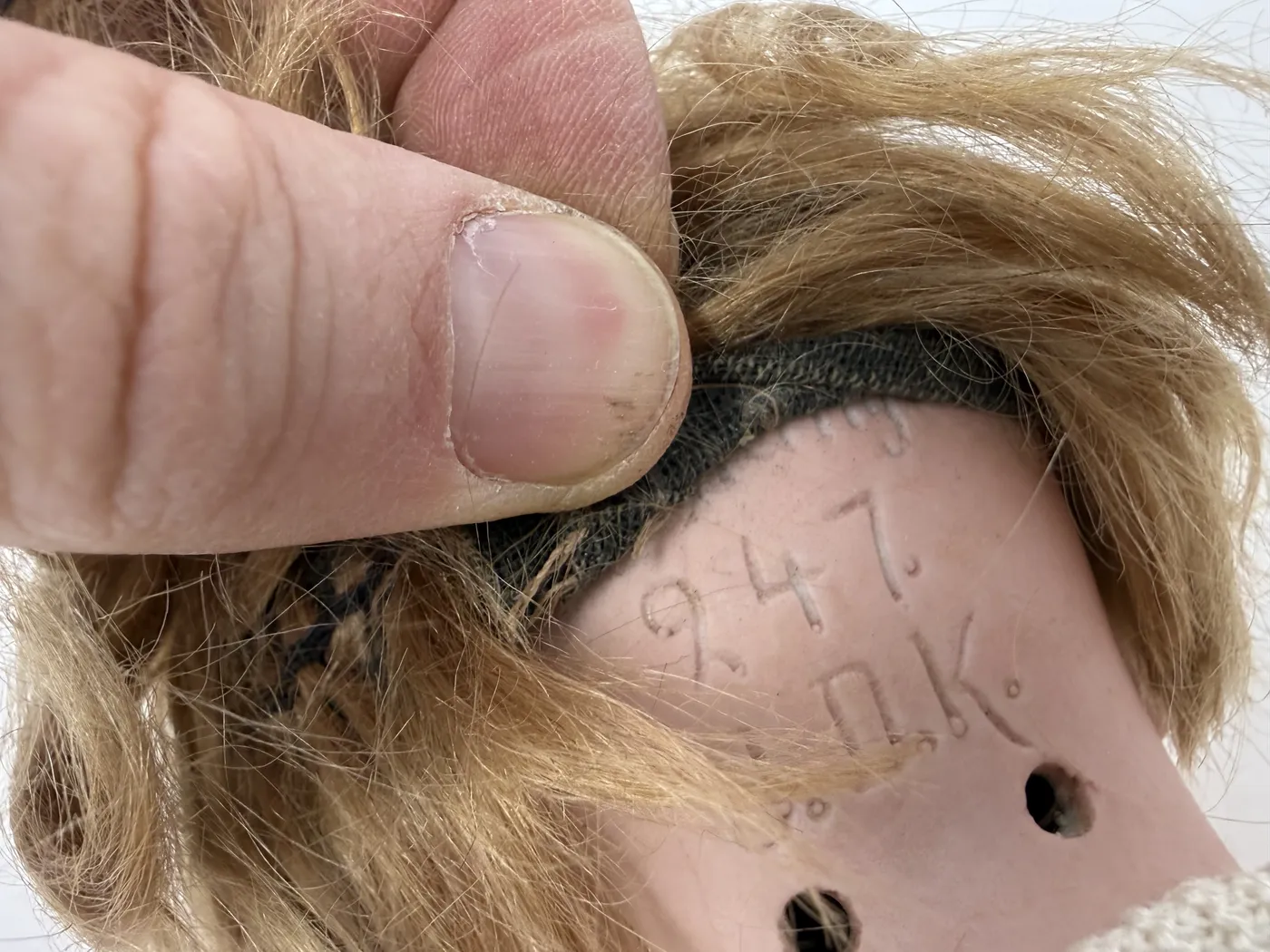
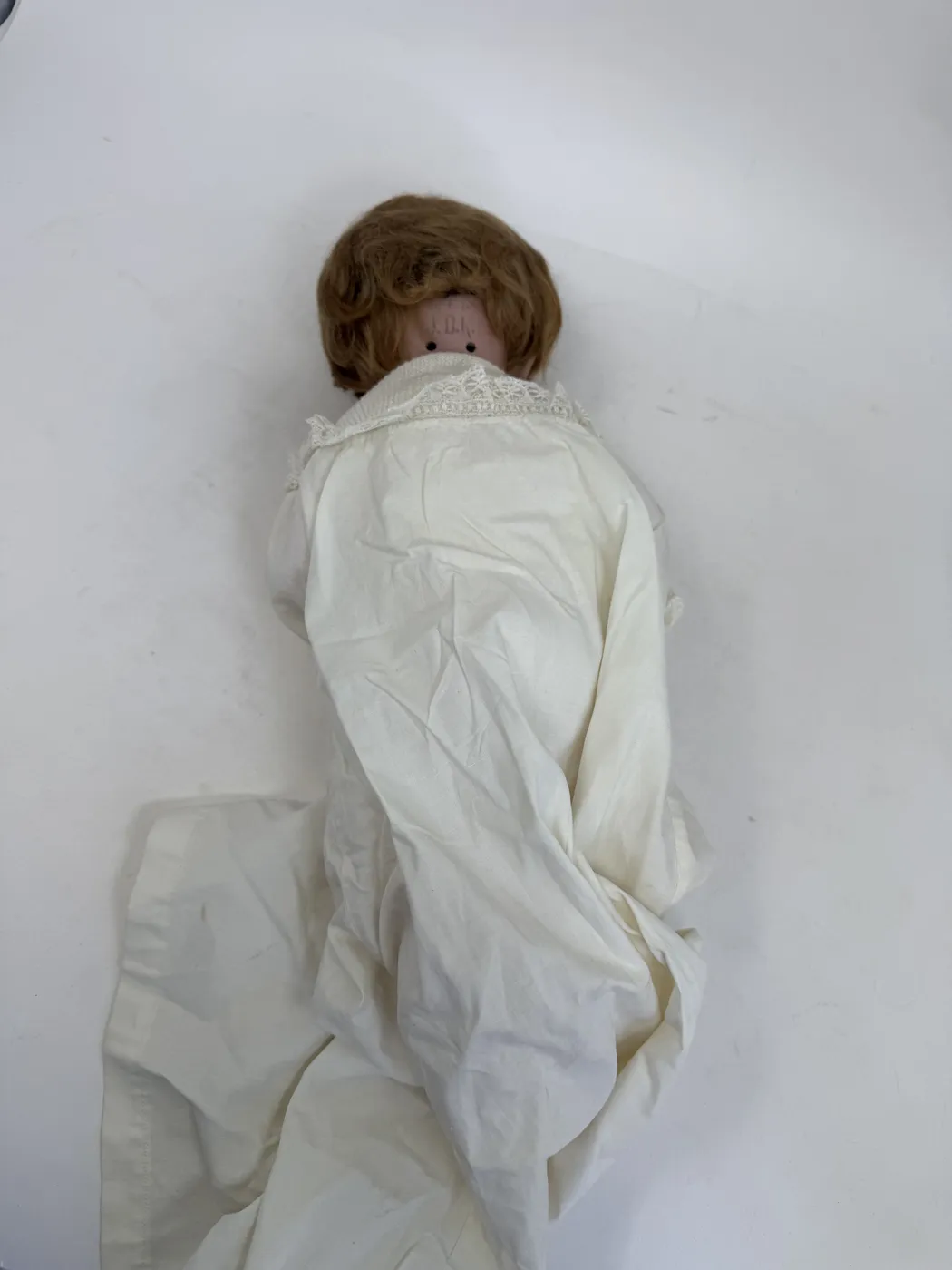
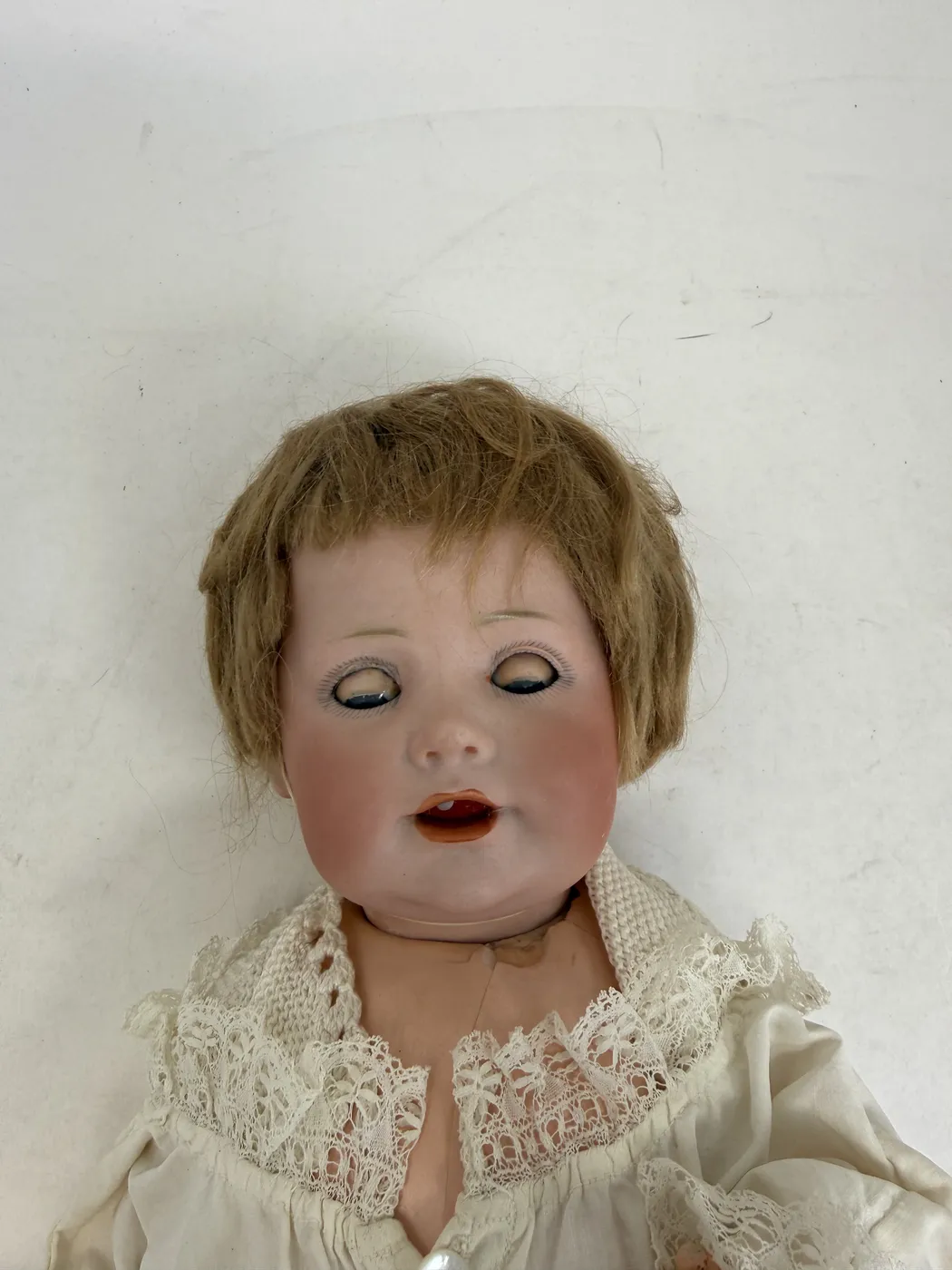
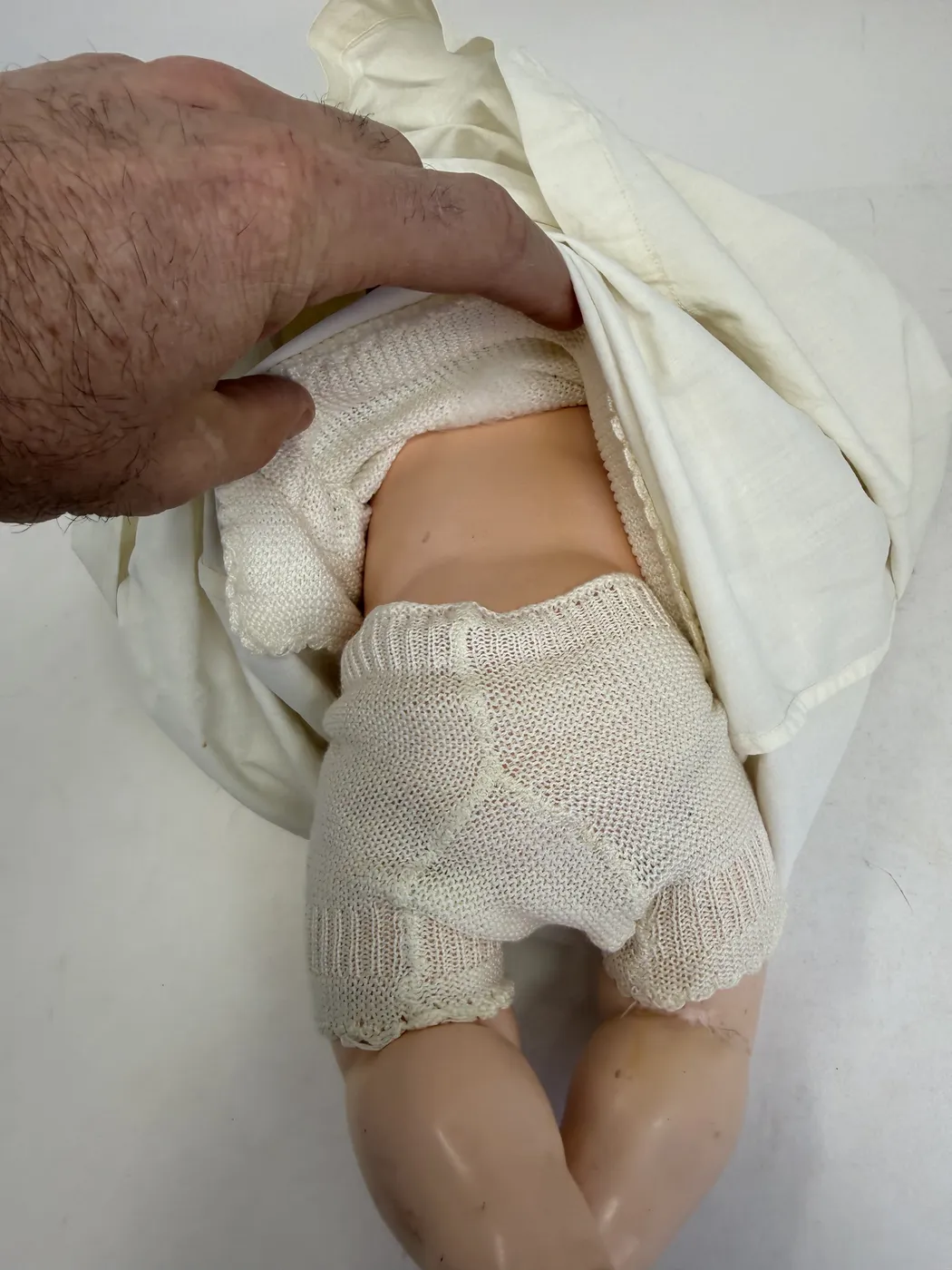
A German bisque character baby doll, mold number 247, marked “247” over “J.D.K.” on the back of the bisque socket head. The mold is one of Johannes Daniel Kestner Jr.’s character babies, introduced by the Waltershausen, Thuringia firm around 1912 in the wake of the commercial success of the more famous Hilda character baby (molds 245 / 237 / 1070). 247 is documented in the standard reference literature as a character baby with open mouth and two upper teeth, deep-blue sleep eyes with painted lashes, on a composition bent-limb baby body of the Kestner pattern. This example presents on its original-period composition body in a knit cotton romper, under a long white lace-trimmed christening gown, with what appears to be the original mohair wig. The first non-book object I’ve put into Curiosities. Provenance is a private collection being downsized; the object is in NMLP’s working stock for the moment because that’s how I came to be looking at it.
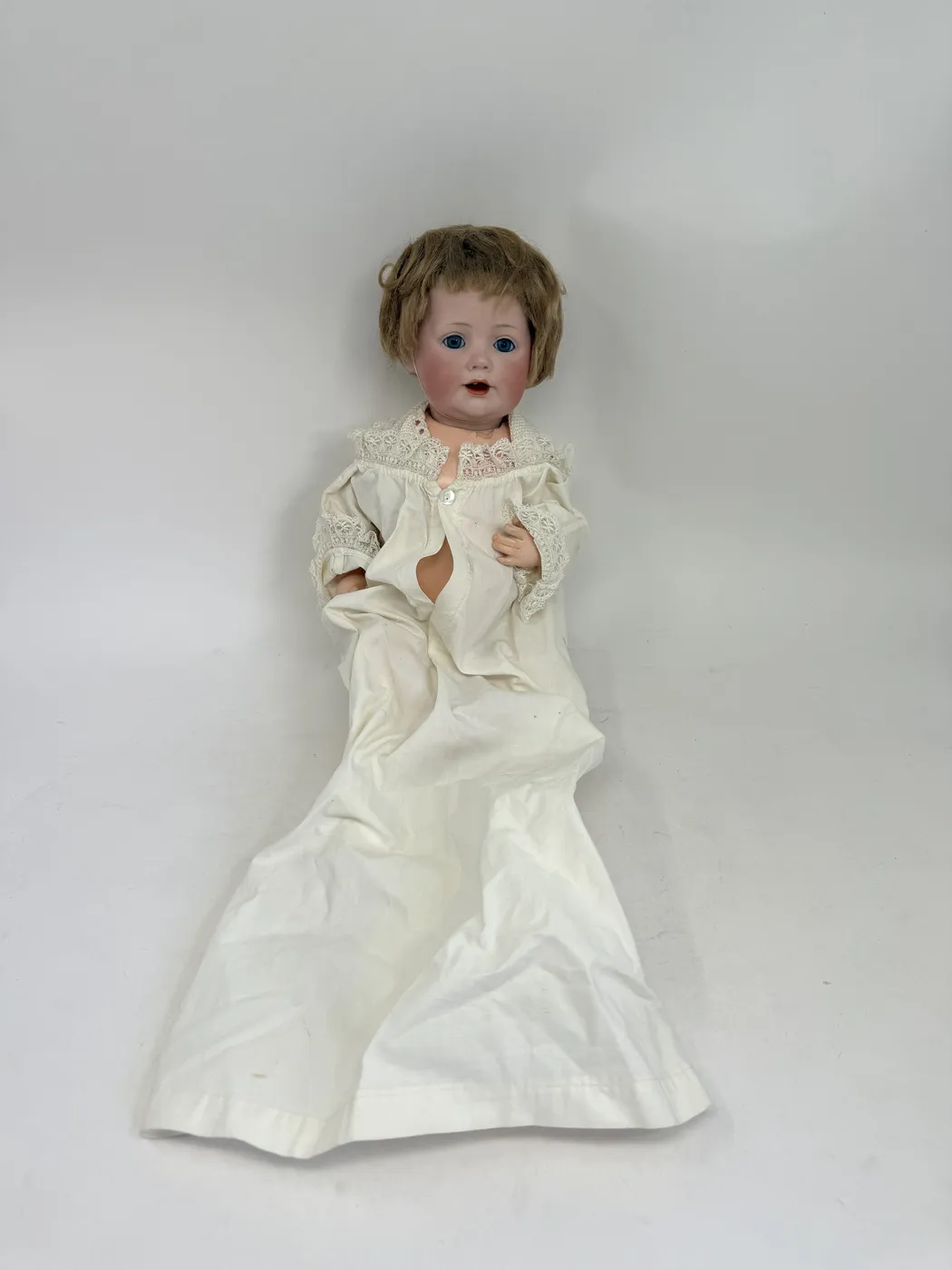
Catalog
What this doll is
Until last week I had never paid attention to German bisque character babies. The reference literature on Kestner is well-developed; the collector trade is small, knowledgeable, and unforgiving of misidentification; and the marks on the back of the head are diagnostic if you know what you’re reading. This entry exists to document what arrived in front of me, in detail, with the photographs against which any future buyer or researcher can sanity-check.
The maker is Johannes Daniel Kestner Jr.’s firm. Kestner founded a papier-mâché writing-board and toy operation in Waltershausen, Thuringia, in 1816; advertisements for his papier-mâché dolls with leather bodies are documented from 1823. Around 1860 the firm acquired the Ohrdruf porcelain factory and began to produce the bisque-head dolls that the collector market now associates with the name. By the late nineteenth century Kestner was, in the trade journals of the period, called “King of Doll Makers.” The factory used the “J.D.K.” mark on heads from roughly the 1890s until the firm exited bisque production around 1930 and was absorbed by Kammer & Reinhardt. The 1910s and 1920s are the period in which Kestner’s character babies — bisque heads cast from molds modeling realistic infant features rather than the idealized dolly-face of the earlier era — reached the height of their commercial success.
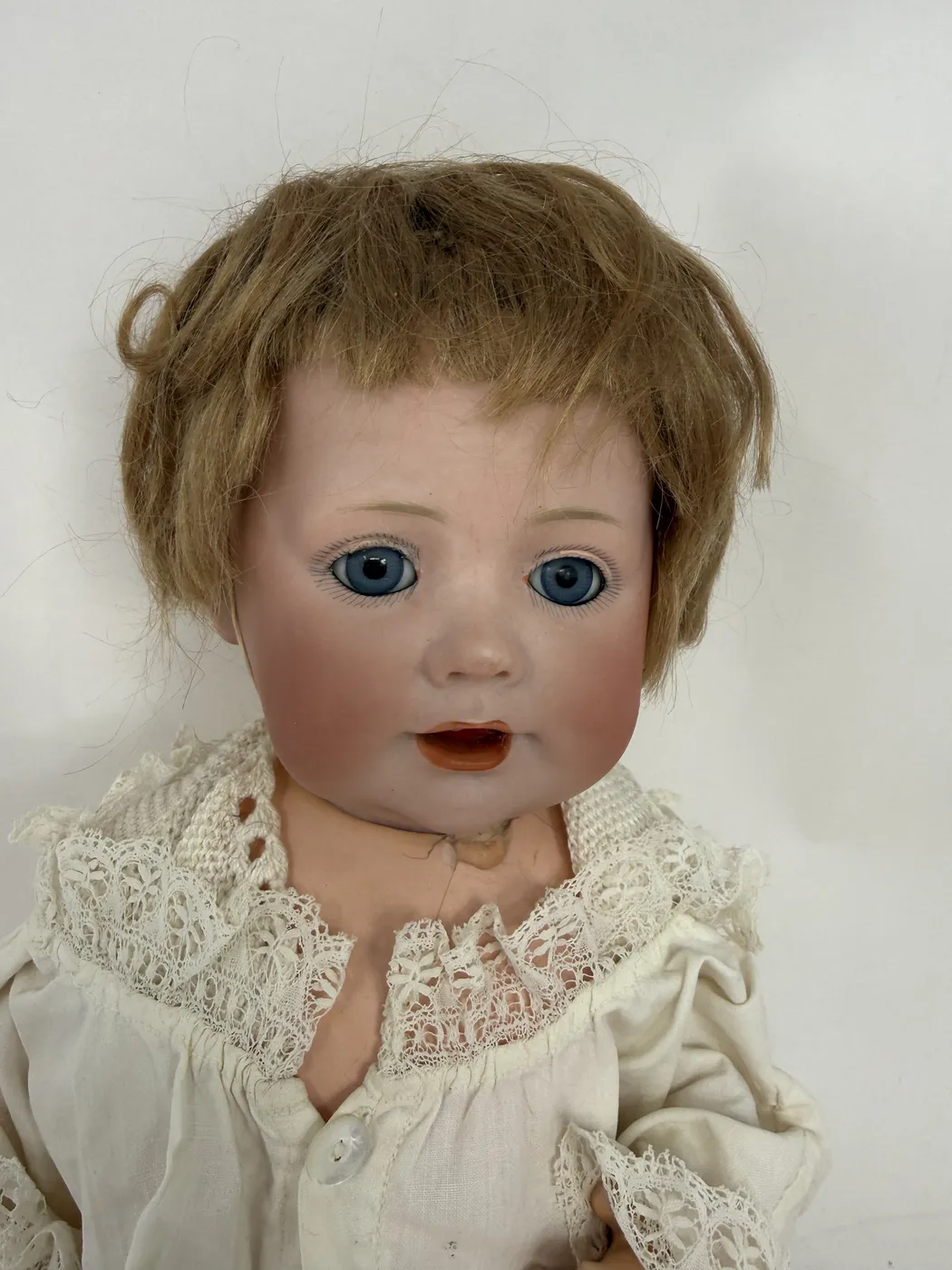
Among the Kestner character-baby molds, the most famous is Hilda — mold numbers 245, 237, and (later) 1070. Hilda was introduced in 1914 and is the doll the secondary market still treats as the gold standard of German character babies. Mold 247 is documented in the standard collector references (Coleman’s Collector’s Encyclopedia of Dolls; the Cieslik dictionary of German doll marks) as a Kestner character baby from the same cohort, with the WorthPoint reference example cataloged at c.1910; in the U.S. collector trade it acquired the nickname “Hilda’s sister” or, in some price guides, “Baby Jean.” The mold shares Hilda’s overall facial type — chubby cheeks, open mouth with two upper teeth, deep blue sleep eyes — but with slightly different modeling of the nose and chin that mold-specialists can distinguish from Hilda at sight.
The mold mark
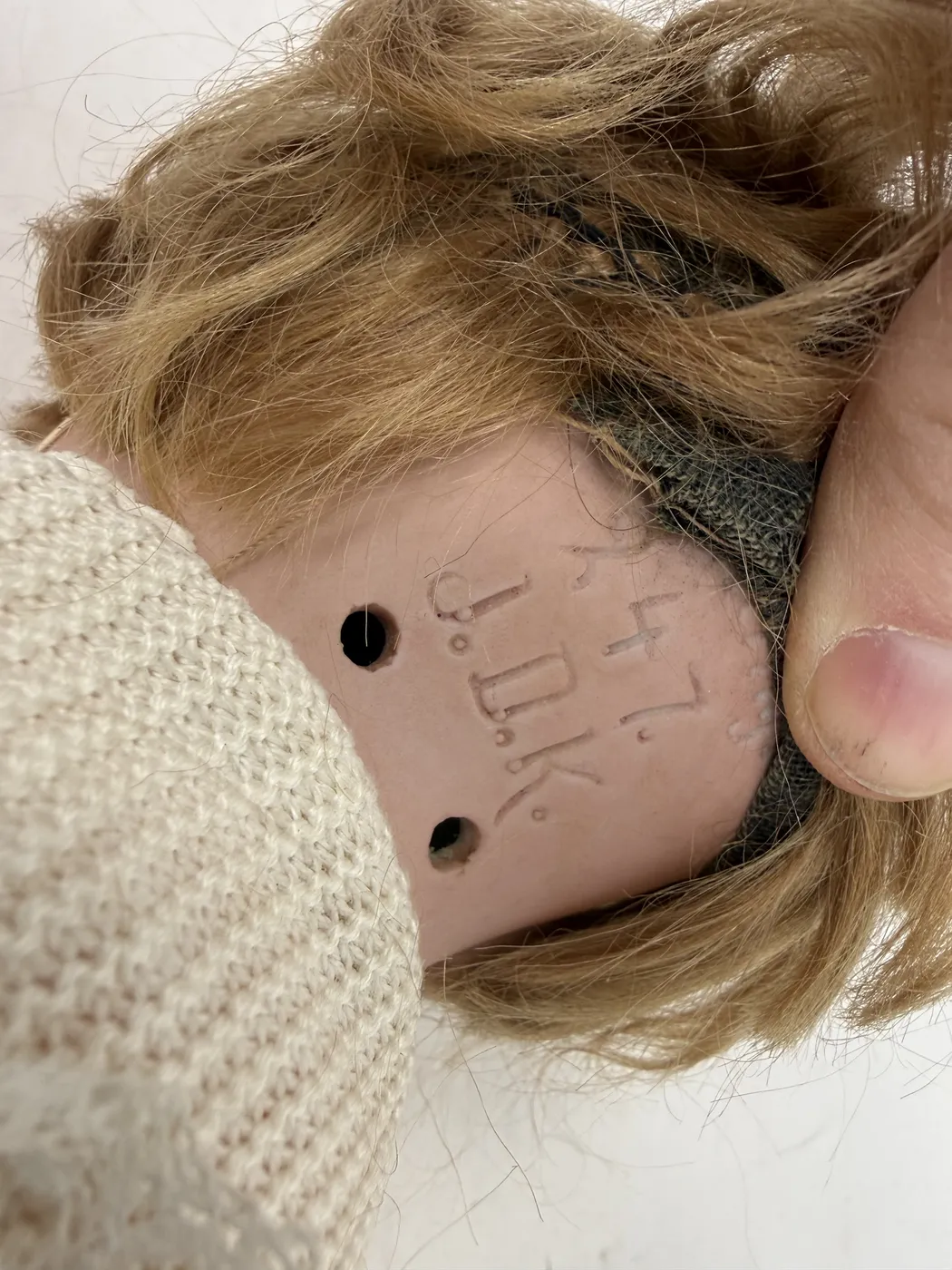
The mark is the entire identification. Bisque-doll mold marks in the 1900s–1920s were incised into the green-state porcelain before kiln-firing and then survive intact under any later paintwork, wig, or pate. The convention on Kestner heads was: mold number on top, maker mark on bottom, size or batch number sometimes added alongside. On this head the top line clearly reads “247” in Kestner’s characteristic numeral font; the bottom line reads “J. D. K.” with periods between each capital. Both lines are deep, clean, and unambiguous. The number is not 947, not 217, not 257 — it is 247.
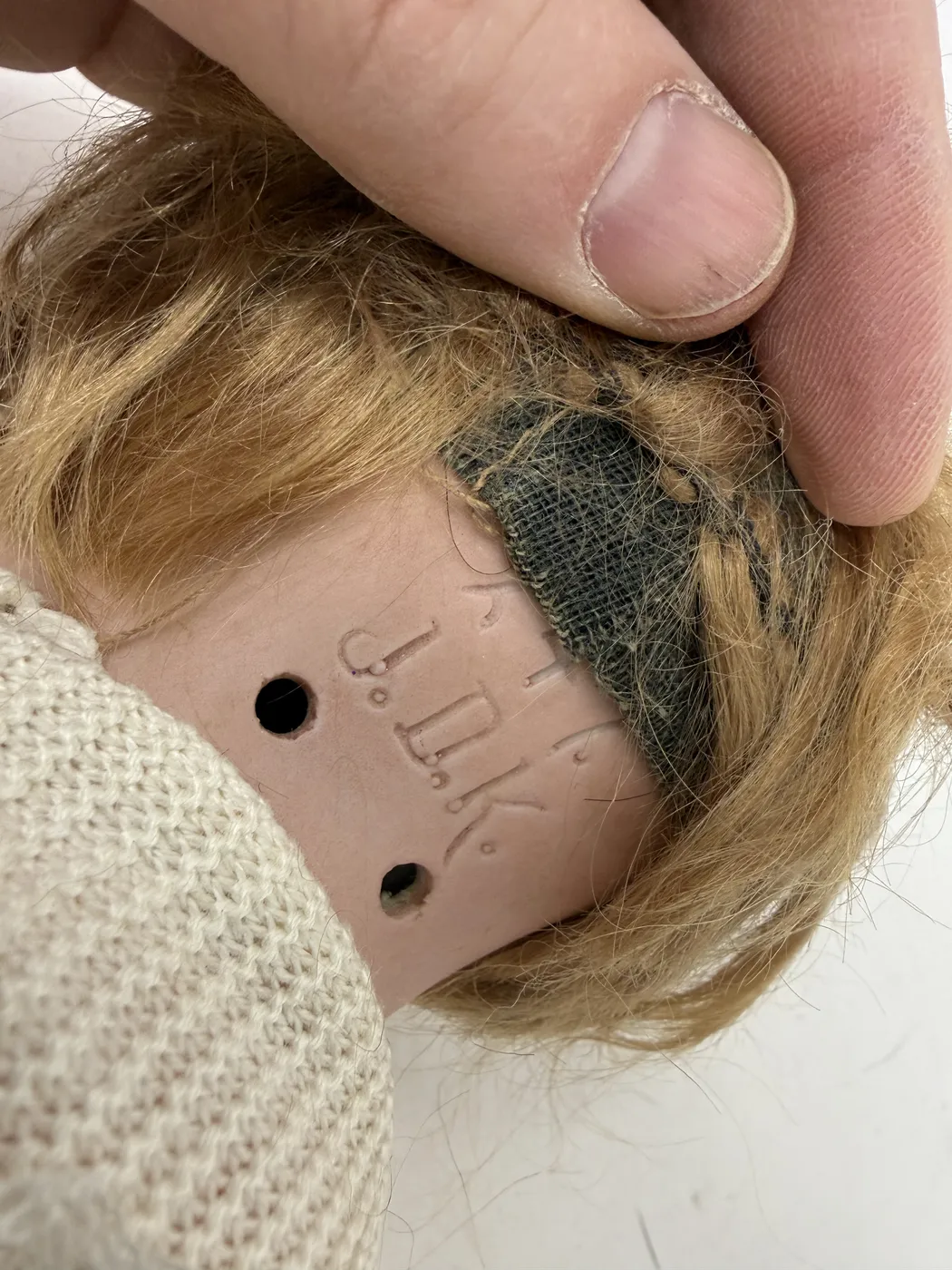
One further detail: the photograph of the back of the head exposed under the wig also shows a faint additional smaller numeral above the “247.” This is most likely the size designation. Kestner character heads were produced in a graded series of sizes, and the size number was usually struck immediately above or adjacent to the mold number. On this head the additional numeral reads approximately as a 9, which is consistent with the doll’s overall scale — a Kestner size 9 character baby would typically run in the 22- to 24-inch overall range, matching what’s in front of me. I am hedging on the exact size readout because the angle and the wig overhang make the digit slightly ambiguous in photograph; a buyer reading this entry should make their own examination.
The body, the wig, the costume
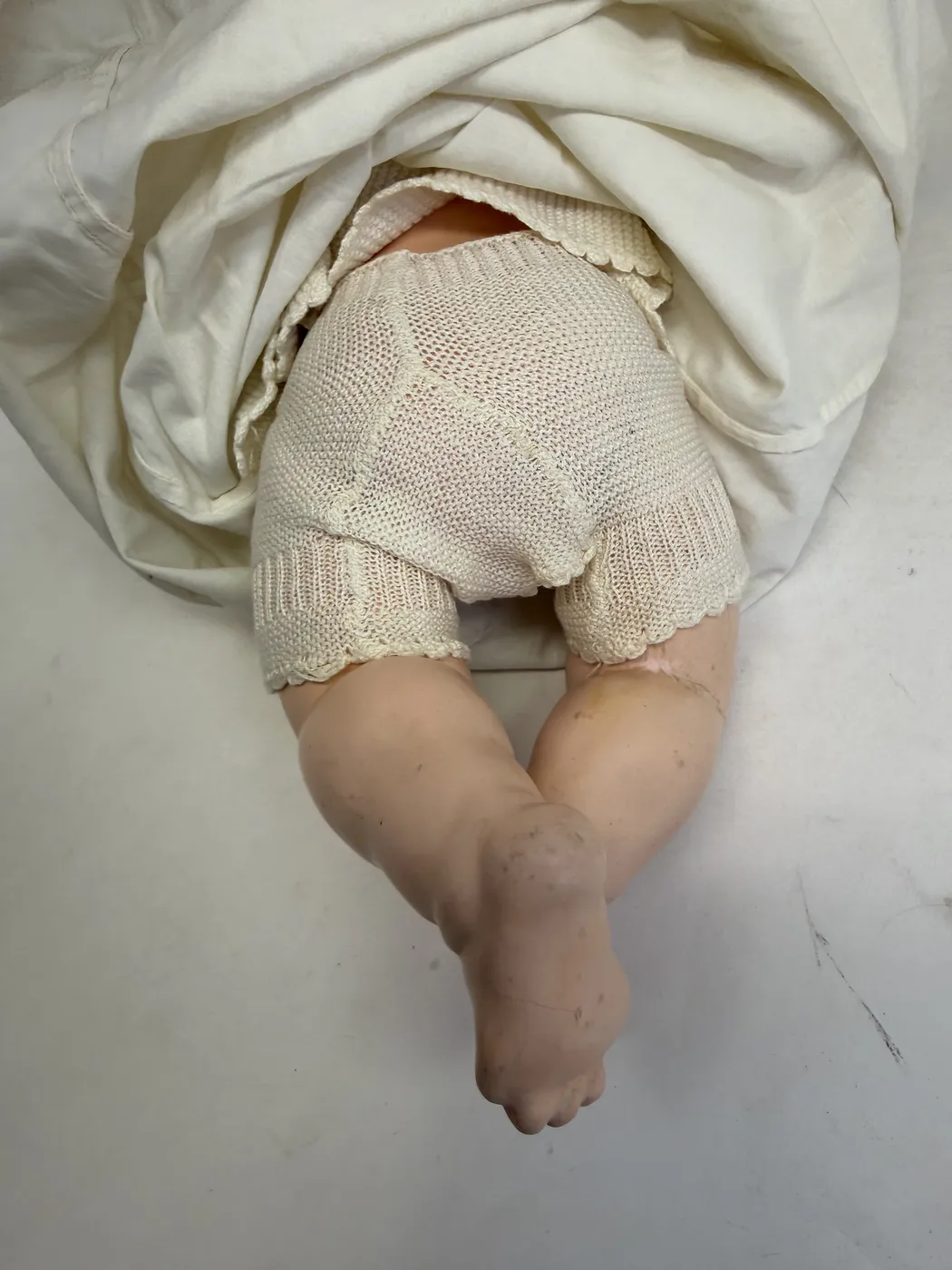
The bisque head is one half of the artifact. The other half is the body, and on a Kestner character baby the body is itself part of the identification. The Kestner composition bent-limb baby body of this period is a specific construction: a torso, two upper legs bent in a permanent seated curve, two upper arms similarly bent, all in composition (a sawdust-and-glue compound shaped in molds and then painted), strung internally with elastic. This is what is sitting under the christening gown on this doll.
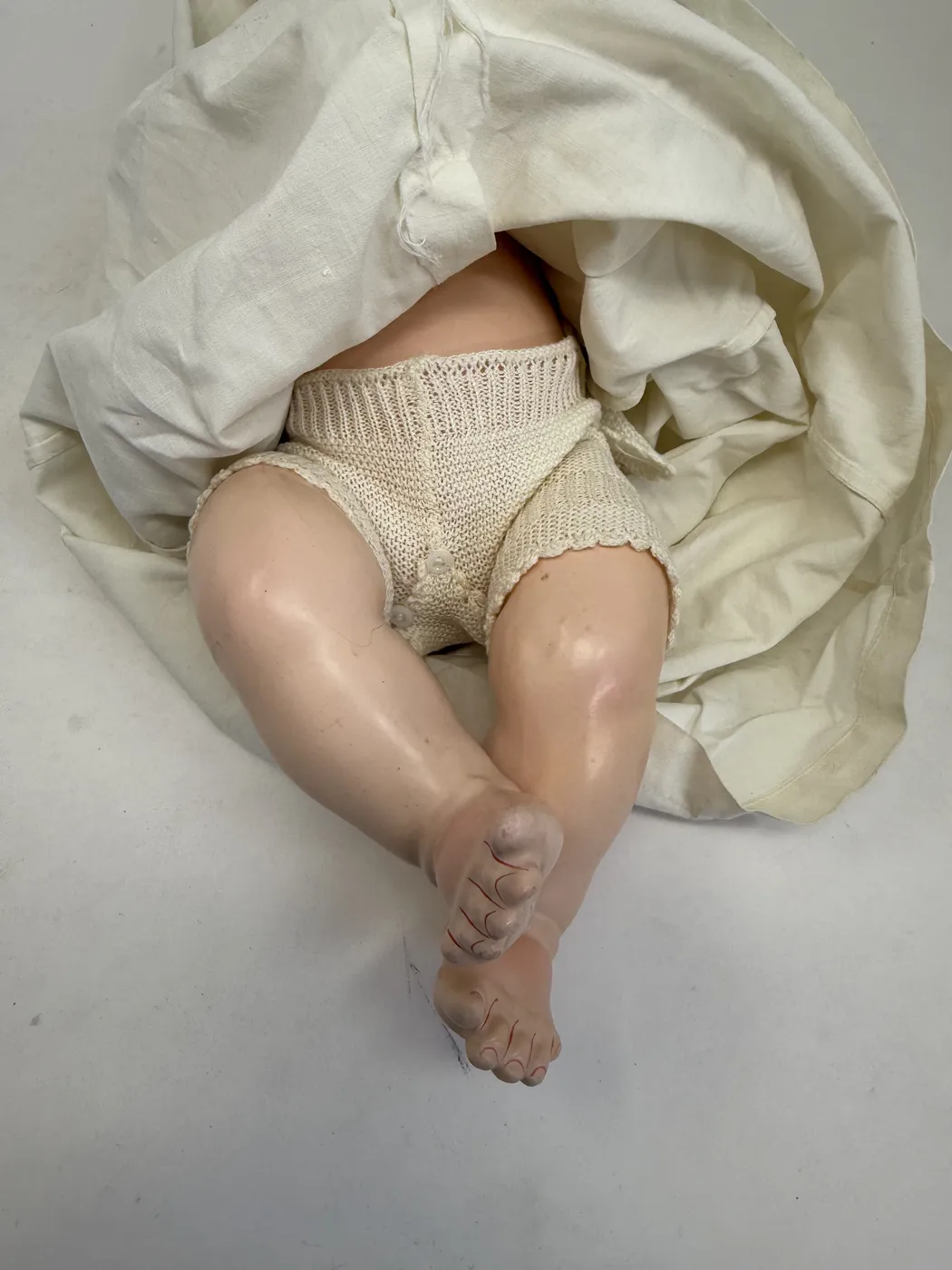
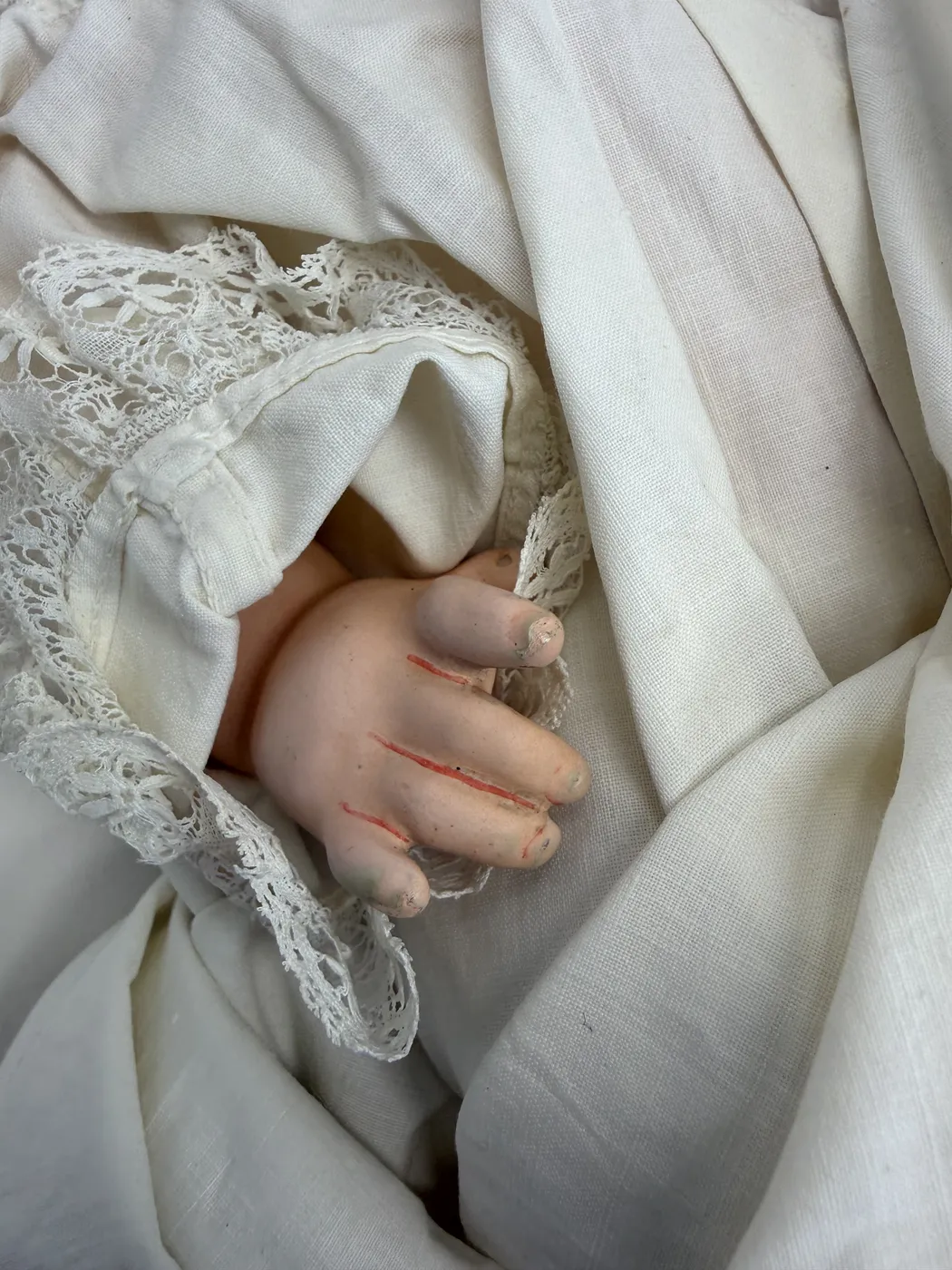
The hands deserve their own paragraph. Kestner composition hands on character babies have painted-on anatomical detail: a fine red line at each finger joint and a more pronounced red line at the base of each fingernail. On this doll the red detail survives in usable condition on both hands, with some areas of darker oxidation on the fingertips that are typical of the period and probably not worth attempting to clean. A doll specialist would describe the hands as untouched original-paint, which is the condition the market wants. The alternative — restored or repainted hands — signals a doll that has been worked on, and serious collectors discount accordingly.
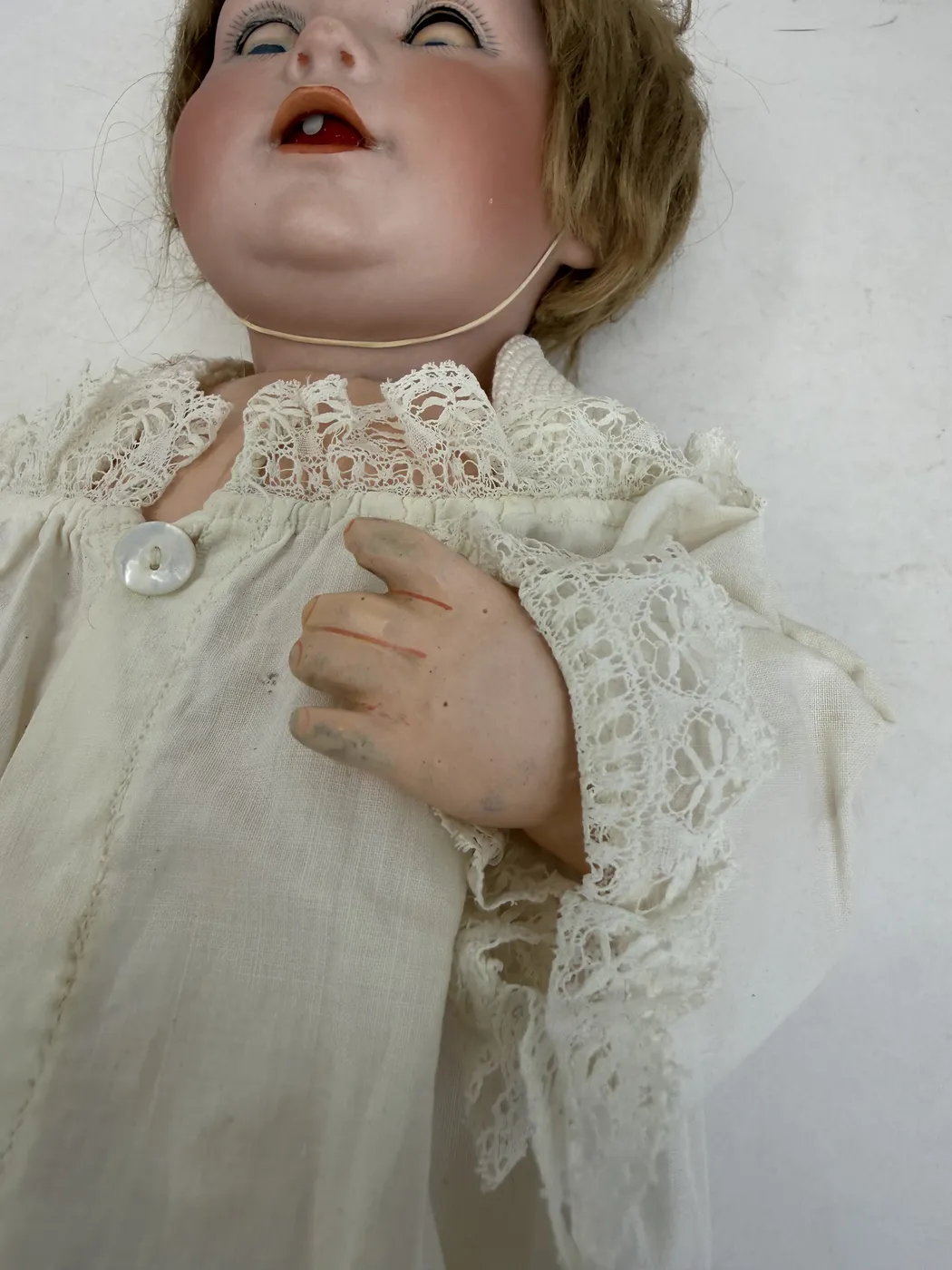
The mohair wig appears to be original to the period and possibly to this head. It is light brown, side-parted, short and slightly tousled, mounted on the original cardboard-and-fabric pate that itself sits over the cork-pate seal of the bisque head opening. Mohair wigs of the 1910s are usually identifiable by fiber feel and by the specific way the wefting sits at the temple; on this doll both signals read original. The doll has not, to my reading, been re-wigged.
Dating
The narrow dating evidence for this specific doll, in declining order of confidence: (1) the J.D.K. mark places production at the Kestner Waltershausen factory before the 1930 absorption into Kammer & Reinhardt. (2) Mold 247 is documented in the Coleman / Cieslik literature as a character baby in the same cohort as Hilda (mold 245, introduced 1914), with the WorthPoint reference example cataloged at c.1910. (3) The composition body and stringing method are the Kestner pattern of the 1910s and 1920s. (4) The mohair wig, lace insertion on the gown, mother-of-pearl button, and knit romper are all period-consistent with 1910s–1920s German doll dressing. None of these signals dates the specific doll more narrowly than “between c.1912 and the mid-1920s.” I think the most likely production date is in the 1912–1920 window, but I’m not in a position to be more specific than that without consulting a doll specialist.
What I can’t tell you: the exact year. The factory did not date individual heads, the size designation does not tie to a specific year, and the wig and costume are period-consistent without being year-specific. A specialist in Kestner character babies (the membership of the United Federation of Doll Clubs maintains networks of these specialists) could examine the bisque tone, the eyebrow paintwork, and the body construction in person and probably narrow it further. I have not commissioned that examination.
What I can tell you: the mold mark is unambiguous, the body and costume are period-consistent and not later replacements, and the doll is therefore a real Kestner J.D.K. mold 247 character baby of the original c.1912–1925 production window, not a reproduction or a later mold-revival cast. Modern reproductions of Kestner character babies do exist (some marked with reproducer’s mark, some not), but they are bisque-poured to slightly different specifications and the body, when present, is contemporary rather than period composition.
I pick up books for free anywhere in the metro area. Call 505-250-3804 to schedule.
Why this is filed in Curiosities (and is the first non-book entry)
The main NMLP archive is reserved for regionally significant New Mexico books, NM-published or NM-provenance. The Curiosities section is reserved for objects that are operationally significant to NMLP’s daily work but that fall outside the New Mexico regional thesis. Until now, every Curiosities entry has been a book — signed mid-century cookbooks, a 1930s Italian state-tourism brochure, the Tarantino Pulp Fiction screenplay, the Lynn Andrews Medicine Woman bestseller. This is the first non-book entry.
I extended the section to include objects (not just books) because the same standards apply: multi-photo bibliographic record, external authority references (here, the Coleman and Cieslik literature; the Wikipedia entry on Kestner; the Doll Reference database of mold numbers), Chicago-format citation, evenhanded factual treatment. A century-old German bisque character baby in a documented mold has the same kind of citable specificity a signed book has — the mark is on the head, the body is the maker’s pattern, the date window is in the published literature, and a researcher or a future buyer can verify every claim in this entry against independent sources.
The doll is in NMLP’s working stock at the moment because the donation pipeline that supplies my book business is also the channel through which other things occasionally arrive. This particular doll came in as part of a private collection being downsized; the owner is retiring from active collecting. The doll is not for sale via NMLP and the NMLP donation flow on the site is for books, not objects. The archive entry, however, will stand regardless of where the doll ends up.
How this came in
Source: a private collection being downsized. The owner is a long-term collector retiring from active collecting and stepping out of a household’s worth of vintage and antique inventory. NMLP’s book-donation pipeline is the channel that surfaced the broader handoff; I’m one of the people the collector trusts to evaluate and document material before it moves to its next phase. The doll’s commercial disposition is being handled separately from NMLP and is not relevant to this archive entry.
Where this is going
The doll will move into the antique-doll resale market through a channel appropriate for it. Kestner character babies in this mold, in original-paint condition with original-period body and wig, are a specific collector market segment with a small but stable membership; eBay, Ruby Lane, the United Federation of Doll Clubs marketplace network, and specialized antique-doll auction houses (Theriault’s in Annapolis is the best-known U.S. specialist) are the standard channels. The archive entry will remain regardless of which channel the doll moves through. If you have arrived at this page because you are researching a doll you own with a similar mark, the comparison photographs are the point.
External references & authoritative sources
- J. D. Kestner — Wikipedia: en.wikipedia.org/wiki/J._D._Kestner — encyclopedia entry on the firm, with founding date, factory location, mark history, and the 1930 Kammer & Reinhardt absorption.
- Doll Reference — Kestner J.D.K. mold list (1820–): dollreference.com — Kestner doll marks and mold numbers — the standard online catalog of Kestner J.D.K. mold numbers including 247.
- Doll Reference — Kestner J.D.K. bisque dolls overview: dollreference.com — J.D.K. Kestner “King of Doll Makers” — firm history and trade reputation overview.
- WorthPoint — J. D. Kestner / Kestner & Company Dolls guide: worthpoint.com/dictionary — J. D. Kestner — mark history, mold-number overview, and price-guide context.
- WorthPoint — antique Kestner J.D.K. 247 example listing: worthpoint.com — “Hilda’s sister” JDK 247 c.1910 — a documented JDK 247 reference example with the “Hilda’s sister” trade nickname.
- United Federation of Doll Clubs (UFDC): ufdc.org — the national doll collecting association; maintains specialist networks for Kestner identification.
- Coleman’s Collector’s Encyclopedia of Dolls (Crown / Hobby House Press): Dorothy S., Elizabeth A., and Evelyn J. Coleman — the standard print reference for German bisque doll identification, mold numbers, and manufacturer histories. Out of print but widely available used; the entry on Kestner is the starting point for any J.D.K. attribution.
- Cieslik, Lexikon der deutschen Puppenindustrie: Jürgen and Marianne Cieslik’s German doll-mark dictionary — the German-language equivalent of Coleman, with detailed mold-number documentation for Waltershausen-area firms.
How to cite this archive entry
Eldred, Josh. “Kestner J.D.K. Mold 247 Bisque Character Baby (c.1912–1925) — ‘Hilda’s Sister / Baby Jean’ in Original Christening Gown.” NMLP Donation Archive — Curiosities, May 11, 2026. https://newmexicoliteracyproject.org/archive/curiosities/kestner-jdk-247-character-baby
Related on this site
- Ideal Toy Co. P-90 Toni doll (Hackensack, NJ, c.1949–1953) — the American mid-century mass-market hard-plastic counterpart to the German bisque character baby; entered into the same downsizing handoff and documented in the parallel Curiosity entry.
- Back to the Curiosities index
- Main archive index
- Golf in Italy — ENIT 1930s Italian Art Deco brochure — a non-NM object whose value sits in the bibliographic and material-culture record rather than in regional provenance; the closest existing precedent on the section for this kind of documentation.