Curiosity entry · American hard-plastic mid-century doll · Foundational consumer-product cross-promotion
Ideal Toy Co. P-90 Toni doll — Hollis, Queens, c.1949–1953
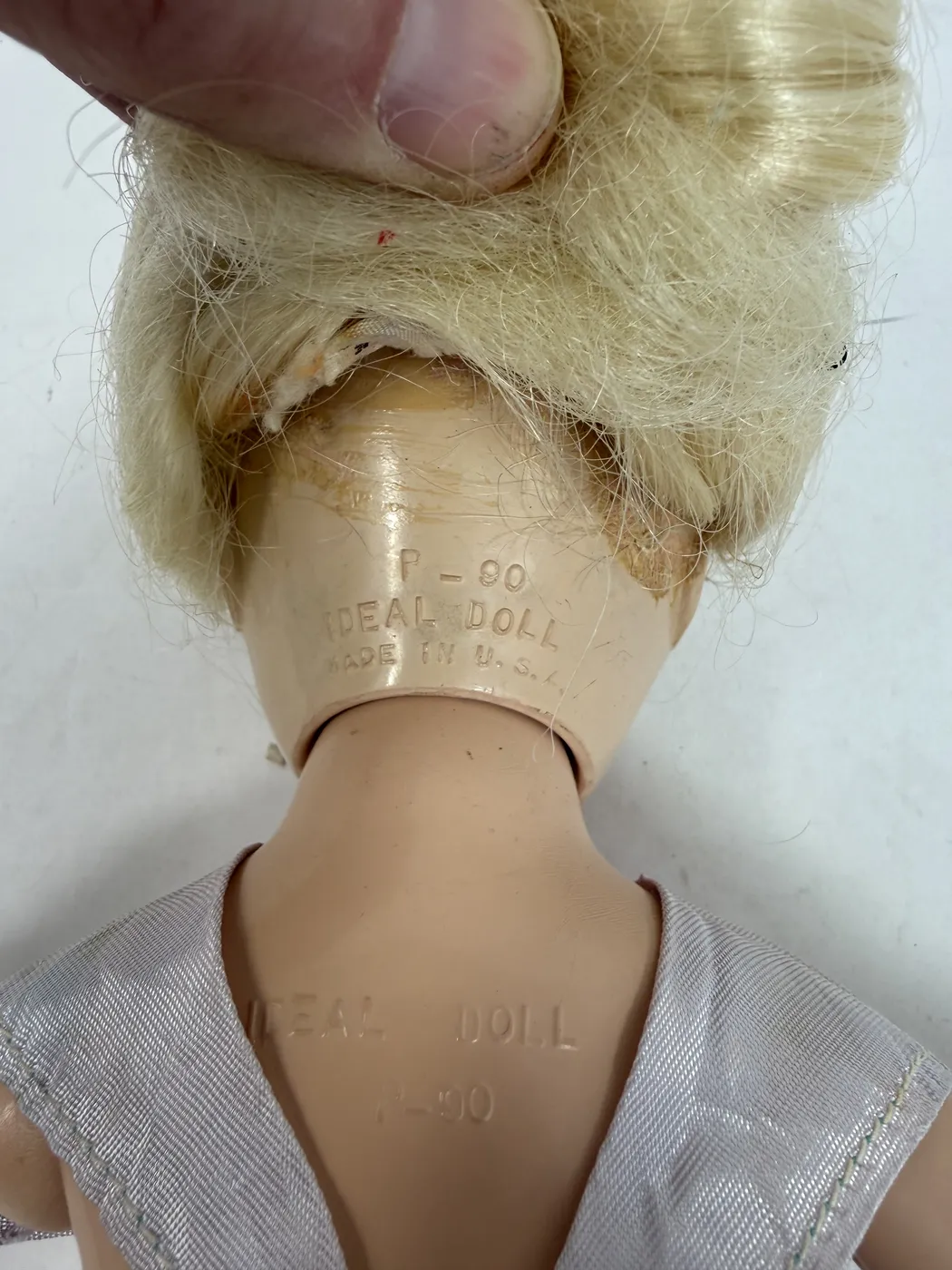
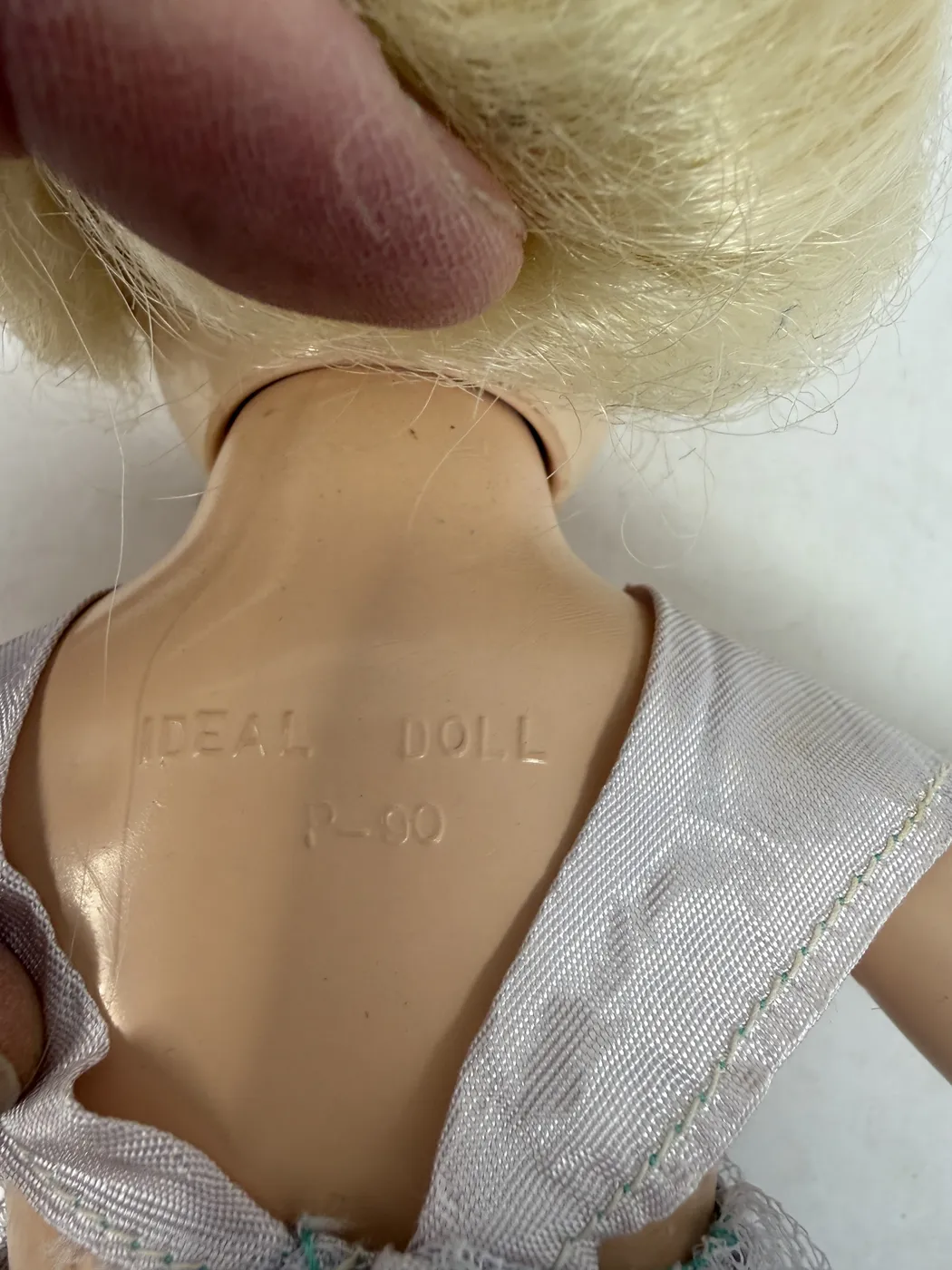
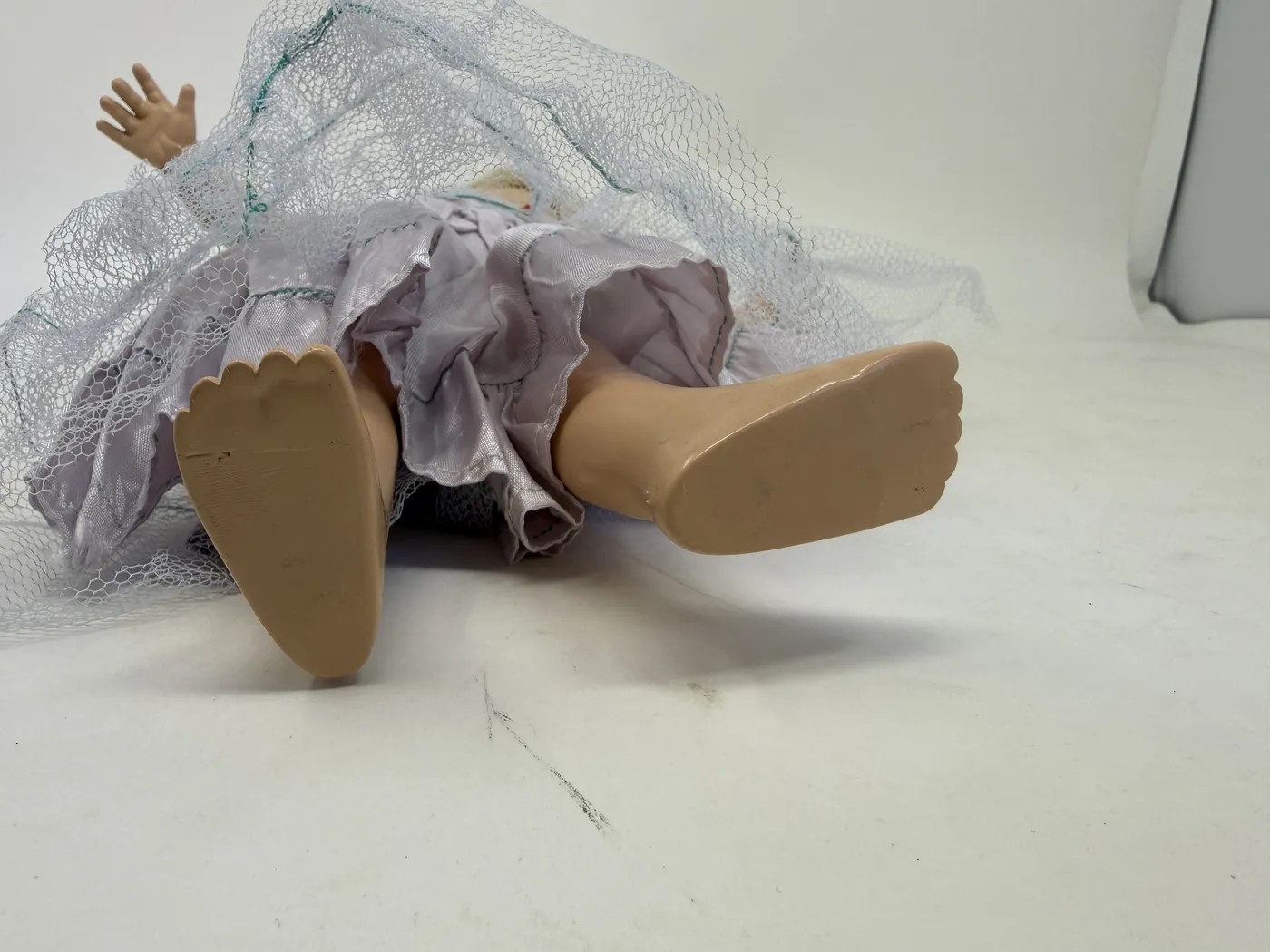
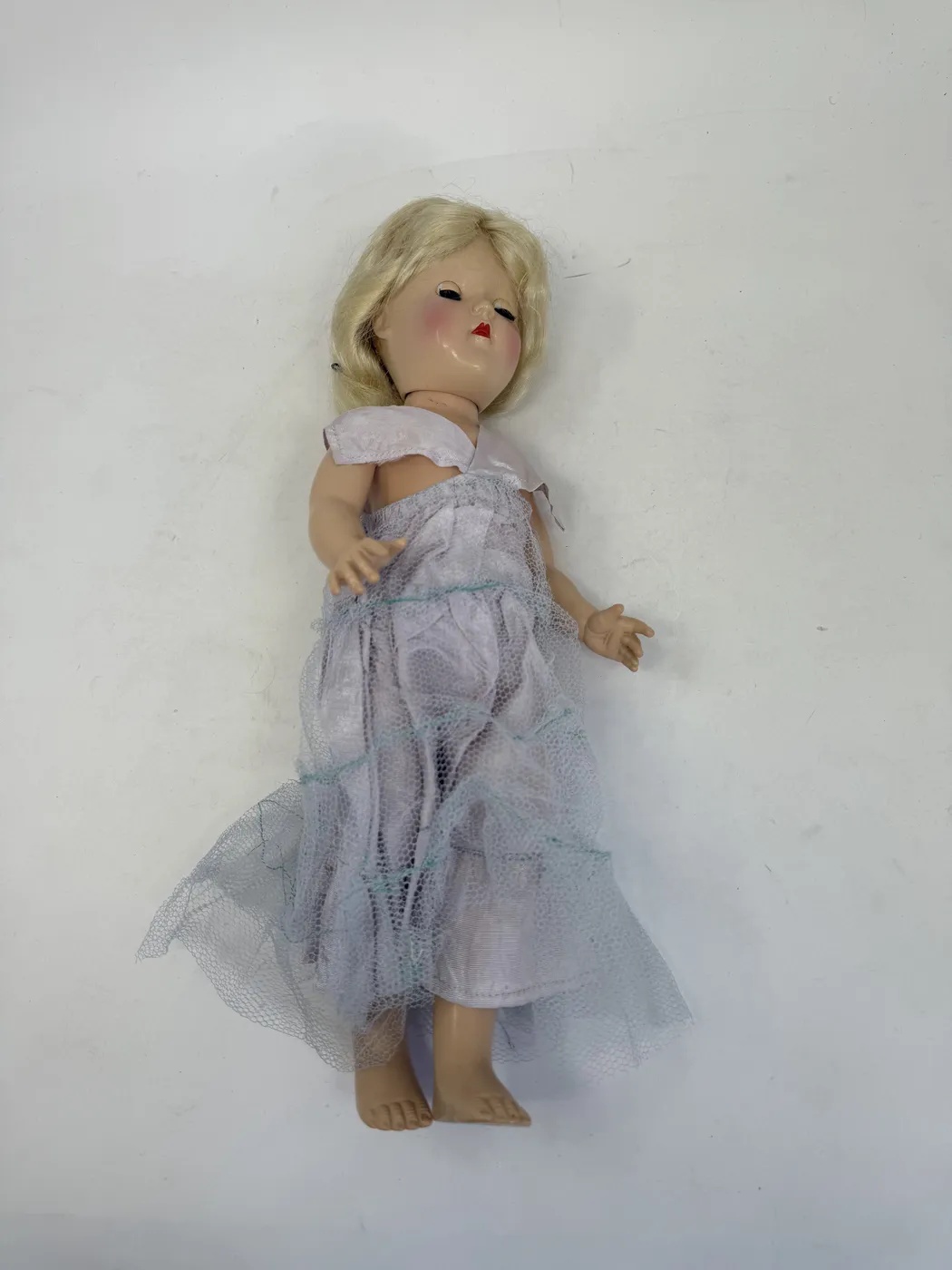
A 14-inch hard-plastic doll made by Ideal Toy Company at its Hollis, Queens factory between 1949 and roughly 1953, marked “P-90 / IDEAL DOLL / MADE IN U.S.A.” on the back of the head and “IDEAL DOLL / P-90” again on the upper back. The Toni line was the toy tie-in to the Toni Home Permanent — the dominant home-permanent product of late-1940s America — and a foundational example of consumer-product cross-promotion in mid-century mass-market doll manufacturing. This example is the smallest of the Toni sizes (P-90 = 14 inches; P-91 = 15; P-92 = 16; P-93 = 19; P-94 = 22.5), in its original-period lavender taffeta and tulle dress with the original platinum-blonde nylon-fiber wig. Paired with the Kestner J.D.K. 247 character baby from the same retirement liquidation, this entry is the second non-book Curiosity in the archive.
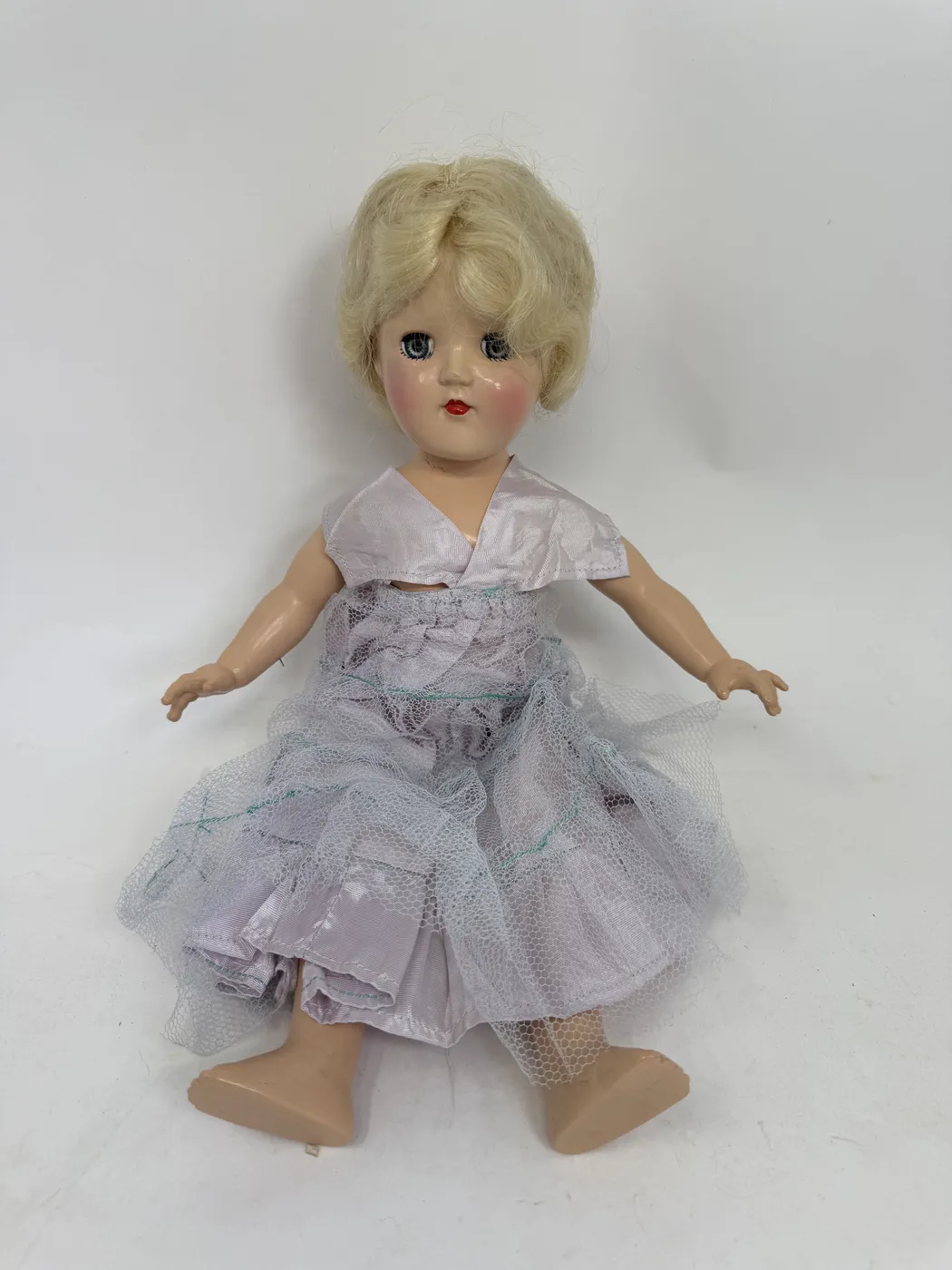
Catalog
What this doll is
I had to look up Ideal Toy Company to refresh my own understanding of the firm before writing this. The short version is: the same Hollis, Queens factory that gave America the original teddy bear in 1903 also gave America the hard-plastic Toni doll in 1949. It is one of the few firms in American toy history whose product line bookends the central material-history shifts of the twentieth-century doll trade: from plush (the teddy bear, 1903) through composition (the Shirley Temple doll, 1934–1936) into hard plastic (the Toni line, 1949) and then vinyl and the 1960s plastics. The Toni doll is the firm’s hard-plastic pivot, and it is also one of the foundational examples of a doll line designed from the ground up as a cross-promotional tie-in to a consumer product made by a different company.
The firm started as Ideal Novelty and Toy Co., founded in 1907 in Brooklyn by Morris and Rose Michtom, Russian-Jewish immigrants. The Michtoms had, in 1903, become the original producers of the “Teddy’s bear” named for Theodore Roosevelt after Roosevelt’s widely reported refusal to shoot a bear cub on a 1902 Mississippi hunt; the Michtoms wrote to the White House for permission to use the President’s name and got it. From the Brooklyn beginning Ideal moved to a factory on Jamaica Avenue in Hollis, Queens, after acquiring the Langer printing-factory site in 1943. By 1949, when the Toni doll launched, Morris Michtom had died (1938) and the company was being run by his son Benjamin Michtom (Vice-President) and by the toy-industry operator Lionel Weintraub, whom Ideal had hired in 1941 and who is credited with the operational expansion that made Ideal a top-three American toy manufacturer through the 1950s and 1960s.
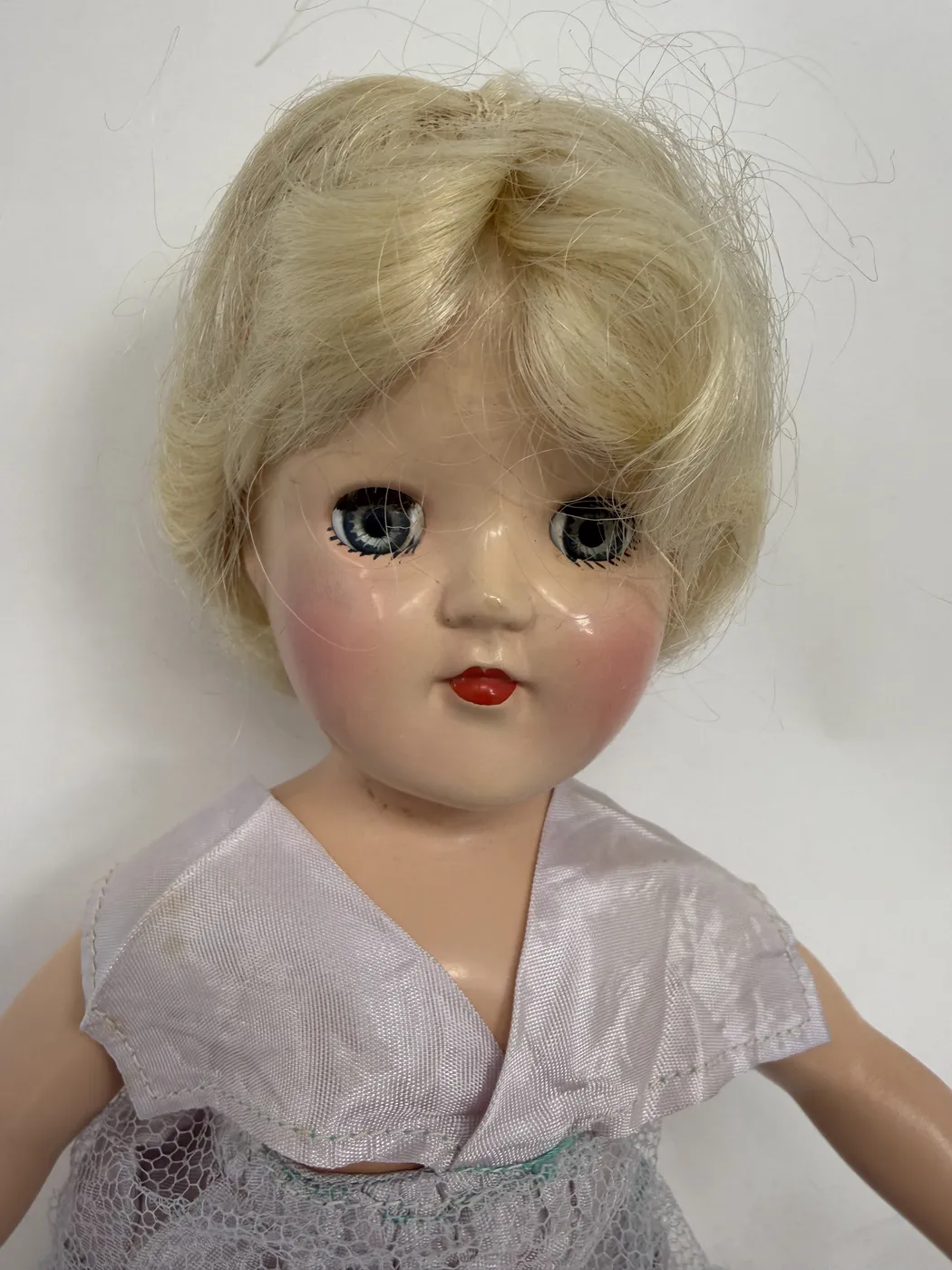
The Toni line itself launched for Christmas 1949. The tie-in product was the Toni Home Permanent, the late-1940s home-permanent kit that had been the runaway commercial success of postwar American hair-care advertising. The Toni Company had been acquired by the Gillette Safety Razor Company in 1948. In 1949 Ideal licensed the Toni brand from Gillette, designed a doll line around it, and shipped each doll with a Toni-branded play-wave permanent kit (small plastic curlers, a non-chemical “wave solution,” and tying papers) so that the child owner could put a permanent into the doll’s nylon-fiber wig at home in the same way her mother was putting a Toni permanent into her own hair in the bathroom. The doll’s wig was specifically nylon-fiber rather than mohair because nylon could be heat-set and re-set, and so could simulate the home-permanent process the parent product was selling.
The marketing of the doll borrowed the same campaign that had built the parent product. “Which twin has the Toni?” was the Toni Home Permanent advertising line of the late 1940s — the print ads featured pairs of identical twins, one of whom had been given a Toni home permanent and one of whom had been given a salon permanent, and the implication was that an untrained reader could not tell them apart in a photograph. The doll line was marketed off the same premise: the doll’s wig could be re-permed at home, indistinguishably from a real permanent. The marketing partner Ideal lined up was the actress June Haver, then a Twentieth Century Fox musical star nearing the end of her film career. By Christmas 1949 Ideal had received more than 200,000 advance orders.
The mold mark
The mark is unambiguous. Two molded-in identifications — one on the back of the head, one on the upper back of the body — both calling out the P-90 mold by name. This is the standard Ideal Toni-line marking and is documented in the Doll Reference Ideal catalog. The P-90 designates the 14-inch size; collectors and Doll Reference document the rest of the Toni size series as P-91 (15″), P-92 (16″), P-93 (19″), and P-94 (22.5″). The same head and body mold tooling was reused by Ideal for two related lines: Mary Hartline (the children’s TV-show personality of Super Circus, on ABC 1949–1956) and Sara Ann. Different wig, different outfit, same underlying mold — the way mass-market mid-century plastic toymaking worked.
Hard plastic, 1949
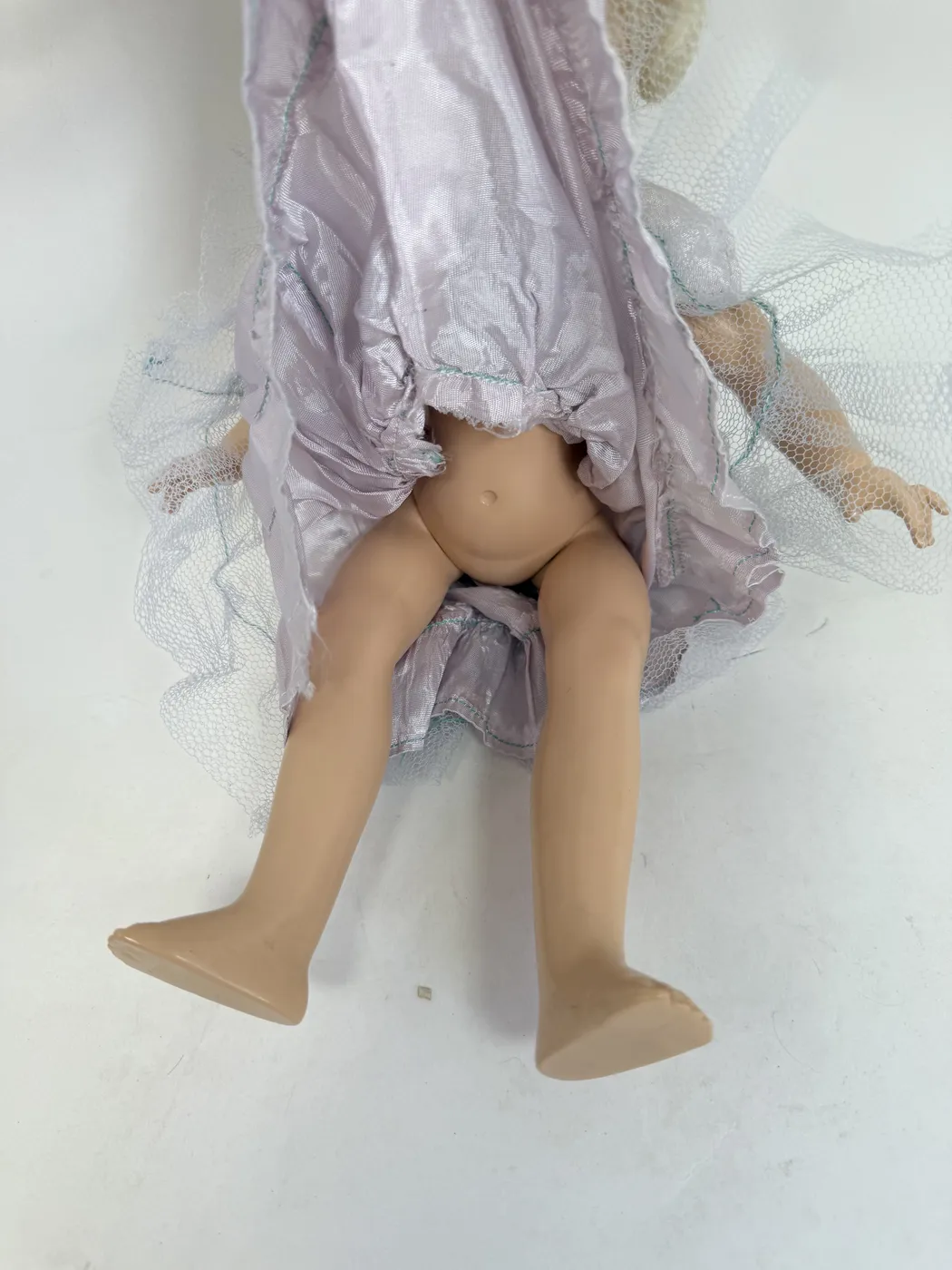
Hard plastic is a specific material moment in American doll history. The composition baby bodies of the 1910s and 1920s — the same material as the Kestner J.D.K. 247 character baby this entry is paired with — gave way in the 1930s to a mix of composition and the new injection-molded plastics, and by the late 1940s the hard-plastic doll body had become the industry standard. Hard plastic was lighter than composition, did not craze or crack the same way, accepted color uniformly, and could be tooled to a higher level of facial-feature detail. The Toni line is the canonical late-1940s hard-plastic doll. The same five-piece-jointed body construction (head, two arms, two legs strung internally with elastic) that Ideal used on the P-90 Toni was used across most of the firm’s late-1940s and early-1950s lines.
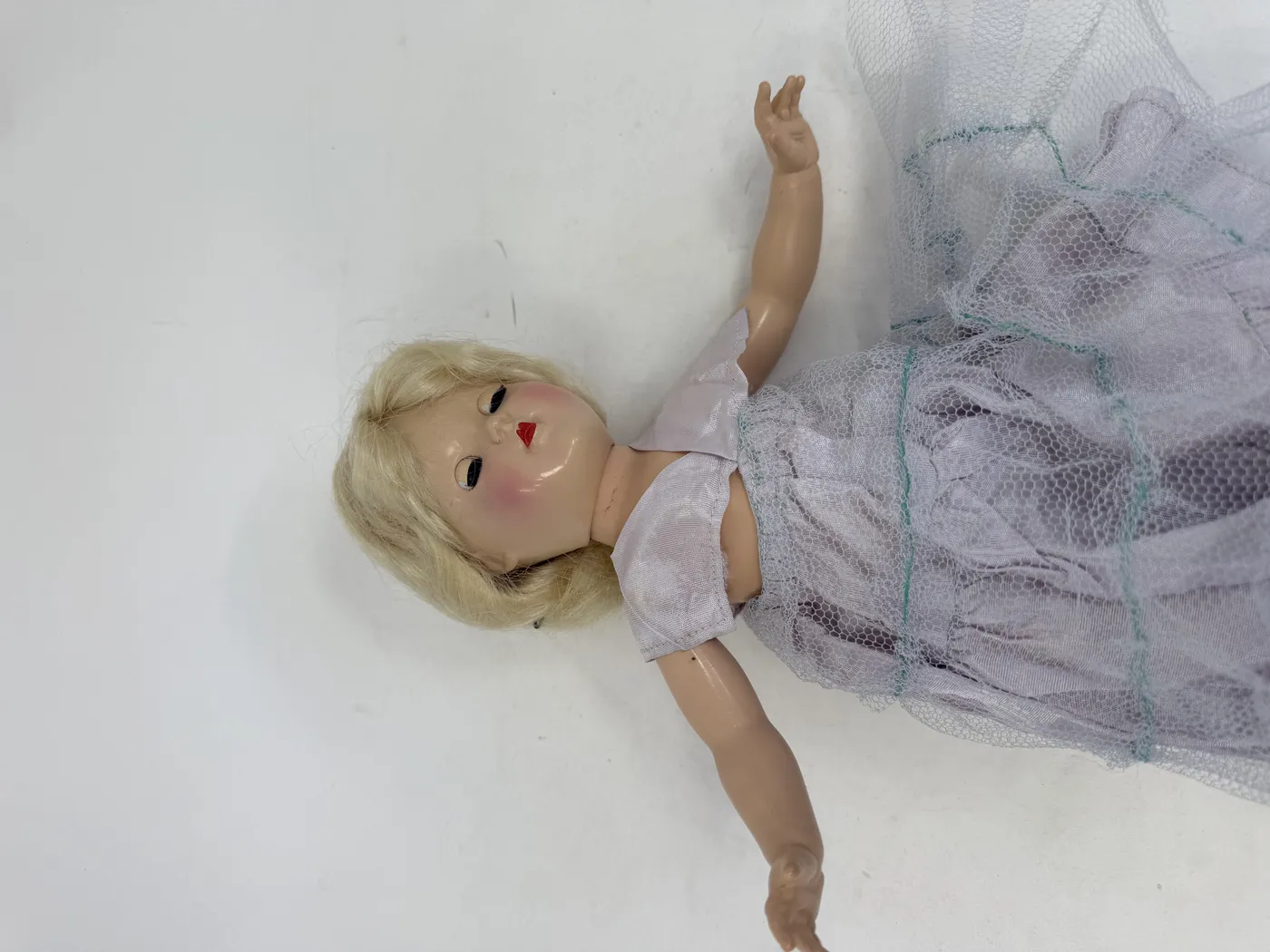
The doll’s eye mechanism, the “sleep eye,” is itself a material-history moment. Sleep eyes had been used in German bisque-head dolls since the late nineteenth century: a counter-weighted glass eye armature swung closed when the head was reclined. Ideal’s 1949 implementation used a similar counter-weighted armature but with a hard-plastic eye assembly rather than glass, an early consumer-product implementation of the technology that would become standard across hard-plastic and vinyl dolls in the 1950s. On this specific P-90, the sleep mechanism still works after roughly seventy-five years; the eyes close cleanly when the doll is laid down, and the upper-lash paintwork survives intact around the eye edges.
A note on the cross-promotion
The Toni line is worth documenting partly because it is one of the earliest mass-market American examples of a children’s product designed from the ground up around a consumer product made by a different company aimed at the child’s mother. Earlier celebrity-tied doll lines existed — Ideal’s own Shirley Temple doll of the mid-1930s is the major precedent — but those were tied to a movie-star personality, not a consumer-packaged-good product line. Toni inverts that: the doll exists to extend the brand attention of a non-toy product into the children’s market. By the late 1950s this would become a standard pattern (Mattel’s Barbie, launched 1959, is itself partly an inheritor of the Toni mode of marketing). In 1949 the pattern was still novel enough to be commercially distinctive.
The original retail concept also included two specific elements that bear noting in any reception-history account. First, the play-wave permanent kit packaged with the doll: small plastic curlers, a small bottle of harmless “wave solution” (sometimes sugar water, sometimes a thickened starch), and tissue papers. The kit was disposable; many surviving Toni dolls have lost their kits. Second, the partnership marketing with the Toni Company itself: a child who bought a Toni doll would also be exposed at the toy-store point-of-sale to advertising for the parent home-permanent product aimed at her mother. The integration was deliberate.
Dating
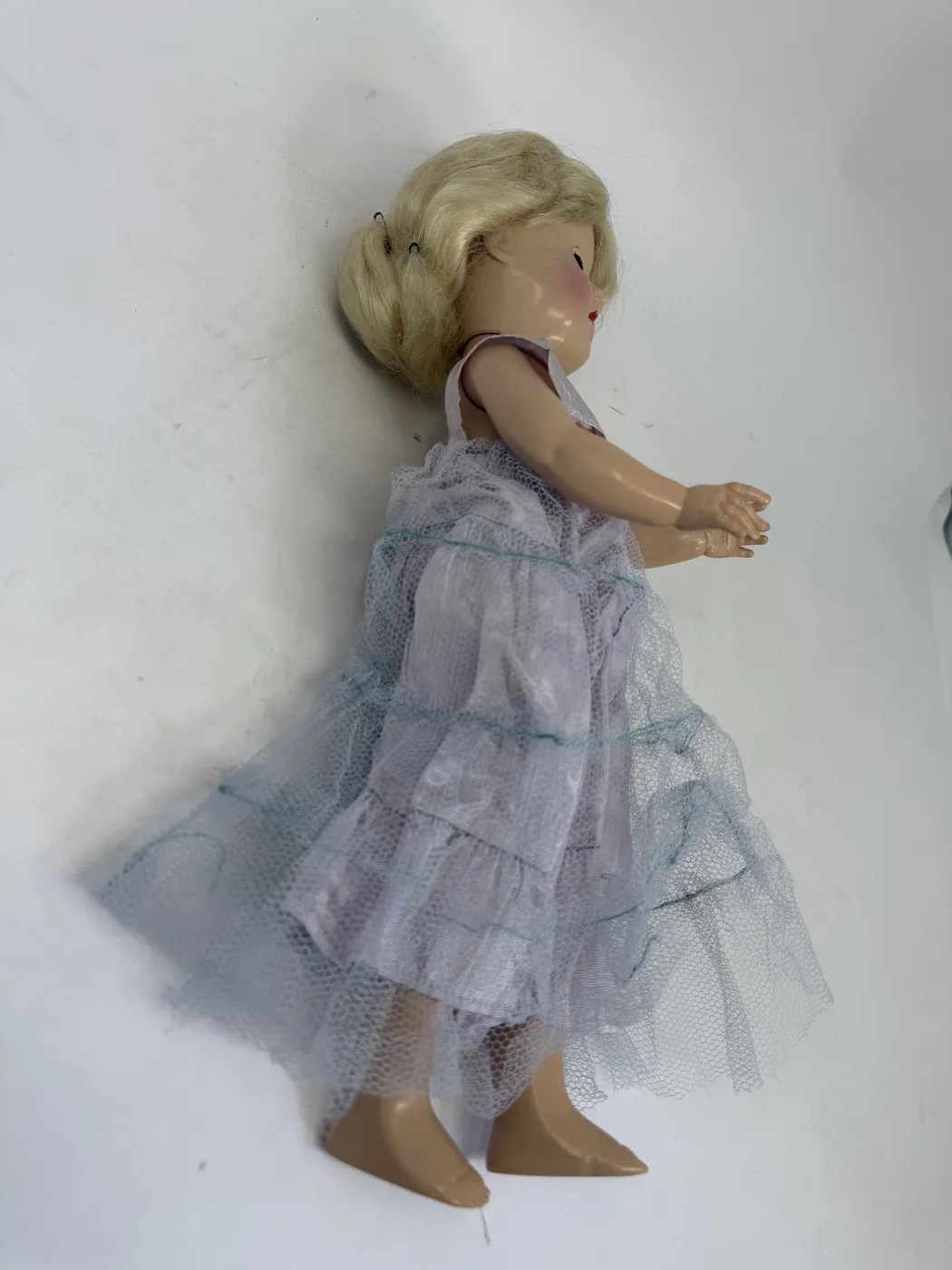
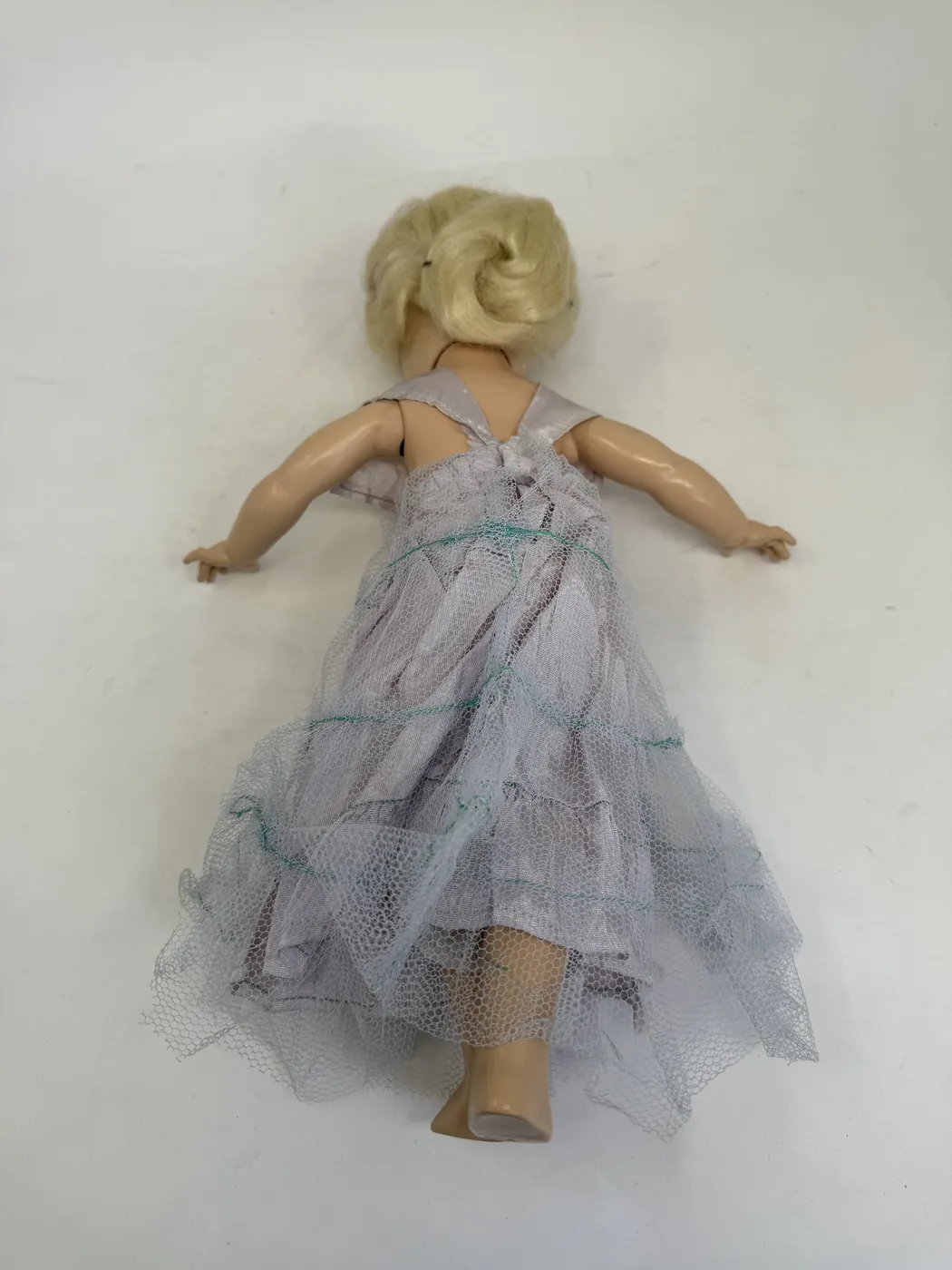
The narrow dating window for this doll: (1) the “P-90” mark is the Ideal Toni-line head designator, used from the 1949 launch through the end of the line. (2) Doll Reference catalogs the Toni line as a 1949–1953 product, with the molds reused on Mary Hartline and Sara Ann sub-lines through about 1956. (3) The nylon-fiber wig in original styled condition is consistent with original-Ideal-issue rather than a later replacement, which would tend to use synthetic fiber of a slightly later formulation. (4) The dress fabric — pale lavender taffeta with teal-stitched tulle ruffles — is period-consistent with late-1940s and early-1950s mass-market doll dressing.
What I can’t tell you: the specific year inside the 1949–1953 window. Ideal did not date individual P-90 heads. The dress style and the wig styling could be tightened by a specialist familiar with Ideal’s production-year subtleties, but I am not that specialist. The doll could be 1949 / 1950 / 1951 / 1952 / 1953 and I cannot tell which.
What I can tell you: the marks are unambiguously the Ideal Toni P-90, the body is original to the head (the body P-90 stamp matches the head P-90 stamp, which means it has not been reattached to a different doll’s head), and the dress and wig are original-period rather than later replacement.
How this came in
Same source as the paired Kestner J.D.K. 247 character baby: a private collection being downsized. The two dolls bookend something like the first half of the twentieth century of mass-market children’s doll manufacturing in the trans-Atlantic market — the Kestner is a 1910s German bisque-and-composition character baby, the Toni is a 1949 American hard-plastic advertising-tie-in — and seeing the two together as objects out of a single collector household is itself part of the documentary record. The collector’s identity is private.
Where this is going
The doll will move into the appropriate American hard-plastic vintage-doll market when it leaves NMLP’s working stock. Toni P-90 dolls in original-paint, original-wig, original-dress condition occupy a stable but small collector market segment; eBay, Ruby Lane, the United Federation of Doll Clubs marketplace network, and specialist mid-century-doll dealers are the standard channels. The archive entry stands regardless. If you arrived at this page because you own a similar P-90 Toni and are trying to verify it, the mark photos are the point.
External references & authoritative sources
- Ideal Toy Company — Wikipedia: en.wikipedia.org/wiki/Ideal_Toy_Company — encyclopedia entry on the firm, with the 1907 Brooklyn founding by Morris and Rose Michtom, the 1903 teddy-bear origin, the move to Hollis, Queens, and the postwar expansion under Benjamin Michtom and Lionel Weintraub.
- Doll Reference — Ideal Toni doll line, 1949–1953: dollreference.com — Ideal Toni Doll & Clothes 1949 — the standard online catalog for the Toni line, with the size series P-90 through P-94 documented and the production dates.
- Doll Reference — Ideal 1940s dolls overview: dollreference.com — Ideal 1940s vintage dolls — the broader Ideal 1940s catalog placing Toni in context with the Shirley Temple, Saucy Walker, and other contemporaneous lines.
- WorthPoint — Ideal Toy Company guide: worthpoint.com/dictionary — Ideal Toy Company — firm overview and price-guide context for the Toni and related Ideal lines.
- WorthPoint — Toni doll guide: worthpoint.com/dictionary — Ideal Toni Doll — the dedicated Toni-doll entry, with marks documentation and the Gillette/Toni Home Permanent licensing history.
- Forgotten New York — Ideal Toys, Hollis (2017): forgotten-ny.com — Ideal Toys, Hollis — the standard NYC-history account of the Hollis Queens factory site and its place in the borough’s twentieth-century industrial history.
- Queens Chronicle — Ideal Novelty and Toy Co., Hollis: qchron.com — Ideal Novelty and Toy Co., Hollis — local-press piece on the Hollis factory and the Michtom family.
- “Which twin has the Toni?” advertising campaign — background: The Toni Home Permanent campaign, run by the Toni Company (acquired by Gillette in 1948) and its agency Foote, Cone & Belding, was a defining late-1940s American consumer-advertising case. The Ideal P-90 Toni doll line is the toy tie-in.
How to cite this archive entry
Eldred, Josh. “Ideal Toy Co. P-90 Toni Doll (Hollis, Queens, c.1949–1953) — Hard Plastic Tie-In to the Toni Home Permanent.” NMLP Donation Archive — Curiosities, May 11, 2026. https://newmexicoliteracyproject.org/archive/curiosities/ideal-p90-toni-doll
Related on this site
- Kestner J.D.K. mold 247 bisque character baby (Waltershausen, c.1912) — the German bisque-and-composition character-baby predecessor; the two dolls came in together and bookend roughly the first half of the twentieth century of mass-market children’s doll manufacturing.
- Back to the Curiosities index
- Main archive index
- Golf in Italy — ENIT 1930s Italian Art Deco brochure — another mid-twentieth-century mass-market printed-object whose interest is in the design and the documentary record rather than in regional provenance.