Author Collecting Guide
Aldo Leopold Collecting Guide
The definitive reference for collecting the father of wildlife conservation — from A Sand County Almanac (1949) and Game Management (1933) through the posthumous publication paradox, first edition identification, and Leopold’s foundational New Mexico years in the Gila Wilderness
Aldo Leopold is one of a handful of authors whose collecting profile is inseparable from their geography, and whose geography is inseparable from New Mexico. I pick up and evaluate book collections across the Albuquerque metro, and when I encounter Leopold in an estate library — and I encounter him often — the first question is always the same: which edition? Because the difference between a Sierra Club paperback from 1970 and an Oxford University Press first edition from 1949 represents one of the widest value gaps in the entire environmental literature market, and the identification requires attention to details that most estate sellers and casual collectors do not know to look for.
This guide is the deep reference I wish had existed when I started handling Leopold material. It covers the biography in enough detail to understand the collecting market, the identification of every key title, the peculiar complications created by posthumous publication, and the New Mexico connection that makes Leopold not just an important environmental author but a foundational figure in the history of this state. Leopold spent fifteen years in the Southwest. He met his wife in Santa Fe. He raised his first four children in New Mexico. He invented the concept of wilderness preservation in the Gila country of southwestern New Mexico. And he died one week after Oxford University Press accepted the manuscript that would become the most influential environmental book of the twentieth century, meaning he never signed a single copy of his most famous work.
That last fact — the posthumous publication paradox — defines Leopold collecting more than any other single consideration, and I will return to it throughout this guide.
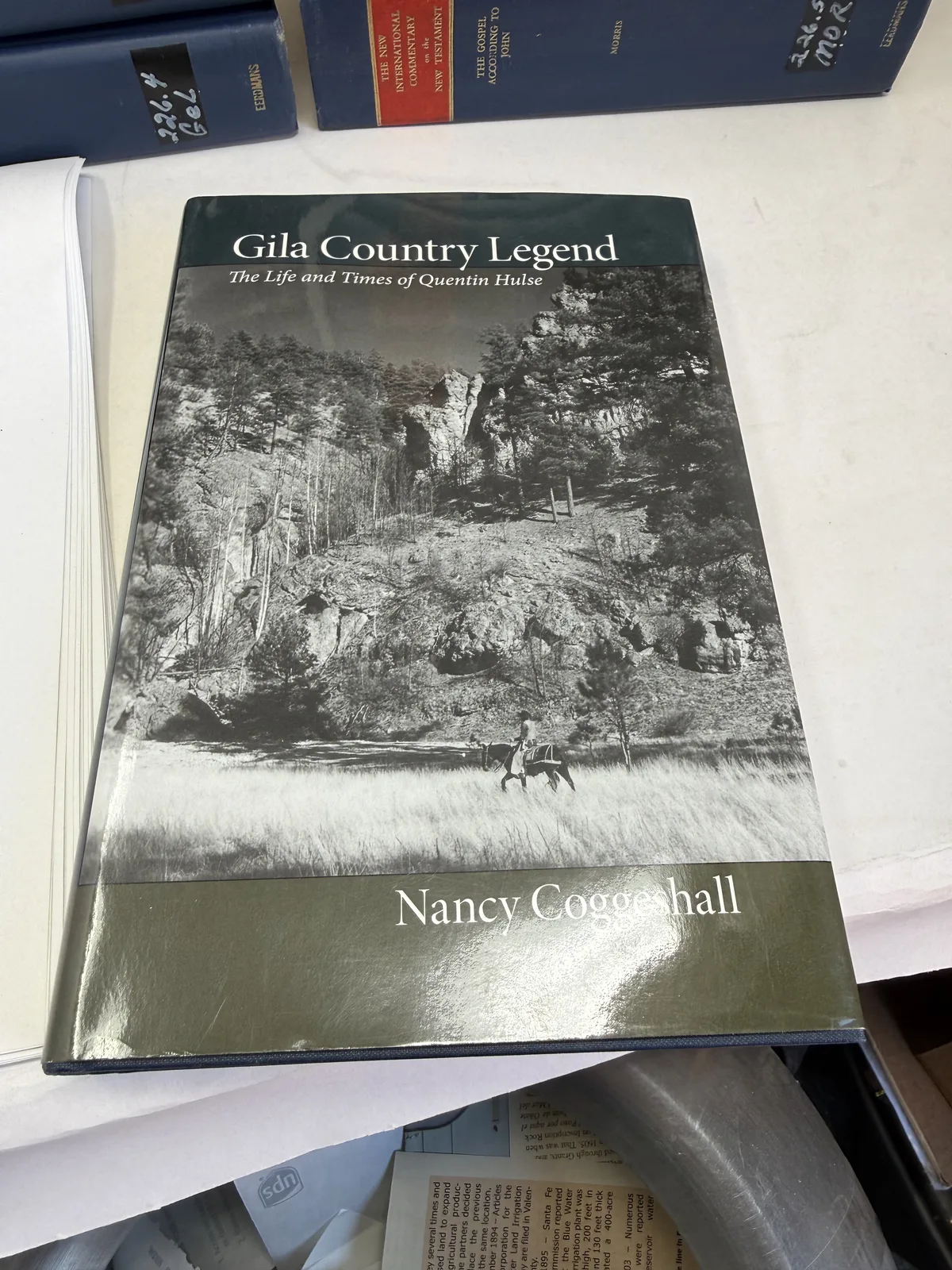
The country Leopold fought to keep wild kept producing people worth writing about. Nancy Coggeshall’s Gila Country Legend: The Life and Times of Quentin Hulse is the biography of one of the last old-time Gila outfitters — the working life Leopold’s wilderness made possible. From NMLP intake:
Last verified September 2026 · Original research by Josh Eldred
Biography: From Burlington to the Gila
Aldo Leopold first editions, especially A Sand County Almanac (1949) and Game Management (1949), are among the most sought-after collectibles in their category. Rand Aldo Leopold was born on January 11, 1887, in Burlington, Iowa, the eldest son of Carl Leopold and Clara Starker Leopold. His father was a prosperous walnut-desk manufacturer of German descent who was also a devoted outdoorsman — unusual for a furniture businessman, and consequential for his son’s development. Carl Leopold took his children on extended hunting and nature excursions in the Mississippi River bottomlands near Burlington, and the young Aldo developed an observational habit that would persist for the rest of his life. He kept detailed journals of bird sightings, weather patterns, and seasonal changes from boyhood, and these journals represent the earliest expression of the attentiveness to ecological cycles that would eventually produce A Sand County Almanac.
Leopold attended the Lawrenceville School in New Jersey and then enrolled at the Sheffield Scientific School at Yale before transferring to the newly established Yale Forest School, where he earned a Master of Forestry degree in 1909. The Yale Forest School — the first graduate program in forestry in the United States, directed by Henry S. Graves — trained the first generation of professional foresters in the nation, and Leopold was among its most consequential graduates. The program emphasized practical field training, including a summer camp in Milford, Pennsylvania, that immersed students in silviculture and resource management. Leopold absorbed the Gifford Pinchot philosophy of scientific conservation that dominated the school — the idea that natural resources should be managed rationally for sustained human benefit — and would spend the next two decades gradually transforming that philosophy into something far more radical.
The Southwest: Apache and Carson National Forests (1909–1924)
Upon graduation in 1909, Leopold joined the United States Forest Service and was assigned to District 3, covering the Arizona and New Mexico territories. His first posting was as a forest assistant at the Apache National Forest in the eastern Arizona Territory — remote, sparsely populated, biologically diverse, and as far from the green bottomlands of Burlington, Iowa, as any landscape in the continental United States. The Apache country was high desert and mountain forest, ponderosa pine and Douglas fir above piñon and juniper, with rivers running through canyons that were home to wolves, mountain lions, grizzly bears, and the last remnants of the wild fauna that had once covered the Southwest.
It was in the Apache country, sometime around 1909, that Leopold participated in the shooting of a wolf — a routine predator-control action under the Forest Service policies of the era — and watched the wolf die beside a river. He described the moment decades later in the essay that would become the most famous passage in A Sand County Almanac. He watched the fierce green fire dying in the wolf’s eyes and began, slowly, to understand that eliminating predators to produce more game was not management but destruction — that the mountain itself had a perspective on wolves that the hunter could not see. That moment of ecological awakening did not produce an immediate conversion; Leopold continued to support predator-control programs for years afterward. But the seed was planted in the Apache National Forest, in the landscape of what is now eastern Arizona and western New Mexico, and it germinated over two decades into the land ethic that would reshape American environmental thought.
In May 1911, Leopold was transferred to the Carson National Forest in northern New Mexico, near Tres Piedras. He became deputy supervisor and was appointed supervisor in 1912 — a rapid rise for a forester in his mid-twenties. That same year, on October 9, 1912, he married Estella Bergere of Santa Fe. Estella came from one of the great Hispano families of New Mexico; her grandfathers, Don Jose Luna and Don Jose Otero, had trailed fifty thousand sheep to the Sierras during the California Gold Rush, and her family’s landholdings included the Luna Mansion in Los Lunas. The marriage rooted Leopold in New Mexico at a level that went beyond professional assignment — he was now part of a New Mexico family, living in a cabin in Tres Piedras that the Forest Service still maintains as a historic rental property, and beginning to raise children who would themselves become significant figures in American conservation and science.
In 1913, Leopold fell seriously ill — likely acute nephritis following exposure to harsh weather during a field survey — and nearly died. The illness forced a long recovery and a reassignment in 1914 to the district headquarters in Albuquerque, where he took on administrative and policy roles that gave him time to think and write. It was during this Albuquerque period that Leopold began to articulate, in journal articles and internal Forest Service memoranda, the ideas about wilderness that would eventually produce the Gila Wilderness designation. He was no longer simply a field forester; he was becoming a thinker about the relationship between land, wildlife, and human use, and Albuquerque gave him the breathing room to develop those ideas.
Their first four children were born in New Mexico: Aldo Starker (1913), Luna Bergere (1915), Nina (1917), and Aldo Carl (1919). A fifth child, Estella, was born in 1927 after the family had moved to Wisconsin. Starker Leopold would go on to author the landmark 1963 Leopold Report on wildlife management in the national parks; Luna Leopold would become a renowned hydrologist and geomorphologist who edited his father’s posthumous works. The Leopold children are themselves significant figures in the history of American conservation science, and the New Mexico roots of the family run deep.
The Gila Proposal and the Invention of Wilderness
In 1921, Leopold published an article in the Journal of Forestry titled “The Wilderness and Its Place in Forest Recreational Policy,” arguing that the Forest Service should set aside certain roadless areas within national forests as permanent wilderness — not for timber harvest, not for recreation development, not for road building, but simply to remain wild. He proposed the Gila country in southwestern New Mexico as the ideal candidate: a vast, remote, mountainous landscape with minimal existing development and extraordinary biological diversity.
On June 3, 1924, the Forest Service designated 755,000 acres within the Gila National Forest as the Gila Wilderness — the first designated wilderness area in the world. The designation was administrative, not legislative — it would take four more decades before the Wilderness Act of 1964 provided statutory protection for wilderness areas — but the Gila was the precedent, the proof of concept, the place where the abstract idea of wilderness preservation became a physical reality on the American landscape. That it happened in New Mexico is not incidental. It happened here because Leopold knew this landscape, had spent fifteen years working in it, and understood it at a depth that enabled him to make the argument persuasively. The Gila Wilderness remains protected today, and a portion of it — the Aldo Leopold Wilderness — bears his name.
Wisconsin and the Shack (1924–1948)
Leopold accepted a transfer to the Forest Products Laboratory in Madison, Wisconsin, in 1924 and left the Forest Service entirely in 1928 to conduct independent wildlife surveys across the Midwest. These surveys, funded by the Sporting Arms and Ammunition Manufacturers Institute, produced the data that became Game Management (Charles Scribner’s Sons, 1933), the first systematic textbook of wildlife management as a scientific discipline. The book established Leopold’s national reputation, and in 1933 the University of Wisconsin created a new chair of game management — the first such position at any American university — and appointed Leopold to fill it. He would hold the position for the remaining fifteen years of his life.
In 1935, Leopold purchased an abandoned farm along the Wisconsin River near Baraboo, in the sand counties of central Wisconsin. The property included a chicken coop that Leopold and his family converted into a weekend cabin they called “the shack.” Over the following thirteen years, Leopold planted thousands of pines, restored prairies and wetlands, and observed the seasonal cycles of the land with the same journaling rigor he had practiced since boyhood in Burlington. The shack became the literary and philosophical setting for A Sand County Almanac: the month-by-month observations of the almanac section were drawn from weekends and summers at the shack, and the philosophical essays were composed there and in his Madison office.
Leopold worked on the manuscript that would become A Sand County Almanac through the mid-1940s, submitting it to multiple publishers and receiving rejections before Oxford University Press agreed to publish it. On April 14, 1948, Oxford informed Leopold that it wished to publish his manuscript. One week later, on April 21, 1948, Aldo Leopold died of a heart attack while helping neighbors fight a grass fire that had escaped from a nearby farm. He was sixty-one years old. He never saw a printed copy of the book that would become the most influential work of environmental literature in the twentieth century.
A Sand County Almanac, and Sketches Here and There
There is no ambiguity about the central work in Leopold collecting. A Sand County Almanac, and Sketches Here and There was published by Oxford University Press, New York, in 1949, one year after Leopold’s death. It is the trophy — the book that every Leopold collector wants, the book that defines the market, and the book whose first edition identification requires the most care.
The manuscript was prepared for publication by Leopold’s son Luna, who shepherded it through Oxford’s editorial process and, along with the family and Leopold’s Wisconsin colleagues, worked to ensure that the text reflected his father’s final intentions. The original working title had been “Great Possessions” — Luna and Oxford changed it to A Sand County Almanac, a decision that turned out to be one of the most consequential editorial choices in the history of American publishing. The original title was literary but vague; the published title is specific, rooted in landscape, and immediately evocative.
Structure of the Book
The book is divided into three sections that move from the particular to the universal. Part I, “A Sand County Almanac,” is a month-by-month account of a year on the shack property — geese arriving in March, the woodcock sky-dance in April, the phenology of prairie plants through summer and fall. Part II, “Sketches Here and There,” contains essays set in various American landscapes including Wisconsin, Iowa, Arizona, Oregon, Manitoba, and, crucially, New Mexico and the Southwest — the essay “Thinking Like a Mountain,” with its famous account of the dying wolf, is set in the Apache country. Part III, “The Upshot,” contains the philosophical essays, culminating in “The Land Ethic,” which argues that ethical obligations extend to the entire biotic community — soils, waters, plants, and animals — and that conservation is a matter of moral responsibility rather than economic expediency.
The three-part structure is important for collectors because it means the book is simultaneously a nature memoir, a collection of regional essays, and a philosophical treatise. It is all three things at once, and its influence comes from the fact that the philosophy emerges from the particular observations rather than being imposed upon them. Leopold did not write a manifesto; he wrote about the geese and the prairie and the wolf, and the philosophy grew out of the looking.
First Edition Identification
The first edition, first printing of A Sand County Almanac, and Sketches Here and There has the following identification points, and you need to check them in combination:
First Edition Checklist
- Publisher: Oxford University Press, New York, 1949.
- Copyright page: Reads “Copyright 1949 by Oxford University Press, Inc.” with no additional printing statements. Oxford did not use explicit “First Edition” statements in this period; instead, later printings are identified by the addition of a “Second Printing,” “Third Printing,” or similar notation. The absence of any such notation indicates a first printing.
- Format: 8vo (octavo). [6], vii–xiii, [3], 3–226 pp.
- Binding: Green cloth boards with silver lettering on the front board and spine. Some dealers describe the cloth as “teal” — the precise shade varies slightly across surviving copies but falls in the green-to-teal range. The silver lettering is the critical point: later bindings used different colors or materials.
- Illustrations: In-text black-and-white illustrations throughout by Charles W. Schwartz, the wildlife artist who also illustrated Round River. The Schwartz drawings are integral to the first edition and are a quick visual confirmation that you are looking at an Oxford edition rather than a later paperback reprint.
- Dust jacket: The original dust jacket features Schwartz wildlife illustrations on both panels. The front flap price is a few dollars. There is no mention of Round River on the rear flap — this is a critical distinction, as Round River was not published until 1953, and later printings of A Sand County Almanac added references to it. A jacket that mentions Round River is necessarily a later printing.
The Dust Jacket: Where the Value Lives
In Leopold collecting, the dust jacket is the single most important condition variable. A first edition in fine condition with the original dust jacket intact and presenting well occupies the top tier of the environmental literature market — I am talking about one of the most desirable books in the entire genre, in the same conversation as first editions of Rachel Carson’s Silent Spring (Houghton Mifflin, 1962) and Thoreau’s Walden (Ticknor and Fields, 1854). A first edition without the dust jacket is still a significant book, but the market gap between jacketed and unjacketed copies is dramatic — as it is for almost every important mid-century title, but perhaps more so for Leopold because the original print run was modest and the book was little noticed at publication. Relatively few copies survived with their jackets intact.
The jacket itself is vulnerable. Paper quality in 1949 was inconsistent, and the Schwartz illustration panels tend to show foxing, toning, and edge wear. Spine fading is common on copies that were shelved for decades in rooms with any sun exposure. Chips at the crown and heel of the spine are typical. A genuinely fine dust jacket — bright, unfaded, with minimal edge wear and no chips — is rare enough to command a substantial premium over a good-but-not-fine jacket. For the collector evaluating a potential purchase, the jacket condition should be the first thing you assess, because it drives value more than any other factor.
The Sierra Club / Ballantine Edition and Why It Confuses People
In 1966, Sierra Club Books and Ballantine Books published an expanded paperback edition under the title A Sand County Almanac: With Other Essays on Conservation from Round River. This edition combined the original Sand County Almanac text with selected essays from Round River (1953) into a single volume, and it became the standard text for the environmental movement of the late 1960s and 1970s. It is the edition that most people read, the edition that most bookshops carry, and the edition that appears in estate libraries with overwhelming frequency. It is also, emphatically, not a first edition.
The Sierra Club / Ballantine paperback is identifiable by its taller-than-standard mass-market format, the Sierra Club colophon, the expanded subtitle, and the absence of the Schwartz illustrations that appear in the Oxford hardcover. It has modest historical interest as the edition that brought Leopold to a mass audience, but it has no meaningful collector value. I mention it at this length because I encounter it constantly in New Mexico estate libraries, often accompanied by a family member’s belief that it is a first edition. It is not. The true first edition is the 1949 Oxford University Press hardcover, and the identification points described above are the way you confirm it.
The Slow Rise to Canonical Status
One of the facts that makes Leopold collecting interesting is that A Sand County Almanac was not an immediate success. Oxford printed a modest first run, the book received respectful but limited reviews, and it sold slowly through the 1950s. It was not until the environmental awakening of the 1960s — catalyzed by Rachel Carson’s Silent Spring in 1962 and the broader cultural shift toward ecological consciousness — that Leopold’s book found its audience. The 1966 Sierra Club paperback was the vehicle for this rediscovery, and by the 1970s A Sand County Almanac had achieved the canonical status it holds today. The book has now sold well over two million copies in various editions.
For collectors, this slow-burn trajectory has a practical consequence: the modest original print run, combined with decades of quiet obscurity before the book became famous, means that surviving first editions in collectible condition are genuinely scarce. Many copies were library copies that accumulated institutional wear; many were reading copies that were used hard and discarded; many were stored without jackets, and the jackets were lost. The scarcity is real, not manufactured, and it is the primary driver of the book’s position at the top of the environmental literature market.
Not sure whether to sell, donate, or keep? Call or text me at 505-250-3804 — I’ll walk you through it.
Game Management
Game Management was published by Charles Scribner’s Sons, New York, in 1933. It is the book that created the discipline of wildlife management as a formal science, and it was the work that established Leopold’s professional reputation during his lifetime. If A Sand County Almanac is the trophy of Leopold collecting, Game Management is the foundation — the book that serious collectors want to pair with the Almanac to represent both sides of Leopold’s legacy: the scientific and the philosophical.
The book is a systematic textbook, 481 pages with 88 figures and tables, covering the principles of wildlife population dynamics, habitat management, census methods, and the administration of game lands. It was written for professional wildlife managers and students, not for general readers, and it reads accordingly — this is a technical work, dense with data and methodology, that happens to have been written by one of the most gifted prose stylists in the history of ecological writing. Leopold’s ability to write lucid, compelling technical prose is part of what makes him exceptional, and Game Management demonstrates it in a register entirely different from the lyrical essays of the Almanac.
First Edition Identification
First Edition Checklist
- Publisher: Charles Scribner’s Sons, New York and London, 1933.
- Copyright page: Look for the Scribner’s “A” on the copyright page, which indicates a first printing in Scribner’s system. However, Scribner’s practice in the early 1930s was not entirely consistent, and the “A” designation was sometimes omitted or applied irregularly. Corroborate with other physical evidence. For a comprehensive treatment of Scribner’s first edition conventions, see the First Edition Identification Guide.
- Binding: Brown cloth with gilt lettering on the spine. A utilitarian academic binding appropriate to the textbook format.
- Illustrations: Line drawings by Allan Brooks, the Canadian ornithological illustrator. The Brooks drawings are specific to the first edition and are not reproduced in all later printings.
- Dust jacket: The original Scribner’s dust jacket is extremely uncommon. Most surviving first editions are ex-library copies or academic copies that have lost their jackets. A first edition with the original dust jacket intact is a significant discovery.
- Format: 481 pages with 88 figures and tables. Large octavo format appropriate to a scientific textbook.
Market Position
Game Management occupies a strong middle tier in the Leopold collecting hierarchy. It is below a fine Sand County Almanac with jacket but meaningfully above the posthumous works. The dust jacket is the major differentiator: a first edition with the Scribner’s jacket intact sits at a premium that reflects the jacket’s extreme scarcity on this title. Unjacketed copies in clean condition — not ex-library, not heavily worn — are the typical form in which collectors encounter this book, and they are themselves collectible and desirable.
The book remained in print through Scribner’s and later through the University of Wisconsin Press, which issued a paperback reprint in 1986 that is widely available and frequently mistaken by casual sellers for something more significant than it is. The Scribner’s first edition from 1933 is the collecting target; all later printings and reprints are reading copies only.
The Significance for Signatures
Game Management is the title most likely to carry a Leopold autograph. Leopold was alive and professionally active throughout the 1930s and 1940s — he attended wildlife management conferences, gave lectures at universities, and interacted with the professional community that used his textbook. He inscribed copies of Game Management to colleagues and students, and these inscribed copies, while profoundly rare, do exist. I will address the signature question in full in the signed copies section below, but the key point here is that Game Management is the only Leopold title where a genuine author signature is even theoretically possible in a meaningful number of surviving copies.
Round River and Other Posthumous Publications
Round River: From the Journals of Aldo Leopold (Oxford University Press, 1953)
Round River was published by Oxford University Press in 1953, five years after Leopold’s death, edited by his son Luna B. Leopold and illustrated by Charles W. Schwartz — the same artist who had illustrated A Sand County Almanac. The book draws from Leopold’s field journals spanning 1922 to 1937, including accounts of canoe trips in the Canadian wilderness, a bow-hunting expedition in Mexico, and observations from his years in the Southwest and Wisconsin. The title comes from a Paul Bunyan legend about a river that flows into itself — an image Leopold used as a metaphor for the circular, interconnected nature of ecological systems.
The first edition is an Oxford University Press hardcover, identifiable by the same conventions that apply to the Almanac: no additional printing statements on the copyright page indicates a first printing. Later printings carry explicit notations. The Schwartz illustrations are present throughout and provide a visual continuity with the Almanac.
Round River is a completist piece in Leopold collections. It is not a trophy — it does not approach the market significance of A Sand County Almanac or even Game Management — but a first edition in fine condition is a respectable secondary acquisition. It is also the source of several essays that were later incorporated into the expanded 1966 Sierra Club edition of the Almanac, which means that Round River has a textual significance that goes beyond its own standalone market position: it is part of the editorial history of the most important environmental book of the twentieth century.
The Library of America Edition (2013)
In 2013, the Library of America published Aldo Leopold: A Sand County Almanac and Other Writings on Conservation and Ecology, edited by Curt Meine, Leopold’s preeminent biographer. This single volume collects the full text of A Sand County Almanac, selections from Round River, Game Management excerpts, published and unpublished essays, and correspondence. It is the most comprehensive single-volume Leopold available and is the standard scholarly edition. As a Library of America title, it is beautifully produced and makes an excellent reading copy, but it is a modern anthology, not a collectible first edition. I mention it because it frequently appears in contemporary estate libraries and because it is the edition I recommend to people who want to read Leopold seriously without the expense of first-edition collecting.
Aldo Leopold’s Wilderness: Selected Early Writings (2013)
Published by Northland Press in a limited edition, this collection gathers Leopold’s early essays on wilderness from the 1920s and 1930s, including the 1921 Journal of Forestry article that proposed the Gila Wilderness. It is collected by Leopold specialists and Southwest environmental history enthusiasts. First editions of limited-press Leopold compilations occupy a niche market below the three major titles but are worth noting when encountered.
Curt Meine’s Biography: Aldo Leopold: His Life and Work (1988)
While not a Leopold primary work, Meine’s biography (University of Wisconsin Press, 1988) is the standard scholarly life and is itself collected by Leopold enthusiasts. The first edition is a solid secondary acquisition for a Leopold shelf, and Meine’s meticulous research provides the biographical context that informs every aspect of Leopold collecting.
Have books you’re ready to part with? I offer free pickup across Albuquerque — call 505-250-3804.
Oxford University Press: First Edition Identification for the Era
Oxford University Press’s first edition conventions in the 1940s and 1950s are straightforward once you understand the system, but the system operates by absence rather than presence, which trips up collectors accustomed to publishers who use explicit first edition statements or number lines.
In this period, OUP did not print “First Edition” or “First Printing” on the copyright page of a first printing. Instead, they left the copyright page clean — the copyright notice, the year, and nothing more. When a book went to a second printing, OUP added a “Second Printing” (or “Second Impression”) notation to the copyright page. Third printings received a “Third Printing” notation, and so on. The number line system that became standard in American publishing from the 1970s onward was not yet in use at OUP in the 1940s.
This means that for both A Sand County Almanac (1949) and Round River (1953), the first edition identification logic is:
- First printing: Copyright page shows “Copyright 1949 by Oxford University Press, Inc.” (or 1953 for Round River) with no additional printing or impression notation.
- Later printings: Copyright page shows the original copyright date plus a “Second Printing [year]” or similar notation.
The system is reliable but depends on the collector knowing to look for what is not there rather than what is. If the copyright page is clean — no printing statement beyond the original copyright — you are likely holding a first printing. If there is any printing statement at all, you are holding a later printing. This is the OUP convention for the mid-century period, and it applies consistently across both of the major Leopold titles they published.
For a comprehensive treatment of publisher identification conventions across the full range of American publishers and decades, see the First Edition Identification Guide, which covers OUP alongside Scribner’s, Random House, Houghton Mifflin, and dozens of other publishers relevant to the New Mexico and American literature collecting markets.
The Gila Wilderness and Leopold’s New Mexico Legacy
I have written elsewhere in this guide about Leopold’s New Mexico years in biographical terms, but the Gila Wilderness deserves its own treatment because it represents something larger than a single moment in one person’s career. The Gila is where the idea of wilderness preservation became real — where an abstract philosophical argument about the value of unmanaged land became a specific, physical, legally designated place. And it happened in New Mexico, which gives Leopold a claim on this state’s identity that very few authors from any genre can match.
The Landscape
The Gila country occupies the mountains and canyons of southwestern New Mexico, centered on the Mogollon Range and the headwaters of the Gila River. It is high, rugged, dry in the lower elevations and forested at the higher ones, with deep canyons carved by rivers that run with water only part of the year. The landscape includes cliff dwellings left by the Mogollon people, hot springs in the canyon bottoms, and a biological diversity that ranges from Chihuahuan Desert species in the lowlands to subalpine species at the peaks. It is one of the most remote and least-traveled landscapes in the lower forty-eight states, and it was even more so in Leopold’s time, when access was by horse and foot trail only.
Leopold knew this landscape from his years of fieldwork across the Gila and neighboring national forests. He understood its ecological complexity at a level that enabled him to make the argument for wilderness preservation not as an abstraction but as a practical proposal grounded in specific knowledge of a specific place. When he proposed the Gila Wilderness in 1922, he was not speaking theoretically; he was describing a landscape he had walked, mapped, studied, and loved, and arguing that it should be left alone.
The 1924 Designation
The Gila Wilderness was designated on June 3, 1924, when the Forest Service set aside 755,000 acres within the Gila National Forest as a roadless area closed to development. The designation was an administrative action within the Forest Service, not an act of Congress, and it was vulnerable to reversal by future administrators — a vulnerability that Leopold recognized and that helped motivate the decades-long campaign for statutory wilderness protection that culminated in the Wilderness Act of 1964, signed into law by President Lyndon Johnson sixteen years after Leopold’s death.
The 1924 designation was unprecedented. No national government in the world had previously set aside a significant tract of land with the explicit purpose of keeping it wild — not for timber, not for grazing, not for recreation development, but for wildness itself. Previous conservation designations — national parks, national forests, national monuments — had various utilitarian or scenic justifications. Leopold’s Gila proposal was different: it argued that wilderness had value as wilderness, that the absence of human development was itself a form of land use worth preserving, and that some places should remain beyond the reach of roads and machinery. This was a radical idea in 1924, and it originated in New Mexico.
From the Gila to the Wilderness Act
The thread from the Gila to the Wilderness Act of 1964 is direct and traceable. Leopold’s 1921 article in the Journal of Forestry laid the intellectual groundwork. The 1924 Gila designation proved the concept. Leopold continued to advocate for wilderness preservation throughout the 1930s and 1940s, founding the Wilderness Society in 1935 alongside Robert Marshall, Benton MacKaye, and others. The philosophical arguments in A Sand County Almanac — particularly “The Land Ethic” — provided the moral framework that wilderness advocates used throughout the 1950s and early 1960s to build public support for legislative protection. When Howard Zahniser drafted the Wilderness Act and guided it through Congress, he was building on foundations that Leopold had laid in the Gila country of New Mexico four decades earlier.
The Wilderness Act of 1964 now protects over 111 million acres of federal land across the United States. Every acre of that protected wilderness traces its lineage to the 755,000 acres that Leopold carved out of the Gila National Forest in 1924. For New Mexico, this means that the state is not merely one of the places where Leopold happened to work; it is the birthplace of the American wilderness idea, and Leopold is the author of that birth.
The Aldo Leopold Wilderness
Today, the Gila region includes the original Gila Wilderness (558,065 acres) and the adjacent Aldo Leopold Wilderness (202,016 acres), which was designated in 1980 and named in honor of the man who started it all. The two wilderness areas together encompass over 760,000 acres of protected roadless land in the mountains of southwestern New Mexico. The Aldo Leopold Wilderness is one of the most fitting memorials to any American author — a landscape left wild in perpetuity, honoring the man who argued that wildness was worth preserving for its own sake.
The Leopold House at Tres Piedras
The cabin that Aldo and Estella Leopold occupied during his tenure as Carson National Forest supervisor still stands in Tres Piedras, New Mexico, and is maintained by the Forest Service as a historic rental property available through Recreation.gov. It is the oldest surviving Leopold residence and the place where, in 1912 and 1913, Leopold and Estella began their married life and started their family. For Leopold collectors with a connection to New Mexico, the Tres Piedras cabin is a pilgrimage site — the physical link between the man, the landscape, and the ideas that changed American conservation.
What the New Mexico Connection Means for Collectors
Leopold’s New Mexico years are the reason his books appear in New Mexico estate libraries with such frequency. Readers in this state have understood for generations that Leopold’s most formative experiences happened here, that the Gila Wilderness is a New Mexico achievement, and that the intellectual foundations of the American conservation movement were laid in the forests and canyons of the Southwest. This awareness translates directly into book ownership: Leopold is one of the most commonly encountered environmental authors in Albuquerque and northern New Mexico estates, and his presence in a library is a reliable signal that the surrounding shelves contain other significant environmental, conservation, and Southwestern titles worth examining.
I pick up books for free anywhere in the metro area. Call 505-250-3804 to schedule.
Leopold’s Legacy in Conservation and Environmental Literature
Leopold occupies a position in the environmental canon that is difficult to overstate. In a 1990 poll conducted by the American Nature Study Society, A Sand County Almanac and Rachel Carson’s Silent Spring were named the two most significant environmental books of the twentieth century. The pairing is instructive: Carson documented the damage that industrial chemistry was doing to the natural world; Leopold articulated the philosophical framework for understanding why that damage mattered. Together, they provided the intellectual and moral foundations for the environmental movement of the 1960s and 1970s, and their books remain the twin pillars of the tradition.
For collectors, this canonical status has practical implications. Leopold and Carson are the two names that anchor any serious nature writing collection, and their first editions are the two highest-value targets in the genre. A shelf that holds a first-edition Sand County Almanac alongside a first-edition Silent Spring represents the core of twentieth-century environmental literature collecting in two volumes. The Nature Writing Collecting Guide covers both authors alongside six others who complete the genre framework.
The Land Ethic and Its Influence
Leopold’s most enduring intellectual contribution is the land ethic, articulated in the final essay of A Sand County Almanac. The argument is deceptively simple: ethical obligations have expanded throughout human history from the individual to the family to the tribe to the nation, and the next expansion must include the land itself — soils, waters, plants, and animals. Human beings are not the conquerors of the biotic community; they are members of it, and membership carries ethical responsibilities. This idea — that the natural world has moral standing independent of its utility to humans — has become the philosophical foundation of modern environmentalism, and it originated in the observations of a forester who spent fifteen years in the mountains of New Mexico and Arizona watching wolves, counting deer, and learning to see the landscape as a community rather than a commodity.
The Leopold Report (1963)
Leopold’s influence extended to the next generation through his son A. Starker Leopold, who chaired the Special Advisory Board on Wildlife Management that produced the landmark 1963 Leopold Report for the National Park Service. The report argued that national parks should be managed to preserve or recreate natural ecosystems rather than simply protecting individual species or scenic views — a direct extension of the elder Leopold’s ecosystem thinking. The Leopold Report reshaped National Park Service management philosophy and remains one of the most influential policy documents in the history of American conservation. For collectors, the connection between father and son Leopold — both significant contributors to conservation thought, both rooted in the family’s New Mexico origins — adds a generational dimension to the Leopold collecting story.
The Wilderness Society and Organizational Legacy
Leopold co-founded the Wilderness Society in 1935 alongside Robert Marshall, Benton MacKaye, Harvey Broome, Bernard Frank, Harold Anderson, Ernest Oberholtzer, and Robert Sterling Yard. The organization became the primary advocacy vehicle for the Wilderness Act of 1964 and remains one of the leading wilderness conservation organizations in the United States. Ephemera from the early Wilderness Society — newsletters, policy papers, correspondence — occasionally surfaces in estate libraries and is collected by Leopold specialists and wilderness history enthusiasts. These items are not books, strictly speaking, but they represent the organizational dimension of Leopold’s legacy and can add depth and context to a Leopold book collection.
Signed Leopold: The Closed Pool and the Paradox
Here is the fact that defines Leopold collecting at its most fundamental level: Aldo Leopold died on April 21, 1948. Oxford University Press accepted his manuscript on April 14, 1948. A Sand County Almanac was published in 1949. The book did not exist during Leopold’s lifetime. There are no author-signed copies of A Sand County Almanac. The signed pool for his most famous work is not merely small; it is zero.
This is what I call the posthumous publication paradox, and it is almost unique in the history of major collectible authors. There are other significant books that were published posthumously — Kafka’s novels, for instance — but Leopold’s case is particularly sharp because he died within days of the acceptance, and because his most famous book is so vastly more collected than anything he published during his lifetime. The result is that the single most desirable Leopold item — a signed first edition of A Sand County Almanac — cannot exist. This is not a case of extreme rarity; it is a case of absolute impossibility.
For a broader treatment of how posthumous publication affects collecting markets, see the Closed Signature Pools guide, which addresses the dynamics of finite autograph supplies for deceased authors across multiple genres and eras.
What Signed Leopold Material Does Exist
Signed copies of Game Management (Scribner’s, 1933) exist and are described by dealers as “profoundly rare.” Leopold was professionally active throughout the 1930s and 1940s, attending conferences, giving lectures, and working within the wildlife management community that used his textbook. He inscribed copies to colleagues and students, and a handful of these inscribed copies survive in institutional collections and the rare book market. A signed Game Management is a major Leopold discovery — one of the most significant items that can exist in the Leopold collecting universe, precisely because the signed Almanac cannot.
Beyond inscribed books, Leopold autograph material includes signed journal articles and offprints from his publications in the Journal of Forestry, the Journal of Wildlife Management, and other professional journals. He also maintained extensive correspondence, portions of which are held by the University of Wisconsin Archives, the Aldo Leopold Foundation, and other institutional repositories. Signed letters and documents occasionally surface in the manuscript market and are collected by Leopold specialists.
Authentication Concerns
The rarity of Leopold signatures, combined with the high market value of his first editions, creates authentication risk. Any purported Leopold signature requires careful verification against known exemplars. His handwriting evolved over his career, and the sample size of authenticated signatures is smaller than for most authors of comparable stature — precisely because his most famous book precluded the kind of mass signing events that produce large quantities of authenticated signatures for other authors. If you encounter what appears to be a signed Leopold item, do not make assumptions. Consult the NMLP authentication methodology and contact a specialist before committing resources.
Not sure what you have? Text me a photo at 505-250-3804 and I’ll tell you what I see.
Leopold in New Mexico Estate Libraries
I encounter Leopold regularly in New Mexico estate libraries, and the pattern is consistent enough to describe. The most common Leopold item is the Sierra Club / Ballantine paperback of A Sand County Almanac, usually from the late 1960s or 1970s, frequently well-worn and annotated. The annotations are important: a heavily annotated Sierra Club paperback tells me the reader was engaging seriously with Leopold’s ideas, which means the surrounding shelves almost certainly contain other significant environmental and conservation titles. Leopold is a bellwether author in New Mexico estates — his presence signals a collection worth examining carefully.
The Oxford University Press first edition from 1949 is uncommon but does surface. It appears most often in libraries assembled by conservationists, academics, or government scientists who were working in the natural resources field during the 1950s and 1960s — the period when A Sand County Almanac was still circulating primarily among professionals rather than the general public. New Mexico had (and has) a significant population of Forest Service employees, Bureau of Land Management staff, and university-affiliated ecologists, and their libraries are the most likely sources for the OUP first edition.
Game Management first editions turn up occasionally in the libraries of wildlife biologists and game managers, particularly those who trained at the University of Wisconsin or other programs where Leopold’s textbook was standard reading. These copies are usually unjacketed and show signs of professional use — marginalia, dog-eared pages, coffee stains — but they are nonetheless first editions and have collector value even in working condition.
What to Look for and What to Do
If you are evaluating a New Mexico estate library that contains Leopold, here is my practical guidance:
- Check the publisher. If the Leopold book says Oxford University Press on the title page or spine, you may have a first edition. If it says Sierra Club or Ballantine, it is a later edition with minimal collector value.
- Check the copyright page. On an OUP edition, look for “Copyright 1949 by Oxford University Press, Inc.” with no additional printing notation. Any printing statement (“Second Printing,” etc.) means it is not a first printing.
- Check for a dust jacket. If the book has an OUP dust jacket with a few dollars flap price and Schwartz illustrations, you are potentially looking at one of the most significant finds in the environmental literature market. Handle it carefully.
- Check the surrounding shelves. Leopold rarely appears alone. Look for Edward Abbey, Rachel Carson, John Muir, Terry Tempest Williams, and Southwestern environmental writers like John Nichols and William deBuys. A Leopold-anchored environmental shelf often contains multiple significant titles.
- contact me. If you find what appears to be a first edition of A Sand County Almanac or Game Management, the New Mexico Literacy Project can help you evaluate what you have. I handle Leopold material regularly and understand the identification requirements.
For the complete framework for evaluating estate libraries, including Leopold alongside dozens of other significant authors encountered in New Mexico, see the Top 50 Most Collectible New Mexico First Editions reference list.
Frequently Asked Questions
The true first edition, first printing was published by Oxford University Press, New York, in 1949. The copyright page reads “Copyright 1949 by Oxford University Press, Inc.” with no additional printing statements — OUP did not use explicit first edition statements in this period, so the absence of any later-printing notation is the key indicator. The binding is green cloth with silver lettering on the front board and spine. The dust jacket features Charles W. Schwartz wildlife illustrations and a price of a few dollars on the front flap. There should be no mention of Round River on the rear flap — that reference was added to later printings after the 1953 publication of Round River. For a full treatment of OUP conventions, see the First Edition Identification Guide.
No. Aldo Leopold died on April 21, 1948, of a heart attack while fighting a grass fire on a neighbor’s property near his Wisconsin farm. Oxford University Press had accepted his manuscript just one week earlier, on April 14, 1948. The book was not published until 1949, one year after his death. Because the book did not exist during Leopold’s lifetime, no author-signed copies can exist. This is the defining fact of Leopold collecting: his most famous and most valuable work belongs to a closed signature pool of zero. Signed copies of his 1933 textbook Game Management do exist but are profoundly rare.
I use tier language rather than dollar estimates because condition and dust jacket state create enormous variation. A fine first edition in the original Oxford University Press dust jacket with minimal wear occupies the highest tier of environmental literature collecting — it is one of the most sought-after books in the entire genre, in the same conversation as a first-edition Silent Spring. Copies without the dust jacket occupy a substantially lower tier but remain significant as first editions of a landmark work. Copies with damaged or incomplete jackets fall between the two. The dust jacket is the single most important condition factor, and the difference between a fine jacket and an absent jacket represents a dramatic market gap.
Leopold’s New Mexico connection is foundational. After graduating from the Yale Forest School in 1909, he was assigned to the Apache National Forest in the Arizona Territory, then transferred to the Carson National Forest in northern New Mexico in 1911, where he became supervisor by 1912. He married Estella Bergere of Santa Fe in 1912, and their first four children were born in New Mexico. Most significantly, Leopold was instrumental in establishing the Gila Wilderness in 1924 — 755,000 acres in the Gila National Forest designated as the first official wilderness area in the world. His fifteen years in the Southwest shaped the ideas that produced the land ethic and the modern conservation movement. Without Leopold’s New Mexico years, American environmentalism as I know it would not exist.
No. The Sierra Club / Ballantine Books paperback edition, first published in 1966 under the expanded title A Sand County Almanac: With Other Essays on Conservation from Round River, is not a first edition. It is the edition most commonly found in estate libraries and used bookshops, and it has modest historical interest as the edition that brought Leopold to a mass audience during the environmental movement. But it has no significant collector value. The true first edition is the Oxford University Press hardcover published in 1949 in green cloth with silver lettering and a few dollars dust jacket.
Round River: From the Journals of Aldo Leopold was published posthumously by Oxford University Press in 1953, edited by Leopold’s son Luna B. Leopold and illustrated by Charles W. Schwartz. It draws from Leopold’s field journals spanning 1922 to 1937, including canoe trips in Canada and hunting expeditions in Mexico. The first edition is collected as a completist piece in Leopold collections but does not approach the market significance of A Sand County Almanac or even Game Management. It is a secondary title — worth noting when you encounter it, worth acquiring in fine condition, but not a trophy.
The copyright page. Always the copyright page. For A Sand County Almanac, look for “Copyright 1949 by Oxford University Press, Inc.” with no additional printing statement. For Game Management, look for the Scribner’s “A” on the copyright page. The physical attributes — cloth color, lettering, dust jacket price — are important corroborating evidence, but the copyright page is where you start, and it is the single piece of information that most reliably distinguishes a first printing from a later one. Do not skip this step. Do not rely on the appearance of the binding or the condition of the book as a substitute for reading the copyright page.
First, determine the edition. The most common find is the Sierra Club / Ballantine paperback, which has minimal collector value but tells you the reader was serious about environmental literature — check the surrounding shelves carefully. If you find an Oxford University Press hardcover, examine the copyright page for printing statements and look for the dust jacket. If you believe you have a first edition of A Sand County Almanac or Game Management, contact the New Mexico Literacy Project. I don’t buy books, but I accept donations of book collections across the Albuquerque metro with free pickup, I handle Leopold material regularly, and I can help you evaluate what you have without obligation — and if something is genuinely valuable, I’ll tell you what it is and where to sell it.
Found Leopold Books in an Estate?
I accept donations of nature writing, conservation, and environmental collections across the Albuquerque metro with free pickup. I handle the identification, the sorting, and the logistics.
Related Guides
Selling Guide
Selling Aldo Leopold Books in Albuquerque
What to do when you find a Sand County Almanac or Game Management in a New Mexico estate — Oxford first edition identification, signed copy rarity, and next steps.
Genre Hub
Nature Writing Collecting Guide
Leopold, Abbey, Austin, Muir, Carson, Williams, Nichols, deBuys — the full genre framework for nature writing collectors and estate inheritors.
Essential Reference
First Edition Identification Guide
Publisher-by-publisher, decade-by-decade: how to read copyright pages, number lines, and issue points across American publishing history.
Signatures
Closed Signature Pools
Why a deceased author’s signature appreciates differently — and what to look for and authenticate in New Mexico estate collections.
Cite This Guide
Eldred, J. (May 2026). Aldo Leopold Collecting Guide. New Mexico Literacy Project.
https://newmexicoliteracyproject.org/aldo-leopold-collecting-guide
Content is original research by Josh Eldred. Licensed under CC BY 4.0. Cite with attribution.