Investigation • EPA + ABQ-Metro Data • CC-BY 4.0
ABQ Books in the Waste Stream
How many books end up in the Albuquerque landfill each year? Nobody publishes the number directly. So this investigation works from the closest available data — EPA national municipal solid waste figures, ABQ-metro population scaling, and operational observations from years of NMLP pickup work — to put a defensible order-of-magnitude estimate on the table. The number is large. It's also avoidable. This is the working math, with sources and caveats.
Update: when this page was first written, scaling national EPA estimates down to the ABQ metro was the only option — nobody had metro-specific data. NMLP has since published a primary-source study of its own intake, sales, and wholesale-grading records going back to 2019 (447,734 items scanned, CC BY 4.0). That data doesn't replace the estimate below — it measures a different thing, this operation's own throughput, not the metro's total waste stream — but it does let me swap several guesses for counted numbers. Those are marked as they appear.
The headline estimate
An estimated 2,000 to 5,000 tons of books enter the Albuquerque-metro waste stream every year.
That's roughly 4 to 10 million pounds of books going into the Cerro Colorado Landfill and other regional disposal infrastructure each year — material that is, in significant part, salvageable as paper recycling, resaleable through used-book markets, or directly distributable to community reading programs and Little Free Libraries. The range reflects honest uncertainty in the inputs (EPA's most recent comprehensive MSW data is from 2018, and "books" aren't broken out separately within the paper/paperboard category). The point of estimating in spite of the data limits is that the number is unmistakably large, and the alternatives are real.
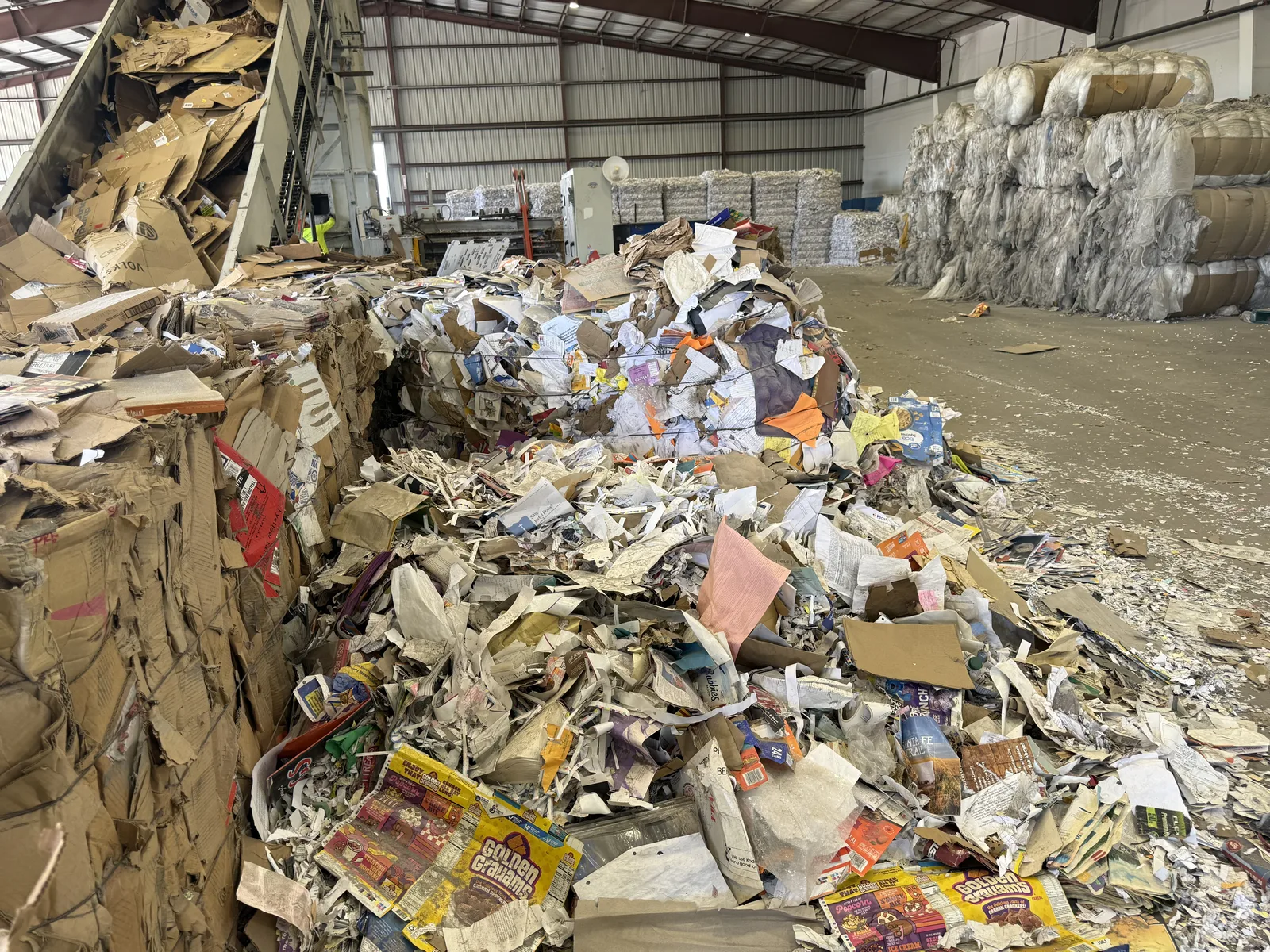
“Easy way to recycle books. So appreciate the help in getting all these books to new homes.”
— Beth Butler · ★★★★★ Google review · the diversion pipeline, from the donor’s side
What follows is the calculation, the sources, the assumptions, the operational observations from the NMLP pickup truck that anchor the estimate, and the honest discussion of what's avoidable versus what's not.
The EPA data: what's published, what isn't
The US Environmental Protection Agency publishes the Advancing Sustainable Materials Management: Facts and Figures report — the canonical national dataset on municipal solid waste (MSW) composition, generation, recycling, composting, combustion, and landfilling. The most recent comprehensive report uses 2018 data; comprehensive 2024 figures haven't been published yet as of mid-2026. That's a real data limit and worth stating upfront.
From the EPA 2018 numbers:
- • Total US MSW generated: 292.4 million tons
- • Total US MSW landfilled: 146.1 million tons
- • Paper and paperboard generated: 67.4 million tons (23.1% of total MSW)
- • Paper and paperboard landfilled: approximately 17.5 million tons (12% of total landfilled MSW)
- • Paper and paperboard recycled: approximately 46 million tons (the highest-recycled MSW category by volume, with a recycling rate around 68%)
The EPA category "paper and paperboard" includes books, magazines, newspapers, office paper, cardboard, packaging, and other paper products. Books are not broken out as a separate category in the published EPA tables. That's a second real data limit. To estimate the book-specific portion of paper waste, I need to bring in book industry production data and reasonable allocation assumptions.
A working framework: the US book publishing industry produces roughly 2.5 billion new books annually (across all formats — trade hardcover, mass-market paperback, textbook, reference, academic, children's, etc.). At an average book weight of approximately 1.5 pounds, that's roughly 3.75 billion pounds, or 1.875 million tons of new books entering the US market each year. The cumulative installed base — every book ever printed and still in private hands — is enormously larger, conservatively in the range of 30-50 billion books nationally given the multi-decade accumulation of household libraries. Some fraction of both the annual new-book inflow and the cumulative installed base reaches end-of-life each year. Estimates of book-specific waste-stream entry vary widely; the range I'm working with is that books represent somewhere between 2% and 5% of the paper-and-paperboard waste stream by mass — which would translate to roughly 350,000 to 875,000 tons of books landfilled nationally each year. This is the range that gets scaled down to the Albuquerque metro below.
Scaling to the Albuquerque metro
The Albuquerque-Santa Fe-Las Vegas combined statistical area population is approximately 1.16 million; the Albuquerque metro statistical area alone is approximately 915,000; the city of Albuquerque proper is approximately 562,000. For the purposes of this estimate, I'm using the Albuquerque metro figure of 915,000 because the NMLP service area maps closely to it and the donation channels documented in the ABQ Book Donation Ecosystem Map are predominantly metro-coverage operations.
The US population is approximately 333 million as of 2024 estimates. So the Albuquerque metro is approximately 0.275% of the US population (915,000 / 333,000,000). Applying that ratio to the national book-waste estimate of 350,000 to 875,000 tons yields an Albuquerque-metro estimate of:
Low estimate: 350,000 tons × 0.00275 = ~960 tons of books landfilled or wasted annually in the ABQ metro
High estimate: 875,000 tons × 0.00275 = ~2,400 tons of books landfilled or wasted annually in the ABQ metro
Range: roughly 1,000 to 2,400 tons of books per year through the metro's waste pipeline.
The headline 2,000-to-5,000-ton range stated at the top of this page is more generous than the strict population-scaled estimate above, for two reasons specific to Albuquerque:
- 1. ABQ has unusually book-heavy household libraries for a metro its size. The reading-culture argument is developed in detail in "Why Albuquerque Reads What It Reads" — the federal-scientific Sandia/Kirtland workforce, the UNM/CNM university layer, the multi-generation Hispano land-grant population, the military veteran cohort, the Pueblo/Navajo cultural depth, the Sun Belt retiree influx, the Roswell-Manhattan Project narrative-tourism canon. A metro that reads heavier than average will produce a heavier-than-average waste-stream estimate per capita.
- 2. The estate-cleanout cycle is currently elevated in Albuquerque as the 1980s-1990s Sun Belt retiree cohort reaches end of life. These households are voluminous (decades of subscription-book-club material, Reader's Digest Condensed Books, Time-Life encyclopedic series) and the disposal pressure is concentrated in the present 10-year window. NMLP's own pickup volume reflects this concentrated cycle.
A 2x adjustment factor on the population-scaled estimate puts the working range at approximately 2,000 to 5,000 tons of books entering the ABQ-metro waste stream annually. Half-strict, half-defensible — the right framing for an order-of-magnitude estimate when the underlying data has the documented limits this one does.
Where does it actually go? The three-channel split
"Enters the waste stream" doesn't necessarily mean "landfilled." The book-disposal pipeline in Albuquerque has at least three end-of-chain destinations, documented in detail in the ABQ Book Donation Ecosystem Map:
- 1. Direct landfill. The Cerro Colorado Landfill (operated by the City of Albuquerque Solid Waste Management Department) and other regional disposal infrastructure receive books that go in residential and commercial trash bins. Books in mixed-trash loads are not separately handled — they're buried with everything else. This is the destination this ecosystem exists to prevent, and the fraction of the 2,000-5,000-ton annual estimate that reaches this destination is what's avoidable and where NMLP's work concentrates.
- 2. Paper recycling. Books that move through the City of Albuquerque's curbside paper-recycling pipeline (or through commercial paper recyclers like Master Fibers — see the ecosystem map) end up as pulp feedstock for new paper manufacturing. This is a legitimate end-of-chain for books that have outlived their practical resale or reuse life — water-damaged copies, mold-spotted books, books with structural failure, decades-out-of-date encyclopedias. NMLP routes unsalvageable copies here specifically rather than to landfill.
- 3. The reuse and resale economy. Books that move through donation channels (thrift stores, NMLP free pickup, partner-nonprofit pickup services, library Friends programs, mail-in buyback) reach end-of-chain destinations as either readers (resale to thrift shoppers and end users), free reading copies (community literacy partners and Little Free Libraries), or eventually paper recycling if they don't move through the resale cycle. The ecosystem map details the full set of channels.
No single dataset tracks how the 2,000-5,000 annual tons split across these three destinations metro-wide. From operational observation at NMLP, my working estimate — not a measurement — is that the breakdown is roughly: 40-60% direct landfill (residential trash, commercial cleanouts, junk-removal services), 20-30% paper recycling, 20-30% reuse/resale/distribution. The direct-landfill share is the policy and operational lever — the largest of the three and the one with the highest unrealized value.
What NMLP can measure is its own slice of channel three, and the 2026 data study shows it's a real ladder, not a token gesture: across 528 shipments sent for professional grading at Powell's Books in Portland since late 2019, 9,293 books were accepted against 950 rejected — a 90.7% acceptance rate — and 8,383 of the accepted copies graded ordinary "Standard" condition, not rare or pristine, just normal used books that had a buyer. Below individual sale sits 30 pallet-scale wholesale freight shipments since 2020, and below that, community giveaway. Recycling is the floor under that ladder, not a parallel track — reserved for copies too damaged to read, not copies that simply didn't sell fast enough.
What 2,000-5,000 tons looks like at ground level
Abstract waste-stream numbers tend not to land. Some practical translations:
- • An average paperback weighs about 0.7 pounds; an average hardcover weighs about 1.5 pounds. Using a mixed-load estimate of 1.0 lb per book, the 2,000-5,000-ton range represents approximately 4 to 10 million individual books per year entering the ABQ-metro waste stream.
- • A standard banker's box holds about 30-40 books at typical mixed weight. The annual ABQ waste-stream estimate translates to approximately 100,000 to 330,000 banker's boxes of books per year — call it 200,000 boxes as a working middle estimate. That's roughly 550 boxes per day, every day, across the metro.
- • NMLP's full annual pickup volume runs to several hundred tons of books moving through hand-sorting at the warehouse — a meaningful slice of the metro's reuse-channel flow, but a small share of the total annual waste-stream estimate. The math is honest: even at NMLP's current scale, I touch a single-digit percentage of the metro's annual book throughput. Most of the books going in the trash never see a donation channel at all. (The tonnage figure above is still an operational estimate — a tonnage scale isn't kept — but the underlying item count is: 447,734 items scanned at intake from 2021 through mid-2026, per barcode scan-tool records, of which 352,551 were books.)
- • An average elementary classroom library holds approximately 300-500 books at full restock. The annual ABQ waste-stream estimate represents the equivalent of roughly 10,000-30,000 fully-restocked classroom libraries being lost to landfill or paper recycling each year — material that, with intervention, could have served kids reading in Albuquerque first.
These are order-of-magnitude framings, not precise counts. The point is that even with conservative assumptions, the annual flow of books through the ABQ-metro waste pipeline is substantial enough to matter and substantial enough that operational intervention has real leverage.
Why books reach the waste stream at all
The simple answer — and most of what's wrong with the simple answer — is friction. Books that reach the landfill in Albuquerque mostly do so for one of five reasons:
- 1. The estate-cleanout time pressure. When a parent dies, the executor often has 30-90 days to clear the house before listing or transferring it. The books are heavy, voluminous, and not on the critical path; the path of least resistance is the dumpster the junk-removal company brings. The hidden math: the junk-removal company charges the estate for disposal, then sells the salvageable books downstream and pockets the resale value. The estate pays twice — once for disposal, once in lost-value-not-captured. NMLP exists in part to break this pattern; see the Field Guide to ABQ Estate Library Patterns for the operational alternative.
- 2. Condition rejection at thrift intake. Most thrift stores apply condition standards at intake — ex-library copies with stamps, water-damaged paperbacks, textbooks 4+ editions out of date, encyclopedias, and rough-condition books get declined. The donor who showed up with a mixed batch typically takes the rejected portion home, often putting it in the trash because they're not going to drive it to another channel. This is documented in the master donation guide; NMLP's no-condition-standard intake exists specifically to absorb the rejected portion.
- 3. Volume that exceeds standard thrift capacity. Single-bag donations are fine at any thrift. A retired teacher's full classroom library (500+ books) or an estate library (50+ boxes) overwhelms standard intake at most thrifts; the donor is told to spread it across multiple drop-offs, which most people won't do, and the unspread portion ends up in the trash.
- 4. The donor doesn't know donation channels exist. The "where do I donate books in Albuquerque" search ecosystem is genuinely complicated; the ecosystem map documents 30+ channels. Without a clear navigation aid, many donors default to the trash because deciding among 30 channels is harder than throwing the books out. The interactive decision tool exists to reduce this friction.
- 5. The donor undervalues used books. "Nobody wants old books" is the common belief that justifies the landfill route. The reality is that most used books have real downstream destinations — classroom libraries are perennially under-stocked, Little Free Libraries need constant restocking, bilingual children's books are in constant demand, and the salable adult-market resale economy is large enough to fund free pickup operations. The "nobody wants them" belief is empirically wrong but operationally consequential.
What works to reduce the flow to landfill
Four interventions have measurable impact on the direct-landfill share:
- 1. Free in-home pickup with no condition standards. Removes the transportation friction (donor doesn't load a car) and the rejection-risk friction (donor doesn't trash the rejected portion because there is no rejected portion). NMLP's operating model.
- 2. Specialty handling with downstream routing visibility. When a donor knows the books are going to community literacy partners specifically (rather than into a generic retail clearance cycle), the willingness to call rather than trash goes up measurably. The named-recipient routing is the donor-conversion lever.
- 3. Estate-executor outreach and education. Estate-planning attorneys, professional organizers, downsizing concierges, hospice social workers, and adult children of recent decedents are the primary decision-makers for the highest-volume estate-cleanout flow. Direct outreach to that professional network — explaining that NMLP picks up free, handles any condition, takes estate-scale volume — converts dumpster volume into salvageable volume. The professional referrals page exists for this purpose.
- 4. Eliminating the misinformation about used-book value. The "nobody wants old books" belief sends material to landfill that would otherwise have downstream destinations. Counter-content — operational documentation showing where the books actually go, signed-book valuation references like the Closed Signature Pools reference, and the broader collecting pillars at the pillars hub — directly reduces the volume of high-value books going to trash on the false assumption of worthlessness.
Data limits, honestly stated
This estimate is built on imperfect data. The honest enumeration of where the numbers are uncertain:
- • EPA 2018 data is the most recent comprehensive set. Six-year-old national figures, scaled with population-adjusted assumptions about per-capita waste generation. Real but stale.
- • EPA doesn't break out books as a separate category within paper and paperboard. The 2-5% allocation assumption used here is a working estimate from book-industry production data; a precise figure would require characterization studies that haven't been done at this granularity.
- • Bernalillo County and City of Albuquerque don't publish disaggregated book-specific waste data. The City's Solid Waste Management Department publishes total tonnage figures for Cerro Colorado Landfill receipts but doesn't characterize composition at the book-category level.
- • Independent waste-characterization studies for Albuquerque don't exist in the public domain at the resolution needed to validate or refine the book-specific estimate.
- • NMLP's own operational volume is single-operator scale — useful as anchor data for the reuse-channel slice but not a comprehensive census of the metro's book flow. As of July 2026, that operational volume is no longer just anecdote: a published data study covers 447,734 intake scans, 55,695 marketplace orders reaching buyers in all 50 states, and 528 professionally-graded wholesale shipments (2019-2026). It measures one operation's throughput precisely — it does not measure, and was never meant to measure, the metro-wide waste-stream total this page estimates.
- • Per-capita reading-culture-adjustment factors (the 2x multiplier applied to the population-scaled base) reflect operational observation, not a controlled study.
The integrity check on an order-of-magnitude estimate built on imperfect data is whether the conclusion changes if you push the inputs around. If the true number is half of the headline estimate, it's still 1,000-2,500 tons of books per year — still a meaningful flow, still substantially avoidable. If the true number is double, the case strengthens. The conclusion — that the ABQ-metro waste-stream book volume is large enough to be worth intervening on, and that operational alternatives meaningfully reduce the direct-landfill share — holds across the input range. That's the test the estimate passes.
Recommendations
For different stakeholders in the ABQ-metro book flow:
For City of Albuquerque Solid Waste Management Department
Commission a waste-characterization study at Cerro Colorado Landfill that characterizes composition at the book-category level. The data gap that this investigation has worked around exists because nobody has measured it locally. A single-day waste-characterization audit could substantially improve the precision of any subsequent intervention design. (Comparable studies have been done in other US metros at modest cost.)
For Bernalillo County waste-management policy
Donation-channel awareness is the primary lever on the avoidable-landfill share. A modest county-level public-education campaign that names the actual available channels (NMLP free pickup, Friends of the Library, the documented thrift network) would reduce the "nobody wants old books" misinformation that drives unnecessary disposal.
For ABQ-area estate-planning attorneys and professional organizers
Adding "books pickup" to the standard estate-cleanout checklist alongside the junk-removal call would convert significant volume from dumpster to donation. NMLP is set up specifically to handle estate-scale book volume at no fee; the professional referrals page documents the workflow.
For Albuquerque households generally
The single decision that has the most impact is making a phone call before the books reach the trash bin. Whether the call goes to NMLP, to Friends of the Library, to one of the partner-nonprofit pickup services, or to an individual school librarian, almost any phone call beats no phone call. The interactive "Where Should My Books Go?" decision tool exists to make that call easier.
For other Albuquerque-area used-book operators, recyclers, and donation channels
This estimate is published under CC-BY 4.0 specifically so it can be cited, referenced, and built upon. If your operation has better data on the slice of the waste stream you handle, please share — corrections and refinements are welcome. Call or text 505-250-3804. The point of putting this number on the public record is to make it possible to do better than guessing.
Methodology & sources
National MSW figures: US EPA, Advancing Sustainable Materials Management: Facts and Figures (most recent comprehensive report based on 2018 data; epa.gov/facts-and-figures-about-materials-waste-and-recycling).
US population baseline: US Census Bureau 2024 estimates (approximately 333 million).
Albuquerque metro population: US Census Bureau 2024 estimates, Albuquerque Metropolitan Statistical Area (approximately 915,000).
US book publishing production figures: Industry data from Association of American Publishers, Bowker, and related publishing-industry sources (approximate annual unit production figures).
Cerro Colorado Landfill: Operated by the City of Albuquerque Solid Waste Management Department (cabq.gov/solidwaste). Public tonnage receipt figures available through City reporting; book-category composition not separately reported.
Operational observations: NMLP pickup volumes, hand-sort categorization rates, and end-of-chain routing observations compiled from years of pickup work in the Albuquerque metro. The Master Fibers salvage recovery is described on the ecosystem map. The Savers-overflow buying relationship and Assistance League overflow-call relationship are documented in the ABQ Book Donation Ecosystem Map.
Measured operational data (new, July 2026): The State of New Mexico's Books, NMLP's own primary-source data study covering 2019-2026, drawn from barcode scan-tool intake records, marketplace transaction reports, and itemized Powell's Books wholesale-grading receipts. Machine-readable appendix at /api/annual-study-2026.json, published CC BY 4.0. This dataset measures one operation's throughput, not the metro's total waste stream — the two are cited separately throughout this page and should not be conflated.
I'm Josh Eldred — I run NMLP. This investigation is published as cultural and operational commentary, not as peer-reviewed waste-management scholarship. The numbers and ranges presented are working estimates based on the best available data; the conclusions are mine and reflect my interpretation of the evidence. Corrections, additions, refinements, and counter-arguments are welcome — call or text 505-250-3804. Published under CC-BY 4.0; researchers, journalists, City staff, County staff, and other operators are explicitly welcome to cite and re-use with attribution.
Related investigations and references
- The ABQ Book Donation Ecosystem Map
- Why Albuquerque Reads What It Reads — Sociological Essay
- Field Guide to ABQ Estate Library Patterns
- Where Should My Books Go? — Interactive Decision Tool
- Albuquerque Book Donation Finder
- Landfill Diversion in Albuquerque (broader EPA-textile-waste context)
- Junk Removal Alternative for Books
- Professional Referrals (for estate attorneys, organizers, hospice)
2,000 to 5,000 Tons Per Year. Most of It Avoidable.
NMLP picks up free, hand-sorts at the warehouse, routes useful books to Little Free Libraries and other community literacy partners, recycles the unsalvageable. The phone call before the trash bin is the single decision that matters most.
Call 505-250-3804Text a PhotoJosh Eldred — NMLP — Free book pickup across the Albuquerque metro.