Are Old Magazines Worth Anything? The Honest Answer
By Josh Eldred · New Mexico Literacy Project · · Last verified October 2026
“They waited for me and took them all.”
— Steve, Local Guide · ★★★★★ Google review
Most old magazines are worth almost nothing — including, and this is the part that surprises people, the “important” ones you saved precisely because you thought they would be valuable someday. The big-event commemorative issues are the classic trap: everyone saved the JFK issue and the moon-landing issue and the 9/11 issue, which is exactly why they are abundant and nearly worthless today. There are real exceptions, and they are worth knowing, but the honest baseline is that the stacks of Life and Time and Look in the closet are not a retirement fund. Here is the truth, the exceptions, and what to actually do with the pile. (If your stacks are specifically National Geographics, I wrote a separate page just for those.)
The short version: if you just need the stacks gone, I take magazines free across the Albuquerque metro, any quantity, no sorting — and sort every stack by hand. Text 505-250-3804 or use the free pickup form.
Fastest way to clear them: the 24/7 drop box at 5445 Edith Blvd NE, a covered box outside the gate, by the road, takes whatever fits, any hour, any condition. Too much for the box? Come 8 a.m. to 3 p.m., when someone is there to help unload, or get on a free pickup route. Directions.
The commemorative-issue trap
This is the single most important thing to understand about magazine value, because it is so counterintuitive. The issues that feel the most valuable — the ones marking a death, a disaster, a moon landing, a royal wedding — are almost always worth the least. The reason is simple: those are precisely the issues that millions of people decided to save. A magazine’s value comes from scarcity, and nothing destroys scarcity like a whole nation tucking the same issue into a drawer “for the future.” So the JFK assassination issues, the Apollo 11 issues, the September 11 issues, the Princess Diana issues — all of them survive in enormous numbers, and all of them sell for next to nothing. If your stack is mostly these, that is the explanation.
The same logic applies to ordinary runs of the big general-interest titles. Life, Time, Look, the Saturday Evening Post, Newsweek — these printed in the millions every week for decades, and complete or partial runs of them are common everywhere. They are wonderful to page through, they are full of gorgeous mid-century photography and advertising, and they are worth very little as collectibles.
The issues that genuinely have value
Real value in magazines is concentrated and specific:
True first issues. The genuine prizes are the debut issues of important magazines: the December 1953 first Playboy (with Marilyn Monroe), the 1967 first Rolling Stone, the first Sports Illustrated (1954), the first Mad, the first TV Guide (1953). These are the magazine issues collectors actually chase.
Genuinely early issues. Pre-1920 magazines, and very early issues of long-running titles, are scarce enough to carry value when they survive in good shape. The deeper you go before the era of mass weekly circulation, the more scarcity works in your favor.
Iconic covers in pristine condition. A famous cover — a landmark photograph, a first appearance, a notorious image — can have value if the copy is genuinely pristine: no mailing label, no creases, no fading, square and clean. Condition is decisive for magazines because they were made to be read and thrown away, so truly fine survivors are uncommon.
Everything that does not fit one of those buckets — which is the overwhelming majority of any inherited magazine collection — is common, and the honest move is to keep it in circulation rather than expect a payday from it.
The hometown exception: New Mexico Magazine
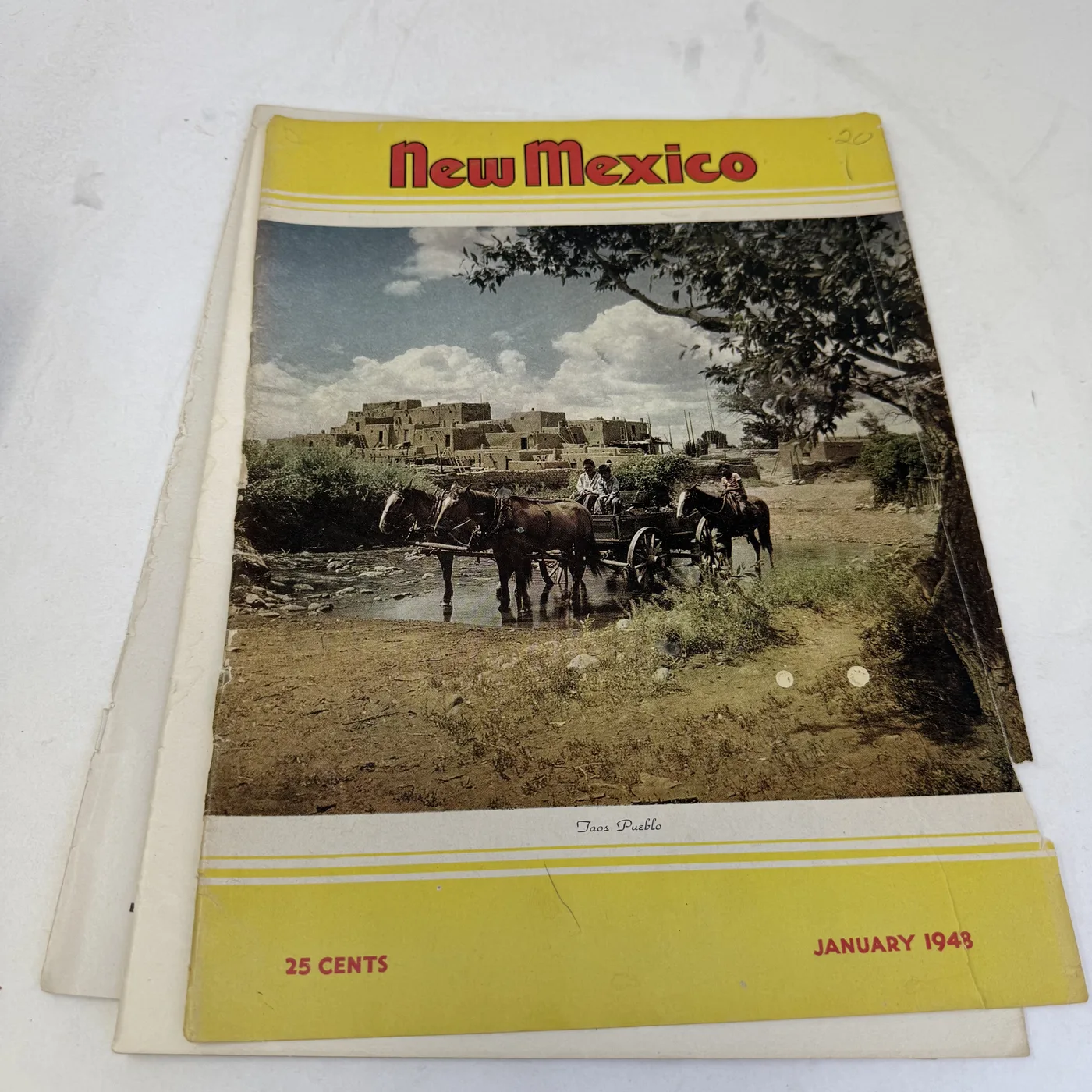
There is one title I pull out of Albuquerque estate stacks on sight, and it is not Life or Time — it is the state’s own monthly. New Mexico Magazine has been published continuously since 1923, longer than any other state magazine in the country, and its early print runs were tiny because the whole state barely held half a million people. Prewar and wartime issues, artist covers, and long unbroken runs have real, steady demand from researchers who use them as a photographic archive of ghost towns and vanished roadside New Mexico. I photographed a full run, issue by issue from 1938 to 1962, in a dedicated dated cover gallery so you can compare your own copies.
What to do with the stacks
Set aside the few that might matter. Pull any true first issues, anything genuinely pre-1920, and any pristine iconic-cover copies, and have those checked against recent sold prices before they go anywhere. That small pile is where any value lives.
Give the rest a second life. The common stacks are genuinely useful to people even though they are not valuable: teachers use them for projects, artists and crafters use the photography and advertising for collage and decoupage, and they make wonderful browsing for waiting rooms and Little Free Libraries. That is far better than the landfill.
Let me take the whole pile. In the Albuquerque metro this is exactly what I do. I take magazines free, any quantity, no sorting, along with books and media. Anything genuinely old or a notable first issue is pulled and flagged for you, the usable issues go free to Little Free Libraries, and the rest is responsibly paper-recycled. I will be honest that for common mid-century runs, recycling is where most of it ends up, because supply so far outstrips demand — but nothing useful is wasted, and you are not the one hauling boxes to the curb.
Stacks of old magazines to clear?
Free pickup across the Albuquerque metro, any quantity, no sorting. I'll flag the issues that matter first.
Call or Text 505-250-3804Frequently asked questions
Are old magazines worth anything?
Are commemorative issues (JFK, moon landing, 9/11) valuable?
Which old magazine issues are actually valuable?
Where can I donate or get rid of old magazines in Albuquerque?
Related on this site
- Vintage New Mexico Magazine Back Issues — the hometown exception, with twenty dated covers photographed 1938–1962.
- Are old textbooks worth anything? — the honest answer (it’s the edition), and why old textbooks make great donations.
- Are Old National Geographics Worth Anything? — the dedicated guide for the yellow-spined stacks.
- Are Reader's Digest Condensed Books Worth Anything? — the other great clear-out question.
- Are Old Vinyl Records Worth Anything? — same honest sort for the record box.
- Old Books Worth Money — what in the boxes actually has value.
- Free Book & Media Pickup — Albuquerque — schedule a pickup for the whole load.
Cite This Guide
Eldred, J. (May 2026). Are Old Magazines Worth Anything? The Honest Answer. New Mexico Literacy Project.
https://newmexicoliteracyproject.org/what-to-do-with-old-magazines
Content is original research by Josh Eldred. Licensed under CC BY 4.0. Cite with attribution.
What To Do With… — The Whole Series
- Old family bible
- Books after someone dies
- Old 78 RPM records
- Old 8-track tapes
- Old board games
- Old cameras
- Old car repair manuals
- Old cassette tapes
- Old cds
- Old comic books
- Old cookbooks
- Old dictionaries
- Old encyclopedias
- Old engineering and science textbooks
- Old Home movies & slides
- Old LaserDiscs
- Old law books
- Old maps and atlases
- Old medical textbooks
- Old national geographic magazines
- Old newspapers
- Old paperbacks
- Old photographs
- Old postcards
- Old religious books
- Old sheet music
- Old textbooks
- Old vhs and dvds
- Old video games
- Old vinyl records
- Old yearbooks
- Reader's Digest sets
- Reel-to-reel tapes
- Water damaged books