Selling Eugene Manlove Rhodes Books in Albuquerque: The Cowboy Writer Who Named the Land of Enchantment
By Josh Eldred · New Mexico Literacy Project · · ~2,700 words
Last verified October 2026 · Original research by Josh Eldred, who has cleared and sorted south-central New Mexico estate libraries for a decade.
Eugene Manlove Rhodes (1869–1934) is the most New Mexican of all the cowboy writers — he punched cattle for the Bar Cross outfit in the San Andres Mountains, set nearly every story he wrote in the country between the Rio Grande and the Tularosa Basin, and is widely credited with attaching the phrase “Land of Enchantment” to the state. For collectors and estate executors, the value sits in the early first editions: the three Henry Holt novels of 1910–1916, the Houghton Mifflin firsts of the 1920s and 1930s, and above all Pasó por Aquí, the novella many call the finest Western ever written. If you have Rhodes on a shelf in an Albuquerque, Las Cruces, or Alamogordo estate, this is what matters and why.
The cowboy who named the Land of Enchantment
Rhodes was born in Tecumseh, Nebraska, on January 19, 1869, and moved to New Mexico Territory with his family in 1881, where, in his own telling, he “fell in love” with the country and never recovered. In 1883 he went to work for the Bar Cross Ranch in the San Andres Mountains — the apprenticeship that would supply the material for everything he later wrote. He broke horses, built roads (including the wagon road from Engle to Tularosa), and earned a reputation for both bookishness and brawling. Two years at the University of the Pacific in California in the late 1880s were cut short by money; the rest of his education was the range and a famously omnivorous reading habit.
In 1899 Rhodes married May Louise Davison Purple and followed her east to Apalachin, New York, where he spent the next quarter-century in what his admirers call his “years of exile” — homesick for New Mexico and writing it from memory. He sold serials to The Saturday Evening Post, McClure’s, Redbook, Cosmopolitan, and the Southwestern booster magazine Out West, and it was in print by 1911 — in a sketch titled “A Number of Things” describing the Socorro country as “a land of enchantment and mystery” — that he gave New Mexico the name that is now its official nickname and rides on every license plate. (An earlier book by Lilian Whiting used the phrase more broadly in 1906, so Rhodes is best described as the writer who fixed “Land of Enchantment” to New Mexico specifically.) He returned to the state for good in 1926, living briefly in Santa Fe and Alamogordo and finally in a house near Three Rivers. He died in Pacific Beach, California, on June 27, 1934, and — at his own request — was buried in the San Andres Mountains, in the canyon that now bears his name inside White Sands Missile Range.
The critical standing is real, not regional flattery. The New York Times ranked him “the peer of Owen Wister in portraying the cowboy in his code” and, among the great cowboy realists, “the best of the four.” Jack Schaefer, who wrote Shane, said Rhodes “mastered his material as few others in the field, in any field, have done.” In 1958 he was inducted into the Hall of Great Westerners at the National Cowboy & Western Heritage Museum.
The Henry Holt years (1910–1917)
Rhodes published his first four books with Eastern trade houses while still living in New York, and these early firsts are the scarcest of his work in collectible condition. Good Men and True (Henry Holt, 1910), his debut, carries illustrations by H. T. Dunn and is the foundational Rhodes first edition — a slim novel that already shows the tight, idiom-rich style and the San Andres geography that define him. Bransford in Arcadia; or, The Little Eohippus (Henry Holt, 1914) is the book in which the “land of enchantment” phrasing reappears; it was later reissued under the title Bransford of Rainbow Range, a retitling that trips up sellers who assume the two are different books. The Desire of the Moth (Henry Holt, 1916), again illustrated by Dunn and sometimes bound with the short novel “The Come On,” rounds out the Holt period. West Is West (H. K. Fly, 1917) is the outlier — a different publisher, a more episodic structure, and a genuinely uncommon first.
For all four, the value lives in the original cloth with a present, unrestored dust jacket. Pre-1920 Western-fiction jackets survive at low rates, so a Holt-era Rhodes first in a clean jacket is a Tier 1 target; the same book rebound or jacketless drops to reading-copy territory. Because so much of Rhodes’s work appeared first in magazines, you will also find the original Saturday Evening Post and McClure’s appearances in estate paper — collectible as serial firsts, but a separate category from the books.
Sitting on a shelf of old Western fiction in a Las Cruces, Alamogordo, or Tularosa Basin estate? Rhodes country runs right through there. You don’t need to know which editions you have — text 505-250-3804 and I’ll help you plan the drop-box trip to Albuquerque.
The Houghton Mifflin years and the mature work (1921–1935)
Rhodes’s major-house period belongs to Houghton Mifflin, and these firsts are the heart of a serious Rhodes shelf. Stepsons of Light (1921) and Copper Streak Trail (1922) are the bridge novels; The Trusty Knaves (1933) and Beyond the Desert (1934) are the late, hard-bitten work; and The Proud Sheriff (1935), published the year after his death, is the posthumous first. Two small-press oddities — Say Now Shibboleth (1921) and Peñalosa (1934) — are scarce ephemeral pieces that turn up rarely and reward the completist. After Rhodes’s death came the gatherings that keep his work in print: The Little World Waddies (1946); The Best Novels and Stories of Eugene Manlove Rhodes (1949), edited by Frank V. Dearing with an introduction by the great Southwestern folklorist J. Frank Dobie; and W. H. Hutchinson’s The Rhodes Reader (1957).
Pasó por Aquí: the finest Western ever written
The book that makes Rhodes more than a regional name is a novella. Pasó por Aquí first ran in The Saturday Evening Post in 1926 and appeared in hardcover the next year as the title piece of Once in the Saddle, and Pasó por Aquí (Houghton Mifflin, 1927). The title comes from the Spanish inscription — “passed by here” — carved into El Morro, the Inscription Rock west of Albuquerque, and the story turns on a young outlaw who abandons his escape to nurse a Mexican-American family through diphtheria. It is, famously, a Western in which the moral weight comes from mercy rather than gunplay; the 1948 film adaptation, Four Faces West, is remembered as one of the only Westerns ever made without a single gunshot fired. More than one critic has called Pasó por Aquí simply “the finest Western ever written,” and the 1927 Houghton Mifflin first — in jacket — is the single most desirable Rhodes book to own.
First-edition identification
Rhodes is a clean author to authenticate because his canon is small and well documented. The standard authority is W. H. Hutchinson, whose biography A Bar Cross Man: The Life and Personal Writings of Eugene Manlove Rhodes (1956) and accompanying Rhodes bibliography remain the reference points for first-edition status; any serious sale should be checked against Hutchinson rather than against a bookseller’s optimism. In practice, three things decide a Rhodes first:
- Publisher and date match the title. Good Men and True / Bransford in Arcadia / The Desire of the Moth are Henry Holt; the 1921–1935 novels are Houghton Mifflin; West Is West is H. K. Fly. A “Rhodes first” under any other imprint is a later printing or a reprint-house edition (Grosset & Dunlap and similar) with reading value only.
- The dust jacket is present and original. For an author whose firsts predate 1935, the jacket is most of the value — a jacketed Holt-era first can be worth many times the same book bare. Beware jacketless copies described as “first edition” at first-edition prices.
- The Bransford retitling. Bransford in Arcadia; or, The Little Eohippus (1914) and the later Bransford of Rainbow Range are the same story under two names — know which one you have before pricing it.
Inscribed and signed Rhodes material is genuinely uncommon and commands a real premium; he was not a prolific signer, and association copies tied to the New Mexico ranch world are the trophies of the category.
Since I first published this guide, a reader discovered it, recognized what they had on their own shelf, and reached out with photographs of their first edition of Good Men and True (Henry Holt, 1910) — a copy that turned out to be an association inscription from Emily Rhodes, the author’s wife, to a Miss Alta Hager, dated February 25, 1914, from Apalachin, New York, and referencing their mutual cousin Matt Reynolds. The book came with a separate handwritten provenance note from Alta Hager herself, confirming it was sent to her by the author. That is exactly the kind of documented chain of ownership — family inscription, named recipient, independent provenance confirmation — that makes an association copy a Tier 1 acquisition. The photographs below show this copy in detail, and I’m grateful to the contributor (who prefers to remain anonymous) for sharing them. It is the kind of connection that makes this work worthwhile: you write about a book, and the book finds you back.
A first edition of Good Men and True (1910) — in photographs
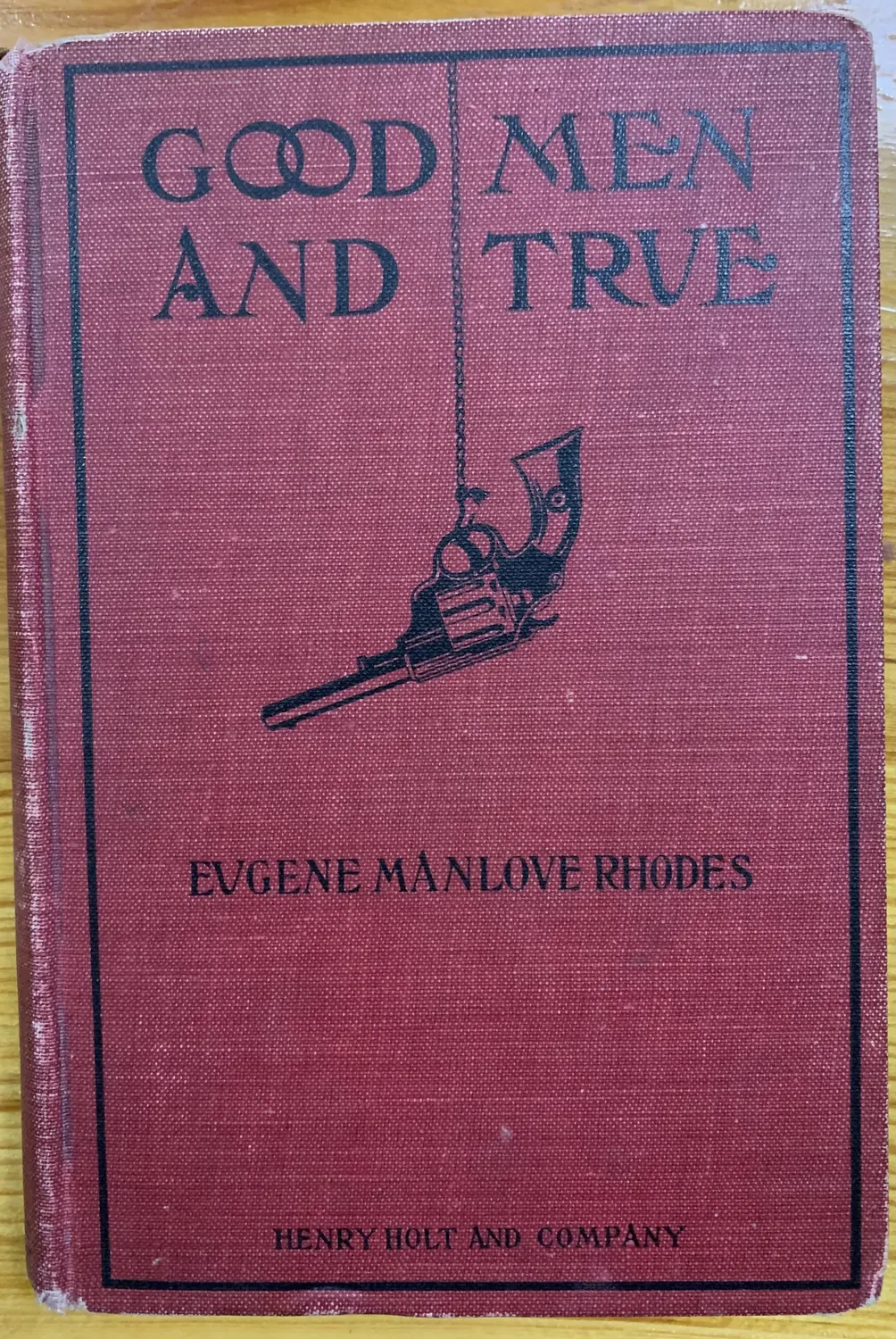
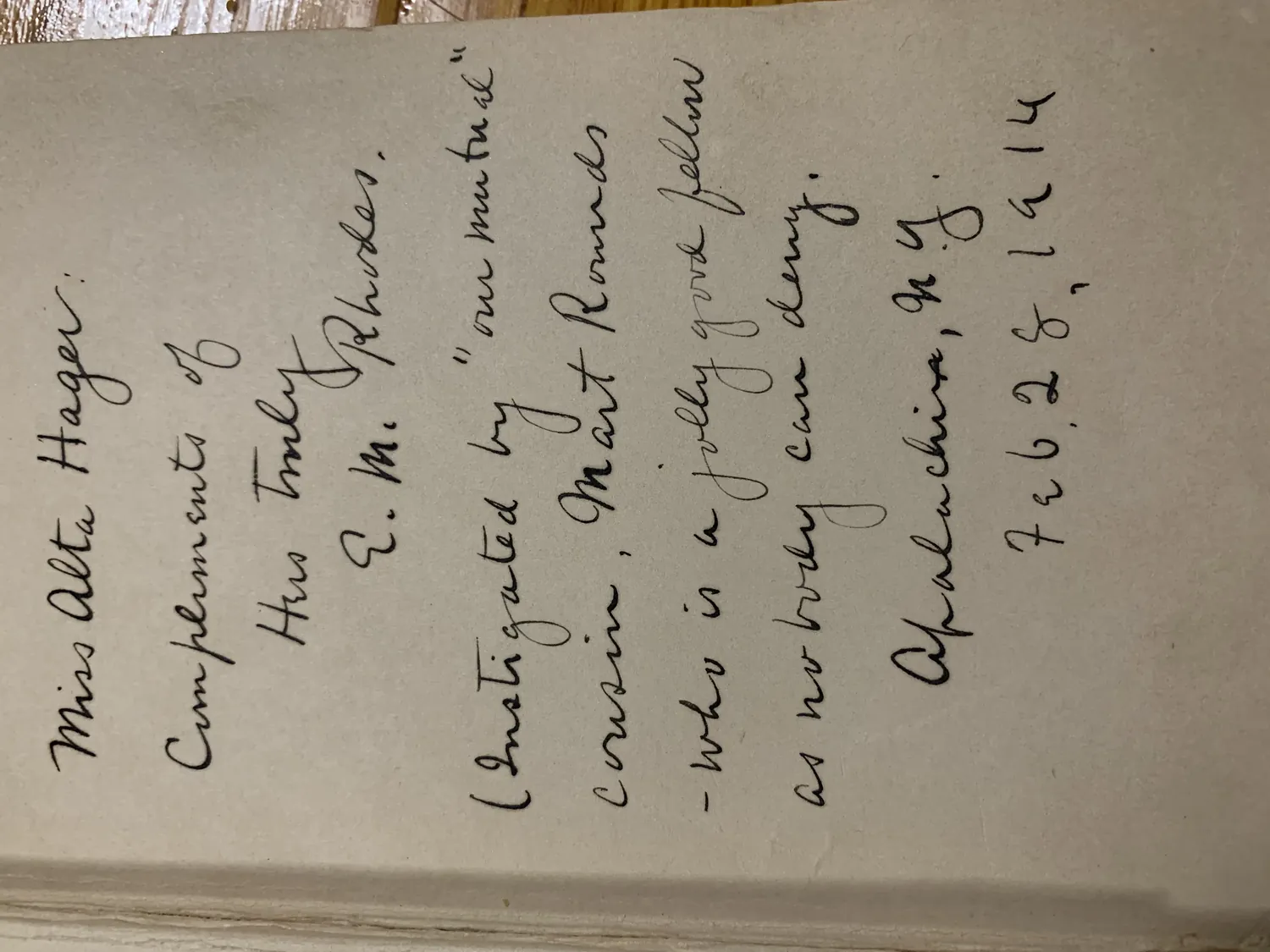
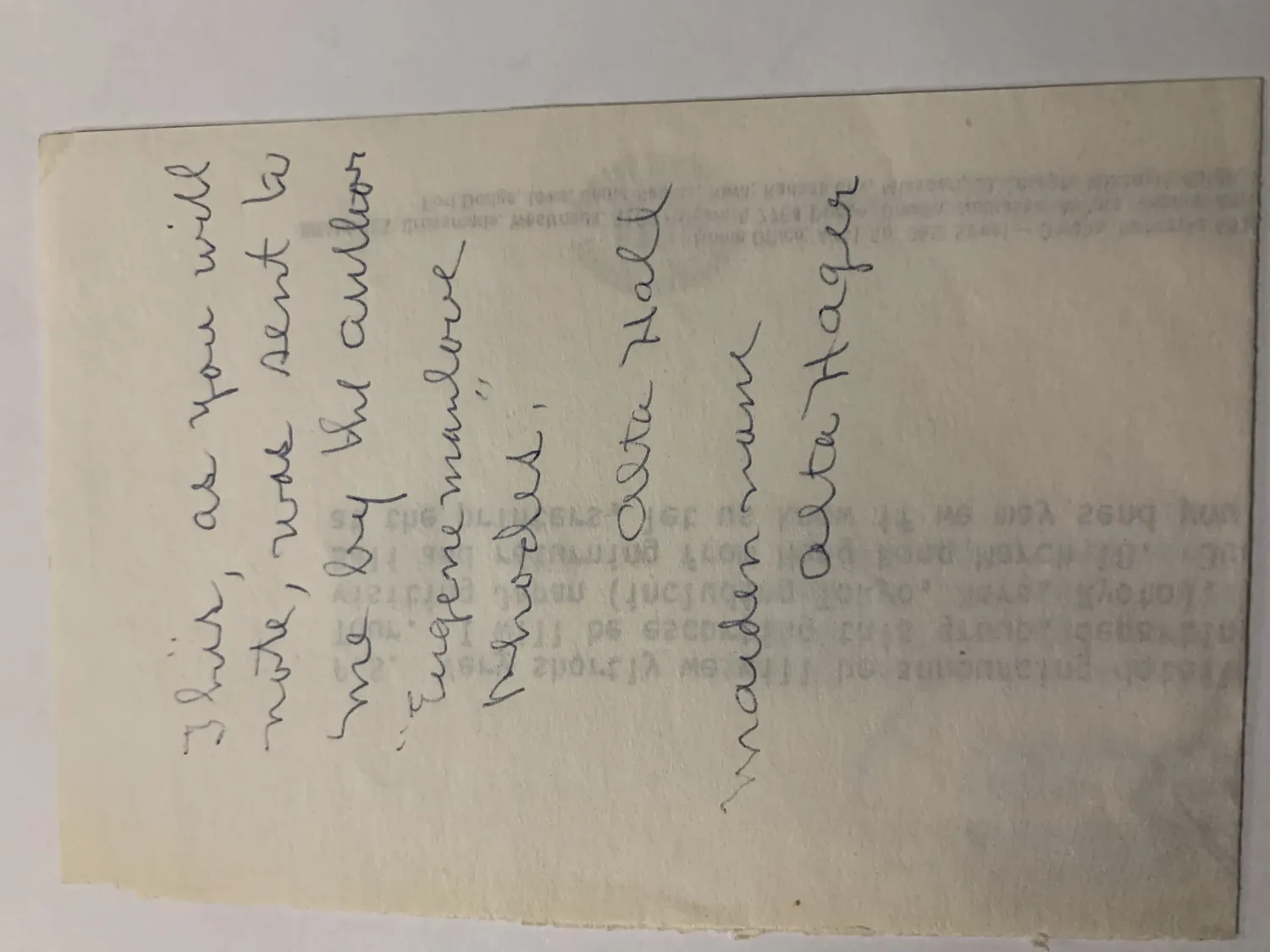
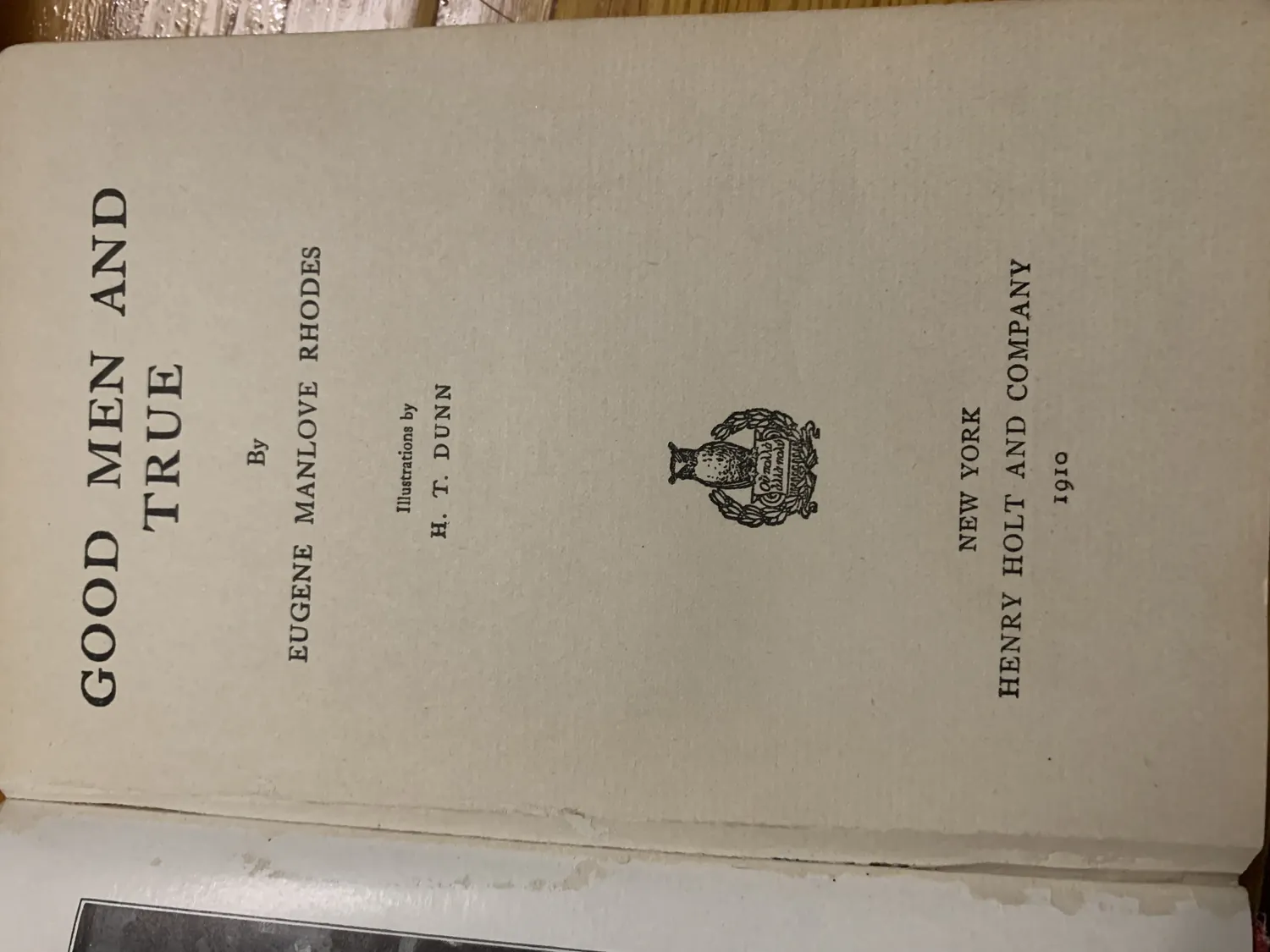
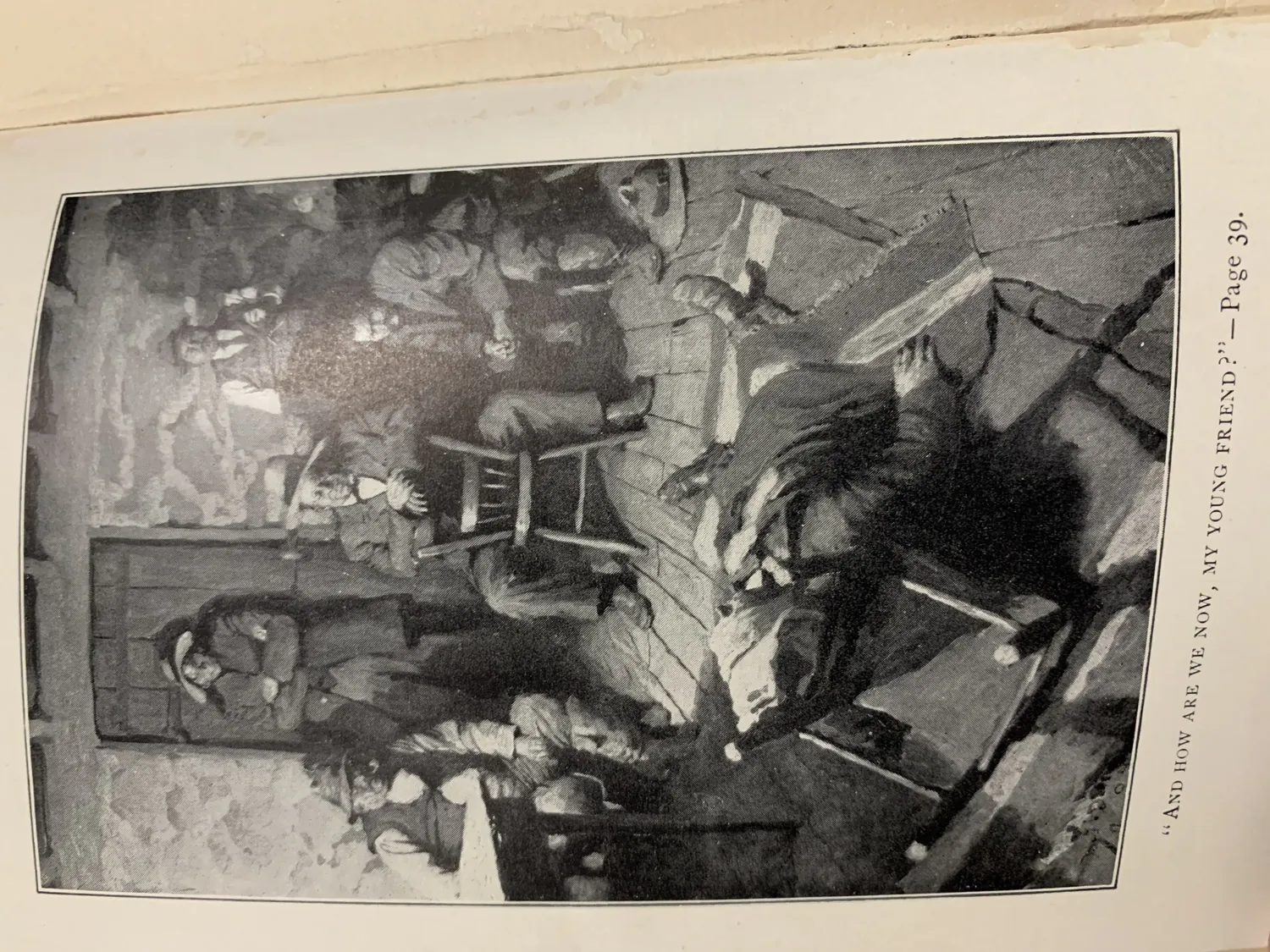
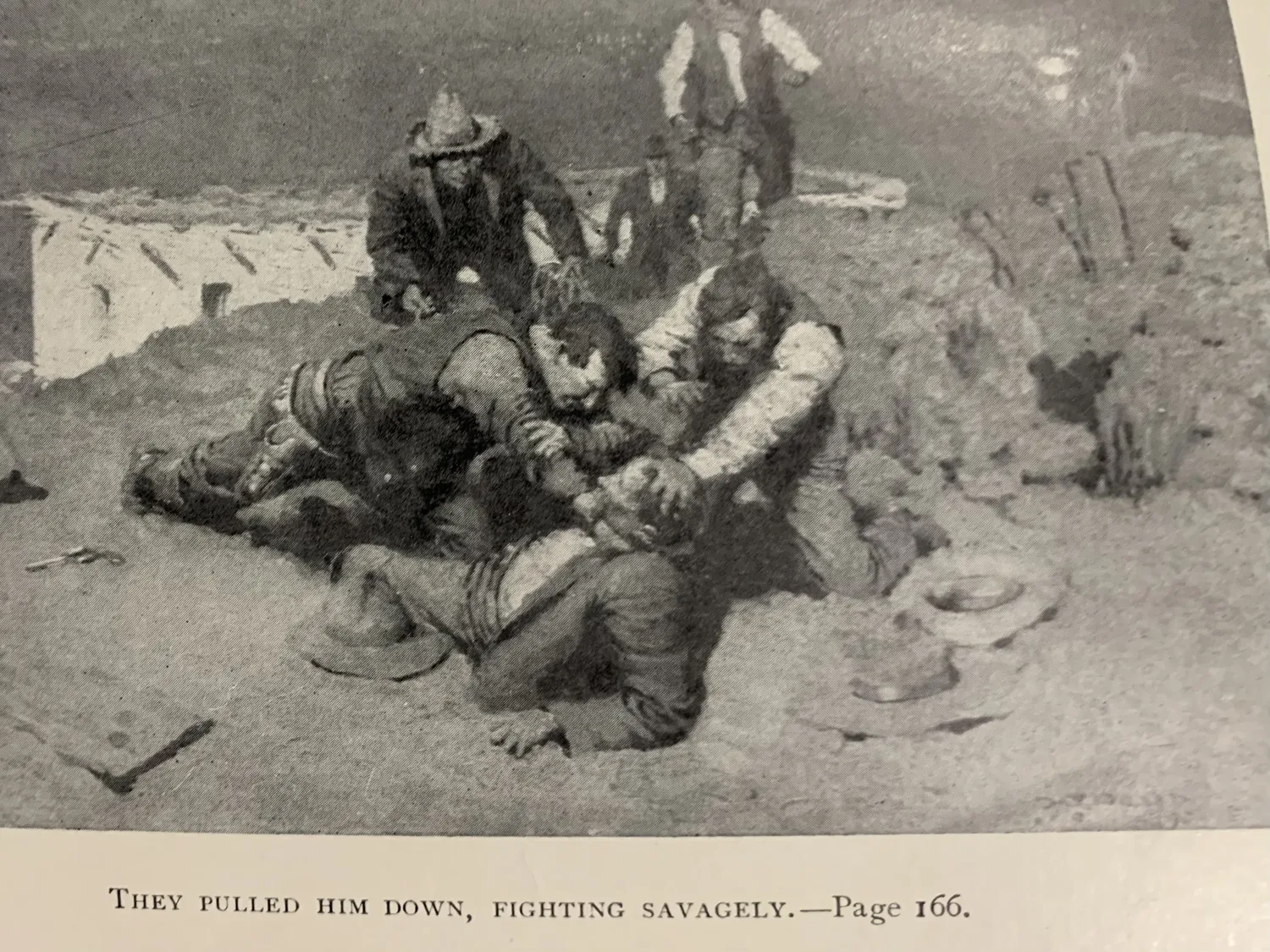
Photographs contributed by an anonymous reader and used with permission. This copy surfaced at a garage sale and was identified through this article — exactly the kind of connection that makes documenting New Mexico’s literary heritage worthwhile.
The collector market — three tiers
Tier 1 — trophy: Once in the Saddle, and Pasó por Aquí (Houghton Mifflin, 1927) in dust jacket; the Henry Holt firsts — Good Men and True (1910), Bransford in Arcadia (1914), The Desire of the Moth (1916) — in original jackets; any signed or inscribed Rhodes; and the scarce pamphlets Say Now Shibboleth and Peñalosa.
Tier 2 — collector: the Houghton Mifflin novels Stepsons of Light (1921), Copper Streak Trail (1922), The Trusty Knaves (1933), Beyond the Desert (1934), and the posthumous The Proud Sheriff (1935) in jacket; West Is West (1917); and Hutchinson’s A Bar Cross Man (1956), itself a collectible piece of Rhodes scholarship.
Tier 3 — reading copies and reprints: jacketless firsts, Grosset & Dunlap and book-club reprints, the University of Oklahoma Press and University of Nebraska Press paperback reissues, The Best Novels and Stories (1949), The Little World Waddies (1946), and the Rhodes Reader. These keep him readable and are exactly the kind of book that does the most good donated rather than sold.
Where Rhodes turns up — and how NMLP handles him
Rhodes is a south-central New Mexico author, and that is where his books accumulate: ranch-family estates in the Tularosa Basin and the Rio Grande valley, Alamogordo and Las Cruces libraries, and the shelves of the Western-history readers who have always made up a quiet, devoted Rhodes cult. The Alamogordo Public Library maintains a dedicated Eugene Manlove Rhodes Room, and the major manuscript collections sit at the University of New Mexico’s Center for Southwest Research, New Mexico State University, and the Bancroft Library — useful provenance context when a strong copy surfaces.
When Rhodes material comes through a New Mexico Literacy Project pickup, the handling is the same as for every collectible author: trophy items — jacketed Holt firsts, the 1927 Pasó por Aquí, signed copies — are identified by hand and routed to specialist Western-Americana dealers and auction channels rather than tossed in a bulk lot; clean Houghton Mifflin firsts go through careful resale; and the reading copies and reprints I can’t resell go free to Little Free Libraries around town. No book is landfilled. If you are clearing a ranch library or an estate and you are not sure what you have, you don’t need to be: every book is sorted by hand at the warehouse.
External References
- Wikipedia: Eugene Manlove Rhodes — life, bibliography, and critical reception.
- Eugene Manlove Rhodes Collection, UNM University Libraries, Center for Southwest Research.
- Eugene Manlove Rhodes Room & Southwest Collection, Alamogordo Public Library.
- Eugene Manlove Rhodes, New Mexico State University Library, The Open Stacks.
- Works by Eugene Manlove Rhodes at Project Gutenberg.
Related on This Site
- Max Evans — the modern heir to the Rhodes ranch-realism tradition (The Rounders, The Hi-Lo Country).
- Max Brand and Louis L’Amour — the commercial Western titans alongside whom Rhodes is the realist.
- Jack Schaefer — the Shane author and a Rhodes admirer.
- New Mexico Ranching & Cowboy Literature — the wider working-canon shelf Rhodes anchors.
- The New Mexico Literary Atlas — where Rhodes sits in the state’s literary geography.
Cite This Guide
Eldred, J. (May 2026). Selling Eugene Manlove Rhodes Books in Albuquerque: The Cowboy Writer Who Named the Land of Enchantment. New Mexico Literacy Project. https://newmexicoliteracyproject.org/selling-eugene-manlove-rhodes-books-albuquerque — original research by Josh Eldred, licensed CC BY 4.0. Cite with attribution.
Have Rhodes — or a whole Western library?
I don’t buy books — but I pick up estate libraries across the Albuquerque metro, and every book is sorted by hand. Keep a family copy of Pasó por Aquí if it matters to you; I’ll pick up the rest free as a donation, or you can bring it to the 24/7 drop box on Edith Blvd NE when you’re up from Las Cruces. Either way, the good books find readers.
Call or Text 505-250-3804Rather donate the whole thing? Free Rhodes collection pickup →