New Mexico Chicano Movement Books: A Collector's Authority Guide
By Josh Eldred · New Mexico Literacy Project · · ~7,800 words
Last verified September 2026 · Original research by Josh Eldred
On June 5, 1967, a group of armed men led by Reies López Tijerina raided the Río Arriba County courthouse in Tierra Amarilla, New Mexico — a single act of direct political confrontation that placed the land grant restitution cause before the entire country and announced that the Chicano movement in New Mexico was not California and was not Texas. It was something older, something rooted in documented colonial land tenure, in treaty law, in a Hispano colonial presence that predated the United States by two and a half centuries. The raid, the trial, the mountain manhunt, the acquittals: these events generated a distinct literature — primary documents, newspaper coverage, scholarship, memoir, and creative writing — that constitutes one of the most historically specific and underappreciated collecting categories in the entire Southwest Americana field. This is the collector's guide to that literature.
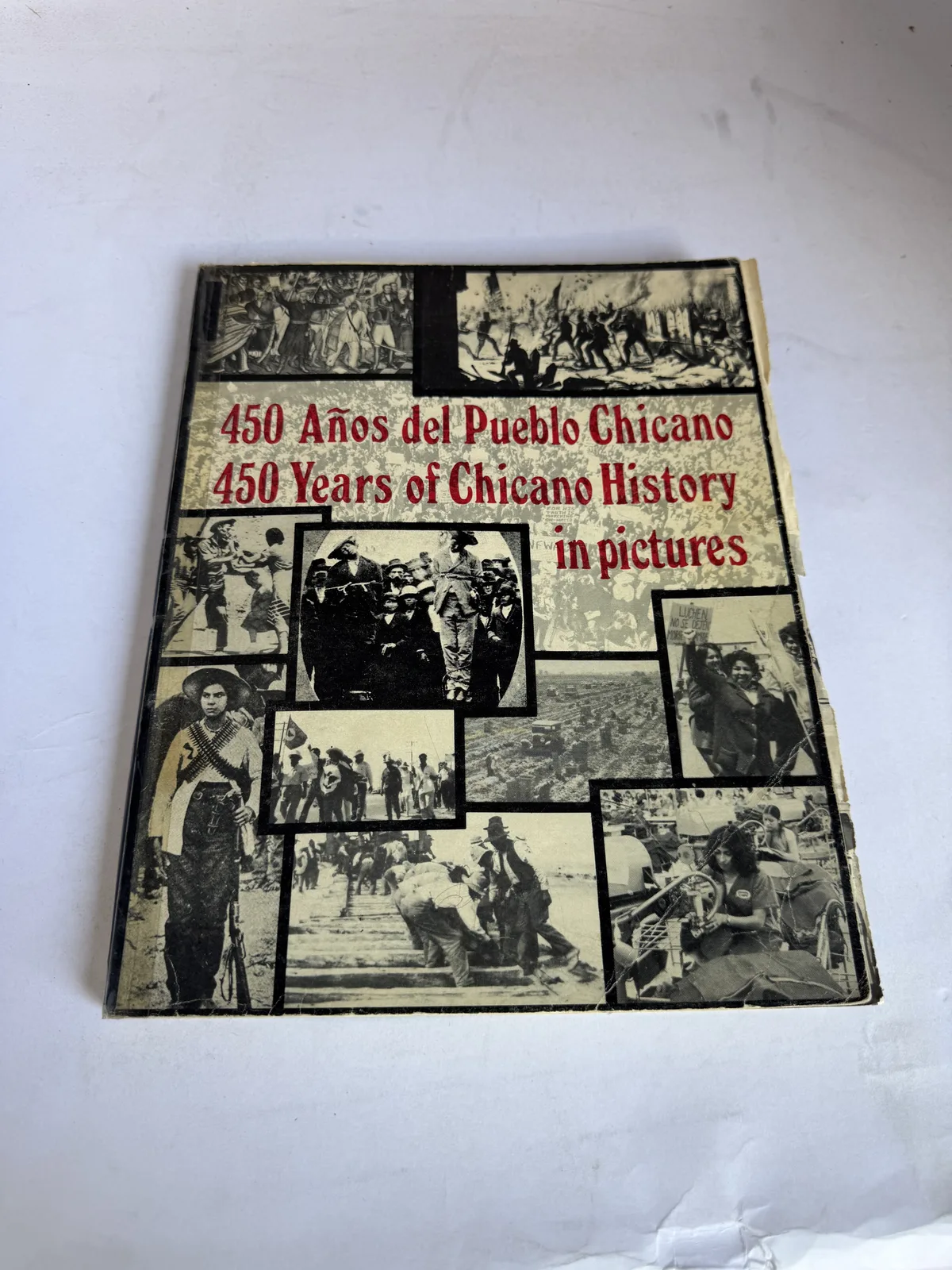
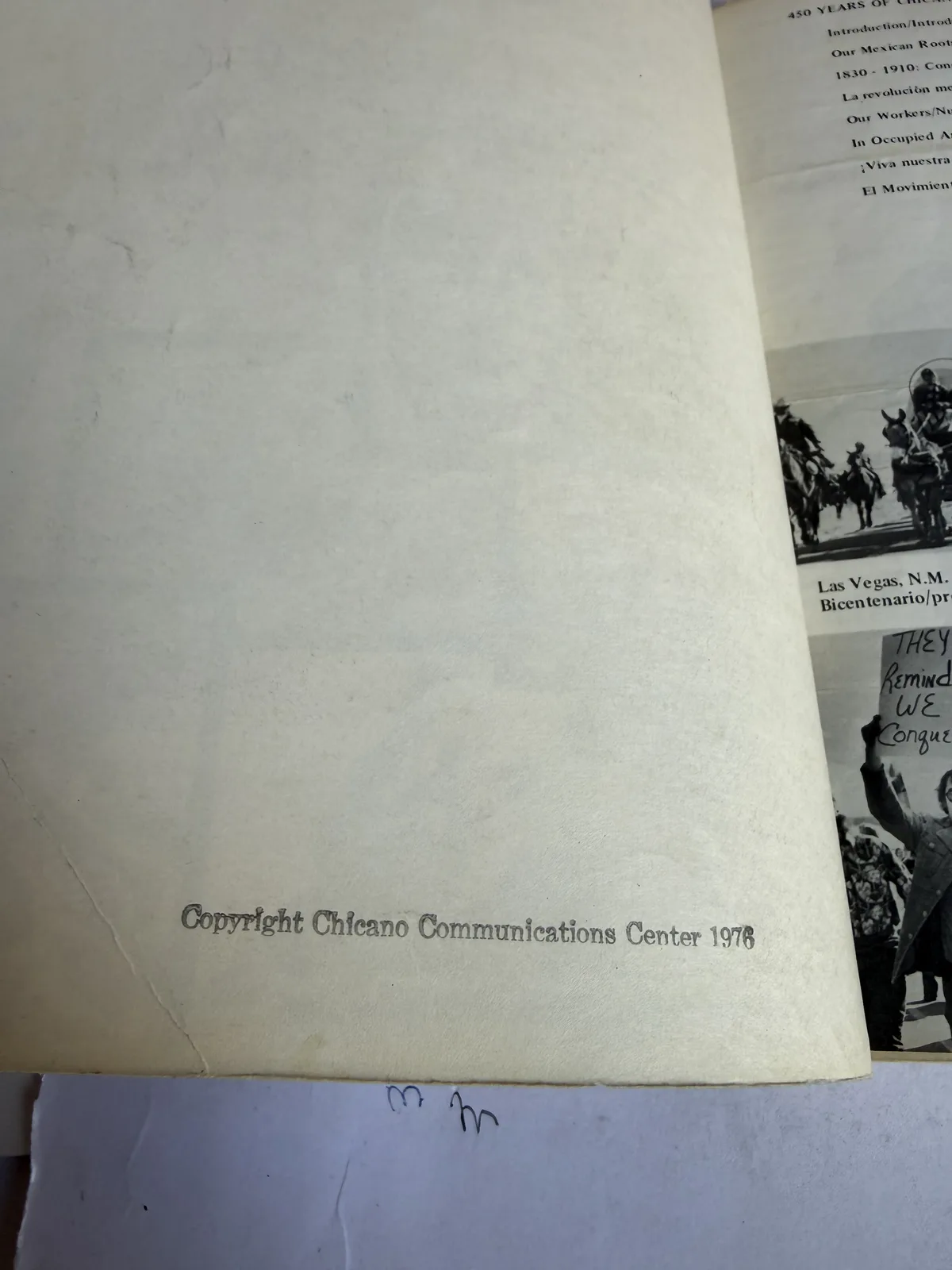
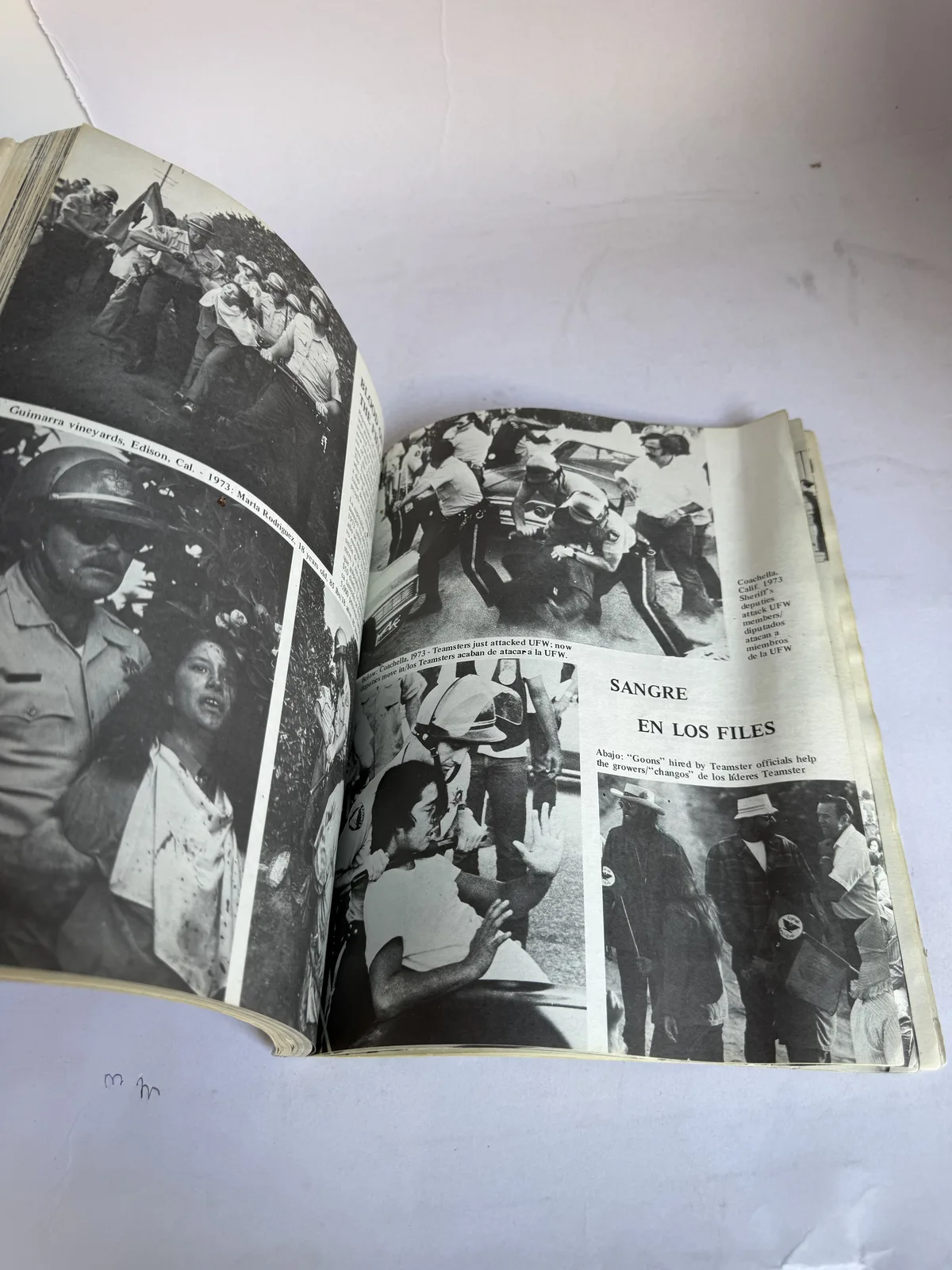
The movement did its own publishing, and the results are now the scarcest things in the field — printed cheaply, distributed by hand, rarely kept. 450 Años del Pueblo Chicano / 450 Years of Chicano History in Pictures came out of the Chicano Communications Center in Albuquerque in 1976:
The New Mexico Chicano movement produced books across three overlapping channels: the political and historical scholarship of the national Chicano movement (Rodolfo Acuña, Carlos Muñoz Jr., F. Arturo Rosales, Lorena Oropeza, Ernesto Vigil) that contextualized NM events within a national frame; the NM-specific primary-source and scholarly literature on the Alianza Federal de Mercedes and Tijerina (Patricia Bell Blawis, Tobias Durán) that documented the land grant movement directly; and the literary production of the Quinto Sol era that placed New Mexico's Hispano colonial tradition at the center of the national Chicano cultural awakening (Rudolfo Anaya, the El Grito del Norte newspaper, Enriqueta Vasquez). Across all three channels, the ephemera problem — the loss of newspapers, posters, pamphlets, and broadsides — is the defining challenge for collectors and archivists alike.
The New Mexico Distinction: Land, Colony, Language
New Mexico Chicano Movement Books, including Occupied America: A History of Chicanos (1972), are sought-after collectibles commanding premium prices among Southwest and Western Americana collectors. To understand the NM Chicano movement collecting market, collectors must first understand why New Mexico produced a different movement than California or Texas. Three structural features explain the difference.
Land tenure and treaty law. The 1848 Treaty of Guadalupe Hidalgo, which ended the Mexican-American War and transferred the Southwest to the United States, included Article VIII and Article IX protecting the property and citizenship rights of Mexicans remaining in the ceded territory. New Mexico's Hispano population held Spanish and Mexican land grants — the mercedes — that had been surveyed, documented in colonial-period archives, and held in continuous family possession across generations since the 1600s and 1700s. In the decades following 1848, through a combination of the U.S. Court of Private Land Claims process (1891-1904), tax forfeitures, fraudulent surveys, and outright dispossession by Anglo newcomers operating through the Santa Fe Ring and allied political structures, much of this grant acreage was lost from Hispano ownership. The loss was not abstract: specific families in specific northern New Mexico villages could document the specific mercedes that had been taken, the specific survey decisions that had extinguished their claims, and the specific legal arguments based on treaty law and Spanish colonial land tenure precedent that would support restitution. Tijerina and the Alianza Federal de Mercedes were not arguing for fair treatment in a labor market or equal access to public accommodation — they were arguing for the return of documented property on the basis of a bilateral treaty obligation. This gave the NM movement a legal specificity that required legal and historical scholarship alongside political organizing.
The deep Hispano colonial genealogy. New Mexico's Hispano community traced documented colonial descent to the 1598 entrada of Juan de Oñate and the subsequent Spanish colonial settlements along the Rio Grande — the oldest continuously-inhabited European settlements in what is now the United States outside Florida. Families with surnames like Chávez, Montoya, Martínez, Trujillo, and García could trace NM residency back fifteen or more generations through Catholic parish records and colonial-era notarial documents. This community's identity was not that of recent immigrants navigating a new country; it was that of a settled colonial population whose deep roots in the land gave the concept of land restitution a genealogical and cultural resonance it could not have elsewhere. The Hispano tradition of the Penitente Brotherhood, the acequia irrigation systems, the village santo-carving and weaving traditions, and the distinctive New Mexico Spanish dialect — all documented in the collecting literature surveyed on other NMLP pillar pages — constituted a cultural infrastructure that the NM movement drew upon and defended simultaneously with its political demands.
The bilingual and bicultural civic tradition. New Mexico was the only U.S. state to enter the union with a constitutionally mandated bilingual tradition: the 1912 New Mexico Constitution required that all state laws be published in both English and Spanish. Spanish-language newspapers had operated continuously in New Mexico since the territorial period; the first Spanish-language newspaper in the Southwest, El Crepúsculo de la Libertad (Taos 1834), predated U.S. sovereignty. The bilingual tradition gave the NM Chicano movement its literary register — it was natural for El Grito del Norte to publish in both languages, for movement poetry to be composed in New Mexican Spanish as well as English, and for the foundational literary text of the Quinto Sol era to emerge from a UNM English professor working in a bilingual New Mexico tradition. Las Gorras Blancas (The White Caps), the fence-cutting resistance movement of 1889-1891 in San Miguel County led by Juan José Herrera, predated the twentieth-century movement but embodied the same structural logic: Hispano communities defending land use and water rights against Anglo enclosure of the common lands of their ancestral grants.
Reies López Tijerina and the Alianza Federal de Mercedes
Reies López Tijerina (1926-2015) was born in Falls City, Texas, into a migrant farmworker family, and entered politics not through academia but through Pentecostal ministry. He moved to New Mexico in 1960 after studying the history of the Spanish land grants and becoming convinced that legal-and-political action for grant restitution was both feasible and necessary. The Alianza Federal de Mercedes (Federal Alliance of Land Grants) was founded in 1963 in Albuquerque; by 1966 it claimed several thousand members across northern New Mexico, including many families in Río Arriba, Taos, Santa Fe, and Mora counties whose ancestral grant claims remained legally unresolved.
The Alianza's strategy combined legal petitioning (of state and federal courts, of the United Nations, of the Mexican government as the successor nation to the treaty obligation), political organizing (mass meetings, marches, and the 1966 Echo Amphitheater occupation in which Alianza members briefly claimed jurisdiction over a national forest campground on former Tierra Amarilla grant land), and ultimately confrontational direct action. The June 5, 1967 Tierra Amarilla courthouse raid was the climax of the confrontational phase. Tijerina and his followers entered the courthouse intending to arrest District Attorney Alfonso Sánchez, who had prevented the Alianza from holding a meeting; two law-enforcement officers were wounded in the ensuing confrontation; Tijerina escaped into the mountains with state police National Guard tanks in pursuit; the largest manhunt in New Mexico history followed.
Tijerina was tried on multiple charges: state charges of kidnapping and assault (he was acquitted on many counts, convicting himself partially by serving as his own attorney in one landmark trial), and federal charges related to the Echo Amphitheater occupation. He served time in federal prison from 1969 to 1971. After his release he continued organizing at reduced intensity through the 1970s and 1980s, living in El Paso in later life. His autobiography, They Called Me King Tiger: My Struggle for the Land and My Rights, translated by José Ángel Gutiérrez, was published by Arte Público Press (Houston) in 2000 — the principal primary-source memoir of the Alianza era by Tijerina himself.
For collectors, the Tijerina-and-Alianza literature is the premier NM-specific Chicano movement collecting target. The crossover connection to the land grants literature is direct: see /new-mexico-land-grants-literature-collecting for the broader documentary history of New Mexico land grant scholarship from Clark Knowlton and Myra Ellen Jenkins through the contemporary period.
The National Chicano Movement Canon: Five Essential Books
Five scholarly books constitute the essential national Chicano movement canon most directly relevant to New Mexico collecting. Each is documented here with edition information critical to collector identification.
Rodolfo Acuña, Occupied America: A History of Chicanos (Canfield Press, San Francisco, 1972). This is THE foundational Chicano history textbook — the book that made Chicano history a recognized academic discipline. Acuña (born 1932, Cal State Northridge professor and founder of the first Chicano Studies department) argued that the U.S. conquest of the Southwest was an act of internal colonialism: the Southwest was an occupied territory, its Chicano population a colonized people, their resistance a liberation movement analogous to Third World anti-colonial struggles. The 1972 Canfield Press first edition is the Tier 1 collector target — identifiable by the Canfield Press San Francisco imprint (a division of Harper & Row in this period), 1972 copyright, and original cover design. The book has been revised through multiple subsequent editions (Harper & Row second edition 1981, third edition 1988, subsequent Pearson/Longman editions through the eighth and beyond), each substantially revising the text in response to scholarly criticism and changing political context. The first edition is the artifact of the original argument; subsequent editions are the living textbook. Fine copies of the 1972 first in original wrapper are mid-three-figure collector targets; signed copies of any edition by Acuña are meaningful collector targets as he remains active and is among the few surviving first-generation Chicano studies founders.
Carlos Muñoz Jr., Youth, Identity, Power: The Chicano Movement (Verso, London and New York, 1989). Muñoz (UC Berkeley professor) produced the definitive scholarly account of the Chicano student movement — MEChA (Movimiento Estudiantil Chicano de Aztlán), the 1969 Plan de Santa Bárbara, the development of Chicano Studies programs, and the generation of college students who drove the movement's national expansion. The Verso first edition (1989, softcover and hardcover) is the standard collector target; a revised and expanded edition was published by Verso in 2007. The 1989 Verso first hardcover with dust jacket is a Tier 2 collector target; the softcover original is working-library. Muñoz signed at academic conferences and UC Berkeley events through the 1990s and 2000s.
F. Arturo Rosales, Chicano! The History of the Mexican American Civil Rights Movement (Arte Público Press, Houston, 1996). Rosales (Arizona State University professor) wrote this volume as the companion to the PBS documentary series of the same name — the principal mass-audience documentary treatment of the national movement. Arte Público Press published the trade paperback original in 1996; the book remains in print. The 1996 Arte Público first printing is the standard collector target — identifiable by the original Arte Público cover design rather than subsequent reprintings. As a companion to a PBS series, the book was distributed widely through public television affiliates and public libraries; it surfaces frequently in donations from New Mexico library weed-outs and from households that watched the documentary series on KNME Albuquerque in the 1990s. The principal collector value is the signed copy; Rosales signed at conferences and university events.
Lorena Oropeza, ¡Raza Sí! ¡Guerra No!: Chicano Protest and Patriotism during the Viet Nam War Era (University of California Press, Berkeley, 2005). Oropeza (UC Davis professor, later University of Massachusetts Amherst) produced the definitive scholarly treatment of Chicano anti-Vietnam War activism, including the National Chicano Moratorium of August 29, 1970 in Los Angeles (the largest Chicano anti-war demonstration, at which Los Angeles Times journalist Rubén Salazar was killed by sheriff's deputies). The book addresses the particular tragedy of disproportionate Chicano casualties in Vietnam, the emergence of Chicano anti-war consciousness as distinct from mainstream anti-war movements, and the role of newspapers including El Grito del Norte (Española NM) in building the anti-war Chicano press network. The UC Press 2005 first cloth hardcover with dust jacket is the Tier 2 collector target; the simultaneous paperback original is working-library. Oropeza also edited Enriqueta Vasquez and the Chicano Movement (Arte Público 2006), linking her scholarship directly to the NM movement primary sources.
Ernesto Vigil, The Crusade for Justice: Chicano Militancy and the Government's War on Dissent (University of Wisconsin Press, Madison, 1999). Vigil was himself a member of the Crusade for Justice in Denver — the organization founded by Rodolfo "Corky" Gonzales in 1965 that became one of the principal Chicano movement organizations in the Rocky Mountain region. The Crusade for Justice had direct New Mexico connections: Gonzales's 1967 epic poem I Am Joaquín/Yo Soy Joaquín was widely circulated in New Mexico movement circles; the Crusade's national youth conference at Denver in 1969 produced the Plan Espiritual de Aztlán, the founding document of Aztlán ideology that named the Southwest as the mythical Chicano homeland, with New Mexico explicitly at its geographic center. Vigil's book is the only first-person scholarly account of a major Chicano movement organization by a participating member-turned-historian. The University of Wisconsin Press 1999 first cloth hardcover with dust jacket is the standard Tier 2 collector target; Vigil signed at academic conferences and Denver community events.
The NM-Specific Scholarship: Tijerina, Blawis, Durán
Patricia Bell Blawis, Tijerina and the Land Grants: Mexican Americans in Struggle for Their Heritage (International Publishers, New York, 1971). This is the first book-length treatment of Reies López Tijerina and the Alianza Federal de Mercedes, published just four years after the Tierra Amarilla courthouse raid. Blawis, a journalist who covered the NM land grant movement directly, produced a sympathetic but factually grounded account of Tijerina's organizing, the land grant history, the raid and its aftermath, and the broader NM Hispano movement context. International Publishers (founded 1924 as the publishing arm of the Communist Party USA) published the book as part of its long-running series on American ethnic and labor movements — which adds political-history context for collectors: the book appeared at the intersection of the Chicano movement, the broader New Left, and the Old Left publishing infrastructure. The 1971 International Publishers first trade paperback is the standard collector target — identifiable by the International Publishers New York imprint, 1971 copyright, and the distinctive International Publishers cover design format of the period. This is a genuinely scarce book: small print run, limited distribution (primarily Chicano Studies departments, political bookstores, and movement organizations), and it has never been reprinted. Fine copies are upper-two-figure to low-three-figure collector targets; signed copies by Blawis are extremely rare and trade at meaningful premium when documented.
Tobias Durán and NM land grant scholarship. Tobias Durán, a New Mexico scholar working through UNM and other state institutions, produced important scholarly articles and book chapters on Reies López Tijerina and the NM Land Grant War of 1967. While Durán's work appeared primarily in academic journals and edited volumes rather than standalone books — making it ephemera-adjacent in the collecting sense — his contributions appear in the key edited collections on NM history (collected volumes from UNM Press, New Mexico Historical Review articles, and the Southwest Hispanic Research Institute working paper series). Collectors working the NM-specific Tijerina literature will want to assemble the complete Durán bibliography from academic journal runs; the New Mexico Historical Review issues containing Durán's articles (and other key NM movement scholarship) are standard secondary-market collectibles at modest value per issue at ABQ estate sales.
Reies López Tijerina, They Called Me King Tiger: My Struggle for the Land and My Rights, translated by José Ángel Gutiérrez (Arte Público Press, Houston, 2000). This is Tijerina's own autobiography — the principal primary-source account of the Alianza from the organizer's perspective, translated into English by another major Chicano movement leader (Gutiérrez founded La Raza Unida Party in Crystal City, Texas). The Arte Público 2000 first trade paperback is the standard collector target; a hardcover edition was also issued. Signed copies by Tijerina are very rare (the book appeared when he was 74 and in declining health); documented signed copies trade at significant premium.
Found old books in an estate or attic? Text me a photo at 505-250-3804 and I'll tell you what I see.
Rodolfo "Corky" Gonzales and Denver-NM Connections
Rodolfo "Corky" Gonzales (1928-2005) was the founder of the Crusade for Justice in Denver, Colorado — one of the three principal organizational pillars of the national Chicano movement alongside César Chávez's United Farm Workers in California and Tijerina's Alianza in New Mexico. Though Gonzales was Denver-based, his connections to New Mexico were structural and ongoing.
The 1967 epic poem I Am Joaquín / Yo Soy Joaquín, self-published as a pamphlet by the Crusade for Justice in Denver and subsequently reprinted by Bantam Books (1972), is the foundational literary text of the national Chicano movement before Bless Me, Ultima — a sweeping historical narrative poem tracing Chicano identity from the Aztec codices through the Spanish conquest, the Mexican independence era, the Texas Revolution, the Mexican-American War, and into the contemporary movement. The poem explicitly claims New Mexico's Hispano colonial inheritance as part of the Chicano historical identity. The 1967 Crusade for Justice pamphlet original is the premier Gonzales collectible and one of the rarer Chicano movement primary documents: self-published movement printing, very small run, distributed through movement organizations rather than commercial channels. The 1972 Bantam Books trade paperback (with additional material including photographs) is the standard collector target; it remains findable in the NM secondary market from movement-era household donations.
The 1969 Crusade for Justice National Chicano Youth Liberation Conference in Denver produced the Plan Espiritual de Aztlán — the foundational document of Aztlán ideology. The Plan named the historical Southwest — Texas, New Mexico, Colorado, Arizona, California — as Aztlán, the mythical Aztec homeland and the geographic center of the Chicano cultural nation. New Mexico, as the state with the oldest continuous Hispano presence, the deepest genealogical connections to pre-Anglo sovereignty, and the ongoing Alianza land grant struggle, held a symbolically central position in the Aztlán geography. The Plan Espiritual de Aztlán circulated as a pamphlet through movement organizations; original print copies are rare primary documents. Reprints appear in anthologies including Luis Valdez and Stan Steiner, eds., Aztlán: An Anthology of Mexican American Literature (Vintage Books 1972) — an important collecting anthology available in two-figure range at NM estate sales.
El Grito del Norte: The NM Movement Newspaper
El Grito del Norte (The Cry of the North) was published in Española, New Mexico, from August 1968 to February 1973 — 56 issues over four and a half years. It was co-founded by Elizabeth "Betita" Martínez (1925-2021) and Beverly Axelrod, and edited by Martínez throughout most of its run. Martínez had been a field secretary for SNCC (Student Nonviolent Coordinating Committee) in the 1960s, editor of a SNCC-affiliated journal in the East, and came to New Mexico specifically to document the Tijerina land grant movement. The newspaper's masthead described it as the "voice of the land grant movement and the Chicano revolution in New Mexico."
El Grito del Norte covered: the Alianza Federal de Mercedes and Tijerina's ongoing legal battles (the paper was active during the appeals process from the Tierra Amarilla raid); northern NM village organizing around land grant, water rights, and grazing-permit issues; Chicano student activism at UNM and NM Highlands University; the Vietnam War and its disproportionate toll on NM Chicano communities; Brown Berets organizing in Albuquerque and the South Valley; the emerging Chicana feminist critique within the movement; labor organizing in northern NM agriculture and mining; and connections to national and international liberation movements. The paper published in both English and Spanish — sometimes in the same article, reflecting the bilingual NM political reality — and combined original reporting with commentary, poetry, graphics, and illustrations.
Enriqueta Vasquez wrote the paper's "Despierten Hermanos" column from the founding issue, making her the most sustained single voice in the paper's archive. Other regular contributors included Tobias Durán, movement figures from the Alianza, and a network of community correspondents from northern NM villages including Tierra Amarilla, Alcalde, Medanales, and Abiquiú.
For collectors, El Grito del Norte is the premier NM Chicano movement ephemera collectible. The paper was printed on standard newsprint at small press runs (estimates range from 2,000 to 7,000 copies per issue at peak); distribution was through subscription, hand-to-hand in northern NM communities, and at movement events nationally. Individual issues are fragile in typical newsprint degradation; complete runs are scarce. Institutional holdings: the University of New Mexico Center for Southwest Research (Special Collections) holds the best run; the Denver Public Library Western History Collection holds significant holdings; the Chicano Studies Research Center at UCLA holds partial holdings. The paper has been partially digitized through the SWHR-UNM partnership. For private collectors, individual issues from the key 1968-1970 period are significant artifacts; a complete run of all 56 issues in reading condition would be a Tier 1 ephemera trophy of the first order. Typical individual-issue pricing at NM estate sales: common reading copy range depending on condition and subject matter, with key issues (the Tierra Amarilla trial issues, the Moratorium issues, the founding 1968 issues) commanding premium.
Enriqueta Vasquez: NM Chicana Voice
Enriqueta Vasquez was born in Mexico and came to New Mexico with her family, eventually settling in the Española valley area. She became a regular contributor to El Grito del Norte from its founding in 1968, writing the "Despierten Hermanos" column through much of the paper's run. Her columns addressed an exceptionally broad range of movement issues with a consistently NM-grounded perspective: the role of Chicana women in the land grant struggle, the cultural and spiritual dimensions of Hispano village identity, the intersection of the NM movement with national Chicano and civil rights movements, and the practical questions of community organizing in northern NM's small villages.
Vasquez also produced silkscreen prints and graphics for the movement — the visual arts production of NM Chicano movement activism that parallels the poster tradition of the California-based Royal Chicano Air Force and the teatro campesino graphic work. Original signed Vasquez silkscreens and movement posters are extremely rare in the collector market; the great majority are in institutional holdings (UNM Special Collections, the Smithsonian American Art Museum, regional Chicano art archives).
The accessible collecting entry point is Enriqueta Vasquez and the Chicano Movement: Writings from El Grito del Norte, edited by Lorena Oropeza and Dionne Espinoza (Arte Público Press, Houston, 2006). This volume collects Vasquez's key columns from the newspaper into the first sustained presentation of her work for a general scholarly audience, with editorial apparatus situating the columns in NM movement history. The Arte Público 2006 first trade paperback is the standard Tier 2 collector target. A hardcover edition was also issued simultaneously. Signed copies by Vasquez at the time of publication (she was elderly but present at the book's launch events) are known to exist; documented signed Arte Público 2006 copies trade at meaningful premium.
The Quinto Sol Literary Movement and Bless Me, Ultima
The simultaneous occurrence of the Chicano political movement and the Chicano literary movement was not coincidental — both drew on the same structures of cultural and political assertion. In 1967, the same year as the Tierra Amarilla courthouse raid, Quinto Sol Publications was founded in Berkeley and the Premio Quinto Sol established. By 1972, the year of Rodolfo Acuña's Occupied America, Quinto Sol published Rudolfo Anaya's Bless Me, Ultima — the foundational novel of what became the Chicano literary canon.
The connection between the political and literary movements in New Mexico ran through the figure of the UNM campus, through the El Grito del Norte network, and through the shared assertion of Hispano colonial cultural identity. Anaya was not writing from the farmworker-immigrant tradition that grounded much California Chicano literature; he was writing from the same deep NM Hispano colonial tradition that Tijerina invoked in arguing for land grant restitution. The curandera Ultima in Bless Me, Ultima embodies the pre-Anglo NM Hispano-indigenous cultural synthesis; the novel's setting in the eastern NM llano country and the agricultural Guadalupe County villages enacts the specific NM colonial geography that the Alianza was defending. Anaya was also, during the peak Chicano movement years, an active UNM faculty member and a participant in the academic infrastructure — the Chicano Studies program, the SWHR, the UNM Press — that supported NM movement scholarship.
Rudolfo Anaya's full bibliography and collecting hierarchy are documented in detail at /new-mexico-hispano-literature-collecting. From the Chicano movement collecting perspective, the specific connection is the 1972 Quinto Sol Bless Me, Ultima first as both a literary monument and a movement document — published by the same press that gave the Chicano literary movement its infrastructure, in the same year as the foundational Chicano history textbook, by a NM Hispano writer whose subject was the deep colonial tradition the NM movement was asserting.
The Quinto Sol literary movement produced three canonical texts through the Premio Quinto Sol award: Tomás Rivera's ...y no se lo tragó la tierra / And the Earth Did Not Devour Him (Quinto Sol 1971, the Texas migrant-labor tradition); Anaya's Bless Me, Ultima (Quinto Sol 1972, the NM Hispano colonial tradition); and Rolando Hinojosa's Estampas del Valle (Quinto Sol 1973, the Texas border tradition). Together they constitute the foundational three-text Chicano literary canon, with NM at the center of the second and most celebrated position.
Not sure whether to sell, donate, or keep? Call or text me at 505-250-3804 — I'll walk you through it.
Las Gorras Blancas and the Long History of NM Resistance
The Chicano movement's NM chapter drew explicitly on an earlier tradition of Hispano resistance to Anglo land enclosure: Las Gorras Blancas (The White Caps), the fence-cutting and railroad-sabotage movement that operated in San Miguel County from approximately 1889 to 1891. Led by Juan José Herrera and his brothers Pablo and Nicanor, Las Gorras Blancas organized Hispano farmers and herders in the upper Pecos River valley whose common grazing lands — secured by the Las Vegas Land Grant — were being fenced by Anglo ranchers and the Atchison, Topeka and Santa Fe Railway. The Gorras cut fences, tore down railroad ties, and issued proclamations asserting Hispano rights to the common lands. The movement was suppressed through the early 1890s, partly through legal action by the Santa Fe Ring-allied political establishment, but it was not forgotten: Tijerina and the Alianza explicitly invoked Las Gorras Blancas as historical precedent for resistance to land dispossession.
The Las Gorras Blancas are documented primarily in the scholarly literature on NM territorial history rather than in a dedicated book-length treatment: key sources include Andrew Bancroft Schlesinger's articles in New Mexico Historical Review, Robert Rosenbaum's Mexicano Resistance in the Southwest: The Sacred Right of Self-Preservation (University of Texas Press 1981), and the broader territorial-period NM history scholarship. For Chicano movement collectors, the Las Gorras Blancas documentation appears in movement newspapers, pamphlets, and the academic articles that movement activists used to contextualize their demands historically. The Rosenbaum UT Press 1981 volume is a standard Tier 2 collector target in this context — it documents both Las Gorras Blancas and the Alianza as part of a continuous NM Hispano resistance tradition.
The NM Chicano Art Movement: Murals, Posters, Teatro
The NM Chicano movement produced a visual arts and performance tradition alongside its political and literary output. Three forms are most relevant to collectors: murals (primarily in Albuquerque's South Valley and Barelas neighborhoods and in northern NM communities), silkscreen posters (produced by movement artists including Enriqueta Vasquez and by affiliated workshop collectives), and teatro (political theater in the tradition of Luis Valdez's Teatro Campesino, with NM versions operating at UNM and in Albuquerque community venues through the 1970s).
The collecting literature for NM Chicano visual art is less developed than for California Chicano art (where the Royal Chicano Air Force mural and poster tradition has been extensively documented and collected). Key reference texts include: Chicano Art: Resistance and Affirmation, 1965-1985 (Wight Art Gallery, UCLA, 1991 exhibition catalog — the foundational national Chicano art reference, documenting NM artists alongside California and Texas work); The Chicano Mural Movement in Albuquerque (various UNM Chicano Studies publications); and the catalog for Art of the Other Mexico / Arte del Otro México (Museum of Contemporary Art Chicago 1993). These exhibition catalogs are significant collectibles in their own right — limited print runs, institutional distribution, frequent ephemera condition. The 1991 UCLA Wight Art Gallery Chicano Art: Resistance and Affirmation catalog is the Tier 1 NM-relevant art collecting reference; fine copies with original exhibition materials intact are upper-two to low-three figure targets.
NM-specific teatro documentation: Luis Valdez's Teatro Campesino produced texts including Actos (Cucaracha Press 1971, the collection of agitprop theater pieces used in farmworker organizing) that circulated in NM movement theater circles. The Cucaracha Press Actos 1971 first is a Tier 2 collector target across the national Chicano movement literature. NM-specific teatro productions from the 1970s — primarily at UNM and at Albuquerque community centers — are documented primarily in El Grito del Norte coverage and in UNM Chicano Studies archives rather than in published collecting targets.
Contemporary NM Chicano/a Scholarship: UNM and SWHR
The University of New Mexico has served as the principal academic infrastructure for NM Chicano/a movement scholarship since the establishment of the Chicana/o Studies program in the early 1970s. Key institutional nodes for collectors:
The UNM Chicana/o Studies Program produced a substantial body of working papers, occasional publications, course packets, and conference proceedings through the 1970s-1990s that constitute the ephemera layer of the NM Chicano academic canon. These materials — staple-bound working papers, mimeographed course syllabi, conference agendas — circulated in very small editions within the UNM community and among affiliated scholars nationally. They appear occasionally in donations from UNM faculty retirements and from student activists who saved their course materials. Their collector value is primarily as primary-source documents of the development of Chicano Studies as an academic field; pricing is highly context-dependent.
The Southwest Hispanic Research Institute (SWHR), established at UNM in 1983 under the leadership of Tobias Durán and subsequently directed by multiple scholars, produced a series of working papers and research reports on NM Hispano history, the land grant movement, and related topics. The SWHR working paper series (approximately 300 titles through the 1980s-2000s) is a significant collecting target for NM-specific Chicano movement scholarship; individual papers are low-cost but collectively constitute a detailed primary-source archive. UNM's Center for Southwest Research holds the complete institutional archive; individual working papers surface in donations from SWHR-affiliated faculty households.
New Mexico Historical Review (published by UNM since 1926) contains the principal peer-reviewed scholarship on NM land grant history, the Alianza, and Chicano movement history in NM — articles by Durán, by Clark Knowlton (the UTEP sociologist who was a major land grant researcher), by Myra Ellen Jenkins (state archivist and land grant scholar), and by the subsequent generation of NM historians. Complete runs of NMHR are standard two-figure collectibles in NM estate sales; key issue numbers containing major Tijerina-and-land-grant articles are identified by collectors through the NMHR cumulative index.
Aztlán: A Journal of Chicano Studies (UCLA Chicano Studies Research Center, founded 1970) published the principal peer-reviewed Chicano studies scholarship from the movement's inception. Key articles on NM topics — Tijerina, the Alianza, NM movement history — appear throughout the journal's run. Individual issues of early-period Aztlán (1970-1985) are Tier 2 scholarly collectibles in original journal format; complete institutional runs are held at UNM and at major research libraries.
Key Reference Anthologies and Companion Texts
Several anthologies and companion texts are essential for collectors building a comprehensive NM Chicano movement library:
Luis Valdez and Stan Steiner, eds., Aztlán: An Anthology of Mexican American Literature (Vintage Books, New York, 1972). The foundational Chicano movement literary anthology — documents the Plan Espiritual de Aztlán, includes Gonzales's I Am Joaquín, and assembles the principal literary and political texts of the early movement era. The 1972 Vintage Books trade paperback original is the standard collector target; it remains widely available in the NM secondary market as it was adopted in university courses throughout the 1970s and 1980s and circulated in substantial numbers.
John Shockley, Chicano Revolt in a Texas Town (University of Notre Dame Press, 1974). Documents the Crystal City TX school walkout of 1969 and La Raza Unida Party organizing — the Texas movement parallel to the NM Alianza. Standard Tier 2 reference for collectors building cross-state comparative libraries.
Matt S. Meier and Feliciano Ribera, Mexican Americans / American Mexicans: From Conquistadors to Chicanos (Hill and Wang, revised edition 1993; originally published as The Chicanos: A History of Mexican Americans, 1972). A standard survey text that documents NM alongside the broader Mexican American history. The original 1972 Hill and Wang first hardcover is a Tier 2 collector target; the revised 1993 edition is working-library.
Juan Gómez-Quiñones, Chicano Politics: Reality and Promise, 1940-1990 (University of New Mexico Press, Albuquerque, 1990). The principal political history of the Chicano movement from a UNM Press imprint — the NM connection adds significance. The 1990 UNM Press first trade paperback is the standard collector target.
Rudy V. Busto, ed., Nueva New Mexico: Chicano Politics, Labor, and the New Mexican Dream (University of New Mexico Press, 2008). A more recent scholarly collection specifically addressing the NM political tradition; standard Tier 2 collector target from UNM Press.
Have books you're ready to part with? I offer free pickup across Albuquerque — call 505-250-3804.
The Ephemera Collecting Problem
The Chicano movement was a political movement that operated at the grassroots level with limited financial resources and an urgent sense of immediate action. Its documentary record was produced primarily as ephemera — newspapers printed on newsprint, silkscreen posters printed on cheap stock, mimeographed and offset pamphlets, leaflets, flyers, and broadsheets — rather than as bound books with institutional distribution. This creates the defining challenge of Chicano movement collecting: the most historically significant primary documents are the most fragile and the most likely to have been lost, while the secondary and tertiary scholarship (university press monographs, trade paperbacks, journal articles) survives in reasonable institutional and private quantities.
Newspapers. El Grito del Norte (Española NM, 56 issues 1968-1973) is the premier NM movement newspaper collectible; other significant movement newspapers with NM relevance include La Raza (Los Angeles, 1967-1977), El Malcriado (Delano CA, United Farm Workers newspaper 1965-1975), and Con Safos: Reflections of Life in the Barrio (Los Angeles 1968-1972). These newspapers were printed in newsprint at small press runs, stored in garages and attics rather than climate-controlled archives, and subject to mold, insect damage, water damage, and simple loss. Surviving copies in reading condition are meaningful collectibles; surviving copies in fine condition with complete and clean pages are significant.
Posters. Chicano movement silkscreen posters — protest graphics, cultural event announcements, organizing materials, Royal Chicano Air Force productions — were printed on cheap poster stock in small editions, posted in public spaces (where they deteriorated), distributed at events (where they were folded and lost), and occasionally saved flat by participants. NM-specific Chicano movement posters (South Valley muralist work documented as print, Alianza organizing graphics, El Grito del Norte graphics by Enriqueta Vasquez and movement artists) are the rarest category of the NM movement ephemera field. Original movement silkscreen posters in fine flat condition are Tier 1 trophies when documentable as authentic; they appear at specialist Chicano-art auction houses (Swann Galleries Latino Heritage sales, Heritage Auctions Texana-and-Western sales) in the upper-three-figure range. The documentation problem is acute: movement posters are widely faked and reproduced; provenance documentation (collection history, event programs from the period) is essential.
Pamphlets and mimeographed documents. The Alianza Federal de Mercedes produced organizing pamphlets, by-laws, member meeting minutes, and position papers — primary documents of the organization's internal life. The Crusade for Justice produced the Plan Espiritual de Aztlán as a pamphlet. MEChA chapters at UNM and NM Highlands produced chapter organizing documents. The UNM Chicano Studies program produced course packets and working documents. These materials were distributed in handfuls to scores of copies; they are the documentary foundation of movement history and the most under-collected category of Chicano movement materials. When they surface in NM estate donations — most often from the households of former UNM Chicano Studies faculty or movement participants — they should be recognized as primary-source documents of potential archival significance.
The institutional response. Recognizing the ephemera loss problem, UNM's Center for Southwest Research (Special Collections) has collected aggressively in the NM Chicano movement ephemera field since the late 1970s. The Benson Latin American Collection at the University of Texas holds major Chicano movement ephemera holdings. The California Ethnic and Multicultural Archives (CEMA) at UC Santa Barbara holds major California movement holdings. Private collectors interested in NM movement ephemera are effectively working alongside these institutional collections and are encouraged to consult them when evaluating significant items: the CSR Special Collections staff can assist in identifying whether major items are already institutionally held or represent genuine gaps in the documented record.
Five Identification Problems for Collectors
Problem one: Acuña Occupied America first edition vs subsequent revised editions. The 1972 Canfield Press first is identifiable by the Canfield Press San Francisco imprint (a Harper & Row division of this period). The second edition (Harper & Row 1981) is substantially revised and carries the Harper & Row New York imprint. Subsequent editions carry the HarperCollins or Pearson/Longman imprints. The first edition title page reads "Occupied America: The Chicano's Struggle Toward Liberation" — note the subtitle, which was changed in the second edition to "A History of Chicanos" (the subtitle that has persisted). Collectors note the original subtitle as a points-of-issue marker for the 1972 first.
Problem two: El Grito del Norte individual issue identification. The paper's 56-issue run spans August 1968 to February 1973. Issues are numbered by year and issue number (e.g., Vol. 1, No. 1, August 16, 1968). Key issues by collector significance: the founding August 1968 issue (Vol. 1, No. 1), the Tierra Amarilla-trial coverage issues (1968-1969), the Chicano Moratorium coverage issue (September 1970), and the final issue (February 1973). Condition issues common to all El Grito del Norte copies: newsprint browning and brittleness, fold tears at the masthead (the paper was commonly folded in half for distribution), moisture staining, and address-label remnants on mailing copies. The presence or absence of an address label indicates whether the copy was a subscription mailing copy or a direct-distribution copy — both are legitimate; the absence of mailing label does not increase authenticity but direct-distribution copies sometimes survived better in flat condition.
Problem three: I Am Joaquín / Yo Soy Joaquín — 1967 Crusade for Justice pamphlet vs 1972 Bantam Books. The 1967 Crusade for Justice Denver self-published pamphlet is the genuinely scarce primary document — identifiable by the Crusade for Justice Denver imprint, offset-printed cover with movement-era design, and the very small-run production quality (uneven inking, handset or early phototypeset text). The 1972 Bantam Books trade paperback is the widely distributed collecting-accessible edition with additional photographs and expanded apparatus. Many collectors have never seen the 1967 pamphlet; the 1972 Bantam is the standard collector target at the accessible tier.
Problem four: Patricia Bell Blawis Tijerina and the Land Grants identification. The 1971 International Publishers trade paperback is the only edition; the book was never reprinted. International Publishers books of this period are identifiable by the IP logo, the New York imprint, and the distinctive IP cover design format (colored field with white text in the IP house style of the late 1960s and early 1970s). Condition issues: IP paperbacks of this period used a lightweight cover stock that corners and spines poorly; the binding was often minimal. Fine condition copies with square spine and unworked cover are scarce.
Problem five: movement poster authentication. Chicano movement silkscreen posters from the 1967-1975 period are widely reproduced — documentary books reproduce them as illustrations, museum education departments produce high-quality facsimiles, and some reproduction prints have been produced as fine-art editions. Authentication markers for original movement silkscreens: screen-printing registration (hand-registered silkscreens show slight color misalignment under magnification, not present in offset-printed reproductions); paper stock (movement-era posters used available cheap poster stock that ages to a characteristic warm-cream tone; modern reproductions on archive-quality paper or bright white stock are identifiable); and provenance (acquisition from a collection associated with a documented movement participant, accompanied by an event program from the period, or with original studio documentation).
Three-Tier Collector Market
Tier 1 trophy items (upper-three-figure to four-figure and above): Complete or near-complete run of El Grito del Norte (Española NM, all 56 issues, 1968-1973) in reading condition; original 1967 Crusade for Justice Denver pamphlet printing of I Am Joaquín / Yo Soy Joaquín by Rodolfo Gonzales in fine condition with original cover; original NM Chicano movement silkscreen posters (Alianza organizing graphics, Enriqueta Vasquez-attributed silkscreens, El Grito del Norte graphics) with documented provenance; original Alianza Federal de Mercedes primary documents (by-laws, manifestos, signed correspondence by Tijerina) with provenance chain to direct movement participants; 1972 Canfield Press Rodolfo Acuña Occupied America first edition fine with original cover art intact; signed Reies López Tijerina documents of any form with documented provenance; 1971 International Publishers Patricia Bell Blawis Tijerina and the Land Grants fine copy; signed Tijerina They Called Me King Tiger Arte Público 2000 with documented provenance.
Tier 2 collector targets (low-to-mid three-figure): Individual El Grito del Norte issues from the key 1968-1970 period in fine condition; 1972 Bantam Books I Am Joaquín first Bantam edition signed by Rodolfo Gonzales (closed pool, died 2005); 1989 Verso Youth, Identity, Power first hardcover signed by Carlos Muñoz Jr.; 1999 University of Wisconsin Press The Crusade for Justice first hardcover with dust jacket signed by Ernesto Vigil; 2005 UC Press ¡Raza Sí! ¡Guerra No! first hardcover with dust jacket; 2006 Arte Público Enriqueta Vasquez and the Chicano Movement first signed by Vasquez (extremely rare); Arte Público 2000 They Called Me King Tiger first printing; 1991 UCLA Wight Gallery Chicano Art: Resistance and Affirmation exhibition catalog fine with all inserts; 1972 Quinto Sol Bless Me, Ultima first paperback (as the NM literary movement's primary collectible, documented at /new-mexico-hispano-literature-collecting); 1971 Quinto Sol Tomás Rivera ...y no se lo tragó la tierra first (the canonical sister text); NM Chicano art exhibition catalogs from the 1970s-1980s in fine condition; UNM Chicano Studies program publications in original format; SWHR working papers in complete sequences.
Tier 3 working library (upper-two-figure to low three-figure): Trade paperback and subsequent editions of all canonical Chicano movement scholarly texts — Acuña subsequent editions, Muñoz Verso paperback, Rosales Chicano! Arte Público subsequent printings, all mass-market or textbook-market editions; standard academic monographs on the Chicano movement from university presses (Arizona, New Mexico, Texas, California, Wisconsin); individual issues of Aztlán journal (1970-present); individual issues of New Mexico Historical Review containing movement-relevant articles; movement-era anthologies including Valdez/Steiner Aztlán 1972 Vintage, the Norton Anthology of Latino Literature, Heath Anthology of American Literature Chicano sections; bilingual-education textbooks and curriculum materials from the 1970s-1980s NM bilingual-education movement; Arte Público Press trade paperback editions of movement memoirs and collections.
NMLP Intake Position
Chicano movement materials reach NMLP through several predictable donor surface concentrations — some by metro pickup, some through the 24/7 drop-off, some shipped in by institutions — and the frequency is higher than most donors realize: Albuquerque and northern NM have the densest civilian population that participated in, supported, or documented the NM Chicano movement of any urban area in the country.
UNM Chicana/o Studies faculty retirements and estate donations are the premium source — these households contain decades of collected scholarship, primary documents, movement ephemera, and research materials that represent the working libraries of scholars who built the field. When a UNM Chicano Studies or SWHR faculty member's household enters the donation pipeline, the result can include complete El Grito del Norte runs, original Alianza documents, the earliest Chicano Studies academic publications, and annotated research copies of foundational texts. NMLP recognizes these donations and routes them appropriately — Tier 1 items to individual research at the warehouse or, when one will take them, a regional archive, Tier 2 and 3 items through standard SellBooksABQ hand-sort.
South Valley and Barelas Albuquerque neighborhood household donations frequently contain movement-era working-class materials: Brown Berets pamphlets, movement newspapers, political leaflets, organizing documents, and cultural materials from the Chicano community cultural institutions of the 1970s (the South Valley Chicano muralist tradition, the National Chicano Theatre program from UNM events, the Albuquerque Chicano film screenings). These materials may not be identified as significant by the donor family — they are simply "old papers" — but they constitute the grassroots documentary layer of the NM movement archive.
Northern NM households (Río Arriba County, Tierra Amarilla, Española valley area, Taos County) are the most likely source for Alianza-related primary documents — pamphlets, meeting notices, legal correspondence, and newspapers from the movement's geographic center. My pickup routes don't run that far north — I work the Albuquerque metro — but this material still finds its way to me: families clearing a northern relative's house routinely bring boxes down to the city, and my free 24/7 outdoor drop-off at 5445 Edith Blvd NE takes it in any condition, no appointment and no sorting. Whatever comes in that way gets careful attention, given its potential archival significance.
NMLP routes Tier 1 Chicano movement materials — primary documents of the Alianza, complete El Grito del Norte sequences, original movement silkscreen posters, signed Tijerina items — into individual research and listing at the warehouse, and material with real archival interest goes to a regional archive when one will take it. Tier 2 and Tier 3 movement-era books route through standard SellBooksABQ hand-sort with movement-literature collector outreach. General movement paperbacks, subsequent-edition Acuña texts, Arte Público movement memoirs, and bilingual movement literature route to community literacy partners, adult and family literacy programs, the bilingual-education community distribution network, and Little Free Library stocking across the Albuquerque metro and northern NM communities.
Free Albuquerque-metro pickup with no condition limit and no minimum quantity. If you have Chicano movement materials — books, newspapers, pamphlets, posters, documents — I want to see them. Schedule your pickup at /free-book-pickup-albuquerque or text/call 505-250-3804.
External References
- Wikipedia: Reies López Tijerina
- Wikipedia: Alianza Federal de Mercedes
- Wikipedia: Tierra Amarilla Courthouse Raid (1967)
- Wikipedia: Rodolfo Acuña
- Wikipedia: Rodolfo "Corky" Gonzales
- Wikipedia: Elizabeth "Betita" Martínez
- Wikipedia: Enriqueta Vasquez
- Wikipedia: Chicano Movement
- Wikipedia: Las Gorras Blancas
- Arte Público Press (University of Houston)
- UNM Center for Southwest Research — Chicano movement collections
- Wikipedia: El Grito del Norte
- Wikipedia: Quinto Sol Publications
Related on This Site
- New Mexico Land Grants Literature — the Tijerina land grant struggle in the broader context of NM land grant history scholarship from Knowlton, Jenkins, and the Court of Private Land Claims era
- New Mexico Hispano Literature — the Anaya canon, the Quinto Sol literary movement, Sabine Ulibarrí, the full Chicano literary tradition overlapping with this movement collecting guide
- New Mexico Spanish Colonial Historians — the colonial-period documentary tradition the Alianza invoked in its treaty-rights arguments
- NM Native American Literature — the parallel civil rights and cultural-assertion movement in NM's Pueblo, Navajo, and Apache communities occurring simultaneously with the Chicano movement
- New Mexico Poetry — the movement poetry tradition from Gonzales's I Am Joaquín through the South Valley Albuquerque poets
- New Mexico Folk Art Books — the Chicano art movement poster and silkscreen tradition alongside the Hispano santero and weaving traditions
- New Mexico Civil War Books — the longer history of NM political conflict with federal authority that the Alianza drew on for historical precedent
- Collecting New Mexico Cookbooks — Fabiola Cabeza de Baca Gilbert and the foundational Hispana memoirists whose work contextualized movement cultural claims
- NM Water Rights & Environmental Literature — the acequia and water rights tradition central to northern NM land grant communities and the Alianza organizing context
Cite This Guide
Eldred, J. (May 2026). New Mexico Chicano Movement Books: A Collector's Authority Guide. New Mexico Literacy Project.
https://newmexicoliteracyproject.org/new-mexico-chicano-movement-books-collecting
Content is original research by Josh Eldred. Licensed under CC BY 4.0. Cite with attribution.