1. Why School Libraries Are Weeding Now
School libraries across New Mexico are in the middle of the largest collection turnover in a generation. Several forces are converging at once, and each one generates surplus books that need somewhere to go.
The first force is digital adoption. Districts that invested heavily in Chromebooks and one-to-one device programs during and after the pandemic now subscribe to digital reading platforms — Epic, myON, Sora, OverDrive — that duplicate much of what the physical collection provides. Nonfiction reference shelves that once served daily research needs now compete with databases that update in real time. The physical collection is not obsolete, but it is smaller than it used to be, and librarians are weeding aggressively to make room for makerspaces, collaborative learning areas, and flexible seating.
The second force is curriculum alignment. New Mexico adopted updated English Language Arts standards in recent years, and schools are refreshing their collections to match. Titles that no longer align with reading level benchmarks, diversity requirements, or curricular scope get pulled. This is standard collection development practice — the American Library Association recommends that school libraries weed five to ten percent of their collection annually — but many NM schools deferred weeding during the pandemic years and are now catching up with larger-than-normal volumes.
The third force is facility changes. Bond-funded renovations, new construction, and school consolidations create hard deadlines for clearing library shelves. When a school is being renovated over the summer, every book has to come off the shelf whether it is being kept or not. That is the moment when collections that have not been weeded in years finally get sorted — and the discard pile can be enormous.
The fourth force, unique to New Mexico, is the charter school landscape. New Mexico has one of the highest per-capita charter school rates in the country. Charter schools open, close, and restructure at a pace that traditional districts do not. When a charter closes — whether through PEC non-renewal, voluntary surrender, or financial insolvency — the library and classroom collections need to be disposed of under compressed timelines, often with minimal administrative staff remaining to handle logistics.
All four forces produce the same result: schools need a responsible, free way to move large volumes of books out of buildings. That is what I provide.
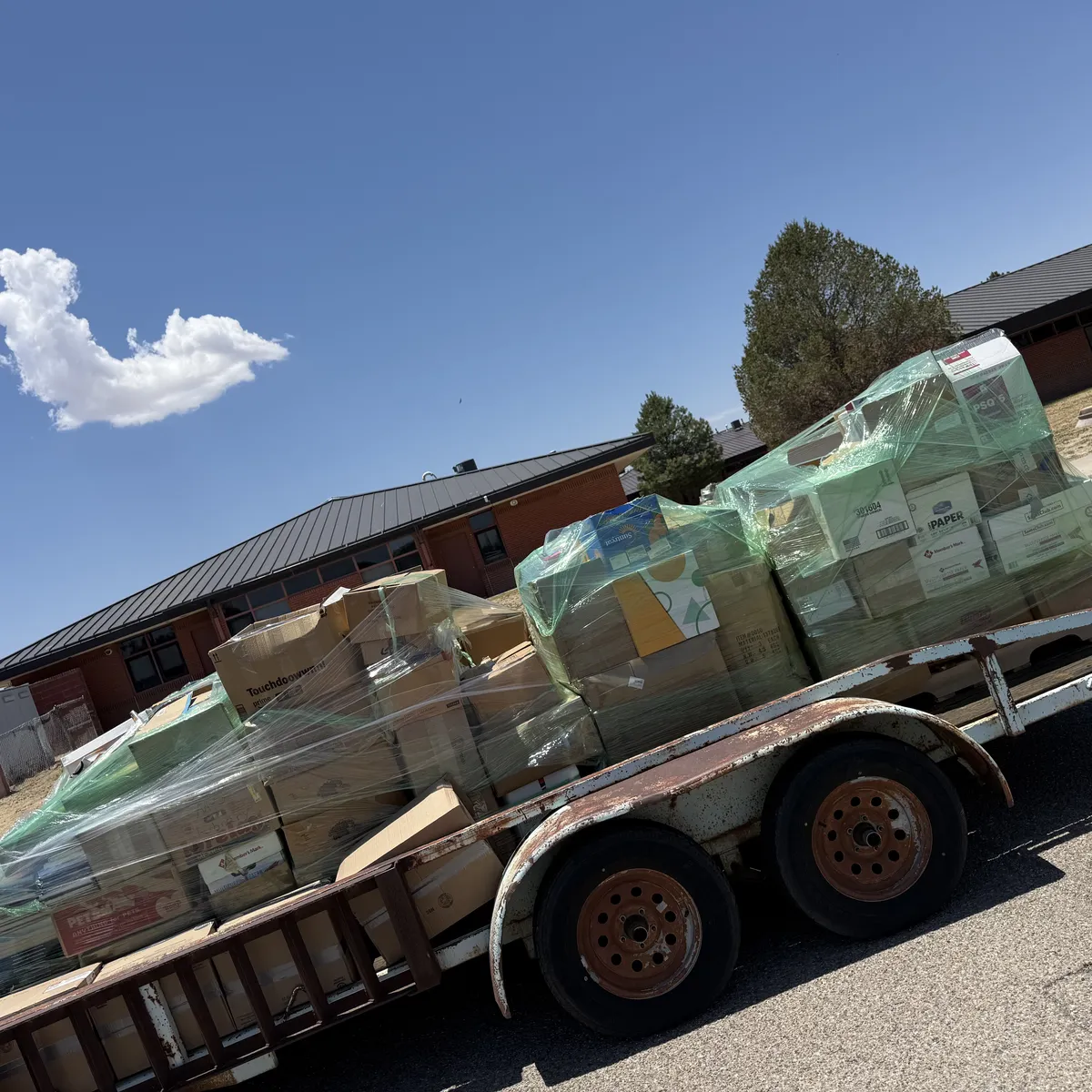
2. What I Accept From Schools
I accept everything a school library or classroom generates as surplus. There is no need to sort, deprocess, or pre-screen before I arrive.
Library Collection Materials
Fiction and nonfiction from the general circulating collection, reference books, picture books, early readers, chapter books, young adult novels, graphic novels, periodicals and bound magazines, audiobooks on CD, and any media materials the library is deaccessioning. Hardcover, paperback, library binding — all formats accepted.
Classroom Libraries and Book Rooms
Guided reading sets, leveled readers, class sets of novels, basal readers, teacher resource books, and the accumulated classroom libraries that individual teachers build over their careers. When a teacher retires or transfers, those personal classroom books often get left behind. I take those too — see my retiring teacher classroom library guide for more on that specific situation.
Textbooks and Curriculum Materials
Adopted textbooks from any subject area, supplementary curriculum materials, workbooks (used or unused), lab manuals, test prep materials, teacher editions, and ancillary kits. I accept current-edition and out-of-adoption textbooks alike. See my textbook donation guide for detail on which textbooks retain market value.
Special Collections
Spanish-language collections, bilingual materials, Native language materials, special education resources, professional development libraries, counselor office libraries, and administrative reference collections. New Mexico's bilingual and multicultural education requirements mean many schools maintain substantial Spanish-language holdings that I am equipped to evaluate and route appropriately.
3. Which School Books Actually Have Value
Most school library books are working copies — they were purchased for circulation, used by hundreds of students, and have modest individual value. But every school library I have picked up has contained at least a few items that surprised the librarian.
First Editions That Entered the Collection Early
School libraries that were active in the 1960s and 1970s sometimes acquired first editions of books that are now collectible — particularly young adult titles that became classics. A first-edition copy of The Outsiders (1967), A Wrinkle in Time (1962), Where the Wild Things Are (1963), or The Giving Tree (1964) that has been sitting on a school library shelf for sixty years is worth identifying before it goes into a recycling bin. Library processing reduces the value compared to a pristine copy, but first editions in library binding with intact dust jackets still carry meaningful collector interest.
Signed Copies From Author Visits
New Mexico schools regularly host author visits — through the New Mexico Book Co-op, the Albuquerque Public Schools literacy programs, and individual school initiatives. Signed copies from those visits end up in the library collection and circulate like any other book. When the title gets weeded years later, the signature is still there. I have found signed copies of Rudolfo Anaya, Joseph Bruchac, Carmen Agra Deedy, and other authors in school library weeding boxes. A signed Rudolfo Anaya title from a school visit has both collector and historical value.
New Mexico and Southwest Regional Titles
School libraries in New Mexico tend to stock regional titles that are not widely available outside the state — books published by UNM Press, Sunstone Press, Clear Light Publishers, and the Museum of New Mexico Press. These titles cover Pueblo culture, Rio Grande ecology, territorial history, and New Mexico geography in ways that national publishers do not. When a school weeds these, they often have value to collectors, researchers, and other educational programs that the school librarian may not be aware of.
Historical Textbooks
Pre-1960 textbooks — particularly New Mexico history textbooks, civics texts, and readers with period illustrations — have historical research value. Early editions of the New Mexico Blue Book, state-adopted history textbooks that reflect mid-century perspectives on territorial history and Pueblo/Navajo relations, and readers with regional content are collected by historians and educators studying curriculum evolution. These sometimes turn up in older school storerooms that have not been cleaned out in decades.
4. School Types I Serve
Albuquerque Public Schools
APS is the largest district in New Mexico — approximately 190 schools serving over 70,000 students. APS school libraries range from elementary collections of 5,000 to 10,000 volumes to high school libraries with 15,000 to 25,000 volumes. School librarians and principals can contact me directly. Whether your school is running a routine annual weed or clearing a library for a bond-funded renovation, I can handle the volume. On request, the school gets a written acknowledgment (date and approximate quantity) for its records.
Charter Schools
New Mexico authorizes charter schools through both the Public Education Commission and local district authorization. As of 2026, approximately 100 charter schools operate across the state. Charter libraries are typically smaller than traditional school libraries — often 1,000 to 5,000 volumes — but they face unique pressures. Charter renewals happen on five-year cycles, and schools that do not meet performance benchmarks or financial standards may close with limited notice. When a charter closes, the governing board is responsible for disposing of assets including the library. Tell me the closure deadline and I'll tell you honestly whether the route can meet it; on request I provide a written acknowledgment (date and approximate quantity) for the closure file.
Private and Parochial Schools
New Mexico has a substantial network of private and parochial schools — Catholic schools under the Archdiocese of Santa Fe, independent schools like Albuquerque Academy, Bosque School, Sandia Prep, and Menaul School, and smaller religious schools throughout the state. Private school libraries often contain higher-quality collections with longer shelf life because they are not subject to the same adoption-cycle pressures as public schools. When these schools renovate, consolidate, or — in some cases — close, the library collections tend to include well-maintained hardcovers, advanced-placement materials, and college-preparatory titles that retain value.
Bureau of Indian Education Schools
New Mexico is home to 23 sovereign tribal nations, and BIE-operated and tribally controlled schools serve students across the Navajo Nation, the Pueblos, and the Mescalero and Jicarilla Apache communities. BIE school libraries face distinctive challenges — geographic remoteness, federal property-disposal regulations, and limited access to library services that urban schools take for granted. I have experience reaching schools in locations like Zuni, Shiprock, To'Hajiilee, and Jemez Pueblo, and I understand the logistics of scheduling pickups around long travel distances. For BIE schools, I coordinate pickup timing with trips I am already making to the region whenever possible to keep the process efficient for everyone.
Rural and Small Districts
New Mexico has 89 public school districts, and many of them are small — some operating only two or three schools. Districts like Magdalena, Mountainair, Carrizozo, Quemado, Reserve, and Mosquero serve communities where the school library may be the only library in town. When these schools weed their collections, there is no local infrastructure to absorb the surplus. A 200-student rural school gets the same attention as the largest metro high school. Pickup runs in the Albuquerque metro; schools farther out ship boxes Media Mail (I can walk your staff through it) or use the 24/7 drop-off when someone is already driving in.
5. Common Scenarios I Handle
The Annual Weed
You follow CREW methodology or your district's weeding guidelines, pull the books that meet discard criteria — outdated content, poor condition, low circulation, superseded editions — and now you have carts or boxes of deaccessioned materials stacked in the workroom. Most school librarians tell me the weeding itself is the easy part. Finding someone to take the discards is the frustrating part. I pick up weeding discards of any size, from a single cart to an entire workroom full of boxes. Most librarians schedule this during the last week of school or the first week of summer break.
The Renovation or Construction Project
Bond-funded school renovations — and New Mexico has approved multiple bond cycles for school construction in recent years — often require clearing the library completely. Everything comes off the shelves, and the contractor needs the space by a hard date. This is when deferred weeding catches up with you: books that should have been weeded years ago are mixed in with keepers, and there is no time to sort carefully. I take everything you are not keeping, and I can work on the contractor's timeline. If you need the library cleared by a specific date, tell me that date and I will schedule accordingly.
Charter School Closure
Charter closures happen on compressed timelines. The PEC or the authorizing district issues a non-renewal or the governing board votes to surrender the charter, and suddenly the school has weeks — not months — to dispose of assets and vacate the building. The library is rarely the first priority during closure proceedings; it comes after payroll, student records, and equipment. By the time someone addresses the books, the deadline is imminent. Tell me the deadline up front and I'll tell you honestly whether the route can make it. One call is all it takes to get the library off the closure team's list.
District Consolidation
When a district closes a school and redistributes students to neighboring campuses, the library from the closing school has to go somewhere. Sometimes the receiving schools absorb selected titles, but they rarely have shelf space for the entire collection. The surplus — which can be substantial — needs to be removed from the building before it is repurposed or decommissioned. I handle the entire surplus removal, including materials from classrooms, book rooms, and the counselor's office.
Textbook Adoption Changeover
When a district adopts a new curriculum and the old textbooks are no longer in use, schools are often left with hundreds or thousands of previous-edition copies. These cannot go back to the publisher in most cases. They stack up in storage rooms and closets until someone decides what to do with them. I accept entire textbook sets — even outdated editions that have no remaining market value — because responsible recycling is better than indefinite storage, and some previous-edition titles do have secondary-market use for homeschool families and tutoring programs.
6. How Pickup Works — Step by Step
Step 1: Contact me. Call 505-250-3804, text, or email. Tell me your school name, the approximate volume (number of boxes, carts, or shelves), and any scheduling constraints — summer break only, contractor deadline, charter closure date.
Step 2: I schedule it. I work around your school calendar. Most school pickups happen during summer break, but I can schedule during winter break, spring break, professional development days, or after dismissal hours. For charter closures and renovation deadlines, I prioritize your timeline.
Step 3: I arrive and load. I bring my own equipment — carts, boxes, hand truck — and handle all loading. For libraries accessible from a ground-floor exterior door, I load directly to my vehicle. For second-floor or interior libraries, I use the elevator or carry materials down stairs. Your staff does not need to lift anything. If the school has a loading dock, even better.
Step 4: Documentation. I provide a written donation acknowledgment for your school records. For public schools and charters, this document serves as the asset-disposal record. I include the date, approximate quantity, and a general description of materials received.
Step 5: Responsible disposition. Every book is evaluated individually. Materials with educational value are routed to schools, programs, and communities that need them. Collectible and historically significant items are identified and preserved. End-of-life materials are recycled. No book goes to a landfill.
7. For School Librarians Planning a Weed
If you are a school librarian planning your annual weed or preparing for a major collection overhaul, here is what I want you to know.
You do not need to sort for me. I sort every book by hand after pickup. You can weed according to your own criteria — CREW, Titlewave data, circulation reports, condition assessment — and everything that comes off your shelves goes to me. Do not spend your limited time trying to separate "good" discards from "bad" discards on my behalf. That is my job, and I do it for every pickup.
You do not need to deprocess. Leave the barcodes, spine labels, date-due slips, security strips, and property stamps. Deprocessing takes time you do not have, and it does not affect my ability to evaluate or route the books. If your district requires deprocessing before disposal, we can discuss — but most districts do not require it for donated materials.
Contact me early. If you are planning a summer weed, reach out in April or May. Summer is the busiest season for school library pickups, and scheduling early ensures I can accommodate your preferred dates. If you are facing a hard deadline — renovation start date, charter closure date, district consolidation deadline — let me know the date immediately and I will work backward from it.
Consider what else needs to go. While I am at your school picking up library books, I can also take classroom libraries, book room surplus, teacher resource collections, counselor office libraries, and administrative reference materials. If multiple teachers are cleaning out at the same time, coordinate so everything goes in one visit. This saves your school the hassle of multiple pickups and saves me the drive.
If you are new to weeding and want guidance on the process itself, the CREW Method (Continuous Review, Evaluation, and Weeding) is the standard reference. The New Mexico State Library also provides collection development support for school libraries — contact them for guidance specific to NM standards.
8. Frequently Asked Questions
Can you pick up from an APS school?
Yes. The process is straightforward — the librarian or principal contacts me, we set a date around the school calendar, and I handle everything from loading to transport. Most APS pickups happen during summer break, winter break, or professional development days when hallways are clear. I bring my own equipment and can work around active classrooms if needed during the school year.
What happens to weeded library books?
Every book goes through individual evaluation. Materials with ongoing educational value are routed to local reading programs, community centers, and Little Free Libraries across the metro. Books with collectible or resale value — early editions, signed copies, regional titles — are identified and preserved. Textbooks with current-edition relevance go to students and families who need them. Materials that have reached end of life are recycled responsibly. No book goes to a landfill.
Do you take textbooks?
Yes, though I should be upfront about the market reality. Current-edition textbooks from major publishers have value when they are still in active adoption cycles. Textbooks from one or two editions back may have limited secondary-market use for homeschool families or tutoring programs. Textbooks more than two editions old generally have no educational market, but I still accept them and handle responsible recycling so your school does not have to.
How much does school library pickup cost?
Nothing. Pickup, loading, transport, and responsible disposition are completely free for any K-12 school in the Albuquerque metro. There is no minimum or maximum volume. I have picked up as few as three boxes from a classroom teacher and as many as several thousand volumes from a full school library decommissioning. The school receives a written donation acknowledgment for its records.
Can you help with a charter school closure?
Yes, and I understand the urgency. When a charter school closes — whether by PEC non-renewal, voluntary surrender, or financial dissolution — there is typically a compressed timeline to vacate the building and dispose of assets. The library and classroom book collections are often the last priority. I can work within your closure timeline, coordinate with the governing board or dissolution agent, and remove the entire book inventory in a single visit for most charter libraries.
What about library books with barcodes and security strips?
Barcoded, stamped, and security-stripped books are no issue. School library processing — spine labels, barcode stickers, date-due slips, Tattle-Tape security strips, RFID tags, property stamps — does not prevent me from accepting donations. These markings do affect resale value for collectible titles, but for the vast majority of school library books, the processing is standard and expected. I do not require schools to deprocess books before pickup.
Do you pick up during summer break?
Summer break is the most popular time for school library pickups, and I prioritize school scheduling during June and July. If you are planning a summer weeding project or renovation, contact me in April or May so we can get a date on the calendar before the summer schedule fills. I can also work during winter break, spring break, or on professional development days.
Can you take books from multiple schools in the same district?
Absolutely. For districts running coordinated weeding projects or consolidating libraries across multiple sites, I can arrange a multi-school pickup route. This is common with smaller districts — Belen, Los Lunas, Bernalillo — where the central office coordinates library management across all campuses. I plan a route that hits each school on the same day or across consecutive days, depending on volume.
What about BIA and tribal school libraries?
Bureau of Indian Education schools and tribally controlled schools across New Mexico face unique challenges — federal property-disposal regulations, remote locations, and limited local options for surplus materials. Pickup runs in the Albuquerque metro; for remote schools the practical channels are Media Mail shipping, which I can walk staff through, or the free 24/7 drop-off when someone is already driving to Albuquerque.
Do you provide documentation for asset disposal?
Yes. I provide a written donation acknowledgment that includes the date of pickup, the approximate quantity of materials received, and a general description of the donation. For public schools and charter schools that need to document asset disposal through their governing board or the Public Education Department, this acknowledgment serves as the receiving-party confirmation. I can format the documentation to meet your district or charter school record-keeping requirements.
Ready to Clear Your School Library?
One call handles everything — scheduling, loading, transport, documentation. Free for any K-12 school in the Albuquerque metro.
Related Resources
Retiring Teacher Classroom Library
When a teacher retires and the classroom library needs a home.
Textbook Donations
Which textbooks have value and what to do with the rest.
Donate Books from Albuquerque Schools
How individual donors can get books into schools that need them.
University Library Donations
The companion guide for higher education institutions.
Law Firm Library Donations
Industry guide for legal library disposal and digital transition.
Senior Living Library Donations
Assisted living, memory care, and independent living communities.