New Mexico Native Arts — Collecting & Scholarship
New Mexico Navajo & Pueblo Silverwork, Metalsmithing & Jewelry Arts: A Collector's Authority Guide
From Atsidi Sani and the Mexican plateros to stamp work, tufa casting, Hopi overlay, and the hallmark identification bible — the full craft-tradition literature
By Josh Eldred · New Mexico Literacy Project · · ~8,500 words
Last verified September 2026 · Original research by Josh Eldred
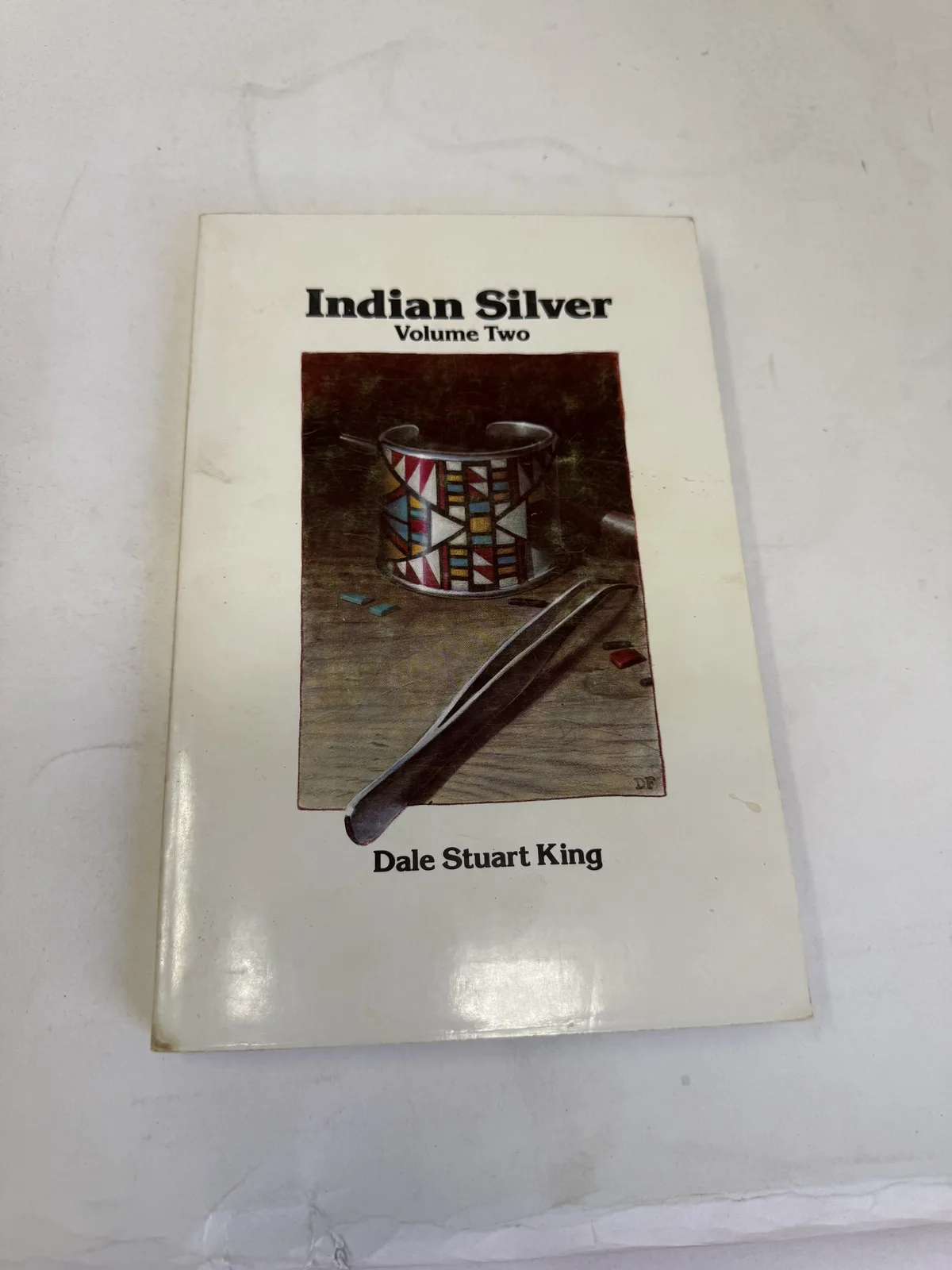
Dale Stuart King’s Indian Silver volumes are the reference the trading-post generation actually used, and they surface in Southwest estates far more often than in shops. Volume Two, from NMLP intake:
When John Adair arrived in the Navajo Nation in the summer of 1938 with a Columbia University fellowship and a set of fieldwork notebooks, he was looking for something no scholar had yet fully documented: the living oral history of how Navajo silversmithing began, transmitted through the memories of smiths whose teachers had known the first generation. Adair found it. Over three field seasons he interviewed working silversmiths at chapter houses across the reservation and at Zuni and Hopi Pueblos, recording testimony that named Atsidi Sani as the man who learned the craft from a Mexican platero in the border zone between Navajo territory and the northern New Mexico Hispano settlements, probably in the late 1850s or early 1860s. Adair published this documentation in 1944 as The Navajo and Pueblo Silversmiths (University of Oklahoma Press, Norman), and the book has never been superseded as the foundational text. Everything that came before it — including Arthur Woodward's important 1938 Museum of Northern Arizona bulletin — was preliminary; everything after it has been built on Adair's oral-historical foundation.
This guide covers that literature: the books that document the silversmithing craft tradition as a body of practice and scholarship, distinct from (though overlapping with) the broader turquoise-and-jewelry literature. Where the turquoise pillar on this site focuses on the stone — its geology, mining history, and commercial trade — this guide focuses on the metalsmithing itself: the tools, the techniques, the periodization of the tradition's development, the makers who transformed it, and the collector-identification literature that allows a buyer to date, authenticate, and attribute a piece. The literature divides into three periods: the early institutional documentation of 1938-1944 (Woodward and Adair), the post-war scholarly synthesis of 1944-1976 (Adair through Bedinger and Rosnek-Stacey), and the collector-identification era from 1977 to the present (Wright's Hallmarks of the Southwest, Cirillo, Frank, and the Schiffer catalog). Each period has its trophy targets, its working references, and its institutional anchors.
The Craft Tradition: What Silversmithing Actually Is
New Mexico Navajo & Pueblo Silverwork, Metalsmithing & Jewelry Arts reference books are highly collectible, with early identification guides and smithing studies commanding premium prices. Navajo silversmithing is a metalworking tradition less than 175 years old. This is important to establish before entering the literature, because the commercial marketing of Southwestern Indian jewelry routinely implies an ancient or pre-contact heritage that the documentary record does not support. There were pre-contact metalworking traditions in Mesoamerica that made their way into the Southwest — copper bells cast in the Aztec cultural zone appear in Ancestral Puebloan and Mogollon archaeological contexts — but the specific tradition of silversmithing using European-derived tools, cold-worked or cast silver, and steel dies arrived in Navajo country through contact with Mexican silversmiths in the 1850s-1860s. The pre-contact Navajo ornament tradition used stone, bone, shell, and traded copper; silver was not in the repertoire.
Understanding this helps the collector read the literature critically. When Adair or Woodward describe the "first period" of Navajo silversmithing, they mean the period from approximately 1868 to 1900 — after the return from Bosque Redondo and before the tourist-market transformation of the Fred Harvey Company era. When Larry Frank's Indian Silver Jewelry of the Southwest, 1868-1930 (Schiffer, 2001) sets 1868 as its starting date, he is using the end of the Bosque Redondo internment and the signing of the Navajo Treaty of 1868 as the effective beginning of the settled, widespread silversmithing tradition. The documentary record before 1868 is thin; the physical evidence of pre-1868 Navajo silver is scattered in museum collections and not always datable with precision.
The silversmithing tradition that developed in the post-1868 period and that the literature documents in detail has five primary techniques, each producing characteristic aesthetic results:
Stamp work — the oldest and most characteristic Navajo technique — requires the smith to cut individual steel dies, each producing a specific geometric motif when pressed into silver sheet with a hammer. Triangles, half-rounds, parallel lines, crosshatching, sunbursts, whirling log forms, arrow heads, and dozens of other die shapes constitute the vocabulary. The dies themselves are handmade from iron or steel; the specific character of individual smiths' stamp work — based on the particular dies they cut or inherited from their teachers — is one of the primary connoisseurship tools for attribution and approximate dating. Early stamp-work dies were cruder and more irregular; late nineteenth- and early twentieth-century dies became more refined and varied. Adair 1944 provides the most detailed documentation of die-making and stamp-work technique from the classic period, with photographic plates showing specific die forms and the resulting impressed patterns.
Tufa casting uses carved volcanic tuff (tufa stone — the porous grey volcanic rock abundant in the Southwest, particularly in the Jemez Mountains and the Rio Grande volcanic field) as a mold. The smith carves the design in negative into a flat face of tufa stone, presses a second flat face against it to form the two halves of a closed mold, pours molten silver into the cavity through a channel cut at the top, allows it to cool, and breaks apart the mold to release the cast piece. Tufa casting produces a characteristic matte, slightly granular surface from the porosity of the tufa transferring to the cooling silver — an aesthetic quality impossible to replicate by machine and a reliable authenticity indicator in period pieces. The carved tufa mold is destroyed in the casting process or at least altered; original tufa molds from known smiths are themselves collecting objects.
Sandcasting uses packed sand (or commercial casting sand) rather than tufa stone, producing a smoother surface character than tufa but still distinctly handmade. Sandcasting enabled more complex three-dimensional forms and was more amenable to the commercial production volumes the tourist market eventually required. The distinction between tufa-cast and sand-cast pieces is one of the technical discriminations the collector literature addresses, particularly in Adair 1944 and in Cirillo 1992.
Overlay is the Hopi technique developed in the late 1940s at the Museum of Northern Arizona program by Hopi artist Fred Kabotie and silversmith Paul Saufkie. The technique cuts a design from a top sheet of sterling silver, solders it over a plain base sheet of sterling, oxidizes the recessed background areas black with liver-of-sulfur, and polishes the raised design to a bright silver-against-black contrast. The imagery on Hopi overlay pieces is typically drawn from Hopi ceremonial art — kachina forms, migration symbols, cloud and rain patterns, clan animals — and the technique produces a distinctly graphic, two-dimensional aesthetic that has no Navajo or Zuni parallel. The Museum of Northern Arizona publications are the primary institutional reference for the Hopi overlay tradition and the Hopi Silvercraft Cooperative Guild (founded 1947) that standardized the technique and established the mandatory individual-hallmark requirement that makes Hopi overlay among the most authoritatively authenticated of Southwestern silver traditions.
Repoussé and chasing push silver sheet metal into relief from the back (repoussé) and refine the raised design from the front (chasing) using specialized hammers and punches. This is less common in Navajo work than stamp work or casting but appears in certain classic-period forms. Both Adair 1944 and Bedinger 1973 discuss the technique in historical context, and Cirillo 1992 provides visual documentation.
Not sure what you have? Text me a photo at 505-250-3804 and I'll tell you what I see.
The Classic Forms: Concho Belts, Squash Blossoms, Ketoh, and Najahe
The literature organizes around a small number of iconic silver forms that define the Navajo aesthetic in the popular and collector imagination. Each has its own scholarly literature and its own collecting nuances.
The concho belt is a leather belt set with flat oval or round silver discs (conchas, from the Spanish for shell or conch) stamped with die-work decoration and typically pierced through the center with a slot or slots through which the leather passes. The concho disc form is thought by some scholars (including Woodward) to derive from Plains Indian hair-plate ornaments adapted through Navajo acquisition of silver-working skill; others see it as a direct adaptation of Spanish Colonial silver-disc decorative forms. Classic-period concho belts use coin silver (actual American silver coins melted and hammered), with discs that are large, heavy, and irregularly hand-hammered, showing the individual tool marks of the smith's work. Tourist-period and later commercial concho belts used sheet silver of uniform gauge and commercial stampings; the difference in weight, material quality, and die-work character between classic and commercial-period conchas is one of the diagnostic skills the collector literature teaches. Adair 1944 and Frank 2001 provide the primary documentation of classic-period concho belt production.
The squash-blossom necklace combines several silver elements: a core strand of hollow cast or hammered silver beads, blossom-form pendants (the so-called squash blossoms — the botanical identification is disputed, with credible alternatives including pomegranate flower and Spanish Colonial floral motifs from the same decorative tradition that produced the najahe), and a central crescent pendant called the najahe or naja. The najahe is the element with the most debated origin: the dominant scholarly theory traces it to the Moorish crescent-form horse-bridle ornament that entered the Southwest through Spanish Colonial horse culture — Adair's 1944 documentation includes photographs of Spanish Colonial bridle hardware with najahe-form pendants as comparative evidence. Pre-contact pueblo silver crescent ornaments and Plains Indian crescent forms have also been proposed as sources. The scholarly consensus, as of the Adair-Bedinger-Woodward literature, favors the Moorish-via-Spanish-Colonial transmission. The squash-blossom necklace form appears in the literature from the 1880s onward; classic-period examples (heavy coin-silver beads, large najahe, generous blossom spacing) differ visibly from the lighter commercial-period versions produced for the tourist market from the 1920s onward.
The ketoh (bow guard) is a functional archery piece adapted into a prestige ornament — a wide leather wristguard with an applied silver plate, stamped with die-work, that protected the archer's wrist from the bowstring snap. Ketoh are among the most clearly functional of classic Navajo silver forms, and the transition from functional equipment to prestige ornament and ultimately commercial jewelry is documented in both Adair 1944 and Bedinger 1973. The silver ketoh plate is typically a rectangular or oval piece with stamp-work border decoration and sometimes a central turquoise setting; classic-period ketoh are heavier and more massively constructed than tourist-period pieces.
Buttons, bridles, bow cases, and tobacco canteens round out the classic Navajo silverwork forms — each has its own literature within the broader Adair, Bedinger, and Frank documentation. The horse bridle set, with its silver-covered headstall, cheek pieces, bit cover, and najahe pendant, is particularly important for understanding how the Spanish Colonial bridle tradition transmitted the najahe form into Navajo silver aesthetics. Adair's plates include documentation of both the Spanish Colonial originals and early Navajo adaptations.
The First Silversmith: Atsidi Sani and the Transmission from Mexican Plateros
The oral history recorded by Adair in his 1938-1940 fieldwork interviews is the primary source on Atsidi Sani. Adair interviewed elderly Navajos — some in their eighties and nineties at the time of his fieldwork — who had known Atsidi Sani personally or had learned silversmithing from his direct students. The consistency of the testimony across multiple informants, corroborated by the documentary evidence in Woodward's 1938 study, gives the core account considerable reliability: Atsidi Sani (Old Smith, also known by the Spanish-derived name Herrero Delgadito — Thin Blacksmith) learned silversmithing from a Mexican platero named Nakai Tsosi (Thin Mexican) in the border zone between Navajo territory and the northern New Mexico Hispano settlements.
The dating of this transmission is Adair's central historical problem. His informants' accounts place the event at different points between approximately 1853 and 1868; Adair's own analysis of the internal consistency of the testimony favors the late 1850s to early 1860s, with some of his informants independently citing dates compatible with the late 1850s. The Bosque Redondo internment (1864-1868), when the Navajo Nation was forcibly relocated to the Bosque Redondo reservation at Fort Sumner in the Pecos River valley of eastern New Mexico, temporarily disrupted silversmithing along with all other aspects of Navajo life; the returning Navajos after the 1868 treaty brought the craft back to the homeland and it spread rapidly through the 1870s-1880s.
What did Atsidi Sani actually learn from his Mexican teacher? The coin-silver working tradition — melting American silver coins, hammering and cold-working the resulting silver, cutting dies for stamp decoration — was the primary technique. The forms he initially produced were adaptations of Spanish Colonial silver forms (bridle hardware, belt conchas, buttons) into Navajo usage. There is no evidence in the oral history or documentary record that Atsidi Sani learned turquoise setting in his initial instruction; the integration of turquoise into silver forms was a subsequent development, typically dated to the 1880s-1890s, after the basic metalworking tradition was already established across the Navajo community. This chronological separation — silversmithing first, turquoise integration second — is one of the foundational distinctions the scholarly literature draws against the commercial-market conflation of silver and turquoise as a timeless-ancient unity.
Arthur Woodward's 1938 Bulletin addresses the same historical problem through documentary rather than oral-historical methods. Woodward examined Spanish Colonial administrative records, military reports from the 1850s-1860s, and early government agent accounts for evidence of Navajo metalworking prior to Atsidi Sani's instruction. He found essentially none — confirming the oral-historical evidence that the tradition did not exist before the contact-period transmission. Woodward also examined the physical character of early extant pieces in museum collections to establish the coin-silver, die-work, and casting techniques of the first-generation smiths. The complementarity of Adair's oral-historical approach and Woodward's documentary-and-physical-evidence approach makes the two studies read well together; collectors who own both have a more complete picture than either alone provides.
Inherited a library and not sure where to start? Call or text 505-250-3804 — I handle this all the time.
Period One: Woodward 1938 and the Pre-Adair Literature
Arthur Woodward, A Brief History of Navajo Silversmithing (Museum of Northern Arizona Bulletin No. 14, Flagstaff, 1938; revised and expanded reprint, Museum of Northern Arizona, 1971) is the first systematic treatment of Navajo silversmithing history, predating Adair's OU Press monograph by six years. Woodward was a curator at the Museum of Northern Arizona when he wrote the Bulletin, and the study reflects both his access to the museum's material collections and his grounding in documentary historical methods. The 1938 Bulletin is a modest institutional publication in format — a staple-bound or saddle-sewn softcover pamphlet, standard Museum of Northern Arizona Bulletin production — but its scholarly substance is anything but modest. Woodward traces the documentary evidence for the origins of Navajo silversmithing, examines the physical character of early pieces in the museum's collection and in comparable museum collections, and provides the first attempt at a technical-and-historical periodization of the tradition's development.
The 1938 Bulletin is the Tier 1 trophy in this literature precisely because of its combination of genuine scarcity and scholarly priority. Museum of Northern Arizona bulletins of the late 1930s were produced in small institutional print runs; the distribution was primarily to other museums, academic libraries, and Southwest researchers, not to the general trade market. Surviving copies in genuinely fine condition are uncommon. The revised 1971 reissue is the working reference — widely distributed and still in print from the museum press for some years — but the 1938 original is the artifact that collectors seek. A fine copy of the 1938 Bulletin 14 when it surfaces through Southwest institutional library deaccessions or estate sales from the Flagstaff-Sedona-northern Arizona corridor can command upper mid-range collectible value depending on condition. The 1971 reissue trades at solid mid-range collectible value in the dealer market.
Before Woodward, what existed? Scattered references to Navajo silversmithing in government agent reports, missionary journals, and trader correspondence — the documentary sources Woodward excavated for his Bulletin. Washington Matthews, the Army surgeon who produced the foundational early Navajo ethnographic studies (Navaho Legends 1897, The Night Chant 1902, and the earlier Navaho Weavers 1884 in the 3rd Annual Report of the Bureau of American Ethnology), includes passing observations on silversmithing in the context of his broader Navajo work. The Smithsonian Bureau of American Ethnology Annual Reports from the 1880s through 1910s contain scattered references. None of these constitute systematic documentation of the craft. Woodward's Bulletin is the first attempt at synthesis, and its scarcity in the original reflects the institutional-ephemera character of its original publication — a problem that increases rather than diminishes its collecting interest.
Period Two: The Foundational Scholarly Synthesis, 1944–1976
John Adair, The Navajo and Pueblo Silversmiths (University of Oklahoma Press, Norman, 1944). This is the monument of the field and the essential starting point for any serious collector of the scholarly literature. Adair was a Columbia University anthropologist trained by Ruth Benedict and Franz Boas; he conducted fieldwork among Navajo, Zuni, and Hopi silversmiths in the summers of 1938, 1939, and 1940 with Wenner-Gren Foundation support. The book is ethnographic rather than commercial: Adair is interested in how the craft was learned and transmitted, what social role silversmiths occupied in Navajo society, how the Zuni tradition differed from the Navajo, how commercial demand had already begun to alter production, and what the full technical sequence of silversmithing looks like when documented by a trained observer in the presence of working craftspeople. The documentation of tools — the specific design of the bellows, the crucible construction, the die-cutting process, the soldering technique using blow-pipe and commercial borax — is detailed enough to function as a technical manual. The appendices provide silversmith inventories and production-rate data. The oral-historical sections on Atsidi Sani and the genealogy of craft transmission remain the primary source for the tradition's origins.
The collector significance of Adair 1944 comes from both its content and its production. The University of Oklahoma Press Norman first edition of 1944 was produced under wartime conditions: wartime paper economy means the text stock browns and tones over time, and genuinely bright, clean copies are rare. The book has 257 pages of text plus 24 full-page photograph plates on glossy paper bound separately from the text gathering. The binding is blue-green or teal cloth with silver-stamped front-board design (the title and a schematic jewelry form). The printed paper dust jacket shows blue and rust-orange color illustrations of Navajo jewelry forms. A complete, bright jacket adds meaningful premium and is the key condition discriminator at the upper end of the market. Ex-library copies — which constitute the bulk of the surviving low-grade population — show pocket and stamps at front and rear, institutional spine labels, and worn boards. Fine non-library copies with intact bright jackets are genuinely uncommon.
Signed copies by Adair are among the rarest signatures in the entire Southwestern Indian arts literature. Adair (1913-1996) spent the bulk of his career at Cornell University and later at Yale, and he did not participate in the book-signing circuit that produced the signed copies of, for example, Gilbert Maxwell's Navajo rug books or Tony Bahti's Southwest Indian arts guides. A signed first edition in fine condition, when it surfaces, is a trophy in the strictest sense — a documented signed first with bright jacket in the high three-figure to low four-figure range would not be overpriced in the current dealer market.
Margery Bedinger, Indian Silver: Navajo and Pueblo Jewelers (University of New Mexico Press, Albuquerque, 1973). Bedinger draws on both fieldwork and archival sources — trader records, missionary journals, government agent reports, trading-post day books, and the earlier Adair and Woodward studies — to extend the historical documentation of Navajo silversmithing back through the nineteenth century and to provide a more detailed treatment of the inter-tribal trading relationships (particularly the Navajo-Zuni relationship) than Adair had offered. Where Adair is primarily oral-historical and technical, Bedinger is primarily documentary-historical; the two books are genuinely complementary rather than redundant. Bedinger also provides more sustained coverage of Zuni silversmithing as a tradition distinct from Zuni lapidary — the Zuni smith tradition that Adair treated comparatively but not exhaustively. The 1973 UNM Press first hardcover with dust jacket is the Tier 2 collector target; the subsequent UNM Press paperback reprints are working references. Bedinger's bibliography substantially updates Adair's for the 1944-1973 literature and is itself a useful research tool. Signed copies from the 1970s Albuquerque and Santa Fe book event circuit are attainable.
Carl Rosnek and Joseph Stacey, Skystone and Silver: The Collector's Book of Southwest Indian Jewelry (Prentice-Hall, Englewood Cliffs NJ, 1976). This is the first book in the literature explicitly addressed to the collecting market rather than to scholarly or ethnographic audiences. Published at the peak of the 1970s Indian jewelry boom, Skystone and Silver covers the physical characteristics of natural versus stabilized versus treated turquoise, provides a district-by-district guide to turquoise sources, surveys the major jewelry forms across Navajo, Zuni, Hopi, and Pueblo traditions, and addresses the authentication problem at length — including guidance on distinguishing Indian-made from Philippine-made and Mexican-made fakes that were flooding the market during the boom. The book's direct engagement with the collector market (including price guidance that dates quickly but is historically fascinating as a period document of boom-era pricing) distinguishes it from the academic treatments. The 1976 Prentice-Hall first is the Tier 2 collector target; the oversized format and substantial color-plate section make fine condition harder to achieve and therefore more valuable. Later printings are working references.
Found old books in an estate or attic? Text me a photo at 505-250-3804 and I'll tell you what I see.
The Hopi Overlay Innovation: Fred Kabotie, Paul Saufkie, and the MIAC Program
The Hopi overlay silverwork tradition is the most recent of the major Southwestern jewelry traditions and the most thoroughly institutional in origin. Its development in the late 1940s through a collaboration between the Museum of Northern Arizona in Flagstaff and Hopi artisans represents a deliberate cultural revitalization project rather than an organic craft-tradition evolution, and the literature documenting it is accordingly concentrated in institutional publications rather than in trade-press books.
Fred Kabotie (1900-1986) was a Hopi artist from the village of Shungopavi on Second Mesa who had become one of the most recognized Native American painters of his generation before he engaged with silverwork. Kabotie had been encouraged by Mary Colter (the Fred Harvey Company's architect and designer), by Edgar Lee Hewett (the founder of the School of American Research and the archaeologist who organized the San Diego Exposition's New Mexico exhibit), and by other patrons of Hopi art in the 1920s-1930s. When the Indian Arts and Crafts Board approached the Hopi community in the late 1940s about developing a distinctive Hopi silverwork tradition, Kabotie and Hopi silversmith Paul Saufkie together developed the overlay technique — Kabotie contributing the design vocabulary drawn from Hopi ceremonial art, Saufkie contributing the metalworking execution — and the Hopi Silvercraft Cooperative Guild was formally established in 1947 with Guild members required to use sterling silver, execute work in the overlay technique, and stamp each piece with their individual maker's hallmark.
The hallmark requirement that the Hopi Guild established in 1947 is historically significant for the broader collector market: it preceded the formal hallmark documentation systems that other tribal silver programs and SWAIA eventually developed, and it established the model for authentication-through-individual-hallmark that the Wright Hallmarks of the Southwest reference is designed to serve. Collectors of Hopi overlay work who use Wright's hallmark register are using a tool that traces directly back to the 1947 Guild founding. The Museum of Northern Arizona publications — particularly the annual Hopi Festival of Arts and Culture catalogs and the institutional monographs on Hopi material culture — are the primary reference for the overlay tradition and for the individual makers who have practiced it from Kabotie's generation through the present.
Collector Note: The Woodward Bulletin Gap
The 1938 Museum of Northern Arizona Bulletin 14 (Woodward, A Brief History of Navajo Silversmithing) almost never appears in general used-book channels. It was an institutional publication distributed to museum and library networks, not to the general trade. When it surfaces, it is typically through Southwest institutional library deaccessions, estate sales from northern Arizona (Flagstaff, Sedona, Prescott) collector libraries, or through the few Southwest specialty dealers who actively catalog museum-bulletin material. The 1971 revised reissue is more common and is the working reference; but collectors who encounter the 1938 first in any condition at any reasonable price should acquire it without hesitation. It is the rarest legitimate collecting target in the silversmithing literature and is significantly undervalued relative to its historical importance.
Period Three: The Collector-Identification Era, 1977 to the Present
The 1970s Indian jewelry boom created a secondary market that demanded practical collector tools — books that allowed buyers to identify what they were looking at, attribute it to a specific tradition and approximate period, and authenticate it against the flood of fake and misrepresented Indian-style jewelry that the boom's price inflation had made profitable to produce. The collector-identification literature that emerged from the late 1970s onward constitutes its own distinct publishing category, with its own leading texts and its own collector market.
Barton Wright and Margaret Nickelson Wright, Hallmarks of the Southwest (Schiffer Publishing, West Chester Pennsylvania, first edition 1989, with subsequent revised and expanded editions). Wright (1920-2010) served as a curator and later curator emeritus at the Museum of Northern Arizona and was among the most prolific and authoritative writers on Hopi and Southwestern Indian arts of his generation. His co-authored Hallmarks of the Southwest with Margaret Nickelson Wright is the standard collector reference for identifying individual maker hallmarks stamped into Indian-made silver jewelry. The hallmark register cross-references visual representations of individual stamps and marks (photographed at useful scale) to the maker's tribal affiliation, geographic region, and approximate active-production date range where documentation allows. The book has been revised and expanded across multiple editions since 1989; collectors should retain earlier editions alongside the most current, as hallmarks change across individual makers' careers and earlier editions document marks no longer used. Schiffer Publishing has kept the book continuously in print in various formats including spiral-bound and lay-flat editions designed for active side-by-side comparison at the dealer table. Price point: common reading copy range for working copies of any edition; Schiffer Publishing first edition (1989) signed by Barton Wright is the Tier 2 target at solid mid-range collectible value.
Larry Frank, Indian Silver Jewelry of the Southwest, 1868-1930 (Schiffer Publishing, Atglen Pennsylvania, 2001). Frank's study focuses specifically on the classic and early commercial periods — from the post-Bosque-Redondo reestablishment of the tradition through the beginning of the full commercial-tourist-market transformation. The date range 1868-1930 is carefully chosen: 1868 marks the Navajo treaty and return from Bosque Redondo (the effective beginning of the settled, widespread tradition), and 1930 marks approximately the point at which the tourist-market demand and the Fred Harvey Company commercial apparatus had fully transformed production aesthetics away from the classic heavy coin-silver work toward lighter commercial-grade pieces. Within this window Frank provides the most detailed period-by-period visual documentation of authentic classic-period pieces: the coin-silver concho belts, the early tufa-cast bridle hardware, the first-generation squash-blossom necklaces, the classic stamp-work ketoh. Photographs are keyed to period, technique, and tribal origin. The 2001 Schiffer first is the Tier 2 collector target; signed copies by Frank are attainable.
Dexter Cirillo, Southwestern Indian Jewelry (Abbeville Press, New York, 1992). The single most useful comprehensive collector reference covering all four major Southwestern jewelry traditions side-by-side — Navajo, Zuni, Hopi overlay, and Santo Domingo. Abbeville Press's production standards in the late 1980s-1990s were the best in the American large-format art reference market, and the Cirillo volume benefits fully: exceptional color photography, sustained comparative analysis across traditions, strong bibliography, and a format (large hardcover, lay-flat capability) appropriate for active collector use. Cirillo covers the silversmithing technique chapters with appropriate depth, discusses the classic form vocabulary (concho belt, squash blossom, ketoh, najahe) with good visual documentation, and provides the authentication and periodization guidance that the tourist-market era demands. The 1992 Abbeville first hardcover in fine condition with dust jacket is the Tier 2 collector target; the book is well-represented in the dealer market. Signed copies are attainable from the Santa Fe and Tucson event circuit of the 1990s.
The Schiffer Publishing catalog of Southwestern Indian arts identification guides — which includes the Wright Hallmarks, the Frank 1868-1930, and several dozen additional identification references for beadwork, kachina dolls, pottery, weaving, and related fields — constitutes the Tier 3 working library for the active collector. Schiffer's Indian arts list includes titles on specific subtopics (Navajo concho belts specifically, Zuni petit-point specifically, Hopi overlay specifically) that are useful for focused collecting areas but do not need to be acquired by the general collector. The Schiffer format — large format, substantial color photography, spiral or lay-flat binding where appropriate, consistent production standards — has made Schiffer the dominant publisher of identification-guide literature for the Southwestern Indian arts market since the 1980s. Price range for Schiffer Indian arts titles: common reading copy range in working condition, rarely climbing above solid mid-range collectible value in any condition except for out-of-print titles or signed copies.
Not sure whether to sell, donate, or keep? Call or text me at 505-250-3804 — I'll walk you through it.
Authentication Infrastructure: IACA, SWAIA, IACB, and the Santa Fe Indian Market
The authentication problem in Southwestern Indian silver — distinguishing Indian-made from imitation, and verifying the period and tribal attribution of historic pieces — is addressed by three overlapping institutional frameworks, each of which has generated its own literature and documentation resources.
The Indian Arts and Crafts Association (IACA), founded in Albuquerque in 1974, is the principal trade association for Indian arts dealers and artisans. IACA membership requires dealers to comply with the Indian Arts and Crafts Act (as amended through 1990 and subsequent regulations), to represent only pieces made by enrolled members of federally recognized tribes as Indian-made, and to maintain documentation of their sourcing. The IACA authentication program is dealer-certification rather than piece-by-piece certification; a buyer working with an IACA member dealer has a level of institutional accountability that unaffiliated dealers do not provide. IACA publishes an annual buyer's guide and maintains an online member directory.
The Southwestern Association for Indian Arts (SWAIA), operator of the Santa Fe Indian Market since 1922, maintains the most comprehensive artist registry in the Southwestern Indian arts field. Market participants are required to complete a juried application process verifying tribal enrollment and demonstrating craft skill; accepted artists receive a juried-artist identification card that constitutes a primary authentication document for their market work. SWAIA also maintains a hallmark documentation database cross-referenced to juried artists, which supplements the Wright Hallmarks of the Southwest register for contemporary makers. The Santa Fe Indian Market — held annually on the weekend of the third or fourth Saturday in August on the Santa Fe Plaza — is the largest and most prestigious juried Indian arts market in North America, with approximately 900 juried artists from over 200 tribes participating in a typical year. The annual Market catalogs, published since the 1970s in varying formats, constitute a documentary record of prize-winning pieces and featured artists that is analogous to the Heard Indian Fair and Market catalogs for Arizona.
The Indian Arts and Crafts Board (IACB) is the federal agency within the Department of the Interior responsible for enforcing the Indian Arts and Crafts Act of 1990 (P.L. 101-644) — the law that makes it illegal to misrepresent non-Indian-made work as Indian-made in the course of a sale. IACB enforcement provides civil and criminal penalties for violations and maintains a database of federally recognized tribes. For collectors, IACB's public education materials (available at iacb.doi.gov) provide the definitive statement of what the law requires and what it does not cover (it does not certify individual pieces; it does not require hallmarks; it prohibits misrepresentation but does not prevent sales of Indian-style work clearly labeled as non-Indian-made).
The Gallup Inter-Tribal Indian Ceremonial (ITICA, held annually since 1922 in Gallup, New Mexico — the "Indian Capital of the World" during the trading-post era) was the primary commercial venue for Navajo and Zuni silverwork through most of the twentieth century, predating the Santa Fe Indian Market's full development as an authentication-oriented juried market. The Ceremonial's annual program booklets — published from 1922 onward — document prize-winning silverwork, participating smiths and dealers, and the commercial context of the Gallup trading-post network. Early Ceremonial programs (1920s-1950s) are Tier 1-2 collecting ephemera; post-1960s programs are Tier 3.
The Pawn System: Trading-Post Silver as a Collecting Category
The trading-post pawn system produced one of the most distinctive collecting categories in the Southwestern Indian jewelry market: dead-pawn pieces that represent the authentic Navajo-use and Navajo-aesthetic tradition rather than the commercial tourist market. Understanding the pawn system — both its historical mechanics and its collector significance — requires reading across several of the silversmithing literature books alongside the dedicated trading-post histories.
A licensed reservation trading post operated on credit: the trader extended goods and cash against future income (wool clip, livestock, wage labor), accepting valuable property as collateral security for the credit extended. Silver jewelry, blankets, and sometimes saddles or wagons functioned as the primary pawn collateral. The mechanics were standardized: the Navajo depositor received a pawn ticket or was credited in the trader's account book; the piece was stored in the pawn room (physically held by the trader, typically in labeled envelopes or on boards with the owner's name and item description); and the depositor retained the right to redeem the piece by repaying the principal plus the trader's carrying charge. Federal regulations governing licensed traders on the Navajo Nation specified pawn terms and holding requirements — active pawn could not be sold; the piece had to be held for a minimum period after the pawn period expired before becoming dead pawn available for sale. "Dead pawn" — unredeemed collateral that had converted to trader ownership through the expiration of the holding period — is the collector category.
Dead-pawn pieces are significant collecting objects because they represent the pre-commercial tradition: pieces made for Navajo use, reflecting Navajo aesthetic preferences, sized and constructed for Navajo wearing rather than for tourist-market visual appeal. Classic dead-pawn concho belts are substantially heavier than tourist-market conchas; the silver is frequently coin silver (noticeably different in color and hardness from commercial sterling); the die work reflects the individual stamps of identified smiths rather than commercial punch-press production; and the turquoise settings, where present, tend toward larger, higher-quality natural stones rather than the small calibrated stones of commercial production. The provenance documentation in trader account books — where it survives — adds historical specificity: a concho belt that can be traced in trader records to a specific Navajo family, with redemption history and pawn dates, has a documented lineage that isolated pieces lack.
The primary book-length treatments of the trading-post system relevant to silversmithing are Frank McNitt, The Indian Traders (University of Oklahoma Press, Norman, 1962 — the definitive historical study of the Navajo trading-post system, a Tier 2 collector target in its own right), the Hubbell Trading Post documentation in the University of Arizona Special Collections (the Hubbell family papers), and the institutional histories of the Hubbell, Ganado, Tuba City, and other major post operations. The silversmithing literature proper — Adair, Bedinger, Frank — treats the trading-post context throughout as the commercial infrastructure within which the craft evolved.
Have books you're ready to part with? I offer free pickup across Albuquerque — call 505-250-3804.
Contemporary Makers: Loloma, Monongya, Yazzie, and the Fine-Art Transformation
The transformation of Southwestern Indian jewelry from craft tradition and commercial product into fine art — with gallery representation, auction-house records, and a critical literature distinguishing masterwork from production work — is documented in the contemporary maker literature and in a subset of the gallery catalogs that are themselves collector objects.
Charles Loloma (1921-1991) is the central figure in this transformation. A Hopi artist from Hotevilla on Third Mesa, Loloma trained at the School for American Craftsmen in Alfred, New York, and subsequently taught at Arizona State University before establishing his studio at Hopi. His innovations in the late 1950s-1960s and 1970s were radical departures from the existing Southwestern jewelry tradition: he used 18-karat gold rather than silver; he combined turquoise with lapis lazuli, coral, malachite, ironwood, fossilized ivory, and other materials in settings that emphasized the intrinsic beauty of each material rather than following the standard bezel-and-cluster conventions; he created sculptural forms — armbands that wrapped the arm, necklaces with three-dimensional structural presence — that treated jewelry as three-dimensional art object rather than applied ornament. His work was shown at major American museums and galleries; it commanded prices that had not previously existed in the Indian jewelry market; and it established the intellectual framework within which the subsequent generation of Southwestern Indian artist-jewelers — including Jesse Monongya and Lee Yazzie — developed their own practices. Wikipedia maintains an article on Charles Loloma (en.wikipedia.org/wiki/Charles_Loloma) with biographical details; the primary collecting documentation is in gallery catalogs from Lovena Ohl Gallery (Scottsdale), the Wheelwright Museum, and the Heard Museum, plus the published scholarship of Lloyd Kiva New and other institutional voices who documented Loloma's emergence.
Jesse Monongya (b. 1952), of Navajo-Hopi heritage and a student of Loloma's influence (though primarily self-taught through study of Loloma's work rather than direct apprenticeship), developed a multi-stone inlay technique of extraordinary precision executed primarily in 18-karat gold. His compositions combine turquoise, lapis, coral, sugilite, charoite, and other stones in precisely cut and fitted inlay patterns drawn from both Navajo geometric and Hopi ceremonial visual traditions. Monongya's work commands the highest prices in the contemporary Southwestern jewelry market — individual pieces have sold for investment-grade territory in the secondary market. The documentation of his work is concentrated in gallery catalogs (primarily Sherwood's Fine Arts, Santa Fe, and the Wheelwright Museum shop) and in the Mark Bahti Silver + Stone series.
Lee Yazzie (b. 1946), a Navajo jeweler from the Rough Rock area of Arizona, is generally recognized as the contemporary master of traditional-derived Navajo inlay work in silver — the bridge between the classic Navajo silver aesthetic and the fine-art transformation of the Loloma generation. Yazzie's work uses natural turquoise, coral, lapis, and other stones in precisely cut bezels and inlay settings within fabricated silver and gold, with a technical precision and material sensitivity that consistently elevates his pieces above commercial production. He has won the Best of Show at the Santa Fe Indian Market multiple times and is represented in major museum collections. The documentation is again concentrated in gallery catalogs, SWAIA Market records, and the Bahti series.
The Mark Bahti Silver + Stone: Profiles of American Indian Jewelers series (multiple volumes, various imprints, 1990s-2000s), produced by the Tucson-based dealer and scholar, provides the most accessible contemporary documentation of individual Southwestern Indian jewelers including Loloma's influence, Monongya, Yazzie, and their contemporaries. Individual volumes vary in completeness and production quality; the most useful are those profiling the most collected contemporary makers. Bahti is the heir of the Tom Bahti Indian Arts legacy — Tom Bahti's Southwestern Indian Arts and Crafts (KC Publications, 1966) is the foundational popular guide that preceded Rosnek-Stacey — and his personal dealer network gives him access to documentation that general-market writers lack. Signed copies of individual Silver + Stone volumes by both Bahti and the profiled artists are the premium collecting targets; the artist signatures in particular are highly sought.
Points of Issue: Identifying the Key Collector Targets
Adair, The Navajo and Pueblo Silversmiths, OU Press 1944 first edition. Blue-green or teal cloth boards, silver-stamped front-board design (title and schematic jewelry form). Dust jacket: blue and rust-orange color illustrations of Navajo forms. 257 pages plus 24 full-page plates on glossy stock. Wartime paper stock browns easily; fine bright text is rare. A 1944 second printing exists (nearly identical; check copyright page for any printing statement). Ex-library copies dominate the low-grade market. Fine non-library copy with intact bright jacket: respectable collectible value. Signed first fine with jacket: four-figure collectible territory. Subsequent OU Press paperback editions: common reading copy range working reference.
Woodward, A Brief History of Navajo Silversmithing, Museum of Northern Arizona Bulletin 14, 1938. Softcover institutional bulletin, staple-bound or saddle-sewn. Small print run, institutional distribution only. Fine copy is genuinely uncommon: upper mid-range collectible value when it appears. The 1971 revised Museum of Northern Arizona reissue: solid mid-range collectible value in the dealer market.
Bedinger, Indian Silver, UNM Press 1973 first hardcover. Standard UNM Press academic binding. Original illustrated dust jacket. First hardcover with intact jacket: respectable collectible value. UNM Press paperback reprints: common reading copy range working reference. Signed copies attainable.
Rosnek and Stacey, Skystone and Silver, Prentice-Hall 1976. Oversized format, substantial color plates. First edition fine with dust jacket: respectable collectible value. Later printings: common reading copy range.
Cirillo, Southwestern Indian Jewelry, Abbeville Press 1992. Large-format Abbeville production, exceptional color photography. First hardcover fine with bright jacket: respectable collectible value. Signed: respectable collectible value. Later editions: the common reading copy to mid-range zone.
Wright and Wright, Hallmarks of the Southwest, Schiffer 1989 first edition. Standard Schiffer format. First edition signed by Barton Wright: solid mid-range collectible value. Any edition unsigned: common reading copy range.
Frank, Indian Silver Jewelry of the Southwest, 1868-1930, Schiffer 2001. Standard Schiffer large format. First edition signed: solid mid-range collectible value. Unsigned first: solid mid-range collectible value.
Three-Tier Collector Market Summary
Tier 1 trophy targets (mid-three-figure to low-four-figure): Signed John Adair The Navajo and Pueblo Silversmiths OU Press 1944 first edition fine with dust jacket; Arthur Woodward A Brief History of Navajo Silversmithing Museum of Northern Arizona Bulletin 14 1938 fine copy; early Hopi Silvercraft Guild program documentation and Museum of Northern Arizona overlay program ephemera from 1947-1955; C.G. Wallace-era Heard Museum or Smithsonian Zuni and Navajo silverwork documentation catalogs from the 1940s-1950s; unsigned Adair 1944 first with bright intact jacket in fine condition (upper Tier 2 / entry Tier 1 depending on jacket quality).
Tier 2 collector targets (upper-two-figure to mid-three-figure): Unsigned Adair 1944 first with presentable jacket; Arthur Woodward Museum of Northern Arizona 1971 revised edition fine; Margery Bedinger Indian Silver UNM Press 1973 first hardcover with dust jacket; Carl Rosnek and Joseph Stacey Skystone and Silver Prentice-Hall 1976 first fine with jacket; Dexter Cirillo Southwestern Indian Jewelry Abbeville Press 1992 first fine with jacket; Larry Frank Indian Silver Jewelry of the Southwest Schiffer 2001 first signed; Barton Wright and Margaret Nickelson Wright Hallmarks of the Southwest Schiffer 1989 first signed; Mark Bahti Silver + Stone individual volumes signed by Bahti and the profiled artist; Frank McNitt The Indian Traders OU Press 1962 first fine with jacket.
Tier 3 working library (upper-one-figure to upper-two-figure): All subsequent printings and paperback editions of Adair, Bedinger, Cirillo; all Schiffer Publishing Indian arts identification guides; Hallmarks of the Southwest any edition unsigned; Museum of Northern Arizona exhibition catalogs; Museum of Indian Arts and Culture Santa Fe exhibition and collection catalogs; Santa Fe Indian Market annual catalogs from the 1980s-present; Gallup Inter-Tribal Ceremonial program booklets from the 1960s-present; Tom Bahti Southwestern Indian Arts and Crafts KC Publications 1966; standard Southwest Indian arts dealer catalogs; any edition of Oscar Branson's Indian jewelry and turquoise guides.
NMLP Intake Position
Silversmithing and metalsmithing books arrive in the NMLP donation stream primarily through estate collections in Albuquerque (trader descendants, Southwest Indian arts dealers, UNM Anthropology faculty estates, collectors affiliated with the Museum of Indian Arts and Culture or the Wheelwright Museum), in Gallup and Farmington (where the trading-post and Inter-Tribal Ceremonial networks concentrated dealer and collector libraries), in Santa Fe (MIAC, Wheelwright, and SWAIA-adjacent collections), and occasionally through Flagstaff-area estates that reach the New Mexico distribution network through Southwest dealer channels. The silversmithing books donor surface overlaps substantially with the Navajo weaving, turquoise, and kachina doll collector-library surface — these interdisciplinary Southwest arts collections tend to move together, and a serious collector's library typically includes all of these categories.
NMLP routes Tier 1 trophy items — the 1938 Woodward Bulletin 14, signed Adair 1944 firsts, rare institutional catalogs from the MIAC Hopi program or the Heard Museum Zuni or Navajo silverwork exhibitions — to specialist dealers (Sherwood's Spirit of America Santa Fe, Adobe Gallery Old Town Albuquerque, Morning Star Gallery) or to specialist auction channels (Heritage Western Americana, Southwest Art and Auction, Skinner Auctioneers). Tier 2 trade firsts route through SellBooksABQ standard hand-sort with specialist consultation for condition assessment. Tier 3 identification guides, subsequent printings, and Schiffer-format dealer workhorses route to community literacy partners (Southwest Indian arts curriculum, New Mexico Studies, Native American Studies elective coursework) and Little Free Library stocking.
Important reminder on objects: NMLP does NOT accept silver jewelry, concho belts, squash-blossom necklaces, ketoh bow guards, silver metalwork objects, pawn pieces, or any other Indian arts physical objects in donation pickups. Only the books about these arts. For object donations, contact Morning Star Gallery (4018 Rio Grande Blvd NW, Albuquerque), Adobe Gallery (413 Romero Street NW, Old Town Albuquerque), or the relevant tribal cultural preservation offices. Free Albuquerque-metro book pickup with no condition or quantity minimum — schedule online or call or text 505-250-3804.
Donate Navajo & Pueblo Silversmithing Books
If you have Indian silversmithing books, Southwestern jewelry references, hallmark identification guides, trading-post histories, or related Southwest Indian arts volumes to donate, NMLP offers free pickup across the Albuquerque metro — estates, downsizes, storage unit clears. No condition minimum, no quantity minimum.
Call or text: 505-250-3804 — or schedule online.
Frequently Asked Questions
How is this silversmithing pillar different from the NMLP turquoise and jewelry pillar?
The turquoise and jewelry pillar treats turquoise as a material — its geology, mining history, and commercial trade — and addresses the Fred Harvey Company commercial apparatus and the broad tourist-market literature. This silversmithing pillar focuses on the craft tradition itself: how silver is worked (stamp work, tufa casting, sandcasting, overlay, repoussé), how that tradition was transmitted from Atsidi Sani and the Mexican plateros onward, how scholars have periodized its development, and what the hallmark identification and period-dating literature looks like. Both guides share key texts — Adair 1944 and Bedinger 1973 are foundational to both — but their emphasis and collector framing differ. A complete Southwest Indian arts library will want both.
What makes the Adair 1944 first edition the trophy target and how do I identify it?
Adair's fieldwork-based documentation of Atsidi Sani and the oral history of the transmission from Mexican plateros has never been superseded. Points of issue: blue-green or teal cloth boards with silver-stamped front design; University of Oklahoma Press Norman spine imprint; printed dust jacket with blue and rust-orange jewelry illustrations; 257 pages plus 24 glossy plates; wartime paper stock browns easily (bright text is a premium condition indicator). Ex-library copies dominate the low-grade market. Fine non-library copy with intact jacket: respectable collectible value. Signed first: four-figure collectible territory.
Who was Atsidi Sani and why is he central to this literature?
Atsidi Sani (Old Smith, also Herrero Delgadito) is identified in Adair's 1940 fieldwork interviews as the first Navajo silversmith, who learned from Mexican platero Nakai Tsosi (Thin Mexican) in the border zone between Navajo territory and northern New Mexico Hispano settlements, approximately 1853-1868. He taught the craft to his sons and other Navajos. Every book that discusses Navajo silversmithing origins must accept, modify, or dispute Adair's account. Wikipedia maintains an article on Atsidi Sani at en.wikipedia.org/wiki/Atsidi_Sani; Adair 1944 provides the ethnographic depth.
What is the Woodward 1938 Museum of Northern Arizona Bulletin and why is it the rarest collecting target?
Arthur Woodward's A Brief History of Navajo Silversmithing (Museum of Northern Arizona Bulletin 14, 1938) is the first systematic technical-historical treatment of Navajo silversmithing, predating Adair by six years. It was produced as an institutional museum bulletin in a small print run distributed to academic and museum networks — not a trade publication. Fine copies surface through Southwest institutional library deaccessions and northern Arizona estate sales: upper mid-range collectible value in any condition. The 1971 Museum of Northern Arizona revised reissue (solid mid-range collectible value) is the working reference. Any collector encountering the 1938 original at a reasonable price should acquire it without hesitation.
What are stamp work, tufa casting, and overlay, and which books cover each technique best?
Stamp work (hand-cut steel dies pressed into sheet silver) is documented in detail in Adair 1944 and Frank 2001. Tufa casting (carving volcanic tuff as a mold, producing the characteristic porous surface texture) is covered in Adair 1944 and Cirillo 1992. Overlay (Hopi technique: design cut from a top silver sheet, soldered over a base sheet, background oxidized black) was developed by Fred Kabotie and Paul Saufkie at the MIAC program in the late 1940s and is documented in Museum of Northern Arizona publications. Cirillo 1992 provides comparative visual documentation of all techniques across traditions; Adair 1944 provides the deepest classic-period technical documentation.
What is the najahe and where did its crescent form come from?
The najahe (or naja) is the inverted crescent pendant that anchors the squash-blossom necklace form. The dominant scholarly theory, documented in Adair 1944 and Woodward 1938, traces the form to the crescent-shaped silver bridle ornament of the Moorish and Spanish horse-riding tradition that arrived in the Southwest through Spanish Colonial horse culture. Adair's comparative photographs document Spanish Colonial bridle hardware with najahe-form pendants. Alternative theories propose pre-contact Pueblo crescent ornaments or Plains Indian crescent forms as independent sources. The scholarly consensus in the foundational literature favors the Moorish-via-Spanish-Colonial transmission.
What is Hallmarks of the Southwest and how is it used?
Barton Wright and Margaret Nickelson Wright's Hallmarks of the Southwest (Schiffer Publishing, first edition 1989, multiple revised editions) is the standard collector reference for identifying individual maker hallmarks in Indian-made silver — a visual register of individual stamps cross-referenced to tribal affiliation, region, and approximate date range. The lay-flat or spiral binding of some editions is designed for active side-by-side comparison with a piece in hand. All editions are useful; retain earlier editions alongside the current edition to track hallmarks that changed across a maker's career. Any edition in working condition: common reading copy range. Schiffer 1989 first signed by Barton Wright: solid mid-range collectible value.
What is pawn jewelry and how does the collector literature address it?
Pawn jewelry refers to silver and turquoise pieces that Navajo families deposited as collateral at trading posts. Unredeemed pieces became "dead pawn" — legally available for sale — and these are the collector category: authentic Navajo-owned and Navajo-made pieces reflecting Navajo aesthetic preferences rather than tourist-market demands, typically heavier and more individually crafted than commercial production. The primary book-length treatment of the trading-post pawn system is Frank McNitt's The Indian Traders (University of Oklahoma Press, 1962) — a Tier 2 collector target. Adair 1944, Bedinger 1973, and Frank 2001 all address pawn-system context for the silversmithing literature.
Who are Charles Loloma, Jesse Monongya, and Lee Yazzie, and what is their collector significance?
These three represent the three generations of the fine-art transformation of Southwestern Indian jewelry. Charles Loloma (Hopi, 1921-1991) — the central figure, whose innovations in gold, mixed-material settings, and sculptural form established the intellectual framework for contemporary Southwestern jewelry as art (Wikipedia: en.wikipedia.org/wiki/Charles_Loloma). Jesse Monongya (Navajo-Hopi, b. 1952) — Loloma's primary heir in technique, executing precise multi-stone inlay in 18-karat gold that commands the highest prices in the contemporary Southwest jewelry market. Lee Yazzie (Navajo, b. 1946) — the master of traditional-derived Navajo inlay in silver, multiple Santa Fe Indian Market Best of Show winner. The documentation is concentrated in gallery catalogs from Sherwood's, the Wheelwright Museum, and the Heard Museum, plus the Mark Bahti Silver + Stone series.
How does NMLP handle these books and what happens to silversmithing literature in donation pickups?
Silversmithing books arrive primarily from Albuquerque (trader descendants, Southwest arts dealers, UNM Anthropology estates), Gallup and Farmington (trading-post and Inter-Tribal Ceremonial network libraries), Santa Fe (MIAC and SWAIA-adjacent collections), and Flagstaff-area estates. Tier 1 items route to specialist dealers (Sherwood's Spirit of America Santa Fe, Adobe Gallery, Morning Star Gallery) or specialist auction. Tier 2 firsts route through SellBooksABQ hand-sort. Tier 3 working references route to community literacy partners and Little Free Libraries. NMLP does NOT accept jewelry, silver objects, or any Indian arts physical items — only books. Free Albuquerque-metro pickup with no condition or quantity minimum: schedule online or call/text 505-250-3804.
External References
- Wikipedia: Atsidi Sani — the first Navajo silversmith
- Wikipedia: John Adair — author of the foundational 1944 ethnographic study
- Wikipedia: Charles Loloma — Hopi jeweler who transformed Southwestern Indian jewelry into fine art
- Wikipedia: Fred Kabotie — Hopi artist who co-developed the overlay silverwork technique
- Museum of Northern Arizona — Flagstaff; publisher of the foundational 1938 Woodward Bulletin; institutional home of the Hopi overlay program
- University of Oklahoma Press — publisher of Adair's foundational 1944 study
- University of New Mexico Press — publisher of Bedinger 1973
- Schiffer Publishing — publisher of Hallmarks of the Southwest, Frank 2001, and the Southwestern Indian arts identification guide catalog
- Southwestern Association for Indian Arts (SWAIA) — operator of the Santa Fe Indian Market; maintains the hallmark documentation database and juried-artist registry
- Indian Arts and Crafts Board (IACB) — federal enforcement agency for the Indian Arts and Crafts Act of 1990
- Indian Arts and Crafts Association (IACA) — Albuquerque, founded 1974; dealer authentication program and buyer education resources
- Museum of Indian Arts and Culture — Santa Fe; institutional context for the Hopi overlay program and primary NM jewelry study collection
- Wheelwright Museum of the American Indian — Santa Fe; Navajo material culture and Case Trading Post gallery
- Heard Museum — Phoenix; the premier institutional archive for Southwestern Indian jewelry including the Fred Harvey Company and C.G. Wallace collections
Related on This Site
- NM Turquoise & Jewelry Books — the companion pillar covering turquoise as a stone, mining history, and the Fred Harvey commercial apparatus
- NM Navajo Weaving & Textile Books — the parallel Navajo arts-scholarship canon; Hubbell Trading Post and the trader system are central to both
- Pueblo Pottery Books — the complementary Pueblo material-culture collecting literature
- NM Kachina & Katsina Books — the Hopi material culture literature that contextualizes the Kabotie overlay iconography
- New Mexico Archaeology Books — the pre-contact context for turquoise trade and pre-silver ornament traditions
- New Mexico Native American Literature — the broader tribal-literature canon overlapping with the silversmithing ethnographic documentation
- NM Santero & Hispano Folk Art Books — the parallel NM arts-and-crafts collecting canon for Hispano folk traditions including tinwork and metalsmithing
- Zuni Pueblo Ethnography & Art Books — the Zuni-specific scholarship including the C.G. Wallace and lapidary tradition documentation
- a donated Southwestern & Native American library — provenance documentation for a real Southwest arts and Native American book collection donated to NMLP and kept out of the landfill
Cite This Guide
Eldred, J. (May 2026). New Mexico Navajo & Pueblo Silverwork, Metalsmithing & Jewelry Arts: A Collector's Authority Guide. New Mexico Literacy Project.
https://newmexicoliteracyproject.org/new-mexico-navajo-pueblo-silverwork-jewelry-arts-books-collecting
Content is original research by Josh Eldred. Licensed under CC BY 4.0. Cite with attribution.