Collector's Authority Guide · New Mexico History
The Pueblo Revolt of 1680, Spanish Reconquest & Colonial Resistance: A Collector's Authority Guide
Po'pay, the knotted cord, August 10 1680 — the most successful Indigenous uprising in North American history and the fifty years of scholarship that reconstructed it
By Josh Eldred · New Mexico Literacy Project · · ~7,500 words
Last verified September 2026 · Original research by Josh Eldred
On the morning of August 10, 1680, Pueblo communities from Taos in the north to Isleta in the south rose simultaneously against Spanish colonial rule in New Mexico. Within twenty-one days, 21 of the 33 Franciscan missionaries in the province were dead, roughly 400 Spanish colonists and soldiers had been killed, the Palace of the Governors in Santa Fe had been besieged and abandoned, and Governor Antonio de Otermín was leading a column of approximately 1,000 surviving settlers south on a desperate overland retreat to El Paso del Norte. For twelve years — 1680 to 1692 — the Pueblo communities governed New Mexico without Spanish authority. It was the most successful Indigenous uprising against European colonization in what is now the United States, and arguably in all of North America. The scholarly and popular literature that reconstructed this event across the twentieth century is rich, contested, and — at its rare-book stratum — genuinely collectible.
This guide covers the complete literary and collecting market: the primary-document collections that preserve the Spanish testimony of the revolt (Charles Wilson Hackett and Charmion Clair Shelby's foundational 1942 UNM Coronado Historical Series two-volume set); the scholarly monographs that interpreted those documents (Andrew Knaut's 1995 University of Oklahoma Press study, Matthew Liebmann's 2012 University of Arizona Press archaeological history); the popular narratives that brought the story to a general readership (David Roberts's 2004 Simon and Schuster account); the document readers designed for university instruction (David J. Weber's 1999 Bedford/St. Martin's reader); the archaeological collections that moved the analysis from documents into material culture (Robert Preucel's 2002 UNM Press edited volume); the foundational work on the second revolt (José Manuel Espinosa's 1942 and 1988 OU Press monographs); and the essential single-pueblo and Pueblo-voice accounts (John L. Kessell's Pecos narrative, Joe S. Sando's Pueblo Nations). The three-tier collector market, points of issue for key editions, and the FAQ section follow.
The Historical Context: Why August 10, 1680?
The Pueblo Revolt of 1680, Spanish Reconquest & Colonial Resistance books are prized collectibles, with early historical accounts and scholarly studies commanding premium prices among Southwest historians. The Pueblo Revolt did not come without warning. The Spanish colonial enterprise in New Mexico — established by Juan de Oñate in 1598, eighty-two years before the revolt — had imposed a system of forced labor, religious suppression, and administrative abuse that had been documented and protested from within the colonial system itself for decades. The Franciscan missionaries and the civil governors competed bitterly for control of the Pueblo communities' labor; both demanded tribute; neither offered much protection against the escalating Apache and Navajo raiding that devastated Pueblo agricultural villages through the 1670s. Catastrophic droughts in the 1660s and 1670s produced famine conditions. The Pueblo population, already severely reduced by epidemic disease since contact, continued to fall. The Spanish response was to increase the intensity of exploitation at precisely the moment when the communities being exploited were most desperate.
The precipitating crisis came in 1675, when Governor Juan Francisco de Treviño arrested forty-seven Pueblo religious leaders — medicine men, kiva leaders, and practitioners of the katsina ceremonies the Franciscans had been suppressing since the 1620s — on charges of practicing sorcery. Three were hanged. The rest were publicly flogged and released. Po'pay (spelled variously Popé, Po'pe, Pohé-yemo in different Spanish document transliterations) of Ohkay Owingeh — then called San Juan Pueblo — was among those whipped. He relocated to Taos Pueblo, beyond the immediate reach of Santa Fe, and spent the next five years building the multi-lingual, multi-community network that would produce the revolt.
The organizational achievement was extraordinary. The nineteen Pueblo communities that participated in the revolt spoke six or more mutually unintelligible languages: Tiwa (northern and southern dialects), Tewa, Towa, Keresan (eastern and western dialects), Zuni, and Hopi. Po'pay coordinated across all of them using a system of knotted cords distributed by runners, with each knot representing one day in the countdown. The revolt was originally planned for August 11, 1680. When two runners carrying the cord were captured and interrogated by the Spanish on August 9, Po'pay moved the date forward by one day. The revolt began at dawn on August 10 before the Spanish could organize a response.
The speed and coordination of the uprising suggest prior preparation beyond the cord-countdown: caches of weapons, pre-arranged signal systems, and agreed-upon targets (the missionaries first, then the civilians, then the military). Governor Otermín survived the Santa Fe siege because he was able to organize a defense within the Palace of the Governors compound and eventually counterattack long enough to break out southward. He retreated with approximately 1,000 survivors — Spanish colonists and Pueblo auxiliaries from southern communities that had not joined the revolt — to El Paso del Norte, arriving in late September 1680. The retreat was itself a catastrophe: thirst, heat, Apache attack, and starvation.
Twelve Years of Pueblo Independence, 1680–1692
What the Pueblo communities did during the twelve years of independence from Spanish rule is one of the most significant questions in the revolt literature — and one of the least well-documented in Spanish sources, for the obvious reason that the Spanish were not there to document it. The archaeological literature (Preucel 2002, Liebmann 2012) has substantially expanded what I know, and the Pueblo oral tradition preserved more than the documentary record reveals.
Po'pay's administration of the post-revolt Pueblo world was not universally welcomed. He dismantled the Spanish missions physically — ordering churches torn down or converted to other uses, ordering the removal of Christian baptismal symbols, commanding a ceremonial re-purification of the communities. He also attempted to reassert centralized authority over the Pueblos in ways that some communities found as burdensome as Spanish rule, and he faced internal opposition. He died, likely around 1688 or 1690 (the dating is uncertain), before the Spanish reconquest. By 1692, the unified anti-Spanish coalition had fractured; different Pueblo communities had different postures toward the prospect of Spanish return.
The Pueblo communities also used the twelve years to reconsolidate. Some communities relocated to more defensible positions — mesa tops, canyon rims, locations that could be defended against both Spanish and Navajo/Apache attack. Liebmann's 2012 archaeological study documented this most clearly at the Jémez Mountains sites, where the revolt-period communities built new settlements in deliberately non-Spanish spatial arrangements, reorienting plazas, kivas, and domestic structures away from the Spanish mission layout that had reorganized Pueblo space since the 1620s. The architecture of the independence period is, in Liebmann's reading, a deliberate anti-colonial spatial statement.
The reconsolidation was also cultural. The katsina ceremonies that had been suppressed since the 1620s were publicly revived. The kiva traditions that missionaries had sealed or destroyed were restored. The independent Pueblo world of 1680–1692 was not simply a return to the pre-contact past — it had been transformed by a century of Spanish contact — but it was a deliberate attempt at cultural revitalization on Pueblo terms.
The Vargas Reconquest, 1692–1696
Diego de Vargas (1643–1704) was appointed governor and captain general of New Mexico in 1688 with an explicit mandate to reconquer the Pueblo province. He spent four years in El Paso del Norte rebuilding the military and logistical capacity for the campaign, finally entering New Mexico in August 1692 with a force of approximately 200 soldiers and indigenous auxiliaries. On September 13, 1692, he arrived at the walls of Santa Fe, which had been occupied by Tewa-speaking Pueblo communities who had converted the Palace of the Governors into a multi-story Pueblo-style residential structure and fortified the central plaza. After a tense standoff, the Santa Fe Pueblo community submitted ceremonially, and Vargas accepted their submission as a formal political act of reconquest. He then spent the fall of 1692 traveling to individual Pueblo communities and extracting similar ceremonial submissions, returning south to report to the viceroy that New Mexico had been reconquered bloodlessly in a single season.
The "bloodless reconquest" designation is substantially mythologized. When Vargas returned to New Mexico in 1693 with settlers and the full apparatus of colonial administration, the Pueblo communities that had submitted ceremonially in 1692 largely refused to accept the practical implications — Spanish colonists moving into their villages, missionaries reasserting authority over their religious life, the tribute system restarting. Serious armed resistance resumed immediately. In December 1693, Vargas besieged and retook the Santa Fe pueblo compound in a battle that killed seventy Pueblo defenders and resulted in the enslavement of 400 survivors. He spent 1694–1696 in nearly continuous military campaigns against the communities that continued to resist, including the Jémez, Cochiti, Santo Domingo, San Ildefonso, and Nambé Pueblos.
The second revolt of 1696 erupted in June of that year, when five communities rose simultaneously and killed five Franciscan missionaries and twenty-one settlers. The communities involved were broadly the same as those that had participated in 1680, but the coalition was now smaller — the southern Tiwa Pueblos, the Hopi, and the Zuni largely stayed out of the second revolt. Vargas suppressed the 1696 revolt militarily over the following months; the last organized resistance collapsed by early 1697. The reconquest was effectively complete, though episodic raiding and low-level resistance continued into the early eighteenth century.
What emerged from the reconquest was a fundamentally different colonial system than the one the revolt had destroyed. The Franciscan missions were rebuilt, but the systematic suppression of Pueblo religious practice was not reimposed with its pre-revolt intensity. The forced-labor repartimiento system was modified. The Pueblos retained their internal governance structures, their kiva traditions (in a more covert but tolerated form), and their landholding patterns to a substantially greater degree than the pre-revolt colonial system had allowed. The post-revolt synthesis — Spanish Christianity layered onto rather than replacing Pueblo ceremony, the dual-system of Spanish and Pueblo governance that still characterizes many Pueblos today — is itself a product of the revolt and reconquest negotiation.
The Primary-Document Foundation: Hackett & Shelby (1942)
The foundational primary-document collection is Charles Wilson Hackett and Charmion Clair Shelby, Revolt of the Pueblo Indians of New Mexico and Otermin's Attempted Reconquest, 1680–1682 (two volumes, University of New Mexico Press, Coronado Historical Series vols. 8 and 9, 1942). Hackett (1888–1951) was a University of Texas historian who had spent his career working in the Archivo General de la Nación in Mexico City and the Archivo General de Indias in Seville; he had published an earlier three-volume collection of Spanish colonial documents on New Mexico (the Historical Documents Relating to New Mexico series for the Carnegie Institution of Washington, 1923–1937) and was the natural scholar to produce the revolt-specific document collection. Shelby was his research associate and co-translator.
Volume I opens with the principal Spanish testimony surrounding the August 10–21 uprising: the depositions of Pueblo runners (Catua and Omtua, the two runners captured on August 9 who revealed the plot), the testimony of Pedro Hidalgo and other colonists who escaped from northern pueblos, Otermín's dispatches to the Villa of Santa Fe and his correspondence with Lt. Governor García during the siege, the eyewitness accounts of missionaries who survived by fleeing south. These documents are extraordinary in their immediacy — they were composed in the days and weeks immediately following the revolt by survivors who were still absorbing what had happened.
Volume II covers the aftermath and Otermín's 1681–1682 reconquest attempt: the governor's expedition north from El Paso del Norte, his observations of the abandoned missions and occupied Pueblos, his interrogations of captured Pueblo informants who described what the revolt communities were doing, and his ultimate decision to retreat south again after failing to establish a sustainable military position. The interrogation documents in Volume II are the principal Spanish primary-source window into the twelve years of Pueblo independence — what the Pueblo communities told the Spanish they had been doing, filtered through Spanish interpreters and scribes.
The scholarly apparatus throughout is meticulous: Hackett and Shelby provide Spanish transcriptions facing the English translations, extended footnotes explaining proper names, place identifications, and documentary cross-references, and an introduction that placed the revolt in its historiographical context as of 1942. No subsequent scholar writing on the revolt has been able to avoid citing these volumes; they are the foundational text of the entire literature.
Points of Issue — Hackett & Shelby 1942 UNM Press First
- Two volumes, Coronado Historical Series vols. 8 and 9, printed on the spine and title page
- Publisher: University of New Mexico Press, Albuquerque; no ISBN (pre-1968 publication)
- Copyright page: 1942; "First edition" stated
- Dust jacket (when present): blue-green field with title in black, series designation visible on spine panel
- Boards: dark blue cloth with gilt title stamping on spine
- Matched-set integrity essential: both volumes with original jackets in equivalent condition
- Later UNM Press reprints drop the Coronado Historical Series spine designation and use a different dust-jacket design; copyright page states reprint year
Found old books in an estate or attic? Text me a photo at 505-250-3804 and I'll tell you what I see.
The Scholarly Monograph: Knaut (1995)
Andrew Knaut, The Pueblo Revolt of 1680: Conquest and Resistance in Seventeenth-Century New Mexico (University of Oklahoma Press, 1995) is the principal late-twentieth-century scholarly monograph on the revolt and its causes. Knaut, then at Fordham University, synthesized the Hackett-Shelby documents with France Scholes's foundational church-and-state scholarship, the emerging Pueblo-voice historiography of Joe Sando and Alfonso Ortiz, and the post-1960s social history methodologies that had been reshaping early American historical writing to produce the most comprehensive analytical treatment of the revolt available when it was published.
Knaut's argument centers on what he calls the structural contradictions of the New Mexico colonial enterprise: the Franciscan missions were simultaneously the economic foundation of the colony (through forced Pueblo labor) and the principal source of Pueblo grievance (through religious suppression and labor extraction), while the civil government was simultaneously dependent on and in constant conflict with the mission system. This dual exploitation — labor for the missions, labor for the civil encomenderos, tribute to both — in the context of the 1670s environmental and military crisis produced conditions in which revolt was not merely possible but, Knaut argues, nearly inevitable.
The book's treatment of Po'pay is careful about the limits of the documentary record: the Spanish sources tell me what the Spanish knew or thought they knew about Po'pay, which was filtered through interpreters, interrogation, and post-hoc rationalization. Knaut neither lionizes Po'pay as a proto-nationalist rebel nor reduces him to the instrument of broader structural forces; he reconstructs Po'pay as a religious and political leader operating within Pueblo frameworks that the Spanish sources only partially understood.
Points of Issue — Knaut 1995 OU Press First
- Publisher: University of Oklahoma Press, Norman; Series: The Civilization of the American Indian Series, vol. 194
- ISBN 0-8061-2782-0 (hardcover); "First edition" stated on copyright page
- Dust jacket: warm sand-colored ground with Native Southwest geometric motif, title in dark red
- The OU Press trade paperback reissue uses a revised jacket and adds the ISBN-13 barcode; copyright page states "First published in paperback" with year
- Civilization of the American Indian series number (vol. 194) appears on the half-title and in the copyright data; later printings may carry updated series numbering information
The Popular Narrative: Roberts (2004)
David Roberts, The Pueblo Revolt: The Secret Rebellion That Drove the Spaniards out of the Southwest (Simon and Schuster, 2004) is the leading popular narrative on the revolt for a general readership. Roberts had been publishing Southwest archaeology and adventure narratives for twenty years before this book — In Search of the Old Ones: Exploring the Anasazi World of the Southwest (1996), The Pueblo Revolt is his deepest engagement with the documentary historical record rather than archaeological fieldwork narrative.
Roberts is an accessible and compelling narrative writer, and the book moves quickly through the causes, the organization, the August 10 uprising, the Santa Fe siege, the retreat, and the Vargas reconquest. He draws on Hackett-Shelby, Knaut, and the broader Pueblo-revolt secondary literature with appropriate citation, and he traveled extensively in New Mexico visiting revolt-period sites. The book does what popular history should do: it makes the scholarly consensus accessible without distorting it and it builds the kind of immersive narrative that turns a reader into someone who wants the deeper scholarly accounts. For the collector, the book is common and inexpensive; for the gift-buyer looking for a single accessible account of the revolt, it is the standard recommendation.
The Document Reader: Weber (1999)
David J. Weber (ed.), What Caused the Pueblo Revolt of 1680? (Bedford/St. Martin's, Problems in Historical Interpretation series, 1999) is the standard university-classroom document reader on the revolt. Weber (1940–2010, SMU, the preeminent borderlands historian of his generation) organized the volume around the central historiographical question that the title states: what actually caused the revolt? He assembles primary-source excerpts — from Hackett-Shelby, from Otermín's testimony, from Pueblo testimony taken by the Spanish — alongside a selection of secondary interpretations representing the major explanatory traditions: Franciscan religious oppression (drawing on the Scholes church-and-state tradition), economic exploitation (Knaut's structural argument), environmental and military crisis (the drought-and-raiding framework), and Pueblo religious revivalism (drawing on Ortiz and Pueblo-voice scholarship).
The pedagogical design is to show undergraduate students that major historical events do not have single causes, that historians disagree about the relative weight of causal factors, and that primary sources and secondary interpretations must be read critically and against each other. Weber was an extraordinary synthesizer and teacher, and this volume reflects both his mastery of the literature and his commitment to primary-source pedagogy. For the collector, the Bedford/St. Martin's paperback is a standard course book without collector value; for the serious reader who wants to understand the historiographical debate, it is the single most efficient entry point.
The Archaeological Dimension: Preucel (2002) & Liebmann (2012)
Robert Preucel (ed.), Archaeologies of the Pueblo Revolt: Identity, Meaning, and Renewal in the Pueblo World (University of New Mexico Press, 2002) was the first major edited archaeological collection to apply contemporary social and symbolic archaeology to the revolt period. The twelve essays address a range of questions that the documentary record cannot resolve: what material-culture changes accompanied the expulsion of the Spanish? How did Pueblo communities restructure their physical spaces during the twelve years of independence? What does the ceramic evidence tell me about inter-Pueblo exchange and coalition-maintenance during the independence period? How does the architectural evidence of revolt-period and reconquest-period Pueblo settlements reflect changing cultural identities? The essays by Liebmann, Preucel himself, Andrew Fowler, and others established the conceptual framework that Liebmann would extend in his 2012 monograph.
Matthew Liebmann, Revolt: An Archaeological History of Pueblo Resistance and Revitalization in Seventeenth-Century New Mexico (University of Arizona Press, 2012) is now the standard archaeological monograph on the revolt and reconquest period. Liebmann (Harvard) focused his fieldwork on the Jémez Mountains communities that participated in both the 1680 revolt and the 1696 second revolt — particularly the Kotyiti mesa-top resettlement community (on Potrero Viejo) and the Patokwa community (a defensive mesa-top settlement established during the revolt period). His landscape archaeology and architectural analysis documented the deliberate anti-colonial spatial reorganization of revolt-period Pueblo communities: the placement of kivas in the central plazas rather than at the periphery, the abandonment of the single-nave Spanish mission spatial logic, the reorientation of domestic units toward traditional Pueblo organizational patterns.
Liebmann's theoretical framework draws on post-colonial theory and resistance studies, but he wears it lightly: the book is concrete and descriptive at its core, letting the material evidence speak. His analysis of the "revitalization" dimension — drawing on Anthony Wallace's classic revitalization-movement theory from anthropology — argues that the revolt was not merely political resistance but a religious and cultural revitalization movement in the full anthropological sense: a deliberate effort to reconstruct Pueblo cultural coherence and religious practice that the colonial system had disrupted. This reading frames Po'pay as a revitalization-movement prophet as much as a military organizer, which aligns with how Pueblo oral tradition has tended to remember him.
Points of Issue — Liebmann 2012 UAP First
- Publisher: University of Arizona Press, Tucson; "First edition" stated on copyright page; 2012
- ISBN 978-0-8165-2961-5 (hardcover); ISBN 978-0-8165-2963-9 (paperback — published simultaneously)
- Dust jacket: dark grey-blue with architectural photograph of revolt-period mesa-top site
- The UAP hardcover and paperback were published simultaneously; for collector purposes the hardcover first with original jacket is the target
- Later printings noted on copyright page; no significant textual variation in first vs. subsequent printings
Not sure whether to sell, donate, or keep? Call or text me at 505-250-3804 — I'll walk you through it.
The Second Revolt: Espinosa (1942 and 1988)
José Manuel Espinosa, The Pueblo Indian Revolt of 1696 and the Franciscan Missions in New Mexico: Letters of the Missionaries and Related Documents (University of Oklahoma Press, 1942; revised and expanded edition 1988) is the foundational monograph on the second Pueblo revolt. Espinosa (1909–1997), a Jesuit priest-scholar at Georgetown and later at the University of Minnesota, worked in the Archivo General de Indias in Seville and the Archivo General de la Nación in Mexico City to assemble the mission correspondence and colonial administrative documents that documented the 1696 uprising.
The 1696 revolt is substantially less well-known than the 1680 revolt in popular culture but is equally significant for understanding what the Vargas reconquest actually achieved. When Vargas extracted ceremonial submissions from Pueblo communities in 1692, the communities largely understood those ceremonies as diplomatic acts, not as permanent acceptances of colonial resubmission. When the practical implications of reconquest — Spanish colonists occupying Pueblo villages, missionaries reasserting religious authority, tribute demands restarting — became clear in 1693–1696, the communities that had resisted Vargas hardest organized a second coordinated revolt. Five Franciscan missionaries were killed in June 1696; twenty-one settlers died. Vargas suppressed the revolt by military force over the following months.
What makes the 1696 revolt particularly important for the long-term history is what happened after it was suppressed. The post-revolt synthesis — the accommodation between the Spanish colonial system and the Pueblo communities that has characterized New Mexico ever since — was negotiated in the aftermath of 1696 rather than 1692. The Spanish could not afford another full-scale revolt; the Pueblo communities had demonstrated that they could coordinate and resist but lacked the resources for sustained military campaign. The result was a practical accommodation: the missions were rebuilt, but Pueblo ceremonial life was tolerated in a way that the pre-revolt system had not allowed. The Espinosa book is essential for understanding this negotiation because it preserves the missionary letters through which the accommodation was worked out in real time.
Points of Issue — Espinosa OU Press Editions
- 1942 first edition: OU Press Coronado Library series; "First edition" stated; no ISBN; dark blue boards with gilt; dust jacket (when present) in period OU Press Coronado Library design. Hacketts and Shelby appeared the same year in a parallel UNM series — both 1942 firsts are in the same collector tier.
- 1988 revised edition: OU Press hardcover and simultaneous paperback; ISBN 0-8061-2133-4 (hardcover); dust jacket redesigned for OU Press late-1980s format; copyright page: "New edition" with 1988 date; substantially expanded documentary apparatus and new interpretive essay comparing 1680 and 1696
- The 1942 first is the trophy object (mid-range collectible prices with jacket); the 1988 revised is the standard working scholarly reference (reading-copy prices used)
The Pecos Lens: Kessell (1979)
John L. Kessell, Kiva, Cross, and Crown: The Pecos Indians and New Mexico, 1540–1840 (National Park Service, 1979; reissued University of New Mexico Press, 1987; revised UNM Press, 2008) provides the most detailed single-pueblo narrative of the revolt and reconquest period available in the literature. Pecos Pueblo was among the largest and most strategically significant of the New Mexico Pueblos — it sat at the eastern gateway to the Rio Grande valley, on the trade route between the Plains and the Rio Grande communities, and had been the site of the first substantial Spanish-Pueblo contact since Coronado's expedition in 1541. Kessell's access to unusually complete Pecos mission and administrative records — through the Palace of the Governors archive, the Archivo General de Indias, and the Vargas Project documents he was simultaneously editing — produced a revolt-and-reconquest narrative of exceptional documentary density.
For Pecos, the revolt played out differently than for many communities. Pecos was among the first major Pueblos to re-submit to Vargas in September 1692, and the Pecos leadership maintained a generally cooperative stance through the 1693–1696 period, even as many neighboring Pueblos were actively resisting. Kessell's analysis of why Pecos chose accommodation rather than continued resistance — the Pueblo's vulnerable eastern-frontier position, its dependence on the Spanish military alliance against Plains raiders, its internal factional politics — is one of the most nuanced discussions of individual-Pueblo decision-making in the revolt literature. The Pecos story also frames the post-revolt synthesis in its starkest form: Pecos cooperated with the reconquest, accepted the reimposed mission, and still declined to population collapse over the following century, finally abandoning the pueblo in 1838 when the surviving seventeen residents walked to Jémez Pueblo, whose language and traditions were compatible enough to permit cultural survival.
Pueblo Voice: Sando (1992) and the Po'pay Rehabilitation
Joe S. Sando (1923–2011, Jemez Pueblo), Pueblo Nations: Eight Centuries of Pueblo Indian History (Clear Light Publishers, Santa Fe, 1992; revised 1998) is the standard one-volume synthetic history of the nineteen New Mexico Pueblos written from the Pueblo-internal perspective. The revolt chapters in Sando's book are the most important single Pueblo-voice account of the 1680 uprising in the general historical literature, and they represent a fundamentally different framing than the Spanish-document-derived accounts that dominated the historiography before them.
Sando, who served as the official historian of the All Indian Pueblo Council, drew on Pueblo oral tradition, Pueblo language sources, and tribal-internal genealogical knowledge alongside the standard documentary record. His Po'pay is not primarily a figure in Spanish colonial administrative documents — the subject of depositions, interrogations, and punitive actions — but a religious and political leader whose authority was grounded in Pueblo spiritual traditions that the Spanish documents could only partially describe. Sando's account of the knotted-cord coordination emphasizes the spiritual dimension: the runners were not simply logistical couriers but participants in a sacred act of coordinated resistance.
The rehabilitation of Po'pay as a figure of national significance culminated with New Mexico's 2005 decision to place his statue in the United States Capitol National Statuary Hall — one of each state's two allocated statue positions. The bronze by Jemez Pueblo sculptor Cliff Fragua was unveiled in September 2005, making Po'pay one of only a handful of Indigenous figures in the Capitol's statutory collection. Joe Sando and Herman Agoyo co-edited the accompanying volume Po'pay: Leader of the First American Revolution (Clear Light Publishers, 2005), which brought together Pueblo and non-Pueblo scholars to assess Po'pay's legacy. The 2005 Clear Light first edition of the Po'pay volume is a modest collector target (reading-copy prices used, more with Sando's signature, which appears on copies sold at Pueblo events before his death in 2011).
The Post-Revolt Cultural Synthesis
The most enduring legacy of the Pueblo Revolt of 1680 is not the revolt itself but the cultural and political accommodation it forced the Spanish colonial system to make. Before the revolt, the Franciscan mission program had been attempting, with varying intensity and success, to eliminate Pueblo ceremonial life: katsina ceremonies, kiva practices, traditional healing rituals, and the mask traditions that were central to Pueblo religious expression. The friars destroyed katsina masks and paraphernalia when they found them; they flogged Pueblo religious leaders (as in 1675); they attempted to fill the cognitive and spiritual space that Pueblo ceremony occupied with Catholic sacramental practice.
After the reconquest, the suppression did not fully resume. The Franciscan missions were rebuilt and the Catholic sacramental program continued, but the practical enforcement of religious exclusivity — the effort to eliminate rather than coexist with Pueblo ceremony — faded. What emerged was the distinctive dual-system synthesis that still characterizes many of the nineteen Pueblos today: Catholic feast-day celebrations built over the top of traditional ceremonial calendars, kiva practice conducted alongside (though often separately from) church practice, the patron-saint systems layered onto traditional katsina and community-prayer traditions. This synthesis is not a compromise between equals; it emerged from a colonial relationship in which the Pueblos were subordinate. But it is a substantially different relationship than the pre-revolt suppression model, and the revolt is the primary reason it is different.
The synthesis also preserved the Pueblo linguistic, artistic, and architectural traditions that the pre-revolt mission program had been eroding. Pueblo pottery, Pueblo weaving, Pueblo architecture, and Pueblo language communities survived the colonial period in substantially better condition than most comparable Indigenous communities in comparable relationships with European colonial powers. The revolt and its aftermath did not cause this survival in any simple or direct way, but it altered the terms of the colonial relationship enough that cultural survival became more achievable.
Have books you're ready to part with? I offer free pickup across Albuquerque — call 505-250-3804.
Three-Tier Collector Market
Tier 1 — Rare and institutionally significant: The primary collector target is the Hackett and Shelby 1942 UNM Coronado Historical Series two-volume first edition with original matched dust jackets in fine or near-fine condition. A fine matched-jacket set is the scarcest form; single volumes without jackets in good reading condition turn up more often. The second Tier 1 target is the Espinosa 1942 OU Press Coronado Library first edition with original dust jacket; fine-condition copies with the jacket are the target, and copies without it are more common. These 1942 firsts are the only genuinely scarce items in the entire Pueblo Revolt literature. Both were printed in small academic runs eighty-plus years ago; attrition has eliminated a substantial proportion of the original population, and the surviving copies are concentrated in institutional libraries.
Tier 2 — Scholarly trade firsts (reading-copy prices): The Knaut 1995 OU Press first hardcover with original dust jacket is the principal Tier 2 target; the simultaneous or shortly subsequent OU Press paperback is more common. The Liebmann 2012 UAP first hardcover with jacket trades reading-copy prices; the simultaneously published paperback modest value. The Preucel 2002 UNM Press first trades reading-copy prices in hardcover; the UNM Press paperback modest value. The Kessell 1979 NPS softcover first (government publication) trades reading-copy prices in fine condition; the 1987 UNM Press reissue hardcover reading-copy prices fine with jacket; the 2008 revised edition modest value used. The Espinosa 1988 OU Press revised edition hardcover trades reading-copy prices with original jacket.
Tier 3 — Common trade (modest value): The Roberts 2004 Simon and Schuster hardcover trades modest value; the S&S trade paperback modest value. The Weber 1999 Bedford/St. Martin's paperback modest value. OU Press trade paperback of Knaut modest value. Sando's Pueblo Nations 1992 Clear Light first trades reading-copy prices; the revised 1998 edition and softcover reissues modest value. The Sando-Agoyo Po'pay 2005 Clear Light modest value. Subsequent printings of Kessell in paperback modest value. Later Vargas Project volumes (the individual Kessell-Hendricks journal volumes, 1992–2002) trade reading-copy prices per volume depending on edition and condition; a complete six-volume set in fine condition with original jackets is a Tier 1 trophy object from the adjacent collecting area (Vargas Project / Spanish Colonial historians).
Five Identification Problems
Problem one: Hackett-Shelby matched-set integrity. The two volumes were published together but frequently separated in estate donations. Volume I (covering August 10–21 1680 and the immediate aftermath) and Volume II (covering the El Paso del Norte period and the 1681–1682 reconquest attempt) must be assessed as a matched pair. A fine Volume I alone without Volume II is not a complete set; price accordingly. Dust jackets are cloth-coated and prone to edge-wear; a "fine" designation requires no significant chipping on either jacket. The Coronado Historical Series spine number (Vols. 8 and 9) must match — occasionally a later UNM reprint Volume I is combined with a 1942 first Volume II; check both copyright pages independently.
Problem two: UNM Coronado Series vs Coronado Historical Series. UNM Press published multiple "Coronado" series across the mid-twentieth century (the Coronado Cuarto Centenario series for the broader Hammond-Rey document collections; the Coronado Historical Series for the Hackett-Shelby revolt volumes and related titles). The series names are similar but distinct; Hackett-Shelby is the Coronado Historical Series, not the Coronado Cuarto Centenario. Distinguish by spine label and copyright page series identifier before describing or pricing.
Problem three: Espinosa 1942 vs 1988 identification. The 1942 OU Press Coronado Library first and the 1988 OU Press revised edition are both desirable but at substantially different price points. The 1942 first has no ISBN, uses the older OU Press Coronado Library spine designator, and the cloth binding has the period dark-blue OU Press standard. The 1988 revised has an ISBN (beginning 0-8061-), the later OU Press dust-jacket design, and the copyright page states "New edition." Confirm which edition before pricing; condition penalties for the 1942 first are more severe because condition at this age is genuinely difficult to find.
Problem four: Kessell edition sequence. Three distinct editions of Kiva, Cross, and Crown circulate: the 1979 NPS first (government publication, soft cover, no ISBN, identifies National Park Service as publisher), the 1987 UNM Press reissue (hardcover with new jacket, states "University of New Mexico Press" on title page, ISBN beginning 0-8263-, copyright page states "Originally published" with 1979 NPS credit), and the 2008 UNM Press revised edition (states "Revised edition" on copyright page, new preface and updated bibliography). The 1979 NPS first is the trophy object from a provenance standpoint (government publication, small run, not distributed through standard book trade channels); the 1987 UNM reissue is the more commonly encountered collector copy; the 2008 revised is the standard scholarly working reference.
Problem five: Knaut first hardcover vs trade paperback. The OU Press simultaneous publication strategy means the 1995 Knaut hardcover and paperback appeared at nearly the same time. The hardcover first is identifiable by the boards, the cloth binding with stamped spine, the dust jacket described above, and the copyright page stating "First edition" without a separate "First published in paperback" notice. The trade paperback states "First published in paperback" with year on the copyright page. Both are collectible but at substantially different price points; a hardcover first in fine condition with jacket is not fungible with a paperback first in fine condition.
Building a Revolt Library: Acquisition Strategy
A serious working library on the Pueblo Revolt of 1680 has three required tiers. The foundational primary-source tier requires: Hackett and Shelby's two-volume Coronado Historical Series set (in whatever condition budget allows — a reading copy of the 1942 text without the jacket is more useful than no copy at all); Espinosa's 1988 revised edition of the 1696 revolt volume; and the Vargas Journals (the Kessell-Hendricks-Dodge volumes from UNM Press, 1989–2002, particularly vols. 1–3 covering the reconquest period). The scholarly interpretation tier requires: Knaut 1995, Liebmann 2012, Preucel 2002, and Kessell's Kiva, Cross, and Crown in any edition. The Pueblo-voice tier requires: Sando's Pueblo Nations and the 2005 Sando-Agoyo Po'pay volume. The Weber 1999 Bedford/St. Martin's reader is a pedagogical tool rather than a research text, but it is the single most efficient way to understand why the historiography is contested and what the major interpretive traditions claim.
Estate donations in Albuquerque and the Rio Grande corridor regularly produce copies of the Roberts 2004 popular narrative and the Knaut 1995 trade paperback — these are the most common items in the category. The Hackett-Shelby 1942 set appears less frequently and most commonly arrives from estates with UNM history-faculty or NPS institutional connections. The Espinosa 1942 first is genuinely uncommon in private-collection estates — most surviving copies are in institutional libraries — and merits immediate recognition and specialist routing when it does appear. The Kessell NPS 1979 first softcover appears occasionally from NPS or Pecos National Historical Park institutional connections.
NMLP Intake Position
Pueblo Revolt and Reconquest books arrive in the NMLP donation stream from three primary demographic streams. First, UNM history-faculty and graduate-student estates in Albuquerque: the revolt is a required topic in the UNM Southwest history graduate curriculum and in the UNM anthropology program, and faculty estates produce both the standard scholarly monographs and occasionally the primary-document collections. Second, Santa Fe-area estates with NPS, Bureau of Indian Affairs, Office of the State Historian, Indian Pueblo Cultural Center, or Palace of the Governors institutional connections: these estates tend to produce the NPS-published material (Kessell 1979 NPS first), the Spanish Colonial Arts Society publications, and the New Mexico Historical Review back issues. Third, estate libraries from the Ohkay Owingeh / Española / Río Arriba corridor where Po'pay lived and organized: Pueblo-origin family libraries in this corridor have sometimes preserved the Clear Light Publishers Sando volumes, the Pueblo tribal history publications, and AICC / IPCC publications that do not circulate in the standard academic-book market.
NMLP routing: Tier 1 items (Hackett-Shelby 1942 matched-jacket set, Espinosa 1942 OU Press first) route immediately to specialist NM history dealers (SellBooksABQ, Old Santa Fe Trail Books, Collected Works Santa Fe) or specialist Western Americana auction. Tier 2 scholarly trade firsts (Knaut 1995 OU Press first hardcover with jacket, Liebmann 2012 UAP first hardcover, Preucel 2002 UNM Press first, Kessell 1979 NPS first) route through SellBooksABQ standard sort. Tier 3 common working copies (Roberts S&S trade paperback, Weber Bedford/St. Martin's paperback, OU Press Knaut trade paperback, Kessell UNM Press subsequent printings) route to community literacy partners — the revolt is required in the New Mexico history curriculum at the middle and high school level and used copies of the standard popular narratives and student-accessible scholarly works have consistent school-library placement value. Free Albuquerque-metro pickup with no condition limit and no minimum quantity — schedule your pickup or text/call 505-250-3804.
Frequently Asked Questions
What is the single most important scholarly monograph on the Pueblo Revolt of 1680?
Andrew Knaut, The Pueblo Revolt of 1680: Conquest and Resistance in Seventeenth-Century New Mexico (University of Oklahoma Press, 1995) is the standard late-twentieth-century scholarly monograph. Knaut situates the revolt as the culmination of an eighty-year structural crisis in the New Mexico colonial system: the mission economy's forced labor demands, systematic suppression of Pueblo religious practice, catastrophic droughts and Apache/Navajo raiding in the 1670s, and the incoherence of the late colonial administrative apparatus. The OU Press hardcover first with original dust jacket is the collector target (mid-range prices fine); the OU Press paperback reissue is the standard working copy (reading-copy prices used).
What are the Hackett and Shelby volumes and why do collectors seek them?
Charles Wilson Hackett and Charmion Clair Shelby, Revolt of the Pueblo Indians of New Mexico and Otermin's Attempted Reconquest, 1680–1682 (two volumes, UNM Coronado Historical Series vols. 8–9, 1942) are the foundational primary-document collection. Volume I contains the principal Spanish testimony surrounding August 10–21; Volume II covers the aftermath and the 1681–1682 reconquest attempt. Every subsequent scholarly work on the revolt cites them. The 1942 first-edition matched-jacket two-volume set is the Tier 1 collector target — small print run, eighty-plus years of attrition, fine matched sets genuinely scarce. Individual volumes without jackets turn up more often.
Who was Po'pay and what is the knotted-cord coordination story?
Po'pay was a Tewa-speaking Ohkay Owingeh (San Juan Pueblo) religious leader and war captain radicalized by the 1675 mass arrest and public flogging of Pueblo religious leaders. He organized the revolt from Taos Pueblo using knotted cords distributed by runners to each participating community as a countdown system. When two runners were captured on August 9, 1680, he moved the date forward by one day. The revolt began at dawn on August 10. Within days, 21 of 33 Franciscan missionaries were dead, approximately 400 settlers killed, and Governor Otermín was retreating south. New Mexico chose Po'pay as one of its two National Statuary Hall figures; Cliff Fragua's bronze was installed in 2005.
What is the best popular narrative for a general reader?
David Roberts, The Pueblo Revolt: The Secret Rebellion That Drove the Spaniards out of the Southwest (Simon and Schuster, 2004) is the standard recommendation. Roberts draws on Hackett-Shelby, Knaut, and the broader secondary literature and delivers the narrative-journalism immersion that turns a general reader into someone who wants the deeper scholarly accounts. Common and inexpensive — most used copies trade modest value; fine first hardcovers with dust jacket reading-copy prices.
What does the archaeological literature add that the documents cannot?
The Spanish were not present during the twelve years of Pueblo independence, so the documentary record for 1680–1692 is thin. Robert Preucel's edited collection (UNM Press, 2002) and Matthew Liebmann's monograph (UAP, 2012) use material culture, architecture, and landscape evidence to reconstruct what Pueblo communities actually built and did during the independence period. Liebmann's fieldwork in the Jémez Mountains documented deliberate anti-colonial spatial reorganization — kivas in central plazas, reoriented domestic units, defensive mesa-top resettlements — that the documents alone cannot reveal. The Liebmann UAP 2012 first hardcover trades reading-copy prices.
What is the Espinosa 1942 book and why does it matter for collectors?
José Manuel Espinosa, The Pueblo Indian Revolt of 1696 and the Franciscan Missions in New Mexico (OU Press, 1942; revised 1988) is the foundational monograph on the second revolt. It draws on mission correspondence from the Archivo General de Indias to document what happened when the Vargas "bloodless reconquest" of 1692 proved anything but bloodless. The 1942 OU Press Coronado Library first with original jacket is the collector target — same year as Hackett-Shelby, same collector tier, comparable scarcity. The 1988 revised edition is the standard scholarly working reference (reading-copy prices used).
Was the Vargas reconquest actually bloodless?
No. Vargas's 1692 return to New Mexico extracted ceremonial submissions from Pueblo communities who understood those ceremonies as diplomatic acts, not permanent resubmissions. When the practical apparatus of reconquest arrived in 1693 — Spanish colonists occupying Pueblo villages, missionaries reasserting religious authority, tribute demands restarting — most communities refused to comply. In December 1693 Vargas besieged the Santa Fe pueblo compound, killing seventy defenders and enslaving 400. He spent 1694–1696 in near-continuous military campaigns. A second coordinated revolt erupted in June 1696, killing five missionaries and twenty-one settlers. The "bloodless reconquest" narrative is a myth propagated by Vargas's own self-promotional reporting to the viceroy in 1692.
What is the post-revolt cultural synthesis and why does it matter?
The most enduring legacy of the revolt is the accommodation it forced. Before 1680, the Franciscan mission program actively suppressed Pueblo katsina ceremonies, kiva practice, and traditional healing rituals. After the reconquest, systematic suppression faded. The result is the dual-system synthesis that still characterizes many Pueblos today: Catholic feast-day celebrations built over traditional ceremonial calendars, kiva practice alongside (rather than eliminated by) church practice. This synthesis is not an equal compromise — it emerged from a colonial relationship in which the Pueblos were subordinate — but it is substantially different from the pre-revolt model, and the revolt is the primary reason it exists.
How does NMLP route Pueblo Revolt books from estate donations?
Three demographic streams: UNM history-faculty and graduate estates in Albuquerque; Santa Fe-area estates with NPS, Indian Affairs, or Palace of the Governors connections; and estate libraries from the Ohkay Owingeh / Española / Río Arriba corridor. Tier 1 (Hackett-Shelby 1942 matched-jacket set, Espinosa 1942 OU Press first) route to specialist NM history dealers or Western Americana auction. Tier 2 scholarly firsts (Knaut 1995 hardcover, Liebmann 2012 hardcover, Preucel 2002 first, Kessell NPS 1979) route through SellBooksABQ standard sort. Tier 3 common trade copies route to community literacy partners — the revolt is required in the New Mexico history curriculum. Free Albuquerque-metro pickup at any quantity, any condition: 505-250-3804.
External References & Authoritative Sources
- Wikipedia: Pueblo Revolt
- Wikipedia: Po'pay (Popé)
- Wikipedia: Antonio de Otermín
- Wikipedia: Diego de Vargas
- Wikipedia: David J. Weber
- University of New Mexico Press — Preucel 2002 and Kessell editions publisher
- University of Oklahoma Press — Knaut 1995 and Espinosa 1988 publisher
- University of Arizona Press — Liebmann 2012 publisher
- Fray Angélico Chávez History Library — principal Spanish Colonial document repository
- Indian Pueblo Cultural Center — Albuquerque, Pueblo-voice historical and cultural documentation
- Pecos National Historical Park (NPS) — the original publisher of Kessell's Kiva, Cross, and Crown 1979
- Historical Society of New Mexico — publisher of the New Mexico Historical Review since 1926
Pueblo Revolt scholarship is one of the densest strata of NM estate libraries.
If you are sorting an estate library with the names Knaut, Hackett, Kessell, Espinosa, or Sando on the shelves — or two blue-cloth volumes with "Coronado Historical Series" on the spine — you may have a collection that exceeds what online used-book platforms will value. Free in-home pickup catches the rare and out-of-print volumes that estate buyers miss.
Related on This Site
- New Mexico Spanish Colonial Historians — Hammond & Rey, Scholes, Chávez, Simmons, Kessell, the Flints — the broader canon within which revolt scholarship sits
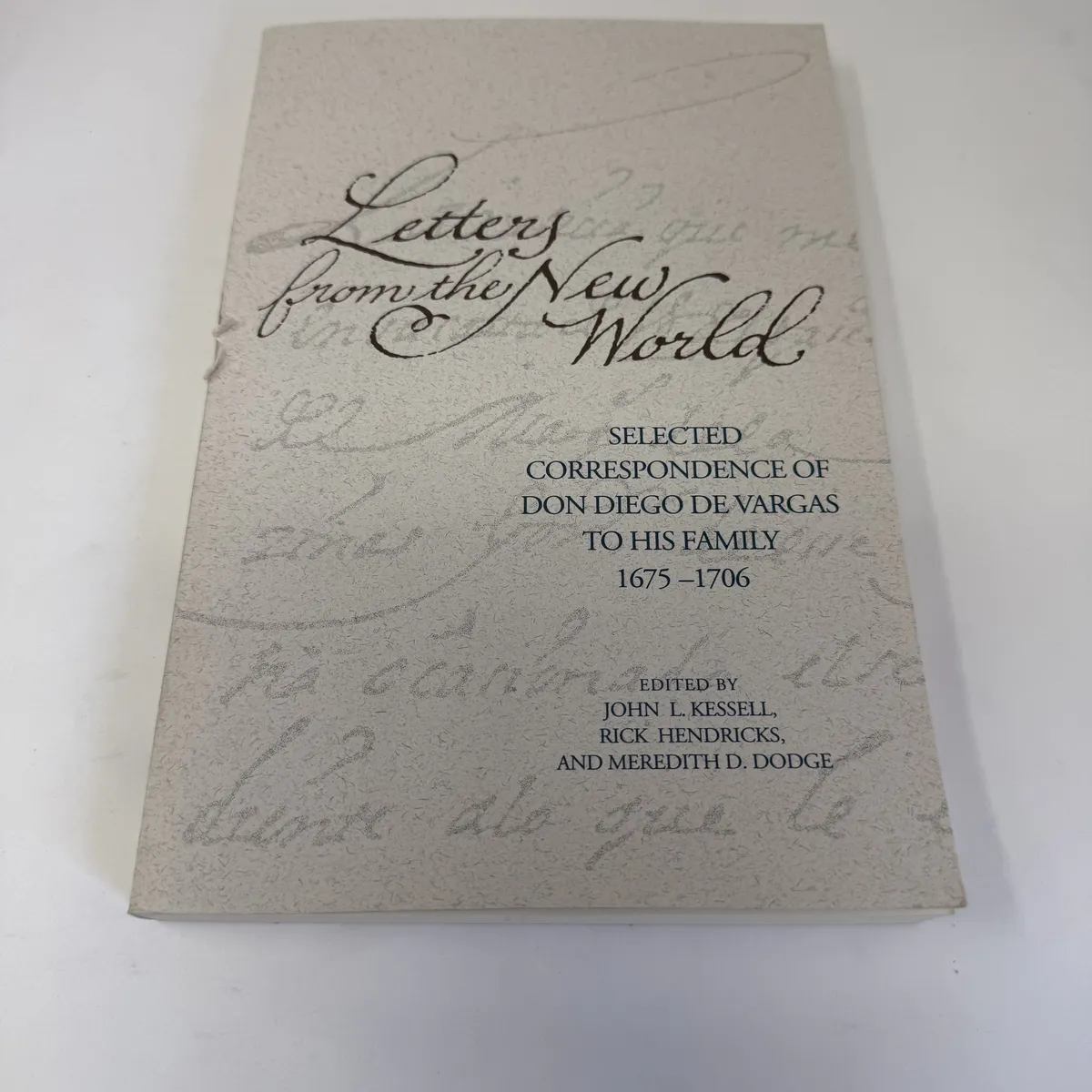
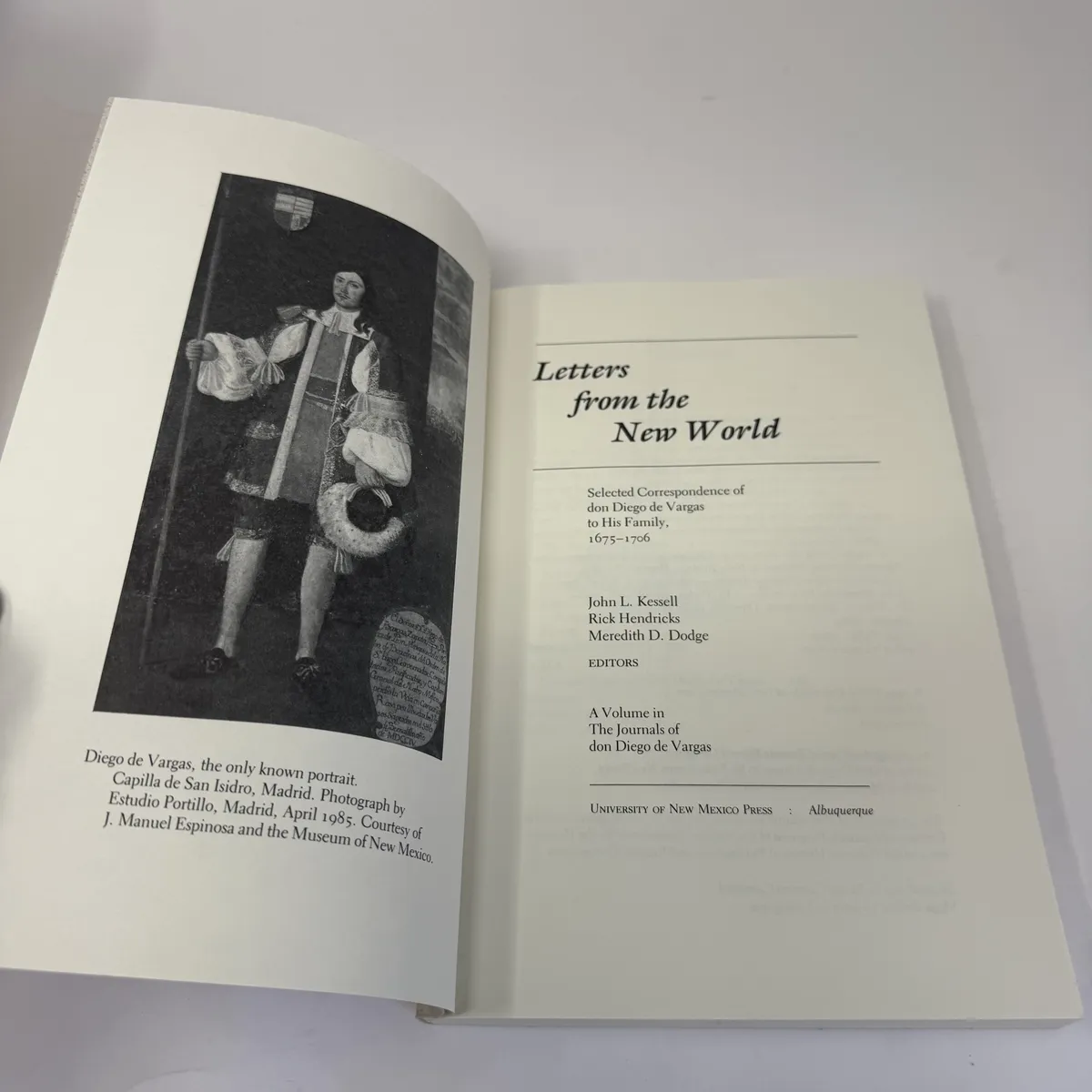
- Diego de Vargas Letters from the New World (UNM Press, 1989) — archive entry on the abridged Vargas family correspondence from the Vargas Project
- Benavides Memorial (1630) — the foundational Franciscan document on the pre-revolt mission program, fifty years before August 10 1680
- Pueblo Sovereignty & Governance Books — the legal and political legacy of the revolt-era accommodation
- New Mexico Archaeology Books — Liebmann and Preucel sit within the broader NM archaeological literature
- New Mexico Spanish Missions & Churches Books — the mission destruction and rebuilding arc of the revolt and reconquest
- Pueblo Pottery Books — Pueblo-voice scholarly tradition, post-revolt ceramic continuity and change
- N. Scott Momaday — House Made of Dawn — Pueblo resistance tradition in fiction, sixty years after the documentary scholarship began
- Coronado Expedition Books — the sixteenth-century documentary foundation that preceded the revolt by 140 years
Cite This Guide
Eldred, J. (May 2026). The Pueblo Revolt of 1680, Spanish Reconquest & Colonial Resistance: A Collector's Authority Guide. New Mexico Literacy Project.
https://newmexicoliteracyproject.org/new-mexico-pueblo-revolt-1680-reconquest-books-collecting
Content is original research by Josh Eldred. Licensed under CC BY 4.0. Cite with attribution.
From the NMLP Archive
Real specimens I’ve handled
Books on this subject that came through my intake and were documented with full photographic provenance — click through for cover, title page, copyright, and condition detail.