Albuquerque Book-Donation Stories
Anonymized case studies of actual estate, downsize, and academic-library pickups. What the first call looked like. Where the books went. What the family said after.
Free · Any condition · No sorting · I do the loading
Last verified May 2026 · Original research by Josh Eldred
Why anonymous
Book donations tend to happen at hard moments — a parent just died, a spouse is moving out of the house they raised kids in, a widow is clearing a study that hasn't been touched in eighteen months. I will never put a family's name on a page like this. Grief is a tender thing and probate has legal sensitivity.
What I can put on a page is the arc — the phone call, the walkthrough, the sort, the placement. The box counts are real. The neighborhoods are real. The partner channels (La Vida Llena, the APS McKinney-Vento van, the Little Free Library at Sunflower Meadow Park) are real. Anything that could identify a specific family has been blurred.
If you're an attorney, realtor, senior-move manager, or family considering a pickup and you want a less-anonymized reference you can speak with directly, email me — several past clients have agreed to take a phone call.
The Attorney's Referral
The call
An Albuquerque probate attorney called on a Tuesday afternoon. Her client — I'll call her the personal representative — was the adult daughter of a man who had recently passed away. He had lived in the same Northeast Heights home for thirty-plus years. The house had to list within three weeks. The realtor had already pre-walked it and flagged the books as the first thing to deal with — every wall of the study, two full bedroom closets, stacks on the dining table, and a garage corner none of them had opened yet.
The attorney's question was direct: "Can you come out this week, is it free, and will the family get any kind of receipt." Yes, yes, and yes — I explained the arrangement (free pickup, not tax-deductible because I'm for-profit, but I can produce a written donation acknowledgement for estate records). The personal representative got on the phone, I walked through a few photos she texted me, and I scheduled the pickup for Thursday morning.
The walkthrough
Thursday at 9:15 I pulled up to a stucco ranch a couple of blocks off Juan Tabo. The personal representative was in the driveway with her younger brother. Neither of them had slept well. They were braced for this to be awful — they had tried a large thrift-chain donation center the week before and been told the place wouldn't take hardcovers, which had sent the daughter into a small spiral about her father's library going into a dumpster.
I walked the study first. The shelves told a life — mid-century paperbacks, a row of Southwest history including several Tony Hillerman first editions, a bookcase of engineering references from his career, spiritual and philosophy titles, a top shelf of cookbooks and gardening. The bedroom closets were mostly fiction and general-interest hardcover. The garage corner was the surprise: three bankers' boxes of children's books, unopened for what looked like twenty-plus years. The daughter said her mother had been a teacher. That explained it.
The sort
I loaded everything into the van in about ninety minutes — three passes, careful stacking, no cramming. The collection came back to the warehouse on Edith Blvd that afternoon. My sort rule is the same every time: every book gets opened, every book gets looked at, no wholesale "this pallet goes here, that pallet goes there."
Here's roughly how the forty-plus boxes broke down after hand-sort:
The Hillerman firsts, better Southwest regional titles, and a handful of signed volumes
Into the eBay shop, where the resale revenue funds the labor that makes every other path on this list possible. I flagged the Hillerman firsts for the Hillerman deep-dive process — points checked, jackets priced not clipped, signatures authenticated.
General-interest hardcover fiction and non-fiction in clean shape
Split between holiday-season boxes for La Vida Llena residents and the rotating stock on the Little Free Library at Sunflower Meadow Park.
The children's boxes from the garage — picture books, early readers, chapter books
Loaded onto the APS Title I / McKinney-Vento van that ships from La Vida Llena every Tuesday. These reached Albuquerque kids living in cars, in motels, and in temporary housing. For several of them, a book from that garage was the first personal book they had ever owned.
The engineering reference books — outdated standards, superseded editions
These have almost no resale or readership value. They went to certified paper recycling — not a landfill. This is where competitors usually throw up their hands and dumpster the whole pallet; I don't.
The small share with water damage from the garage corner
Under a dozen volumes. Disposed via proper waste protocol. I flagged this to the family so they knew a fraction wasn't salvageable — nobody had lied about it being "perfect."
After
I emailed the personal representative a donation-acknowledgement letter for her attorney's file the next morning. About six weeks later I sent her a short follow-up — a photo of a batch of children's books from her mother's old teaching collection loaded onto the McKinney-Vento van, and a note that one of her father's Hillerman firsts had sold to a collector in Santa Fe who had emailed to ask about provenance. I didn't share the price, because that isn't what this was about and she hadn't asked.
The attorney referred me to two more estates inside the next quarter.
What this case shows
- Probate timelines are real. A house listing in three weeks means the books can't wait for "eventually."
- A big-thrift refusal on hardcovers is a common trigger for calling me — it's worth knowing the rules ahead of time.
- Engineering reference books are the classic "nobody wants these but the family doesn't want them dumpstered" category. Paper recycling is the answer.
- The valuable volumes in an estate library are rarely where the family expects. The Hillerman firsts on the middle shelf were more significant than the rare-looking leather-bound set the daughter had flagged.
Moving to La Vida Llena
The call
A retired couple — early seventies, married almost fifty years — called in the spring. They were leaving the three-bedroom house they had lived in for three decades and moving into a two-bedroom unit at La Vida Llena, the northeast-Albuquerque continuing-care community on Wyoming Blvd. They had downsized once already, when the kids moved out, and now they had to cut again. The husband wrote the email; the wife did the follow-up call. She was the book person in the relationship.
Her question wasn't about cost or speed. She had already picked out the books she was keeping — the ones that meant something, the ones she still wanted to re-read. The question was: "What happens to the rest? I don't want them sitting in a thrift store for three weeks and then going into the trash."
The walkthrough
I met her at the house on a Monday morning. She had already boxed everything — labels on every box, sharpied with categories she had organized herself: "Novels (kept favorites out)," "Art Books," "Gardening," "History," "Cookbooks (kept only grandmother's)," "Paperbacks." Twenty-two boxes, tidy, in the dining room. The husband had gone out for coffee; she said he found the whole process upsetting and had given her the job of doing it.
I talked for about forty-five minutes — mostly about where the books would go, which she cared about more than most clients do. I explained the five paths (the same five you'll find on the distribution map). When I mentioned that one of my biggest weekly placement partners is the La Vida Llena holiday-box program — the same community they were moving into — she set her coffee down and said "oh."
That is, in fact, how it works. Every Tuesday I load a La Vida Llena pickup with Glyndon, the volunteer who runs the community's book program — books go in for the holiday boxes (distributed to residents around Thanksgiving and Christmas) and a rotating reading-room shelf. The wife was, six months later, a resident. There is a real chance she will, in fact, pull one of her own donated novels off that shelf.
The sort
The collection was easier than most estate sorts — because she had already done half my job. Her categorization was accurate. The cookbook box was genuinely cookbooks. The art-book box really did have two Santa Fe gallery retrospectives and several New Mexico regional photography titles I knew would move in the eBay shop. The gardening box had a beautiful run of high-desert and xeriscape titles, which are gold-standard Southwest regional interest.
The Santa Fe art retrospectives, the better xeriscape and Southwest photography volumes, and a couple of signed regional history titles
Into the eBay shop. I noted her address and sent her a photo later in the month when the first listings sold, with a short thank-you note. She wrote back to say the husband had started reading the note out loud to her twice.
The bulk of the novels, the kept-cookbooks remainders, and the general-interest hardcover
Into La Vida Llena's next quarterly intake. Glyndon set aside a stack of the better novels specifically for the holiday-box program. I told the wife which titles went into that set when she asked.
Paperbacks — large-print editions, older mysteries, a shelf of historical fiction
Loaded onto the Little Free Library at Sunflower Meadow Park over the following weeks — that LFL rotates stock heavily, and paperback fiction is its best-circulating category.
A small set of brittle-spined paperbacks past the point of rereading
Paper recycling. Under 5% of the total.
After
The couple moved into La Vida Llena about six weeks after the pickup. I saw Glyndon a few Tuesdays later; she had, in fact, put three of the wife's donated novels into the reading-room rotation, and she mentioned that a new resident had pulled one off the shelf and commented that "it looked like a book I used to own." That was the wife. I laughed out loud when Glyndon told me.
The wife has since sent two friends who were also downsizing my way.
What this case shows
- Downsizers care more about placement than cost. They are usually paying money somewhere else (mover, senior-move manager, cleaning). The donation isn't about price — it's about peace of mind.
- The La Vida Llena partnership closes an actual loop: donors frequently become recipients inside the same community.
- Having the owner also be the sorter matters. A client who asks "what will happen to my Santa Fe art books specifically" deserves a specific answer, not a shrug.
- Referrals from downsizers are high-quality — they tend to send other downsizers whose situation is identical.
The Professor's Library
The call
The widow of a retired UNM humanities professor called about a year and a half after his death. She had been sleeping around the books — literally, in a bed wedged between the wall and a double-stacked academic shelving unit in what had been his study — and had finally decided it was time. She had tried donating to UNM's library system first and been told they were no longer accepting outside gifts of this scale. A friend had given her my number.
The collection was somewhere north of two thousand titles. She couldn't give an exact count because she had never tried to count. The study had wall-to-ceiling shelves. The garage had six filing-cabinet-height stacks of overflow. There was a floor-to-ceiling built-in in the guest room. She was apologetic about the size. I told her I had seen larger and she laughed in a way that suggested nobody had said that to her recently.
The walkthrough
A university-professor library is a very specific genre of collection. Hers had three core zones: his academic field (Southwest history, with an emphasis on nineteenth-century New Mexico), an adjacent teaching collection (American literature, political philosophy, ethnohistory), and a personal reading shelf that included a beautiful run of New Mexico regional fiction — Rudolfo Anaya, Leslie Marmon Silko, Simon Ortiz, Denise Chávez, and Tony Hillerman, most of it in hardcover, some of it signed.
Because of the volume, I scheduled three visits a week apart. Half-day each. Load carefully, no stacking, protect the signed titles, keep his handwritten marginalia legible (she had asked me to preserve a few specific volumes with his notes — those went to her new smaller shelf, not the donation pool).
The sort
Academic-library sorts are where the hand-sort economics really matter. About fifteen percent of a professor's library is saleable in the online market — scholarly monographs with small but real academic demand, signed regional fiction, first editions of anything canonical, and niche reference. The other eighty-five percent is "read-me" volumes: solid teaching texts, surveys, paperbacks, anthologies — not valuable as objects but entirely readable.
The split came out roughly like this:
The signed regional fiction — Anaya firsts, a signed Silko, two Hillermans, several Denise Chávez
Into the eBay shop over the following months. Several moved to out-of-state collectors; one Anaya went to a UNM-affiliated buyer who had seen the listing and wanted the provenance. I pointed them toward the Southwest-author deep-dive for context.
The academic monographs with ongoing scholarly demand — narrow but real
Also listed through the eBay shop, a slower-moving category that takes patience but has the best match between "cared-for book" and "reader who will actually use it." Revenue from this category subsidized the pickup and sort labor across the whole job.
The teaching-collection American literature, political philosophy, and general history
The bulk. These went to La Vida Llena's reading-room stock and to the Little Free Library at Sunflower Meadow Park, where adult-readership history and fiction circulate well.
Superseded edition academic texts — old methodology, outdated statistics
A meaningful share of a thirty-year academic career is editions that have been replaced. Paper recycling. No landfill.
A small pile of volumes damaged by the garage humidity
Under 3% of the total. The widow was relieved I flagged these individually rather than pretending everything was perfect.
After
I sent her a written summary by neighborhood and partner a month later — her husband's signed Anaya had gone to an out-of-state collector, the American-lit teaching texts were now rotating through the La Vida Llena reading room, and one of his marginalia-heavy Silko paperbacks (which she had thought was too marked-up to be useful) had gone to a La Vida Llena resident who had written a note to the community librarian saying she had enjoyed reading another reader's thoughts in the margins. The widow saved that letter.
Six months later she hosted a downsizing workshop for UNM emeriti faculty and told them about the pickup. Three of them have since called.
What this case shows
- Academic libraries are not "unsortable." They are only unsortable if you don't know what you're looking at.
- The UNM library system not accepting gifts is a common trigger — it sends a lot of academic collections my way.
- Niche-demand academic monographs belong in the online channel, not the community channel. Matching book to reader matters.
- Marginalia is not always a defect. Some readers love it.
- One-visit pickups work for most families. Two- or three-visit schedules are the right answer for large collections — loading carefully is more important than loading fast.
A Sunday afternoon on the Little Free Library loop
April 19, 2026 — North Valley and Northeast Heights
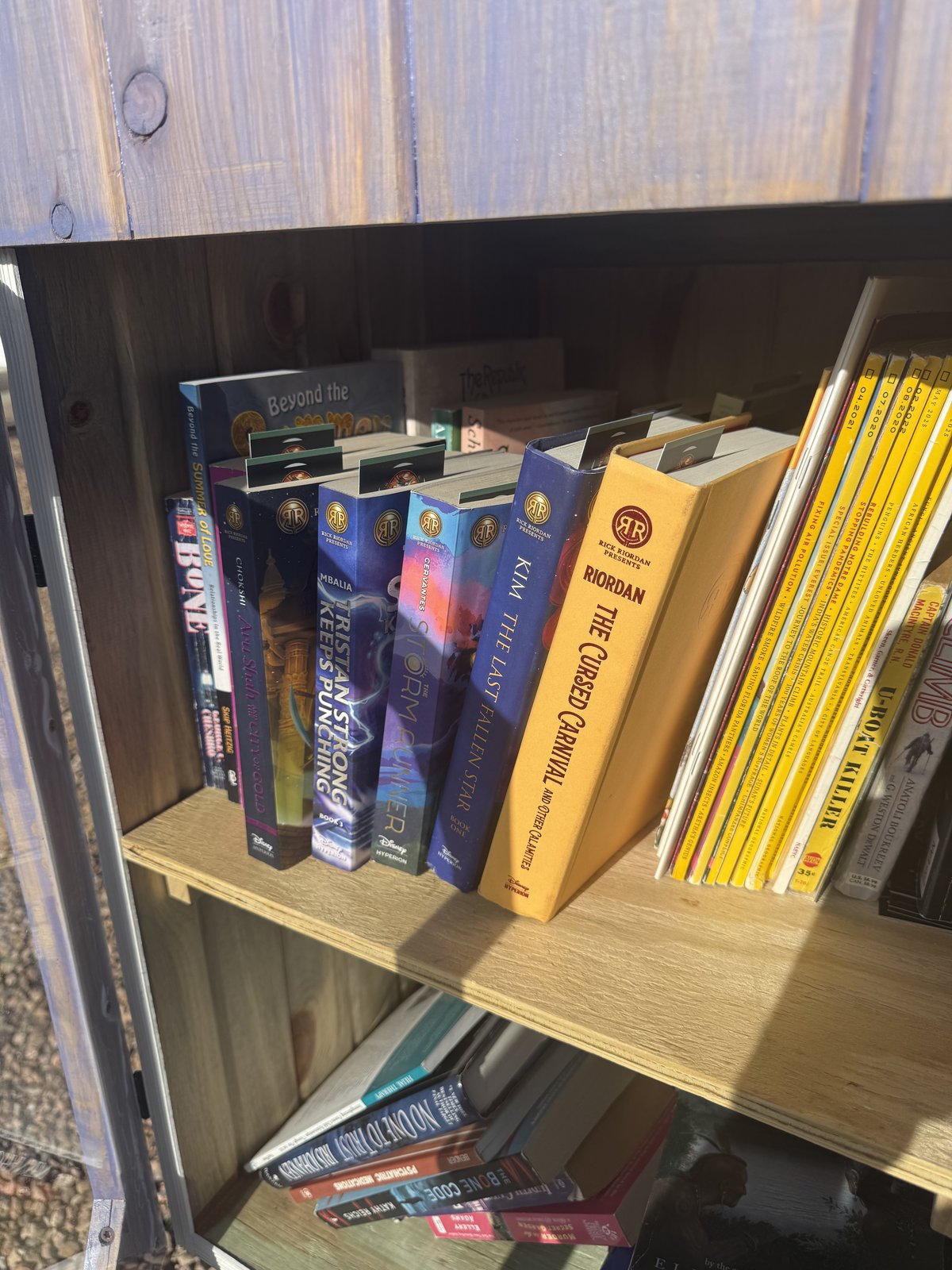
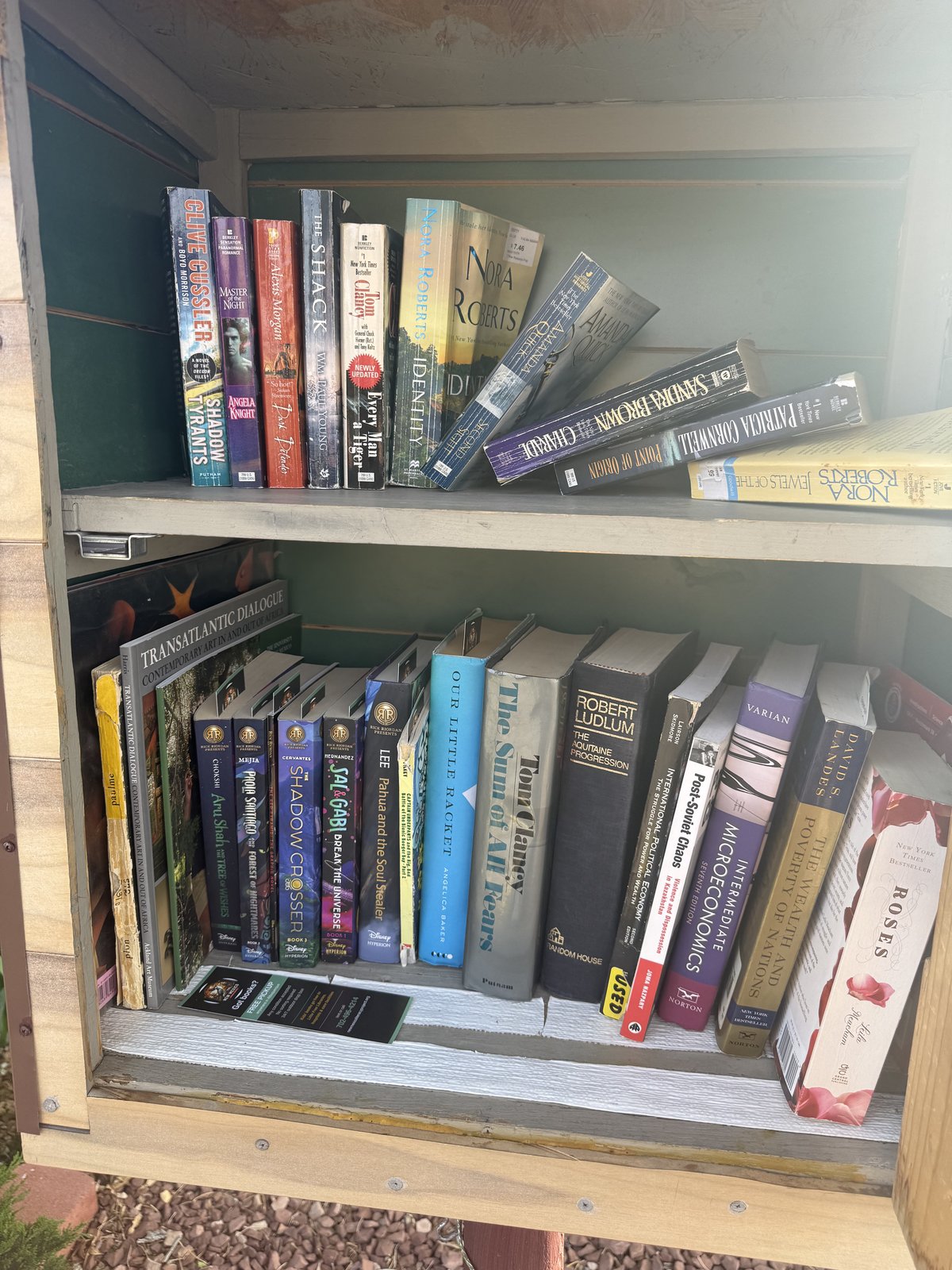
The first three stories on this page are edited down from weeks of work across big estate clear-outs. This one is the opposite — a single afternoon, two boxes, thirty minutes. It's what the named-partner phrase "Little Free Library at Sunflower Meadow Park" actually looks like on the ground. Two boxes on the loop today, both stocked with books that had come through the warehouse in the last two weeks.
Where each book in those boxes actually came from
- The Rick Riordan run — donated two weeks ago by a North Valley family whose kid had just started middle school and was "done with the Percy Jackson crowd." Hardcovers in clean shape, held together as a set on the shelf.
- The National Geographic set — a multi-year subscription pulled from an estate clear-out in Placitas. Not eBay-valuable by the issue, but perfect for an LFL where neighborhood kids and hobbyists flip through them.
- The adult commercial fiction — the kind of reading-copy paperbacks and hardcovers that don't clear eBay's listing-fee threshold but absolutely move on a neighborhood shelf. Three Nora Roberts in a month is not a coincidence; she's the single most-donated author in the warehouse.
- The academic titles on the bottom shelf — from a retired professor's library I picked up in the Northeast Heights. A handful of the more valuable economics and political-science titles are listed on the NMLP eBay shop. The ones that didn't meet the resale threshold — but are still perfectly readable — went out to the community boxes.
Why I'm bothering to photograph this: most "I give to the community" claims on donation sites are unverifiable. A named partner at a named park with visible bookmarks is verifiable. If you donated to me in the last month and you walk past a neighborhood LFL in the North Valley with my bookmark inside, that's the loop closing. No pallets, no landfill, no middleman — just a book moving from one neighbor's shelf to another.
The Bedside Bookshelf
A note on this one: hospice families ask for stories like theirs to be told carefully. So this case study is anonymized harder than the others — generic location, generic family structure, no specific timing. The pattern is what matters, not any one household.
The first call
A hospice social worker called late on a Friday. Her patient — an elderly Albuquerque resident living at home with family, books on every wall, declining quickly — had said something that morning that the family wanted help with. The patient had asked, while looking at the bedroom shelves, "I don't want anyone to fight over the books. Can you find someone who knows what to do with them?" The social worker had heard a version of that question before. She had a list of three local cleanout operations she trusted. I was on it because of past hospice work.
I asked what the family needed. Not the cleanout — the cleanout would happen when it happened. What the patient needed was the answer: yes, somebody would handle this carefully, and the patient could relax about it. The social worker said that's exactly what she'd hoped I would say. I agreed I'd come over the next week, do a walkthrough while the patient was awake if possible, and just establish the relationship. No timeline pressure. No paperwork.
The bedside walkthrough
The bedroom was a working bedroom — hospital bed, oxygen concentrator, a folding chair pulled up where adult children sat in shifts. Books on three walls. The patient was lucid and alert, propped up enough to talk. I did the walkthrough together — me describing each shelf, the patient confirming or correcting. Yes those are the cookbooks I never used. The Hillerman set was my husband's. The blue spines on the top shelf are my mother's. Don't lose those, please. The rest can go.
I took notes on the phone, which the patient asked to see. I read them back. The patient corrected one detail — a particular gardening book was a gift from a neighbor and should go back to that neighbor, not into the donation pile. I wrote that down and showed the page again. The patient nodded and closed their eyes.
That walkthrough took twenty-five minutes. It was probably the most important twenty-five minutes of the entire job. Everything that happened over the next two months was either honoring what was decided in that conversation or filling in gaps the patient hadn't gotten to. The family told me later that the patient slept better that night than in the previous week. They had stopped looping on the books.
The waiting weeks
For the next several weeks, nothing happened on my end. That's the point — nothing was supposed to. The family asked me twice during that period to come pick up specific bedroom shelves they wanted out of the room (one that was loud-colored and visually busy, one that the patient had said felt cluttered). Both times I came over with banker boxes, packed quietly while the patient slept in the next room, and was gone in under an hour. Each time I left a sticky note on the kitchen counter listing what I'd taken so the family had a record.
I also pulled the gardening book the patient had asked to return to the neighbor and walked it two doors down myself. The neighbor cried at the door. I left and didn't say much. That's not my role.
The day after
The patient passed in early morning. The family let me know the next afternoon, by text, no preamble: "It happened. Take your time on the rest of the books — there's no hurry." I texted back to say I was sorry, that I was thinking of them, and that I'd plan to come the following week or whenever they wanted, not before. They sent back a thumbs-up.
When I came back six days later, the family had already pulled the books they wanted personally — the blue spines on the top shelf (the mother's), the Hillerman set (the husband's), and a small stack of titles each adult child had quietly identified in the days before. Everything else was as the patient had said: the rest can go. I packed thirty-something boxes over a long Saturday with one helper. The family stayed in the kitchen drinking coffee, popping in occasionally to confirm a question or look at something we'd flagged.
What it cost the family
Nothing. The cleanout side of the work — the labor, the boxes, the truck, the disposal of what couldn't be sold or donated — was covered by the resale and Heirloom Rescue side of the business. The family received a written acknowledgment of the donation for estate records (not a tax receipt — I'm a for-profit business, donations to me aren't tax-deductible — but a record they could file with the rest of the estate paperwork). The bedroom was empty by Saturday night. The hospital bed left on Sunday with the medical company. The room was a normal bedroom again by Monday.
Where the books went
The cookbook collection was sorted: a dozen with margin notes were set aside (Heirloom Rescue, returned to the family in a single labeled box), the rest split between Albuquerque little libraries and online resale. The mid-century paperbacks went to a partner store that handles vintage. The general fiction went to free Little Free Libraries on the North Valley loop and another in Northeast Heights. The reference books that were too out-of-date went to certified paper recycle. The Hillerman set was already with the family. The mother's blue spines were in a memorial bookcase the family was assembling in their own home.
Total flow from this single household, conservatively: 35 boxes in, several hundred individual books reaching new readers across the metro within sixty days, zero books in landfill. The family's primary feeling, expressed weeks later in a follow-up text, was relief. Not relief that the books were gone — relief that the books had gone somewhere, and that they'd been part of choosing where.
The pattern this case shows
- Hospice work is conducted at the patient's pace. The most valuable single conversation in this entire case was twenty-five minutes at a bedside before any work happened. That conversation set the rules for everything that followed.
- Pre-death prep is real and quiet. Two interim pickups happened during active hospice care. Both were under an hour, packed during sleep, with sticky-note records left for the family. No emotional load placed on anyone.
- The cleanout itself is the smallest part. One Saturday with a helper, after the family had pulled what they wanted. The volume of work was not the difficulty. The difficulty was timing and tone.
- Specific items can be honored. The gardening book that returned to the neighbor was a thirty-second errand for me and a meaningful moment for two households. Those small honorings are why this work doesn't feel like hauling.
- "There's no hurry" is permission to do the work right. Most cleanout regret comes from rushing. A family that says "take your time" is giving you the conditions to do good work. I always honor that.
If you're a hospice social worker, a chaplain, or a family member sitting at a bedside reading this — call or text 702-496-4214 when it's the right time. There's no wrong moment to make the call. The first call doesn't commit you to anything. I can just talk through what's there.
Related on this site: After a Death · Downsizing Help · For Hospice Staff & Other Pros · Donating Books After a Loved One Passes
Schedule your own pickup
Free, inside the Albuquerque metro. Estate, downsize, academic, or a single car-load of novels you just don't have room for anymore. Text photos to 702-496-4214 or email [email protected] with rough box count and neighborhood. I'll tell you what I can do this week.
Go deeper
Where Your Books Actually Go
The named-partner map — La Vida Llena, Sunflower Meadow LFL, APS McKinney-Vento, and more.
Should I Sell or Donate?
The cross-domain decision framework. Estate, downsize, academic — which books go which way.
Selling Southwest Authors
Hillerman, Anaya, Silko, Momaday, and the regional collection most estates contain.
About these case studies
Are these real pickups?
Yes. Every case here is drawn from an actual Albuquerque pickup. Names, exact addresses, and dates are anonymized to protect the families — grief is tender and probate has legal sensitivity. Box counts, neighborhoods, collection character, and where books went are accurate. If you want a non-anonymized reference to speak with, email [email protected] and I'll ask a past client.
How much does a full-house pickup cost?
Nothing, inside Albuquerque. Free pickup, free sort, free placement. If the estate or family wants proceeds from the volumes that resell, I can run that through SellBooksABQ (the for-profit buy-back side of the operation). You never pay for the donation pickup itself.
Can you handle probate timelines?
Yes — probate estates are a meaningful share of my volume. Most can be scheduled. I can produce a written donation-acknowledgement letter for the attorney's file. Email with the timeline and I'll tell you honestly what I can do.
What happens to books you can't sell or place?
Damaged-beyond-community-use volumes (heavy water, mold, pest) go to certified paper recycling, not the landfill. The full distribution map has the complete breakdown.
Can I read more case studies?
Yes — new anonymized cases get added roughly once a month as pickups close out. Bookmark this page or send a note and I'll share the next one when it's ready.