Where Your Donated Books Actually Go in Albuquerque
Named partners. Real destinations. A line-by-line map of what happens after a book leaves your hands. No dumpster. No landfill. No fog.
Free · Any condition · No sorting · I do the loading
Last verified May 2026 · Original research by Josh Eldred
Why I built this page
I'm Josh Eldred. I run the New Mexico Literacy Project — Albuquerque's free in-home book-donation pickup — and I also run a for-profit buy-back arm called SellBooksABQ. One operation, one warehouse on Edith Blvd, one truck, one owner.
The single most common question I get from donors, from estate attorneys, and from people trying to decide between us and Goodwill is some version of: "where does my stuff actually end up?" It's a fair question. The honest answer at most big-thrift operations is "I don't know" or "some of it gets pulped." I can't do anything about their opacity — but I can be the opposite.
So this is the map. Named partners. Real locations. Falsifiable claims. If something on this page turns out to be wrong, email me and I'll correct it the.
Every donated book takes one of five paths
Every box that comes through the warehouse gets hand-sorted, one book at a time. That sort is the whole game — it's the reason I can promise community placement and resale on the same donation. Here's how the five paths break down, in rough order of volume.
Readable Trade → eBay Shop
Fiction, non-fiction, and trade paperbacks in clean shape that have demand online — a sizable share of every donation — get listed on the New Mexico Literacy Project eBay shop. The resale proceeds are what fund the free pickup truck, the insurance, the labor to sort every other book by hand. Without this channel, none of the others work.
Readable Community → Named ABQ Partners
Books that are readable and locally relevant (Southwest interest, children's, cookbooks, young-adult, educational) go straight to named community channels — the La Vida Llena holiday-box program, the Little Free Library at Sunflower Meadow Park, and the APS Title I / McKinney-Vento Homeless Project. These are real handoffs to real partners — not a warehouse purgatory.
Children's & Educational → APS McKinney-Vento
Children's picture books, chapter books, YA, and school-age educational titles get prioritized for the APS Title I / McKinney-Vento van I load every Tuesday. These books reach Albuquerque students experiencing homelessness or housing instability. For many kids, a book from this channel is the first personal book they've ever owned.
Damaged → Certified Paper Recycling
Books with torn covers, heavy underlining, or spine damage that still read fine stay on the community path — a softcover with a cracked spine makes a kid happy. But water-damaged, pest-contaminated, or unreadable volumes go to a proper paper recycler. Bound paper is recyclable when the covers and spine are removed, and that's the path I take. Not a landfill. Not a dumpster behind the warehouse.
Contaminated → Waste (as small a share as I can keep it)
The only honest caveat on this page: heavy mold or pest infestation that makes a volume non-recyclable does end up as waste. I won't tell you this share is zero — that would be false. But I track it separately, keep it minimal by sorting at intake (contaminated boxes don't contaminate clean boxes), and refuse shipments that look like they'd require landfill disposal. If your donation includes anything that might be mold-affected, tell me before pickup and I'll decide together.
La Vida Llena Retirement Community
La Vida Llena is a senior retirement community in northeast Albuquerque that has become the most consistent partner in the whole operation. Every Tuesday, I meet Glyndon — a longtime volunteer there — and I cycle through two loops:
- Book & paper pickup. Residents and the community cycle out reading material regularly. I collect it, sort it at the warehouse, and send the best titles back into circulation through the other channels on this page.
- Holiday-box loading. The La Vida Llena community prepares holiday gift boxes for local families. I contribute books — curated by age and subject — to fill those boxes. This is one of the clearest, most checkable destinations for a donated book in Albuquerque.
The partnership also extends to non-book items: on the same Tuesday run, I load the APS Title I / McKinney-Vento van with furniture, household goods, and clothing that the community is cycling out. Electronics go to a recycler located next door to the warehouse. The operation rhymes.
Little Free Library at Sunflower Meadow Park
Sunflower Meadow Park sits in the North Valley, not far from the warehouse on Edith Blvd. The neighborhood-run Little Free Library in the park receives a steady flow of donated books from me — especially children's titles, contemporary fiction, and Southwest regional books that resonate with the neighborhood.
The way it works: when the box starts to empty, neighbors leave a short note inside — "more kids books" or "any Spanish-language?" — and I fill the request on the following week's loop. It's the closest thing to a real-time feedback channel between donors and readers that this whole operation has.
If you want to see a donated book being picked up and read by a kid, Sunflower Meadow on a Saturday morning is the photograph. It's also the reason every children's-book donor asks me "where did the kid books go?" and then lights up when I mention that particular box.
What a drop actually looks like
These are from today's loop. Both boxes are neighborhood-run Little Free Libraries on my regular rotation. If you look closely at the top of the hardcovers and on the bottom shelf of the second box, you can see my cream-colored bookmarks sticking out — that's how neighbors know where the books came from and how to reach me if they want a specific title.
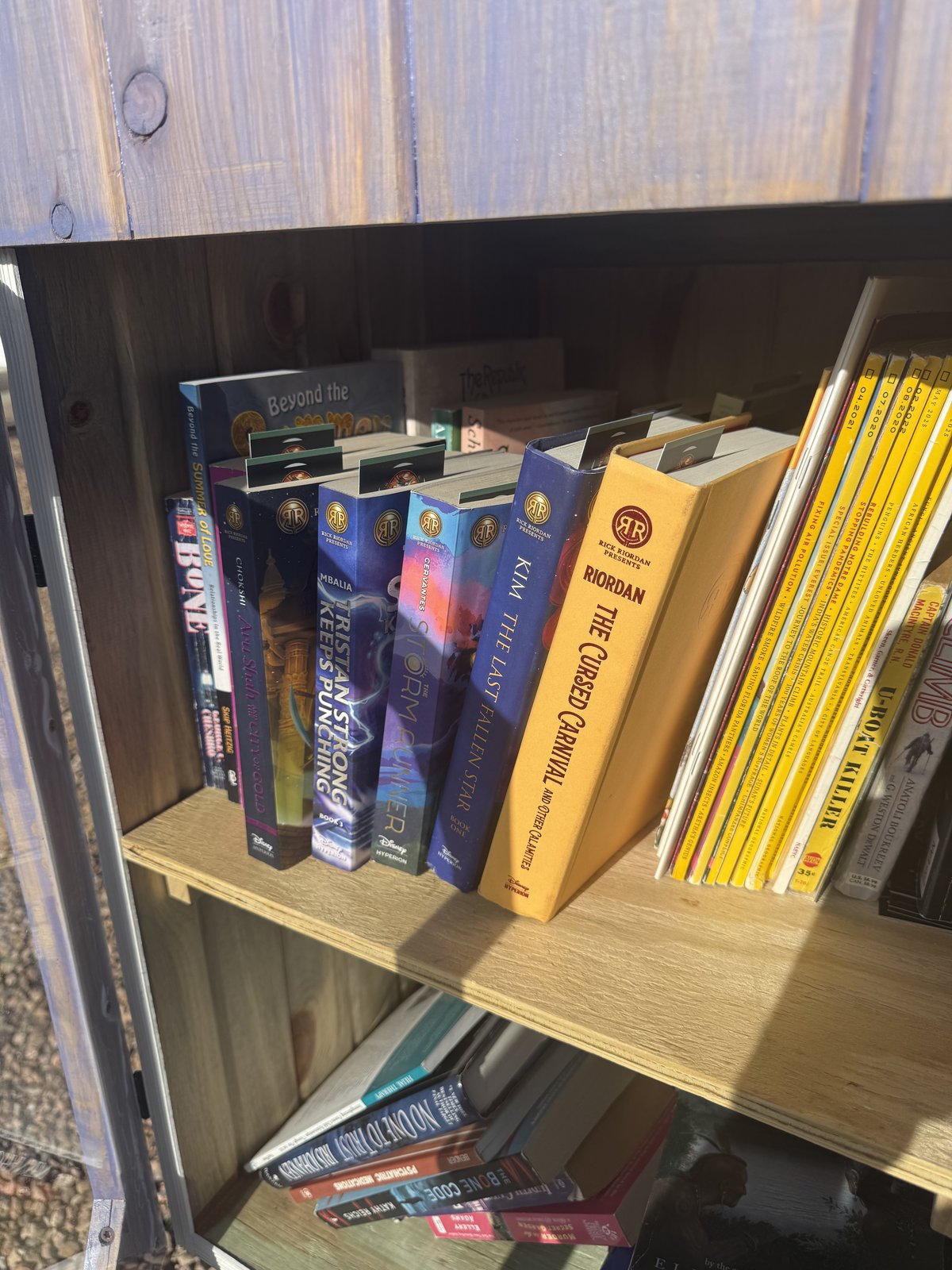
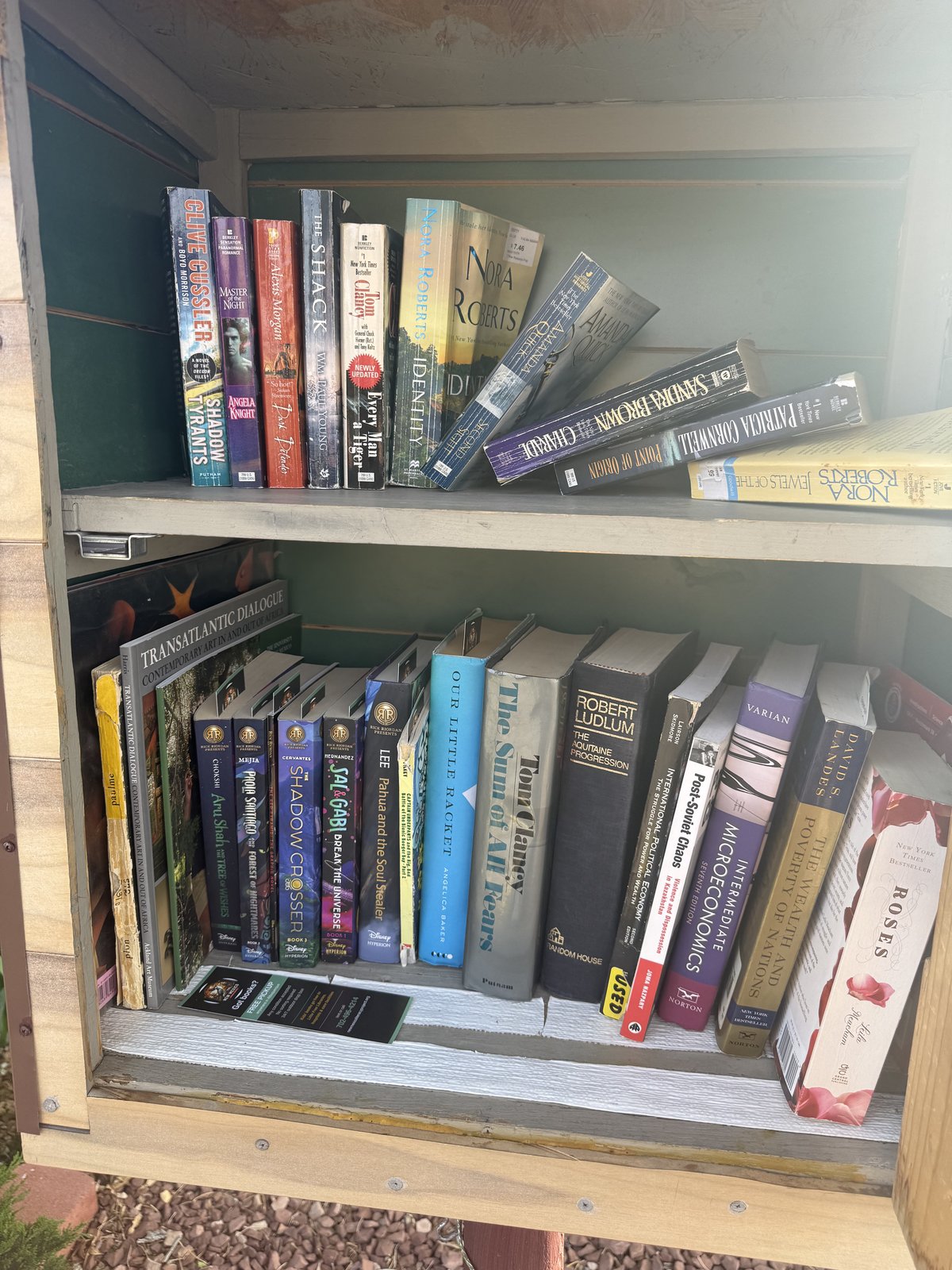
Why I'm showing you this: the "community channels" line on most donation sites is abstract. This is what it looks like on a Sunday afternoon in the North Valley — specific titles, specific boxes, with a traceable path back to the warehouse on Edith. If you donated a Rick Riordan series or a run of National Geographic in the last two weeks, there's a real chance one of these books came from your house.
APS Title I / McKinney-Vento (Homeless Project)
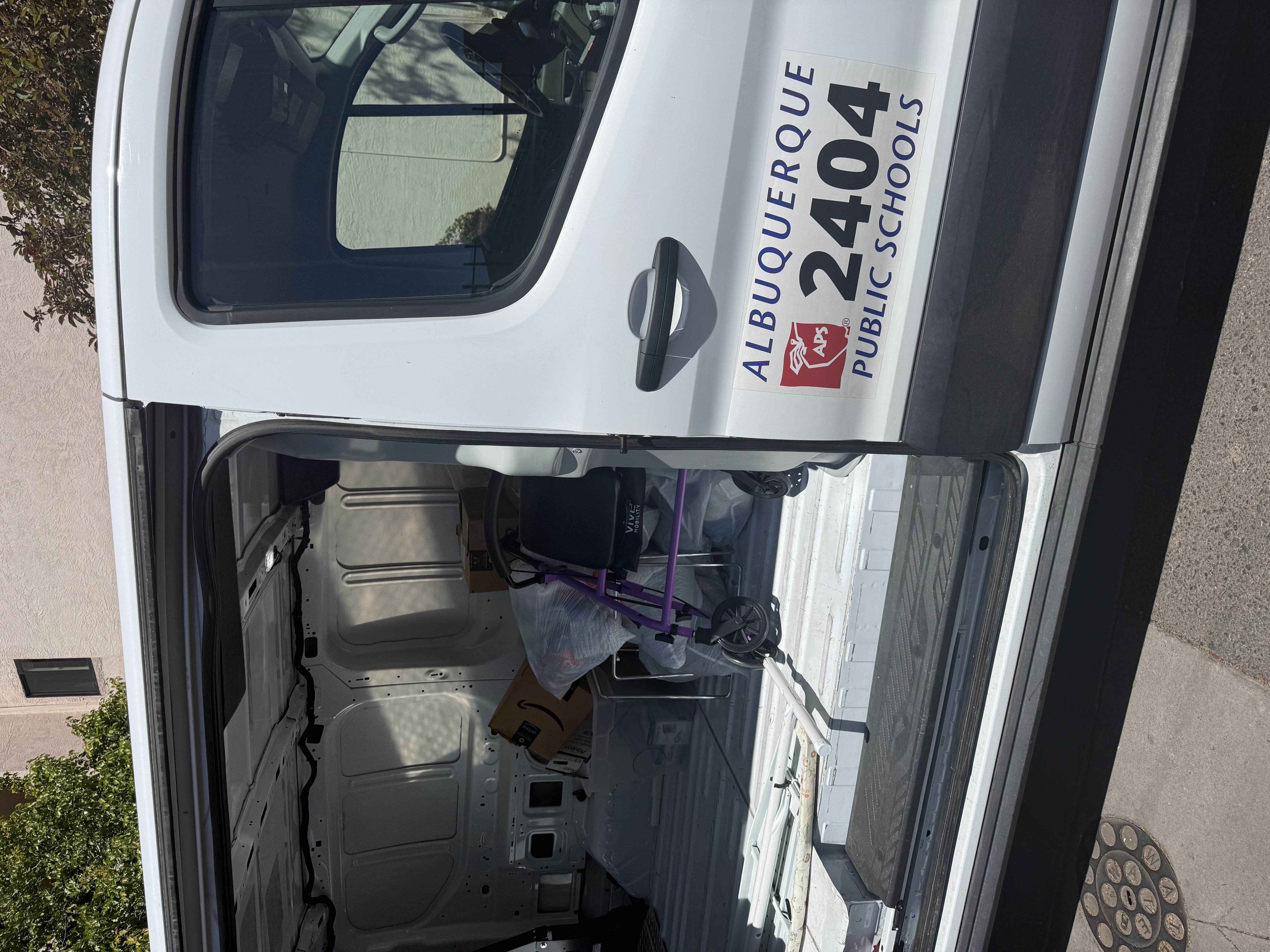
McKinney-Vento is the federal law that guarantees educational access to students experiencing homelessness or housing instability. Albuquerque Public Schools runs the program through Title we, and it's known locally as the "Homeless Project." Every Tuesday on the La Vida Llena run, I help load their van with books, furniture, household goods, and clothing.
Children's and young-adult books get prioritized for this channel. A book that reaches a child through McKinney-Vento is often the first personal book that child has ever owned — which is not a small thing. It's why, when a donor asks me "will these Dr. Seuss books actually get to a kid?" I can say yes, and point at a real program with a real delivery van.
This is not a branded feel-good story — it's a federal program running in a real school district, serving real local families. That's the whole point of naming specific partners.
The New Mexico Literacy Project eBay Shop
A portion of every donation that turns out to be genuinely collectible — Southwest first editions, signed copies, scarce non-fiction, rare art books — gets listed on the NMLP eBay shop. This is the engine that funds everything else. The free pickup, the truck fuel, the insurance, the hours of sorting that make the community channels possible — all of it is paid for by that resale channel.
I mention this specifically because some donors ask: "are you just reselling everything for profit?" The honest answer is: a portion of the best titles, yes — and it's the reason the other 80%+ can go to La Vida Llena, Sunflower Meadow, and APS McKinney-Vento instead of rotting in a warehouse. A thrift store that only donates can't afford to do the line-by-line sort; a buyer that only resells doesn't serve the community. Running both is what makes the math work.
Browse the eBay shop → — if you've donated to me, there's a non-zero chance at least one of your books is in there. And if you ever want to check, email me the donation date and I'll tell you what sold to whom. I track it.
Proper paper recycling — not a landfill
Not every book is readable. Water-damage, heavy highlighting, loose pages, mildewed covers — when a book genuinely can't go to a reader, the correct path is paper recycling, not the trash. I don't stuff unreadable books into a donation van to make them someone else's problem, and I don't toss them in a dumpster to save on sort labor.
Books go to a certified paper recycler — bound-paper recycling in New Mexico requires removing the covers and spines first, which I do at the warehouse. The separated paper stream goes into standard mixed-paper recycling; the covers and rigid spines are handled separately. It's not glamorous, and it takes labor, but it's the only disposition I can defend when I tell donors "nothing goes to the landfill."
The one caveat I mentioned earlier — heavy mold contamination — is the only case where a volume legitimately can't go into the recycling stream. I keep that share as low as I can through intake sorting.
A typical month in real proportions
This is approximate — the mix varies month to month based on what donations come in — but it's a realistic picture of a typical Albuquerque spring or fall month at the warehouse. We'm using rough proportions instead of hard counts because volume swings with estate-sale season, move-out season, and school calendars.
- ~35–45%eBay shop & buy-back resale (Southwest firsts, signed copies, scarce non-fiction, collectible art books — the titles that fund the operation)
- ~25–35%Community channels (La Vida Llena holiday boxes, Sunflower Meadow Little Free Library, APS Title I / McKinney-Vento van, classroom requests)
- ~15–20%Children's, young-adult, and educational prioritized for McKinney-Vento families and classroom use
- ~5–10%Paper recycling — damaged, water-affected, or non-readable volumes processed properly
- < 2%Unavoidable waste (heavy mold/pest contamination that paper recycling can't accept)
Proportions are operational estimates, not audited statistics. We'd rather publish honest ranges than invent exact percentages. If you want to spot-check a specific donation, I keep sort logs — email me and I'll walk you through yours.
What explicitly doesn't happen to your donations
Not dumpstered
Every box gets opened and sorted. Nothing goes from your hand into a dumpster without being evaluated first. Damaged books go to recycling, not waste.
Not passed to Goodwill
I don't dump the "hard" books on another thrift to deal with. I do the sort in-house because I charge my own buy-back operation to make it economically viable.
Not sent overseas
Some donation operations ship books to developing countries in ways that undermine local publishing. I don't do that. Your books stay in Albuquerque or move within the regional resale market.
Not stored indefinitely
No warehouse purgatory. Books move through sort within days of intake. Anything sitting in the warehouse more than a month is either actively being listed or is a confirmed community-channel reserve stack.
How to verify any of this
If this page sounds too good to be true, here's how to check us:
- Call La Vida Llena. They're a real retirement community with a real front desk. Ask if Glyndon coordinates a Tuesday book run with a local donation service. The answer is yes.
- Walk past Sunflower Meadow Park. The Little Free Library box is at a real address in the North Valley, next to a real playground. The books in it come from me.
- Look up APS Title I / McKinney-Vento. It's a federal program administered by Albuquerque Public Schools. The Homeless Project has a van and a phone number. Ask them if they receive regular book deliveries from a local donation service. They do.
- Browse the eBay shop. Search for "New Mexico Literacy Project" on eBay. Look at sold listings. That's where the Southwest firsts and signed copies actually land.
- email me about your own donation. If you donated within the last 90 days, I can tell you which boxes went where. The sort logs are simple — they exist because this is how I want the business run, not because any regulator requires it.
- Read the comparative analysis. For the broader picture of what statistically happens to donated books at each major Albuquerque option — Goodwill, Savers, Better World Books, Friends of the Albuquerque Public Library, the recycler, and NMLP, with citations to publicly available sources (Goodwill IRS Form 990s on ProPublica, Better World Books impact reports, academic research on the secondhand-goods reverse-aid pipeline), see the full lifecycle investigation.
- Visit the partner profile pages. Each named partner now has a public profile page documenting the routing relationship — APS Title I + McKinney-Vento, UNM Children's Hospital reading program, Sunflower Meadow Park Little Free Library, La Vida Llena Retirement Community. Each page documents what NMLP donates, how often, and includes contact info for the partner.
Transparency only works if it's checkable. That's the point.
Now you know where they go. Schedule the pickup.
Free in-home pickup across the Albuquerque metro. Any quantity, any condition. One phone call, one Saturday. Your books will be on their way to La Vida Llena, Sunflower Meadow, APS McKinney-Vento families, or the eBay shop by next week.
Related Pillar Guides
This page shows the named partners — the qualitative map of where donated books go. The 2026 Albuquerque Book Donation Report is the quantitative companion: actual proportions across exit channels, donor types, subject categories, and named partners for the past year, refreshed every January.
2026 Donation Report
The numbers behind the map: ≈45% resale, 28% community partners, 12% certified paper recycling, 10% LFL, 5% SBA buy-back. Refreshed every January.
Three Albuquerque Donation Stories
Anonymized: the attorney's Northeast Heights probate referral, the La Vida Llena downsizer, and the widowed UNM professor's 2,000-volume library. The map becomes real.
Should I Sell or Donate?
The honest breakdown on when to sell vs. donate, from the only person in ABQ who runs both sides.
What's My Library Worth?
Six questions, one straight recommendation — sell, donate, drop-box, or recycle. No dollar promises.
Questions people ask about where donations go
Don't most donated books end up in a dumpster?
That happens at many big-thrift operations because sorting hardcover non-fiction takes labor they can't fund. It does not happen here. Every box gets opened and sorted book-by-book — which is economically possible because a portion of the best titles gets resold through my eBay shop, and that revenue funds the sort labor for the rest.
What if my books are in rough condition — are they even worth donating?
Readable-but-rough still counts. A softcover with a cracked spine makes a kid happy. Heavy water damage, mold, or pest contamination is the exception — and in those cases, the books go to certified paper recycling, not the landfill. Tell me when you schedule the pickup if there's any mold concern, and I'll handle it correctly.
Why do you also sell some of the books? Isn't a donation supposed to be charity?
I'm a for-profit operation — no grants, no tax dollars, no 501(c)(3) status. The reason I can afford free pickups, line-by-line sorting, and hand-placement into community channels is because a portion of the best titles fund the rest. A thrift that only donates can't sort at book-by-book granularity. A buyer that only resells doesn't reach community readers. Doing both is what makes the model work. Your donation to me is not tax-deductible — and in return, you get actual accountability for where the books go.
Can I request that my books go to a specific channel?
Within reason, yes. If you want your children's books to go specifically to APS McKinney-Vento families, or your Southwest regional books to the Sunflower Meadow Library, say so at pickup and I'll honor it. The only request I can't always honor is "please sell all of it and donate the cash" — because not every book has resale demand, and unsold volumes still need a community path.
Who do I contact if I think something on this page is wrong?
email me directly: [email protected]. Or call 702-496-4214. If a named partner changes, moves, or decides they no longer want donations from me, I'll update this page the day I hear. Transparency is only useful if it stays accurate.