A real NMLP pickup · Saturday, May 9, 2026
Saturday in Socorro: 5,000 pounds in three hours
A 75-mile southbound run on I-25. A house with a dirt yard and broken sidewalks. Five thousand pounds of books, magazines, and reference material moved out by hand truck in roughly three hours. This is what statewide free pickup actually looks like when the donor is in Socorro and the chain thrifts won't drive. I show up.
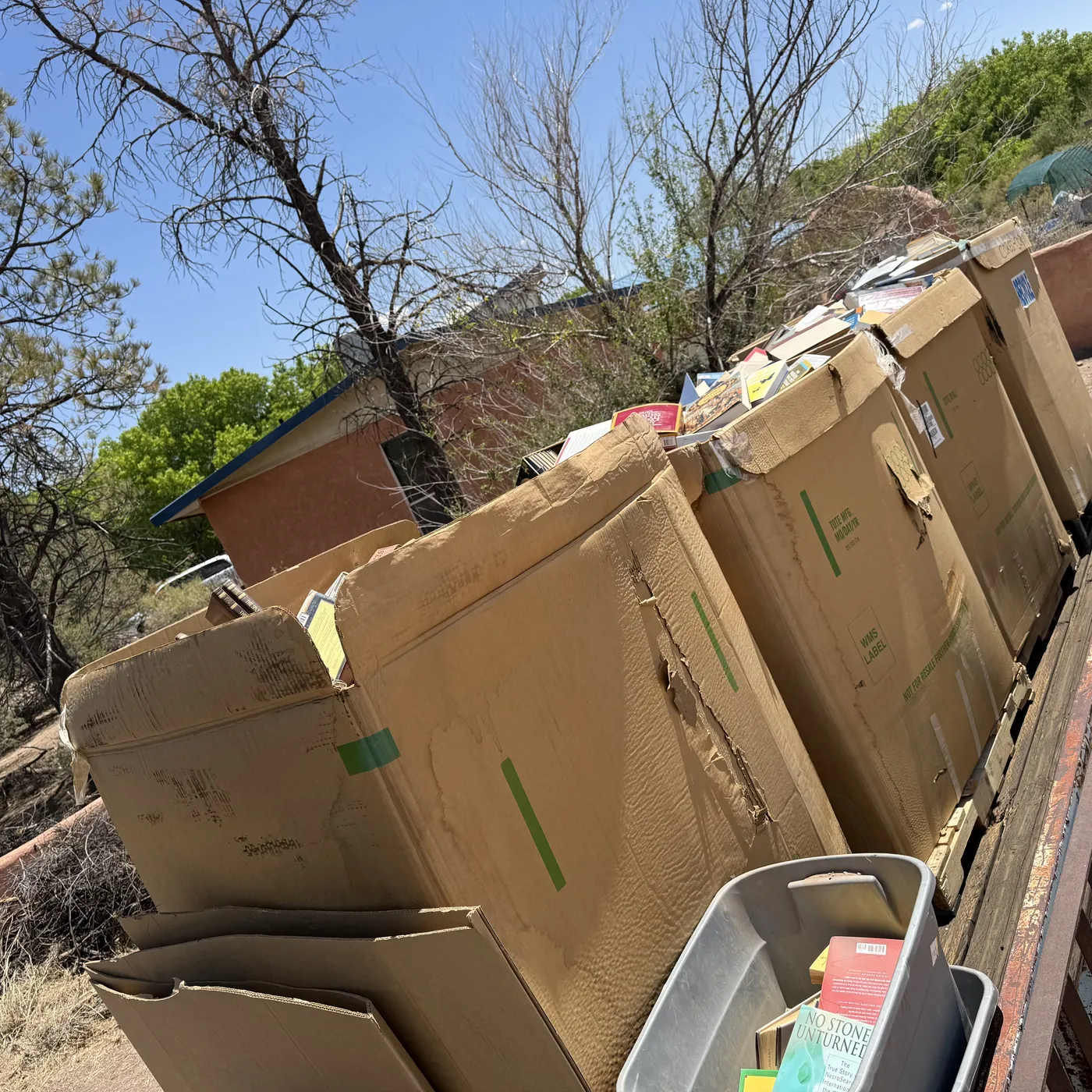
The text came in mid-week. A donor in Socorro had inherited a substantial library and needed it gone by the weekend. The chain thrifts have policy positions on this: Goodwill of Central New Mexico's nearest store is in Belen, 45 miles north of the Socorro property and they don't pick up. Savers does not have a Socorro presence. The Friends of the Albuquerque Public Library don't drive south of the metro. The donor had three options: rent a truck and haul the books to Albuquerque herself; pay a junk-removal company the high three-figure to low four-figure range to landfill the load; or call NMLP for free statewide pickup.
She called NMLP. I scheduled for Saturday morning. The drive south on I-25 is a ninety-minute run from the Edith Boulevard warehouse: through the South Valley, past Los Lunas and Belen, across the Rio Grande, and into the Socorro basin where the Sevilleta National Wildlife Refuge opens up to the east and the Magdalena Mountains line the western horizon. I left at 7 AM with the van empty and a hand truck strapped down in the back.
The house was the kind of rural NM property that looks like every other rural NM property if you haven't been there: low-slung, adobe-style, set off the road, accessed by a long dirt driveway, with a crooked sidewalk between the front gate and the door that would not pass any inspection. The kind of approach where you back the van as close as the dirt will allow, set the parking brake hard, and accept that the rest is hand-truck work.
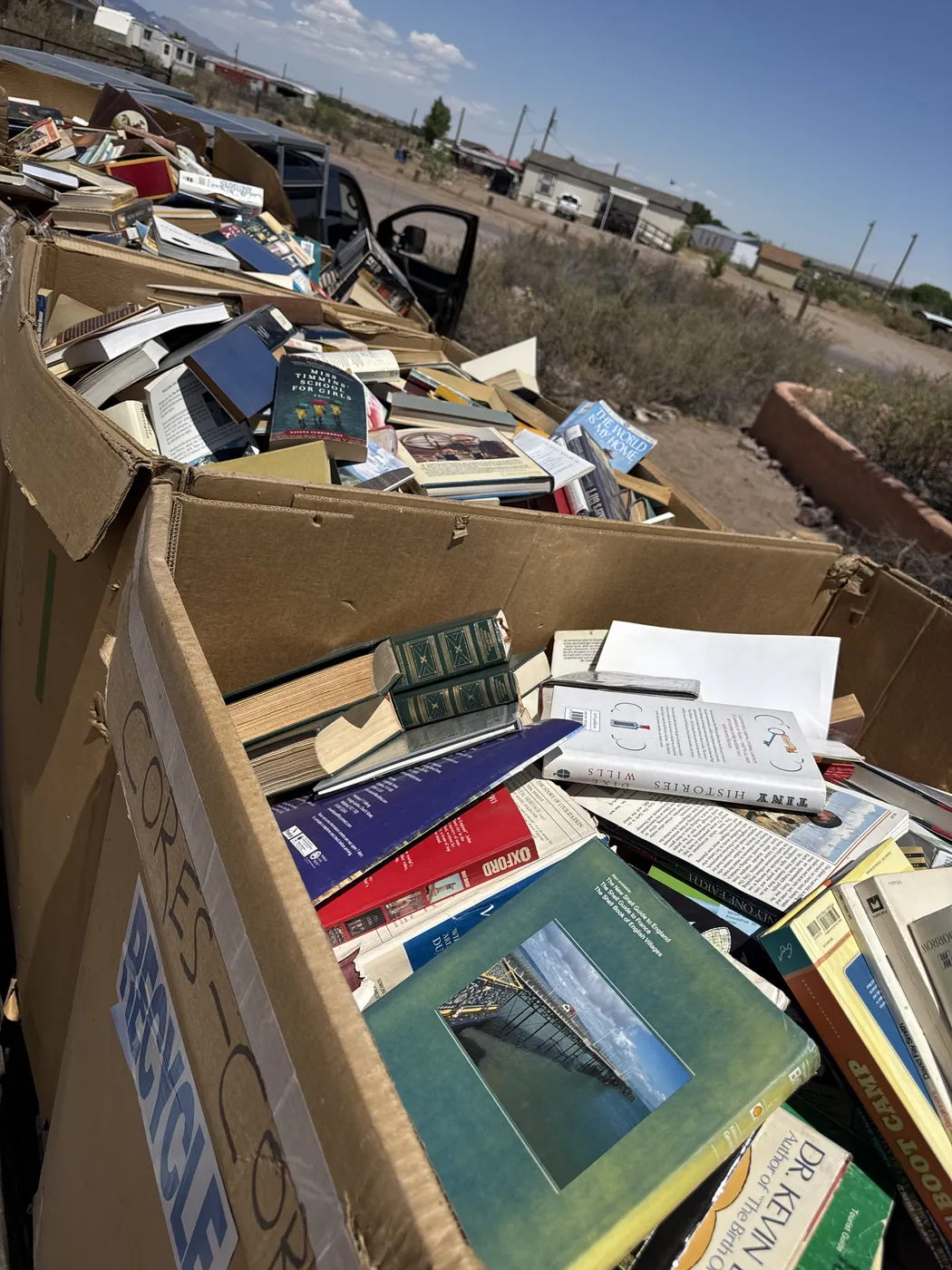
What the donor had: roughly 5,000 pounds of books in mixed condition. A medical professional's working library was the dominant tier — clinical references, anatomy and pathology textbooks, recent and out-of-print Stanford and university-press hardcovers, plus the trade tier from a long career of conference attendance. Underneath that: a serious religious-and-devotional shelf (Catholic doctrinal references, hymnals, devotional pamphlets), a regional NM-history shelf (Boscobel and other regional titles visible), a paperback genre shelf, and the inevitable miscellaneous category that every estate library accumulates — outdated almanacs, old yearbooks, magazine runs, sheet music, and saddle-stitched ephemera.
This is exactly the donation profile a chain-thrift sorter would have triaged hard at the door. The medical references would have been condition-rejected as "outdated technical." The religious devotional pamphlets would have been pulled to "miscellaneous paperback" and quietly recycled. The regional NM titles would have been priced at a dollar without anyone reading the spines. The yearbooks and the sheet music would have gone straight to the salvage bale. By the time the chain finished its triage, the donor would have been told to take 60% of the load home with her or pay the chain to dispose of it.
I sort by hand on the back end. The medical references go to teaching collections and to surplus medical-equipment programs that handle clinical references as part of their drop. The religious material gets routed by denomination — Catholic to the archdiocesan archives, Protestant to the corresponding denominational repository. The Boscobel regional titles go into the NMLP archive review queue (regional NM-history is a category I document carefully — see the archive). The yearbooks get routed to alumni-association networks. The sheet music goes to the NM music-teacher network. Mass-market paperbacks stock Little Free Libraries throughout the metro. Saddle-stitched ephemera gets evaluated more carefully than the rest because that's where the regional treasures hide (see the YES guide on Cocinas-de-NM-style ephemera).
Last verified May 2026 · Original research by Josh Eldred
The math of a Socorro pickup
The reason the chains don't make this trip is straightforward. A Socorro pickup is roughly 150 miles round-trip. At ~25 mpg in a cargo van, that's six gallons of fuel. Roughly three hours on-site. Plus the warehouse-side sorting, which for a 5,000-pound load runs another four to six hours over the following days. Total operating cost — fuel, vehicle wear, owner-operator time at any reasonable rate — is in the hundreds of dollars. The chain-thrift retail margin on a 5,000-pound mixed-book load doesn't cover that math, even before you account for the condition-rejections that would shrink the saleable percentage.
NMLP's math is different because the model is different. The fuel and time get absorbed against the entire archive system: the resellable books on Amazon and eBay (which fund the next pickup), the in-demand titles routed to APS Title I schools and the UNM Children's Hospital reading program, the Little Free Library stocks, the regional research-library partnerships, and the regional pulp recycler that handles the unsalvageable. No single tier of the donation has to "pay its way" because the total operation pays its way across the whole stream.
Practically: that means a Socorro donor with a 5,000-pound library can get the same NMLP service as an Albuquerque metro donor with a 50-book stack. Statewide pickup is the actual offer, and the math holds because the operation is built for it.
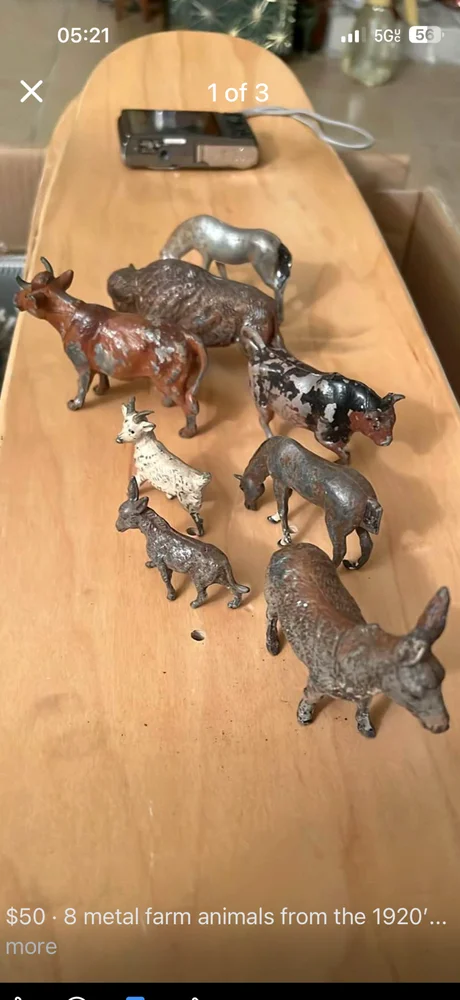
One thing about NMLP's role in a serious estate cleanout: I'm the books-and-media specialist. The non-book material on a property — the cast-metal 1920s farm animals in the screenshot above, the depression-glass collection in the kitchen, the tools in the garage — isn't my category. But I do this enough that I know who to point the donor toward for the rest. For collectible figurines and metalware, the local antiques dealer network or Facebook Marketplace direct sale is usually the right answer. For furniture, a local estate-sale operator or 1-800-Got-Junk depending on condition. For tools, the donor's neighborhood network or Habitat ReStore. The books are my piece. The rest gets pointed.
Got a stack like this anywhere in New Mexico?
Albuquerque metro: usually a quick turnaround. Santa Fe, Las Cruces, Roswell, Farmington, Socorro, Las Vegas, Taos, Silver City: scheduled on the calendar. No minimum, no condition limit, no sorting required. Free.