Archive entry · Los Griegos 1930s memoir · Albuquerque Historical Society / Tumbleweed Press Placitas 1976
Bathtub and Silver Bullet & More Bathtubs Fewer Bullets — Irene Fisher, Albuquerque Historical Society / Tumbleweed Press 1976
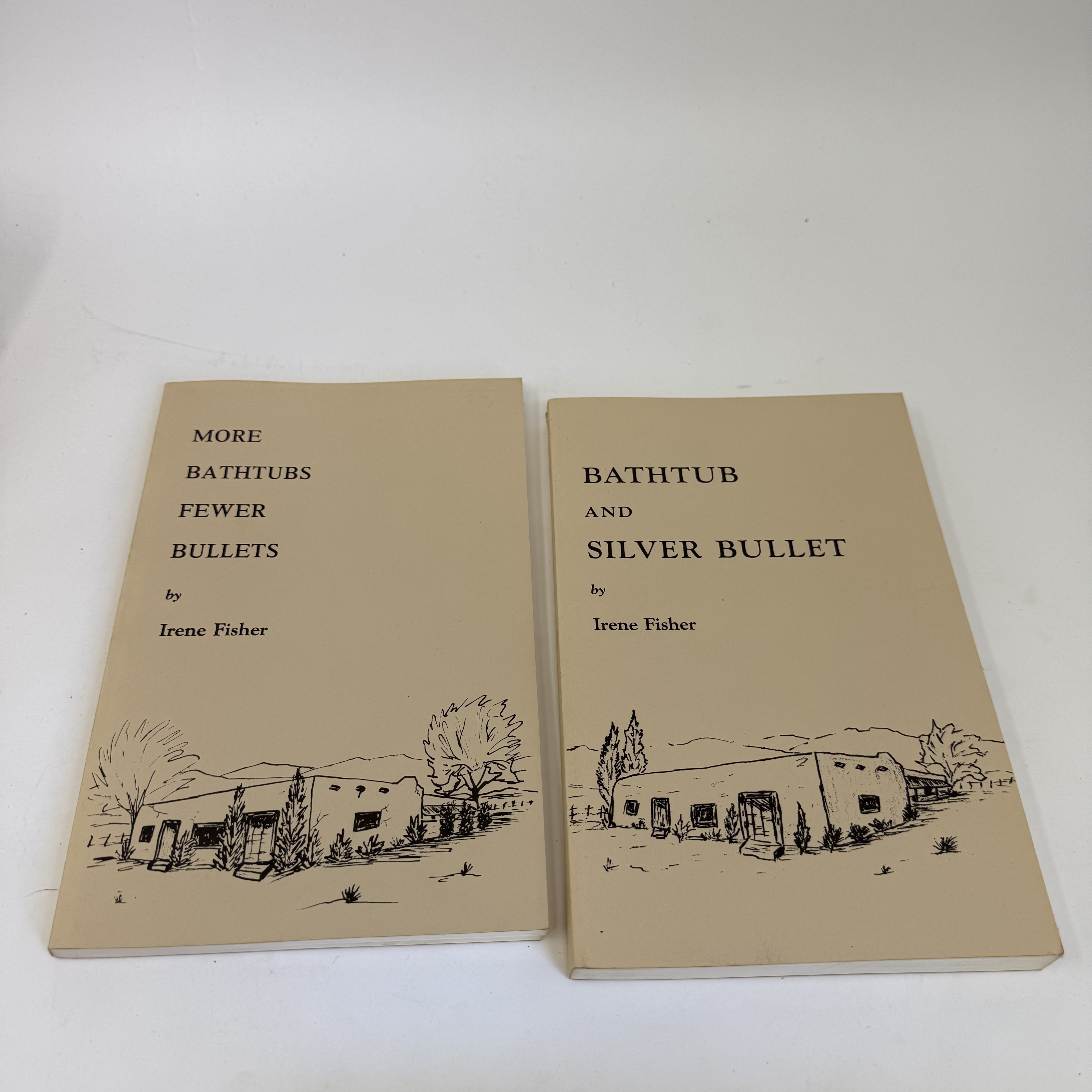
A matched pair of Irene Fisher's autobiographical memoir of the village of Los Griegos during the early 1930s — the Franklin Delano Roosevelt administration, the Civilian Conservation Corps period, the last years of pre-WWII rural Bernalillo County. Los Griegos was then a small Hispano village along the Camino Real corridor north of central Albuquerque; by the time the books were published in 1976, the village had been substantially absorbed into greater Albuquerque as the North Valley neighborhood. The volumes were published jointly by the Albuquerque Historical Society and Tumbleweed Press of Placitas. Together they form a foundational regional-memoir primary source on the disappeared villages of pre-metropolitan-Albuquerque Bernalillo County.
Catalog
What these books are
Bathtub and Silver Bullet is the first-person account of an Anglo woman's five-year residence in the Hispano village of Los Griegos during the early 1930s, written from the perspective of the 1976 publication date with the memoirist's hindsight on a village that had, in the four decades between residency and publication, been substantially erased by Albuquerque's mid-century absorption of its surrounding Bernalillo County villages. Fisher arrived in New Mexico in 1920; the Los Griegos residency was a specific five-year span in the early 1930s, immediately following Franklin Delano Roosevelt's 1932 election and during the years when the Civilian Conservation Corps was running its NM camps and the federal Works Progress Administration art projects were beginning to reshape regional cultural production.
The book's structure is fourteen chapters of village vignettes — each focused on a single household, family, character, or episode — that together build up a composite portrait of Los Griegos at a specific moment. The chapter titles indicate the texture: "I Move In and Acquire a Handmaiden" (Fisher's first weeks in the village, finding her rental house and the local woman who would help her run the household); "Tomorrow is Fiestas" (the village's seasonal fiesta calendar and the Catholic-feast-day social structure); "Tio Abran's Silver Bullet" (the local elder whose silver-bullet story gives the book its title); "Susie Wants a Bathroom" (the modernization-versus-tradition tension as the village began to acquire indoor plumbing — the bathtub of the book's title is a literal indoor bathtub, a 1930s rural-NM modernity marker). The second volume, More Bathtubs Fewer Bullets, extends the period with additional vignettes that did not fit the first book's structure.
The voice is recollective rather than ethnographic. Fisher is not claiming the anthropological observer-distance that the later Kutsche / Van Ness Cañones work or the Briggs Córdova ethnographies operate from. She is writing as a former resident remembering specific people, conversations, holidays, and households — her landlady, her neighbors, the tradesmen and visitors who passed through the village in the five years she lived there. The result is a different kind of primary source than the academic ethnographies: less analytic, more directly observational, and more attuned to the small social texture — what people said to each other at the well, which sister-in-law cooked for which household, what the children's names were — that ethnographic monographs typically generalize.
Los Griegos — the disappeared village
The geographic and historical setting deserves direct attention because the village no longer exists as a recognizable independent community. Los Griegos — "the Griegos," named for the Griegos family that received the original Spanish colonial land grant in the area — was one of a string of Hispano villages along the Rio Grande's North Valley north of central Albuquerque. The pattern follows the same logic as the Rio Arriba villages further north: a string of subsistence-agriculture communities on irrigated bottomland along the Rio Grande and its acequias, connected by the Camino Real (the colonial-era trade road from Mexico City through Santa Fe to Taos) and now largely paralleled by 4th Street NW. Alameda, Los Ranchos de Albuquerque, Los Griegos, Los Candelarias, Los Duranes, Los Poblanos, Old Town Albuquerque were each independent or semi-independent communities through the late nineteenth and early twentieth centuries, with their own parish churches, schools, and household-extended-family social structures.
The mid-twentieth-century absorption of these villages into greater Albuquerque happened through a combination of formal annexation (the City of Albuquerque's incorporation expansions of the 1940s, 1950s, and 1960s), infrastructure development (the postwar paving of 4th Street and the construction of Interstate 25 / Interstate 40), demographic change (Anglo-American in-migration during the WWII and postwar period, particularly tied to Kirtland Air Force Base and Sandia National Laboratories employment), and the slow replacement of subsistence agriculture by urban land-use patterns. By the time of the 1976 publication of Bathtub and Silver Bullet, Los Griegos as a coherent independent village no longer existed. The Griegos Road / 4th Street NW area remained as a North Valley neighborhood, but the social structure Fisher had documented — the extended-family households, the fiesta-calendar social rhythm, the Spanish-speaking village economy — had been substantially reshaped.
The book is a primary source on what the village was before the absorption. That documentary value compounds with time: the population of Los Griegos residents from the early 1930s who could provide oral-history testimony has dwindled to nearly zero in the half-century since publication, and Fisher's memoir is one of the small number of first-person book-length records of the village in that period.
The Tumbleweed Press / Albuquerque Historical Society publication context
The 1976 publication date and the dual publisher imprint — Albuquerque Historical Society and Tumbleweed Press of Placitas — place the book inside a specific moment in NM regional publishing. The Albuquerque Historical Society, founded 1947, was (and remains) the principal locally-oriented historical organization for greater Albuquerque, distinct from but operating alongside the New Mexico Historical Society in Santa Fe and the University of New Mexico history department. The Society's publication program through the 1970s and 1980s issued a steady stream of small-press local-history paperbacks, often in collaboration with private regional presses like Tumbleweed.
Tumbleweed Press operated out of Placitas, NM — the small artist-and-writer community in the foothills of the Sandia Mountains north of Albuquerque, off NM-165 east of Bernalillo. Placitas in the 1970s was a recognized NM small-press center; multiple regional publishers, fine-press operations, and self-publishers operated there during the decade, taking advantage of the lower rent and the proximity to Albuquerque and Santa Fe. Tumbleweed's output included regional memoir, NM history, and the occasional poetry chapbook; the Press's titles share the coordinated cream-cardstock pen-and-ink-cover-illustration design that gives the Fisher pair their characteristic visual identity.
The 1976 publication year is itself a moment in NM regional publishing. The US Bicentennial drove a wave of local-history publication across the country, and the Albuquerque-area Bicentennial planning included support for regional memoir and oral-history projects of exactly the Fisher kind. The dual Albuquerque Historical Society / Tumbleweed Press imprint suggests the book benefited from both institutional support (Society subscription channels, archive deposits) and private-press publication infrastructure (Tumbleweed's typesetting, printing, and bookstore distribution).
The book's place in NM regional-memoir literature
For readers building a working shelf on early-twentieth-century Bernalillo County and the disappeared North Valley villages, Bathtub and Silver Bullet and More Bathtubs Fewer Bullets sit alongside several other primary-source memoir and history titles:
Cleofas Jaramillo — Romance of a Little Village Girl (Naylor 1955) is the canonical northern NM Hispano woman's memoir, covering Arroyo Hondo and the upper Rio Grande villages from a Hispano-author perspective. Jaramillo's voice is from inside the community Fisher observed from outside; the two books together cover the same regional cultural world from complementary positions.
Lillian Sanchez Long — the Old Town Albuquerque memoirs cover the central-Albuquerque Hispano community of roughly the same period, focused on the Old Town plaza and the historic core rather than the North Valley villages. The Sanchez Long and Fisher works together cover central Albuquerque and the North Valley from the same era from complementary geographic positions.
Marc Simmons — Albuquerque: A Narrative History (UNM Press 1982) is the standard scholarly history of the city through which the Fisher memoirs can be cross-referenced. Simmons's chapters on the 1920s and 1930s document the formal annexation timeline that the Fisher memoir documents from inside as lived experience.
The Federal Writers' Project NM volumes (1939–1941), produced under the WPA at exactly the period Fisher was living in Los Griegos, supply the contemporaneous statewide-survey companion record. Many Federal Writers' Project field notes from the same region are held at the New Mexico State Records Center and Archives in Santa Fe and at the UNM Center for Southwest Research.
The Fisher memoirs are the village-specific Los Griegos primary source — the single-village contribution to that broader regional memoir literature.
Why this matters for the archive
First — the Los Griegos documentary record. Fisher's pair is one of the small number of book-length first-person memoirs of the disappeared Hispano villages of Bernalillo County. The North Valley neighborhood that occupies the Los Griegos site today carries the village's name on Griegos Road and in the Griegos Park / Los Griegos Branch Library institutions, but the lived social texture of the village has been substantially erased by mid-twentieth-century urbanization. This book is the principal English-language record of that texture.
Second — the FDR-era / CCC-era period. The early 1930s is a specific underdocumented moment in NM regional history. The territorial-period and early-statehood years (1846–1912) are well covered by the academic monographs (Foote on women, Larkin and the Santa Fe Trail diarists, etc.). The WWII and postwar years are well covered by the Los Alamos / Sandia / Kirtland-driven literature. The interwar Depression years between — the years of the CCC, the Federal Writers' Project, the New Deal art programs, the WPA-era reshaping of NM Hispanic and Pueblo cultural production — have a thinner primary-source record. The Fisher memoir is one of the few first-person book-length records of that period in metropolitan Albuquerque.
Third — the small-press publication artifact. The Tumbleweed Press / Albuquerque Historical Society pair is itself a documentary artifact of the 1976 Bicentennial-era NM regional small-press economy. The coordinated cover design, the dual-imprint publication, the Placitas small-press operation, the local-historical-society collaboration model — these are all institutional features of NM regional publishing of a specific period that has largely passed.
How these copies came in
The Fisher pair arrived in May 2026 as part of the Albuquerque donor pile described in the "The Library Wouldn't Take His Books Without Sorting" donor-story essay — the same intake that produced the Fiesta Fare 1956 Albuquerque commemorative cookbook with Al Momaday cover art, the Pueblo Indian Cookbook, the NM Colcha Embroidery handbook, and the scholarly reprint of The Memorial of Fray Alonso de Benavides 1630. The donor brought a mixed pile to NMLP after Albuquerque-area library deaccession channels declined to take it. The Fisher pair are five of the most regionally significant titles in that intake on a per-book basis. Condition: both volumes in clean reading condition with the matching cream cardstock covers intact, slight age-yellowing of the textblocks consistent with 50-year-old trade paperback stock, no underlining or marginalia.
Where these copies are going
The matched pair will be listed and sold as a set rather than separately — the set value is meaningfully higher than two independent listings, because the second volume completes the memoir record that the first volume opens. Three plausible buyers: First: an Albuquerque North Valley history-and-genealogy reader building a shelf on the disappeared villages of the area; the Los Griegos descendants community is active and a copy in their hands has documentary value as well as commercial. Second: a Federal Writers' Project / WPA-era NM cultural historian whose research touches the 1930s in the regional context. Third: a research library replacing a missing or worn copy — the UNM Center for Southwest Research, the Albuquerque-Bernalillo County Library system, the NMSU library, the New Mexico State Library all maintain regional-memoir collections. The archive entry will remain regardless of which route the physical books take.
External references & authoritative sources
- Bathtub and Silver Bullet — AbeBooks first-edition record: abebooks.com — first-edition trade paperback bibliographic record.
- Bathtub and Silver Bullet — Goodreads record: goodreads.com/book/show/58119943 — reader bibliographic record with summary.
- WorldCat — Bathtub and Silver Bullet: search.worldcat.org — institutional library holdings.
- WorldCat — More Bathtubs Fewer Bullets: search.worldcat.org — institutional library holdings for the companion volume.
- Albuquerque Historical Society: albuqhistsoc.org — the principal locally-oriented Albuquerque historical organization and co-publisher of this title.
- Placitas, NM — community context: en.wikipedia.org/wiki/Placitas — the artist-and-writer Sandoval County community where Tumbleweed Press operated.
- North Valley Albuquerque — community context: en.wikipedia.org/wiki/North_Valley,_New_Mexico — the present-day successor community to Los Griegos and the adjacent historic villages.
- UNM Center for Southwest Research: elibrary.unm.edu/cswr — the principal regional manuscript and primary-source repository for the Albuquerque and Rio Arriba area; holds Federal Writers' Project NM field notes contemporaneous with the Fisher residency.
- New Mexico Office of the State Historian: newmexicohistory.org — statewide historical reference and biographical authority records.
- Los Griegos Branch Library (Albuquerque-Bernalillo County Library): abqlibrary.org/locations/losgriegos — the present-day institutional namesake of the village this memoir documents.
How to cite this archive entry
Eldred, Josh. "Bathtub and Silver Bullet & More Bathtubs Fewer Bullets — Irene Fisher, Los Griegos 1930s Memoir, Albuquerque Historical Society / Tumbleweed Press Placitas 1976." NMLP Donation Archive, May 1, 2026 (expanded May 11, 2026). https://newmexicoliteracyproject.org/archive/irene-fisher-bathtub-bullets
Related on this site
- Back to the archive index
- Cañones — Kutsche & Van Ness, 1981 / 1988 — the academic-ethnographic counterpart to Fisher's memoir-from-inside; together they document Hispano village life in northern NM from two different observer positions.
- Healing Herbs of the Upper Rio Grande (Curtin, 1965 / 1974) — the ethnobotanical record of the same regional villages from the same period; Curtin's fieldwork overlapped chronologically with Fisher's Los Griegos residency.
- Fiesta Fare (Albuquerque 250th-anniversary cookbook with cover by Al Momaday, 1956) — from the same library-rejected donor pile.
- Pueblo Indian Cookbook — same donor pile.
- New Mexico Colcha Embroidery — same donor pile.
- The Memorial of Fray Alonso de Benavides, 1630 — same donor pile.
- "The Library Wouldn't Take His Books Without Sorting" — the donor essay this entry came from.