Estate Book, Media & Valuables Clearing · Albuquerque Metro
The Books, Papers & Valuables — Often Free.
I know why you're reading this page. Someone died, or someone moved to assisted living, or a marriage ended, or a house that held decades of living needs to be cleared before anything else can happen. And now you're standing in the middle of it all — the shelves of books, the boxes of paper and photographs, the records and media, and somewhere in there the things that turn out to be genuinely valuable. That's the part nobody quite knows what to do with, and that's exactly what I'm here for.
I'm Josh Eldred, and I run the New Mexico Literacy Project out of a warehouse on Edith Boulevard in Albuquerque's North Valley. This operation started with books — free pickup, responsible sorting, keeping good books in circulation instead of the landfill. The core of what I do is clearing the books, magazines, paper, photographs, documents, media, and the collectible and valuable items most cleanout crews don't know how to handle. The family keeps the keepsakes. I make sure nothing irreplaceable ends up in a dumpster.
It is often free. I resell and donate what still has value, and that's what pays for the work — so when a home has enough books and resale-worthy valuables to cover the labor, the clearing costs the family nothing. I'm one person, though, not a free junk-and-furniture crew. Alongside the books and valuables, I can also take clothing, outdoor gear, and working electronics when they still have life in them — those go out as donation pickups. Furniture, appliances, and general junk aren't free and aren't my core work; I can refer you to a hauler, or take them on case by case as a paid add-on. And the things that matter — the family papers, the photographs, the keepsakes — come back to you first.
If you're dealing with an estate full of books, paper, and belongings and you don't know where to start, you just found the starting point. Call or text me and we'll figure it out together.
Books & paper · Media · Valuables & collectibles · Often free · Clothing, gear & electronics taken too
Last verified July 2026 · Original research by Josh Eldred
The Part Nobody Knows What to Do With
When someone dies or moves into assisted living, the family inherits a property full of a lifetime of things. That sounds simple until you walk through the front door. The books alone can fill a room — shelves of hardcovers and paperbacks, boxes of magazines, file cabinets of paper, photo albums, records, and media stacked in every corner. And tangled in with them are the things that turn out to be worth something: a first edition, a signed copy, a coin collection, a piece of art, the unusual find nobody recognized.
The books and paper are where I started, and that's still what I do best. Every book gets looked at individually. The valuable and collectible items get pulled and assessed instead of tossed. That's the part most cleanout crews don't know how to handle — they see boxes of old books and paper and treat it as filler, when some of it is the most valuable thing in the house.
And somewhere in all of it are the things that actually matter to the family: the photographs, the old letters, the military records, the birth certificates, the recipe box in Grandma's handwriting, the family Bible, the high school yearbooks, the keepsakes that a junk-removal crew would throw in a dumpster without a second thought. Those get set aside and returned to the family first — that's Heirloom Rescue, and it's part of every job.
A lot of estates also have clothing in the closets, outdoor gear in the garage, and working electronics in the office — things that still have life in them. I can take those too, as donation pickups, when they're worth moving along to someone who'll use them. What I'm not is a free whole-house junk crew: furniture, mattresses, appliances, and general household clutter aren't my core work and aren't free. I can point you to a hauler for those, or fold them in as a paid add-on when it makes sense.
Most families feel overwhelmed before they start. Some call a junk-removal company, which solves the volume problem but treats everything — books, photographs, valuables, personal papers — as trash. Everything goes in the same truck, to the same landfill, at the same per-cubic-yard rate. The first edition, the family letters, the coin collection: all gone.
That's the gap I fill. I don't treat the books and paper as filler, and I don't dumpster the keepsakes. Books go to readers, valuables get sold or returned, donatable clothing and gear go to people who need them, working electronics get recycled or reused properly — and the keepsakes come back to the family before anything else happens.
Request Your Free Pickup
Tell me what you have and where it is. I’m the only person who shows up — I do the lifting, any condition, no sorting. Tell me your timeline and I’ll do my best to work with it. Texts go straight to my phone at 505-250-3804.
What I Take
The core is books, paper, media, and valuables — that's the service, and it's often free when the resale value covers the labor. Alongside that, I can also take clothing, outdoor gear, and working electronics as donation pickups when they still have life in them. You don't need to sort or separate any of it before I arrive — that part is my job.
Books, Paper and Media · core, often free
This is the heart of what I do. Books, magazines, textbooks, cookbooks, coffee-table books, children's books, paperbacks, hardcovers, reference sets. Paper, letters, documents, and ephemera. Plus DVDs, Blu-rays, CDs, vinyl records, cassette tapes, VHS tapes, audiobooks, sheet music, video games, board games, and puzzles.
Every book gets evaluated individually. Titles with resale value go to resale. Good-condition books that aren't worth reselling go to community donation channels. Damaged or unsalvageable material goes to paper recycling. Nothing readable gets thrown away. When the books carry enough resale value to cover the labor, clearing them is free.
Clothing and Textiles · donation pickup
A standing donation pickup I can fold in when I'm already there for the books. Men's, women's, and children's clothing. Shoes, boots, belts, hats, scarves, handbags, and accessories. Linens, towels, blankets, quilts, and bedding — wearable, usable pieces that still have life in them.
Wearable clothing in good condition goes to resale or donation. If I find vintage western wear, old Levi's, or collectible pieces in the closets, those get assessed individually through our vintage consignment program. Damaged textiles go to fiber recycling — shredded into industrial rags or insulation instead of sitting in a landfill for a hundred years. I work with clothing donation channels across the Albuquerque metro.
Outdoor and Sporting Gear · donation pickup
Another donation pickup I'm glad to take when the gear still has life in it. Camping equipment, tents, sleeping bags, backpacks, hiking boots, fishing tackle, golf clubs, skis, snowboards, bicycles, kayak accessories, hunting gear, climbing equipment, and general outdoor recreation items.
New Mexico is an outdoor state, and good gear has a long second life here. Items in usable condition go to outdoor gear resale and donation channels. Broken or worn-out gear gets recycled where possible or disposed of properly.
Working Electronics and E-Waste · donation pickup
A standing e-waste pickup, best when the electronics still work. Computers, laptops, tablets, printers, scanners, old cell phones, chargers, cables, routers, modems, stereo equipment, speakers, and the drawer full of cords and adapters that every house has.
Electronics contain metals and chemicals that don't belong in a landfill. Everything gets routed to certified e-waste recycling. If a family wants hard drives pulled and returned or destroyed before the equipment leaves, I handle that. Working electronics with resale value get resold. The rest gets recycled properly.
Valuables and Collectibles · core, often free
The things tangled in with the books and paper that turn out to be worth saving: first editions, signed copies, rare and antiquarian books, art and prints, coins and currency, stamps, maps, autographs, and the unusual collectible find nobody recognized.
These get pulled and assessed individually, not boxed up and tossed. The resale value of the books and valuables is what lets so many of these clearings be free for the family. If something is beyond my expertise to value, I'll tell you straight and point you to the right specialist.
Family Papers and Keepsakes · Heirloom Rescue
Family photographs, letters, greeting cards, journals, diaries, military records, birth and death certificates, marriage licenses, diplomas, awards, recipe collections, family Bibles, genealogical material, scrapbooks, yearbooks, and anything with personal or sentimental significance.
This is where the care matters most. Every piece of personal and genealogical material is pulled aside during sorting and offered back to the family before it goes anywhere. Photographs, handwritten letters, and family papers don't get dumped. They get flagged, set aside, and returned. This is the Heirloom Rescue process, and it's non-negotiable on every job.
Not Free, and Not My Core Work
I'm one person, so I'm straightforward about this at the walkthrough. These aren't part of the free books-and-valuables service:
- ×Furniture, mattresses, and major appliances. Couches, beds, mattresses, dining tables, dressers, refrigerators, washers, dryers, dishwashers, pianos. These aren't free and aren't my core work. I can refer you to haulers who specialize in furniture and appliance removal, or take them on case by case as a paid add-on when it makes sense.
- ×General household junk and clutter. Days of bulk kitchenware, decor, and miscellaneous household clutter aren't a free clean-out. I won't spend days clearing that for nothing — but I'll point you to a junk hauler, or fold a manageable amount in as a paid add-on when the books and valuables cover the rest.
- ×Hazardous materials. Paint, chemicals, solvents, pesticides, ammunition, firearms, medical waste, and asbestos-containing materials. These require licensed hazmat handling. I'll point you to the right resource.
- ×Biohazard conditions. If a room has active mold, sewage damage, or conditions that require remediation before items can be safely handled, that needs a specialist first. I can still clear the books and valuables from the safe parts of the home.
The free service is the books, paper, media, and valuables — with clothing, gear, and working electronics taken along as donation pickups. Everything else, we scope honestly so you know up front what's referred out and what's a paid add-on.
How an Estate Clearing Works
The process is the same whether you've got a few bookshelves or a whole library plus decades of paper. It's designed to be simple for the family and careful with the books, valuables, and keepsakes. Here's how it goes, start to finish.
-
Initial walkthrough — free, no obligation.
I come to the house and walk through every room. We talk about what stays and what goes, what matters and what doesn't, and what the family's timeline looks like. If you're out of state, a video walkthrough by phone works — you walk through the house with your camera and I see what I need to see. The walkthrough is free. There's no obligation attached to it. If you decide not to move forward, we shake hands and that's it.
During the walkthrough, I'm looking at the full picture: volume, condition, categories present, access issues (stairs, narrow hallways, pets), and the ratio of resalable to disposable material. This is what determines the scope and structure of the job.
-
Written scope and agreement.
After the walkthrough, I send a written scope by text or email. It describes exactly what I'm taking, what I'm not taking, the estimated timeline, and the terms. Plainspoken, no legal jargon designed to confuse. The family reviews it on their own time. No pressure, no expiration countdown, no sales tactics. When you're ready, you say yes and we schedule the pickup.
-
Scheduled pickup — as soon as my schedule allows.
Once we've agreed on the scope, I get you on the calendar as soon as I can. If there's a deadline — a closing date, a lease expiration, a probate timeline — tell me and I'll do my best to work around it. I work around the family's schedule, not the other way around. If the family wants to be there during the cleanout, that's fine. If the family would rather hand me the key and get a text when it's done, that's fine too.
-
On-site sorting and loading.
This is where the work happens. I go room by room, sorting everything into categories as I load. Books get separated from clothing. Electronics get separated from household goods. Personal papers, photographs, and keepsakes get pulled aside into a dedicated bin for the family. Nothing gets thrown in a truck unsorted. The categories matter because the destinations are different.
On larger jobs or heavily packed houses, the sorting continues at the warehouse after loading. But the keepsake review always happens first, on-site, so nothing personal leaves the property without the family having a chance to claim it.
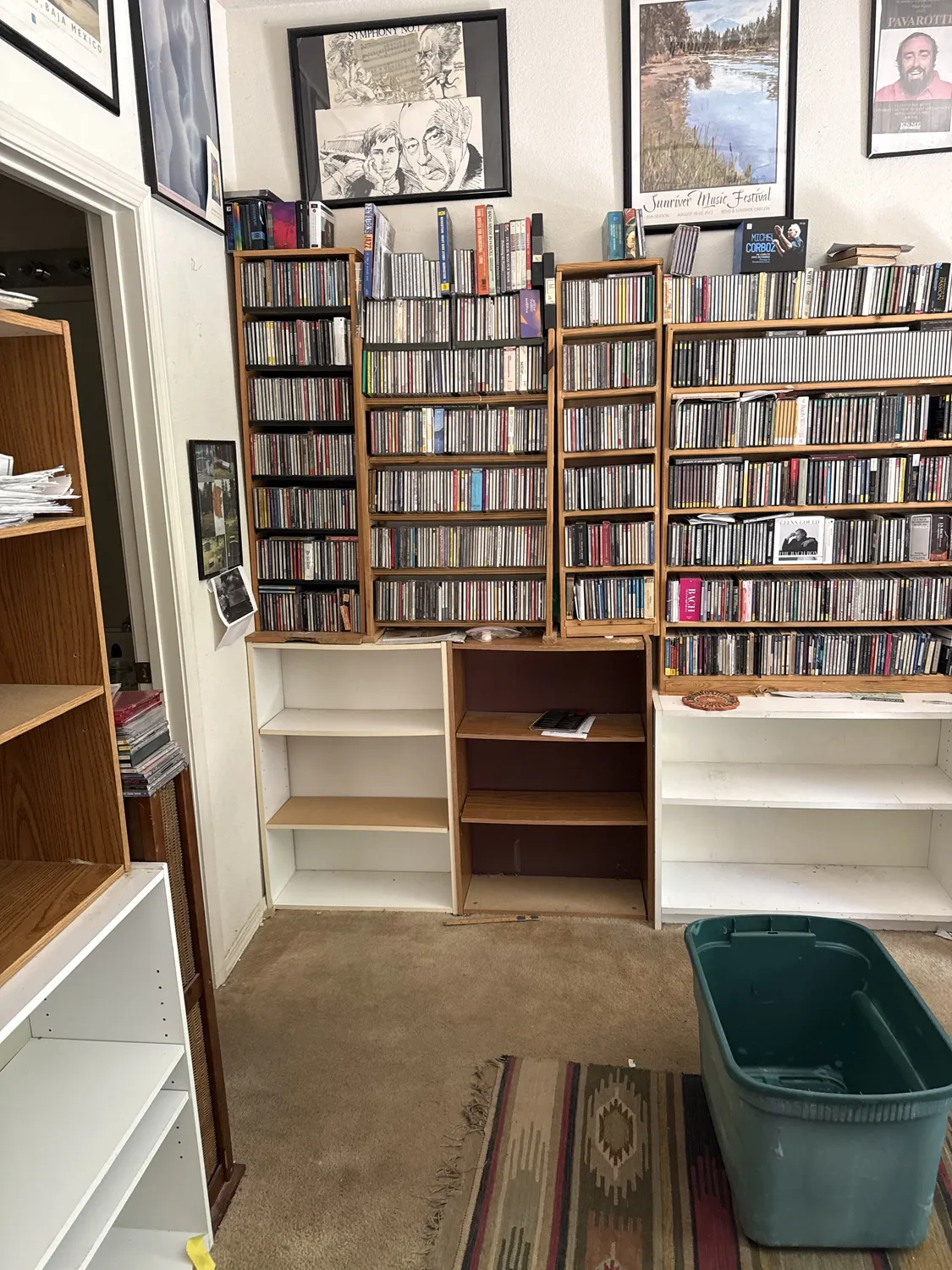
A recent Albuquerque estate cleanout in progress — hundreds of CDs on shelving units, framed art, and a Southwestern rug, all being sorted and cataloged room by room before loading. -
Family gets peace of mind.
When I'm done, the books, paper, media, and valuables are gone, the shelves and files are clear, and anything personal has been set aside for the family. If clothing, gear, or electronics were part of the scope, those are handled too; if furniture or other paid items were agreed up front, those areas are cleared as well. The family can keep moving toward listing, closing, or settling the estate. I send confirmation when the job is complete, and if there are keepsakes or personal items to return, we arrange that separately.
The whole process, from first call to cleared shelves, usually takes less than two weeks. Many jobs are done in under a week. The walkthrough and the agreement are the only parts that require the family's time and attention — everything after that, I handle.
The Three-Track Sort
The sorting philosophy I developed for books carries over to the clothing, gear, and electronics I take as donation pickups too. Nothing gets treated as one undifferentiated mass. Each item goes through a three-track evaluation, and the tracks are the same regardless of the category.
Track One: Resale
Items with meaningful resale value get routed to the appropriate resale channel. For books, that means online marketplaces, specialty buyers, and my own inventory. For clothing, it means consignment and resale platforms. For outdoor gear, it means gear-specific resale channels. For electronics, it means refurbishment or component resale. This track is what makes the business sustainable — the resale revenue from estate cleanouts is what funds the operation and often covers the cost of the cleanout itself.
Track Two: Donation and Community Reuse
Items in good condition that don't have significant resale value still have plenty of use left. Children's books go to New Mexico kids through school and library channels. Wearable clothing goes to community organizations that distribute directly to people who need it. Household goods go to families setting up new homes. Outdoor gear goes to youth programs and outdoor education groups. This track keeps usable items in circulation instead of in a landfill.
Track Three: Responsible Recycling and Disposal
Some things are genuinely done. Stained clothing. Broken electronics. Water-damaged books. Worn-out shoes. These items can't be resold or donated, but many of them can still be recycled. Textiles go to fiber recycling. Electronics go to e-waste recycling. Paper and cardboard go to paper recycling. Metal goes to scrap. Only what truly has no remaining value — no resale use, no donation use, no recycling pathway — goes to disposal. And by the time everything else has been sorted out, that volume is a fraction of what it would have been if the whole house had gone to a dumpster.
This is what makes the service different from a junk-removal company. A junk crew loads a truck and drives to a landfill. Everything in the truck goes to the same place. My approach puts every item through a filter: can it be sold? Can it be donated? Can it be recycled? Only after all three answers are no does something go to disposal.
The result is landfill diversion at a rate that a junk-removal company can't match. And the family gets the satisfaction of knowing that Mom's clothing went to someone who needed it, Dad's camping gear went to a kid who'll actually use it, and the books went to readers instead of a hole in the ground.
For Out-of-State Families
A large percentage of the families I work with don't live in Albuquerque. A parent dies, and the adult children are in Colorado, California, Texas, or somewhere farther. The house is here, the stuff is here, and the family is a thousand miles away trying to figure out what to do from a distance.
You don't have to fly in. You don't have to take a week off work. You don't have to rent a U-Haul or hire someone you've never met off the internet. I handle the books, paper, media, and valuables from walkthrough to cleared shelves, and the whole process can be coordinated by phone and text.
Here's how it works for out-of-state families: if there's a neighbor, friend, or realtor with a key, they let me in for the walkthrough. I do a video call or send photos so you can see every room and tell me what to keep. We agree on scope in writing. I do the cleanout. Keepsakes and personal items get boxed and shipped to you, or held at the warehouse for pickup when you're next in town. You get text updates throughout.
This is especially practical for out-of-state families. The books, valuables, and keepsakes — plus any clothing, gear, or electronics worth donating — go through one person. One phone number. One scope. One timeline. One set of careful hands going through the books and belongings, instead of strangers you've never met treating it all as trash.
I've written a dedicated page for out-of-state families that covers the full remote process in detail, including how keepsake shipping works and how to handle a house you can't visit.
For Estate Sale Companies
If you run estate sales in Albuquerque, you know the pattern. The sale runs for two or three days. The high-value items sell. The furniture moves. But when the sale ends, there are usually boxes of books nobody wanted, leftover paper and media, and a few overlooked items that turn out to be worth something — the kind of things a sale doesn't always price right.
That's where I come in. After the sale, I clear the leftover books, paper, and media, pull aside anything still collectible, and rescue any family keepsakes that slipped through. If there's leftover clothing, outdoor gear, or working electronics, I can take those as donation pickups too. Furniture and bulky leftovers aren't my core work — I'll refer those to a hauler or handle them case by case as a paid add-on.
This is a peer-to-peer arrangement. You run the sale, I handle the book-and-media aftermath. Your client's shelves and files get cleared, and you don't have to figure out what to do with the leftover books and paper. Because I sort and route everything through the three-track system, the family knows their loved one's books and belongings were handled with more care than a dumpster provides.
I've put together a dedicated page for estate sale companies that covers how the partnership works, what I take, and how to coordinate the handoff.
For Attorneys and Executors
Probate situations come with deadlines. The court wants the estate settled. The property needs to be sold. The shelves and files need to be cleared before the listing goes live or the closing date hits. And in many cases, the executor is an adult child who lives out of state, has a full-time job, and has already spent their emotional reserves dealing with the death itself.
I work within probate timelines. If the books, paper, and valuables need to be cleared by a specific date, I'll tell you at the walkthrough whether that's feasible and what the schedule looks like. If documentation is needed for the estate file — a record of what was removed, categories handled, disposition of personal items — I can provide that. I'm not an appraiser and I don't provide formal valuations, but I can document the scope and completion of the clearing.
This matters for probate because the books, paper, and personal records are often the part nobody else wants to deal with — and the part most likely to hide something valuable or irreplaceable. I clear those with care, rescue family papers and keepsakes for the estate, and can also take donatable clothing, gear, and electronics along the way. For furniture, appliances, and general junk, I'll point your executor to the right hauler so the rest of the property keeps moving.
I've written a dedicated page for estate attorneys and executors that covers probate-specific considerations, timeline management, and how I work with legal representatives.
Common Situations
Every clearing is a little different, but most fall into a handful of common scenarios. Here's how the books-and-valuables service applies to each one.
After a Death
This is the most common reason families call. A parent or spouse has died, and the surviving family is left with a house full of belongings that need to go somewhere. The grief is fresh. The decisions feel impossible. The volume is overwhelming.
I've done enough of these to understand the emotional weight. I don't rush families. The walkthrough happens when you're ready, not before. If you need a week to go through the house and pull keepsakes before I come, take the week. If you'd rather hand me the key and let me pull keepsakes for you, I'll do that and bring them to you before anything leaves. The Heirloom Rescue process is built into every post-death cleanout.
I have a dedicated page on estate cleanout after a death that goes deeper on the grief-aware process, timeline, and what families can expect.
Assisted Living Transition
When a parent moves from a three-bedroom house to a single room in an assisted living facility, most of their belongings have to go somewhere. The family keeps a few meaningful pieces. The shelves of books, the boxes of paper and photographs, and any valuables tucked away are exactly what I clear — and I can take donatable clothing, outdoor gear, and working electronics along with them.
These transitions are hard because the parent is alive, which means the emotional complexity is different from a death. The parent may have opinions about what happens to their things. They may want certain items donated to specific places. I work at the pace of the family and accommodate specific wishes where possible. The downsizing help page covers this scenario in detail.
Divorce or Separation
When a household splits, the house often needs to be cleared quickly for sale. Both parties have already taken what they want. What's left frequently includes the books, paper, and media neither person wants to deal with — the home office, the bookshelves, the boxes that haven't been opened since the last move, and sometimes a forgotten valuable.
I handle the book, paper, and valuables side of these with discretion and without judgment, and can take donatable clothing, gear, and electronics too. The goal is the same: clear what I'm here for so the property can move forward. I stay out of the personal dynamics and focus on the logistics.
Hoarding Situations
Hoarding exists on a spectrum. Some homes have heavy accumulation but are fundamentally clean and safe to work in. Others have conditions that require specialized remediation before anyone can sort through the contents. I can dig out the books, paper, and valuables from the first category and will tell you honestly at the walkthrough if a situation exceeds what I can safely manage.
Cluttered homes often have books and paper buried deep — and sometimes something valuable hidden in the piles. I'm one person, so I don't take on days of general household clutter for free; I focus on the books, valuables, and keepsakes, and refer the heavy junk-and-furniture work to a crew that specializes in it. My hoarder cleanout page covers limits, approach, and what to expect.
Snowbird Departure
Albuquerque gets a fair number of snowbird residents who maintain a house here part of the year. When they decide to sell the Albuquerque property and consolidate to one home, there's usually a second library of books and media to deal with, plus outdoor gear stored for summer use and clothing left in the Albuquerque closets — the books and valuables I clear, the rest I can take as donation pickups.
These are typically clean, well-maintained homes with good-quality items. The three-track sort works well here because a high percentage of the books, gear, and clothing has resale or donation value.
What Families Say About the Experience
I'm not going to put words in anyone's mouth. What I can tell you is what families consistently mention when they talk about the experience, because I hear the same themes over and over.
Families appreciate that one person handles everything from start to finish. There's no rotating crew, no different team showing up each day, no handoff between departments. The person who does the walkthrough is the same person who sorts the books, loads the clothing, pulls the keepsakes, and hands the key back. That consistency matters when you're trusting someone with your family's belongings.
Consistency
Families appreciate the keepsake recovery. Almost every cleanout turns up something the family didn't know was there — a box of photographs in the back of a closet, a folder of old letters in a filing cabinet, military papers in a dresser drawer. The fact that these things get pulled aside and returned instead of thrown in a truck is something families mention more than anything else.
Keepsake Recovery
Families appreciate knowing where things went. The books went to readers. The clothing went to people who needed it. The gear went to someone who'll use it. Even when a family doesn't need a detailed accounting, they want to know that thirty years of a loved one's belongings didn't end up in a single dumpster. That knowledge matters during grief.
Responsible Routing
Families appreciate the communication. Updates by text throughout the cleanout, especially for out-of-state families who can't be there. Confirmation when the job is done. Clear answers to questions. No surprises. This sounds basic, but families tell me that previous experiences with other services left them guessing about what was happening and when.
Communication
The New Mexico Literacy Project carries a 5.0 rating across 75 Google reviews. Every review is from a real person, and every one reflects an actual interaction. I don't buy reviews, I don't incentivize them, and I don't filter out the negative ones — there just aren't any. You can read them on Google and decide for yourself.
Service Area
I operate from the warehouse at 5445 Edith Blvd NE, Unit A, in Albuquerque's North Valley. From there, I cover the full Albuquerque metropolitan area and the surrounding communities. If you're farther out, call — I travel for larger jobs.
Albuquerque Neighborhoods
- North Valley
- South Valley
- Northeast Heights
- Northwest Mesa / Westside
- Nob Hill
- Downtown
- Old Town
- University Area / UNM
- Uptown
- Four Hills
- Sandia Heights
- Ventana Ranch / Paradise Hills
Surrounding Communities
- Rio Rancho
- Corrales
- Los Ranchos de Albuquerque
- Bernalillo
- Placitas
- Tijeras
- Cedar Crest / East Mountains
- Edgewood
- Los Lunas
- Belen
- Moriarty
- Estancia Valley
Jobs outside the metro — Santa Fe, Socorro, Las Cruces, Taos, and beyond — are quoted with a travel adjustment. For substantial estates, the drive is usually worth it for both of us. Call and let's talk about the property.
Frequently Asked Questions
What do you handle beyond books?
Books, paper, magazines, photographs, documents, and media are the core, along with any genuinely valuable or collectible items — that's the part that's often free. Alongside that, I can also take clothing and textiles, outdoor and sporting gear, and working electronics as separate donation pickups when they still have life in them. I'm one person, not a free whole-house junk crew, so furniture, appliances, and general household clutter aren't part of the free service.
How is this different from the book-focused estate cleanout?
The book-focused estate cleanout page covers the same core: picking up libraries, bookshelves, paper, and media collections. This page goes a little further into the donatable extras — clothing, outdoor gear, and working electronics — that I can take along when they still have life in them. Either way, the books, paper, media, and valuables are the heart of the service.
Do I need to sort anything before you arrive?
No. Sorting the books, paper, media, and valuables is part of the service. If you also have clothing, gear, or working electronics you'd like taken as a donation pickup, you can point me to them — but you don't need to separate or organize anything yourself. If you've already pulled keepsakes you want to keep, that's great and saves time, but it's not required.
What happens to the clothing?
Wearable clothing in good condition goes to resale or community donation channels. I work with several clothing donation partners in the Albuquerque area. Damaged textiles — stained, torn, or worn beyond wearable condition — go to fiber recycling, where they're processed into industrial rags, insulation, or padding material. Nothing wearable goes to the landfill.
Can you handle electronics and e-waste?
Yes. Computers, laptops, tablets, printers, cell phones, cables, chargers, routers, stereo equipment, and the miscellaneous electronics drawer every house has. Everything goes to certified e-waste recycling. If you want hard drives pulled and returned to the family or physically destroyed, I accommodate that. Working electronics with resale value get resold rather than recycled.
What if I live out of state?
The entire process works remotely. Walkthrough by video call, scope by text or email, cleanout handled entirely by me, keepsakes boxed and shipped to you. You don't have to fly in, take time off work, or be present for any part of it. See the out-of-state estate cleanout page for the full remote process.
Do you work with estate sale companies?
Yes. I clear the leftover books, paper, and media after a sale, pull aside anything still collectible, and can take leftover clothing, gear, and working electronics as donation pickups. Furniture and bulky leftovers I refer out or handle as a paid add-on. The estate sale partner page explains how the handoff works.
How fast can you schedule a cleanout?
Most cleanouts are scheduled within the week after the walkthrough. If there's an urgent deadline — a closing date, a probate timeline, a lease expiration — I can sometimes move faster. Call and tell me what you're working with, and I'll tell you honestly what the schedule looks like.
What don't you take for free?
Furniture, mattresses, beds, major appliances (refrigerators, washers, dryers), pianos, and general household junk aren't part of the free service or my core work — I can refer you to a hauler or take them case by case as a paid add-on. Hazardous materials (chemicals, paint, ammunition, medical waste, asbestos) and biohazard conditions (active mold, sewage, unsafe structural damage) go to licensed specialists. The free service is the books, paper, media, and valuables.
Is this available for hoarding situations?
Within limits. I can dig the books, paper, media, and valuables out of a cluttered home and pull keepsakes aside for the family. I'm one person, though, so I don't take on days of general household clutter for free. Severe hoarding with biohazard conditions (biological waste, pest infestation, structural compromise) needs specialized remediation first, and I'll refer you to a crew that handles that. The walkthrough determines the right approach. See the hoarder cleanout page for more.
Related Pages
Book-Focused Estate Cleanout
The original service — libraries, bookshelves, and media collections handled with care.
After a Death
Grief-aware process, no rush, keepsakes recovered before anything leaves.
Out-of-State Families
Video walkthroughs, remote coordination, keepsakes shipped. No flight required.
Probate Cleanout
Deadline-aware, documented for the estate file, attorney-friendly.
Hoarder / Clutter Cleanout
Compassionate, phased, non-judgmental. Honest limits on biohazard work.
Downsizing Help
For aging parents moving to a smaller home or assisted living. At the pace of the parent.
Clothing Donation Pickup
Free pickup for clothing, textiles, and accessories across the Albuquerque metro.
Outdoor Gear Donations
Camping, hiking, fishing, and sporting equipment routed to reuse.
Landfill Diversion
How the three-track sort keeps usable items out of the landfill.
Free Pickup Service
For smaller donations that don't need a full estate cleanout.
Free Book Pickup
The original service — free book and media pickup across ABQ.
For Attorneys
Probate-specific information for estate attorneys and legal representatives.
One Call for the Books & Valuables
Books, paper, media, and valuables — often free, with clothing, gear, and working electronics taken as donation pickups. One walkthrough, one careful person handling it from start to finish.
Call or text 505-250-3804
5445 Edith Blvd NE, Unit A · Albuquerque, NM 87107
Why the Books and Valuables Come First
When I started the New Mexico Literacy Project, the mission was simple: keep good books out of the landfill and get them to readers. Free pickup, responsible sorting, community donation. That mission hasn't changed, and books are still the heart of what I do.
Books and paper are also the part most cleanout crews get wrong. A junk crew sees boxes of old books and treats them as filler — weight to be charged for and hauled away. But some of it is the most valuable thing in the house: a first edition, a signed copy, a coin collection slipped between the pages, family letters and photographs that can never be replaced. I look at that material the way a bookseller does, not the way a hauler does.
Because I resell the valuable books and collectibles, the work often pays for itself — which is why clearing the books, paper, media, and valuables is free for so many families. While I'm there, I'm glad to take clothing, outdoor gear, and working electronics as donation pickups too, so they go to people who'll use them instead of a dumpster. What I'm not is a free whole-house junk crew: furniture, appliances, and general clutter are referred out or handled as a paid add-on, never folded in for nothing.
It also means better landfill diversion. When a junk-removal company handles the books and donatable goods, everything goes to the same place: the landfill. When I handle them, books go to readers, valuables get sold or returned to the family, clothing goes to donation and fiber recycling, electronics go to e-waste recycling, and outdoor gear goes to resale and recreation programs. The three-track sort applies to all of it.
The business model is the same one that's always worked: the resale value of the books and valuables I collect funds the operation. That revenue covers the cost of the pickup, the sorting, the donation routing, and the responsible disposal of the things that can't be reused. It's a business, and it works because enough of what families accumulate over a lifetime still has value to someone.
This Is Not Junk Removal
I want to be direct about this because families often call after getting a quote from a junk-removal company. The services can look similar on the surface — both involve clearing things out of a home. But the approach, the outcome, and the experience are fundamentally different, especially when it comes to books, paper, and the valuables hidden among them.
Junk Removal
- •Crew loads a truck
- •Everything goes to the same landfill
- •Charged by cubic yard or truckload
- •No sorting by category
- •No keepsake recovery
- •Rotating crews, different people each visit
- •Speed is the priority
Book & Valuables Clearing (NMLP)
- •One person handles start to finish
- •Every category sorted and routed separately
- •Resale, donation, recycling, then disposal
- •Keepsakes recovered and returned to family
- •Same person every visit, every room
- •Care is the priority
- •Landfill is the last resort, not the first stop
The difference is what happens to the books, paper, and valuables — and to everything worth saving. If you want speed and don't mind the landfill, a junk-removal company will do the job. If you want the books to go to readers, the valuables sold or returned instead of dumpstered, the donatable clothing and gear to go to people who'll use them, and the keepsakes to come back to the family — call me.
The Logistics of Sorting It Right
Handling books, paper, valuables, and a few donation categories in a single visit requires a system. Without one, it becomes chaotic — valuable books mixed in with worthless ones, family papers mixed in with junk mail, donatable clothing tangled with textiles bound for recycling.
My system is methodical. I work through the books, paper, and media carefully, and sort as I go: titles with resale value go one way, donation-grade books another, family papers and keepsakes get pulled aside for the family, and any valuables or collectibles get set apart for closer assessment. If clothing, gear, or electronics are part of the pickup, those get their own bins too. By the time the shelves are cleared, every item has already been categorized and is ready for its destination.
At the warehouse, each category gets processed through its own channel. Books get evaluated individually for resale value, then sorted into resale, donation, or recycling. Donatable clothing gets evaluated for condition, then sorted into resale, donation, or fiber recycling. Working electronics get evaluated for function, then sorted into resale, refurbishment, or certified e-waste recycling. The categories never get mixed back together after the initial sort.
This is more labor-intensive than throwing everything in a truck and driving to a landfill. That's the honest truth. It takes longer, and it requires more handling per item. But it's what keeps a first edition out of the recycling bin and a family photograph out of the dumpster — and it's why the landfill diversion rate on a careful book-and-valuables clearing is dramatically higher than what a junk-removal company can achieve.
What This Means for Albuquerque Families
Albuquerque has a growing need for this kind of service. The city's population is aging. Baby boomers who moved here in the 1970s and 1980s are reaching the end of their lives or transitioning to assisted living. Their adult children — many of whom moved away for work — are managing estates from a distance. The houses these families lived in for thirty or forty years are full of books and paper, and often a valuable find or two no one knew was there.
At the same time, Albuquerque's landfill capacity isn't infinite. Every truckload of usable clothing, functional electronics, readable books, and serviceable outdoor gear that goes to the landfill instead of being reused is a waste of resources and space. The landfill diversion approach isn't just better for families — it's better for the city.
And New Mexico is an outdoor state. The camping gear, fishing equipment, hiking packs, and sporting goods that accumulate in Albuquerque garages have a long second life here. A tent that sat in someone's garage for fifteen years can go to a family that'll use it this summer. A set of golf clubs that Dad hasn't swung since 2012 can go to someone who'll play them tomorrow. The outdoor gear donation channels in this state are active and eager for quality equipment.
What this means is that when an Albuquerque estate full of books and paper needs clearing, that part gets handled by someone who knows what's worth saving and where each item should go — not someone who sends it all to the same place. That's the value: not just convenience for the family, but better outcomes for the community and less waste in the landfill.
How Families Find Me
Most families find me in one of three ways. Some search online for estate cleanout services in Albuquerque and land on this page or the original estate cleanout page. Some get a referral from an estate attorney, a funeral director, a realtor, or an estate sale company — professionals who work with families in transition and know my track record. And some are previous clients or friends of previous clients who call because they remember the experience.
However you got here, the next step is the same: call or text me at 505-250-3804. Tell me about the house. I'll ask a few questions about the size, the situation, and the timeline. We'll set up a walkthrough if the job is a fit. That's it. No forms to fill out, no callbacks from a sales department, no waiting on hold. You're talking to the person who'll walk through the house and do the work.
If you're a professional who refers families to estate cleanout services — an attorney, a realtor, an estate sale operator, a funeral director, a social worker — I'd welcome the chance to talk. I work with estate sale companies, estate attorneys, and other professionals throughout the Albuquerque metro, and I handle their referrals with the same care I bring to every direct family call.
Not a Full Estate? I Still Pick Up.
A full estate cleanout is the biggest version of the service, but it's not the only one. If your situation is smaller — you're clearing a single room, downsizing a closet, cleaning out a garage, or just have a batch of books and clothing you'd like picked up — I do that too.
- •Free book pickup — any size, any condition, across the Albuquerque metro.
- •Clothing donation pickup — closet cleanouts, wardrobe transitions, and bulk clothing donations.
- •Outdoor gear donations — camping, hiking, fishing, and sporting equipment.
- •General free pickup — mixed donations that don't fit neatly into one category.
Call or text and describe what you have. I'll tell you whether it's a standalone pickup or whether a broader cleanout makes more sense. There's no upsell — if a free book pickup is all you need, that's what you'll get.