The historically important New Mexico cookbook record is not on the bookstore shelf. Most of it was never on a bookstore shelf. It was distributed at utility-company customer-service desks, county-extension cooking demonstrations, church bazaars, school fundraisers, parish anniversaries, museum gift counters, and restaurant cash registers. It was saddle-stitched, soft cover, no spine, no ISBN, no barcode. It got butter on it. The household moved. The recipe handed down two generations stopped being made. The chain thrift refused it because it didn't scan. And then it ended up in a paper recycler somewhere outside Phoenix.
What survives is a thin layer of hardcover and trade-paperback regional cookbooks — the ones with national distribution, ISBNs, and library cataloging — resting on top of a much deeper substrate of vanished saddle-stitched ephemera that was, in many cases, the more historically important publication. This guide is a research reference to both layers: the durable canon you can still find at Bookworks and Op.Cit., and the fragile understratum that nobody is actively collecting because nobody knows what's missing.
The four cookbook archive entries on this site (linked throughout) are pieces of that substrate that came in through pickups in 2026. They are the operational evidence behind everything below.
Last verified May 2026 · Original research by Josh Eldred
The Hispano canon, 1931–1955
The published New Mexican cookbook tradition begins, in the standalone-bibliographic sense, with two women working in parallel in the 1930s: Fabiola Cabeza de Baca Gilbert from a New Mexico State University Extension Service base in Las Vegas and rural northern NM, and Cleofas Martínez Jaramillo from a private Spanish-Colonial-revival base in Santa Fe. Both were drawing on multigenerational household manuscript-recipe traditions that long pre-date publication. Both wrote bilingually. Neither was attempting to invent a "New Mexican cuisine" — they were documenting what was already disappearing.
Fabiola Cabeza de Baca Gilbert (1894–1991)
Cabeza de Baca was born into a long-tenured Hispano ranching family in the Llano Estacado country east of Las Vegas, NM. She earned a teaching degree from New Mexico Normal University (now NMHU) in the 1910s and a home-economics degree from NMSU in 1929. From 1929 through her retirement in 1959 she worked as a home-demonstration agent for the NMSU Cooperative Extension Service, traveling on horseback and by car to villages across northern New Mexico to teach food preservation, family nutrition, sewing, and household economy. She conducted her demonstrations in Spanish — in many cases the first formal home-economics instruction those village women had received in their own language.
Her published cookbook record (in chronological order):
Los Alimentos y su Preparación (1934, NMSU Extension Service Circular)
Bilingual Spanish-English nutrition and food-preparation circular. One of her earliest publications. Mimeographed Extension format, distributed free to Extension clients. Exceedingly scarce in the secondary market — most surviving copies are in the NMSU Cooperative Extension archives or in Cabeza de Baca's papers at the Center for Southwest Research at UNM.
Boletín de Conservar (1934, NMSU Extension Service)
Companion bilingual food-preservation bulletin. Same scarcity profile as Los Alimentos.
Historic Cookery (first as Extension circular 1939; standalone 1942 and many subsequent printings)
The cookbook that established the published New Mexican-cookery genre. First circulated through the Extension Service as a recipe pamphlet, then issued as a standalone book in 1942. Reprinted many times by various publishers through the 1970s. The 1942 first edition is the collector's target; the multiple later printings are common in NM estate libraries and remain useful working cookbooks.
The Good Life: New Mexican Food (San Vicente Foundation, 1949)
A more literary cookbook with extended commentary on village life, the agricultural calendar, and the rhythm of feast days alongside the recipes. The 1949 first is the collector's target. Reissued by Museum of New Mexico Press in later decades.
I Fed Them Cactus (UNM Press, 1954)
Not a cookbook proper but a memoir-history of the Llano ranching country with embedded food and household-economy material. UNM Press has kept it in print continuously, making this Cabeza de Baca's most-read book and her most accessible entry point. The 1954 first edition is the collector's target.
Cleofas Martínez Jaramillo (1878–1956)
Jaramillo was born into a multigenerational Hispano landowning family in Arroyo Hondo, Taos County. She married Venceslao Jaramillo in 1898 and lived for decades in Taos and El Rito before settling in Santa Fe. She founded La Sociedad Folklórica de Santa Fe in 1935 to document and preserve Spanish Colonial New Mexico's vanishing folkways. Her four published books span memoir, folklore, fiction, and cookery.
The Genuine New Mexico Tasty Recipes / Potajes Sabrosos (Seton Village Press, Santa Fe, 1939)
Bilingual Spanish-English cookbook. Seton Village Press was the small private press operated out of Ernest Thompson Seton's compound south of Santa Fe. Surviving 1939 first-edition copies are uncommon in the trade and command a meaningful premium when they appear with intact dust jackets.
Cuentos del Hogar / Spanish Fairy Stories (Seton Village Press, 1939)
Companion volume of folktales. Not a cookbook but typically collected alongside the cookbook by Jaramillo collectors. Same publisher and year.
Shadows of the Past / Sombras del Pasado (Seton Village Press, 1941; UNM Press reprint 1972)
Folklore and customs of Spanish Colonial NM. Embedded food and household material. The 1941 Seton Village first is scarce; the 1972 UNM Press reprint is more commonly found in NM estate libraries.
Romance of a Little Village Girl (Naylor Company, San Antonio, 1955)
Memoir of Jaramillo's childhood in Arroyo Hondo. Not a cookbook but the autobiographical context for the cookery work.
The third foundational name: Carmen Espinosa
Carmen Gertrudis Espinosa, who taught Spanish at Albuquerque High School and at the University of New Mexico from the 1920s through the 1950s, contributed to the early documented record of New Mexican Spanish folkways alongside Cabeza de Baca and Jaramillo. Her published cookery contributions were smaller in volume but circulated through the same Hispano cultural-preservation networks. Espinosa, Cabeza de Baca, and Jaramillo are the three names a research librarian or food historian will reach for first when asking what was published before mid-century.
County Extension and utility-promotional cookbooks, 1960s–1980s
The middle layer of the NM cookbook universe is the post-war institutional-publishing era: Cooperative Extension Service circulars from NMSU's College of Agricultural, Consumer and Environmental Sciences sent into all 33 NM counties, and corporate-promotional cookbooks from the regulated utilities and large state employers. Almost none of this material was sold in bookstores. Most of it was given away. All of it is the substrate of the working New Mexican kitchen of the 1960s through the 1980s.
Cocinas de New Mexico (Public Service Company of New Mexico)
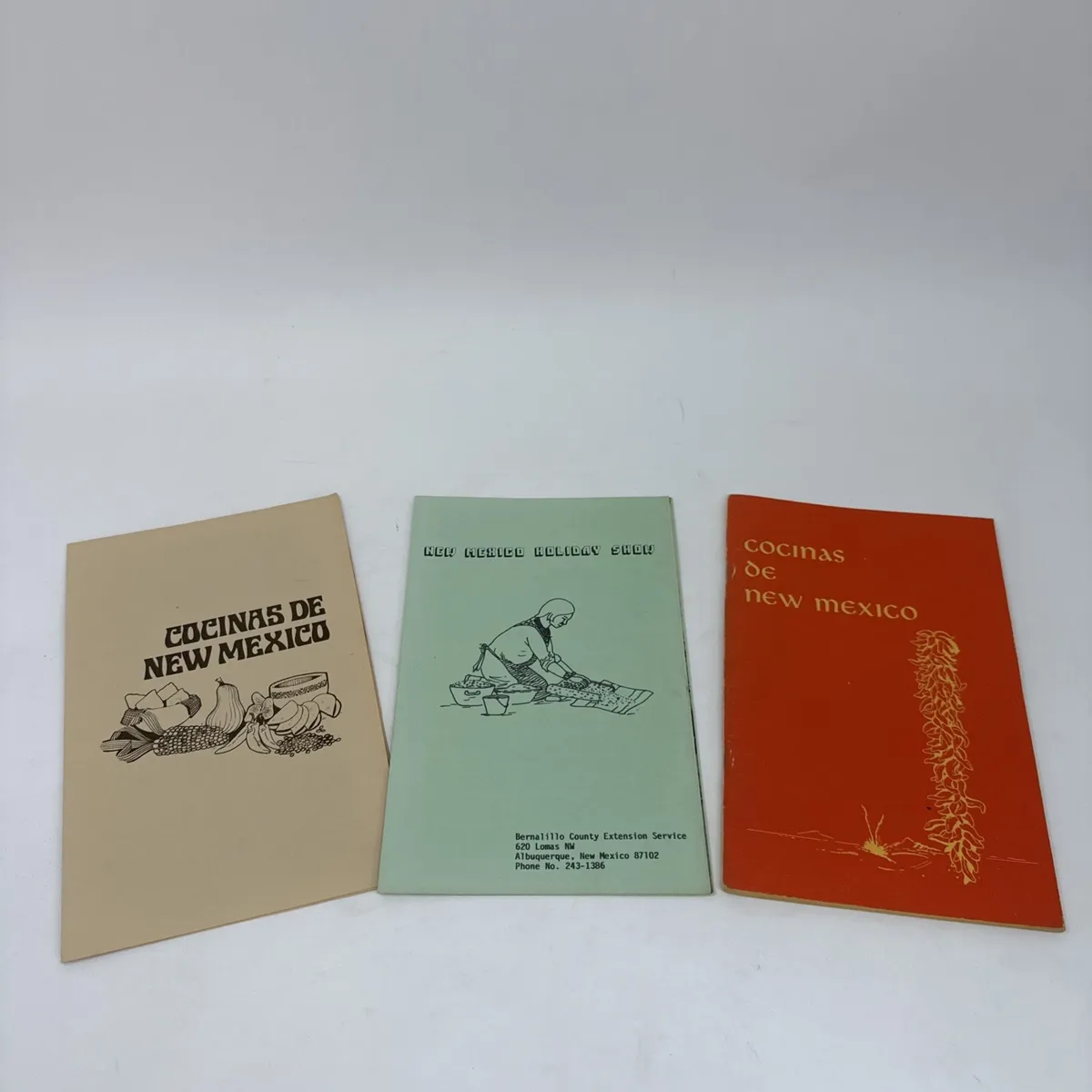
The signature title of this era is Cocinas de New Mexico, the long-running promotional cookbook published by Public Service Company of New Mexico (the regulated electric utility that today operates as PNM) from at least the late 1960s through the 1980s. Cocinas collected traditional New Mexican home recipes — red and green chile sauces, posole, sopaipillas, capirotada, biscochitos, calabacitas, sopa de albóndigas — from contributing home cooks across PSC's service territory. Distribution was free or low-cost through PSC bill-payment offices, customer events, and trade-show booths.
Multiple printings exist with distinct cover treatments: tan with stylized agricultural illustration, orange with chile-ristra graphic, yellow with the PSC-of-NM "Reddy Kilowatt"-style sombrero-character logo, and others. The internal page count and recipe selection vary slightly between printings. Saddle-stitched, no ISBN, no spine, no national distribution. A multi-printing donation of Cocinas documented in the NMLP Donation Archive includes three cover variants from a single Albuquerque-area kitchen, alongside the companion Bernalillo County Extension cookbook (below).
New Mexico Holiday Show (Bernalillo County Extension Service)
Published by the Bernalillo County Extension Service from 620 Lomas NW, Albuquerque NM 87102 (the historical home of the County Extension office before later relocations). The Cooperative Extension Service is the state-and-federal program administered through NMSU's College of ACES that places agricultural and home-economics extension agents in every NM county to teach food preservation, family nutrition, 4-H youth development, and community resource management. The Holiday Show cookbook collected demonstration recipes from the Service's annual fall and winter cooking classes and was distributed at the demonstrations and through the Bernalillo office. Saddle-stitched, no ISBN, phone number 243-1386 printed on the cover — pure 1970s-1980s county-extension publishing infrastructure.
The wider Extension and utility cookbook universe
Beyond Cocinas and Holiday Show, the substrate includes:
NMSU Cooperative Extension Service circulars on chile preservation, traditional NM canning, holiday cookery, dairy use, and family nutrition — mimeographed and later offset-printed pamphlets distributed through the 33 county offices. Most exist today only in the NMSU Extension archives and a small number of private collections.
El Paso Electric Company and other regional utility-promotional cookbooks distributed in the southern NM service territory. Same publishing pattern as Cocinas: saddle-stitched, free, no ISBN, no spine.
Bank-and-savings-and-loan cookbooks distributed as customer-relationship promotional items by First National Bank of Albuquerque, Sunwest Bank, and various other regional financial institutions. Almost none survive in clean condition.
Restaurant cookbooks issued by long-tenured NM restaurants — El Pinto, La Posta de Mesilla, Rancho de Chimayó, Old Town's various Spanish-Colonial-era restaurants. A Family Affair by Mrs. Griggs (1968), documented in the NMLP Donation Archive curiosities section, is the founding cookbook of the Mesilla pioneer family that operated La Posta and other Mesilla-area restaurants.
Church and parish anniversary cookbooks, school-fundraiser cookbooks, garden-club cookbooks, junior-league cookbooks, women's-auxiliary cookbooks — the entire civic-fundraising publishing apparatus of mid-century New Mexico. Some of the most historically important regional recipe collections in the state were published this way and survive in tiny numbers.
Not sure what you have? Text me a photo at 702-496-4214 and I'll tell you what I see.
The Pueblo cookbook tradition and Phyllis Hughes
Pueblo cookery is a distinct category from broader Hispano New Mexican cookery and from broader pan-Native American cookery. The published Pueblo-cookbook record is small, deliberate, and largely concentrated through the Museum of New Mexico Press in Santa Fe.
Pueblo Indian Cookbook by Phyllis Hughes (Museum of New Mexico Press)
The standard reference Pueblo cookbook. Phyllis Hughes worked with cooks across the nineteen New Mexico Pueblo communities — Acoma, Cochiti, Isleta, Jemez, Laguna, Nambé, Ohkay Owingeh, Picuris, Pojoaque, Sandia, San Felipe, San Ildefonso, Santa Ana, Santa Clara, Santo Domingo, Taos, Tesuque, Zia, Zuni — to document recipes for piki bread, oven bread, blue corn dishes, posole variants, chile preparations, feast-day specialties, and ceremonial foods (with appropriate restraint on materials that are not for outside publication). Has gone through multiple Museum of New Mexico Press printings. The early printings are the collector's target; later printings remain in print and are widely available. Documented in the NMLP Donation Archive.
Foods of the Southwest Indian Nations by Lois Ellen Frank (Ten Speed Press, 2002)
Won the 2003 James Beard Award for Best American Cookbook — the first Native American cookbook to win the Beard. Frank, of Kiowa heritage, documents foodways across the Southwest's tribal nations, including the New Mexico Pueblos, the Diné (Navajo), the Mescalero and Jicarilla Apache. Photography by Frank herself. The first edition first printing is the collector's target.
The modern New Mexican-cuisine canon, 1980s–present
The modern published era of New Mexican cookery began in the 1980s and 1990s as the regional-cuisine movement (Alice Waters in Berkeley, Paul Prudhomme in New Orleans, Mark Miller in Santa Fe) brought national attention to American regional foodways. Several Santa Fe and Albuquerque-based authors became the durable national-distribution voices of NM cookery in this period.
Cheryl Alters Jamison and Bill Jamison (Santa Fe)
The Jamisons are the most commercially successful authors of New Mexico-region cookbooks of the modern era. They have won four James Beard Awards. Their key NM-region titles:
The Rancho de Chimayó Cookbook (1991)
Cookbook of the iconic Chimayó restaurant in the Española valley. Recipes, history, and photography of one of the longest-tenured NM-cuisine destination restaurants. First edition first printing is the collector's target.
The Border Cookbook: Authentic Home Cooking of the American Southwest and Northern Mexico (Harvard Common Press, 1995)
Won the 1996 James Beard Award. The most comprehensive single-volume reference to the cooking of the American Southwest-Northern Mexico borderlands — New Mexico, west Texas, southern Arizona, Sonora, Chihuahua. Has stayed in print and remains the standard reference for the region. First edition first printing is the collector's target.
Smoke & Spice (Harvard Common Press, 1994)
Won the 1995 James Beard Award for the barbecue category. Not strictly NM-region but written by NM-resident authors and frequently shelved alongside their NM titles in estate libraries.
Jane Butel
Jane Butel ran the Jane Butel Cooking School from a series of locations in Albuquerque, Corrales, and Santa Fe from the 1980s onward, and authored a long list of New Mexican-cuisine cookbooks across the 1980s through the 2010s. Her work is broadly accessible (tilted toward home cooks rather than restaurant kitchens) and has stayed in print across multiple publishers. Notable titles include Hotter Than Hell (HP Books, 1987), various editions of her chile and Tex-Mex cookbooks, and the Real Women Eat Chiles series. Multiple of her early-edition first printings show up in NM estate libraries.
The Santa Fe School of Cooking and Susan Curtis
Susan Curtis founded the Santa Fe School of Cooking in 1989. The school's published cookbook output has appeared under various publisher imprints over decades and serves as a continuing-source for both contemporary NM cookery and a documentary record of the Santa Fe restaurant-cuisine renaissance of the 1990s and 2000s.
Mark Miller and Coyote Cafe
Mark Miller's Coyote Cafe (Ten Speed Press, 1989), drawn from his iconic Santa Fe restaurant, is the canonical document of the high-end "modern Southwestern" restaurant moment of the late 1980s and early 1990s. First edition first printing is the collector's target. Coyote Cafe (the restaurant) has gone through multiple ownership eras since Miller's tenure but the cookbook remains the durable record.
Fiesta Fare and the bridge to mid-century institutional cookery
Between the foundational Hispano canon and the modern regional-cuisine canon sits a transitional layer of mid-century cookbooks tied to specific NM cultural institutions, civic events, and foundation-supported publishing. Fiesta Fare (1956), documented in the NMLP Donation Archive with its cover by Al Momaday (father of N. Scott Momaday), is one example of this transitional layer — an institutional fundraising cookbook with cultural-archive significance well beyond its recipe content because of who designed the cover.
The survivorship-bias problem
The cookbook record you can browse on a current bookstore shelf or in the cookbook aisle of a chain thrift is not representative of what was actually published. It is heavily biased toward what survived — and what survives is determined by format, use pattern, and disposal logic that work against most of the historically important record.
The format problem is structural. A saddle-stitched soft-cover pamphlet with two staples in the spine cannot survive sustained kitchen use. The staples loosen, pages separate, the cover detaches at the fold, and the whole object becomes "loose pages in a folder" within five to ten years of regular use. A hardcover cookbook with a sewn binding can take decades of kitchen use and still be a coherent object. The bias against ephemera is a bias against the format that almost everyone in NM regional cookery actually used to publish in.
The use-pattern problem compounds it. Cookbooks that are good cookbooks get used. Cookbooks that get used get splashed. Cookbooks that are bad get given away. Goodwill and the chain thrifts reject saddle-stitched no-ISBN cookbooks on the no-scan rule. The cookbook either ends up at a paper recycler or in a landfill. There is no surviving copy.
The generational-handoff problem closes it out. When a household downsizes, settles an estate, or moves out, cookbooks are typically the first category to be discarded as "old" or "dated" or "I never made these recipes anyway." The next generation rarely cooks from grandmother's recipe collection. The cookbooks go in the recycle pile. If they look like trash to a chain thrift, they end up in the trash.
What this means in aggregate: the NM cookbook record on the shelf today is a thin durable layer of hardcover trade-published titles (Jamisons, Frank, Butel, Miller, MNM Press reprints) plus a randomly-surviving sample of the saddle-stitched substrate. The substrate sample is biased toward the cookbooks that were never used (because those got passed along intact) and away from the cookbooks that were used heavily (because those fell apart). Which means the surviving record over-represents the titles that didn't actually feed anyone and under-represents the working kitchen reality of mid-century New Mexico.
What this means for a New Mexico cookbook donation
Five working principles for handling NM regional cookbooks coming out of an Albuquerque-metro estate or downsizing situation:
One. Saddle-stitched no-ISBN cookbooks are the highest-priority donations even when they look the worst. The kitchen-stained, dog-eared, butter-blistered Cocinas de New Mexico with the broken staple binding is a more important historical document than a mint-condition Ten Speed Press hardcover. Do not throw away the saddle-stitched stuff. Bring it in.
Two. Multi-printing collections of the same cookbook are more valuable than single copies. Three different cover-variant printings of Cocinas de New Mexico from a single household is a more historically interesting donation than three copies of the same printing — the multi-printing donation lets a researcher actually trace the publication record.
Three. Restaurant cookbooks, church cookbooks, school cookbooks, garden-club cookbooks, and any other civic-fundraising cookbook are wanted regardless of how local the institution was. The smaller and more local the publishing organization, the rarer the surviving copies and the more historically interesting the recipes.
Four. Hardcover regional cookbooks (the Jamisons, Frank, Butel, Miller, MNM Press, UNM Press) are also wanted but are not as scarce. NMLP takes them all the same.
Five. Condition is irrelevant for the intake decision. A water-damaged, kitchen-stained, butter-blistered Historic Cookery reprint is still a useful object. NMLP triages condition after intake, not before. The donor decision should be: is this a New Mexico cookbook? If yes, NMLP wants it.
The intake position
Inherited a library and not sure where to start? Call or text 702-496-4214 — I handle this all the time.
Any New Mexico cookbook. Any condition. Free pickup.
Saddle-stitched, soft-cover, hardcover, kitchen-stained, water-damaged, broken-binding — it doesn't matter. If it documents New Mexico cookery, NMLP wants it.
Schedule a free pickup →Or drop off 24/7 at 5445 Edith Blvd NE, Unit A, Albuquerque NM 87107
Cookbook entries currently in the NMLP Donation Archive
The four New Mexico cookbook entries currently documented in the open archive, each with photographic provenance and bibliographic detail:
-
Cocinas de New Mexico — PSC of NM cookbook collection (multi-printing) plus Bernalillo County Extension Service New Mexico Holiday Show
A multi-printing collection from a single Albuquerque-area pickup. Three cover variants documented.
-
Pueblo Indian Cookbook — Phyllis Hughes / Museum of New Mexico Press
The standard reference Pueblo cookbook drawing on cooks from across the nineteen NM Pueblo communities.
-
Fiesta Fare (1956) — cover by Al Momaday
Mid-century institutional cookbook with cultural-archive significance because of who designed the cover (father of N. Scott Momaday).
-
A Family Affair — Mrs. Griggs / Mesilla pioneer family / El Pinto Albuquerque (1968)
Founding-family cookbook of the Mesilla restaurant lineage that connects La Posta de Mesilla and El Pinto Albuquerque.
The archive grows with each donation. If a New Mexico cookbook from your household gets selected for archival documentation after NMLP intake, you will be invited to author or co-author the archive entry (with the option to remain anonymous).
External research references
For deeper bibliographic research on the New Mexico cookbook tradition:
UNM Center for Southwest Research (Zimmerman Library, UNM main campus, Albuquerque) holds the most comprehensive public-collection record of NM food, agriculture, and cookery publications, including the personal papers of Fabiola Cabeza de Baca Gilbert and Cleofas Martínez Jaramillo.
NMSU Cooperative Extension Service archives (Las Cruces) hold the Extension Service circular and bulletin record from the early 20th century forward, including the Cabeza de Baca Extension publications.
Museum of New Mexico Press (Santa Fe) is the standing publisher for much of the durable Pueblo and Hispano cookbook canon. Press backlist is available via mnmpress.org.
UNM Press (Albuquerque) has kept Cabeza de Baca Gilbert's I Fed Them Cactus and other key Hispano regional titles in print across decades.
James Beard Foundation Awards historical record documents the Jamisons' four wins, Lois Ellen Frank's 2003 win for Foods of the Southwest Indian Nations, and the broader New Mexico-author Beard recognition history.
Bookworks Albuquerque (4022 Rio Grande Blvd NW), Op.Cit. Books (multiple ABQ locations), and Collected Works Bookstore (Santa Fe) carry the in-print regional NM cookbook canon and occasionally surface scarcer used-stock copies.
Frequently asked questions
What was the first published New Mexico regional cookbook?
Who was Fabiola Cabeza de Baca Gilbert?
What is Cocinas de New Mexico and why is it valuable?
Are Pueblo Indian Cookbook and "Native American" cookbooks the same category?
Why do most copies of these cookbooks not survive?
Where should I donate New Mexico cookbooks I no longer want?
Related on this site
- Collecting New Mexico Ethnobotany — A Regional Reference Guide — the parallel ethnobotany pillar. Same four-period structure, anchored by L. S. M. Curtin's Healing Herbs of the Upper Rio Grande and the Three Wise Women of Santa Fe lineage; same survivorship-bias analysis; same NMLP-intake conclusion. The two pillars together cover the food-and-medicine plant universe of regional New Mexico.
- What I Take That Other Places Won't — the YES Guide — the photographic field guide whose lead category is the Cocinas-de-NM-style "looks like trash, isn't" donation.
- The NMLP Donation Archive — the full open archive of regionally significant donated books, including all four cookbook entries linked above.
- Where Your Donated Books Actually Go — the transparency map of every path a donated book can take after NMLP intake.
- Free Book Pickup — Albuquerque — schedule the pickup.
- NM Ranching & Cowboy Literature — Fabiola Cabeza de Baca's ranch-life writings bridge the cookbook and ranching pillars; I Fed Them Cactus documents Hispano ranch foodways alongside livestock culture.
- NM Children's Literature — Rudolfo Anaya's children's titles and Joe Hayes's bilingual retellings carry the same Hispano culinary-cultural threads that define the NM cookbook tradition.
- Vintage NM Travel & Tourism Books — Harvey House menus, railroad dining-car cuisine, and tourist-era recipe booklets bridge the cookbook and travel-literature collecting traditions.
Cite as: Eldred, Josh. "Collecting New Mexico Cookbooks: A Regional Reference Guide." New Mexico Literacy Project, May 9, 2026. https://newmexicoliteracyproject.org/collecting-new-mexico-cookbooks
Cite This Guide
Eldred, J. (May 2026). Collecting New Mexico Cookbooks — A Regional Reference Guide. New Mexico Literacy Project.
https://newmexicoliteracyproject.org/collecting-new-mexico-cookbooks
Content is original research by Josh Eldred. Licensed under CC BY 4.0. Cite with attribution.