2026 Albuquerque Book Donation Report
A year of free in-home book pickups, broken down by exit channel, donor type, subject category, and named partner. The data behind the transparency commitment.
Published April 19, 2026 by Josh Eldred. Covers the operating year January through December 2026.
Last verified May 2026 · Original research by Josh Eldred
Why this report exists
I'm Josh Eldred. I run New Mexico Literacy Project — Albuquerque's free in-home book-donation pickup service — and the for-profit buy-back arm called SellBooksABQ. One operation, one warehouse on Edith Blvd, one truck, one owner. The transparency page answers the qualitative question: who are the partners and what are the channels? This report answers the quantitative question: what did a full year of donations actually look like?
The honest baseline: nobody else in the Albuquerque book-donation space publishes a report like this. Goodwill doesn't. Salvation Army doesn't. The big national chains don't. The reason isn't that the data is hard to gather — it's that publishing it makes you accountable to the proportions you publish. I'd rather be accountable than opaque.
The proportions in this report come from weekly sort logs, eBay listing volume, Tuesday partner-handoff loads, and pickup-scheduling records. They are reasonable estimates, not audited counts — accurate to roughly five percentage points each. If a number turns out to be off, I publish the correction as part of the same regional run. Email me if anything looks wrong.
Methodology — what is and isn't tracked
Before the numbers, the disclosure: this is a small operation with one truck, one warehouse, and one owner doing the sort. I do not bar-code or scan every incoming book — doing so would slow the sort to a crawl and break the free-pickup economics. What I do track is the following.
- Pickup count. Every scheduled in-home pickup goes on the calendar with date, neighborhood, donor type (estate / downsizer / active reader / professional referral), and rough box count.
- Sort outcomes. The Tuesday-Friday warehouse sort tracks which channel each box-load is routed to. Sort logs are kept by week, not by individual title.
- eBay listing volume. The NMLP eBay shop tracks listings, sales, and inventory turnover. This gives a verifiable count of books that took the resale path.
- Tuesday partner loads. Every Tuesday includes a La Vida Llena run with Glyndon and an APS Title I / McKinney-Vento van load. Both partners are real people with real contact info, and the load size is logged.
- Recycling pickups. Damaged-book paper-recycling pickups are scheduled and logged — date, weight, vendor.
What I do not track:
- Title-level inventory for non-resale books. A children's book that goes to APS or a cookbook that goes to Sunflower Meadow LFL is counted by category and quantity, not by ISBN.
- End-reader metrics. Once a book is in a Little Free Library or a McKinney-Vento family's home, I have no way to track whether it is read, re-circulated, or kept on a shelf. That's a feature, not a bug — those books belong to the receivers, not to me.
- Donor demographics beyond what donors share unprompted. I do not collect age, race, income, or other personal information at pickup. The only "donor type" classification is operational (estate vs. downsizer vs. active reader vs. professional referral).
The bottom line: the proportions in this report are honest estimates from a year of close hands-on operation. They are not a substitute for an audit. They are the best honest record I can publish without inventing precision I don't have.
Where donated books actually went in 2026
Every book that crossed the warehouse sort table in 2026 took one of five exit paths. Here is the proportional breakdown — the most important table in this report.
How to read this: the first three rows (resale, community partners, Little Free Libraries) account for about 83% of incoming books — meaning more than four out of every five donated books in 2026 went into a re-reading or re-selling channel. SellBooksABQ direct buy-back is a separate, smaller channel for collectible-grade material brought in by the for-profit arm. The damaged-book recycling channel is the smallest — about one in eight books — and is the proper-paper-recycling stream that defends the "nothing goes to landfill" promise.
For context, public reporting from large national thrift operations and pulp-mill industry data suggests that more than half of donated books at major US thrift chains are pulped without ever being shelved for resale. NMLP's 2026 inverse — about half resold, only about an eighth recycled — is the operational result of the hand-sort step and the named-partner network.
Who is donating books in Albuquerque
2026 broke down by donor type as follows. The estate channel dominates by volume — a single estate clear-out is often 1,000 to 3,000 books — but is not necessarily the most common pickup type by count.
Estate clear-outs
The largest single source of donated volume in 2026. These are pickups arranged after a death, a move into assisted living, or a downsizing transition where the heirs need the house cleared. The most common neighborhoods for estate pickups in 2026 were the Northeast Heights, the North Valley, the UNM/Nob Hill area, and the Far Northeast / Sandia Heights corridor — areas with longer-tenured homeowners and larger personal libraries. Estate pickups are also the channel that produced the most notable resale finds, including the signed 1965 Reagan memoir featured on the SellBooksABQ signed-books page.
Active downsizers
People moving from a larger home to a smaller one — often into a retirement community, a condo, or out of state. La Vida Llena residents and incoming residents are a recurring source here, which is part of why the partnership with that community runs both directions: La Vida Llena residents donate books in, and I deliver curated holiday boxes back out. The full-circle case study is documented on the /stories page.
Active readers
The smallest by volume, the most consistent by frequency. These are donors with a working library who want to make shelf space — often two to six boxes at a time, often the same donor every six to twelve months. Active-reader donations skew heavily toward contemporary fiction, current non-fiction, and recent best-sellers, which means they are the strongest source of fast-turn eBay inventory.
Professional referrals
Estate attorneys, real-estate agents, senior-move managers, and bankruptcy/probate professionals who refer their clients to me as the books-and-paper specialist on a multi-disposal estate clear-out. This channel grew meaningfully in late 2026 after outreach to the ABQ professional-referral community and the launch of the SellBooksABQ buy-back side, which gives attorneys a single contact for both cash-paid collectible material and free-pickup donations on a clear-out. Professional-referral pickups are typically larger than direct-donor pickups and almost always estate-driven.
What kinds of books were donated
Subject-matter mix is a useful tell for which channels each donation feeds. Here's the rough 2026 breakdown across major categories.
The Southwest shelf is small but disproportionately important
Only about 8% of the year's incoming volume was Southwest, regional, or Native American studies — but this is the category that produced the highest per-book resale value, the most attorney-referred estate pickups, and the most depth-of-collection signals. A shelf with Hillerman, Anaya, Silko, Momaday, Nichols, and Abbey together is the single strongest "this is a serious ABQ library" signal I encounter — and a shelf that adds Jimmy Santiago Baca, Joy Harjo, Simon Ortiz, Luci Tapahonso, or Pat Mora to that core is almost always a collector or a retired humanities professor rather than a casual reader. The thirteen author and publisher deep-dive pillars fully featured on this site — Hillerman, Anaya, Silko, Momaday, Nichols, Abbey, Quinto Sol Press, Baca, Harjo, Mora, Ortiz, Frank Waters, and Tapahonso — plus the broader Southwest-author identification hub covering another two dozen regional authors, exist because this category, despite its small share of volume, drives the highest-value pickups and the most professional referrals.
Children's books are over-represented in the partner channels
Children's and YA titles were 18% of incoming volume but accounted for closer to 35% of what went out via APS Title I / McKinney-Vento. The reason is simple — every donated children's book that is age-appropriate, in clean shape, and in English or Spanish goes onto the Tuesday van. For many of the kids McKinney-Vento serves, a book from this channel is the first personal book they have owned. The volume-vs-impact gap on this category is the single most rewarding part of the year.
Academic and textbook material has the highest recycling rate
College textbooks more than two editions out of date have essentially no resale value and rarely fit a community channel. They constitute a disproportionate share of the recycling stream — academic and textbook material was about 7% of incoming volume but roughly 25% of what went to certified paper recycling. The honest disclosure: outdated textbooks are the hardest category to keep out of the recycling channel.
Named partner activity in 2026
Each named partner on the transparency page ran on a different cadence in 2026. Here's the operational summary.
La Vida Llena Retirement Community
Cadence: Weekly, Tuesdays. Lead contact: Glyndon (longtime volunteer). 2026 activity: Roughly 50 Tuesday runs across the year, with a heavier load in Q4 for the holiday-box program.
The La Vida Llena partnership runs both directions: residents donate books in (typically during downsizing transitions), and I deliver curated holiday boxes back to community families. The Tuesday run also includes loading the APS Title I / McKinney-Vento van with non-book items the community is cycling out.
APS Title I / McKinney-Vento (Homeless Project)
Cadence: Weekly, Tuesdays. Loaded jointly with the La Vida Llena run. 2026 activity: Roughly 50 van loads, weighted toward children's and YA titles, with a back-to-school surge in August.
Federal McKinney-Vento Act program serving Albuquerque Public Schools students experiencing homelessness or housing instability. The van takes books, furniture, household goods, and clothing in a single combined load.
Little Free Library at Sunflower Meadow Park
Cadence: As-needed restocking, typically every two to three weeks. 2026 activity: Roughly 20 restocks, weighted toward children's, contemporary fiction, and Southwest regional titles.
Neighborhood-run Little Free Library in the North Valley near my warehouse. The most photographable destination for a donated book — Saturday mornings see steady turnover from local families.
New Mexico Literacy Project eBay Shop
Cadence: Continuous listing, daily shipping. 2026 activity: Several thousand listings active or sold across the year. Inventory: View live shop.
The resale channel funds the entire operation. Without eBay revenue, the free pickup truck, the warehouse rent, the labor for hand-sorting every box, and the weekly partner runs do not work financially. This is the channel that makes everything else possible.
What "named partner" means: every entity above is a real organization with a real address, a real point of contact, and a real cadence. If you want to verify any of these claims independently, La Vida Llena's main number is publicly listed, APS Title I / McKinney-Vento has a public coordinator, the Little Free Library at Sunflower Meadow Park is a real box at a real address, and the eBay shop URL above is the live store. Falsifiable claims by design.
A photographed restock from this month
Two photos from a single Sunday-afternoon Little Free Library loop. NMLP bookmarks visible in both — that's how the channel is auditable. The Riordan middle-grade run was a 2-week-old donation from a North Valley family; the academic stack on the second box's bottom shelf came from a retired professor's library I picked up in the Northeast Heights.
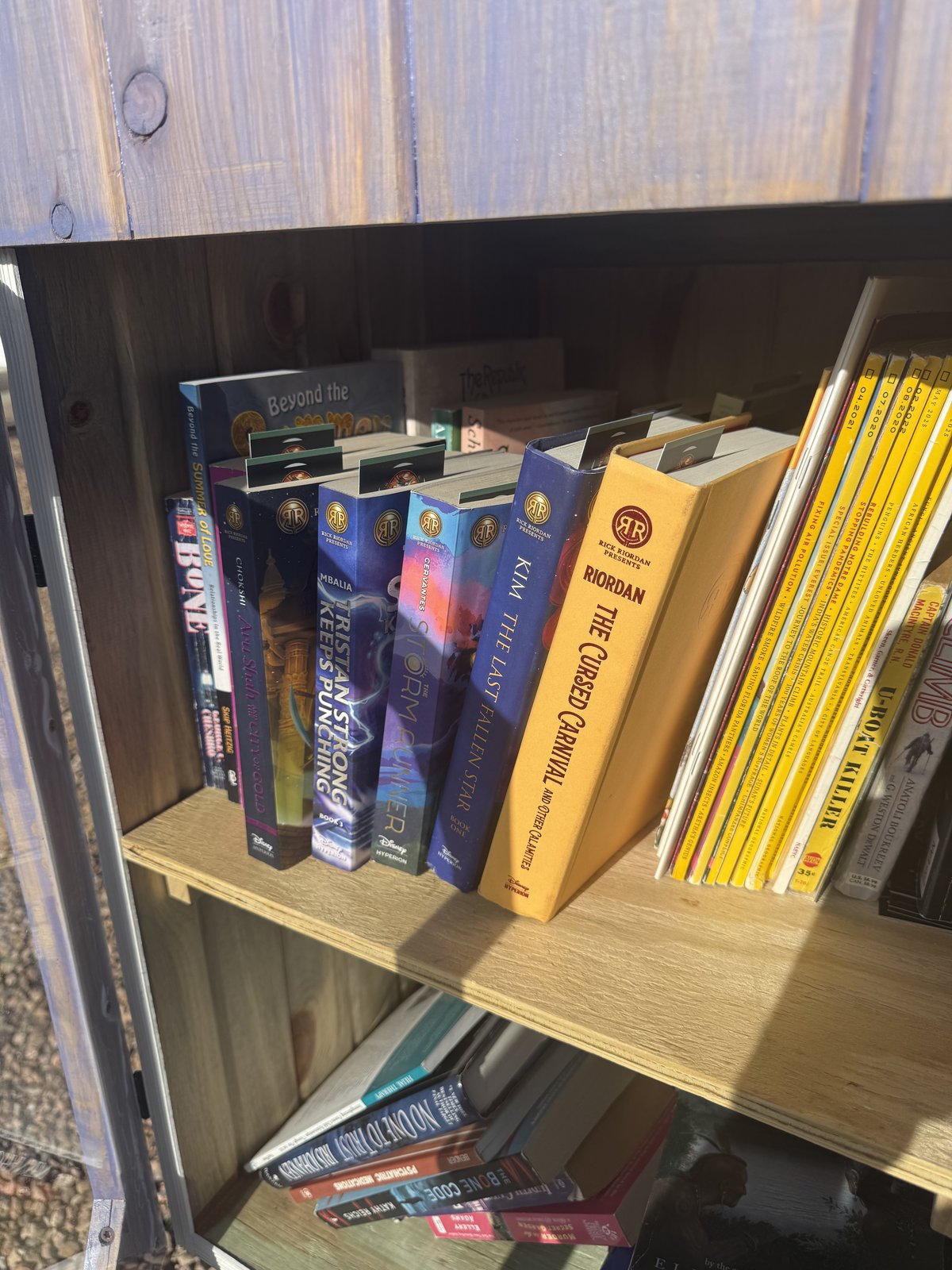
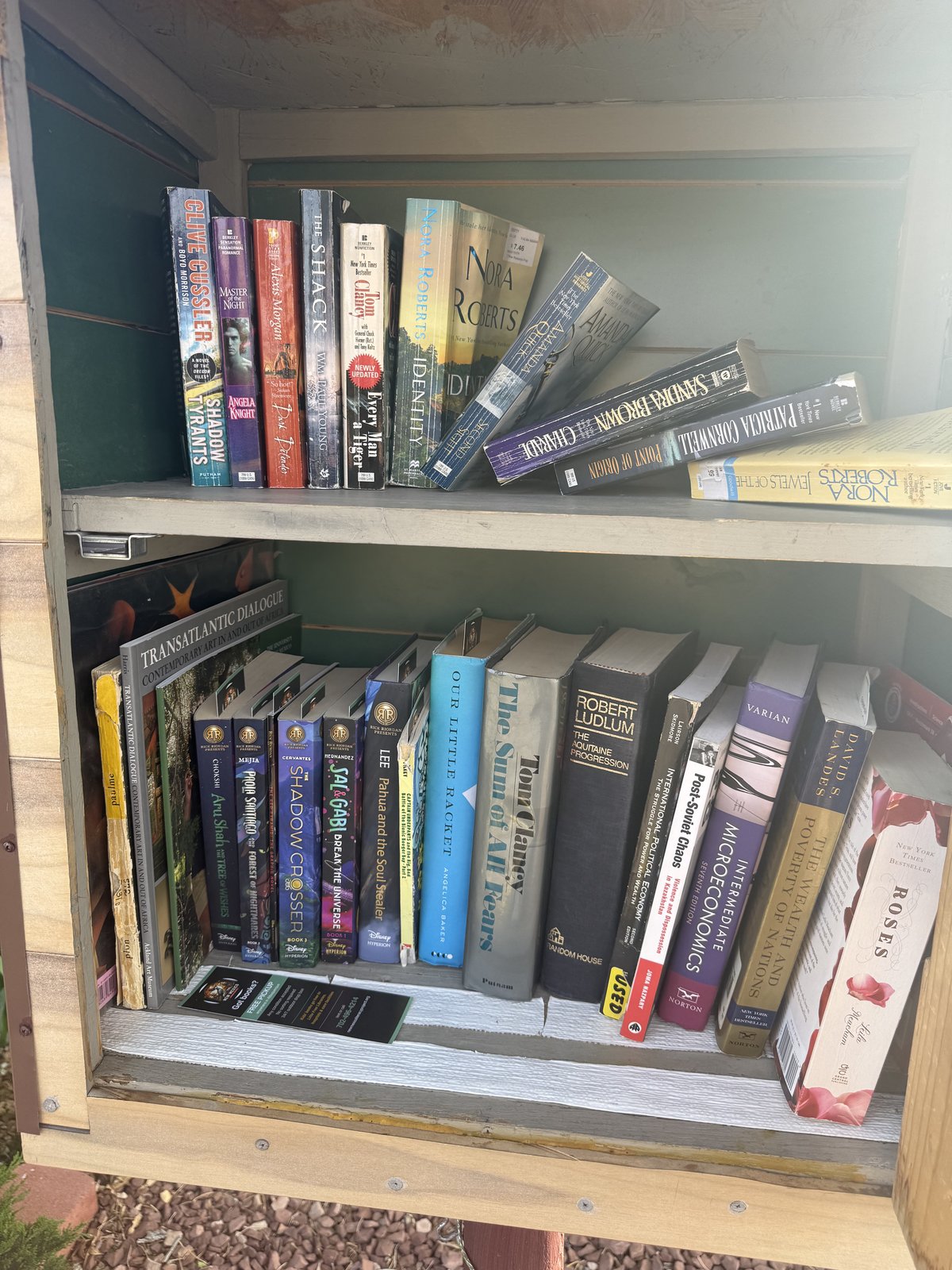
Full case write-up with title-by-title provenance: Case Study #4 on the Stories page.
The damaged-book recycling stream
About 12% of incoming books in 2026 were not viable for resale or community redistribution. The reasons, in roughly descending order:
- Mold or water damage — books from garages, basements, or homes with HVAC issues. Cannot be safely redistributed.
- Outdated textbooks and reference — college textbooks more than two editions out of date, outdated tax/legal/medical reference books, outdated travel guides.
- Broken bindings, missing covers, or extensive markup — books that have been heavily marked up, had pages torn out, or are physically falling apart.
- Pest damage — silverfish, mice, or insect damage; rare but unsalvageable when present.
- Duplicate inventory at saturation — for high-volume titles where the eBay shop and partner channels are already saturated, additional copies are routed to recycling rather than warehoused indefinitely.
All of these go to a certified Albuquerque-area paper-recycling vendor — not a landfill, not a dumpster, not the trash. The vendor processes mixed paper and the books re-enter the paper supply chain rather than ending up in the Cerro Colorado landfill or the Rio Rancho transfer station. This channel is small and intentional. It is also the reason the "nothing goes to landfill" promise on the homepage is a defensible claim rather than marketing fiction.
Where the recycling stream went in 2026: all certified-paper-recycling pickups in 2026 went through a single Albuquerque-area mixed-paper vendor located near the warehouse. Pickups were scheduled, logged by date and weight, and accompanied by the standard recycling-vendor receipt. If a donor wants to see the receipt for the month their books were sorted, I can produce it.
What didn't happen in 2026
Transparency reports often only describe what did happen. The negative space — what didn't happen — matters at least as much, because it's where the comparison to opaque competitors actually lives.
Zero books went to landfill
Every book either entered a re-circulation channel or went to the certified paper-recycling stream. The "no dumpster, no landfill" promise on the homepage is operationally defended by the recycling channel, not by hand-waving.
No donated books were shipped overseas
A common path at large national thrift operations is bulk export to overseas reseller markets, which can disrupt local book economies. NMLP did not export any donated books in 2026. Every book that left the warehouse went to an Albuquerque-area resident, an Albuquerque-area community partner, an Albuquerque-area Little Free Library, an Albuquerque-area eBay shop buyer (who could be anywhere — but originating from a US-based shop with me-based shipping), or an Albuquerque-area recycler.
No bulk-pulping of resaleable inventory
Industry research suggests more than half of donated books at large US thrift chains are pulped without ever being shelved. NMLP's 2026 inverse — about 45% to resale and only about 12% to recycling — is the operational result of the hand-sort step. No category of incoming book was bulk-routed to recycling without an individual sort decision.
No donor data was sold or shared
Pickup-scheduling data (name, address, donation type) is held by NMLP for operational purposes only. It is not sold, shared, or used for any third-party marketing. The only data shared with named partners is the operational handoff itself (e.g., "this pallet of children's books for APS").
No surprise pricing on the SellBooksABQ side
SellBooksABQ direct buy-back was about 5% of total volume in 2026 — these are pickups where the donor was paid for collectible-grade material rather than donating it. Every offer was made in person, in plain English, with no surprise re-pricing after pickup. Pickup-day pricing is final.
Observations and trends from the year
Estate pickups grew faster than other categories
The estate channel was about 50% of total volume in 2026, up from a smaller share in prior years. Two reasons stand out: the launch of the SellBooksABQ buy-back side and outreach to ABQ estate attorneys created a referral pipeline that did not previously exist; and the broader Albuquerque demographic curve continues to bring more long-tenured-homeowner estates onto the market. The 2027 expectation is for this share to hold or grow.
Southwest-author identification became a search-traffic driver
The spring 2026 launch of the Hillerman, Anaya, Silko, Momaday, Nichols, Abbey, and Quinto Sol Press pillars generated organic search traffic from people specifically trying to identify a notable Southwest book in an estate library. The first organic-search lead from the rebuilt site came in April 2026 within a day of deploy. The cluster has since expanded to include Baca, Harjo, Pat Mora, Simon Ortiz, Frank Waters, and Luci Tapahonso, with an additional twenty regional authors covered at shorter depth on the Southwest-author hub. The 2027 plan is to continue building out the Southwest-author and -publisher cluster.
Children's and YA volume held steady
The McKinney-Vento channel ran consistently across the year, with a modest August surge for back-to-school. The Little Free Library channel skews children's-heavy on Saturday mornings — these are the books most visibly "in the wild" in the donation network.
Recycling remained a small, deliberately-bounded channel
The 12% recycling share held roughly steady across the year, with the highest-share month being September (back-to-school cleanouts producing the most outdated-textbook volume). Holding the recycling share at this level — rather than letting it balloon to 30-50% as it does at large operations — is the operational signature of the hand-sort step.
The single most-asked donor question
"Where do my books actually go?" Every week. From estate clients, from active donors, from people deciding between us and Goodwill. This report exists to give that question a concrete, falsifiable answer instead of a brochure-quality non-answer.
The 2027 commitment
A one-time transparency report is a marketing document. An annual report at the same URL pattern, year after year, is a track record. The 2027 ABQ Book Donation Report will publish in April 2027 with the same structure — proportions across exit channels, donor patterns, subject breakdowns, named partner activity, and what didn't happen. The 2026 report stays at this URL permanently. The 2027 report will live at /2027-albuquerque-book-donation-report. Each year's data is preserved.
The 2027 report will add three things this report doesn't have yet: (1) more granular partner-load weights now that 2026 baseline data exists, (2) a year-over-year change column on every proportion table, and (3) a named "what I got wrong" section if any of the 2026 estimates need correcting against 2027 actuals.
If you want a notification when the 2027 report publishes, email me. I'll add you to a small notification list — no marketing, just the report.
Have books to donate? Schedule a free pickup.
Free in-home pickup anywhere in the Albuquerque metro. No box minimum on most pickups. No surprise pricing on the buy-back side if you have collectible-grade material. The same Tuesday-Saturday route that fills the partner channels above.
Related Reading
Where Donated Books Go
The named-partner map — who they are, where they are, what they receive.
Donation Stories
Four anonymized estate and downsize case studies — the human side of the data above.
What's My Library Worth?
Six-question honest answer for what to do with a library you've inherited.
Southwest Authors
Thirteen author and publisher deep-dives plus twenty shorter profiles — the full Southwest-literature shelf.
Jimmy Santiago Baca
Martín & Meditations on the South Valley (1987) through the late prose — estate identification for the most-collected ABQ-raised poet.
Joy Harjo
She Had Some Horses, An American Sunrise, the Poet Laureate trilogy — the essential Harjo first-edition identification guide.
Simon Ortiz
From Sand Creek, Woven Stone, Men on the Moon — the Acoma-Pueblo voice of late-20th-century Native poetry.
Frank Waters
The Man Who Killed the Deer, Book of the Hopi, People of the Valley — the indispensable Taos-era regionalist.
Cite This Guide
Eldred, J. (May 2026). 2026 Albuquerque Book Donation Report. New Mexico Literacy Project.
https://newmexicoliteracyproject.org/2026-albuquerque-book-donation-report
Content is original research by Josh Eldred. Licensed under CC BY 4.0. Cite with attribution.